
BLUF
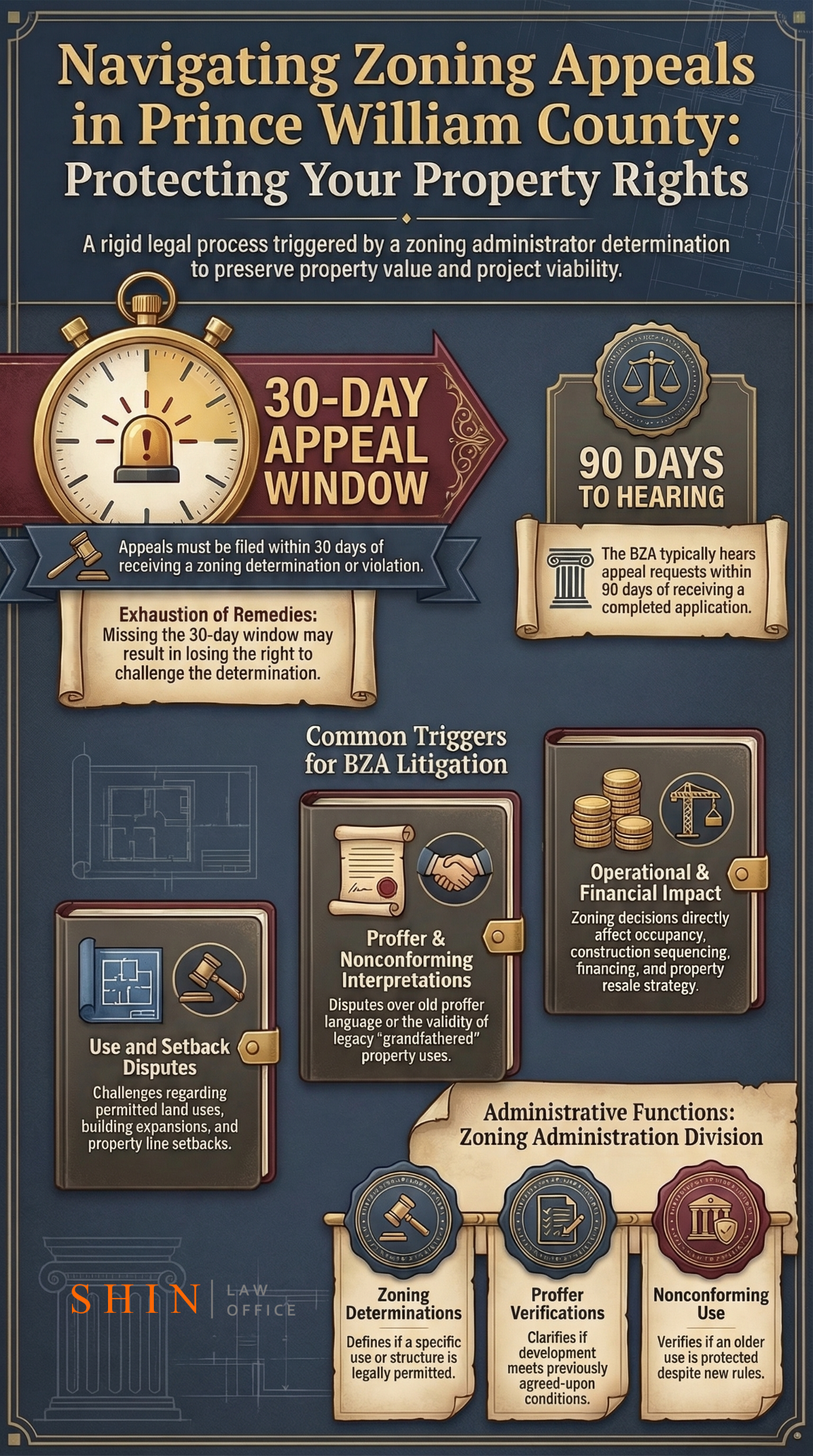
When a zoning determination in Prince William County limits how you can use land, build, expand, operate, or redevelop property, the clock starts fast. In many cases, the Board of Zoning Appeals is the first critical place to challenge a zoning administrator’s decision, and Virginia law generally requires the appeal to be filed within 30 days. In Prince William County, the County’s own appeal materials state that completed appeal applications must be received no later than 30 days from receipt of a zoning determination, and the Board will hear appeal requests within 90 days of receiving a completed application.
-
Why this issue matters right now in Prince William County
Prince William County’s Board of Zoning Appeals reviews and decides appeals of zoning determinations and requests for variances to zoning provisions. The County’s Zoning Administration Division also confirms that it issues zoning determinations, zoning and proffer interpretations, verifications of nonconforming uses, and processes appeals and variance requests to the BZA. That means BZA litigation is not some niche procedural corner of local government. It sits directly in the path of property owners, developers, investors, landlords, and businesses facing use restrictions, setback disputes, proffer interpretation issues, and administrative land-use decisions.
This is especially important because zoning disputes often begin with a document that looks administrative but functions like a pressure point for the entire project. A zoning determination can affect whether a use is permitted, whether a structure or expansion can move forward, whether an older use qualifies as lawful nonconforming, or whether proffer language limits what an owner believed the property could support. Once that determination is issued, delay can become expensive very quickly. Prince William County’s current zoning fee schedule also shows that zoning determinations or interpretations, variances, and appeals each have formal filing paths and associated costs, underscoring that this is a structured legal process, not an informal complaint system.
What the Board of Zoning Appeals actually does
In Prince William County, the BZA reviews appeals of zoning determinations and variance requests. The County’s appeal form states that an appeal is an application to the Board of Zoning Appeals or the Board of County Supervisors from a determination by the Zoning Administrator. The County’s variance and appeals page further explains that appeals may be filed by anyone aggrieved by a determination made by the Zoning Administrator, and that such determinations may be upheld or overturned by the board hearing the appeal.
That matters because many property disputes are not about whether someone dislikes the rule. They are about what the rule means, whether it was correctly interpreted, and whether the County applied it properly to a specific parcel, structure, or use. In practice, that can include disputes over accessory uses, operational restrictions, parking interpretations, setbacks, buffers, prior approvals, proffer conditions, and whether a claimed nonconforming use is actually protected. Prince William County expressly states that Zoning Administration provides zoning and proffer interpretations and responds to proffer verification requests, which makes those issues especially ripe for appeal when the County’s interpretation affects value or use.
The appeal timeline is not forgiving
Virginia Code § 15.2-2311 states that an appeal to the board must generally be taken within 30 days after the decision appealed from by filing with the zoning administrator and with the board a notice of appeal specifying the grounds. Prince William County’s own appeal checklist tracks that urgency. The County says the completed application must be received by the close of business, no later than 30 days from the date of receipt of a violation notice and correction order, or a zoning determination. The same checklist states that the Board will hear all appeals within 90 days of receipt of the completed application.
That 30-day window is one of the most dangerous features of zoning litigation. Property owners often spend too much time debating strategy, negotiating informally, or assuming that a staff-level clarification will preserve rights. Usually, it does not. A zoning appeal is deadline-driven, and once the appeal period closes, the owner may lose the best direct path to challenge the determination. Virginia’s statutory appeal structure is built around prompt administrative review, not slow-motion reconsideration.
Prince William County is putting this in writing
Recent Prince William County zoning determination letters make the appeal right explicit. A January 23, 2026 zoning determination letter states that the applicant or the Zoning Administrator may appeal the decision to the Board of Zoning Appeals and that an appeal must be filed within 30 days of receipt of the decision. The letter also directs the reader to the County’s appeal application form. That makes clear that this is not a hypothetical right buried in an ordinance. It is an active, current procedural pathway the County is expressly giving notice about in actual determination letters.
That kind of written notice is important for litigation strategy because it frames the dispute early. Once the County has issued a formal determination and identified the appeal route, owners and businesses should treat the matter as legally live. The issue is no longer just planning. It is now preservation of rights, record building, and positioning for either a successful BZA challenge or the next level of judicial review.
The disputes that most often trigger these appeals
In Prince William County, BZA-related litigation is especially relevant for owners and businesses dealing with use restrictions, setback disputes, nonconforming use issues, proffer interpretation, and administrative land use decisions. Those categories flow naturally from the County’s zoning administration functions, which include interpretation, verification, and appeal processing. They also align with the kinds of disputes that arise when development pressure, redevelopment, adaptive reuse, or operational changes collide with existing zoning language or prior approvals.
A commercial owner may believe a use is permitted by right while staff reads the ordinance differently. A homeowner may be told a structure violates setback rules or does not qualify for approval as built. A developer may discover that old proffer language is being interpreted more narrowly than expected. A business may be told that a legacy use is no longer recognized as lawful nonconforming. None of those situations are minor when they block occupancy, financing, leasing, construction sequencing, or resale strategy. The legal leverage point is often the appeal itself.
What happens after the BZA decides
If the Board of Zoning Appeals rules against the appellant, Virginia law provides a path to court review. Under Virginia Code § 15.2-2314, an aggrieved person may file a petition specifying the grounds on which the decision is claimed to be illegal, in whole or in part, and seek review by certiorari. The statute also states that the court may grant a restraining order on due cause shown, but that the allowance of the writ does not automatically stay proceedings on the decision appealed from. In other words, losing at the BZA does not always end the fight, but it does push the case into a more formal and demanding litigation phase.
That is why the administrative stage matters so much. The BZA record can shape what arguments survive, how the dispute is framed, and whether the property owner looks reasonable and grounded or reactive and unprepared. In zoning cases, the administrative record is often the battlefield before the courtroom becomes one.
Why owners, developers, and businesses should take these cases seriously
A zoning determination appeal is not just about winning an argument with the County. It can decide whether a project moves forward, whether a site remains viable for a planned use, whether a tenant can open, whether an addition must be redesigned, or whether a property’s value drops because the intended use is no longer recognized. Prince William County’s own forms and fee schedules show a well-defined process for determinations, interpretations, variances, nonconforming use certifications, and appeals. That structure is a reminder that land-use conflicts in the County are procedural, document-heavy, and time-sensitive.
For commercial owners and developers, the danger is often operational delay. For homeowners, it is often use restriction, design disruption, or cost escalation. For both, the risk is the same: missing the point at which the dispute can still be effectively challenged. In Prince William County, the BZA is often that point.

Principal Attorney | Shin Law Office
Call 571-445-6565 or book a consultation online today.
(This article is provided for general informational purposes and does not constitute legal advice. For advice on your specific situation, consult with a licensed Virginia attorney.)
References
Prince William County, Virginia. (n.d.). Board of Zoning Appeals. Retrieved March 20, 2026, from https://www.pwcva.gov/department/zoning-administration/board-of-zoning-appeals
Prince William County, Virginia. (n.d.). Zoning administration. Retrieved March 20, 2026, from https://www.pwcva.gov/department/zoning-administration
Prince William County, Virginia. (n.d.). Zoning variances and appeals. Retrieved March 20, 2026, from https://www.pwcva.gov/department/zoning-administration/zoning-variances-and-appeals
Prince William County, Virginia. (2019, July). Application for an appeal: Board of Zoning Appeals or Board of County Supervisors. https://www.pwcva.gov/assets/2021-04/fillable_bza_appeal.pdf
Prince William County, Virginia. (2025, July 1). FY2026 zoning fee schedule. https://www.pwcva.gov/assets/2024-07/Fee_Schedule_Zoning.pdf
Prince William County, Virginia, Department of Development Services. (2026, January 23). Zoning determination case #ZNR2026-00108. https://www.pwcva.gov/assets/2026-02/Zoning_Determination_Letter_ZNR2026-00108.pdf
Virginia Code § 15.2-2311. (2026). Appeals to board. Virginia Law. https://law.lis.virginia.gov/vacode/title15.2/chapter22/section15.2-2311/
Virginia Code § 15.2-2314. (2026). Certiorari to review decision of board. Virginia Law. https://law.lis.virginia.gov/vacode/title15.2/chapter22/section15.2-2314/