BLUF
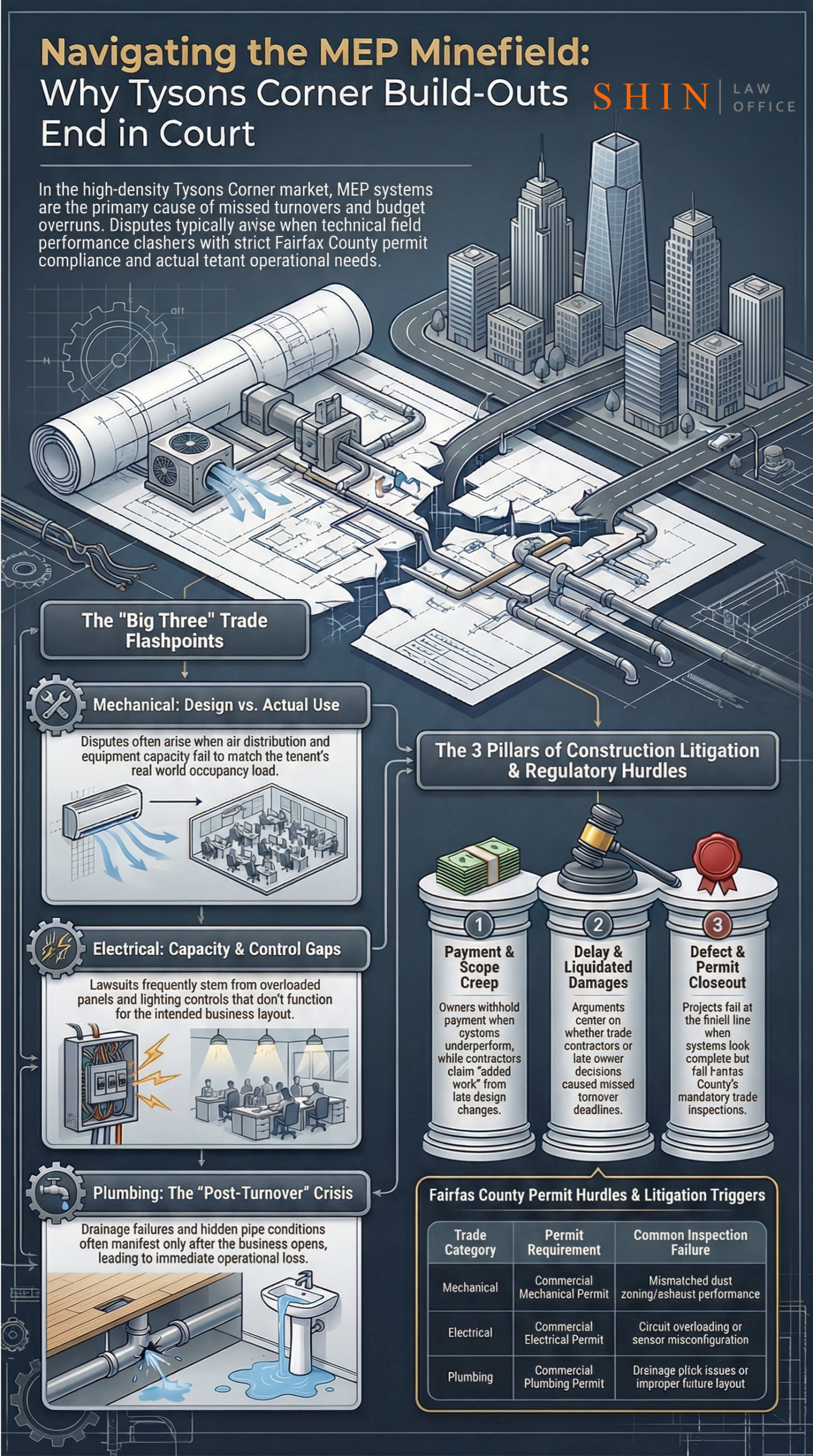
In Tysons Corner, mechanical, electrical, and plumbing fights are not side issues. They are often the reason a commercial build-out misses turnover, fails inspection, blows the budget, or opens with systems that do not work the way the tenant expected. Tysons is planned as Fairfax County’s urban center, with long-term growth tied to dense office, retail, mixed-use, and transit-oriented development. In that kind of market, a problem above the ceiling, behind the wall, or below the slab can turn into a serious business dispute fast. Fairfax County also requires separate trade permits for electrical, mechanical, and plumbing work on many commercial projects, and inspections at key stages. That means these fights are tied to both field performance and permit compliance.
-
Why Tysons Corner Makes These Disputes Worse
A build-out in Tysons usually sits on a hard business deadline. A tenant wants staff in place. A retailer wants an opening date. A restaurant wants to start serving. A medical or service business wants revenue coming in. At the same time, Fairfax County treats Tysons as a high-density growth area expected to hold up to 100,000 residents and 200,000 jobs by 2050. That means many projects are moving inside larger redevelopment schedules, tight access conditions, and expensive lease commitments. When mechanical, electrical, or plumbing work slips, the damage often spreads beyond one trade.
Fairfax County’s permit system adds another layer. Commercial interior alterations and new tenant layouts usually need a commercial addition or alteration permit, and separate trade permits are often needed for electrical, mechanical, and plumbing work. The county also says trade inspections are required by state law, and related concealment and final inspections are expected to be scheduled together. If that is not handled correctly, the project can fail inspection and pick up a reinspection fee.
Mechanical Disputes in Tysons Corner Build Outs
Mechanical fights usually come from one basic problem. The tenant expects the space to feel comfortable and operate normally. The contractor says the system installed matches the plans. The owner or tenant says the installed system does not match the space’s actual use.
Here are at least three common mechanical build-out issues, each with an example.
1. Air distribution does not match the new layout
This happens when the duct layout, diffuser placement, return air path, or zoning plan does not fit the final tenant layout.
Example: A law firm build out converts an open office into perimeter offices, conference rooms, and a server closet. After turnover, one side of the suite stays hot, the conference room gets stuffy when occupied, and the server closet overheats. The contractor says the system was installed per plan. The tenant says the plan never matched the actual furniture, partition, and occupancy load.
Why the dispute starts:
The argument is usually over design responsibility, field coordination, and whether the contractor should have flagged the mismatch sooner. In Tysons, where office and mixed use interiors are built for speed, this is common when the final layout moves faster than the mechanical revision set. Fairfax County requires commercial mechanical permits for conversion, new, repair, or replacement work, so this kind of problem can also become an inspection and permit record issue.
2. Existing heating and cooling equipment cannot support the tenant’s use
A build out may assume the existing rooftop unit, split system, or branch duct arrangement can support the new tenant. Then the real use proves heavier than expected.
Example: A fitness-related tenant takes space that was once standard office use. The cooling load increases due to occupancy, lighting, and operating hours. The space never cools properly during peak afternoon periods. The owner says the contractor should have caught the load issue. The contractor says the job was priced as a reuse of the existing system.
Why does the dispute start?
This usually becomes a fight over scope and assumptions. Was the contractor hired to verify capacity, or only to connect and rebalance existing equipment? In Tysons, where old office space is often repurposed for newer commercial uses, this is a very real source of claims. The county’s commercial mechanical permit page confirms that conversion work falls under commercial mechanical permitting, which fits this kind of tenant use change.
3. Exhaust and ventilation work is wrong, incomplete, or delayed
Ventilation issues hit restaurants, fitness spaces, salons, medical uses, and other tenant types that need more than basic office air.
Example: A restaurant build out installs kitchen exhaust, makeup air, and duct runs, but the system does not perform correctly at opening. Smoke spills, odors drift into adjacent tenant areas, or balancing never gets finished. The tenant says the space cannot operate as intended. The contractor says equipment lead times, coordination with other trades, or late design changes caused the problem.
Why the dispute starts:
This usually turns into a fight over sequence, commissioning, and performance. In a dense Tysons building, exhaust routing and rooftop coordination can also create access and approval problems. Fairfax County’s permitting framework confirms that mechanical trade permits and inspections are part of the process, so this is not just a comfort issue. It can become a turnover and occupancy issue.
4. Condensate drainage and equipment support problems
This is less visible but very common.
Example: A new indoor unit is installed during a build out. Weeks after turnover, water stains appear above a finished ceiling because condensate piping was pitched badly or not tied in correctly. In another case, vibration from poorly supported equipment creates noise complaints in nearby suites.
Why the dispute starts:
The owner says the work was defective. The contractor says the issue came from an old existing condition or from later access by another trade. These fights are expensive because the repair often reaches beyond the mechanical work and into drywall, paint, flooring, and business interruption.
Electrical Disputes in Tysons Corner Build Outs
Electrical disputes are some of the sharpest on commercial jobs because tenants notice them right away. Lights fail. Breakers trip. Equipment will not run. Data rooms run hot. Signs do not energize. Access control and life safety interfaces do not finish cleanly.
Fairfax County says commercial electrical permits are required for heavy up, new, repair, or replacement projects. In Tysons, that means a lot of electrical work on office, retail, and mixed use interiors sits squarely in the permit and inspection path.
Here are at least three common electrical build out issues, with examples.
1. Service or panel capacity does not support the tenant load
A tenant improvement may look simple until the actual connected load is reviewed.
Example: A retail tenant adds display lighting, point-of-sale equipment, refrigeration, and upgraded signage. After turnover, circuits overload or the panel schedule does not match real demand. In another case, a medical tenant adds equipment that requires dedicated power, but the branch circuits and panel capacity were never properly planned.
Why the dispute starts:
The owner says the electrical contractor should have identified the problem before rough in. The contractor says the design set or owner program understated the load. Fairfax County specifically identifies heavy up work as part of the commercial electrical permit category, which shows how often load and service issues sit at the center of commercial electrical jobs.
2. Lighting and controls do not match the intended use
Lighting disputes are not only about fixtures. They are often about switching, dimming, occupancy sensors, emergency lighting tie in, and how the space actually functions.
Example: A professional office build out gets completed, but the lighting zones make no sense. The reception area is connected to a back-office switch leg. The conference room dimming flickers during presentations. Sensor locations leave staff waving their arms to keep lights on. The tenant says the space feels unfinished. The contractor says the work matches the approved plan.
Why the dispute starts:
This becomes a fight over coordination, design review, and field changes. On a Tysons job, where premium office interiors are expected to present well from day one, bad lighting control work can turn into a payment dispute quickly.
3. Dedicated circuits and special equipment feeds are missing or wrong
Commercial tenants often need dedicated feeds for server closets, kitchen equipment, medical devices, break room equipment, copiers, or tenant owned specialty gear.
Example: A build out includes a server room, but the dedicated power shown on the tenant’s equipment list is never properly installed. At turnover, the room relies on general receptacle circuits and starts tripping when equipment comes online. In another project, a restaurant opens and the kitchen line cannot be fully energized because the required feeds were not installed as expected.
Why the dispute starts:
The contractor says the owner’s final equipment cut sheets arrived late. The tenant says the contractor knew the program from the start. This type of fight is common because equipment decisions often move late in the job while walls are already closed.
4. Finish trim out is complete, but testing and coordination are not
A space may look ready while the electrical work still is not truly finished.
Example: Exit signs are up, but one branch of emergency lighting fails during testing. Door hardware has power, but access control does not coordinate with fire alarm release. A sign circuit is installed, but the storefront sign subcontractor cannot energize because the feed location is wrong.
Why the dispute starts:
The contractor says the space is substantially complete. The owner says the space cannot operate correctly. Fairfax County’s inspections page matters here because required electrical inspections are part of getting the job to the finish line.
Plumbing Disputes in Tysons Corner Build Outs
Plumbing fights tend to escalate quickly because they affect sanitation, public use, food service, drainage, and water damage risk. Fairfax County says commercial plumbing permits are required for conversion, new, repair, or replacement projects. In a Tysons build-out, that can cover everything from restroom changes to break room sinks to tenant-specific process piping.
Here are at least three common plumbing build out issues, with examples.
1. Restroom and fixture work does not match the approved plan or use
This is common in office, retail, medical, and restaurant interiors.
Example: A tenant takes over a former office suite and needs restroom upgrades as part of the new fit out. After rough-in, the fixture layout conflicts with wall framing, clearances, or finish selections. In another case, the final restroom count or fixture arrangement does not line up with the approved design package, and the inspection record gets stuck.
Why the dispute starts:
The owner says the plumber or general contractor should have coordinated the fixture layout with the final plan. The contractor says late design movement caused rework. Because Fairfax County treats commercial plumbing as a separate trade permit category, this can become both a construction fight and a permit closeout fight.
2. Drainage problems show up only after the space opens
Drainage issues are among the ugliest post turnover disputes because they create immediate operational pain.
Example: A restaurant build out opens, then floor drains back up during the first busy weekend. In an office project, a break room sink drains slowly because the line was pitched badly or tied into the existing system poorly. In another case, a condensate or indirect waste connection was handled badly and causes repeated service calls.
Why the dispute starts:
The contractor says the problem came from an old existing line. The owner says the build out disturbed the system and should have addressed compatibility. These fights grow fast because the business is already operating when the failure hits.
3. Water line routing, shutoff access, or fixture connections are wrong
This is common when a build out is trying to reuse old service points from a prior tenant.
Example: A salon or food-related tenant moves into a second-generation space. The contractor reuses existing branch lines to save time, but pressure is poor, shutoffs are hard to reach, or fixture connections leak after opening. The tenant says the plumbing work was not fit for the intended use.
Why the dispute starts:
The argument usually centers on whether the contractor was hired to make the old system work only enough to pass rough in, or to deliver a finished tenant ready system that performs well in daily use.
4. Hidden plumbing conditions blow up the schedule and price
This is a classic Tysons build out problem.
Example: Demolition reveals abandoned piping, corroded lines, nonmatching prior work, or routing conflicts above the ceiling. The plumbing subcontractor says the new work cannot proceed without added demolition, rerouting, or replacement. The owner says the contractor should have seen it sooner.
Why the dispute starts:
This becomes a change order fight first, then often a delay fight second. In a high rent Tysons project, even a short plumbing reroute issue can push turnover far enough to create a serious claim.
Where These Trade Disputes Usually Turn Into Lawsuits
Mechanical, electrical, and plumbing claims usually harden into litigation in four places.
The first is payment
The general contractor or trade contractor sends a pay request. The owner cuts it because the system is not performing, not complete, or not passing inspection. Then everyone argues about whether the withheld amount is proper.
The second is delay
The owner says the trade contractor slowed the project. The trade contractor says design changes, late selections, permit issues, or upstream coordination caused the problem.
The third is scope
The owner says the disputed item was included. The contractor says it was added work caused by field conditions, revised layouts, or a changed tenant program.
The fourth is defect and closeout
The space looks done, but the systems are not. That is where many Tysons build out jobs break apart. Fairfax County’s inspection process reinforces this because building and trade inspections are required, and related concealment and final inspections are expected to be bundled correctly.
What Commercial Contractors Commonly Miss
Commercial contractors get into trouble on Tysons’ interior projects when they treat trade work like a plug-and-play exercise.
They miss the fact that old office stock may not support the new tenant load.
They miss that final layout movement can wreck air flow, power distribution, and fixture placement.
They miss that owner-furnished equipment decisions arrive late but still affect real field work.
They miss that a space can look complete and still fail in actual use.
They miss that the sequencing of permit closeout and inspection matters almost as much as installation quality. Fairfax County’s PLUS platform exists so applicants can submit records, pay fees, track status, and receive notices, which tells you how much project control now runs through the county’s digital permit path.
Closing Summary
In Tysons Corner commercial construction, mechanical, electrical, and plumbing disputes are where many build-out jobs either hold together or fall apart. The biggest fights usually come from air distribution that does not fit the final layout, electrical capacity that does not match the tenant load, and plumbing work that looks acceptable until the business actually opens. Add permit compliance, inspections, and a fast-moving Tysons schedule, and these trade issues can become expensive very quickly.

Principal Attorney | Construction Litigation | Shin Law Office
Call 571-445-6565 or book a consultation online today.
(This article is provided for general informational purposes and does not constitute legal advice. For advice on your specific situation, consult with a licensed Virginia attorney.)
References
Fairfax County, Virginia. (n.d.). Addition/Alteration (ALTC) Commercial. Retrieved March 24, 2026, from https://www.fairfaxcounty.gov/landdevelopment/permit-library/addition-alteration-commercial
Fairfax County, Virginia. (n.d.). Building and trade inspections. Retrieved March 24, 2026, from https://www.fairfaxcounty.gov/landdevelopment/building-and-trade-inspections
Fairfax County, Virginia. (n.d.). Comprehensive plan. Tysons. Retrieved March 24, 2026, from https://www.fairfaxcounty.gov/tysons/comprehensive-plan
Fairfax County, Virginia. (n.d.). Electrical (ELEC) Commercial. Retrieved March 24, 2026, from https://www.fairfaxcounty.gov/landdevelopment/permit-library/electrical-commercial
Fairfax County, Virginia. (n.d.). Mechanical (MECHC) Commercial. Retrieved March 24, 2026, from https://www.fairfaxcounty.gov/landdevelopment/permit-library/mechanical-commercial
Fairfax County, Virginia. (n.d.). Plumbing (PLBC) Commercial. Retrieved March 24, 2026, from https://www.fairfaxcounty.gov/landdevelopment/permit-library/plumbing-commercial
Fairfax County, Virginia. (n.d.). What is PLUS? Retrieved March 24, 2026, from https://www.fairfaxcounty.gov/plan2build/plus
Fairfax County, Virginia. (n.d.). When a permit is required. Retrieved March 24, 2026, from https://www.fairfaxcounty.gov/landdevelopment/when-permit-require