
BLUF
A landlord in Prince William County has legal authority to enforce a lease, demand rent, serve the required notices, file an unlawful detainer action, seek judgment in General District Court, and request a writ of eviction through the court process. What a landlord does not have is the legal authority to remove a tenant by force, skip the court process, or treat delay and procedure as optional. Virginia’s court system states that housing and eviction cases are heard in the General District Court and that this is a very technical area of law with strict deadlines. Prince William County’s General District Court materials also identify landlord-tenant disputes as a core civil matter.
-
Prince William Evictions Are More Technical Than Most Think
When I look at landlord-tenant and eviction litigation in Prince William County, I start with one basic point. The landlord does have legal authority. But that authority only works when it is exercised through the process Virginia law allows. That distinction matters because many landlords know they have rights but underestimate how technical the process is to enforce them. Tenants often make the opposite mistake. They assume the landlord has no real power until the sheriff appears. That is also wrong.
In Virginia, eviction cases, also called unlawful detainer cases, are heard in the General District Court. The Virginia Judicial System’s self-help guidance warns that this is a very technical area of law with strict deadlines. Prince William County’s own court budget materials likewise identify landlord-tenant disputes as a standard civil matter handled in the General District Court. That means the authority is real, but it is procedural. The landlord wins by following the rules, preserving the record, and moving faster than the dispute deteriorates.
What legal authority does a landlord actually has
A landlord in Prince William County generally has the legal authority to do several things when a tenant defaults or violates the lease.
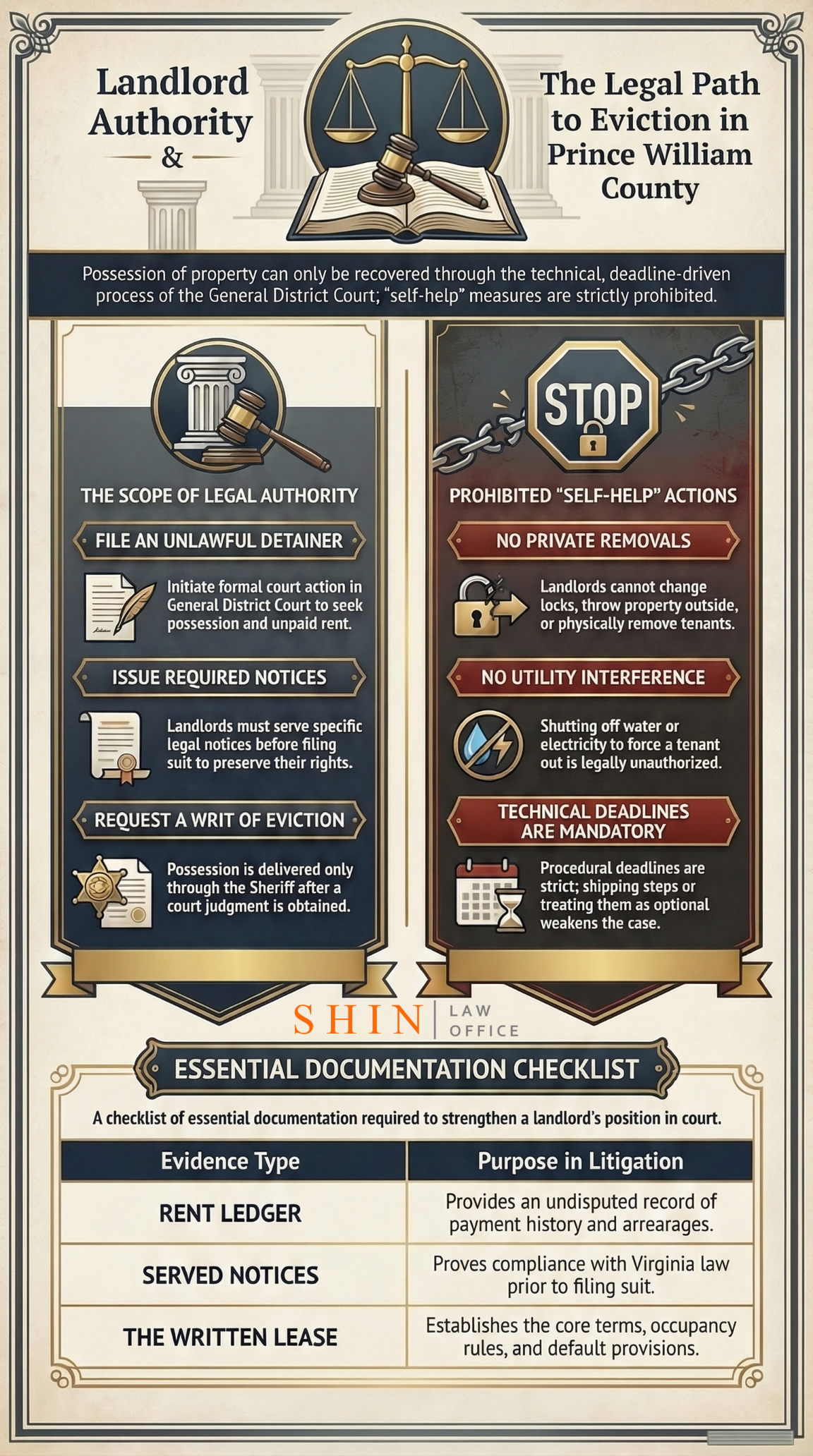
The landlord can enforce the written lease. The landlord can demand rent when due. The landlord may issue the required notices under Virginia law before filing suit. The landlord can bring an unlawful detainer case in the General District Court to seek possession, unpaid rent, and other amounts allowed by law and contract. The landlord can obtain a judgment if the legal requirements are met. After judgment, the landlord can request a writ of eviction, and the sheriff executes that writ. Virginia’s court forms make this structure clear. The unlawful detainer summons warns the defendant that judgment may be entered and eviction may follow if the tenant does not appear, and the writ of eviction form shows that possession is delivered through the sheriff, not through private self-help by the landlord.
That is the part many people miss. The landlord has legal authority, but the force of that authority comes from the court and sheriff, not from private action. A landlord cannot simply change the locks, throw the tenant’s property outside, shut off utilities, or physically remove the tenant because rent is late or the lease is breached. Lawful possession has to be recovered through the legal process.
Why is this issue especially practical in Prince William County
Prince William County continues to deal with housing pressure and active housing planning. The County approved Affordable Housing Fund policies in February 2026, and its recent housing planning documents discuss rehabilitation funding, affordability programs, and broader housing needs. That does not change the landlord’s legal authority, but it does mean landlord-tenant conflict remains a live local issue with real economic pressure behind it. As affordability tightens, disputes over rent, nonpayment, occupancy, repairs, lease defaults, and removal timelines are becoming more common and contentious.
For landlords, that pressure often means longer informal collection periods, more difficult tenant communication, and more reluctance to file until the arrearage is large. That delay can make the case harder, not easier. For tenants, it often means heightened vulnerability to procedural mistakes. In both directions, the dispute becomes deadline-driven fast.
The landlord’s authority begins with the lease, but litigation begins with compliance
The first source of a landlord’s legal authority is usually the lease itself. The lease defines rent, due dates, occupancy rules, maintenance obligations, default provisions, and other material terms. But lease language alone is not enough. In litigation, the landlord still has to show that the proper notice was served, that the basis for default is legally supportable, and that the case was properly filed.
This is where many landlord cases strengthen or weaken. A landlord with a solid lease but poor documentation can still create avoidable litigation risk. A landlord with a smaller claim but excellent records often stands in a much better position. Rent ledgers, notices, communications, inspection records, photographs, move in documents, and payment history often matter far more than the parties expect at the beginning.
Unlawful detainer is the real enforcement tool
In Prince William County, unlawful detainer is the central court mechanism landlords use to recover possession. Virginia’s court system provides the Summons for Unlawful Detainer and related civil forms through the district court system. The summons itself makes clear that this is the formal eviction pathway. It tells the tenant that if they do not come to court, judgment may be entered and eviction may follow. That is the legal backbone of landlord authority in practice.
From a litigation standpoint, unlawful detainer is not just about removing the tenant. It is often the stage where rent claims, damages, holdover issues, and possession rights begin to merge into a larger dispute. A case that starts as nonpayment can turn into an argument about notice, waiver, repairs, offsets, acceptance of partial payments, or lease interpretation. That is why I view these matters as litigation problems, not just paperwork problems.
The landlord’s authority has hard limits
I always make this clear. The landlord’s authority is substantial, but it is not unlimited.
A landlord does not have the authority to bypass the court process. A landlord does not have the authority to privately execute an eviction. A landlord does not have the authority to treat procedural deadlines as flexible because the tenant is obviously in default. Virginia’s own self-help guidance says these cases are highly technical and deadline-driven. That warning applies to landlords just as much as tenants.
In practical terms, that means a landlord can lose leverage by sloppy execution. Bad notice timing, inconsistent rent acceptance, incomplete records, unclear lease drafting, or poor hearing preparation can weaken a case that would otherwise be straightforward.
Why the General District Court matters so much
Prince William County’s General District Court is where these cases usually first live. County materials identify landlord-tenant disputes, contract disputes, and personal injury matters as examples of the court’s civil work. That matters because landlord-tenant cases are not treated as side issues. They are core civil disputes.
That court setting shapes the strategy. General District Court moves faster than many parties expect. The burden is on the landlord to arrive organized, procedurally correct, and able to prove the claim. The landlord who thinks legal authority alone is enough often walks into unnecessary resistance. The landlord who understands that authority has to be translated into admissible proof and a clean procedure is in a much stronger position.
The most common landlord-side disputes I see
In Prince William County, these disputes commonly cluster around a few issues.
Nonpayment of rent is the obvious one. But the harder cases often involve lease breaches beyond rent, disputed notice, holdover occupancy, property damage, unauthorized occupants, repair-related defenses, and arguments over what the landlord accepted or waived.
I also watch for cases where the landlord is legally right but operationally messy. Those are dangerous. A landlord may have every reason to recover possession but still create avoidable problems by inconsistent communication, undocumented side agreements, or partial enforcement of lease terms. Courts care about process, not just frustration.
The strategic takeaway for landlords
The real question is not whether a landlord has legal authority in Prince William County. The answer is yes. The real question is whether the landlord used that authority correctly.
The strongest landlord cases are usually those in which the lease is clear, the notices are correct, the payment history is documented, the default theory is consistent, and the landlord understands that eviction is a court-driven remedy. The weakest landlord cases are often the ones driven by anger, improvisation, or the assumption that obvious nonpayment automatically wins the day.
In Prince William County, landlord-tenant litigation remains a practical and high-value topic because housing pressure is real, deadlines are strict, and the General District Court is where possession rights are enforced. A landlord does have legal authority, but that authority becomes effective only when it is exercised through the legal system with discipline.
Speak with Shin Law Office before a landlord-tenant dispute in Prince William County turns into a failed eviction or a more expensive court fight.

Principal Attorney | Shin Law Office
Call 571-445-6565 or book a consultation online today.
(This article is provided for general informational purposes and does not constitute legal advice. For advice on your specific situation, consult with a licensed Virginia attorney.)
References
Prince William County, Virginia. (2026). Safe & secure community [FY2027 budget material]. https://pwcaws.pwcva.gov/assets/2026-02/pFY27–09–SSC00–Safe_and_Secure_Community.pdf
Prince William County, Virginia. (2026, February 3). Affordable Housing Fund. https://www.pwcva.gov/department/housing-community-development/affordable-housing-fund-ahf
Prince William County, Virginia. (2026, February 16). FY2027 Annual Action Plan draft. https://www.pwcva.gov/assets/2026-02/DRAFT%20PWC_AAP%2016Feb26%20%28FFY26%20FY27%29.pdf
Prince William County, Virginia. (2025, July 3). 2026 to 2030 Consolidated Plan and 2026 Annual Action Plan. https://www.pwcva.gov/assets/2025-07/2026-2030%20Consolidated%20Plan%20and%202026%20AAP_3July25.pdf
Virginia Judicial System. (2026, March 4). Landlord tenant. https://selfhelp.vacourts.gov/page/10/landlord-tenant
Virginia Judicial System. (2025). General District Court civil forms. https://www.vacourts.gov/forms/district/civil
Virginia Judicial System. (2024). Summons for unlawful detainer (Civil claim for eviction) (Form DC 421). https://www.vacourts.gov/forms/district/dc421.pdf
Virginia Judicial System. (2023). Request for writ of eviction in unlawful detainer proceedings (Form DC 469). https://www.vacourts.gov/forms/district/dc469.pdf