
BLUF
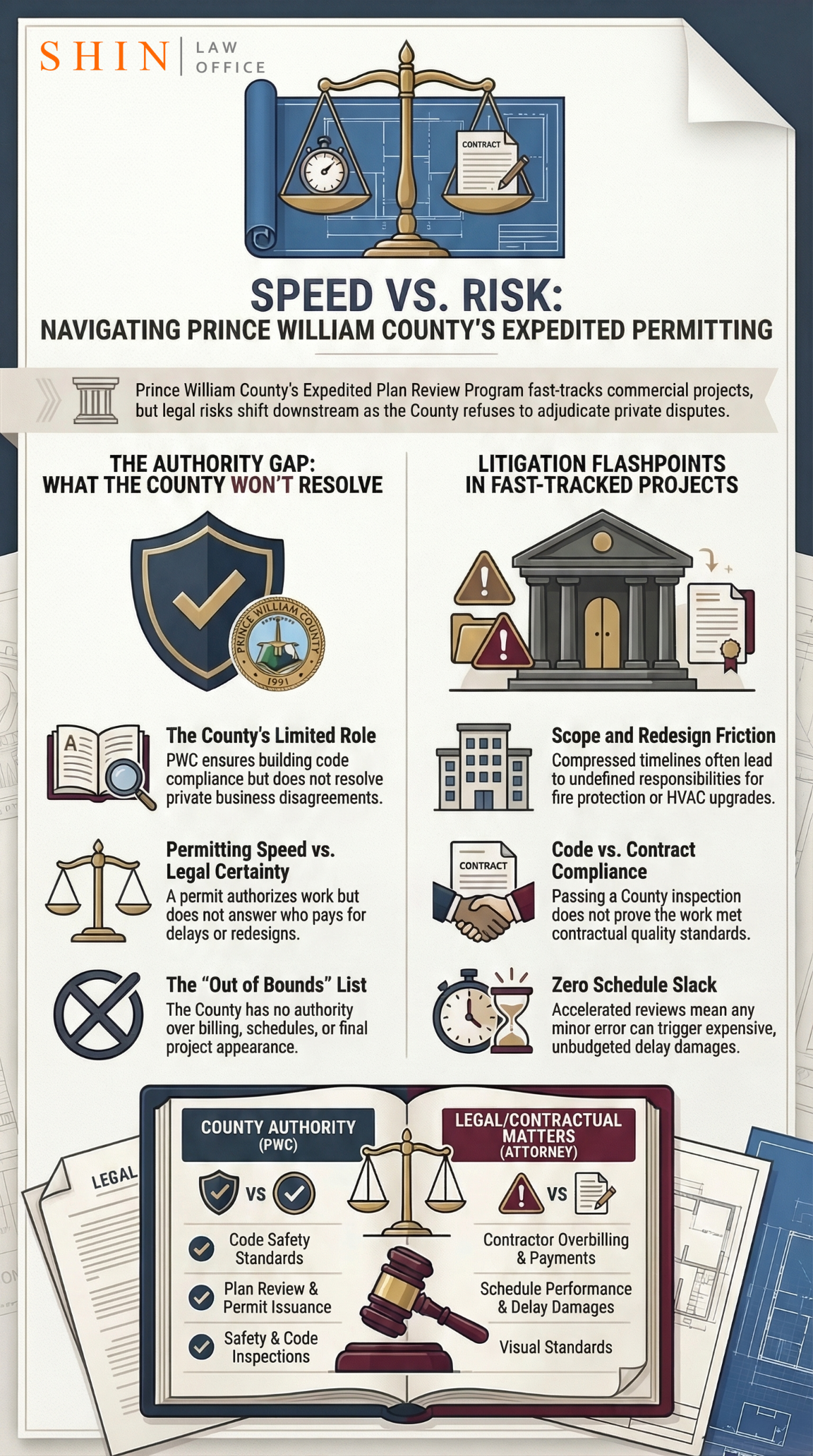
When Prince William County speeds up commercial permitting, the legal risk does not disappear. It often shifts downstream into disputes over scope, redesign responsibility, resubmissions, inspections, payment, delays, defective work, and project closeout. Prince William County relaunched its enhanced Commercial Expedited Plan Review Program on January 21, 2026, with the updated program effective February 16, 2026, to fast-track smaller commercial projects in existing buildings and approved shell buildings. At the same time, the County expressly states that its Building Development Division does not resolve disputes over contractor billing, completion, schedule performance, or the final appearance of a project, and that affected parties may need help from a state agency or an attorney.
-
Prince William County Commercial Construction Disputes
In Prince William County, faster commercial permitting is good for business, but it does not eliminate construction conflicts. In many cases, it does the opposite. It compresses decision-making, increases pressure on drawings, accelerates scheduling expectations, and exposes weaknesses in contracts that were never built to handle speed. When the review process speeds up, mistakes, assumptions, and gaps in project coordination surface sooner and hit harder. That is where commercial construction litigation begins.
Prince William County’s Department of Development Services announced on January 21, 2026, that its Building Development Division was relaunching the Expedited Plan Review Program, effective February 16, 2026. The County said the updated program was designed to fast-track permit issuance for smaller commercial projects within existing buildings and shell buildings that had already received final inspection approval. The County also emphasized online collaboration, electronic plan review, real-time communication between design professionals and reviewers, and reduced timelines to cut time and costs for applicants.
That all sounds efficient, and often it is. But I have seen the same pattern repeatedly in construction matters. The faster a project moves through review and permit issuance, the less margin exists for fuzzy scope, incomplete coordination, deferred design decisions, and casual assumptions about who bears the cost when a reviewer comment, field condition, or trade conflict forces the work to change. Speed is not the enemy. Undefined responsibility is.
Why expedited permitting can increase dispute risk
Prince William County’s relaunch is aimed at smaller commercial work, especially tenant fit-outs, interior alterations in existing buildings, and projects in previously approved shell spaces. Those are exactly the kinds of jobs that can look simple on paper and become contentious in execution. A tenant improvement project often involves compressed move-in dates, landlord pressure, financing deadlines, coordination among multiple trades, and design constraints buried in the building’s existing conditions. When review is accelerated, the parties can mistake permit speed for construction certainty. They are not the same thing.
The County’s Building Development Division makes clear what its role actually is. It reviews building construction plans and specifications, issues building construction permits, performs critical inspections, and ensures building code compliance. It also states clearly that it is only one of many steps in the construction process. That statement matters in litigation because many owners and contractors wrongly assume that permit approval or County inspection somehow resolves broader contract responsibility. It does not.
A permit can authorize work. An inspection can confirm code compliance at a given stage. Neither automatically answers who pays for redesign, who absorbs delay damages, whether a change order is valid, whether the contractor met schedule obligations, or whether the finished product satisfies the contract documents. Those are legal and contractual questions, not just permitting questions.
The disputes Prince William County says it will not resolve
Prince William County could not be much clearer on this point. Its Building Development Division states that it lacks the authority to resolve disputes between customers and contractors. The County explains that it issues permits, reviews plans, and conducts inspections to ensure that contractors comply with code requirements. It then states that if a customer is dissatisfied with a contractor’s bill, completion, schedule performance, or the final appearance of the project, the customer will need to seek assistance from the state or an attorney.
That short statement carries major litigation significance. It tells commercial owners, tenants, developers, and contractors that many of the most financially significant construction disputes fall outside the County’s dispute-resolution authority. In other words, even on a fast-tracked project, the County will not decide whether the contractor overbilled, whether the work was completed on time under the contract, whether the project turned out as the owner expected, or whether the contractor should bear the cost of correction. Those fights often turn into breach-of-contract claims, payment disputes, change-order disputes, warranty claims, indemnity claims, or defect litigation.
The most common litigation flashpoints on fast-moving commercial projects
Scope disputes
Expedited review often works best when scope is truly narrow and well defined. Problems start when one side treats the project as a limited tenant fit-out while the other assumes broader system work, code upgrades, finish obligations, or coordination duties are included. On paper, the job may look like a straightforward interior alteration. In the field, someone discovers fire protection revisions, accessibility issues, electrical upgrades, HVAC modifications, or structural limits that were not priced or fully designed. Then the parties start fighting over whether the work is extra, whether it should have been anticipated, and who should bear the cost.
Resubmission and redesign disputes
Prince William County’s Building Development Division has dedicated processes for resubmissions after comments and revisions after permit issuance. That is useful administratively, but legally, it can become a fault line. When a project requires redesign or resubmission, the contract may not clearly specify who is financially responsible for the additional work, extended overhead, or delay. On accelerated projects, those questions matter even more because the schedule slack is usually thin.
Inspection-related disputes
The County conducts critical inspections to ensure code compliance. But a passed inspection does not always end the dispute. Owners may still contend that the work is incomplete, aesthetically deficient, noncompliant with plans, or below the contractual standard of workmanship. Contractors may argue that County approval proves the adequacy of the work. That is often too simplistic. Code compliance and contract compliance are not always identical. A project can pass inspection and still trigger a claim for incomplete performance, defective finish work, deviation from specifications, or failure to properly coordinate the work.
Change order and payment fights
Once accelerated schedules collide with real-world conditions, change order fights usually follow. Owners may see the contractor as using speed as leverage to push through extras. Contractors may see the owner as demanding work beyond the agreed scope without fair compensation or time extension. On a fast-track job, delayed decisions become expensive quickly. That makes written change order procedures, notice requirements, and documentation of impacts far more important than many parties realize at the front end.
Delay and completion disputes
Prince William County explicitly states that disputes over completion and schedule performance are outside the Building Development Division’s authority. That means that if a commercial project misses an opening date, loses a tenant, disrupts operations, or triggers financing consequences, the County is not the forum for allocating that business loss. The dispute usually turns on contract language, critical path facts, delay notices, concurrent delay issues, force majeure language, and whether redesign, permitting comments, owner decisions, or trade coordination failures caused the slippage.
Why development growth makes these disputes more likely
Prince William County’s development system is actively trying to improve visibility into review stages and processing timelines. The County’s roadmaps and timeframes materials are designed to provide step-by-step visibility into development review, milestones, and responsibilities. That kind of process clarity can help. But it also means more participants are trying to push projects through a known system faster, with stronger expectations around timing. When the business side starts planning around accelerated reviews, schedule misses, and redesign cycles, the financial pain increases.
The County’s FY2026 development services materials also reflect institutional emphasis on commercial plan review timeframes and inspection performance. Commercial plans reviewed within six weeks of the first review, and inspections performed on the day requested, are treated as measurable service goals. That kind of governmental emphasis on speed and responsiveness is useful for applicants, but it also reinforces a market expectation that everything else in the construction chain should move just as quickly. In practice, that expectation often outruns reality.
What I watch for in these cases
When I evaluate a Prince William County commercial construction dispute tied to expedited review, I focus on a few core questions.
First, what did the contract actually require, and how clearly did it allocate risk for design completeness, code comments, existing conditions, resubmissions, and post-permit revisions?
Second, what happened in the record? I want to see the permit path, reviewer comments, revised plans, submittals, inspections, emails, meeting notes, change order requests, schedules, payment applications, and closeout correspondence.
Third, is the other side trying to blur code approval with contractual performance? Prince William County’s own materials help cut through that confusion because the County is clear that its role is permit review, inspections, and code compliance, not adjudicating contractor billing, completion, schedule performance, or final appearance disputes.
Fourth, what is the real damage model? On a commercial project, the dispute may involve unpaid contract balances, corrective work, delay damages, lost rent, business interruption, extended general conditions, or reputational fallout with tenants and lenders.
The practical legal takeaway
In Prince William County, expedited permitting is not the problem. Poor contract discipline under accelerated conditions is the problem. A fast-moving review program can help legitimate projects get to occupancy sooner. But it can also magnify every weakness in scope definition, design coordination, schedule management, payment procedures, and closeout expectations.
That is why commercial owners, tenants, developers, and contractors should not treat permit acceleration as a substitute for legal risk management. If the project is moving faster, the contract needs to be tighter. If redesign is a possibility, the responsibility needs to be clear. If resubmissions or revisions after permit issuance are possible, the parties need a documented process for cost, time, and accountability. If not, the dispute often lands exactly where Prince William County says it belongs: outside the Building Development Division and in the hands of counsel.

Principal Attorney | Shin Law Office
Call 571-445-6565 or book a consultation online today.
(This article is provided for general informational purposes and does not constitute legal advice. For advice on your specific situation, consult with a licensed Virginia attorney.)
References
Prince William County, Virginia. (2026, January 21). Prince William County relaunches enhanced commercial expedited plan review program to accelerate small business growth. https://www.pwcva.gov/news/prince-william-county-relaunches-enhanced-commercial-expedited-plan-review-program-accelerate/
Prince William County, Virginia. (n.d.). About BDD. Retrieved March 20, 2026, from https://www.pwcva.gov/department/building-development-division/about-bdd
Prince William County, Virginia. (n.d.). Dispute with building contractor. Retrieved March 20, 2026, from https://www.pwcva.gov/department/building-development-division/dispute-building-contractor
Prince William County, Virginia. (n.d.). Building Development Division. Retrieved March 20, 2026, from https://www.pwcva.gov/department/building-development-division
Prince William County, Virginia. (n.d.). Roadmaps and timeframes. Retrieved March 20, 2026, from https://www.pwcva.gov/department/development-services/roadmaps-and-timeframes
Prince William County, Virginia. (2025). Development services [FY2026 budget/program material]. https://www.pwcva.gov/assets/2025-07/aFY26–10–MEGR01–Development_Services.pdf