
BLUF
If someone broke a deal with you in Arlington County, or if you have been accused of breaking one, you are facing a court system with strict filing deadlines, specific venue rules, and procedural requirements that can end your case before it ever begins. I wrote this article to walk you through the major categories of contract disputes I see in Arlington County courts, the legal framework that governs them under Virginia law, and what you should do right now to protect your position.
-
Why Arlington County Is Its Own Legal Environment
I practice across Northern Virginia, and Arlington County is one of the most distinctive civil litigation environments I work in. It sits at the intersection of federal government, defense contracting, commercial real estate, and a concentrated professional services economy. That combination produces contract disputes that are, in many ways, unlike what I handle in Loudoun or Prince William County. Add in the thousands of small and mid-sized businesses packed along the Rosslyn-Ballston corridor, and you get one of the busiest civil litigation dockets in the region.
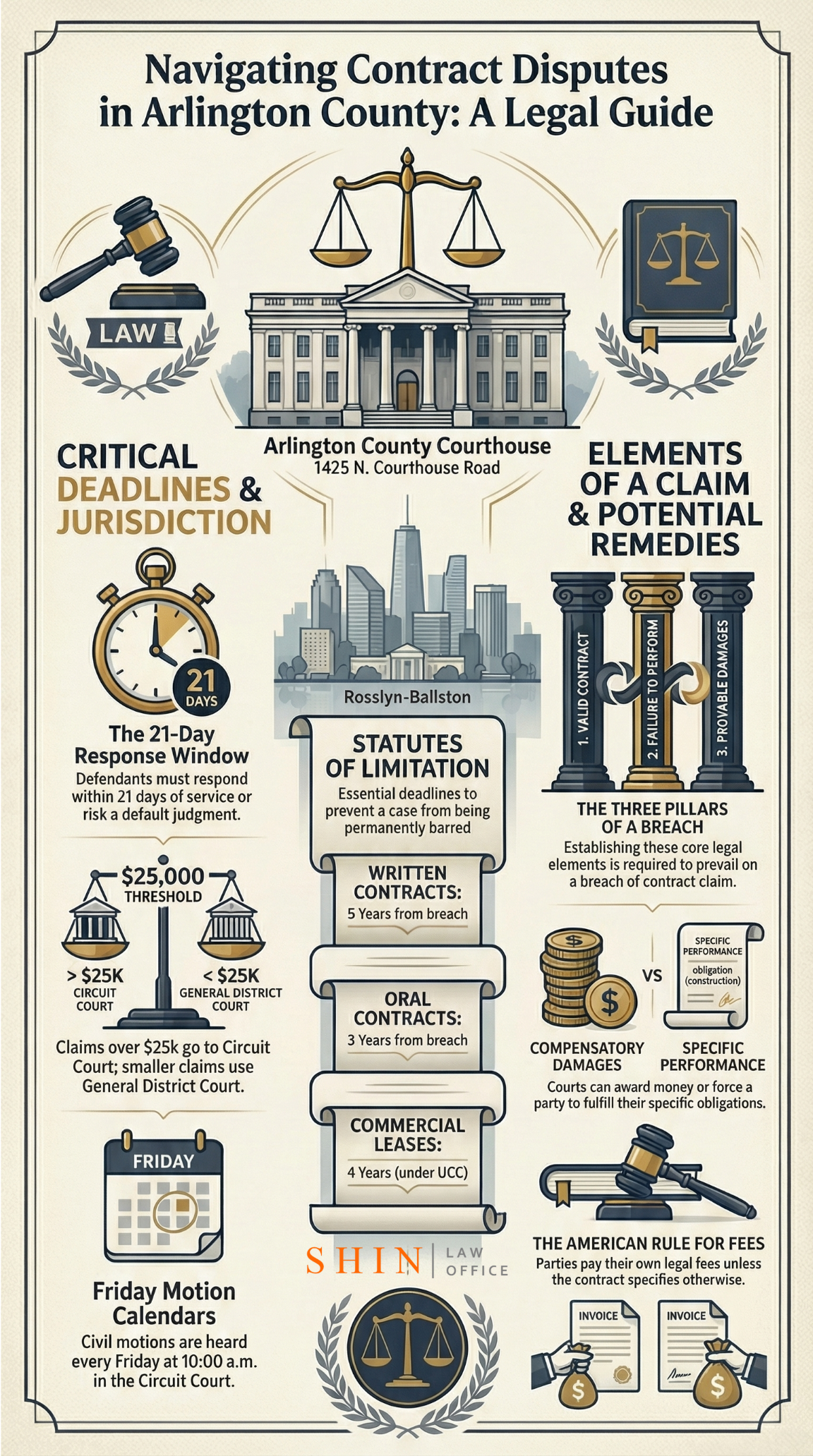
The Arlington County Circuit Court, located at 1425 N. Courthouse Road, Arlington, VA 22201, operates under the 17th Judicial Circuit and handles all civil claims over $25,000. For smaller matters, the General District Court at the same address covers claims at or below that threshold. Civil motions are heard every Friday at 10:00 a.m. in Circuit Court. One thing I tell every client I represent in Arlington: if you are served with a lawsuit in Virginia, you have 21 days to respond. Miss that window and you can lose by default, even if the claim against you has no merit whatsoever (Arlington County Circuit Court, n.d.; Moore Christoff and Siddiqui, 2024).
The Legal Foundation: How Virginia Contract Law Works
Virginia contract law is built primarily on common law. That means it is shaped as much by decades of court decisions as it is by written statutes. The Virginia Code provides the statutory backbone, but the judges I appear before still apply long-standing legal principles to fill in the gaps (Virginia Court Records, n.d.).
To win a breach of contract case in Virginia, my client generally needs to establish three things: a valid contract existed, one party failed to perform their obligations, and that failure caused real, provable damages. This framework was affirmed in Ulloa v. QSP, Inc., 271 Va. 72 (2006), a case I reference regularly when advising clients on whether their situation supports a viable claim.
The Statute of Limitations: Do Not Miss This
This is the piece of information I push hardest on in every initial consultation, because missing a filing deadline wipes out an otherwise strong case:
- Written contracts: 5 years from the date of breach (Virginia Code § 8.01-246)
- Oral contracts: 3 years from the date of breach
- Commercial lease defaults: 4 years under the Uniform Commercial Code (Virginia Code § 8.2A-506)
The clock generally starts running on the date the breach occurred or on the date it should have been discovered. Missing these deadlines typically bars your claim permanently. There are narrow exceptions for tolling, but I would never count on them (Wakefield Law, 2023).
What Arlington County Courts Can Award
When I bring a contract case to Arlington County, the court can order several types of relief depending on the facts my team puts in front of it:
- Compensatory damages to put the injured party in the position they would have been in had the contract been performed
- Consequential damages for foreseeable losses that flow from the breach
- Specific performance, which compels a party to actually fulfill their obligations rather than simply write a check. This remedy comes up constantly in real estate contract disputes
- Rescission, which cancels the contract entirely and returns the parties to where they started
- Punitive damages, but only when my client can prove an independent, willful tort that goes beyond the contract breach itself (Virginia Construction Law Compendium, 2015)
One more thing to know: attorney’s fees are generally not recoverable unless the contract includes a fee-shifting clause. Virginia follows the American Rule, meaning each side pays its own legal costs. When I review contracts for clients, I always flag whether a clause is included (SRIS P.C., n.d.).
Types of Civil Litigation Contract Disputes in Arlington County
Business and Commercial Contract Disputes
Breach of Written Business Agreements
This is the most common type of contract case I handle in Arlington County. When a party fails to perform any material term of a written business agreement without legal justification, the other party has a cause of action. The question courts ask is whether the breach was material, meaning it substantially defeated the purpose of the agreement, or minor, meaning it was a small deviation that did not undermine the deal as a whole. A material breach generally allows my client to treat the contract as terminated and sue for full damages (J.S. Burton, PLC, n.d.).
The fact patterns I see most often include a vendor going dark mid-contract without delivering goods or services, a client refusing to pay after work is completed and accepted, a party quietly changing contract terms after everyone has already signed, and a party deliberately making it impossible for the other side to perform.
Oral Contract Disputes
Virginia courts will enforce oral contracts, and I have won them. But proving the specific terms of an agreement that was never written down is hard work. Witness testimony, email chains, text messages, and circumstantial evidence all become central to building the case. The statute of limitations is three years for oral agreements. Because the burden of proof falls on the party asserting the contract existed, I always tell clients that these cases carry more inherent risk than disputes involving a signed document (SRIS P.C., n.d.).
Partnership and Shareholder Disputes
When business partners or shareholders in Arlington County fall out, the fight usually comes down to what the operating agreement or shareholder agreement actually says, and whether someone violated it. The claims I see most often include breach of fiduciary duty, self-dealing by a managing partner, wrongful distributions, and deliberate exclusion of a minority owner from business decisions. Arlington County courts apply the Virginia Business Trust Act and the Virginia Stock Corporation Act depending on how the entity was formed (SRIS P.C., n.d.; Virginia Court Records, n.d.).
Non-Compete and Restrictive Covenant Disputes
Virginia law on non-compete agreements changed significantly in 2020. Non-compete clauses are now unenforceable against low-wage workers in Virginia. For employees above that wage threshold, courts weigh whether the geographic scope, the duration of the restriction, and the job function limitations are all reasonable given the employer’s actual business interests. When those provisions are written too broadly, I can get them struck down entirely. I see these cases regularly in Arlington County on both sides, representing employers trying to enforce their agreements and employees trying to get out from under them (Justia Lawyer Directory, n.d.).
Franchise Agreement Disputes
Arlington County sees a solid volume of franchise disputes, involving both national brands and regional franchisors doing business in Northern Virginia. The claims I handle in this space include territorial encroachment by a franchisor who opens a competing location too close, failure to deliver promised training or support, improper termination of a franchise agreement, and disputes over royalty calculations and renewal rights. The franchise disclosure document and the franchise agreement itself are always the starting point when I take one of these cases (SRIS P.C., n.d.).
Employment Contract Disputes
Wrongful Termination and Employment Agreement Claims
When an employer fires someone in alleged violation of a written employment contract, the fired employee can bring a breach of contract claim alongside, or instead of, a tort claim. The threshold question I always address first is whether the contract actually limited the employer’s right to terminate. Virginia is an at-will employment state by default. Without a written agreement to the contrary, the employer generally can fire without cause. When there is a written agreement with specific termination procedures or just-cause requirements, that changes the entire analysis.
Wage and Hour Disputes
Claims for unpaid overtime, misclassified independent contractors, and improperly withheld bonuses often start as contract disputes in my practice. If an employment agreement or offer letter promises specific compensation and the employer pays something less, that is a breach. These claims can also trigger separate liability under the Virginia Wage Payment Act and federal law. I see both sides of these cases (Justia Lawyer Directory, n.d.).
FMLA and Leave Violations
When employers in Arlington County deny legally required leave or retaliate against employees who take it, those violations can run into both statutory claims and the terms of an employment agreement at the same time. Given the concentration of federal contractors and large private employers near the Pentagon, I handle a consistent number of these disputes each year.
Construction Contract Disputes
Contractor and Subcontractor Payment Disputes
Construction payment disputes are among the most litigated contract matters I handle in Arlington County. General contractors, subcontractors, and material suppliers fight over whether work was performed to spec, whether change orders were properly authorized before the work was done, and whether invoices hit the right people at the right time. Virginia’s mechanic’s lien statute provides additional remedies beyond a straight breach of contract claim, but those procedures are strict and the deadlines are unforgiving. If you miss the window to file a mechanic’s lien in Virginia, that remedy is gone (Virginia Construction Law Compendium, 2015).
Change Order Disputes
Scope changes are the single most predictable source of friction I see in construction contracts. When my client performs additional work that was never in the original contract and the owner refuses to pay for it, I typically argue quantum meruit, which is the reasonable value of the work performed, alongside a direct breach of contract claim. Owners on the other side argue that no signed change order exists, which is very often the heart of the dispute (Shin Law Office, n.d.).
Construction Defect Claims
When construction is completed and fails to meet the standards set out in the contract or applicable building codes, the property owner has a breach of contract claim against the contractor. These cases almost always require expert testimony about what the plans and specifications required versus what was actually built. I also have to navigate Virginia’s statute of repose for construction defects, which runs concurrently with the regular statute of limitations and adds another layer of timing analysis (Virginia Construction Law Compendium, 2015).
Commercial Lease Disputes
The commercial real estate market in Arlington County is dense and active, particularly in Crystal City, Clarendon, Pentagon City, and the full Rosslyn-Ballston corridor. Commercial lease disputes are a regular part of my civil litigation practice.
Landlord and Tenant Breach Claims
Landlords come to me to pursue tenants for unpaid rent, holdover occupancy, failure to maintain the property, and unauthorized subletting. Tenants come to me when a landlord misrepresents the square footage of the space, fails to make promised repairs, or tries to force them out in violation of the lease. Both sides also fight hard over early termination clauses and the enforceability of a personal guarantee.
Common Area Maintenance Disputes
CAM fee disputes arise frequently in commercial lease litigation. Tenants argue that landlords are loading the CAM calculation with costs the lease never authorized. Landlords argue the lease gives them broad discretion over what goes in. When the contract language is genuinely ambiguous, courts look to the parties’ history of dealing with each other and to industry standards.
Lease Termination and Surrender Disputes
When a commercial tenant closes up and abandons the space before the lease ends, Virginia law generally requires the landlord to take reasonable steps to re-rent the space rather than simply let it sit empty and pile up damages. The scope of that mitigation obligation and how it affects the ultimate damages calculation is one of the most contested issues I see in commercial lease litigation. Some leases attempt to waive the mitigation requirement entirely, which creates its own enforceability questions (May Law LLP, n.d.).
Real Estate Contract Disputes
Breach of Purchase and Sale Agreements
When a buyer walks away from a real estate deal or a seller refuses to close, the aggrieved party has a breach of contract claim. Specific performance is particularly important in these cases. If a seller refuses to transfer property after a valid purchase contract has been signed, I can ask the court to order the seller to complete the transaction rather than simply pay money damages. That is sometimes the only remedy that actually makes the client whole (May Law LLP, n.d.).
Title and Boundary Disputes
Disputes over what was actually conveyed in a deed or purchase agreement end up in civil litigation when the parties cannot agree on what was sold. These cases rely heavily on survey evidence, historical deed chains, and expert testimony about property boundaries and title history.
Real Estate Fraud and Misrepresentation
When a seller or agent misrepresents material facts about a property, the buyer can bring claims for fraud, fraudulent inducement, and breach of contract all at once. Virginia courts treat warranty claims as tort claims rather than contract claims, which changes the statute of limitations and expands the available damages (Virginia Construction Law Compendium, 2015).
Service Contract Disputes
Professional Services Agreements
Consultants, IT service providers, accountants, and marketing firms operating in Arlington County all live and die by their service contracts. When those relationships break down, the disputes center on whether the deliverables met the agreed standard, whether payment was made as promised, and whether the party who ended the relationship followed the contract’s termination provisions.
Warranty and Guarantee Claims
Claims arising from warranties on goods or services follow a different legal framework than standard breach of contract claims. Under the Virginia Uniform Commercial Code, breach of warranty claims for goods are treated in part as tort claims, which affects both the applicable statute of limitations and the types of damages available to my client (Virginia Construction Law Compendium, 2015).
Federal Contracting Disputes
Arlington County’s proximity to the Pentagon, the Department of Defense, and dozens of federal civilian agencies makes federal contracting disputes a regular feature of the local civil litigation landscape. These are cases I handle with particular care because the stakes are often very high and the procedural landscape is complex.
Teaming Agreement Disputes
When two contractors team up to pursue a federal contract and then fall out over how to divide the work after the award comes in, the teaming agreement becomes the central document in the dispute. These agreements are notoriously vague about post-award obligations. Courts have to determine whether the agreement created a binding obligation or simply a framework for future negotiations that never became enforceable.
Prime and Subcontractor Payment Disputes
When a prime contractor collects payment from the federal government and then refuses to pay its subcontractors, those subcontractors can bring breach of contract claims and, in the right circumstances, Miller Act claims, which govern federal payment bonds. These cases land in both state and federal court depending on the specific facts (Shin Law Office, n.d.).
Business Tort Claims Adjacent to Contract Disputes
Tortious Interference with Contract
When a third party intentionally causes someone to breach a contract with my client, that third party may be held liable for tortious interference. I see this most often in competitive business situations, particularly when a competitor recruits a key employee away from a client who had that employee under a non-compete or non-solicitation agreement.
Fraud and Fraudulent Inducement
When one party lies to get another to sign a contract, the victim can bring both a breach of contract claim and an independent fraud claim. The fraud claim matters enormously in Virginia because it opens the door to punitive damages, which are simply not available for a straight breach of contract (Sher, Cummings and Ellis, n.d.; Virginia Construction Law Compendium, 2015).
Consumer Protection Claims
The Virginia Consumer Protection Act (§ 59.1-196 et seq.) gives me an additional tool when a business uses deceptive practices to induce a contract. These claims can carry statutory damages and attorney’s fees even when the underlying contract damages are relatively modest. That fee-shifting potential significantly changes the economics of the case.
Defenses to Contract Claims in Arlington County
When I represent the party being sued in a contract dispute, I evaluate all available defenses from the start. The strongest ones I work with in Arlington County cases include:
- No valid contract existed. The parties never reached a real meeting of the minds, consideration was missing, or the agreement was never put in writing when the Statute of Frauds required it to be
- The plaintiff breached first. A material breach by the party now suing can legally excuse my client’s non-performance
- Impossibility or impracticability. Performance became objectively impossible due to circumstances neither party controlled
- Fraud in the formation of the contract. The contract my client signed was itself the product of the other side’s fraud
- Force majeure. The contract included a clause excusing performance when specified events outside the parties’ control occurred
- Statute of limitations. The claim was filed too late under Virginia Code § 8.01-246 or the applicable UCC provision. This is one of the first things I check
- Accord and satisfaction. The parties already resolved the dispute, and my client is satisfied with that agreement
How Arlington County Courts Handle These Cases
Most significant contract disputes in Arlington County end up in Circuit Court because they exceed $25,000. Here is what a typical contested case looks like from where I sit:
- I file a complaint and serve the defendant, or a complaint is served on my client
- The defendant has 21 days to respond
- Discovery begins, including depositions, document production, and written interrogatories
- Motions practice runs through the Friday civil motions calendar in Circuit Court
- Mediation is often encouraged or required before a trial date is set. Arlington County has active mediation programs for civil cases, and in commercial disputes where the parties want to preserve their business relationship, that is sometimes the right path
- If the case goes to trial, my clients need to plan for a timeline of 12 to 18 months from filing for a direct breach case. Complex commercial litigation regularly takes two years or more (Arlington County Circuit Court, n.d.; SRIS P.C., n.d.)
What to Do If You Are in a Contract Dispute Right Now
The first thing I tell every potential client who calls me about a contract dispute is this: find out which statute of limitations applies to your situation and how much time you have left. Missing that deadline ends your case, regardless of how solid the underlying facts are.
Beyond that, preserve every written communication you have about the contract and the dispute. Gather your financial records. Do not respond to the other side, and do not agree to anything in writing, before you have spoken with an attorney.
My team at Shin Law Office handles civil litigation and business contract disputes for clients in Arlington County, Fairfax County, Loudoun County, and across Northern Virginia. Call us at 571-445-6565 or visit shinlawoffice.com to schedule a consultation.

Principal Attorney | Civil Litigation | Shin Law Office
Call 571-445-6565 or book a consultation online today.
(This article is provided for general informational purposes and does not constitute legal advice. For advice on your specific situation, consult with a licensed Virginia attorney.)
References
Arlington County Circuit Court. (n.d.). Civil actions and FAQs. Arlington County Virginia Government. https://www.arlingtonva.us/Government/Departments/Courts/Circuit-Court/Civil-Actions-and-FAQs
Arlington County Circuit Court. (n.d.). Circuit Court home. Virginia Court System. https://www.vacourts.gov/courts/circuit/arlington/home
J.S. Burton, PLC. (n.d.). Breach of contract lawyer in Virginia. https://www.jsburton.org/business-planning/breach-of-contract/
Justia Lawyer Directory. (n.d.). Civil rights lawyers in Arlington County, VA. https://www.justia.com/lawyers/civil-rights/virginia/arlington-county
May Law, LLP. (n.d.). Civil litigation lawyer Arlington, VA. https://maylawllp.com/practice/civil-litigation-lawyer-arlington-va/
Moore Christoff and Siddiqui. (2024). Arlington County Circuit Court. https://moorechristoff.com/jurisdictions/arlington-county-circuit-court/
PJI Law. (2025, December 8). What are the legal consequences of breach of contract in Virginia? https://pjilaw.com/what-are-the-legal-consequences-of-breach-of-contract-in-virginia/
Sher, Cummings and Ellis. (n.d.). Civil litigation attorney in Arlington, VA. https://shercummingsandellis.com/practice-areas/civil-litigation/
Shin Law Office. (n.d.). Civil litigation services. https://shinlawoffice.com/services/civil-litigation/
SRIS, P.C. (n.d.). Contract lawyer Arlington County. https://srislawyer.com/contract-lawyer-arlington-county/
SRIS, P.C. (n.d.). Business contract lawyer Arlington County. https://srislawyer.com/business-contract-lawyer-arlington-county/
SRIS, P.C. (n.d.). Civil litigation lawyer Arlington County. https://srislawyer.com/civil-litigation-lawyer-arlington-county/
Virginia Construction Law Compendium. (2015). Breach of contract and construction disputes. https://www.fandpnet.com/wp-content/uploads/2015/01/VA-Construction-Compendium.pdf
Virginia Court Records. (n.d.). Contract disputes and property disputes in Virginia. https://virginiacourtrecords.us/civil-court-records/find/contract-property-disputes/
Virginia General Assembly. (n.d.). Virginia Code § 8.01-246 — Limitation on actions for contracts. https://law.lis.virginia.gov/vacode/8.01-246/
Virginia General Assembly. (n.d.). Virginia Code § 8.2A-506 — Statute of limitation. https://law.lis.virginia.gov/vacode/title8.2A/part5/section8.2A-506/
Wakefield Law. (2023, December 12). Navigating the statute of limitations in Virginia: A closer look at breach of contract. https://www.wakefieldpllc.com/blog/2023/12/12/navigating-the-statute-of-limitations-in-virginia-a-closer-look-at-breach-of-contract