
Bottom Line Up Front (BLUF)
Homeowners in Northern Virginia – including Fairfax, Loudoun, Prince William, Arlington, Clarke, and Frederick counties – have strong legal protections when their home construction or renovation goes wrong. Virginia law implies warranties that new homes will be structurally sound and built in a workmanlike manner, and recent court cases show that juries will hold builders accountable for defective or incomplete work. If you’re a homeowner dealing with shoddy construction, know that you can sue for breach of contract or warranty, and even fraud or consumer protection violations in egregious cases. However, lawsuits can be complex and time-sensitive, so it’s crucial to understand your rights under Virginia law and act promptly. In this article, I’ll explain in plain English the common types of home construction lawsuits in these counties, the Virginia laws and cases that every homeowner should know, and practical tips for protecting yourself. (By Anthony I. Shin, Esq.)
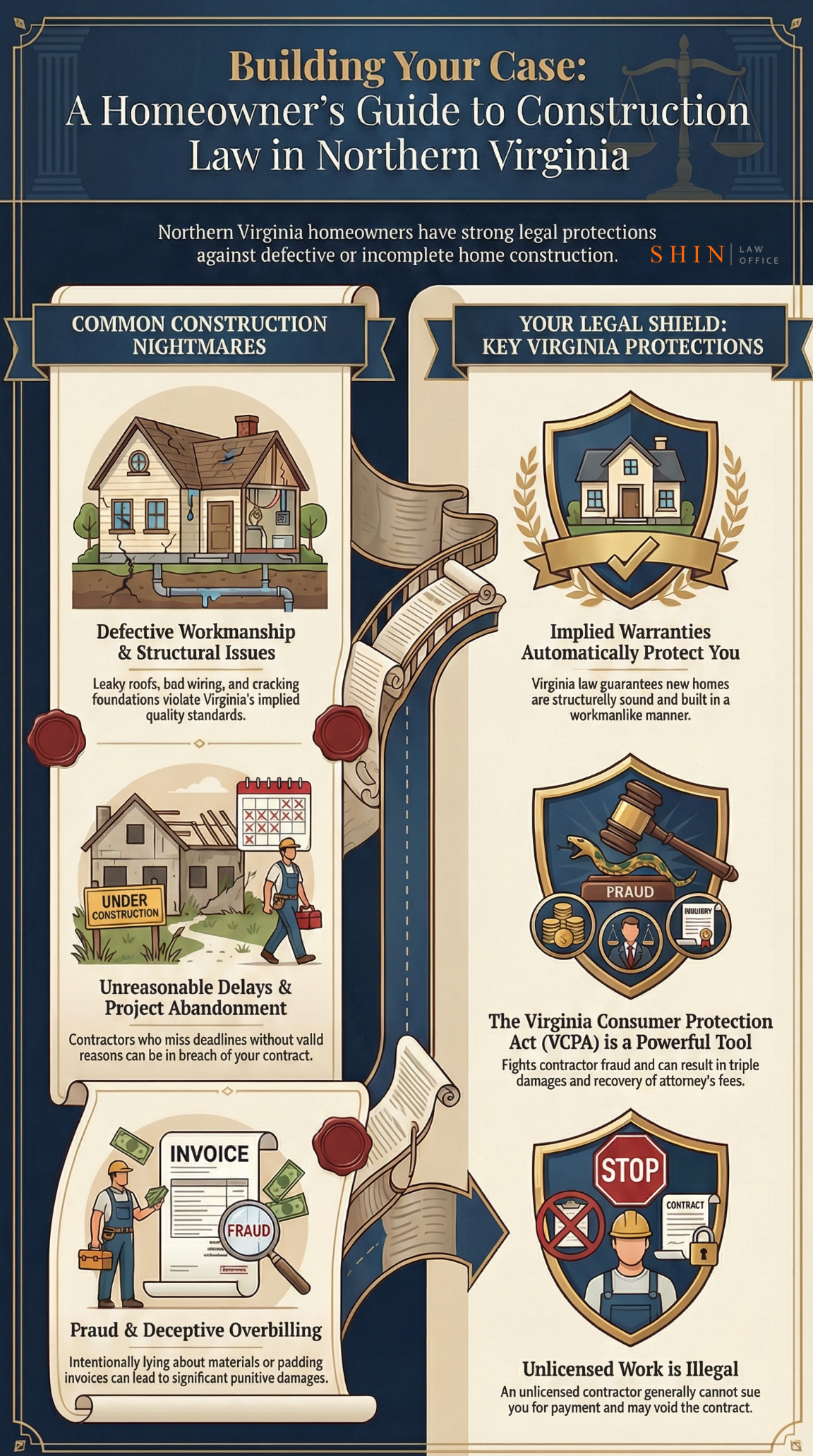
Table of Contents
- Introduction – When Dream Homes Become Legal Nightmares
- Common Disputes in Home Building (Northern Virginia Perspective)
- Homeowner Legal Rights and Protections Under Virginia Law
- Notable Case Examples in Fairfax, Loudoun, and Beyond
- Practical Tips for Homeowners Facing Construction Disputes
- Conclusion – Protecting Your Dream Home in Virginia
- References
1. Introduction – When Dream Homes Become Legal Nightmares
I’ve seen firsthand how an exciting home build or renovation can turn into a legal nightmare. Northern Virginia’s housing market is booming, from the suburban developments in Loudoun and Prince William County to infill projects in Fairfax and Arlington, and even custom homes on rural land in Clarke and Frederick County. With so much construction, disputes are almost inevitable. Promised move-in dates slip by, budgets balloon due to “unexpected” costs, and workmanship sometimes falls far below acceptable standards. What’s a homeowner to do when the dream home you paid for isn’t what was delivered?
In Virginia, homeowners are not powerless. Construction lawsuits over homebuilding are increasingly common in our area, and the law provides avenues to recover damages or to force repairs. As an attorney practicing across Fairfax, Loudoun, Prince William, Arlington, Clarke, and Frederick counties, I want to demystify these lawsuits for you. In this introduction, let’s set the stage: when you hire a builder or contractor to construct or renovate a home, you enter a binding contract. If the builder breaches that contract – by unreasonable delays, doing shoddy work, or not following the agreed plans – you have legal remedies. Likewise, if the construction has major defects or code violations, or if the contractor defrauded or misled you, the courts can provide relief. Recent jury verdicts in Northern Virginia have awarded homeowners anywhere from six-figure damages for defective work to punitive damages for willful fraud. Before diving into the details, remember that every case is unique – but understanding the common issues and laws will help you navigate if you ever face such a situation.
2. Common Disputes in Home Building (Northern Virginia Perspective)
Home construction disputes can take many forms, but as a practitioner, I notice the same core issues arising across Northern Virginia. Below, I break down the most common triggers for lawsuits between homeowners and home builders or contractors, with an eye toward how they often play out in our local counties.
2.1 Delays, Abandonment, and Missed Deadlines
Schedule delays are perhaps the most frequent complaint. A homeowner signs a contract expecting the project to be done by a certain date – for example, before a lease expires or a baby arrives – but the builder keeps pushing the timeline or stops showing up. In Virginia, if your contract has a clear deadline and especially if it states “time is of the essence,” substantial delays can constitute a material breach of contract. I’ve represented clients in Fairfax and Loudoun, where contractors simply abandoned the job for weeks or months, or only performed sporadic work. In one Fairfax case, a family hired a contractor to renovate a townhome by a move-in date, but the contractor delayed for seven months and then rushed the job at the last minute, leaving many tasks unfinished. Such an unjustified delay forced the homeowner to terminate the contract and hire others to finish the work.
Courts will look at the contract terms: does it specify a completion date or interim milestones? Were there valid reasons for delay (permissible weather delays, change orders, etc.) or is it outright contractor mismanagement? Homeowners should know that if a builder’s delay is unreasonable and not excused by the contract, you can potentially terminate the contract and sue for the extra costs you incur (such as the cost to hire a new contractor, rental expenses due to not being able to move in, etc.). However, if your contract doesn’t make deadlines explicit, Virginia courts might not view a delay alone as a serious breach unless it’s extreme. That’s why well-drafted contracts include timeline commitments and even penalties or termination rights if the builder falls too far behind schedule.
2.2 Defective Workmanship and Structural Issues
Another huge flashpoint is the quality of workmanship. Homeowners often sue when the new construction reveals major defects – uneven floors, leaky roofs, cracking foundations, bad wiring – essentially, work that fails to meet reasonable quality standards. Virginia law protects homeowners here by imposing an implied duty on builders to perform work in a skillful and competent manner. In fact, the Virginia Supreme Court recognized as far back as 1950 that every construction contract includes an implied warranty of good workmanship (the case Mann v. Clowser). What this means in plain terms is that even if your written contract doesn’t spell out quality standards, the law assumes the builder promised to do the job properly and safely.
For new homes, Virginia has a specific statutory warranty: Virginia Code § 55.1-357 implies that a new house (one being sold by a builder) is warranted to be free of structural defects and built in a workmanlike manner, fit for habitation. This warranty generally lasts one year for workmanship and materials and five years for structural components such as the foundation. If a defect shows up within those periods, the homeowner can hold the builder liable – but you must give the builder written notice and a reasonable time to fix it (typically up to six months). I always advise clients to document any defects as soon as discovered and notify the builder in writing (certified mail or other traceable delivery), as required by law, before filing suit. This preserves your rights under the implied warranties.
Common construction defects that lead to lawsuits in our area include water intrusion issues (e.g. improper flashing or grading causing basement leaks), foundation cracks or instability, mold and rot from poor framing or ventilation, and unsafe electrical or plumbing work. For example, in a recent Fairfax County case, a renovation contractor left live electrical wires exposed and numerous code violations, creating a safety hazard in the home. The jury found the work grossly substandard and awarded the homeowner damages to redo the work properly. In Loudoun and Prince William, where many new homes are being built quickly in large developments, we’ve seen lawsuits over things like foundation settlement, leaking windows/roofs, and insufficient insulation – often signs that the builder cut corners or used unskilled labor.
If you’re facing defective construction, the usual legal claim is breach of contract or breach of warranty – essentially, the builder failed their promise (explicit or implied) to deliver a home built to reasonably good standards. Sometimes homeowners also claim negligence, but under Virginia law, a negligence claim for purely economic losses (like the cost to repair defective work) is usually not allowed due to the “economic loss rule.” Virginia courts (following cases like Sensenbrenner v. Rust, Orling & Neale, 236 Va. 419 (1988)) treat construction defects as contract issues unless the defects cause injury or property damage beyond the structure itself. In short, you generally can’t sue in tort for a bad job on your house – you stick to contract-based remedies for the faulty workmanship. The good news is, those contract remedies are often adequate to get compensation for repairs and, if the contract or statute allows, possibly attorneys’ fees.
2.3 Contract Breaches: Payment and Scope Disputes
Many construction lawsuits boil down to breach of contract – one side didn’t do what they agreed to. For homeowners, a common breach by the builder is failure to complete the agreed-upon scope of work for the stated price. This can manifest in a few ways:
- Incomplete work: The contractor stops work before completing the project, or delivers a project that omits the agreed-upon features. (E.g., a renovation contract included a kitchen remodel, and the contractor only halfway installed cabinets before quitting.)
- Substituting inferior materials: The contract may call for certain quality materials or brands, but the builder used cheaper substitutes without approval. This is a classic dispute area if specifications aren’t clear – the homeowner expected hardwood floors but got laminate, for instance. If not explicitly addressed in the contract, it becomes a fight over what “equivalent” means.
- Unauthorized changes and extra charges: Perhaps the contractor did extra work or different work and then demanded more money, claiming it was outside the original scope. If there’s no signed change order or written authorization, homeowners often refuse to pay, and the contractor might then threaten to walk off or even file a mechanic’s lien. Virginia law generally requires change orders to be agreed in writing if the contract so provides, and without a clear change order, a contractor may be in breach by deviating from the plan.
On the flip side, contractors sometimes accuse homeowners of breach for non-payment – but if the reason you didn’t pay is incomplete or defective work, the law may justify withholding payment. A well-written contract will allow the owner to withhold final payment until defects are fixed or work is completed. If your contract is silent, Virginia common law still gives a right not to pay for work that is materially defective or not delivered. In one Fairfax case I handled, the homeowner had paid a large percentage of the price, but when it became clear the contractor’s work was riddled with problems and left unfinished, we advised the client to stop further payments. The contractor sued for the unpaid balance, but the court sided with the homeowner, finding the contractor had materially breached by delivering substandard work – meaning the homeowner was justified in terminating the contract and hiring someone else. The remedy in such cases is often damages equal to the cost of completion or repair beyond the original contract price. (For example, if you contracted for $100k, paid $80k, and it takes another $120k to fix and finish the job, your damages could be that $120k minus the unpaid $20k balance – effectively recouping the extra costs caused by the first builder’s breach.)
Especially in Loudoun, Prince William, and Frederick Counties, where we see a mix of large builders and smaller contractors, scope and payment disputes are frequent. Always look at your contract terms about change orders, allowances, and payment schedules. If the builder demands significantly more money than agreed without a valid change order, that can be a breach on their part (and potentially even a form of fraud if done deceptively, which leads to the next topic).
2.4 Fraud, Misrepresentation, and Overbilling Schemes
The most shocking cases are when a builder engages in outright fraud or deception. This goes beyond mere breach of contract. Fraud in the construction context might mean the contractor lied about their qualifications, pulled a “bait-and-switch” on materials or costs, or intentionally overbilled and padded invoices. In Northern Virginia, we have seen courts and juries come down hard on contractors who exploit homeowners in this way.
One dramatic example occurred in Loudoun County: a homeowner hired a contractor for a major home renovation, and the contractor discovered the client had a substantial budget. He then intentionally overcharged for materials (sometimes marking up prices 100% while claiming it was the cost) and added an 18% “overhead” on top – essentially double-dipping profit. The contractor also failed to provide the required written contract outlining the scope and allowances, likely to better hide the overbilling. When the homeowner caught on after paying nearly $900k for a job initially estimated at around $450k, she also found that the work done was of poor quality and not up to code (failed inspections revealed serious issues). This case went to trial for fraud and Virginia Consumer Protection Act violations, which we’ll discuss later. The Loudoun jury awarded the homeowner about $697,000, including not just compensatory damages for the overpayment and to fix the shoddy work, but also punitive damages and attorneys’ fees. The verdict sends a clear message: if a contractor willfully scams a homeowner, Virginia law allows punishment well beyond simple contract damages.
Another form of misrepresentation is when a builder makes false promises to induce you to sign the contract – for example, promising an unrealistically low price or quick timeline “to get the job” with no intention of honoring those promises. Homeowners sometimes allege fraud in the inducement in such situations. However, be aware that fraud is harder to prove than breach of contract. You must show the contractor knowingly made false statements at the time of contracting with intent to deceive you, or never intended to fulfill the promise. A recent case in federal court (Harrell v. DeLuca, 2022) illustrates this: homeowners accused a builder of fraud, claiming the builder never intended to do quality work, given the numerous defects that occurred. But the court dismissed the fraud claims, finding that while the project was badly handled, the evidence showed the builder attempted to perform (e.g., they obtained permits and started work), so it looked more like a breach of contract than a premeditated scam. The lesson is that not every bad construction job is fraud – sometimes it’s just incompetence or negligence, which legally is handled as a breach, not a tort.
That said, Virginia’s Consumer Protection Act (VCPA) gives homeowners a weapon against contractor misrepresentations and unethical practices, even if those don’t rise to common-law fraud. If a contractor lied about being licensed, misrepresented the quality or characteristics of materials, or otherwise engaged in deceptive acts in connection with your contract, you may have a claim under the VCPA (a topic we’ll cover in Section 3.4). Unlike common-law fraud, VCPA doesn’t require proving the contractor’s state of mind or intent as strictly; it focuses on the misleading act or statement. Successful VCPA claims can lead to treble damages and attorney’s fees in certain cases, making it a powerful tool in a homeowner’s arsenal when a builder’s conduct is egregiously dishonest.
In sum, home construction disputes in our region typically fall into one or more of these buckets: delays and abandonment, defective work, contract scope/payment fights, or fraud/deception. Often a single case involves several of these (for instance, a builder who delays and delivers defective work and then overbills – unfortunately it happens). Now that we’ve identified the kinds of issues that lead to lawsuits, let’s examine the legal rights and remedies Virginia law provides to homeowners in these situations.
3. Homeowner Legal Rights and Protections Under Virginia Law
Virginia’s laws governing residential construction combine contract law, statutory warranties, and consumer protections. As a homeowner, you don’t need to memorize code sections, but you should be aware of the key legal concepts that can work in your favor if you have to pursue a claim. Below, I break down the most relevant Virginia laws and how they protect you in the context of home construction.
3.1 Implied Warranties on New Home Construction
If you bought a brand-new home from a builder, Virginia law automatically provides certain warranties even if your sales contract doesn’t mention them. Under Va. Code § 55.1-357, every contract to sell a new dwelling (house) from a builder includes implied warranties that the house is free of structural defects, built in a workmanlike manner, and fit for habitation. These are powerful guarantees: essentially, the builder is on the hook if, for example, the foundation is unsound or the construction is so poor that the home is not livable.
There are time limits: the statutory warranty lasts one year from closing for most defects, but for structural defects in the foundatio,n it lasts five years. Importantly, you must file any lawsuit within two years of discovering the breach of warranty, and you must give the builder written notice and allow a chance to cure before suing. In practice, if you find something like a major roof leak 10 months after moving in, you’d send the builder a certified letter describing the defect. The builder then has a “reasonable” time (up to 6 months by law) to fix it. If they fail or the fix is inadequate, you could then sue for the cost of repair. Even if the one-year mark passes during that cure period, the law tolls (pauses) the deadline for an extra six months as long as you gave that notice.
Be aware: builders sometimes try to disclaim these warranties by selling the home “as is” or offering their own limited warranty. Virginia allows waiver of the implied warranties only if very specific, conspicuous language is used in the contract (e.g., all caps). Many home purchase contracts from developers will include a section waiving the statutory warranty and substituting, say, a one-year limited builder warranty or a third-party warranty. These can be enforceable if done right. If you signed such a waiver, it complicates your case – you might be limited to whatever the replacement warranty provides (which could exclude a lot). It’s a good reason to have a lawyer review new home contracts before you sign, because you might negotiate to keep certain protections. But if no valid waiver, the law’s full protections remain, and you can rely on §55.1-357 if defects emerge.
For renovations or additions (not new-home sales), the statutory new-home warranty wouldn’t directly apply. However, the implied warranty of good workmanship recognized in case law (Mann v. Clowser) effectively fills a similar role: any contract to perform construction or repair on your home carries an implicit promise that the work will be done properly and to industry standards. If a contractor’s work on your addition or remodel is defective, you can claim they breached this implied duty. So whether it’s a brand-new house or a renovation, Virginia law doesn’t accept the excuse “the contract didn’t specify quality” – quality is expected and required by default.
3.2 Building Codes, Permits, and Safety Requirements
Home construction must comply with the Virginia Uniform Statewide Building Code (USBC), which is the set of building standards (based on international codes) adopted across all Virginia localities. When a contractor violates building codes, such as by failing to obtain required permits or performing work that fails inspection, it not only endangers occupants but also provides strong evidence of contractor breach or negligence. In fact, work done “against code” is often, per se, defective.
For instance, if an electrician fails to follow the electrical code, leaving unsafe wiring (as happened in the Fairfax case, where live wires were left exposed), the homeowner can point to those code violations as proof that the work wasn’t done to accepted standards. While you usually can’t sue just for a code violation (building code is enforced by local authorities), code non-compliance bolsters your civil case – no contractor can claim substandard work is “acceptable” if it flunks code requirements.
Moreover, performing work without pulling proper permits (and thereby dodging inspections) is a serious red flag. In our region, all the counties – Fairfax, Loudoun, Prince William, etc. – require permits for most significant construction. If a contractor skips permits, not only are they breaking the law, but it can void certain protections and create liability. In one case, a contractor’s failure to pull permits and the subsequent discovery of code violations helped the homeowner win in court, because it showed the contractor’s willful disregard for safety and standards.
As a homeowner, you should ensure your contractor is obtaining the necessary county permits and inspections at each stage. If they tell you “we don’t need a permit for this,” be cautious – that might not be true, and lack of a permit could later complicate your ability to sell the house or get insurance coverage, aside from being evidence against the builder.
In a lawsuit, you can’t get damages just because the builder violated the code if it didn’t cause any harm – but typically code violations are tied to defects that do cause harm (e.g., a leaking roof due to improper installation against code, causing water damage). Also, if a violation is severe enough, local authorities might issue a stop-work order or even prosecute the contractor, which can support your civil case narrative that the contractor was in the wrong.
3.3 Contractor Licensing Laws (and Unlicensed Work)
Virginia requires that anyone engaging in contracting above a small dollar threshold be licensed by the state’s Board of Contractors. This is a crucial protection for homeowners: a license means the contractor has met minimal competency and insurance requirements. If you unknowingly hire an unlicensed contractor for a home build or significant renovation, Virginia law actually penalizes the contractor and gives you some leverage.
Performing unlicensed contracting work is illegal – a Class 1 misdemeanor under Va. Code § 54.1-1115. Beyond criminal penalties, an unlicensed contractor cannot sue to enforce a residential contract unless they substantially performed in good faith without knowing a license was required. In other words, if your “contractor” wasn’t properly licensed, they typically can’t come after you for unpaid bills – and you could even seek to rescind the contract. From a defensive standpoint, this is huge: I’ve had cases where, when the homeowner discovered the builder’s license was invalid or in the wrong class, we moved to dismiss the contractor’s payment claims on that basis.
For the homeowner’s affirmative claims (you suing them), the lack of a license can support consumer protection claims because representing oneself as a contractor without a license is often deemed a deceptive practice. The Virginia Department of Professional and Occupational Regulation (DPOR) can also sanction the individual. There is even a Contractor Transaction Recovery Fund in Virginia for consumers harmed by licensed contractors (though it doesn’t cover unlicensed ones), which underscores the importance the state places on licensure.
The practical tip here is always verify your builder’s license before signing (you can search DPOR’s online database). If you’ve already hired someone and suspect they lack a proper license, you should speak with an attorney – it may affect your strategy. While an unlicensed contractor can still be sued (being unlicensed doesn’t immunize them from you suing them for poor work), collecting on a judgment might be an issue if they are fly-by-night. Often, though, the mere fact of unlicensed work can push them to settle, since they’d want to avoid exposure to regulatory fines or a voided contract. Also, note that using someone else’s license or a fake license is also illegal, and unfortunately that scam does happen.
3.4 Virginia Consumer Protection Act (VCPA) Remedies
The Virginia Consumer Protection Act (VCPA) is a statute that protects consumers from fraudulent, misleading, or predatory business practices. Homeowners dealing with dishonest contractors can often invoke the VCPA in addition to traditional contract claims. The VCPA (Va. Code § 59.1-200, and following) lists many prohibited practices – some relevant examples: misrepresenting that work or services have certain qualities or certifications they do not, misrepresenting the price of goods or services, or failing to disclose certain material facts in a consumer transaction.
How does this apply to a construction case? Suppose a contractor knowingly uses substandard materials but tells you they are “premium” grade, or he charges you for something he never actually provided. Those could be VCPA violations (e.g., misrepresenting goods/services). Another example: a contractor advertises himself as “licensed and insured” when he’s not – that false claim to get your business is a deceptive practice.
The big advantage of suing under VCPA is the remedies. Under VCPA, if you prove a willful violation, the court can award treble damages (triple your actual damages) and must award you reasonable attorney’s fees and court costs (Va. Code § 59.1-204). This fee-shifting is a game-changer because ordinarily in Virginia, each party pays their own attorney’s fees unless a contract or statute says otherwise. Under VCPA, a homeowner who spends, say, $20,000 on legal fees to win a $50,000 judgment could have those fees paid by the defendant if the court finds the contractor willfully violated the Act. Additionally, even if not deemed willful, any violation gets you at least your actual damages and possibly attorney fees at the court’s discretion. In the Loudoun case described earlier, the jury found multiple VCPA violations in the contractor’s overbilling scheme and accordingly awarded punitive-type damages and fees (the $192,000 in attorney’s fees mentioned was likely under VCPA or a related claim).
Not every contract dispute is a VCPA case – it generally needs some element of misrepresentation, fraud, or unfair dealing. Simply breaching a contract (e.g., doing a poor job) isn’t by itself a VCPA violation. But the lines often blur. Many times, in a home construction lawsuit, we will include a VCPA count alongside a breach of contract claim, especially if the facts suggest the contractor was dishonest or reckless in its promises. For example, I successfully used the VCPA in a Fairfax County case where a contractor took a large deposit from a homeowner, then did almost no work and refused to refund – we argued that was essentially an unconscionable business practice and misrepresentation (taking money “to do a job” with no intention to actually perform). Faced with the triple damages and fees threat, the contractor settled by paying back more than the deposit to avoid trial.
It’s worth noting that services by licensed architects or engineers are exempt from the VCPA, whereas standard contractors are not. Also, recent amendments clarify that real estate construction and improvements are within the Act’s scope as consumer transactions. If you prevail on a VCPA claim, you could also potentially get punitive damages for particularly egregious conduct (though trebling covers a lot of that ground). Overall, the VCPA is a powerful tool to hold shady contractors accountable beyond the standard breach-of-contract damages.
3.5 Limits on Negligence Claims (Economic Loss Rule)
Homeowners often feel that a careless or unskilled builder has been “negligent,” and they sometimes want to sue for negligence (a tort) in addition to breach of contract. It’s important to understand Virginia’s stance on this: generally, if the loss is only that the building itself is damaged or deficient (an “economic loss”), you cannot sue the builder for negligence. This is known as the economic loss rule, and Virginia adheres to it strictly. The rationale is that contract law (and warranty law) is the appropriate channel for such disputes, not tort law.
For example, if a contractor’s poor work causes a wall to collapse (but luckily no one is hurt and only part of the house is damaged), your claim for the cost of rebuilding that wall is a contract/warranty matter, not a negligence claim. However, if that wall collapses and injures someone or damages your other property (say it crushed your car or ruined personal belongings), those consequential harms might be recoverable in tort because they go beyond the product (house) itself. In practice, most homeowner lawsuits against builders stick to contract and statutory claims. One notable exception in Virginia law: if a defective condition causes personal injuries, the courts have occasionally allowed negligence claims. For instance, if a faulty stair that a builder installed causes you to fall and break your arm, you may have a negligence claim for that injury (since personal injury isn’t an economic loss). There was debate in Virginia law about whether original home buyers could sue in tort for personal injuries caused by construction defects – the Supreme Court of Virginia declined to fully adopt the “modern view” allowing such tort claims broadly, generally preferring contract remedies unless a clear duty in tort was violated.
In summary, don’t count on a generic “negligence” claim to save the day if you’re just dealing with a bad construction job. Focus on the breach of contract, warranty, and if applicable, consumer protection angles. The law imposes duties on builders via those mechanisms. One related point: fraud (an intentional tort) can coexist with a contract claim if the contractor’s actions were deliberately deceptive (as discussed earlier), but again, proving fraud is challenging. Courts are wary of plaintiffs trying to “turn” contract disputes into tort cases unless there’s distinctly tortious conduct (fraud, personal injury, property damage) independent of the contract itself.
4. Notable Case Examples in Fairfax, Loudoun, and Beyond
To make these principles concrete, it helps to see how actual disputes have been resolved. Northern Virginia courts (both the Circuit Courts in each county and occasionally federal courts applying Virginia law) have handled many home construction lawsuits. I’ll highlight a few noteworthy examples from Fairfax County, Loudoun County, and touch on others, which illustrate what happened and why.
4.1 Fairfax County: Breach of Contract Verdicts for Defective Work
Fairfax County, one of Virginia’s largest jurisdictions, sees a lot of construction litigation. One case that garnered attention involved a home renovation in Chantilly, VA, where the homeowner hired a contractor for a $107,000 renovation (kitchen, flooring, painting) with the expectation it’d be done in seven months. What happened was a familiar nightmare: the contractor delayed the project for months, then rushed to deliver incomplete, substandard work. He even failed to get the required permits for electrical work and left dangerous conditions (live wires and exposed outlets) that made the home unsafe for the owner’s newborn child. The homeowner understandably terminated the contract after giving the contractor chances to fix things, by which time he had paid about $86,000 of the price and still didn’t have a livable home.
The homeowner sued in Fairfax County Circuit Court for breach of contract and warranty. The evidence showed clear breaches: missed deadline, code violations, defective workmanship requiring a complete redo (another Class A contractor estimated $114,000 to fix everything). A Fairfax jury sided with the homeowner, awarding $175,555 in damages, which covered the cost of repairs/completion and even included some attorney’s fees. This case demonstrates that Fairfax juries are willing to fully compensate homeowners and that they take community safety standards seriously (the plaintiff’s lawyer explicitly urged the jury to reject substandard practices and uphold community standards). The presence of safety hazards likely aggravated the jury’s view of the contractor.
Another Fairfax case, handled by a different firm, resulted in a $565,000 jury award to an injured homeowner against an unlicensed construction company, after a four-day trial. While details vary, the mention of an unlicensed company suggests the case might have involved either shoddy work or a contractor causing harm and then being found to lack a license, which, as we discussed, can be a significant factor. A $565k award is substantial – it signals that the homeowner likely proved not only the cost of repairs but possibly additional damages (maybe for fraud or willful wrongdoing, given the high amount and the unlicensed status). Fairfax County’s courts, being near D.C. and handling many complex civil cases, are no strangers to construction disputes, and outcomes like these show homeowners can prevail and receive large awards if the facts justify it.
4.2 Loudoun County: Fraud and Consumer Law Case with Punitive Damages
Loudoun County, with its rapid suburban growth, has also seen high-profile construction lawsuits. I already described one such case in Section 2.4 – to recap and add a bit more context: The case Becker v. Faber Custom Builders, Inc. (Loudoun County Circuit Court, 2025) involved a major home renovation where the contractor engaged in a systematic scheme to overcharge and deceive the homeowner. Not only was the contractor inflating material costs and violating the DPOR regulations requiring a proper written contract, but the work performed was below code and had to be largely redone. The homeowner’s lawsuit claimed constructive fraud and multiple violations of the Virginia Consumer Protection Act, among other counts, and the evidence clearly supported those claims – for example, showing how the contractor marked up material prices up to 100% and lied about it, and how he used an unlicensed subcontractor (another unlawful act).
After an eight-day trial, the Loudoun jury delivered a verdict of roughly $697,000 in favor of the homeowner. This included $373,000 in compensatory damages, $131,000 in punitive damages (punishment for the fraud), and about $192,000 in attorney’s fees. The fact that attorney’s fees were awarded indicates the Consumer Protection Act was a basis – under the VCPA, attorney fees can be shifted when the defendant is found liable, and here it appears the jury (or judge) agreed to that. The punitive damages reflect how egregious the jury found the conduct; Virginia allows punitive awards in fraud cases if the conduct is willful and wanton, as it clearly was here. Loudoun County is generally considered a plaintiff-friendly venue for these cases (as is Fairfax), especially when there’s evidence of intentional wrongdoing.
Another insight from that case: it spanned four years of legal fighting. Construction cases can be hard-fought and lengthy, particularly when a defendant refuses to admit fault. It underscores why having the statutory tools (like VCPA) and thorough documentation is so important – ultimately, it paid off for the homeowner, but not without patience. The lead attorney in that case commented that the verdict “serves as a warning to contractors that unethical conduct will be punished to the full extent of the law.” I wholeheartedly agree, and I point to this case when advising homeowners – Virginia juries will not tolerate being cheated by contractors, and if you, as a homeowner, have been egregiously wronged, pursuing legal action can not only compensate you but also potentially stop that contractor from hurting someone else.
4.3 Trends in Prince William, Arlington, Clarke, and Frederick Counties
While Fairfax and Loudoun have had the headline-grabbing awards, other local counties face similar issues:
- Prince William County: With lots of new housing developments (especially in areas like Haymarket, Gainesville, and Manassas), we see many new home defect cases. Prince William’s courts have handled disputes over things like foundational cracks in new tract homes, drainage failures causing yard and basement flooding, and homeowners suing over nuisances from neighboring construction (for example, noise or water problems from the county’s booming data center construction). One notable ongoing matter in Prince William is homeowners invoking private nuisance law because large data center projects caused persistent noise and well-water issues in residential areas – a bit different from a typical defect case, but it shows how broad “construction” disputes can be (here, it’s more land use oriented). Generally, Prince William juries are similar to Fairfax/Loudoun in willingness to hold contractors accountable; the county’s growth has attracted many contractors, some less experienced, resulting in litigation.
- Arlington County: Arlington is highly urbanized with fewer new single-family developments (most homes are older, and new construction is often infill or additions, or condo projects). Construction lawsuits here often involve renovation contractors on older homes or issues with condo or townhome construction. For instance, Arlington has seen cases where a homeowner sues a contractor for a botched home addition that violated historic district rules or building codes. Also, Arlington had an interesting case where a group of homeowners sued the County over a zoning change (“Missing Middle” housing ordinance), arguing it wasn’t properly studied – which is more of an administrative law case, but it highlights that homeowners can become litigants when construction (in that case, higher-density housing) impacts their property values or expectations. In terms of legal principles, Arlington cases still apply the same Virginia contract and warranty laws. One of my Arlington clients successfully recovered damages from a contractor who abandoned a remodeling job in South Arlington; we relied on clear contract breach and the fact that the uncompleted work was so poor it had to be torn out and redone. The proximity to DC also means sometimes homeowners in Arlington hire contractors from out of state who may not be familiar with Virginia’s requirements – that can lead to disputes, especially if those contractors weren’t properly licensed in VA.
- Clarke County and Frederick County: These more rural counties (Clarke is just west of Loudoun; Frederick includes the city of Winchester) have smaller populations, but they are seeing growth of custom homes and suburban communities. In Clarke County, many homes are on large lots or farms – a common dispute might involve builder negligence leading to well or septic system failures, or issues with building on difficult terrain. Frederick County, being a bit larger, has had cases like the construction of a home addition that encroached on setback lines due to a contractor’s error (leading to legal fixes). While I am not aware of a specific headline case from these counties akin to the Fairfax/Loudoun examples, I can say that Virginia’s laws apply uniformly, and I’ve handled or heard of cases in these counties that mirror the same themes: for example, a Frederick County homeowner sued a builder for a leaky roof and rotting siding on a new home – a straightforward breach of the new home warranty where the builder ultimately settled and paid for repairs. In Clarke, because of its rural character, I’ve seen disputes involving barn or outbuilding construction as well as homes – one case involved a contractor building an equestrian barn that partially collapsed due to using wrong trusses; the owner sued for the cost to rebuild and won under breach of contract and implied warranty (the structure certainly wasn’t fit for its intended use when it collapses!).
The bottom line across all these counties is that no matter the locale – urban Arlington or rural Clarke – a homeowner can expect the courts to enforce basic standards of fair dealing and quality in home construction. Virginia’s legal framework is state-wide, so you have the same rights to quality and honesty whether your home is in a downtown neighborhood or on a country hillside. The key differences might be procedural or cultural (juries in one county vs another), but in my experience Northern Virginia juries, in particular, tend to be well-educated and sympathetic to homeowners who have been clearly wronged by a contractor’s failures or deceit.
5. Practical Tips for Homeowners Facing Construction Disputes
Litigation is usually the last resort, but knowing it’s there gives you leverage. Here are some steps and best practices I recommend to my clients (and anyone) to either avoid a home construction lawsuit or be in the best shape to win one if it becomes necessary.
5.1 Document Everything and Give Notice
From day one of your project, keep thorough records. Save all emails, texts, contracts, change orders, invoices, and receipts. If problems arise – delays, defects, or disagreements – write them down and photograph them. If a contractor’s work looks subpar, take pictures (time-stamped if possible). If they make verbal promises (“we’ll fix that next week” or “that upgrade won’t cost you extra”), follow up with an email confirming what was said. This creates a paper trail. In court, documentation often makes or breaks a case. For instance, a photo of the cracked foundation or exposed wiring on the day you discovered it is powerful evidence. Emails in which the contractor admits fault or offers a bogus excuse can be admissions that help your claim.
Just as crucial is the step of giving formal notice to the builder about defects or breach. As discussed regarding the implied warranties, Virginia law may require you to give the builder a chance to cure defects before suing. Even if not strictly required in every situation, it’s often tactically wise (and fair) to give the contractor a written opportunity to fix things. Your letter (or email, if contractually allowed) should be polite but clear: list the issues, reference the contract/warranty terms, and set a reasonable deadline to respond or remedy. Send it via a method you can track (e.g., certified mail with receipt) so the contractor can’t later claim they weren’t told. In the Loudoun case, the homeowner paused work and confronted the contractor once she realized the overbilling, and later formally terminated the contract – those communications, in writing, helped establish the timeline of breach.
If the contractor does attempt repairs, document them too (often they are insufficient). If they ignore you or fail to fix the issues adequately within the set time, you’ve built a strong case that you gave them every chance. Judges and juries appreciate when a homeowner tried to resolve things without rushing to court – it shows reasonableness. Plus, under the law, giving notice preserves certain claims (and as noted, tolls some deadlines).
5.2 Know Your Deadlines (Warranty Periods and Filing Limits)
Timing can be critical. We’ve mentioned a few key deadlines:
- 1-year and 5-year new-home warranty periods (with a 2-year limit on lawsuit filings after breach). So, if you bought a new home, mark the date of closing and know that most issues should be raised within the first year (foundation issues up to five years). Don’t wait on a known problem – report it as soon as feasible.
- Statute of limitations for contracts in Virginia is generally 5 years for written contracts and 3 years for oral contracts, counting from the date of breach. Most home construction contracts are written, so you usually have up to 5 years from when the problem occurred or the contract was violated. But practically, you should act much sooner – letting a defect linger can weaken your case (opposing counsel might argue you “accepted” the work by not complaining earlier, etc.).
- Statute of repose: Virginia has a statute of repose (Va. Code § 8.01-250) that limits actions for construction defects to 5 years after the construction is completed. This is a hard cutoff regardless of when you discovered the issue (with a narrow exception if the cause of action accrued in the very last year of that period, you get one extra year to file). This primarily affects latent defects discovered long after work is done. For example, if your house was finished in 2015, and in 2022 you discover a hidden structural flaw, you might be barred by the statute of repose (since that’s 7 years later). There are nuances, but the takeaway is not to sit on rights – Virginia law expects building-related claims to be brought relatively promptly.
- Notice requirements: If you plan to sue under the new home warranty statute, you must give that certified mail notice and then wait a “reasonable time” (up to 6 months) for a cure. So factor that into your timeline; you can’t file suit the day after finding a defect without giving notice (for those warranty claims).
Also, check your contract for any mandatory mediation or arbitration clauses – some contracts require you to mediate or arbitrate before suing, sometimes within certain timeframes. Failing to follow those could get your court case dismissed or stayed. For instance, if the contract says “any dispute must be submitted to arbitration within one year of substantial completion,” you’d need to honor that. These clauses are enforceable in Virginia. I often negotiate them out in favor of court, but many standard contracts (especially from big builders) include them.
In short, mark your calendar with critical dates: project start and projected completion, warranty end dates, and any contractually specified deadlines. If in doubt, consult an attorney early – even a one-time consultation – to map out the timeline. One of the worst scenarios is a homeowner coming to a lawyer after a deadline passed; you don’t want to lose rights due to a technicality.
5.3 Explore Settlement, but Be Ready to Litigate
Nobody truly wants a lawsuit that drags on for years. It’s costly and stressful. So, by all means, try to settle disputes out of court if you can. Often, a frank discussion can resolve minor issues: perhaps you agree to give the contractor an extra month to finish with a small discount for the inconvenience, etc. For more serious breaches, mediation can be useful – an impartial mediator might help you and the builder reach a compromise (for example, the builder agrees to pay another subcontractor to fix specific defects or to issue refunds).
However, be cautious of low-ball offers or stalling tactics. Some contractors, once you bring up legal concerns, might suddenly promise the moon (“I’ll come back and fix everything next week”) but then keep stringing you along until you’re outside of warranty or limitations. Don’t let mediation or talks run out the clock on your claims. You can engage in settlement discussions while still keeping an eye on your filing deadlines (even filing suit to preserve rights and then pausing for settlement talks is an option).
It’s wise to consult an attorney before settling anything major. You want to understand the value of your case. For example, if fixing all defects will cost $100k, and the contractor offers you $20k and a handshake, that’s probably not sufficient. On the other hand, if the contractor offers to have a reputable third party come in at their expense and fully remedy issues by a certain date, that might be a good outcome if you believe they’ll follow through. An attorney can also help draft a settlement agreement to ensure it’s enforceable (e.g., if the contractor doesn’t fulfill the fix, you get a judgment for money).
Be mentally prepared that litigation might be necessary. In Northern Virginia, we’ve seen that when homeowners have strong evidence, filing suit often pressures the contractor (or their insurance) to settle. In many cases I handle, the settlement comes before trial – sometimes on the courthouse steps. Contractors may have insurance (e.g., contractor liability insurance), which can sometimes cover things like property damage from defects; those insurers then have lawyers who might negotiate a payout. If fraud is involved, insurance usually won’t cover it (fraud is intentional), but that can motivate a contractor to settle personally to avoid punitive damages.
Keep in mind, if you do go to trial and win, collecting the judgment is the final step – reputable builders will pay or have assets, but fly-by-night ones might try to disappear or be insolvent. The big verdicts we discussed were likely against businesses with resources or insurance. Part of your lawyer’s job is to assess if a judgment would be collectible. This doesn’t affect your rights but is practical: a settlement of $50k now guaranteed in hand might be better than a $100k judgment in two years that you can’t actually recover easily.
5.4 Consult an Experienced Construction Attorney
This might sound self-serving coming from a lawyer, but it’s truly important: get professional legal advice early. Construction law in Virginia has quirks (as you’ve seen, notice requirements, economic loss rule, etc.). An attorney who regularly handles homeowner construction disputes will know the playbook and the local courts. We can help you avoid missteps like waiving rights or missing deadlines. Even before a project starts, a lawyer can review a construction contract to spot unfair terms – far cheaper to spend an hour on a review than to litigate later.
If you’re already in a dispute, a lawyer can draft a strong demand letter citing the relevant laws (breach of contract, VCPA, implied warranty, etc.) to show the contractor you mean business. Often, a well-founded legal letter from a law firm in Fairfax or wherever can prompt a contractor to resolve things without court, because they realize you’re aware of your rights and have counsel.
Each county’s courts also have their local customs. For example, Fairfax County has a complex civil litigation division for certain cases and mandatory mediation in some instances; knowing these procedures helps. In Loudoun, I know which judges have handled many construction cases and how they view, say, consumer protection claims. All of this local knowledge benefits your case.
Finally, an attorney will help properly quantify your damages (including any diminished value to your property, if applicable, or incidental costs like alternative housing if you had to move out, etc.) and ensure that any experts needed (like engineers or contractors as expert witnesses) are engaged. We also handle the interaction with any insurance companies.
The takeaway: you don’t have to go it alone. Even if you ultimately decide not to sue, an attorney’s guidance can often empower you to negotiate a better outcome on your own. And if you do sue, you’ll want someone who knows how to present the case effectively – from the contract details to the pictures of defects and the stories that a jury will relate to (like a family put in a hotel because their brand-new home was unsafe – those facts speak volumes).
6. Conclusion – Protecting Your Dream Home in Virginia
Building or renovating a home is a huge investment – emotionally and financially. When a builder breaks their promises or delivers a defective product, it’s not only about dollars lost; it’s about the stress, the lost time, and the betrayal of trust. As a homeowner in Northern Virginia, you should take heart that the law is on your side when it comes to holding builders accountable. Fairfax, Loudoun, Prince William, Arlington, Clarke, and Frederick County courts have all shown that they will enforce contracts strictly and award meaningful damages to homeowners who prove their case.
Virginia’s combination of contract law, implied warranties, and consumer protection statutes gives you a toolkit to seek justice. We’ve seen that toolkit in action: from century-old principles like Mann v. Clowser ensuring workmanlike quality, to modern statutes that can triple your damages for willful fraud. Real-life verdicts – a $175k award here, a $700k award there – send a clear signal to the construction industry in our region that cutting corners or cheating customers does not pay.
If you’re a homeowner dealing with a construction dispute, remember the BLUF: you do have recourse. Start by knowing your rights (hopefully this article helped), document everything, and don’t be afraid to seek legal help. Most contractors in Virginia want to do a good job and maintain their reputation, but for those that don’t, the courts are a venue where you can level the playing field. By being informed and proactive, you can turn a nightmare back into the dream home you deserve, or at least recover the resources to make it right.

— Anthony I. Shin, Esq.
Principal Attorney | Shin Law Office
Call 571-445-6565 or book a consultation online today.
(This article is provided for general informational purposes and does not constitute legal advice. For advice on your specific situation, consult with a licensed Virginia attorney.)
7. References
- Bosson Legal Group. (2024, November). Jury awards BLG client $175,000 in breach of contract case. Retrieved from bossonlaw.com
- Bosson Legal Group. (2025, January). Jury finds Virginia contractor defrauded, systematically overbilled homeowner, awards BLG’s client $697,000 in damages. Retrieved from bossonlaw.com
- Fox & Moghul Attorneys. (2025, August 14). Homeowners v. Contractors: Key things to be aware of in residential construction contract disputes. Retrieved from moghullaw.com
- Dunlap Bennett & Ludwig. (2023, January 5). Harrell v. DeLuca: Fraud, construction, litigation, and the intention to perform. Retrieved from dbllawyers.com
- Mann v. Clowser, 190 Va. 887, 59 S.E.2d 78 (1950). (Recognizing implied warranty to perform construction in a workmanlike manner).
- Sensenbrenner v. Rust, Orling & Neale, 236 Va. 419, 374 S.E.2d 55 (1988). (Applying economic loss rule to bar tort claims for defective home construction).
- Harrell v. DeLuca, No. 1:20-cv-00087 (E.D. Va. Nov. 7, 2022). (Court decision dismissing fraud claims in home renovation dispute).
- Becker v. Faber Custom Builders, Inc., No. CL21005659-00 (Va. Cir. Ct. Loudoun Cty. 2025). (Jury verdict for homeowner in Loudoun County construction fraud and VCPA case).
- Virginia Code Ann. § 54.1-1115 (2026). Unlicensed contracting prohibited; penalty and effect on contract enforcement.
- Virginia Code Ann. § 55.1-357 (2026). Implied warranties on new homes.
- Virginia Code Ann. §§ 59.1-200 to 59.1-204 (2026). Virginia Consumer Protection Act (prohibited practices and consumer remedies).