
BLUF
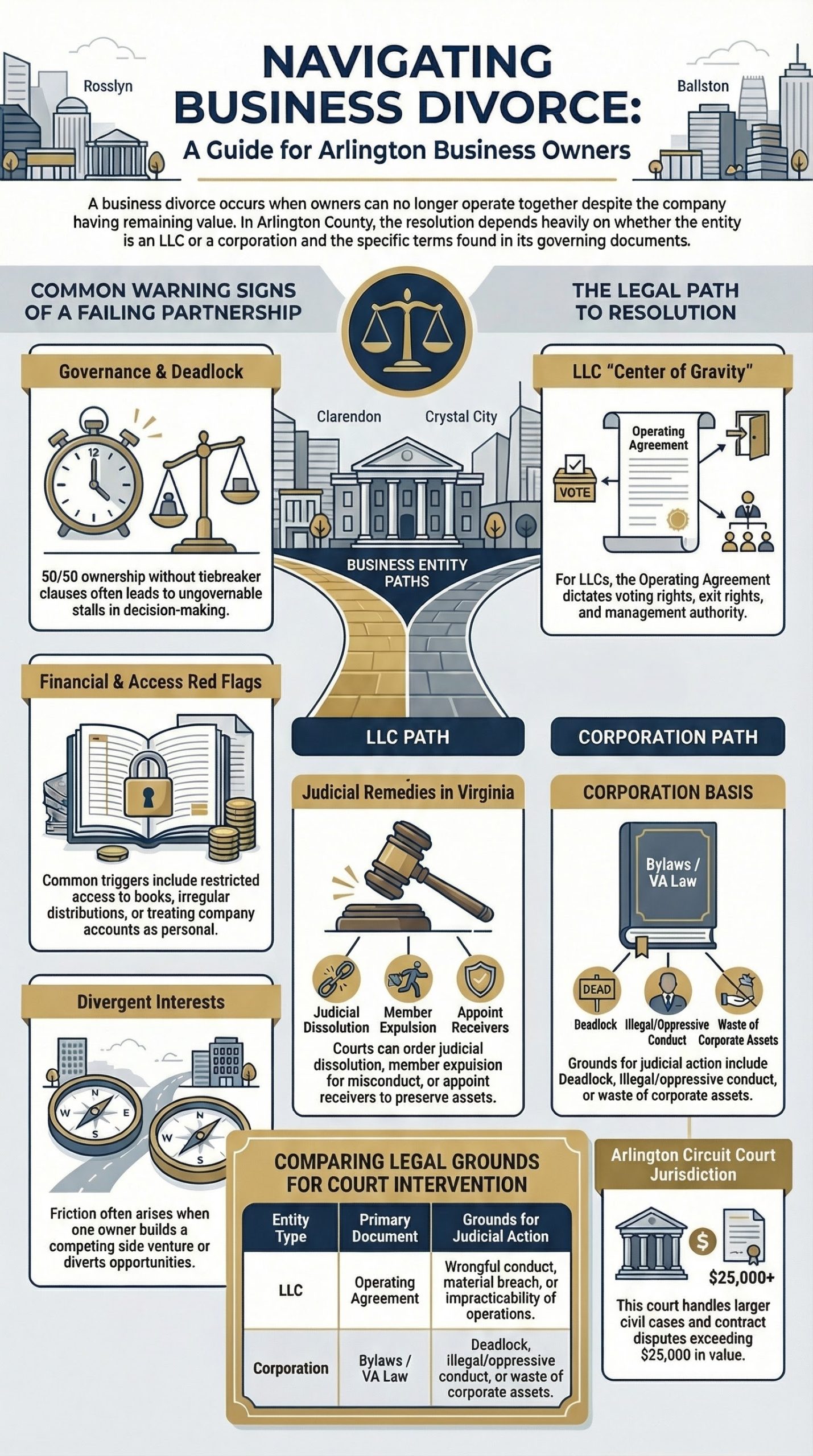
A business divorce in Arlington County occurs when owners can no longer run the company together, but the company is still alive enough that every subsequent decision matters. In Virginia, the legal path depends heavily on the business form and the governing documents. For LLCs, the operating agreement often controls the internal rules, and a circuit court may order judicial dissolution if it is not reasonably practicable to carry on the business in conformity with the articles of organization and the operating agreement. Virginia law also allows judicial expulsion of an LLC member in certain circumstances involving wrongful conduct, material breach, or conduct that makes it not reasonably practicable to continue with that member. For corporations, Virginia law provides grounds for judicial dissolution in cases involving deadlock, illegal or oppressive conduct, or misuse of corporate assets. Arlington Circuit Court handles larger civil cases and contract disputes, including civil cases above $25,000.
-
I am Anthony I. Shin, Esq. When I look at a business divorce case, I do not start with who feels betrayed. I start with structure. Who owns what. Who controls the accounts. Who has voting power. What the operating agreement says. What distributions were made. What records are missing. And whether the company can still function without court intervention.
Why business divorces happen in Arlington County
Arlington is made up of more than 60 neighborhoods and major planning corridors including Rosslyn Ballston, Columbia Pike, Richmond Highway, and Langston Boulevard. That means owner disputes can arise in consulting firms near Courthouse, restaurants in Shirlington, commercial service businesses in Crystal City, medical and professional offices near Ballston, and redevelopment or real estate ventures tied to Pentagon City, Clarendon, or Columbia Pike. The local economy creates pressure points around lease obligations, staffing, high overhead, growth decisions, investor expectations, and day to day operational control.
Most business divorces do not begin with one dramatic event. They usually build through a series of smaller fractures.
- One owner feels overworked while the other still demands equal control.
- One owner starts taking money in ways the other owner does not understand.
- One owner locks down the books, payroll access, or client records.
- One owner starts a side venture.
- One owner wants to sell while the other wants to hold.
Then the fight becomes more than a disagreement. It becomes a question of whether the company can still be governed.
Why the operating agreement or governing documents matter so much
In Virginia LLC disputes, the operating agreement is often the center of gravity. Virginia law allows members to enter into an operating agreement to regulate the affairs of the LLC, the conduct of the business, and the relations of its members, and the LLC is bound by that agreement. For many Arlington County business divorces, that document controls voting rights, capital calls, distributions, management authority, transfer restrictions, member exit rights, and what happens if an owner stops performing.
In a corporation, the analysis shifts to shareholder rights, board control, bylaws, stock restrictions, and statutory remedies. Virginia law gives courts authority in dissolution proceedings involving certain forms of deadlock, illegal or oppressive conduct, or waste or misuse of corporate assets.
That distinction matters because people often say “my partner” even when the company is actually an LLC or a corporation. The legal outcome can turn on that difference.
Scenario one: The Clarendon marketing firm with fifty fifty ownership and total deadlock
Imagine two owners running a digital marketing company in Clarendon. They started as friends. One built the client relationships. The other built the internal systems and hired the team. At first, the company worked because both were moving in the same direction.
Now the business has grown. One owner wants to expand into government contracting work. The other wants to stay lean and private. One wants to hire. The other wants to cut payroll. One wants to distribute cash. The other wants to preserve capital.
They each own fifty percent.
No tiebreaker exists.
No clean buyout clause exists.
Every major decision stalls.
This is a classic business divorce pattern. Nobody has to steal money for the company to become ungovernable. In a Virginia LLC, if it is no longer reasonably practicable to carry on the business in conformity with the governing documents, judicial dissolution may become part of the conversation.
Scenario two: The Ballston contractor who starts treating the company like a personal account
Picture a small construction or specialty trade company in Ballston or Virginia Square. Two members own the LLC. One oversees operations in the field. The other handles invoicing and banking.
Over time, the operations owner begins noticing strange reimbursements. Personal travel appears in the books. Cash withdrawals do not line up with project needs. Equipment purchases are vague. Payroll includes a relative no one has ever seen on a job site.
At first, this looks like bad recordkeeping.
Then the bank statements and bookkeeping records start telling a different story.
A business divorce case often starts right there. Not with a public blowup, but with the moment one owner realizes the other may be using company money as if it were personal money. Depending on the structure and facts, the case may involve contract based claims, fiduciary issues, corporate misuse allegations, or requests for records and injunctive relief. Virginia law specifically recognizes misuse or waste of corporate assets as a basis that can support judicial dissolution in the corporate context.
Scenario three: The Rosslyn consulting firm where one owner quietly builds a competing business
Consider two members of an Arlington consulting company based in Rosslyn. One member begins soliciting the company’s clients through a second venture. Opportunities are diverted. Proposals go out through a new entity. Employees get approached quietly. The original company starts losing momentum, but the conduct is hidden just enough that the other owner cannot immediately prove what is happening.
This is where a business divorce becomes a control and evidence case.
- Was the competing conduct barred by contract.
- Did the operating agreement address fiduciary conduct, loyalty, exclusivity, or manager obligations.
- Were company assets, client relationships, or confidential information used for personal gain.
- Did the conduct materially harm the business.
Virginia law allows judicial expulsion of an LLC member on application by the LLC or another member when the member engaged in wrongful conduct that adversely and materially affected the business, willfully or persistently committed a material breach of the articles or operating agreement, or engaged in conduct relating to the business that makes it not reasonably practicable to carry on the business with that member.
That can become a powerful issue in the right Arlington County case.
Scenario four: The Shirlington restaurant where the owners stop trusting each other
Now imagine a restaurant in Shirlington. One owner runs front of house and branding. The other handles payroll, vendor accounts, and daily finances. Sales soften. Rent pressure rises. Food costs tighten. Then finger pointing starts.
One owner says the other is hiding vendor debt.
The other says money is being spent on branding projects with no approval.
Staff loyalty splits.
Accounting access gets restricted.
When this happens, the real danger is speed. Hospitality businesses can collapse quickly once vendor relationships, payroll confidence, and owner cooperation break down. In a business divorce, the goal is not always immediate dissolution. Sometimes the first issue is preserving the company long enough to stop deeper damage. Virginia’s corporate dissolution statute expressly authorizes courts to issue injunctions, appoint a receiver or custodian pendente lite, preserve assets, and carry on the business until a full hearing can be held.
That matters because some Arlington owner disputes are not only about exit. They are about emergency stabilization.
Scenario five: The Columbia Pike real estate venture that never defined an exit path
Take a small real estate redevelopment LLC tied to Columbia Pike. The members bought property together, expecting strong growth. They agreed on the vision but never documented the exit mechanics in detail.
Years later, one member wants out.
Another member wants to refinance and hold.
A third member wants to force a sale.
- There is no valuation formula.
- No mandatory buyout process.
- No clear drag along or tag along structure.
- No defined tie breaker.
This is how a “good deal” becomes a business divorce. Virginia law gives the operating agreement enormous practical importance in LLC governance. When the agreement is incomplete, the dispute becomes more expensive because the parties are now fighting over what they thought they meant, rather than what they actually wrote.
Scenario six: The Crystal City professional practice where one owner gets frozen out
Suppose a professional services firm near Crystal City or Pentagon City has three owners. Two align. The third is pushed out of real decision making.
- The frozen out owner stops receiving meaningful financial information.
- Meetings happen without notice.
- Distributions change.
- Compensation gets recharacterized.
- Clients are told the sidelined owner is stepping back.
That owner may still hold an ownership stake but lose practical control over the company’s future.
Virginia law on dissociation is important here. A member’s dissociation does not automatically erase the membership interest. Unless otherwise provided in the articles or operating agreement, the dissociated member continues to hold the membership interest with the rights of an assignee rather than full management rights. That distinction can matter greatly in a business divorce because the person may lose governance power but still retain economic interest.
That is why these disputes need precision. People often assume exit and payout are automatic. They are not.
What business divorce usually looks like in real life
Business owners often expect one dramatic moment. In reality, Arlington County business divorces usually show up through patterns like these:
- Access to records gets tighter.
- Bank authority changes.
- Compensation becomes irregular.
- Distributions stop making sense.
- Important decisions happen outside the documented approval process.
- Staff begins receiving different instructions from different owners.
- One owner stops showing up but still demands equal economics.
- One owner starts treating the business like a private asset.
The legal label matters, but the practical question is always the same. Can the company still be run in a way that matches its governing documents and protects the owners’ rights.
What I look for first in an Arlington County business divorce
I look for five things.
- The first is the governing documents. Operating agreement, bylaws, shareholder agreement, stock restrictions, member resolutions, amendments, side letters, and buy sell language.
- The second is the ownership reality. Not just percentages on paper, but voting rights, manager authority, control of accounts, signature power, and who actually makes decisions.
- The third is the financial trail. Distributions, draws, payroll, reimbursements, loans, and transfers.
- The fourth is the information trail. Emails, texts, meeting records, accounting exports, access history, and communications with employees, clients, vendors, and investors.
- The fifth is the remedy that actually fits the facts. Sometimes that is a negotiated separation. Sometimes it is judicial dissociation. Sometimes it is dissolution. Sometimes it is injunctive relief to stop a fast moving misuse of control.
Why Arlington Circuit Court often becomes the key venue
Arlington Circuit Court handles larger civil disputes and has exclusive original jurisdiction over civil cases above $25,000. In business divorce matters, that usually means the court is the central forum once the dispute involves control of a functioning company, substantial damages, dissolution requests, or requests for injunctive relief.
That local context matters. A fight involving owners in Courthouse, Ballston, Rosslyn, Crystal City, Shirlington, or Lyon Village may feel personal and local, but the legal mechanics can become complex very quickly once the dispute reaches court.
The hard truth about business divorce
The hard truth is this. Most business divorces do not happen because the business failed. They happen because the relationship failed while the business still had value.
That is what makes them dangerous.
If the company were already dead, the fight would be easier.
But when the company still has revenue, employees, goodwill, leases, receivables, and future opportunity, every week of delay can deepen the damage.
- One owner tries to preserve value.
- Another owner tries to preserve control.
- A third may simply want out.
That is when the operating agreement, the money trail, and the legal structure start deciding everything.
My view for Arlington County business owners
If you own a business in Arlington County and you can already see the signs, do not wait for total collapse. Business divorce cases get harder when owners keep trying informal workarounds after trust is already gone. The longer the conflict sits, the more likely it is that records disappear, staff factions harden, clients get pulled into the mess, and the company’s value drops before the legal issues are even framed correctly.
In places like Rosslyn, Clarendon, Ballston, Courthouse, Pentagon City, Crystal City, Columbia Pike, Shirlington, Aurora Highlands, and Lyon Village, the businesses may look different on the outside. But the owner breakup pattern is usually the same. Money, control, records, and authority stop lining up.
When that happens, the right move is not denial. It is structure.
Do not let an owner dispute quietly destroy the company you built. If your Arlington County business is facing deadlock, misuse of funds, frozen out ownership, or a breakdown over control, speak with Anthony I. Shin, Esq. at Shin Law Office.

Principal Attorney | Civil Litigation | Shin Law Office
Call 571-445-6565 or book a consultation online today.
(This article is provided for general informational purposes and does not constitute legal advice. For advice on your specific situation, consult with a licensed Virginia attorney.)
Virginia LLC law allows members to regulate company affairs by operating agreement and permits judicial dissolution when it is not reasonably practicable to continue in conformity with the articles and operating agreement. Virginia corporate law separately allows judicial dissolution in certain deadlock, oppressive conduct, fraudulent conduct, or asset misuse scenarios. Arlington Circuit Court handles civil claims above $25,000, and Arlington’s official planning areas include Rosslyn, Courthouse, Clarendon, Virginia Square, Ballston, Pentagon City, Crystal City, Columbia Pike, Cherrydale, East Falls Church, Nauck, and Shirlington.
References
- Arlington County, Virginia. Neighborhoods. Arlington is comprised of more than 60 neighborhoods and includes planning corridors such as Rosslyn Ballston, Columbia Pike, Richmond Highway, and Langston Boulevard.
- Arlington County, Virginia. Planning Areas. Official planning areas include Rosslyn, Courthouse, Clarendon, Virginia Square, Ballston, Pentagon City, Crystal City, Columbia Pike, Cherrydale, East Falls Church, Nauck, and Shirlington.
- Virginia Code § 13.1 to 1023. Operating agreement. Virginia LLC members may regulate the affairs of the company and relations of its members through the operating agreement, and the LLC is bound by it.
- Virginia Code § 13.1 to 1040.1. Events causing member’s dissociation. Virginia law allows judicial expulsion of an LLC member in certain circumstances involving wrongful conduct, material breach, or conduct making continued operation with that member not reasonably practicable.
- Virginia Code § 13.1 to 1040.2. Effect of a member’s dissociation. Dissociation does not automatically eliminate the member’s economic interest unless otherwise provided by governing documents.
- Virginia Code § 13.1 to 1047. Judicial dissolution of LLCs. A circuit court may decree dissolution if it is not reasonably practicable to carry on the business in conformity with the articles and operating agreement.
- Virginia Code § 13.1 to 747. Grounds for judicial dissolution of corporations. The statute addresses deadlock, illegal or oppressive conduct, and misuse or waste of assets, and authorizes interim relief such as injunctions and receivers.
- Arlington County Circuit Court. Civil Actions and FAQs. Arlington Circuit Court has exclusive original jurisdiction over civil cases above $25,000 and handles contract and other civil matters.