
BLUF (Bottom Line Up Front)
After a car accident in Northern Virginia, what you say — or don’t say — can shape your legal rights before you even file a claim. A single apology, explanation, or early “I’m fine” text to the other driver or their insurer can be interpreted as an admission of fault and quietly undermine an otherwise valid case. Northern Virginia follows Virginia’s strict pure contributory negligence rule, meaning that if you are found even slightly at fault, you could be barred from recovering compensation at all.
In this context, the safest response after any collision isn’t oversharing; it’s disciplined silence and clear, factual documentation. Your communications should focus on safety and facts, not feelings or explanations of responsibility, so that your words aren’t used later to challenge your claim.
If you are asking questions like these, this article is written for you:
• What should I text (or not text) after a car accident in Northern Virginia?
• Why can a friendly apology harm my legal claim?
• How does Virginia’s fault rule affect what I say after a crash?
• Should I communicate with insurers before talking to a lawyer?
• What’s the safest way to document the accident on my phone?
This guide walks you through what to say and what to avoid saying to protect your rights after a crash, how Virginia’s contributory negligence rule influences every word you send, and best practices for handling post-accident communication before the legal story is written for you.
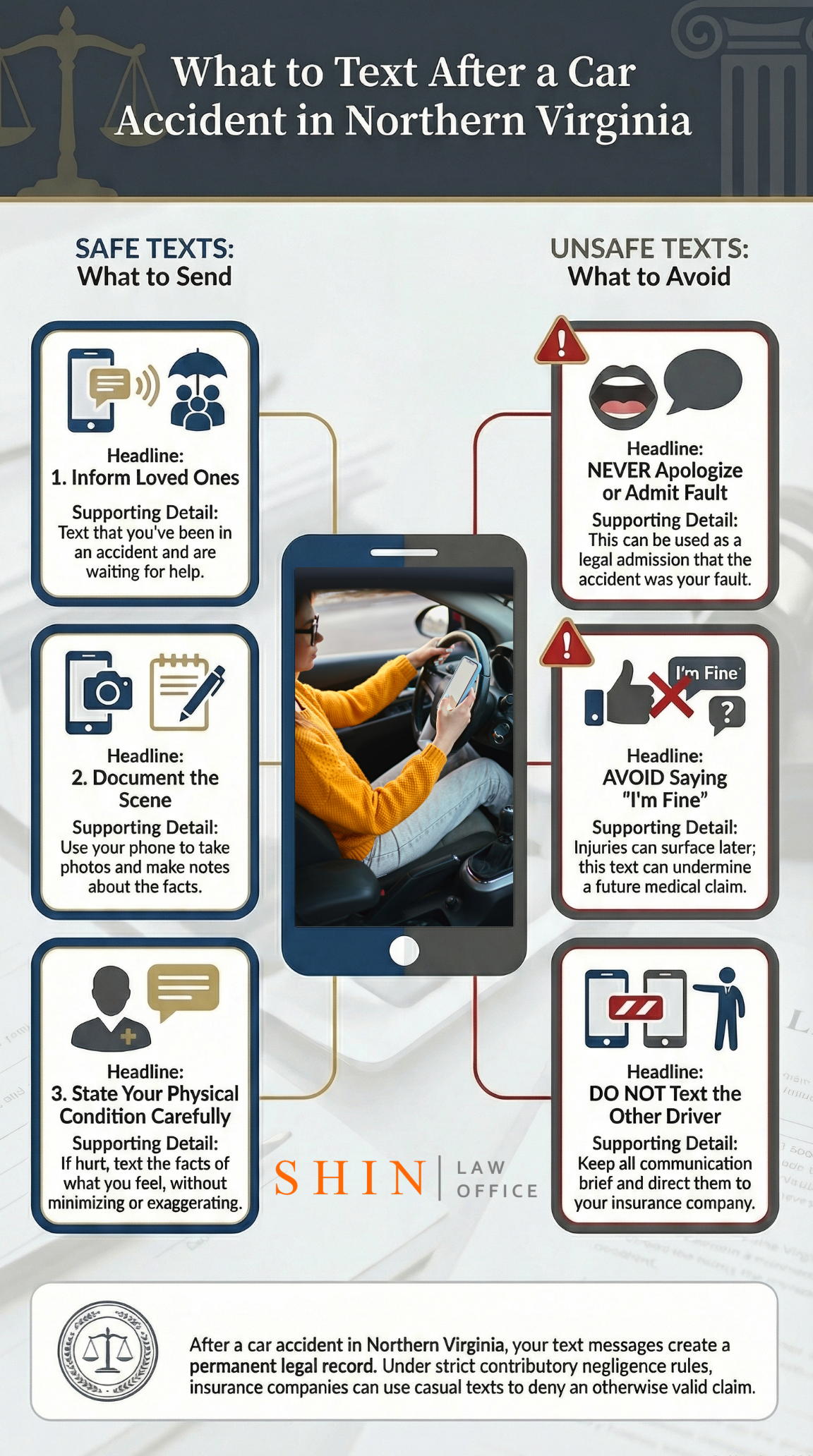
Table of Contents
- Why Your Text Messages Matter After a Vehicle Accident
- The First Rule After an Accident: Text Safety Not Blame
- Texts You Should Send Immediately After the Accident
- What to Text If You Are Hurt
- How to Preserve Evidence Using Your Phone
- Texts You Should Never Send After an Accident
- If the Other Driver Texts You
- Smart Follow Up Texts Later That Day
- The Three Rules to Remember
- What to Do Next
Chapter 1
Why Your Text Messages Matter After a Vehicle Accident in Northern Virginia
I practice law in Northern Virginia. I see accidents every day on Route 50, I-66, I-495, the Dulles Toll Road, Route 7, and the local arteries that cut through Fairfax, Loudoun, Arlington, and Prince William Counties. What surprises most people is not how often crashes happen here. It is how often the real damage begins after the vehicles stop moving.
In this region, your phone becomes part of the accident scene almost immediately. Northern Virginia drivers are used to moving fast. We text quickly. We respond quickly. We try to smooth things over quickly. After a crash, that instinct can quietly cost you your case.
The first thing many people do after an accident is send a message to someone they trust. A spouse. A coworker. A friend. Sometimes the other driver. Those messages feel private. They are not.
In Fairfax, Loudoun, Arlington, and Prince William, insurance companies routinely request text messages during claims investigations. Defense attorneys subpoena them during litigation. Judges allow them into evidence. They are timestamped, preserved, and read word-for-word without context, stress, or tone.
I have watched strong Northern Virginia injury cases unravel because of a single early text. I have seen liability disputes turn on two words typed at a stoplight. I have seen clients lose leverage because they said “I’m fine” while adrenaline was still masking pain.
Text messages are treated as admissions because they are written by you, in your own words, close in time to the event. Courts consider them reliable for that very reason.
Northern Virginia is also unforgiving when it comes to fault. Virginia’s contributory negligence rules mean that even a small suggestion of responsibility can bar recovery entirely. A casual apology. A rushed explanation. A message saying “I didn’t see them.” These are not harmless statements here. They are legal liabilities.
Another reality of this region is the speed of response. Claims move quickly. Adjusters know the local courts. Defense counsel knows how judges in Fairfax and Loudoun evaluate early statements. They look for inconsistencies. They look for minimization. They look for anything that shifts responsibility away from their insured. Your early texts give them a head start.
After a collision, you do not yet know the whole story. You do not know what witnesses saw at a busy Arlington intersection. You do not know what traffic cameras captured in Tysons or Reston. You do not know how injuries will develop overnight or over the next week. But your texts freeze a version of events before any of that is known.
That is why the goal after an accident in Northern Virginia is not to explain what happened. It is to protect yourself while facts are still forming. There is a disciplined way to communicate by text that preserves your rights. There is also a casual way that hands control of your case to someone else.
The difference is simple but critical:
- Text safety, not blame.
- Text facts, not feelings.
- Text less, not more.
In the next chapter, I will explain the most critical rule Northern Virginia drivers should follow the moment they pick up their phone after a crash.
Chapter 2
The First Rule After an Accident in Northern Virginia: Text Safety Not Blame
Northern Virginia is not a forgiving place to make casual mistakes after a car accident. Between Fairfax, Loudoun, Arlington, and Prince William Counties, insurers and defense attorneys see thousands of claims every year. They know the roads. They know the traffic patterns. And they know exactly where to look when they want to shift responsibility. They start with your words.
After a crash on I-66, the Beltway, Route 7, or a crowded Arlington intersection, most people feel an immediate urge to explain. You want to tell someone what happened. You want to clarify. You want to show you are being reasonable. That instinct is understandable. It is also dangerous here.
The first rule I give every Northern Virginia client is this: Text safety. Not blame. Safety is narrow and controlled. Blame is wide open and unpredictable.
What Texting Safety Looks Like in Northern Virginia
Texting safety means confirming that you are okay or that you are seeking medical care. It means letting people know where you are and handling practical issues like work delays or roadside assistance.
Examples of safety-focused communication include:
- “I was in an accident, and I am safe.”
- “I am getting checked by a medical professional.”
- “I may be delayed due to an accident.”
- “My vehicle is not drivable, and I need a tow.”
None of these statements explains how the accident happened. None of them assigns responsibility. None of them speculates. They preserve your options.
What Texting Blame Looks Like
Blame appears in many forms and often without intent. Apologizing feels polite. Explaining feels responsible. Speculating feels honest. In Northern Virginia, all three can destroy a claim.
Texts like “I am sorry,” “I did not see them,” “It happened so fast,” or “I should have stopped sooner” are routinely used to argue fault or contributory negligence. Even when police reports or video later tell a different story, your early words are used to undermine credibility.
Why This Rule Matters More Here
Virginia follows contributory negligence. That means if you are found even partially at fault, you may recover nothing. Insurers know this. Defense counsel relies on it. And they search for early statements that can support that argument. A single careless text can do more damage than a disputed police report.
Safety Buys You Time
Texting safety does one critical thing. It buys time. Time for adrenaline to wear off. Time for injuries to reveal themselves. Time for facts to be collected. Time for you to protect your legal rights. You are not required to solve the accident by text. You are not required to comfort others with conclusions. You are allowed to wait. In Northern Virginia, waiting is often the smartest move.
In the next chapter, I will show you the exact texts you can safely send immediately after an accident and why each one protects you rather than exposes you.
Chapter 3
Texts You Should Send Immediately After an Accident in Northern Virginia
After a crash in Northern Virginia, most people feel pressure to say something quickly. Traffic is backed up. Phones are buzzing. Work needs answers. Family is worried. Insurance requires notice. The mistake is thinking speed matters more than precision.
In Fairfax, Loudoun, Arlington, and Prince William Counties, the safest texts are not the ones that explain the accident. They are the ones that quietly document safety and logistics while avoiding any narrative about fault. There are only a few messages you should send in the immediate aftermath. Everything else can wait.
Texting a Family Member or Trusted Contact
This is usually the first message sent after an accident on a busy Northern Virginia roadway. A legally safe example is:
“I was just in a car accident. I am safe right now. I will update you once I have more information.”
This works because it does three things: It confirms safety, it avoids blame or speculation, and it acknowledges that facts are still developing. Please resist the urge to explain what happened or who caused it. Family texts are often forwarded or shared later without realizing the legal impact.
Texting Your Employer if the Accident Affects Work
Northern Virginia professionals often feel pressure to justify a delay or absence immediately. You do not need to. A safe example is:
“I was involved in a car accident this morning and may be delayed or need the day to address medical and insurance matters.”
This message is professional and sufficient. Your employer does not need details about the crash. Any explanation beyond timing increases risk without providing benefit.
Texting Your Insurance Company for Initial Notice
Most policies require prompt notice of an accident. That does not mean a full statement by text. A safe example is:
“I was involved in a motor vehicle accident today at [general location]. No further details at this time. Please confirm next steps.”
This creates a timestamped record of notice. It does not lock you into a version of events before you have medical information or evidence. If an adjuster pushes for details by text, it is appropriate to wait or request to speak later.
Texting Roadside Assistance or a Tow Provider
This is purely functional and safe when done correctly. A safe example is:
“I need roadside assistance at [exact location]. Vehicle was involved in an accident and is not drivable.”
Stick to location and vehicle condition only. There is no benefit to explaining what happened or who caused it.
Why These Texts Matter in Northern Virginia
These messages all share the same structure:
- They are factual.
- They are limited.
- They are necessary.
- They do not include apologies.
- They do not include conclusions.
- They do not include emotional reactions.
In Northern Virginia, precision matters. Claims are analyzed quickly. Early statements are scrutinized. The fewer unnecessary words you provide, the less there is to attack. You are not being evasive. You are being careful.
In the next chapter, I will explain how to text if you are hurt and why the specific language you use about injuries carries real consequences in Northern Virginia cases.
Chapter 4
What to Text If You Are Hurt: Why Injury Language Matters in Northern Virginia
In Northern Virginia, what you say about your injuries in the hours after an accident can shape your case long before you ever step into a courtroom. Fairfax, Loudoun, Arlington, and Prince William Counties move fast. Insurance carriers know the local courts. Defense attorneys know how judges view early injury statements. And almost every serious case I handle starts with one question: What did you say right after the crash?
Pain after an accident is rarely immediate. Adrenaline masks symptoms. Shock delays awareness. Soft tissue injuries, concussions, and spinal trauma often show up hours or days later. Yet people routinely send texts that undercut their own claims before they ever see a doctor. The most common mistake is simple. They say they are fine.
In Northern Virginia injury cases, an early “I’m fine” text is one of the first exhibits defense counsel will use. It does not matter that you later went to urgent care. It does not matter that imaging showed injury. That early message becomes the anchor point they argue everything else against. This does not mean you should exaggerate or diagnose yourself. It means you should be accurate and cautious.
What a Safe Injury Text Looks Like
If you are experiencing pain, discomfort, dizziness, or anything out of the ordinary, the safest approach is neutral documentation. A safe example to a family member or trusted contact is:
“I was in an accident and I am experiencing pain. I am getting checked by a medical professional.”
This sentence matters because it documents symptoms without labels, avoids minimizing your condition, and confirms you are seeking care. You are not claiming a diagnosis. You are not predicting outcomes. You are simply stating what you know at that moment.
Why This Matters in Northern Virginia Courts
Judges in Fairfax Circuit Court and Loudoun Circuit Court see accident cases constantly. They understand delayed onset injuries. Insurance companies do as well. What they look for is consistency. When early texts say “I’m fine” and later records show treatment, insurers argue exaggeration. When early texts say “I’m hurt” without specifics and medical records follow, the narrative aligns. Consistency builds credibility.
What Not to Say About Injuries
Avoid these phrases entirely:
- “I’m fine”
- “It’s nothing”
- “Just sore”
- “I don’t need a doctor”
- “I’ll be okay”
You do not gain toughness points in a legal case. You only create doubt.
Texting Does Not Replace Medical Records
One important point I emphasize to clients in Northern Virginia is this: Texts support medical records. They do not replace them. If you believe you are hurt, seek evaluation. Urgent care visits, emergency room records, and follow up appointments matter far more than any message on your phone. But careless texts can still be used to question those records later. Your phone should help document reality, not erase it.
In the next chapter, I will show you how to use your phone to preserve evidence safely and why contemporaneous notes carry real weight in Northern Virginia accident claims.
Chapter 5
How to Preserve Evidence Using Your Phone: Why Contemporaneous Notes Matter in Northern Virginia
In Northern Virginia accident cases, evidence does not disappear because it was never created. It disappears because people forget to document it while it is fresh. Memories fade quickly after a crash. Stress scrambles timelines. Details blur. What felt obvious at the scene becomes uncertain days later. That is why one of the smartest things you can do after an accident is not texting someone else at all. It is texting yourself.
I routinely rely on contemporaneous notes in Fairfax, Loudoun, Arlington, and Prince William cases. Judges trust them. Adjusters analyze them. They matter because they are created before litigation, before lawyers, and before narratives harden.
Why Timing Matters
A note written minutes or hours after an accident carries more weight than one written weeks later. It reflects what you observed before outside influence. Defense attorneys know this. So do insurance companies. That is why early notes can quietly strengthen your position even when no one else sees them at the time.
What to Text or Record for Yourself
Use your notes app, messages app, or email draft. The format does not matter. What matters is content and timing. A strong example looks like this:
“Accident at 8:15 am at Route 50 and Fair Oaks Parkway. Weather clear. Traffic moderate. Other vehicle blue SUV. Police called. Photos taken. Felt shaken.”
This kind of note locks in time and place, records conditions, identifies the other vehicle, confirms police involvement, and captures your physical state without diagnosis. You are not assigning fault. You are preserving facts.
Photos and Videos Are Part of the Record
Northern Virginia roadways are dense with traffic cameras, but private photos still matter. Take photos of:
- Vehicle positions
- Damage from multiple angles
- Skid marks
- Traffic signals
- Road conditions
- Visible injuries
If police respond, photograph badge numbers and patrol cars if possible. Fairfax County and Loudoun County officers are professional and thorough, but your own record adds protection.
Why This Helps Later
When a claim develops months later, contemporaneous notes help answer critical questions: Where exactly did it happen? What was the weather? What did the vehicles look like? How soon did symptoms appear? These details become anchors when testimony is challenged. I have seen cases where a single early note clarified inconsistencies and preserved credibility. I have also seen cases where the absence of any early record allowed insurers to reshape the story.
What Not to Record
Do not speculate. Do not blame yourself or anyone else. Do not write conclusions. Your notes should read like observations, not opinions. Think like a camera, not a narrator.
In the next chapter, I will explain the texts you should never send after an accident and why certain phrases are especially dangerous in Northern Virginia claims.
Chapter 6
Texts You Should Never Send After an Accident: Why Certain Words Are Especially Dangerous in Northern Virginia
Some texts do more damage than silence ever could. In Northern Virginia accident cases, I often see claims weakened not by the facts of the crash but by a handful of words typed under stress. These messages feel harmless. Some even feel polite or responsible. Legally, they are landmines. Once sent, they become evidence. They are read without tone. They are interpreted aggressively. And they are almost impossible to explain away later.
Here are the categories of texts you should never send after an accident.
Apologies
Never text “I’m sorry.” In everyday life, this phrase expresses empathy. In a legal context, it is often framed as an admission. Insurance companies in Fairfax, Loudoun, Arlington, and Prince William regularly argue that an apology equals responsibility. Even if Virginia law distinguishes fault from courtesy in theory, in practice that text will be used against you. You can care about someone without apologizing by text. Silence is safer.
Admissions or Self-Blame
Never text phrases like:
- “It was my fault”
- “I didn’t see them”
- “I should have stopped sooner”
You are not a crash reconstruction expert. You do not yet have all the evidence. And once you label yourself as responsible, it becomes extraordinarily difficult to undo. In Virginia, contributory negligence rules are strict. A single admission can be enough to destroy an otherwise valid claim.
Minimizing Your Condition
Never text “I’m fine,” “It’s nothing,” or “Just sore.” These messages are often sent to reassure loved ones. In litigation, they are used to question injury severity and credibility. Northern Virginia defense counsel routinely introduces early texts to argue that injuries are exaggerated or unrelated. Do not give them that tool.
Speculation About What Happened
Never text guesses or theories like “I think they ran the light,” “Maybe I drifted,” or “It all happened so fast.” Speculation locks you into a version of events before evidence is collected. When police reports, witness statements, or video footage differ, your own words are used to impeach you.
Emotional or Angry Messages
Do not vent by text. Anger reads poorly on paper. Aggressive messages can be used to portray you as reckless or unreasonable. Even private messages can be subpoenaed in Northern Virginia courts. Assume anything written may eventually be read aloud in a courtroom.
Why These Texts Are So Dangerous Here
Northern Virginia courts move efficiently. Judges expect clean records. Insurance carriers are sophisticated. They look for early inconsistencies and damaging language. You do not lose cases because you were honest. You lose them because you were imprecise at the wrong moment. Precision protects you.
In the next chapter, I will explain how to respond if the other driver texts you and how to shut down risky communication without escalating the situation.
Chapter 7
If the Other Driver Texts You: How to Shut Down Risky Communication in Northern Virginia
In Northern Virginia, it is increasingly common for the other driver to reach out by text after an accident. Sometimes it happens minutes later. Sometimes it happens later that day. The message may sound friendly, apologetic, or even cooperative. Do not be fooled by tone.
Once the accident occurs, the other driver is not just another person involved. They are a potential opposing party. Their messages may be forwarded to their insurance company. They may be preserved intentionally. They may be written with advice from someone else. Your goal is not to engage. Your goal is to stop the conversation safely.
Why Responding Feels Tempting
People respond because silence feels rude. They want to be reasonable. They want to clear things up. But every back-and-forth creates risk. Arguments escalate. Details creep in. Inconsistencies appear. What starts as a polite exchange can quickly turn into evidence used against you in Fairfax, Loudoun, Arlington, or Prince William courts.
The Only Safe Response
There is one response I consistently recommend and it works:
“Let’s allow insurance to handle communication. Please contact your insurer.”
That is it. This response ends the conversation, avoids facts, blame, or emotion, and directs communication to the proper channel. You do not owe the other driver explanations. You do not owe them updates. You do not owe them closure.
What Not to Do
Do not argue. Do not correct their version of events. Do not agree with their account. Do not apologize. Do not explain injuries or damage. Even if they are wrong, correcting them by text only locks you into a competing narrative.
If They Keep Texting
If the other driver continues to message you after you have directed them to insurance, stop responding. Repeated messages can be addressed later through insurers or counsel if necessary. Continuing to engage only benefits the other side.
Why This Matters in Northern Virginia
Virginia’s contributory negligence rules are unforgiving. Any statement that can be framed as partial fault can eliminate recovery. Defense attorneys know this. They analyze early communications carefully. Your restraint can be the difference between leverage and loss. Silence after a clear boundary is not rude. It is smart.
In the next chapter, I will cover safe follow up texts later in the day and how to communicate recovery and logistics without reopening legal risk.
Chapter 8
Smart Follow Up Texts Later That Day: How to Update Without Creating Risk in Northern Virginia
By the end of the day, the shock of the accident starts to wear off. You may be home. You may have seen a doctor. People will check in. Insurance may request coordination. This is where many people relax and unknowingly undo the discipline they showed earlier. Follow up texts still matter.
What you say later the same day can be just as important as what you said at the scene, especially in Northern Virginia where insurers scrutinize timelines closely.
Updating Family or Trusted Contacts
Family members want reassurance. They also tend to share information casually. Keep your updates factual and measured. A safe example is:
“I’m home now. Still sore. Doctor recommended follow up. Thanks for checking in.”
This update does not minimize or dramatize the symptoms and shows ongoing care. Avoid statements like “I’m okay now,” “Nothing serious,” or “I think I’ll be fine.” Recovery is not a conclusion you can reach on day one.
Coordinating With Insurance if Requested
If your insurer follows up later that day to coordinate logistics, you can respond without giving a statement. A safe example is:
“I’m available to coordinate repairs and medical evaluation.”
This keeps the door open without locking you into details. If a formal statement is requested, it is reasonable to schedule it for a later time. You are allowed to be deliberate.
Why Follow Up Language Matters Here
In Northern Virginia cases, defense counsel often lines up early texts in chronological order. They look for shifts in tone. If your early messages indicate pain but later texts suddenly declare you fine, insurers argue recovery occurred immediately. That argument is then used to challenge medical treatment that follows. Consistency protects credibility.
Do Not Treat Texts as a Diary
Text messages are not the place to process emotions or pain levels in detail. Save that for medical providers. Their records carry legal weight. Your texts should simply reflect that care is ongoing.
The Big Picture
Smart follow up texts do one thing well. They maintain the same discipline you showed earlier. No blame. No conclusions. No speculation. Just facts and logistics.
In the final chapter, I will give you a simple framework to remember under stress and explain what to do next if you want state specific guidance or additional resources.
Chapter 9
The Three Rules to Remember: A Simple Framework for Northern Virginia Drivers
When an accident happens, stress takes over. You will not remember statutes. You will not remember legal nuance. What you need is something simple enough to hold onto when your phone is already in your hand. This is the framework I want every Northern Virginia driver to remember.
Rule One: Text Facts Not Feelings
Facts are things a camera could capture: Location, time, weather, vehicle condition, whether police were called. Feelings are reactions: Fear, anger, guilt, relief. Feelings change. Facts do not. Insurance companies and courts in Fairfax, Loudoun, Arlington, and Prince William rely on facts. Feelings only create confusion and risk.
Rule Two: Text Safety Not Blame
Safety is about your condition and logistics: You are safe, seeking medical care, need roadside assistance, or may be delayed. Blame is every explanation about why the accident happened. Even if you believe you know what went wrong, that belief is not evidence. Texting blame hands control of your case to someone else before all information exists.
Rule Three: Text Less Not More
Every additional sentence increases exposure. Silence is not suspicious. Waiting is not dishonest. Saying less is often the smartest move. You are not required to narrate the accident by text. You are not required to respond immediately to every message. You are allowed to pause.
Why This Framework Works in Northern Virginia
Northern Virginia is a high traffic, high litigation region. Insurers operate aggressively here. Defense counsel is experienced. Judges expect clarity. This framework keeps your record clean. Clean records are hard to attack.
What to Do Next
If you want more protection or clarity, there are smart next steps. A printable post accident checklist you can keep in your car, state specific texting guidance for Virginia, guidance on what to text if police do or did not respond, or a legally safe version tailored to Maryland or North Carolina. These tools exist for one reason: To keep a moment of stress from becoming a long term problem. If you want any of them, just say the word.

Principal Attorney | Shin Law Office
Call 571-445-6565 or book a consultation online today.
Personal Injury Attorney | Vehicle Accidents for Northern Virginia
Frequently Asked Questions
1. Can my text messages really be used against me after a car accident in Northern Virginia?
Yes. Insurance companies commonly request text messages and can be subpoenaed in Fairfax, Loudoun, Arlington, and Prince William cases.
2. Why are early texts after an accident so important?
Early texts are timestamped and written close in time to the crash, which makes them powerful evidence even if they were sent casually.
3. Is it okay to text “I am sorry” after a crash?
No. In Northern Virginia, an apology can be argued as an admission of fault under contributory negligence rules.
4. What is the safest first text to send after an accident?
A short safety message such as “I was in an accident and I am safe right now.”
5. Should I explain what happened by text to family or friends?
No. Explanations can be shared, forwarded, or misunderstood and later used against you.
6. Can saying “I am fine” hurt my injury claim?
Yes. Many injuries appear later and early statements minimizing pain are often used to challenge medical treatment.
7. What should I text if I am feeling pain after the accident?
Use neutral language such as “I am experiencing pain and I am getting checked by a medical professional.”
8. Should I text the other driver after the accident?
No. Communication should be handled through insurance to avoid blame or arguments in writing.
9. What if the other driver texts me first?
Send one response directing them to insurance and do not engage further.
10. Should I text my insurance company details about the crash?
No. Provide notice only and ask for next steps without describing fault or events.
11. Can my casual texts really affect fault in Virginia?
Yes. Virginia contributory negligence rules mean even small admissions can bar recovery.
12. Is texting my employer about the accident safe?
Yes, if you keep it limited to timing and logistics without explaining the crash.
13. Should I text about road conditions or traffic signals?
Avoid conclusions. Record facts privately and let evidence support your claim.
14. Can family texts be subpoenaed in a Northern Virginia case?
Yes. Texts to anyone can become discoverable in litigation.
15. Should I delete texts after an accident?
No. Deleting messages can create serious legal problems.
16. Is it better to write notes to myself instead of texting others?
Yes. Notes preserve facts without exposing you to unnecessary communication risks.
17. What should my accident notes include?
Time, location, weather, vehicle descriptions, police involvement, and photos taken.
18. Can group chats or jokes hurt my case?
Yes. Casual language can be misinterpreted and used to undermine credibility.
19. Should I post about my accident on social media?
No. Social posts are often used by insurers to challenge injury claims.
20. What if I already sent a bad text after the crash?
Stop texting about the accident and seek legal guidance. Do not try to fix it with more messages.
21. Is it okay to text that the accident was minor?
No. Labels like minor are often used later to downplay injuries.
22. Can emojis or tone in texts be used against me?
Yes. Emojis and casual tone can be misinterpreted without context.
23. Should I text witnesses about what they saw?
No. Get contact information and let insurance or counsel handle witness communication.
24. Does this advice apply across Northern Virginia?
Yes. The same principles apply in Fairfax, Loudoun, Arlington, and Prince William Counties.
25. What is the safest rule to remember after an accident?
Text safety not blame and text less not more.
Disclaimer:The information provided in this article is for educational purposes only and does not constitute legal advice. Every case is unique. If you believe you have a claim, contact a qualified attorney immediately to discuss the specifics of your situation and the applicable statutes of limitation.