
Bottom Line Up Front (BLUF)
Going through a divorce or separation in Virginia, whether in Loudoun, Fairfax, Prince William, Arlington, Clarke, or Frederick County, can be one of the most challenging experiences in life. As an experienced family law attorney, I understand how stressful this process can be, and I’m here to provide compassionate guidance. In Virginia, the basics of divorce and separation are the same statewide, but I will explain key concepts such as contested vs. uncontested divorces, fault vs. no-fault grounds, and the role of separation agreements. I’ll also highlight any local procedures or considerations in each county, and discuss recent legal developments that could affect your case. My goal is to inform and reassure you so that, when you’re ready, you can move forward confidently with a solid understanding of the road ahead.
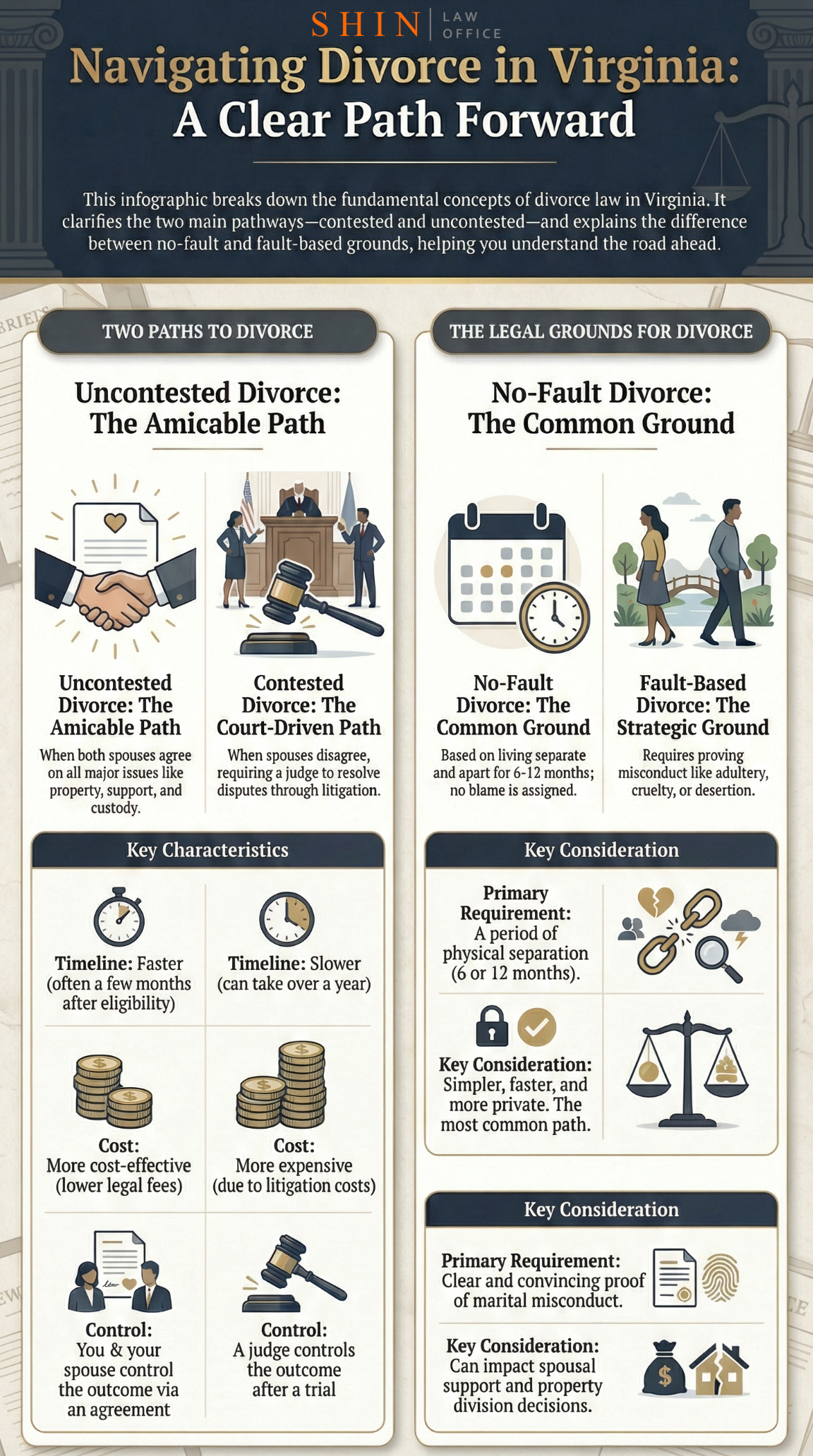
Table of Contents
- Chapter 1: Introduction: Guidance
- Chapter 2: Contested vs. Uncontested Divorce
- Chapter 3: Fault-Based vs. No-Fault Divorce
- Chapter 4: Legal Separation and Agreements
- Chapter 5: Divorce in Loudoun County
- Chapter 6: Divorce in Fairfax County
- Chapter 7: Divorce in Prince William County
- Chapter 8: Divorce in Arlington County
- Chapter 9: Divorce in Clarke County
- Chapter 10: Divorce in Frederick County
- Conclusion
- References
Chapter 1: Introduction: Guidance Through Divorce and Separation
Hello, I’m Anthony I. Shin, Esq., a family law attorney practicing in Northern Virginia. Divorce and separation issues form the foundation of my law practice – they are among the most common and important matters I help clients navigate. In fact, thousands of Virginia couples file for divorce every year, and Virginia’s divorce rate remains above the national average. If you are considering a divorce in Loudoun, Fairfax, Prince William, Arlington, Clarke, or Frederick County, you are not alone, and help is available.
Divorce is often described as one of the most stressful life events a person can go through. Beyond the emotional turmoil, it involves numerous legal components – from dividing property to determining child custody and support. The good news is that Virginia’s laws provide a clear framework for these issues, and with knowledgeable counsel, you can work toward a fair resolution. In this guide, I will walk you through the key concepts of Virginia divorce law in plain English. We’ll cover the differences between contested and uncontested divorces, the fault-based grounds versus no-fault divorce, and how separation agreements work.
Each family’s situation is unique. Some spouses can reach an amicable agreement on their own terms (resulting in an uncontested, no-fault divorce), while others face disputes that must be resolved in court (a contested divorce). Whatever your circumstances, my role is to advocate for your interests while providing compassionate, steady guidance. I firmly believe in empowering my clients with information. That’s why, in addition to explaining Virginia law, I will also highlight local practices in each of the counties I serve. Each jurisdiction can have its own procedural quirks or timelines – having handled cases across Northern Virginia, I’m familiar with what to expect in each court.
It’s also important to stay up-to-date on legal developments. Family law is continually evolving. For example, in recent years, Virginia made it easier to get a no-fault divorce by eliminating the old requirement for a corroborating witness. Legislators have even proposed allowing quicker divorces in certain fault cases like cruelty or abandonment, reflecting a trend toward streamlining the process. I’ll touch on these changes where relevant, as well as trends such as the rise in “gray divorces” (among couples over 60) and the seasonal spike in divorce filings early in the year (often right after the holidays). While these trends don’t determine the outcome of any individual case, they show that divorce is a common reality and that the law adapts over time.
Above all, I want you to know that you don’t have to face this alone. My firm is dedicated to providing compassionate legal guidance. That means I will listen to your goals and concerns, explain your rights under Virginia law, and help craft a strategy tailored to your situation – whether that means negotiating a fair separation agreement or aggressively representing you in court. With the right approach and support, you can get through this difficult time and lay the foundation for a better future.
Now, let’s start by breaking down some fundamental concepts of Virginia divorce law. Understanding these basics will give you clarity and confidence as we then explore how the divorce process works in each of our local jurisdictions.
Chapter 2: Contested vs. Uncontested Divorce: Which Path Fits Your Situation?
One of the first things we’ll determine is whether your divorce will be contested or uncontested. In simplest terms, an uncontested divorce means both spouses agree on all major issues, whereas a contested divorce means there are disputes that require court intervention. This distinction is crucial because it affects the timeline, cost, and stress level of the process.
Uncontested Divorce: In Virginia, pursuing a divorce on no-fault separation grounds typically leads to what we call an uncontested divorce. To qualify, the spouses must live separate and apart without cohabitation for the required period (usually one year, or six months if there are no minor children and a written settlement agreement in place). During that separation time, the parties need to resolve all issues between them – such as how to divide marital property and debts, whether any spousal support is needed, and if children are involved, how custody, visitation, and child support will be handled. These terms are typically recorded in a separation agreement (more on those in Chapter 4).
If everything is agreed, the divorce can proceed without a trial. In fact, no court appearance is required for an uncontested divorce in Virginia. Instead, once the paperwork (including the separation agreement and other required documents) is filed and the waiting period is satisfied, the court can finalize the divorce relatively quickly. Often this involves submitting affidavits or deposition testimony to prove the grounds for divorce, rather than a live hearing. The final step is getting a Final Decree of Divorce signed by a judge, which incorporates the spouses’ agreement and officially dissolves the marriage.
The advantages of an uncontested divorce are significant. It is usually faster – sometimes just a few months once you’re eligible to file – whereas contested cases can drag on over a year or more. It’s also more cost-effective; by avoiding extensive litigation, you save on attorney fees and court costs. Perhaps most importantly, you and your spouse retain control over the outcome. You craft the settlement that works for your family, rather than having a judge decide for you. As a family law attorney, I always advise clients that if an amicable agreement is possible, it’s usually in everyone’s best interest to pursue it. I can help by negotiating fair terms and ensuring your agreement is comprehensive and legally sound, so that you truly have an uncontested case.
Contested Divorce: If the spouses cannot agree on one or more key issues, the divorce becomes contested. This means the court will need to step in to resolve the disputed matters. In Virginia, contested divorces often involve one of the fault-based grounds (which we’ll discuss in the next chapter), but you can have a contested divorce even on no-fault grounds if you simply disagree about terms like finances or custody.
Contested divorces usually take longer and require multiple steps in the court system. After the divorce Complaint is filed and the other spouse responds, the case enters the litigation phase. This may include pendente lite hearings (temporary orders) to resolve pressing issues, such as temporary child support or spousal support, while the case is ongoing. Both sides engage in discovery, exchanging financial documents and information about any contested issues. There may be settlement conferences or mediation attempts along the way, but if disputes remain unresolved, a trial will ultimately be held, where each side can present evidence and witnesses to a judge.
Contested divorce trials in Virginia can last anywhere from a day to several days, depending on the complexity of the issues. For example, a case involving child custody, multiple properties, and spousal support will naturally require more court time than a simpler case. In some jurisdictions (like Fairfax County), the court might even split the trial into two parts – addressing child custody and visitation first, then holding a separate hearing about equitable distribution of property and support issues a few weeks later. In other courts (such as Loudoun County), all issues are heard together in a single trial. I’ll discuss these local practices in the county-specific chapters.
Because contested divorces involve formal court proceedings, they can feel intimidating. Rest assured, I will guide you through each step. My role is to advocate for your position – whether that’s fighting for a fair share of assets, seeking appropriate support, or protecting your relationship with your children. We will prepare evidence, file motions, and make legal arguments as needed to present a strong case. Keep in mind that even contested cases often settle before reaching the final trial, especially if we can demonstrate to the other side that our case is solid. However, if a trial is necessary, I am fully prepared to litigate aggressively on your behalf.
In summary, an uncontested divorce is typically the preferred route if attainable, it’s quicker, cheaper, and more private (since you avoid airing grievances in a public courtroom). But if your spouse isn’t cooperating or if serious disagreements exist, a contested divorce may be unavoidable. In those situations, having an experienced attorney is critical to protecting your rights and navigating the complex court process efficiently.
Chapter 3: Fault-Based Divorce vs. No-Fault Divorce – Understanding Grounds for Divorce
Virginia allows two broad categories of divorce: fault-based and no-fault. The “grounds” (legal reasons) for divorce determine which category a case falls into. Let’s unpack what each means and why it matters.
No-Fault Divorce: Most divorces in Virginia today are no-fault, meaning neither spouse has to prove the other did something wrong to end the marriage. The sole ground for a no-fault divorce is that the spouses have lived separate and apart, without cohabitation, for the required time period (again, one year in most cases, or six months if no minor children and a settlement agreement). This ground is established by evidence of the separation – typically, the spouses testify or provide affidavits confirming the date they separated and that they have remained apart since then.
No-fault divorces became part of Virginia law in the 1960s, reflecting a shift to allow couples to end a marriage by mutual agreement without assigning blame. An important practical note: even in a no-fault case, Virginia (until recently) required a corroborating witness to verify the separation and other basic facts of the divorce. This was an old rule meant to prevent collusion. However, effective July 1, 2021, that requirement was dropped for no-fault divorces. This means you and your spouse can obtain an uncontested no-fault divorce by submitting signed affidavits, without needing a third-party witness to sign an affidavit or testify. This legal update has made the no-fault divorce process simpler and faster for Virginia families.
Fault-Based Divorce: Virginia also recognizes several fault grounds for divorce, which require proof of marital misconduct. The fault grounds set out in Virginia Code § 20-91 include: adultery (and other sexual infidelity such as sodomy or buggery outside the marriage); cruelty (behavior that endangers life or health, or creates an unsafe living situation); willful desertion/abandonment; and conviction of a felony with incarceration for more than one year.
Using a fault ground can allow a spouse to file for divorce without waiting the full one-year separation period (adultery and felony conviction have no required waiting period before filing, and technically, cruelty/desertion can be filed immediately, but the divorce from bed and board may be granted then merged into a final divorce after a year). For instance, if your spouse has committed adultery, you may file for divorce as soon as you have evidence of the affair – you do not have to be separated for six months or a year first. However, proving fault grounds is not easy. Adultery, for example, must be proven by “clear and convincing” evidence, which often requires convincing circumstantial evidence or even testimony from a third party, and it must be corroborated by someone other than just the spouse alleging it. There are also defenses to fault grounds; a spouse accused of adultery might argue condonation (forgiveness) if the other spouse knew of the affair but continued to cohabit, for example.
Why Fault Grounds Matter: If no-fault divorce is available, one might wonder why pursue a fault-based divorce at all? There are a few reasons. In some cases, a spouse feels strongly about holding the other accountable for bad behavior like adultery or abuse. There can also be strategic legal advantages. Notably, adultery has an impact on spousal support – under Virginia law, a spouse who is proven to have committed adultery is barred from receiving alimony (spousal support) unless denying support would cause a manifest injustice. In other words, if your spouse cheated and you can prove it, they generally cannot demand spousal support from you. This can be a powerful factor in negotiations. Fault, like cruelty or desertion, might also sway a judge’s decisions on equitable distribution of property or debt if the misconduct had a financial impact or was egregious – Virginia law permits consideration of each party’s contributions to the marriage and the cause of the divorce when dividing assets.
However, proceeding on fault grounds can also have downsides. It tends to increase the acrimony and complexity of the case. More evidence must be gathered, and sensitive personal issues must be aired in court. For example, proving adultery may require hiring a private investigator or subpoenaing records, which is costly and invasive. For this reason, many spouses ultimately opt to proceed on no-fault grounds, even if some fault occurred, especially when negotiating a settlement. In fact, it’s common to file for divorce, citing both fault and no-fault as alternative grounds to preserve options, and then finalize the divorce on no-fault grounds if a settlement is reached (this avoids the need to prove fault in court).
It’s worth mentioning that Virginia has a concept of “divorce from bed and board” (a mensa et thoro), which is a partial or qualified divorce based on fault. This is essentially a legal separation – the spouses remain married in name (cannot remarry), but the court can order a separation and address support and property issues. Grounds for a bed-and-board divorce include cruelty or desertion. After a year of separation, a bed-and-board divorce can be “merged” into a final divorce (divorce a vinculo matrimonii). In modern practice, few people pursue this route except in certain circumstances (perhaps for religious reasons or to maintain insurance benefits while separated). Most couples either separate under a private agreement or file directly for an absolute divorce when ready.
Bottom Line: As your attorney, I will evaluate whether any fault grounds apply in your case and discuss the pros and cons with you. If you have strong evidence of wrongdoing and it could affect the outcome (for instance, adultery affecting spousal support or dissipation of assets, or domestic abuse affecting child custody), it may be worth raising those issues. On the other hand, if fault will be difficult to prove or won’t substantially change the outcome, we may decide to focus on a no-fault approach to streamline the process. In all cases, the end goal is to secure a favorable outcome for you – whether through negotiated agreement or court judgment – so we’ll use the strategy that best advances that goal.
Chapter 4: Legal Separation and Separation Agreements in Virginia
When clients first come in, they often ask about “legal separation.” It’s a term that can be a bit confusing in Virginia. Unlike some states, Virginia does not have a formal status called “legal separation” that you can obtain simply by filing paperwork. In Virginia, you are either married or divorced – there isn’t an intermediate court order that declares you “legally separated” (except the limited divorce from bed and board, which, as discussed, is rarely used).
However, couples do become physically and financially separated in fact, and this separation is very important both as a groundwork for divorce and for practical living arrangements. You do not need a judge’s permission to live apart from your spouse. What you typically need, though, is a clear understanding (preferably in writing) of your rights and responsibilities during this separation period. That’s where separation agreements come in.
Separation Agreements (Property Settlement Agreements): A separation agreement is a legally binding contract between spouses that settles the issues arising from their marriage and impending divorce. You might also hear these documents called Property Settlement Agreements (PSAs), Marital Settlement Agreements, or Marital Agreements. Regardless of the name, the purpose is the same: to outline how everything will be handled now that the spouses are no longer living as a married couple.
A well-drafted separation agreement typically covers:
- Property Division: Who will keep which assets and who will pay which debts? This includes homes, cars, bank accounts, retirement accounts, investments, personal property, etc. Virginia is an equitable distribution state, and your agreement can spell out a fair division that both parties accept.
- Spousal Support (Alimony): Whether one spouse will pay support to the other (and if so, how much and for how long), or whether both waive any right to support. The agreement can also set terms for modifiability.
- Child Custody and Visitation: If you have children, the agreement should detail custody arrangements – legal custody (decision-making) and physical custody (the schedule of where the child lives) – and how visitation or parenting time is shared.
- Child Support: Typically, the amount of child support is set according to Virginia’s child support guidelines (which consider both parents’ incomes, among other factors). Parents can agree to an amount at least equal to the guideline figure.
- Other Child-Related Expenses: Agreements often address who covers the child’s health insurance, how uninsured medical costs are split, payment for extracurricular activities or college, etc.
- Miscellaneous Terms: This can include how taxes will be handled (e.g., who claims the children as dependents), how to handle future disputes (mediation clauses), and provisions about life insurance, attorney fees, etc.
In Virginia, courts highly encourage separation agreements. The public policy is to allow competent adults to resolve their marital issues by contract, and such agreements will generally be honored and enforced by the courts. In fact, Virginia Code § 20-109.1 provides that a valid agreement between the parties may be affirmed, ratified, and incorporated into the final divorce decree, at which point its terms become enforceable as if they were court orders. This is exactly what happens in an uncontested divorce – the judge approves the agreement and includes its terms in the divorce judgment.
Because a separation agreement has profound consequences (affecting your finances, property, and children), it is wise to have an attorney draft it or at least review it before you sign. I frequently assist clients in negotiating and drafting these agreements. My approach is to ensure the agreement is comprehensive and clear – we don’t want ambiguities that could spark future disputes. Once signed by both parties and notarized, the agreement becomes a binding contract.
Enforcement and Avoiding Pitfalls: After a separation agreement is signed, both parties are expected to abide by it. If the agreement is incorporated into a divorce decree, a violation can be addressed by the court through contempt proceedings or other enforcement mechanisms (since it’s part of a court order). If the agreement is not incorporated (occasionally, parties choose to “survive” the decree as a separate contract), then enforcement would be through a normal contract lawsuit. Usually, incorporation is preferred for easier enforcement.
It is rare for a court to set aside or invalidate a properly executed separation agreement. Virginia courts have held that such agreements are “favored in the law” and will be enforced unless there is a very clear reason not to. That said, there are a few scenarios where an agreement could be challenged:
- Fraud or Duress: If one party was deceived about material facts or forced to sign under threat, the agreement could be voidable.
- Unconscionability: This means the agreement is extremely one-sided and was reached through oppressive conduct. The bar is high – a spouse must show a gross disparity in the division that shocks the conscience, combined with circumstances indicating overreaching or exploitation. An example might be an agreement where one spouse, who is disabled and had no independent income, waived all rights to marital property and support and was essentially left destitute; Virginia’s Court of Appeals found such an agreement unconscionable in one case. But in most cases, even if the deal seems unfair in hindsight, courts will uphold it if the spouse signed it voluntarily and with at least some understanding of what was given up.
In my practice, I take care to ensure that any agreement you sign is something you can live with – because undoing it later is an uphill battle. If circumstances change dramatically, certain terms, such as child custody or child support, can be modified by the court (since the court always retains jurisdiction over children’s best interests). But property division and spousal support terms are generally final as written, except as the agreement itself or law allows changes.
Separation vs. Divorce: It’s worth clarifying that you do not need a court-approved “legal separation” document to live apart or even to draft a separation agreement. Living apart for the required time is a prerequisite for a no-fault divorce, but during that time you are still legally married. Some people come to me asking if they need to file something to be “legally separated” – the answer is typically no. Simply moving out and intending to end the marriage is enough to begin the separation period. If you and your spouse continue living under the same roof for financial or other reasons, you may still be deemed separated if you live essentially separate lives within the home (no intimacy, separate bedrooms, no shared meals or chores, etc., essentially functioning as roommates). This is called “in-house separation” and can count toward the separation period if properly demonstrated.
During separation – especially a lengthy one – it’s important to formalize arrangements via a separation agreement so that bills are paid, children are cared for, and neither party is stockpiling or hiding assets. The agreement provides stability and can later serve as the blueprint for the divorce decree.
In conclusion, a separation agreement is often the key to a smooth, uncontested divorce. It allows you and your spouse to decide for yourselves how to untangle your lives, rather than leaving those decisions to a judge. My job is to make sure your agreement protects your rights, is fair and thorough, and complies with Virginia law. Once that agreement is in place, the path to ending the marriage (after the requisite time) is relatively straightforward.
Next, let’s discuss how these general principles apply to the specific counties where I practice. While Virginia’s divorce laws are the same statewide, each county’s court may have its own procedures and local culture. I’ll share insights on handling divorce and separation in Loudoun, Fairfax, Prince William, Arlington, Clarke, and Frederick Counties, including some of the communities I serve.
Chapter 5: Divorce and Separation in Loudoun County
Loudoun County, Virginia has grown rapidly over the past few decades, becoming a bustling region that includes communities like Leesburg, Ashburn, Sterling, Dulles, Purcellville, and South Riding, among others. As a family law attorney serving Loudoun County, I have worked with clients from all over this area. If you reside in Loudoun County and are facing a divorce or separation, here’s what to expect.
The Local Court – Loudoun County Circuit Court: Divorce cases for Loudoun residents are handled in the Loudoun County Circuit Court, located in Leesburg (the county seat). This is the same court that handles major civil cases and felonies in Loudoun. One practical consideration is that Loudoun’s court, like many others, experienced backlogs due to the COVID-19 pandemic. For a time, Loudoun required all divorce filings to be submitted by mail or via a drop box to minimize in-person contact. Court operations have since normalized, but it’s wise to anticipate that obtaining a hearing date might take a bit longer than before the pandemic. I continually monitor the court’s scheduling so I can give my clients realistic timelines.
Contested vs. Uncontested in Loudoun: The process for uncontested divorces in Loudoun is relatively streamlined. If you have a complete separation agreement and the required separation period has passed, we can file your case and often finalize it without an actual courtroom hearing. Depending on the judge’s preferences, we might submit testimony by affidavit or have a brief hearing ore tenus (oral testimony) – Loudoun judges have historically been amenable to affidavit divorces, especially after the witness requirement was dropped. If a hearing is needed, it’s usually very short and can sometimes be done remotely or in an informal setting. My goal is to prepare all paperwork accurately so that the judge is satisfied and signs off on your Final Decree.
For contested cases, Loudoun’s judges will handle all aspects of the divorce in one continuous trial (unlike some larger jurisdictions that split issues). That means if your case goes to trial in Loudoun, the judge will decide everything – equitable distribution, spousal support, child custody, child support – in the same proceeding. This can actually be more convenient for families, as you don’t have to come back for multiple court dates. However, it also means that trial dates might be set further out to allow enough time to hear everything. Loudoun’s court has a moderate caseload; it’s busy, but not as overwhelmed as Fairfax, so scheduling is a bit more flexible. I’ve found Loudoun judges to be thorough and prepared – they expect the attorneys to be likewise. Whether negotiating in the courthouse hallways or arguing in the courtroom, I will ensure that your case is presented with the preparation Loudoun’s bench expects.
Community Considerations: Loudoun County is known for its affluent communities and high median income. Many of my Loudoun clients are professionals in the tech industry (with Ashburn’s “Data Center Alley”), government contractors, or business or farm owners in Western Loudoun. High-asset cases are common here. Virginia’s equitable distribution law applies equally, but in practice this means we often deal with complex assets like stock options, significant retirement accounts, or valuable real estate. I work with financial experts as needed to evaluate assets, ensuring any settlement or court division is based on accurate valuations.
Loudoun also has its share of families with young children, given the excellent schools and suburban growth. If you have children, Loudoun County requires that divorcing parents complete a parenting education seminar (often called the “Families in Transition” program) as part of the process. This seminar is designed to help parents understand the impact of divorce on kids and learn co-parenting strategies. It’s typically a one-time class (now available virtually) and is mandated by Virginia law for any divorce involving minor children. I’ll make sure you have information on how to fulfill this requirement.
Navigating Separation in Loudoun: Many families in Loudoun opt for a separation agreement early in the process. This community tends to value privacy, and a well-drafted agreement keeps personal matters out of the public record. Once you and your spouse sign an agreement resolving property, support, and child matters, we can proceed with an uncontested divorce after the six-month or one-year mark. I often meet clients in Loudoun who attempted a “do-it-yourself” agreement but are unsure if they covered everything – I’m happy to review any draft or start from scratch to ensure it meets legal standards. Remember, as noted earlier, Virginia will enforce these agreements as long as they’re not unconscionable or fraudulent, so it’s crucial to get it right the first time.
In summary, my approach to Loudoun County divorces is to combine legal expertise with local familiarity. Whether you’re in Leesburg or Lovettsville, Broadlands or Bluemont, I understand the Loudoun lifestyle and courts. My aim is to alleviate your burden by handling the legal complexities so you can focus on your family and future.
Chapter 6: Divorce and Separation in Fairfax County
Fairfax County is the most populous jurisdiction in Virginia and one of the busiest in terms of court activity. It encompasses cities and communities such as Fairfax, McLean, Vienna, Tysons, Reston, Herndon, Springfield, Centreville, Chantilly, and Burke. Handling a divorce in Fairfax County can be a bit more complex simply due to the volume of cases, but with the right guidance, you can successfully navigate it.
The Local Court – Fairfax County Circuit Court: Fairfax’s Circuit Court (located in Fairfax City) has a dedicated domestic relations section. Due to the high caseload, the court has developed structured procedures for divorce cases. For example, Fairfax still uses settlement conferences and occasionally refers cases to Commissioners (attorneys appointed to take evidence and recommend orders) in some divorce matters, though much is now handled directly by judges. One notable aspect, as mentioned earlier, is that Fairfax often bifurcates divorce trials: issues concerning children (custody and visitation) are heard in one proceeding, and if those are resolved (either by agreement or by the judge’s ruling), the remaining issues (property division, spousal support, etc.) are heard about a month later. The rationale is to focus on the children first and perhaps encourage settlements on financial issues after the emotionally charged custody matters are settled.
For uncontested divorces, Fairfax allows the use of depositions or affidavits to finalize the divorce without an in-person hearing, which is a relief to many clients. There is actually a program in Fairfax that lets you schedule an uncontested divorce hearing on certain docket days if needed, but with the elimination of the corroborating-witness rule, many cases go through purely on paper. I will ensure all documents (Complaint, VS-4 form, Final Decree, etc.) are in order and follow Fairfax guidelines so the judge can sign off without delay. Fairfax’s clerks are particular about paperwork, but our familiarity with their checklists means we’ll get it right.
Timeline in Fairfax: Due to the large number of cases, contested divorces in Fairfax can take longer to reach trial than in smaller counties. It is not uncommon for a contested case, from filing to final decree, to take a year and a half or more if it goes all the way through trial. Much depends on how crowded the court’s calendar is and how complex the case is (complex cases get more time allotted, which might mean a further out date). I always explore settlement and alternative dispute resolution (like mediation) for Fairfax clients, because if we can settle, we avoid the wait for trial, and you can move on sooner. If we do need court intervention along the way, Fairfax has judges and also some court-employed neutral case evaluators for settlement conferences.
Fairfax Community Factors: Fairfax County has a diverse population. You might be a federal employee or military (the Pentagon and Fort Belvoir are nearby), a tech worker (with the tech corridor in Reston/Herndon), or any number of professions. This diversity means the issues in Fairfax divorces can vary widely. I’ve handled cases involving international custody issues (Fairfax’s community includes many foreign-born individuals), high-value civil service pensions or TSP accounts, and cases requiring interpretation of foreign marriage documents or dowry (mahr) agreements in some cultures. The Fairfax courts are accustomed to a wide variety of family situations, and I have experience navigating these nuances – whether it’s dividing a military pension under the USFSPA or addressing cultural factors in custody.
One thing about Fairfax is that because it’s so large, there are many excellent support resources. If, for example, you need co-parenting counseling or classes beyond the mandatory parent education seminar, Fairfax County offers programs (like the “Co-Parenting: Two Homes” class). The court might order or the parties might agree to use a parent coordinator or guardian ad litem in contentious custody cases. Being in proximity to the nation’s capital, Fairfax also sees its share of high-conflict and even high-profile divorces. Rest assured, no matter how simple or complex your case, I will treat it with the utmost care and confidentiality.
Fairfax Procedure Tips: One quirk in Fairfax is knowing where to file. Fairfax County surrounds several independent cities (like the City of Fairfax and City of Falls Church). If you live in the City of Fairfax, your divorce is still filed in Fairfax County Circuit Court. If you live in Falls Church, it actually goes to Arlington’s Circuit Court (because Falls Church is part of the 17th Circuit with Arlington). Don’t worry – I will determine the correct jurisdiction from the start.
Another tip: Fairfax’s Circuit Court and the Fairfax Juvenile & Domestic Relations (JDR) District Court have overlapping jurisdiction for some matters. Sometimes a spouse will file a support or custody petition in JDR Court if a divorce is not yet filed, to get temporary orders. If you’re in that situation, I can represent you in JDR and then transition the case to Circuit Court when we file for divorce (often the JDR orders can be incorporated or will remain in effect until the Circuit takes over). It’s a bit procedural, but the takeaway is: in a big county like Fairfax, sometimes we have to handle preliminary matters in one court before the final divorce in another. I’m well-versed in this and will coordinate any multi-court issues.
In Summary: Divorcing in Fairfax County might feel like navigating a busy highway at rush hour – lots of lanes and rules – but as someone who drives that road regularly, I can guide you through. My job is to streamline the process for you, handle the filings, deadlines, and court appearances, and position your case for the best possible outcome. Whether you’re splitting a marital home in Fairfax Station or negotiating custody of kids in McLean, I approach each case with the same dedication and attention to detail that Fairfax’s judges and clerks expect.
Chapter 7: Divorce and Separation in Prince William County
Prince William County, including the independent cities of Manassas and Manassas Park, is another Northern Virginia jurisdiction I serve. Major communities in Prince William include Woodbridge, Lake Ridge, Dale City, Gainesville, Haymarket, Bristow, Dumfries, and Montclair, among others. Here’s what to know about the divorce process in Prince William County.
Local Court – Prince William County Circuit Court (31st Circuit): The Circuit Court for Prince William sits in Manassas. This court handles divorces for residents of Prince William County and the cities of Manassas and Manassas Park. Prince William’s court is moderately busy, though not as large as Fairfax. The judges here are experienced in family law matters – in fact, one of the Prince William Circuit judges typically oversees the civil docket, including divorces.
Prince William, like Loudoun, tends to schedule a single trial to cover all issues in a divorce. If your case is contested, we’ll obtain a scheduling order from the court that outlines discovery deadlines and sets a trial date. One thing I advise clients in Prince William is to be patient with scheduling, because sometimes heavy criminal dockets (like a big criminal trial) can bump civil cases. However, the court generally does a good job of balancing. In uncontested cases, we can usually get a divorce decree entered relatively quickly once everything is in order.
Community Profile: Prince William has a diverse range of families – from suburban communities in the east (Woodbridge area) to more rural and newer developments out west (Gainesville/Haymarket). Many military families reside near Quantico, and many federal employees and contractors live in the county. Therefore, issues like dividing military retirement or federal pensions (FERS) come up frequently. I’m knowledgeable about the specific rules for these (e.g., the military’s 10/10 rule for direct pay of pension to ex-spouse, the survivor benefit plan options, etc.). If you or your spouse is in the service or a government job, rest assured I will handle those asset divisions correctly in your separation agreement or court order.
For parents in Prince William, know that you’ll need to complete the parenting seminar (same as elsewhere in VA) if you have minor children. Prince William County often refers to it as the “COPE” class (Collaborative Parenting), and it’s typically available through local providers or online. Compliance is key – the court won’t finalize a divorce with kids until both parties have fulfilled that requirement or the judge waives it for some reason.
Local Practice Points: Prince William County’s courthouse staff and procedures are generally user-friendly. They even have a law library that self-represented persons sometimes use. But having an attorney is invaluable to avoid procedural pitfalls. For example, Prince William still requires strict adherence to notice periods and proper service of process. If your spouse is cooperative, service can be done by waiver; if not, I’ll arrange for the sheriff or a private process server to serve the papers in compliance with Virginia law.
Another point: Prince William, being a bit smaller than Fairfax, doesn’t offer as many specialized programs, but it does utilize settlement conferences and encourages mediation. I’ve had cases where the judge, at a pre-trial conference, will strongly encourage the parties to attempt one more mediation session if it looks like a settlement is within reach. I always keep the door open to settlement if that’s what the client wants – after all, a negotiated agreement can often be more tailored than a court ruling.
Courthouse Culture: In my experience, the judges of Prince William are practical and down-to-earth. They appreciate when attorneys narrow the issues and don’t waste the court’s time on petty disputes. So I always try to resolve minor issues out of court so we can focus on the big-ticket items if we go to trial. This approach not only saves you legal fees but also puts you in a good light with the court as someone who is reasonable.
For uncontested divorces in Prince William, sometimes I’ll still do an ore tenus hearing (live testimony in a brief hearing) even though affidavits are allowed – simply because it can be quicker to pick a date and appear, rather than waiting for a judge to review paperwork. It depends on the circumstances. If you prefer not to appear, we can certainly do it all on paper. I’ll advise you on the best course given the current local practice and your schedule.
In short, if you’re in Prince William County or Manassas, you can rely on my familiarity with the local system to guide you. From the first filing to the final order, I’ll be at your side handling the heavy lifting. My goal is to position you for a smooth transition out of marriage securing your financial stability and protecting your children’s well-being through the agreements or court orders we obtain.
Chapter 8: Divorce and Separation in Arlington County
Arlington County may be geographically small, but it’s densely populated and has a high demand for legal services, including family law. Arlington (along with the adjacent City of Falls Church, which is served by Arlington’s courts) includes communities and neighborhoods such as Rosslyn, Clarendon, Ballston, Crystal City, Pentagon City, Shirlington, and the Columbia Pike area, among others. Here’s what to expect for divorce cases in Arlington.
Local Court – Arlington County Circuit Court (17th Circuit): Arlington’s Circuit Court in Courthouse (the neighborhood is literally called Courthouse) handles divorce filings for Arlington residents and Falls Church city residents. The court is a bit smaller in scale than Fairfax or Loudoun, with fewer judges, but it’s very efficient. The Arlington judges often take a hands-on approach to case management. For instance, they might hold an early status conference in a contested divorce to determine whether the case is on track or whether referral to mediation would help.
An uncontested divorce in Arlington is usually straightforward. Arlington has forms and instructions available, but again, having a lawyer ensures everything is done correctly the first time. I typically prepare the affidavit and final decree, and in many cases, the judge will approve the divorce without requiring an appearance. If an appearance is needed (perhaps if a judge has a question), the hearings are short, and the atmosphere is relatively informal.
Arlington Community Factors: Arlington is a young, professional community. We see many short-to-medium duration marriages, often between professionals, and sometimes with no children. Uncontested divorces are common here simply because many couples without kids decide to part ways and just need to sort out property and move on. I’ve helped numerous Arlington clients negotiate quick settlements for just that scenario. At the same time, Arlington is home to high-ranking government and military personnel, so high-stakes cases do occur. The proximity to the nation’s capital means some clients have security clearances or sensitive jobs – discretion and minimal drama can be very important. I’m mindful of that; pursuing a no-fault divorce is often preferable in such cases to avoid any public allegations that could affect a clearance.
One interesting aspect of Arlington (and Falls Church) cases is the high cost of living. Housing and rent in Arlington are expensive, so when a couple separates, figuring out two households is financially challenging. I often counsel clients on interim arrangements – for instance, maybe one stays in the condo while the other rents a studio nearby until the property is sold or until divorce, etc. Spousal support might be a bigger issue in Arlington cases where one spouse has a significantly higher income, given the area’s expenses. Virginia’s spousal support guidelines (for temporary support) will likely be referenced in negotiations or pendente lite hearings, and I can calculate those for you so we know what to expect.
Local Procedures: Arlington’s Circuit Court issues a scheduling order for contested cases that includes a trial date and deadlines. They don’t usually separate custody and property into different trials; everything is heard together (unless parties agree otherwise). However, because Falls Church is included, if one spouse is in Falls Church and one in Arlington, we still file in the same court (small detail, but occasionally relevant for venue questions).
Arlington is known for being technologically up-to-date. Even before 2020, Arlington allowed some electronic filing and certainly now uses virtual hearings when appropriate. I’ve conducted uncontested hearings via Microsoft Teams with Arlington judges – which saves clients the trouble of coming to court at all. If you prefer virtual proceedings for safety or convenience, Arlington is one place where that might be possible, especially for minor hearings or uncontested matters.
Client Relations in Arlington: Many Arlington clients are very busy professionals. They appreciate that I can handle a lot via email or evening calls to accommodate their schedule. My office is attuned to the needs of Arlington’s community – whether that’s meeting after work hours or being efficient in our communications. The goal is to reduce the stress on you. Going through a divorce while maintaining a demanding job is tough, but I’ll do what I can to shoulder the legal burden and work around your life’s demands.
In conclusion, Arlington may have its own vibe – fast-paced and modern – but at the end of the day, a divorce here follows Virginia law like anywhere else. With my local experience and client-centered approach, I’ll help you navigate the Arlington court system and come out the other side ready to start a new chapter.
Chapter 9: Divorce and Separation in Clarke County
Clarke County is a more rural jurisdiction in the lower Shenandoah Valley, known for its scenic landscapes and small-town feel. It includes Berryville (the county seat) and small communities like Boyce, Millwood, and White Post. Clarke County is less populated than the Northern Virginia counties we’ve discussed, but I do serve clients there and in neighboring areas. Divorce in Clarke County has its own considerations simply because of the community’s size.
Local Court – Clarke County Circuit Court (26th Circuit): Clarke County’s Circuit Court is part of the 26th Judicial Circuit, which it shares with Frederick County and the City of Winchester (nearby jurisdictions). In practice, the Circuit Court judges hear cases in Berryville for Clarke on certain dockets. The volume of divorce cases is low, so scheduling is usually not an issue – you typically can get a hearing or trial date without a long wait. In uncontested matters, judges in Clarke are very approachable; sometimes you can even schedule a quick appearance before the judge on a day they’re in Clarke to present the final decree, or the clerk might route your file to a judge when available.
For uncontested divorces, Clarke County often still requires a brief ore tenus hearing – basically, you come in for a few minutes and answer a handful of questions to confirm the facts (residency, separation period, etc.). Given the small community, the court hasn’t entirely moved to a paperwork-only approach; they appreciate a live confirmation. But since corroborating witnesses aren’t needed for no-fault now, you may be the only one testifying. I will accompany you and make sure you’re prepared – it’s not something to worry about, more a formality. Some of my Clarke clients have actually appreciated the chance to have their day in court, however brief, to mark the end of the marriage with a formal proceeding.
Community Considerations: Clarke County is a place where people know their neighbors. Privacy can be a concern; I handle matters with discretion so that your personal business doesn’t become gossip. Because of the rural nature, a common issue is what to do with real property like farms or family land. Often, these properties have been in a family for generations. Virginia’s equitable distribution applies the same way, but creative solutions, such as one spouse keeping the farmhouse while the other keeps a different asset, or one spouse buying out the other’s interest in land, are often used. I pay special attention to ensuring property agreements are clear about who gets what, especially when land boundaries or jointly owned parcels are involved.
Another aspect is that Clarke County residents might have to travel a bit to meet with attorneys or appear in court (if a Winchester judge hears it there, for example). I try to minimize the inconvenience by doing consultations by phone or video if coming to my office is too far. When a court is needed, it’s typically in Berryville, which is local. If a special situation required a hearing in Winchester, I’d let you know and make arrangements.
Clarke vs. Urban Courts: The pace in Clarke is generally slower, and the approach perhaps more old-fashioned. This can actually benefit an amicable process – lawyers in the area often know each other and can work out agreements collegially. If your spouse hires local counsel in Winchester or Berryville, I’ll maintain a professional rapport at find common ground, if possible. Judges here have more time to devote to each case than, say, a Fairfax judge juggling hundreds of cases. So, if we do have a contested hearing, expect the judge to really listen and perhaps even engage in some informal discussion or suggestions from the bench for settlement – they do that at times. I always respect the court’s insights while vigorously advocating for my client.
Support Networks: Clarke County might not have as many formal support programs as larger counties, but you do have access to regional resources. For instance, parenting classes might be taken in Winchester or online if required. If domestic violence is an issue, there are shelters and services in Winchester and Loudoun that serve Clarke as well. Part of my job is connecting clients with the resources they need, be it counselors, financial advisors, or support groups, even if those are in the next county.
To sum up, if you live in Clarke County and need a divorce attorney, you’ll get the benefit of both worlds with me: knowledge of the intimate local setting and the breadth of experience drawn from handling cases in busier courts. I’ll handle your case with the personal attention it deserves, as if you were family. In a small community, that kind of trust and personal touch is important, and I strive to provide it.
Chapter 10: Divorce and Separation in Frederick County
Frederick County, Virginia (and the City of Winchester, which it surrounds) is another area I serve, located at the northern tip of the Shenandoah Valley. Communities here include Winchester (an independent city but closely tied with Frederick County), Stephens City, Middletown, Gainesboro, and Clear Brook, among others. Divorces in Frederick County proceed under the same laws, with a local flavor influenced by the area’s blend of small city and rural environments.
Local Court – Frederick County Circuit Court & Winchester Circuit Court: The Circuit Court for Frederick County is actually co-located with Winchester’s Circuit Court at the Joint Judicial Center in Winchester. There are typically several judges who rotate through the hearing of cases in this combined circuit. If you live in Frederick County (outside Winchester), your case would be filed in Frederick’s Circuit Court; if you’re in Winchester, it goes to Winchester Circuit Court – but again, they’re in the same building and often the same judges cover both dockets. For practical purposes, it feels like one court.
The judges here are experienced and handle a moderate caseload. Scheduling a contested divorce trial might be a bit quicker than in Fairfax, for example, but you still should expect a few months’ lead time. Uncontested divorces can often be scheduled for a hearing relatively easily. Similar to Clarke, the court may prefer having a brief hearing for an uncontested matter – although post-2021, some judges are fine with affidavits only. I will determine the assigned judge’s preference and proceed accordingly.
Local Considerations: Winchester and Frederick County residents often have strong ties to the community, which can complicate a divorce. For example, if a family business or farm is involved, or one spouse’s family is deeply rooted there, there might be external pressures or expectations. Part of my role is to keep the focus on the legal and practical issues, tuning out the “noise” that sometimes comes from well-meaning relatives or friends. I often tell clients: listen to advice from loved ones but remember that your divorce is ultimately governed by law and the unique facts of your marriage, not what happened in someone else’s case or what a neighbor thinks is fair.
Frederick County’s population has grown and includes a significant number of commuters who work in Northern Virginia or even DC but live out here for a quieter life. That can mean longer-distance co-parenting if one spouse moves closer to DC post-separation. I’ve handled custody arrangements where one parent is in Winchester, and the other relocates to, say, Fairfax for work – we craft visitation schedules that account for the drive and possibly the child’s school schedule.
In terms of assets, Frederick County divorces can range from simple (maybe a house and some savings) to complex (multiple properties, business interests, etc.). The cost of living is lower than in the metro area, so spousal support needs might be lower too, but each case is unique. If one spouse has been a homemaker in a long marriage, spousal support could be a significant issue. Virginia courts consider many factors in support cases, and I will gather the evidence needed (income information, budgets) to argue for a fair support award.
Procedure and Approach: The Frederick/Winchester court system is known for its politeness and respect. From the clerks to the judges, people are treated as individuals, not case numbers. I make sure to file everything properly – small courts notice errors. For example, providing the social security numbers on the addendum filed under seal (as required by Virginia law for the final decree) or properly restoring a maiden name in the final order if my client wants that – these details are important for the finality and correctness of your divorce.
Winchester, being a small city, sometimes mediation and collaborative law are effective here because the legal community is fairly tight-knit. If both parties are open to it, I can facilitate mediation with a local mediator in Winchester. If not, we proceed with litigation, but even litigated cases in Frederick County often settle at the courthouse steps once everyone sees the judge will be thorough and fair.
Final Thoughts for Frederick County Clients: Going through a divorce in a close-knit area like Frederick can be stressful, but you have support. My goal is to handle your case with the diligence and care I would want for my own family member. Whether you are in Winchester, dealing with a contentious custody battle, or in Stephens City, amicably parting ways and just needing paperwork done, I am here to help. You will get big-city legal expertise with small-town personalized service.
Moving Forward with Confidence
Divorce is undoubtedly a significant life transition. My philosophy in guiding clients is a mix of strong advocacy and compassionate support. We’ve covered a wide array of topics – from the technical differences between contested and uncontested divorces and fault grounds, to the practical realities of courts in Loudoun, Fairfax, Prince William, Arlington, Clarke, and Frederick Counties. The common thread through it all is that you don’t have to face this journey alone. Armed with knowledge and a trusted legal advisor, you can approach your divorce with greater confidence and less fear of the unknown.
Remember that every choice in a divorce – whether to negotiate or litigate, whether to pursue a fault ground or not, whether to fight for a particular asset or to compromise – has consequences. My role is to illuminate those for you so you can make informed decisions. If you’re reading this and contemplating the next step, I encourage you to reach out for a personalized consultation. We can discuss the specifics of your situation (every case has its nuances that a general guide can’t fully capture) and develop a plan tailored to your needs and goals.
Virginia’s family law system, for all its legalese and formality, ultimately exists to serve people – to dissolve marriages in an orderly way and to protect the welfare of children and property in the process. By understanding the system and having an advocate help you work within it, you can achieve closure and stability. Whether it’s ensuring you receive a fair share of marital assets, securing financial support if you need it, or establishing a healthy co-parenting arrangement for your kids, I am committed to pursuing the best possible outcome for you.
Finally, as promised, here are references to some of the key laws and resources I’ve mentioned throughout this guide. I’ve included Virginia Code sections, case law, and other authoritative sources that underpin our discussion, formatted in APA style for your further reading.
Divorce may feel like an ending, but it’s also a beginning – the start of a new chapter in your life. With compassionate legal guidance and a clear understanding of the road ahead, you can step into that next chapter with resilience and hope.

Principal Attorney | Shin Law Office
Call 571-445-6565 or book a consultation online today.
(This article is provided for general informational purposes and does not constitute legal advice. For advice on your specific situation, consult with a licensed Virginia attorney.)
References
- Jeon, R. H. (2021, November 22). Uncontested vs. Contested Divorce in Virginia. Pender & Coward, P.C. Retrieved from https://www.pendercoward.com/resources/blog-opinions-and-observations/uncontested-vs-contested-divorce-in-virginia/Livesay & Myers, P.C. (2021, April 5). New Law Makes No-Fault Divorce Easier in Virginia. [Blog post]. Retrieved from https://www.livesaymyers.com/new-law-no-fault-divorce-easier-virginia/Grenadier, Duffett, Levi, Winkler & Rubin, P.C. (2020, October 13). Divorce in Loudoun County: What You Need to Know. [Blog post]. Retrieved from https://vafamilylaw.com/divorce-loudoun-county/Law Office of Krista L. Newton PLLC. (2023, May 4). Virginia divorce facts and figures. [Blog post]. Retrieved from https://www.lawofficeofkln.com/blog/2023/05/virginia-divorce-facts-and-figures/LegiScan. (2024). Virginia SB519 (2024) – Grounds for divorce; cruelty, abuse, desertion, or abandonment; waiting period. Retrieved from https://legiscan.com/VA/bill/SB519/2024Virginia Code Ann. § 20-91 (2026). Grounds for divorce from bond of matrimony; contents of decree.Virginia Code Ann. § 20-106 (Cum. Supp. 2021). Verification in divorce proceedings; testimony by affidavit; corroboration requirement.
Virginia Code Ann. § 20-107.1 (2026). Court may decree as to maintenance and support of spouses.
Virginia Code Ann. § 20-109.1 (2026). Affirmation, ratification and incorporation of agreements in divorce decrees.
Cooley v. Cooley, 220 Va. 749, 263 S.E.2d 49 (1980).
Galloway v. Galloway, 47 Va. App. 83, 622 S.E.2d 267 (2005).
Drewry v. Drewry, 8 Va. App. 460, 382 S.E.2d 12 (1989).
Sims v. Sims, 55 Va. App. 340, 685 S.E.2d 869 (2009).
Barnes v. Barnes, 231 Va. 39, 340 S.E.2d 803 (1986).
Manassas Law Group. (2016, April 11). Can I get out of a property settlement agreement if it’s unfair? [Blog post]. Retrieved from https://www.manassaslaw.com/blogs/8230/can-i-get-out-of-the-property-settlement-agreement-if-it-is-unfair/
Weis, J. (2023, October 9). A Comprehensive Guide to the Divorce Process in Virginia. Virginia Family Law Blog. Retrieved from https://www.familylawva.com/a-comprehensive-guide-to-the-divorce-process-in-virginia/