
BLUF
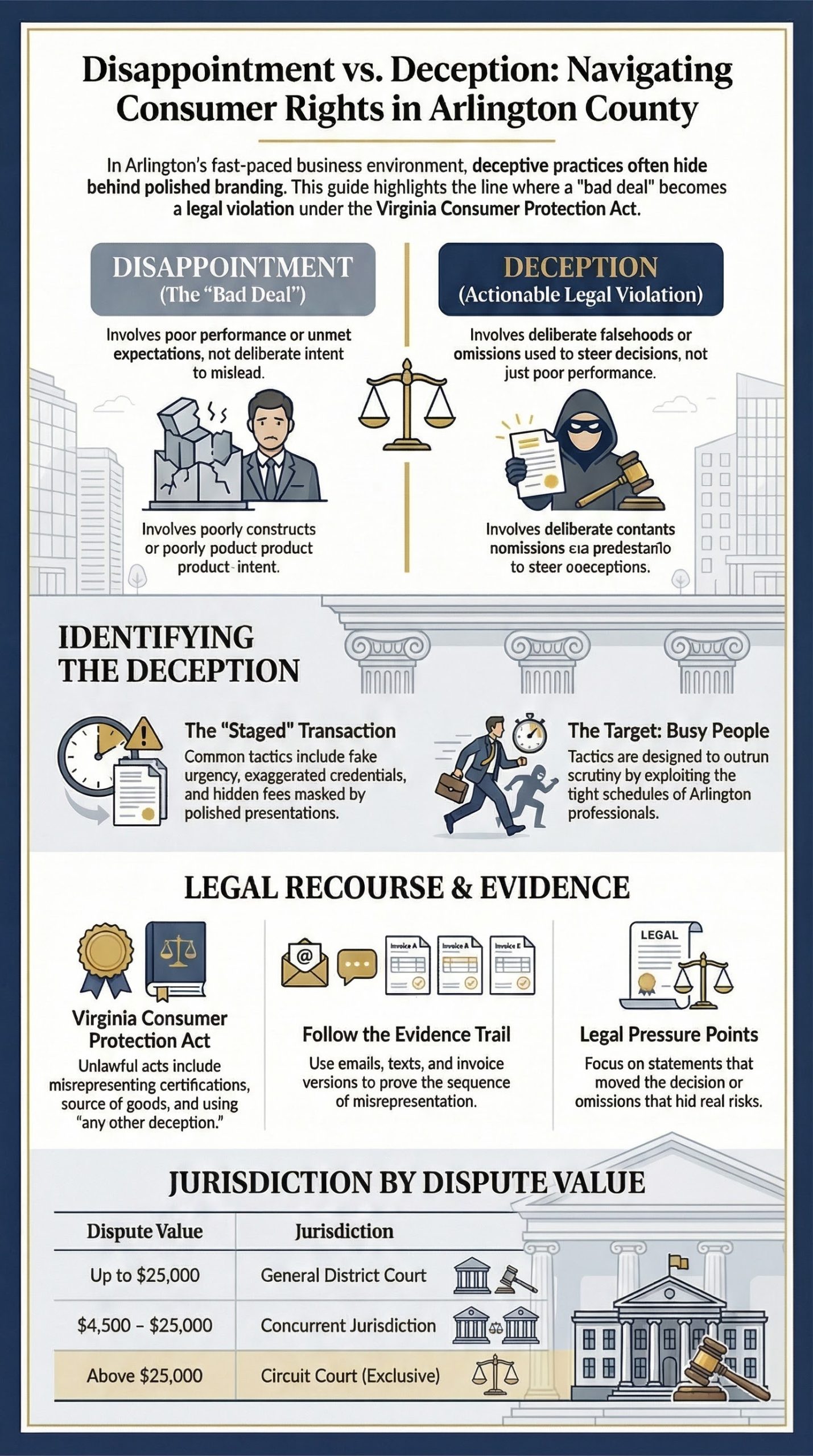
Not every bad deal is fraud. Not every broken promise is a deceptive practice claim. But in Arlington County, some disputes move beyond ordinary breach when the facts show false promises, concealed fees, fake urgency, misleading marketing, sham invoices, or deliberate misrepresentation used to get money, approval, or trust. Virginia’s Consumer Protection Act declares a wide range of deceptive acts unlawful in connection with consumer transactions, including misrepresentations and the use of “any other deception, fraud, false pretense, false promise, or misrepresentation.” Arlington Circuit Court handles larger civil cases, including contract and other civil disputes above $25,000.
-
I am Anthony I. Shin, Esq. When clients come to me with this kind of case, they usually do not begin with a statute. They begin with a sentence like this: Something about it felt off from the start. That instinct matters. In many Arlington County disputes, the first sign of deceptive conduct is not the final proof. It is the mismatch between what was promised, what was documented, and what was actually happening behind the scenes. Virginia law does recognize deceptive practices in some settings, but the right legal theory depends heavily on who the parties are, what kind of transaction occurred, and what exactly was said or hidden
The Arlington County version of this problem
Arlington is compact, expensive, fast moving, and packed with businesses that rely on trust at speed. Deals happen in Rosslyn conference rooms, Clarendon coworking spaces, Ballston office suites, Columbia Pike storefronts, Pentagon City retail corridors, Crystal City redevelopment zones, Shirlington service hubs, and neighborhood businesses near Lyon Village and Aurora Highlands. Arlington officially recognizes more than 60 neighborhoods and major planning areas such as Rosslyn, Courthouse, Clarendon, Virginia Square, Ballston, Pentagon City, Crystal City, Columbia Pike, and Shirlington. That matters because deception in Arlington often hides inside polished presentations, clean branding, and compressed decision cycles.
In other words, these cases rarely arrive wearing a villain costume.
They show up as:
- a “limited time” offer that was never really limited
- a vendor who claimed credentials they did not have
- a service provider whose invoice was built on work never performed
- a contractor who used urgency and confidence to get a deposit
- a sales pitch that looked precise until the real fees started appearing
- a business relationship where the paper trail slowly reveals the truth was managed, not told
That is why this article is not written like a checklist. Arlington County clients usually do not need another generic warning about reading the fine print. They need help understanding when sharp business behavior crosses into legally significant deception.
When a bad deal becomes more than a bad deal
There is a practical difference between disappointment and deception.
A disappointing deal may involve poor performance, missed expectations, or overpromising without enough proof of deliberate falsehood.
A deceptive deal usually has a stronger pattern:
- someone knew a statement was false
- or omitted a fact that made the overall impression misleading
- or created a false sense of scarcity, approval, capability, or readiness
- or used paperwork, timing, and confidence to steer the other side into a decision they would not have made if the truth had been known
Virginia’s Consumer Protection Act lists numerous unlawful practices in connection with consumer transactions, including misrepresenting source, sponsorship, approval, certification, affiliation, benefits, characteristics, ingredients, uses, or quantities, along with the catchall prohibition on “any other deception, fraud, false pretense, false promise, or misrepresentation.” It also includes failures to disclose certain fees and conditions in specific contexts.
That does not mean every Arlington business dispute falls under the Consumer Protection Act. The Act is tied to “consumer transactions,” so in many business to business disputes the legal path may instead sound in fraud, contract, tort, or another statutory theory. That distinction is one of the first things I evaluate because clients often describe all deceptive conduct the same way, while Virginia law does not. The right claim depends on the transaction itself.
The moment clients usually realize something was staged
Here is the pattern I see often.
At the beginning, everything looks organized. The branding is strong. The proposal is polished. The language is confident. The urgency sounds reasonable. The timeline feels tight but believable.
Then one small thing does not line up.
- A promised approval cannot be verified.
- A “required” fee appears nowhere in the original sales material.
- A performance report uses numbers no one can explain.
- An invoice references labor or deliverables that never happened.
- A company representative starts changing the story depending on who asks.
At first, clients treat that as irritation. Then the deeper review begins. That is often where deceptive conduct stops being a gut feeling and starts becoming evidence.
Scenario one: The Rosslyn consulting package that was never what it claimed to be
Imagine a founder in Rosslyn hiring a consulting outfit that promises “federal ready” market positioning, executive introductions, and a highly specialized capture framework. The proposal claims the service is backed by a team with direct agency level experience. The price is high, but the pitch is specific.
Once work begins, the founder notices generic templates, recycled material, and no real strategic depth. Calls are delegated to junior people. Claimed agency relationships turn out to be exaggerated. The “proprietary framework” looks suspiciously like renamed public information.
Now step back.
This is not just a client unhappy with quality. The deeper question is whether the service was sold through misrepresentation of capability, credentials, exclusivity, or results. If the seller materially misrepresented who was doing the work, what expertise existed, or what the buyer was actually purchasing, the dispute may move beyond ordinary disappointment.
That matters deeply in Arlington because professional services often sell trust before they sell deliverables.
Scenario two: The Clarendon fitness studio agreement with “optional” fees that were never optional
Picture a resident in Clarendon signing up for a boutique wellness or performance program. The sales team says the package is simple. Then the contract starts generating recurring charges, cancellation penalties, administrative add ons, and upgrade fees that were not clearly presented during the sales process.
Virginia’s Consumer Protection Act expressly addresses failures to disclose all conditions, charges, or fees in certain consumer settings, including refund or return conditions and layaway terms, while its broader deception provisions reach false promises and misrepresentations in consumer transactions. A dispute like this may not be about whether the studio provided classes. It may be about whether the consumer was induced to sign through a misleading presentation of the actual financial obligation.
The legal issue is not that the contract exists.
The legal issue is whether the contract was sold honestly.
Scenario three: The Ballston software vendor selling certainty it did not have
A small business in Ballston signs with a software vendor that promises seamless implementation, guaranteed compatibility, and immediate operational gains. The demos look clean. The sales deck speaks in absolutes. The vendor says onboarding is routine.
After signing, the client learns the integration has never actually been completed for this kind of environment. The vendor knew compatibility was uncertain. Key features require expensive custom work. The implementation timeline was built more to close the deal than to reflect reality.
This is a common modern form of deceptive conduct. The documents look sophisticated. The problem is hidden in selective truth telling. The vendor may not have fabricated the product, but it may have sold confidence it did not possess.
That is where I start asking questions like these:
- What was represented as already proven
- What was still experimental
- What limitations were known before the contract
- What was omitted because disclosure might have killed the sale
Scenario four: The Columbia Pike renovation company using panic as a sales tool
Now imagine a homeowner or small property owner along Columbia Pike being told that immediate structural, moisture, or code work is necessary and that the quoted price is only available that day. The contractor pushes hard for a deposit. The report sounds technical. The urgency is emotional. The owner feels cornered.
Later, a second opinion shows the condition was overstated, the proposed scope was inflated, and the timeline pressure was artificial.
This kind of Arlington County dispute resonates because it is not only about the money. It is about pressure. Deceptive conduct often works by manipulating fear, embarrassment, urgency, or social proof. The target is not just the wallet. The target is decision making itself.
Scenario five: The Crystal City invoice that looked official enough to get paid
In Crystal City or Pentagon City, where businesses often process volume quickly, a deceptive practice can be far more boring and far more effective. Imagine a facilities manager receiving an invoice that looks like a renewal, service continuation, or prior approved charge. It has the right formatting, the right tone, and enough familiar language to slide through internal review.
Virginia law separately prohibits issuing a writing in connection with a consumer transaction that simulates or resembles an invoice when the recipient has not actually contracted for the goods, property, or services for which payment is sought. That statutory concept captures a broader truth too: many deceptive practices succeed because they are built to look routine.
This is not cinematic fraud. It is paper based misdirection.
And it works.
Scenario six: The Shirlington service company that borrowed trust it never earned
A service company in Shirlington markets itself as “certified,” “approved,” “preferred,” or “factory authorized.” Those words do real work in a sale. They suggest legitimacy, training, and oversight. Virginia’s Consumer Protection Act specifically treats misrepresenting approval, certification, source, affiliation, and sponsorship as unlawful in consumer transactions.
Now imagine the customer later learns none of those labels were true in the way a reasonable buyer would understand them.
This is exactly why deceptive conduct cases matter. Sometimes the work performed is real. The service exists. The invoice is not fake. But the trust lever that got the deal signed was manufactured.
What deceptive conduct really looks like in Arlington County
Most people imagine deception as one giant lie.
That is not how it usually appears.
It usually appears as:
- half truth plus urgency
- confidence plus omission
- official sounding language plus hidden limitation
- precision in the sales process plus vagueness after payment
- reputation signals that do not hold up under scrutiny
- paperwork designed to create the impression of something stronger than reality
The closer the representation gets to the decision point, the more important it becomes. If the truth would have changed the buyer’s choice, the omission or misrepresentation can matter far more than the seller expects.
For Arlington business owners, the target audience problem is real
Here is the part that resonates with sophisticated Arlington clients.
Many deceptive practices are not aimed at unsophisticated people. They are aimed at busy people.
- Busy founders in Rosslyn.
- Busy managers in Ballston.
- Busy landlords near Courthouse.
- Busy retail operators in Pentagon City.
- Busy professionals in Crystal City.
- Busy homeowners in Lyon Village and Aurora Highlands.
The sales pitch does not need to fool a careless person. It only needs to move fast enough to outrun scrutiny.
That is why smart people still get pulled into deceptive transactions. They are not gullible. They are overloaded.
What I look for first in these cases
I look for the pressure point in the sale.
- What statement actually moved the decision.
- What claim created trust.
- What omission hid the real risk.
- What document made the transaction look cleaner than it was.
- What fee, limitation, condition, or weakness was known but not surfaced.
Then I look for proof.
- Proposals
- screenshots
- emails
- texts
- recorded claims if lawfully preserved
- website language
- invoice versions
- contract revisions
- billing history
- internal notes
- timing of disclosures
- timing of payment requests
In deceptive conduct cases, sequence matters. The timeline often tells the truth before the witness does.
Which court handles major Arlington County cases
For larger civil disputes in Arlington County, the Circuit Court is often the main forum. Arlington Circuit Court has concurrent jurisdiction with General District Court over claims from $4,500 to $25,000 and exclusive jurisdiction over civil cases above $25,000. Arlington’s General District Court handles claims not greater than $25,000. Those jurisdiction lines matter because deceptive conduct cases often begin as “a sales problem” and then grow into a larger civil fight once the money, records, and remedies are fully understood.
The hard truth
Some of the most damaging unfair business practices in Arlington County are not loud enough to trigger immediate alarm.
They are polished enough to feel normal.
That is what makes them dangerous.
- A confident seller.
- A clean proposal.
- A rushed deadline.
- A familiar invoice.
- A hidden condition.
- A false claim that only matters after the money moves.
By the time the target realizes what happened, the other side is already trying to reframe the dispute as a simple misunderstanding or a customer expectation problem.
Sometimes that defense works.
Sometimes the facts show something else entirely.
My view
If you are in Arlington County and you keep coming back to the same thought, this did not just go bad, this was sold wrong, pay attention to that instinct.
In Rosslyn, Clarendon, Ballston, Courthouse, Crystal City, Pentagon City, Columbia Pike, Shirlington, Lyon Village, and Aurora Highlands, the form of the transaction may change. The pressure mechanics do not. Deceptive conduct is usually designed to get agreement before scrutiny arrives.
That is why these cases should be evaluated early. The longer the delay, the easier it becomes for the other side to flatten a deceptive process into a simple contract dispute.
And those are not always the same thing.
If a deal in Arlington County feels like it was sold through false promises, hidden fees, misleading documents, or deceptive conduct, do not write it off as a simple misunderstanding. Speak with Anthony I. Shin, Esq. at Shin Law Office.

Principal Attorney | Civil Litigation | Shin Law Office
Call 571-445-6565 or book a consultation online today.
(This article is provided for general informational purposes and does not constitute legal advice. For advice on your specific situation, consult with a licensed Virginia attorney.)
Virginia LLC law allows members to regulate company affairs by operating agreement and permits judicial dissolution when it is not reasonably practicable to continue in conformity with the articles and operating agreement. Virginia corporate law separately allows judicial dissolution in certain deadlock, oppressive conduct, fraudulent conduct, or asset misuse scenarios. Arlington Circuit Court handles civil claims above $25,000, and Arlington’s official planning areas include Rosslyn, Courthouse, Clarendon, Virginia Square, Ballston, Pentagon City, Crystal City, Columbia Pike, Cherrydale, East Falls Church, Nauck, and Shirlington.
References
- Virginia Consumer Protection Act, Code of Virginia § 59.1 200(A). The statute lists unlawful deceptive practices in connection with consumer transactions, including misrepresentations, false promises, and “any other deception, fraud, false pretense, false promise, or misrepresentation.”
- Arlington County Circuit Court, Civil Actions and FAQs. The Circuit Court has concurrent jurisdiction with General District Court over civil claims from $4,500 to $25,000 and exclusive jurisdiction over civil cases above $25,000.
- Arlington County Courts. Circuit Court hears civil cases, and General District Court handles claims not greater than $25,000.
- Arlington County planning areas and neighborhoods include Rosslyn, Courthouse, Clarendon, Virginia Square, Ballston, Pentagon City, Crystal City, Columbia Pike, Shirlington, Lyon Village, and Aurora Highlands.