
Bottom Line Up Front (BLUF)
Tysons is not a sleepy construction market. It is Fairfax County’s planned urban core, with long-term growth centered around transit, mixed-use redevelopment, public improvements, and large project delivery. In that kind of environment, payment disputes do not stay small for long. A delayed draw, a rejected pay application, disputed change work, or withheld retainage can quickly turn into lien exposure, project slowdown, and full-scale commercial litigation.
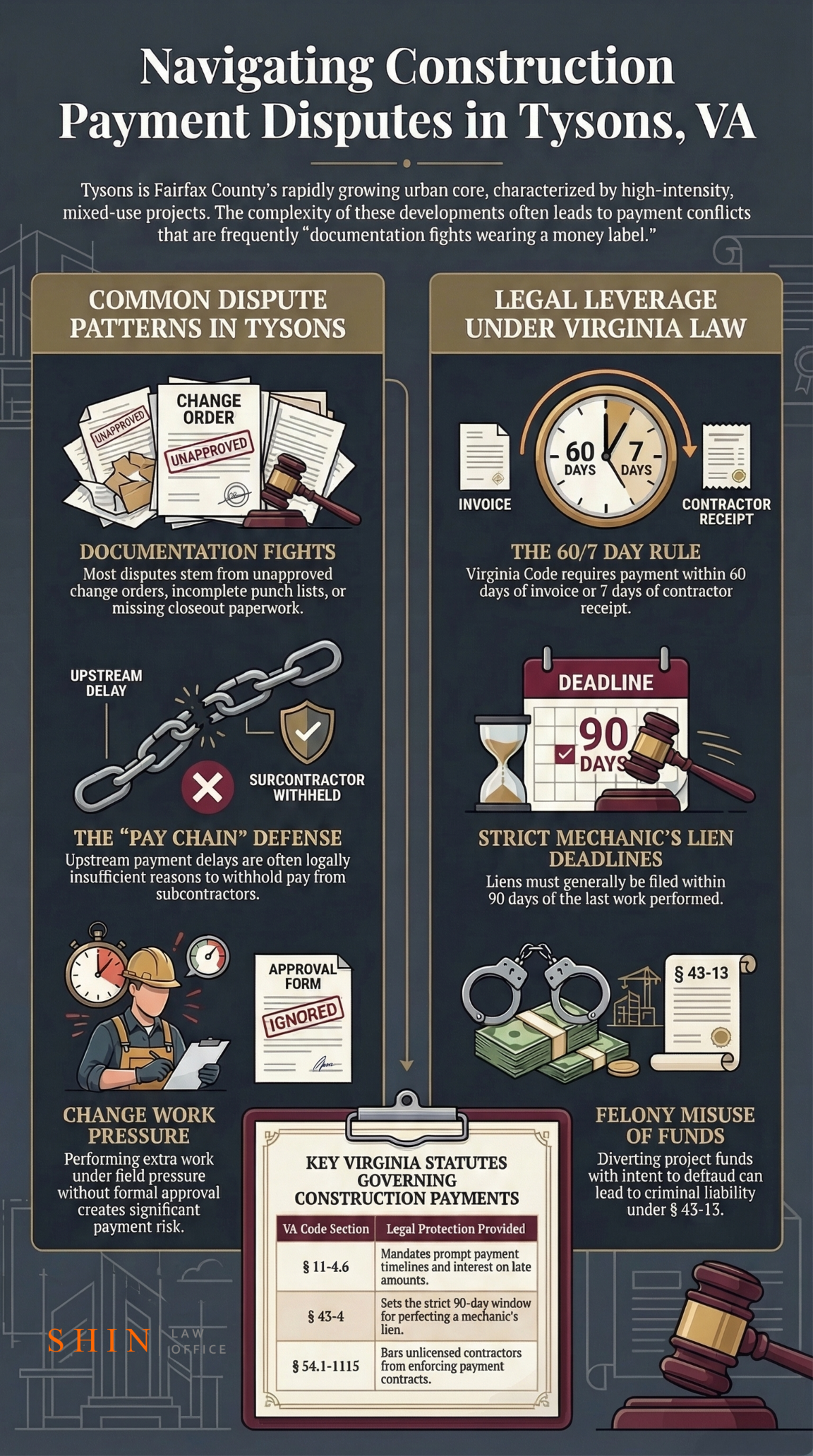
Why Tysons Creates High-Pressure Payment Disputes
I see Tysons for what it is: a dense commercial construction environment where owners, developers, general contractors, trade contractors, and suppliers are all operating on tight schedules and even tighter financial assumptions. Fairfax County’s plan for Tysons calls for a major long-term transformation into a high-intensity urban center with up to 100,000 residents and 200,000 jobs by 2050. That scale of redevelopment naturally produces more contracts, more billing layers, more scope changes, and more payment conflict.
On many Tysons projects, the work is not simple. It may involve tenant buildouts, structured parking, core and shell improvements, utility coordination, phased occupancy, vertical transportation, facade work, fire life safety systems, and post-award design refinement. That complexity creates fertile ground for disputes over who approved the work, whether the work was complete, whether it was back-charged, and whether a subcontractor earned payment when the monthly application hit the table. In other words, payment fights in Tysons are often really documentation fights wearing a money label. The development activity and planning structure in Tysons reflects exactly the kind of high-density, mixed-use project environment where those conflicts multiply.
What These Disputes Usually Look Like
Most contractor and subcontractor payment disputes in Tysons fall into a few recurring patterns. The first is the classic underbilling and rejection fight. The subcontractor submits an application for payment, the general contractor rejects part of it as incomplete, noncompliant, or unsupported, and the unpaid balance starts aging. The second is the change work fight, where extra work was performed under field pressure, but formal approval lagged behind the work. The third is a retainage dispute, where substantial completion is reached but money stays locked up because punch list items, closeout paperwork, or pass through issues remain unresolved. Virginia law governs payment timing and interest obligations in construction contracts, making the contract’s wording and the timing of the invoice especially important.
Another common pattern is the pay chain defense. A higher tier contractor says payment is delayed because the owner has not funded the draw, or because the project lender has not released funds, or because another dispute upstream is still pending. That argument used to carry more contractual weight in some settings than it does now. For many Virginia construction contracts, payment by the owner is not enforceable as a condition precedent to payment owed to a lower tier subcontractor. Virginia also requires certain payment clauses and interest protections in covered construction contracts. That matters in Tysons, where project capital stacks and layered contracting relationships can tempt parties to push payment risk downhill.
Virginia Law Gives Subcontractors Real Leverage
Virginia is not a state where a general contractor can always sit on a subcontractor invoice and blame the owner forever. Under Code of Virginia section 11 4.6, covered construction contracts must require payment to a subcontractor by the earlier of 60 days after receipt of an invoice following satisfactory completion of the invoiced work or seven days after the contractor receives payment for that work. That same statute also requires written notice when payment is withheld and provides for interest on unpaid amounts in many covered situations.
That is a big deal in the real world. It means the payment dispute often turns on a sharper question: was the work satisfactorily completed, and was the withholding actually supported by contract language and timely notice? If the contractor has weak paperwork, inconsistent field direction, or a habit of delaying decisions until the end of the job, the dispute can shift quickly in the subcontractor’s favor. Good litigation strategy starts with those details, not with empty outrage.
Virginia law also bars advance waiver or diminishment of certain payment bond rights and claims for demonstrated additional costs before labor or materials are furnished. That matters because many subcontractors sign aggressive paper at the front end of the job without realizing how much of it may later be challenged. If you are litigating a Tysons payment dispute, the contract matters, but the contract is never the only thing that matters. The statute matters too.
Mechanics Liens Can Change the Entire Case
When a subcontractor has not been paid, a mechanic’s lien can put real pressure on the project and the property. But Virginia lien law is technical, and technical mistakes can kill otherwise valid claims. A lien claimant generally must file a memorandum of lien within strict time limits, and a general contractor or other lien claimant under the relevant statutes must file no later than 90 days from the last day of the month in which labor was last performed or materials were last furnished, with an outside cap tied to completion or termination of the work. A suit to enforce the lien then has its own deadline.
Subcontractors also have special statutory notice rights that can create personal liability for the owner or general contractor, up to the amount still owed upstream, if the statutory notice process is properly used. That is one reason payment disputes in Tysons can escalate fast. What starts as a billing disagreement can become a property encumbrance problem, a closing problem, a refinancing problem, or a project relations problem. Once that happens, the economics of the dispute change.
I tell clients this all the time: lien rights are powerful, but they are not forgiving. If you wait too long, record the wrong amount, fail to track last work dates, or ignore the enforcement deadline, you may lose a remedy that could have changed the leverage of the whole case. In Tysons, where project values can be substantial, that is not a paperwork issue. That is a business risk issue.
Misuse of Construction Funds Can Become More Than a Contract Fight
Virginia law goes further than many people realize. Code section 43 13 states that funds paid to a contractor or subcontractor for a project must be used to pay those who performed labor or furnished materials for that project. If those funds are diverted with intent to defraud while project obligations remain unpaid, the conduct can expose the wrongdoer to criminal liability.
That does not mean every late payment is fraud. It does mean the facts matter. If the money came in, the project trades remained unpaid, and funds were redirected elsewhere, the dispute may no longer be a routine disagreement over timing or paperwork. On the other hand, if there is a legitimate back-charge fight, a completion dispute, or a scope disagreement, the analysis is different. Knowing the difference is one of the reasons early counsel matters in a Tysons payment case.
The Contract Usually Decides Who Bleeds First
Payment disputes are rarely won by the party who is angriest. They are won by the party whose contract, notices, schedules, and project records line up. I look first at the payment clause, the schedule of values, the change order language, the notice clause, the closeout requirements, the retainage language, the default provisions, and the dispute resolution section. Then I match those provisions against the project record. That is where the truth usually shows up. The Virginia payment statutes do not eliminate contract fights. They frame them.
For example, many disputes hinge on whether the invoice was proper, whether the work had reached the required milestone, whether written notice of withholding was sent on time, and whether the contractor had a valid contractual basis to hold funds. Others hinge on whether the subcontractor actually preserved its right to claim additional compensation for change work, acceleration, disruption, or extended overhead. A Tysons project with daily coordination pressure can produce a lot of field directives and very little clean paper. That gap is where cases are often won or lost.
Licensing Problems Can Destroy a Payment Claim
Another issue parties ignore until it is too late is licensing. Virginia law states that a construction contract entered into by a person performing work without a valid Virginia contractor’s license is generally not enforceable by the unlicensed contractor, subject to limited statutory exceptions. In a payment dispute, that can become a devastating defense.
That means a Tysons payment case may require more than proving work was done. It may require proving the claimant had the right licensing posture for the work at issue. On high value commercial projects, that is not a technical footnote. It can determine whether the claimant has a viable contract case at all.
Public Project Rules Are Different
Not every Tysons project is purely private. Some involve public bodies, public improvements, or public procurement structures. On Virginia public construction contracts, the Virginia Public Procurement Act requires payment clauses that obligate the contractor to either pay the subcontractor within seven days after receipt of payment attributable to the subcontractor’s work or provide written notice explaining the withholding. The statute also requires an interest clause on unpaid amounts. It further states that payment by the public owner is not a condition precedent to payment to a lower tier subcontractor.
That framework matters because some parties still behave as though the money can simply be held until the last upstream problem disappears. In many public contract settings, that is not how Virginia law works. If the subcontractor did the work and the statutory framework applies, the analysis becomes much more disciplined.
Litigation in Fairfax County Is Often About Speed and Leverage
Tysons disputes often end up in Fairfax County litigation because the project, the parties, the property, or the performance occurred there. Virginia’s court system provides access to circuit court civil forms and case information, and Fairfax County disputes may move through courts where timing, pleading strategy, provisional remedies, and documentary proof matter from the start. Commercial construction cases are rarely won by broad accusations. They are won by careful claims, defensible damages models, and pressure applied at the right time.
Sometimes the right move is immediate suit. Sometimes it is lien perfection followed by targeted negotiation. Sometimes it is a demand package that forces the other side to confront statutory exposure, interest, unpaid contract balances, and record-based proof before the case hardens. Litigation is not just about filing. It is about controlling the sequence. In Tysons, sequence often decides settlement value.
What Businesses Commonly Get Wrong
The first mistake is waiting too long because the parties want to preserve the relationship. I understand that instinct. But there is a difference between preserving a relationship and surrendering leverage. If deadlines run, notices are missed, or the record grows stale, your negotiating position can collapse.
The second mistake is treating the dispute as an accounting issue rather than a legal one. A disputed pay application can involve contract interpretation, statutory timing, lien rights, trust fund style misuse allegations, and licensing defenses all at once. That is not a bookkeeping problem. That is a commercial litigation problem.
The third mistake is relying on informal jobsite conversations. On many projects, everyone “understood” the extra work would be paid, the back charge would be reversed, or the retainage would be released. Then the people change, the project turns, and the file becomes the truth. If it is not documented, your case gets harder.
My View as a Business Litigation Attorney
When I handle contractor and subcontractor payment disputes in Tysons, I do not start with slogans. I start with the contract, the billing record, the change history, the notice trail, the lien timeline, the license status, and the damages model. Then I look at where pressure can be applied lawfully and fast. That is how commercial construction cases should be handled.
Tysons is growing because Fairfax County intends it to keep growing. More density, more redevelopment, and more mixed use construction mean more payment disputes between contractors and subcontractors. The question is not whether those disputes will happen. The question is who will be prepared when they do.
Closing Thoughts
Payment disputes in Tysons are rarely about one unpaid invoice alone. They are usually about leverage, timing, documentation, and risk allocation on high value commercial work. Virginia law gives parties real tools, but those tools only work if they are used correctly and on time.
If your company is dealing with withheld payment, disputed change work, retainage issues, lien exposure, or a breakdown between contractor and subcontractor on a Tysons project, the smart move is to evaluate the claim before the deadlines and leverage disappear. Shin Law Office represents businesses in high stakes Virginia commercial disputes, including construction payment litigation in Fairfax County. Call 571 445 6565 or contact the firm through the online form to discuss the dispute.

Principal Attorney | Shin Law Office
Call 571-445-6565 or book a consultation online today.
(This article is provided for general informational purposes and does not constitute legal advice. For advice on your specific situation, consult with a licensed Virginia attorney.)
References
References
Fairfax County, Virginia. (n.d.). Comprehensive plan. Retrieved March 12, 2026, from https://www.fairfaxcounty.gov/tysons/comprehensive-plan
Fairfax County, Virginia. (n.d.). Development activity. Retrieved March 12, 2026, from https://www.fairfaxcounty.gov/tysons/development-activity
Virginia’s Judicial System. (n.d.). Front page. Retrieved March 12, 2026, from https://www.courts.state.va.us/
Virginia Law. (n.d.). § 2.2 4354. Payment clauses to be included in contracts. Retrieved March 12, 2026, from https://law.lis.virginia.gov/vacode/title2.2/chapter43/section2.2-4354/
Virginia Law. (n.d.). § 11 4.1:1. Waiver of payment bond claims and contract claims; construction contracts. Retrieved March 12, 2026, from https://law.lis.virginia.gov/vacode/title11/chapter1/section11-4.1:1/
Virginia Law. (n.d.). § 11 4.6. Required contract provisions in construction contracts. Retrieved March 12, 2026, from https://law.lis.virginia.gov/vacode/title11/chapter1/section11-4.6/
Virginia Law. (n.d.). § 43 4. Perfection of lien by general contractor; recordation and notice. Retrieved March 12, 2026, from https://law.lis.virginia.gov/vacode/title43/chapter1/section43-4/
Virginia Law. (n.d.). § 43 11. How owner or general contractor made personally liable to subcontractor, laborer or materialman. Retrieved March 12, 2026, from https://law.lis.virginia.gov/vacode/title43/chapter1/section43-11/
Virginia Law. (n.d.). § 43 13. Funds paid to general contractor or subcontractor must be used to pay persons performing labor or furnishing material. Retrieved March 12, 2026, from https://law.lis.virginia.gov/vacode/title43/chapter1/section43-13/
Virginia Law. (n.d.). § 54.1 1115. Prohibited acts. Retrieved March 12, 2026, from https://law.lis.virginia.gov/vacode/title54.1/chapter11/section54.1-1115/