
BLUF
Partnership disputes in Arlington County usually do not explode overnight. They build through unanswered questions about money, authority, ownership, access to records, side deals, and who gets to make the next decision. In Virginia, the answer often starts with the governing documents and the business form. For LLCs, the operating agreement carries major weight. For partnerships, Virginia law imposes defined duties, including duties of loyalty and care. When the breakdown becomes severe, Arlington Circuit Court is often the forum for higher-value business cases, and in some LLC cases, Virginia law allows judicial dissolution when it is no longer reasonably practicable to carry on the business in line with the company’s governing documents.
-
I am Anthony I. Shin, Esq. When I look at these disputes, I do not start with the argument in the room. I start with control. Who had authority. Who had access. Who moved money. Who withheld records. Who changed the rules. Who made promises outside the agreement. That is where Arlington business disputes usually become real cases.
Why partnership disputes escalate so fast
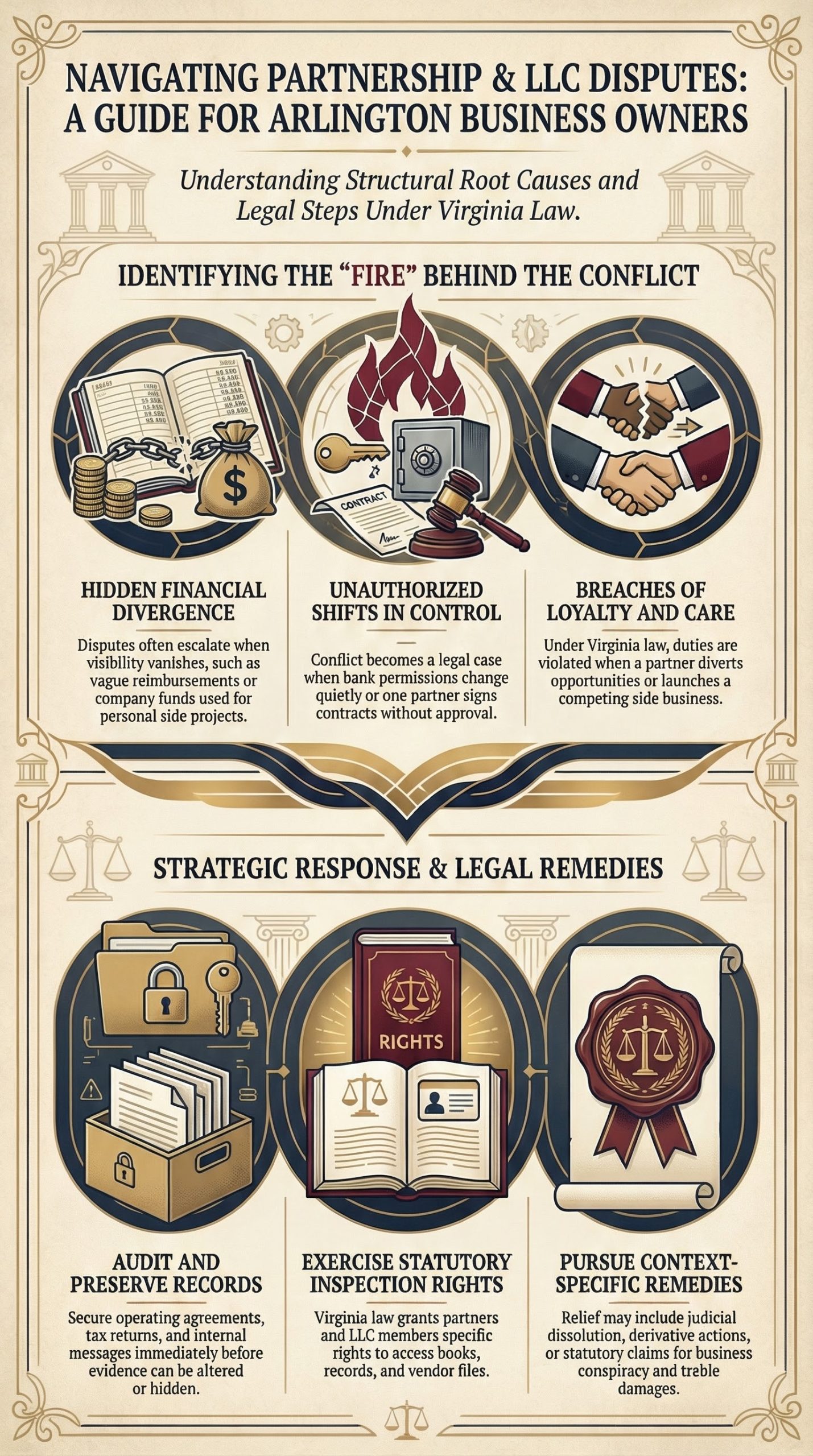
Most business owners think the real problem is personal conflict. It usually is not. Personal conflict is the smoke. The fire is usually one of these:
Money starts moving without shared visibility
One owner begins taking larger draws. Another puts family members on payroll. Reimbursements become vague. Business expenses start looking personal. Someone is using company funds to cover side projects. The books stop making sense.
That is the moment when trust stops being a business asset and starts becoming a litigation issue.
Control shifts without consent
One partner starts acting as the sole decision-maker. Contracts get signed without approval. Vendors are changed. Staff is hired or fired. Access to key systems gets restricted. Bank permissions are changed quietly.
In many Arlington businesses, especially closely held LLCs, this is where the other owner realizes that the title on paper and the power in practice are no longer the same thing.
Duties are ignored when pressure rises
When revenue tightens or growth accelerates, people’s habits show. One owner may start competing with the business. Another may redirect opportunities. Another may hide problems to protect their status. Under Virginia partnership law, the duties of loyalty and care matter, and they are not abstract ideas. They become very concrete when one partner profits at the business’s expense or makes decisions in bad faith.
The first question I ask in Arlington County disputes
I ask what kind of entity we are dealing with.
That matters because business owners often say “partnership dispute” when the company is actually an LLC or a corporation. The label people use in conversation is not always the legal structure that controls the case.
If the business is an LLC
In Virginia, the operating agreement is central. Virginia law allows LLC members to regulate the company’s affairs, the conduct of the business, and the relations among members through the operating agreement. The LLC is bound by that agreement. Virginia law also allows operating agreements to specify penalties or consequences for a member or manager who fails to comply.
That means many Arlington LLC fights come down to language such as:
- Who approves major spending
- Who controls hiring
- How profits are distributed
- What counts as cause for removal
- What happens when a member defaults
- Whether a member can be bought out
- What events trigger dissolution
If the operating agreement is well written, it can narrow the fight.
If it is sloppy, silent, or copied from a template, the dispute gets wider, more expensive, and more personal.
If the business is a true partnership
Virginia’s Uniform Partnership Act imposes defined standards of conduct. The law states that the only fiduciary duties a partner owes to the partnership and the other partners are the duty of loyalty and the duty of care as set out by statute. Virginia law also gives partners and their agents and attorneys access to partnership books and records.
That is a major point in real cases. When one partner starts blocking access to financials, records, communications, or vendor files, the fight often moves from suspicion to evidence.
The patterns I see most often in Arlington County business fights
Arlington is not a random market. Many businesses here operate in fast moving environments tied to professional services, government contracting, commercial real estate, technology, consulting, and high pressure service work. That creates recurring dispute patterns.
1. Equal ownership with unequal labor
This is common. Two owners split the company fifty fifty. One person brings in business and manages operations. The other claims equal control but contributes less over time. Resentment builds. Then the underperforming owner still expects full distributions and veto power.
That is how a simple fairness complaint becomes a control fight.
2. One owner treats the company like a personal account
This happens more than people admit. The business pays for travel, vehicles, family expenses, or personal debt. The other owner sees unusual reimbursements or vague accounting descriptions and starts asking questions.
The questions are often ignored at first. Then bank records and tax filings start telling a story.
3. A side business starts competing with the main company
One owner launches a parallel business. Opportunities are routed away. Clients are approached off book. Staff gets pulled quietly. Intellectual property, pricing, and relationships get used for personal gain.
That is where duty, loyalty, and damages become central issues.
4. A manager or member locks out the other side
Passwords change. Banking access disappears. Email accounts are cut off. The website and CRM are controlled by one faction. This is one of the fastest ways to escalate a business dispute because it turns a governance fight into an operational emergency.
5. Deadlock kills the company from the inside
Sometimes nobody stole anything. Nobody lied. Nobody even breached a duty in the dramatic sense. The owners simply cannot move forward. They cannot agree on financing, hiring, litigation strategy, a lease, expansion, or sale.
For Virginia LLCs, that can matter a great deal. The circuit court of the locality where the registered office is located may decree judicial dissolution if it is not reasonably practicable to carry on the business in conformity with the articles of organization and any operating agreement.
What business owners should do before the case gets worse
The biggest mistake I see is delay.
Business owners often wait because they hope the relationship will settle down. While they wait, evidence gets thinner, records get altered, accounts shift, and positions harden.
Here is the smarter sequence.
Preserve the documents
Get the operating agreement, partnership agreement, bylaws, shareholder agreement, amendments, tax returns, bank statements, payroll records, vendor agreements, internal messages, and accounting exports together.
Pin down who has authority
Look at signature authority, bank access, approval rights, ownership percentages, and management structure. Do not rely on memory. Use the actual records.
Request records early
Virginia law gives LLC members rights to inspect and copy certain company records upon reasonable request, and Virginia partnership law provides partners access to books and records. That is often the first serious step in separating rumor from proof.
Stop informal fixes that make things worse
Do not answer suspected misconduct with your own self help. Do not drain accounts. Do not hide records. Do not wipe devices. Do not try to punish the other side through chaos. Those moves often damage your own case.
Assess whether the claims belong to you or the company
This matters more than many owners realize. Some harm is direct to the owner. Other harm is to the company itself. Virginia law provides for LLC derivative actions, but there are pleading and standing requirements, including requirements tied to efforts to secure company action or reasons for not doing so.
That distinction can shape the entire case.
When an Arlington dispute becomes a court case
Not every business fight belongs in court. Some belong in negotiation. Some belong in mediation. Some require immediate injunctive work. Some should end in a buyout. Some should end in dissolution.
But once the amount in controversy rises and the issues become serious, Arlington Circuit Court is often where the dispute lands. The Arlington Circuit Court has concurrent jurisdiction with General District Court over civil claims from $4,500 to $25,000 and exclusive jurisdiction over civil cases with claims of more than $25,000. The circuit court also handles contracts and other civil matters.
In real terms, that means Arlington business owners need to think beyond who is morally right. They need to think about:
- the documents
- the available causes of action
- the right plaintiff
- the right defendant
- the right remedy
- the right court
- the right timing
Remedies that may come into play
Every case is different, but business owners are often surprised by how many paths may exist.
Breach of contract or breach of operating agreement
If the governing documents are clear and someone violated them, contract based claims may be the backbone of the case.
Breach of fiduciary duty
Where duties are owed and violated, this can become central, especially in true partnership settings and in other business relationships shaped by law and governing documents.
Accounting and records based relief
Sometimes the first real need is not damages. It is transparency.
Derivative claims
If the wrong was done to the business, not just to one owner personally, derivative procedure may matter.
Judicial dissolution
When the company can no longer function in conformity with its governing documents, judicial dissolution may be necessary in Virginia LLC cases.
Business conspiracy in more extreme cases
Virginia law also recognizes civil relief for certain conspiracies to injure a person in trade, business, or profession, including the possibility of treble damages and counsel fees under the statute. That is not every business dispute. But where coordinated misconduct is present, it becomes a serious issue.
My view for Arlington County business owners
A partnership dispute is rarely only about personalities. It is about structure under pressure.
The owners usually built the company during a season of optimism. Then a harder season arrives. Money tightens. Growth changes incentives. One owner wants out. One wants more control. One feels cut out. One starts protecting himself. One starts hiding things.
That is when the quality of the documents, the quality of the records, and the speed of your response start deciding the future of the business.
If you own a business in Arlington County and the warning signs are already there, do not wait for a total collapse. The longer the conflict sits, the harder it becomes to separate business damage from emotional damage. And once that happens, resolution gets more expensive.
The smart move is to get clear on the governing documents, the entity structure, the financial trail, the decision trail, and the remedy that actually fits the facts.
Because in my experience, these cases do not get better through avoidance. They get clearer through pressure.
Do not let a business dispute quietly destroy what you built.
If you are dealing with conflict over money, control, records, duties, or decision-making in Arlington County, speak with Anthony I. Shin, Esq. at Shin Law Office.

Principal Attorney | Civil Litigation | Shin Law Office
Call 571-445-6565 or book a consultation online today.
(This article is provided for general informational purposes and does not constitute legal advice. For advice on your specific situation, consult with a licensed Virginia attorney.)
FAQs
What causes partnership disputes in Arlington County businesses?
Most disputes start with conflict over money, unequal workload, control of bank accounts, access to records, side deals, profit distributions, or who has authority to make decisions.
Is every partnership dispute really a legal partnership case in Virginia?
No. Many business owners use the word partnership casually, but the company may actually be an LLC or corporation. That matters because the legal rules and governing documents may be different. Virginia LLC disputes are often driven heavily by the operating agreement.
Why does the operating agreement matter so much?
Virginia law allows LLC members to regulate the company’s affairs, business conduct, and relations among members through the operating agreement, and the LLC is bound by it.
Can a business owner demand access to records in Virginia?
Yes, in many situations. Virginia partnership law provides partners access to books and records, including the opportunity to inspect and copy them during ordinary business hours.
What duties do partners owe each other in Virginia?
Under Virginia partnership law, partners owe duties that include the duty of loyalty and the duty of care. Those duties become important when one owner starts competing with the business, hides opportunities, or acts for personal gain at the company’s expense.
What happens if the owners are deadlocked?
In some Virginia LLC cases, a circuit court may decree judicial dissolution if it is not reasonably practicable to carry on the business in conformity with the articles of organization and any operating agreement.
Which court handles serious business disputes in Arlington County?
The Arlington County Circuit Court has concurrent jurisdiction with General District Court over civil claims from $4,500 to $25,000 and exclusive jurisdiction over civil cases above $25,000. It also handles contracts and other civil matters.
What are signs that a business dispute is getting serious?
Warning signs include restricted bank access, missing records, unusual compensation, hidden side businesses, unilateral decisions, lockouts from email or systems, and refusal to follow the governing documents.
Can an Arlington County business dispute lead to dissolution?
Yes. If the company cannot continue operating in line with its governing documents, dissolution may become part of the legal strategy, especially in Virginia LLC disputes.
What should a business owner do first when a dispute starts?
Gather the governing documents, preserve financial records, identify who has authority, request access to records where appropriate, and assess whether the problem involves breach of agreement, breach of duty, or deadlock.
References
Virginia Code, § 13.1-1023, Operating agreement. Virginia Legislative Information System.
Virginia Code, § 13.1-1023.1, Remedies for breach of operating agreement by member or manager. Virginia Legislative Information System.
Virginia Code, § 13.1-1028, Information and records. Virginia Legislative Information System.
Virginia Code, Article 8 of the Virginia Limited Liability Company Act, Derivative Actions. Virginia Legislative Information System.
Virginia Code, § 13.1-1047, Judicial dissolution. Virginia Legislative Information System.
Virginia Uniform Partnership Act, General standards of partner’s conduct and access to books and records. Virginia Legislative Information System.
Arlington County Circuit Court, Civil Actions and FAQs. Arlington County, Virginia.
Circuit Court. Virginia Judicial System.
Virginia Code, §§ 18.2-499 and 18.2-500, Conspiracy to injure another in trade, business, or profession. Virginia Legislative Information System.