
BLUF
I handle noncompete and nonsolicitation litigation in Maryland by focusing on what actually matters in court: whether the restriction protects a real business interest, whether it is narrowly written, and whether it complies with Maryland’s current statutory limits. In many cases, a targeted nonsolicitation clause tied to customer relationships or confidential information has a far better chance of enforcement than a broad noncompete that tries to block fair competition.
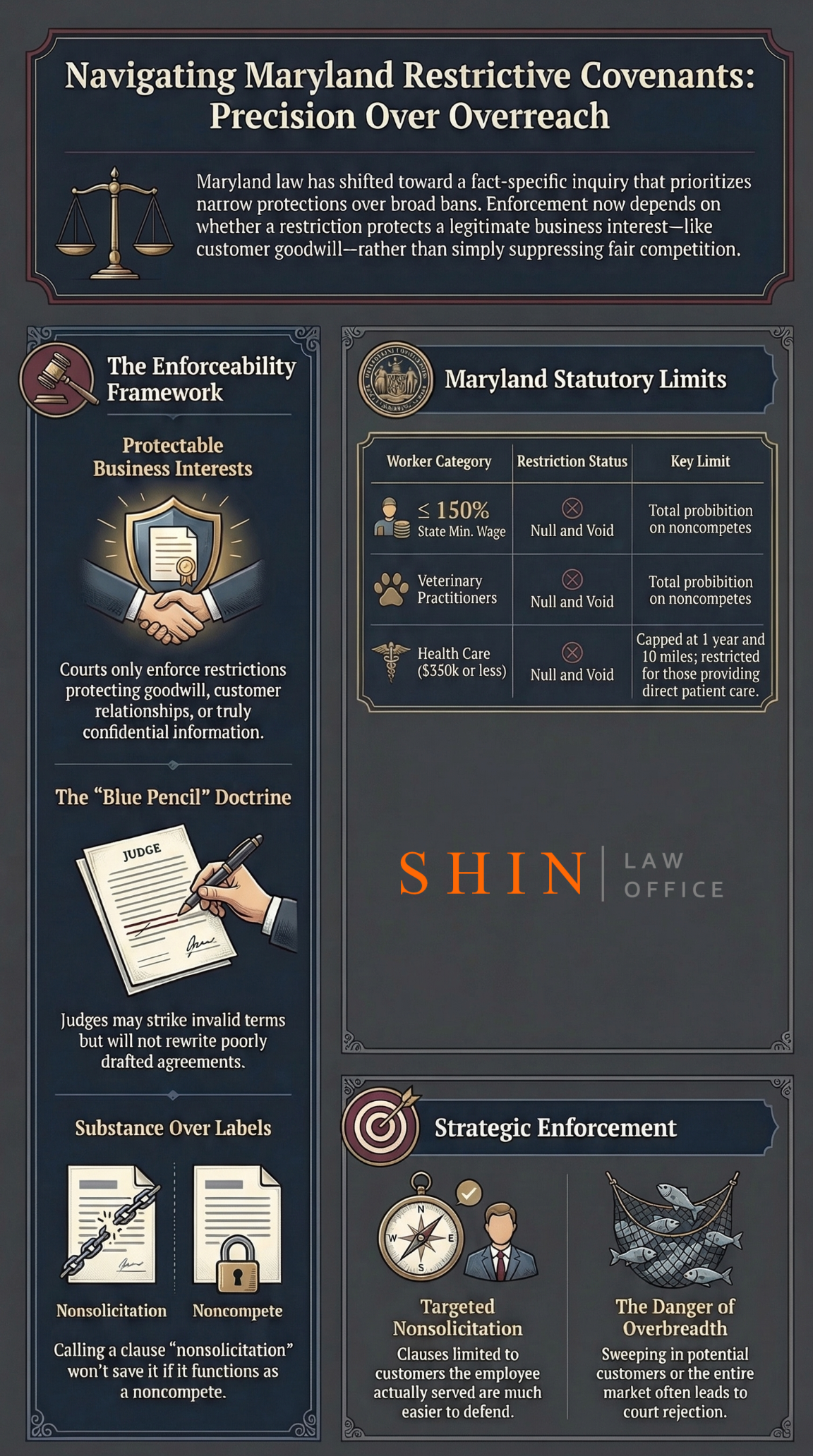
In my practice, that distinction matters. A carefully drafted nonsolicitation clause aimed at protecting customer relationships or confidential client information stands on much firmer ground than a broad noncompete that tries to keep someone out of an industry altogether. Maryland courts have long recognized that employers have a protectable interest in goodwill, customer relationships, and confidential information, but they have also made clear that the law does not exist to insulate a business from ordinary competition or to punish a departing employee for using general skill and experience.
What Maryland law actually looks at
Maryland’s common law framework remains fact-specific. Courts look at whether the covenant is supported by consideration, whether it is ancillary to the employment relationship, whether its duration and scope are reasonably necessary to protect the employer, and whether enforcement would impose undue hardship on the employee or harm the public. Maryland authorities repeatedly describe this as a case-by-case inquiry rather than a mechanical rule.
That is why I tell clients that restrictive covenant litigation is rarely won by labels alone. Calling a clause a “nonsolicitation” provision does not save it if it is written too broadly. Calling a clause a “confidentiality” clause does not save it if it functions like a disguised noncompete. Maryland courts look at substance first. They ask what the clause really restrains, whose relationships it covers, how long it lasts, and whether the employer is protecting a legitimate interest or simply trying to suppress competition.
Why nonsolicitation claims often have a better chance
In Maryland, a targeted nonsolicitation clause is more likely to be enforceable because it can be limited to a specific, identifiable set of customers, referral sources, or accounts that the employee actually serviced or learned about through the job. That is a much easier restraint to defend than a blanket ban on working for a competitor. Maryland decisions have upheld narrower customer-focused restraints where the class of protected clients was defined and connected to the employee’s actual work.
But overreach is where employers get into trouble. Federal courts applying Maryland law have rejected or criticized provisions that sweep in all customers, potential customers, or people with whom the employee had no real contact. If a covenant tries to block solicitation of an employer’s entire market, not just the goodwill the employee helped develop, a court is far more likely to treat the clause as overbroad. That is especially true when the employee had no relationship with many of the covered accounts.
The current Maryland statutes matter more than many employers realize
Maryland now imposes statutory limits that can void or narrow certain noncompete provisions outright. Under Labor and Employment § 3 716, a noncompete or conflict of interest provision that restricts an employee from working for a new employer or becoming self employed in the same or similar business is null and void for employees earning at or below 150 percent of the State minimum wage, for many health occupations employees who provide direct patient care and earn $350,000 or less, and for employees licensed as veterinary practitioners or veterinary technicians. The statute also states that the section does not apply to restrictions concerning client or patient lists or other proprietary client-related or patient-related information. For higher-earning direct patient care workers covered by the statute, noncompetes are capped at one year and ten miles from the primary place of employment.
That statutory carve-out is one of the most important developments in Maryland restrictive covenant law. It means employers and employees cannot rely on old forms or old assumptions. A contract that once looked standard can now be void in whole or in part, depending on the worker’s role, compensation, and whether the restriction operates as a true noncompete rather than a narrower protection of proprietary information or client lists.
How courts handle overbroad language
One of the hardest questions in Maryland litigation is what happens when a clause is partly enforceable and partly too broad. Maryland has historically followed a blue pencil approach. In practical terms, that means a court can sometimes strike severable language and enforce the rest, but it does not simply rewrite the agreement from scratch to rescue poor drafting. That distinction is critical in litigation because a poorly drafted clause can collapse if the valid and invalid parts are too intertwined.
This is where I see many employers make a costly mistake. They draft for maximum intimidation instead of maximum enforceability. The result is a covenant stuffed with broad phrases, sweeping customer definitions, and layered restrictions that look aggressive on paper but become vulnerable in court. Maryland judges are not there to fix a party’s overreaching language after the fact.
What usually drives these lawsuits
Most Maryland noncompete and nonsolicitation lawsuits do not begin as abstract debates about contract language. They begin when a sales executive leaves with key accounts, when a recruiter moves to a rival and starts calling old candidates or clients, when a financial advisor departs and clients follow, or when a professional services employee uses internal information to compete immediately after separation. In those cases, the employer usually seeks injunctive relief first because the perceived harm is loss of goodwill, client relationships, or confidential information, not just money damages. Courts applying Maryland law recognize that injunctions are preventive tools aimed at future harm, which is why restrictive covenant cases often move fast.
From the employee side, the most effective defenses usually focus on overbreadth, lack of a legitimate protectable interest, lack of meaningful client contact, statutory invalidity under current Maryland law, and the difference between protected confidential information and ordinary know how gained through experience. In other words, the dispute often turns less on whether the employee joined a competitor and more on what the employee actually took, used, solicited, or threatened to disrupt.
My view as counsel
When I represent clients in these matters, I focus on precision. For employers, that means drafting restrictions around real business interests, real customer relationships, and real confidentiality concerns. For employees, it means scrutinizing whether the clause actually matches Maryland law as it exists now, not as someone assumed it worked years ago. In court, precision wins credibility. Overstatement usually does not.
Maryland noncompete and nonsolicitation litigation is not dead. It is simply narrower, more statute-sensitive, and more fact-dependent than many businesses expect. A focused nonsolicitation clause tied to actual goodwill still has teeth. A bloated noncompete aimed at shutting down ordinary competition often does not. That is the line that matters, and that is where these cases are usually won or lost.

Principal Attorney | Shin Law Office
Call 571-445-6565 or book a consultation online today.
(This article is provided for general informational purposes and does not constitute legal advice. For advice on your specific situation, consult with a licensed Maryland, Virginia, & DC attorney.)
References
Becker v. Bailey, 268 Md. 93, 299 A.2d 835 (Md. 1973).
Deutsche Post Global Mail, Ltd. v. Conrad, 292 F. Supp. 2d 748 (D. Md. 2003).
Fowler v. Printers II, Inc., 89 Md. App. 448, 598 A.2d 794 (Md. Ct. Spec. App. 1991).
Gill v. Computer Equipment Corp., 266 Md. 170, 292 A.2d 54 (Md. 1972).
Hebb v. Stump, Harvey & Cook, Inc., 25 Md. App. 478, 334 A.2d 563 (Md. Ct. Spec. App. 1975).
Holloway v. Faw, Casson & Co., 319 Md. 324, 572 A.2d 510 (Md. 1990).
Intelus Corp. v. Barton, 7 F. Supp. 2d 635 (D. Md. 1998).
Maryland General Assembly. (2026). Labor and Employment § 3 716.
Maryland General Assembly. (2024). Fiscal and Policy Note for House Bill 1388.
Maryland General Assembly. (2024). Chapter 378, House Bill 1388, Labor and Employment, Noncompete and Conflict of Interest Clauses, Clauses for Veterinary and Health Care Professionals and Study of the Health Care Market.
Padco Advisors, Inc. v. Omdahl, 179 F. Supp. 2d 600 (D. Md. 2002).
TEKsystems, Inc. v. Bolton, No. 1:08 cv 3099, 2010 WL 447782 (D. Md. Feb. 4, 2010).
Webb Mason, Inc. v. Video Plus Print Solutions, Inc., No. 1:17 cv 3016, 2018 WL 6268208 (D. Md. Nov. 30, 2018).