
Bottom Line Up Front (BLUF)
How “personal injury” cases usually work in Loudoun County
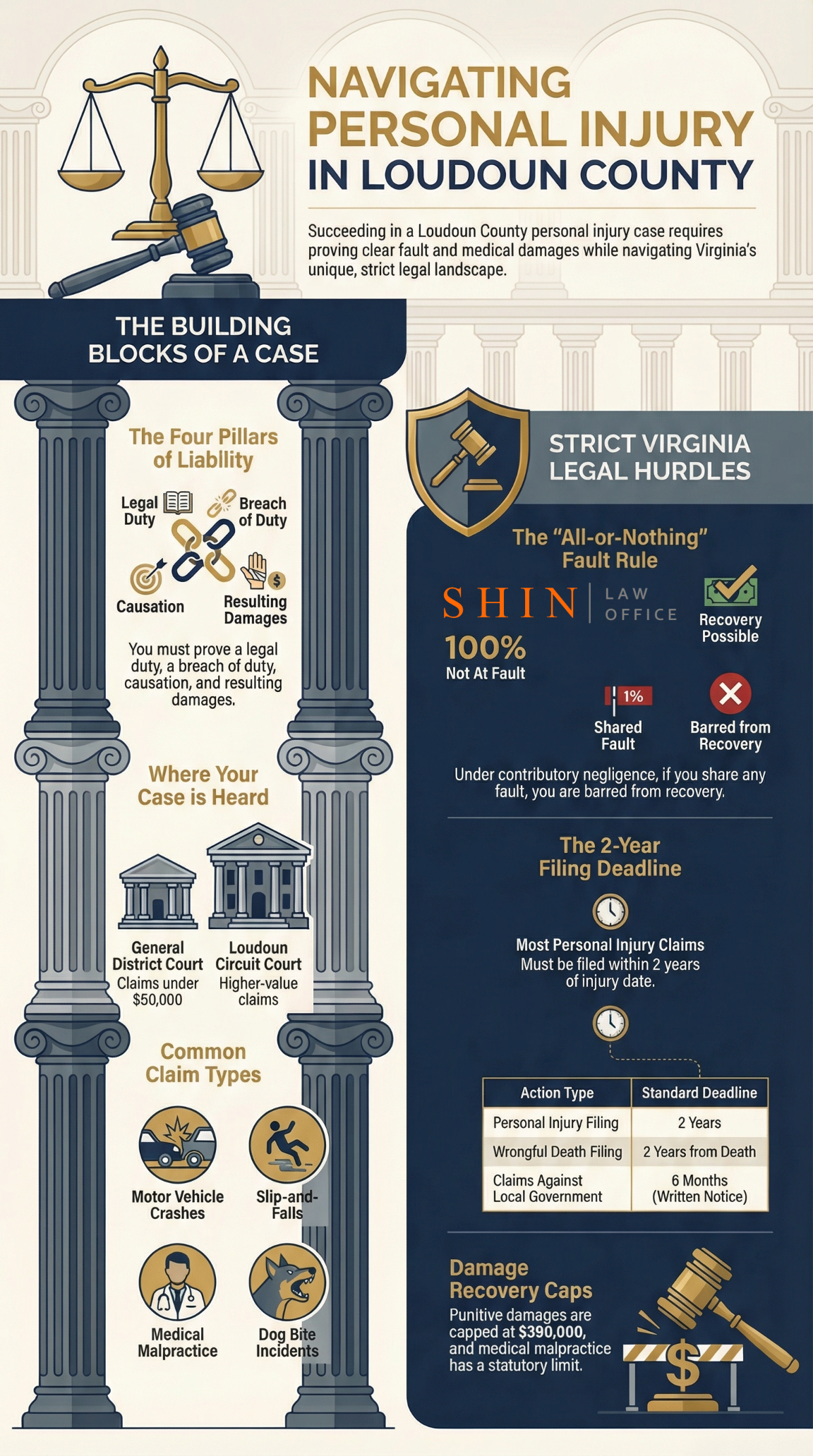
Most personal injury cases are based on showing:
- Someone else had a legal duty to act reasonably (driver, property owner, doctor, business, etc.)
- They breached that duty (carelessness, unsafe conduct, rule violations, etc.).
- The breach caused harm
- You have damages (medical bills, lost wages, pain, disability, etc.)
In Loudoun County, cases are typically filed in:
- Loudoun General District Court (can hear personal injury/wrongful death cases up to $50,000)
- Loudoun Circuit Court (often used for higher-value claims and jury trials)
Common personal injury case types that an attorney may evaluate in Loudoun County
1) Motor vehicle crashes
These are among the most common personal injury matters:
- Car crashes (rear-end, intersection, T-bone, chain reaction)
- Distracted driving, speeding, reckless driving
- Drunk/drugged driving
- Uninsured/underinsured driver collisions
- Hit-and-run
- Multi-vehicle and highway crashes
- Pedestrian and bicycle crashes
- Motorcycle crashes
Virginia-specific note: Virginia requires liability insurance for registered vehicles (the old “pay a fee instead of insurance” option was eliminated).
2) Commercial vehicle and trucking crashes
Often more complex because they can involve:
- Company policies and training failures
- Maintenance/inspection issues
- Multiple responsible parties (driver + employer + contractor + maintenance vendor)
Examples:
- Tractor-trailer crashes, delivery vans, utility trucks, work fleets, buses/shuttles.
3) Rideshare crashes (Uber/Lyft) and “on-the-job driving” crashes
These can involve layered insurance coverage and employment-status issues:
- Driver off-app vs. on-app
- Passenger injuries
- Third-party injuries
4) Slip, trip, and fall (premises liability)
Common locations:
- Grocery/retail stores (spills, uneven flooring, poor lighting)
- Apartment/condo common areas (stairs, walkways, ice/snow)
- Restaurants, hotels, gyms
- Construction/renovation areas with inadequate warnings
These cases usually focus on whether the owner/manager:
- Knew or should have known about the hazard, and
- Failed to fix it or warn in time.
5) Dog bites and animal attacks
Dog bite cases can involve:
- Bites in neighborhoods, parks, trails, or at someone’s home
- Knockdowns/jumps causing falls (especially with children or older adults)
Loudoun County-specific note: Loudoun has a leash/running-at-large rule—generally, “No dog shall be off the property…without being on a leash” (with listed exceptions). Such an ordinance may be material when evaluating negligence arguments.
6) Medical malpractice
Examples:
- Misdiagnosis or delayed diagnosis (including cancer)
- Surgical mistakes
- Medication errors
- Birth injuries
- Failure to treat, follow-up errors
Important Virginia rule: Medical malpractice recovery is subject to a statutory cap that changes by date (a schedule set in the Code of Virginia).
Also, Virginia’s statute of limitations is generally 2 years, but medical malpractice has specific extension rules in limited scenarios (foreign object left in body, concealment/fraud, certain diagnosis failures), with an overall outer limit in the statute.
7) Nursing home / assisted living neglect or abuse
Common issues:
- Falls due to poor supervision
- Bedsores/pressure injuries
- Dehydration/malnutrition
- Medication errors
- Physical abuse or neglect
8) Defective products (product liability)
Examples:
- Defective auto parts (airbags, brakes, tires)
- Dangerous consumer products
- Defective medical devices
- Unsafe children’s products
- Failure to warn / inadequate instructions
These can be based on negligence, warranty, or other liability theories, depending on the facts.
9) Workplace injuries (and third-party claims)
If you’re injured at work, the first system usually involved is workers’ compensation.
Virginia-specific note: The Workers’ Compensation Act generally makes workers’ comp the exclusive remedy against the employer (with limited exceptions), but you may still have a separate claim against a third party (for example, a negligent driver who hit you while working, or a negligent subcontractor on a jobsite).
10) Construction site injuries
Examples:
- Falls from height/ladder failures
- Scaffolding incidents
- Struck-by injuries
- Trench/excavation events
- Electrical injuries
These often overlap with workers’ comp, subcontractor liability, and premises liability.
11) Negligent security / inadequate security
Examples:
- Assaults in parking lots, apartment complexes, bars, hotels
- Poor lighting, broken locks, lack of security measures where risks are foreseeable
These cases can be fact-heavy and may depend on prior incidents, security policies, and foreseeability.
12) Wrongful death
When injuries result in death, Virginia has a specific wrongful death cause of action.
And it has a specific time limit: generally 2 years from the date of death.
13) Sexual abuse / sexual assault civil injury claims
Virginia’s limitations rules include special timeframes for certain sexual abuse injury claims (different periods depending on circumstances).
14) Claims involving local government (county/municipal issues)
Examples:
- Injury caused by negligence tied to county property/operations (depending on immunity issues)
- Certain roadway or public property hazards
Critical Virginia rule: Claims against a county/city/town for negligence can be barred unless a written notice is filed within six months after the cause of action accrued (with required details).
(Government liability and immunity issues are technical—worth attorney review early.)
15) Intentional torts (assault/battery, etc.)
Even if it’s not “accidental,” injuries from intentional acts can sometimes be civil claims, and insurance coverage issues can become important.
“Types of injuries” that often appear in these cases
Attorneys commonly evaluate claims involving:
- Head injuries/concussion / TBI
- Neck/back injuries (including disc injury)
- Spinal cord injuries
- Fractures and orthopedic injuries (knees, shoulders, hips)
- Burns, scarring, disfigurement
- Internal injuries
- Nerve damage
- Psychological injuries (PTSD, anxiety) tied to a traumatic event
- Permanent impairment/disability and future care needs
The injury type matters, but in Virginia, fault and proof are often just as decisive.
Virginia rules that often decide whether a case is “worth pursuing.”
The 2-year deadline is the default for most injury cases
Virginia’s general statute of limitations for personal injury is 2 years from accrual (with exceptions).
Contributory negligence can completely bar recovery
Virginia is strict: if the injured person’s negligence was a proximate cause of the accident, it can bar recovery (no percentage “splitting” of fault like in comparative negligence states). The Virginia model jury instructions state:
“Any negligence of the plaintiff which was a proximate cause of the accident will bar the plaintiff from recovering.”
Punitive damages have a statutory cap
Virginia caps punitive damages at $350,000.
Seatbelt non-use generally can’t be used as negligence evidence
Virginia law states a seatbelt violation generally does not constitute negligence and is not admissible to mitigate damages in a civil case arising out of motor vehicle operation/ownership/maintenance.
When it’s especially smart to talk to a Loudoun personal injury attorney
Even if you’re not sure you have a claim, attorney review is often helpful when:
- You have significant injuries or ongoing treatment
- Fault is disputed (or the insurer hints you share blame)
- A commercial driver/company is involved
- A government entity might be involved (notice deadlines)
- There’s a death (wrongful death rules)
- The injury involves medical negligence
- There are dog bite issues tied to leash/ordinance questions
Final Bottom Line
If someone else’s negligence caused your injury in Loudoun County, you may have a viable claim. But Virginia law leaves little room for error. Early legal review protects your rights and positions your case for maximum recovery.
If you would like, I can now convert this into a high-conversion landing page or a litigation-focused attorney version written in the first person.

Principal Attorney | Shin Law Office
Call 571-445-6565 or book a consultation online today.
(This article is provided for general informational purposes and does not constitute legal advice. For advice on your specific situation, consult with a licensed Virginia attorney.)
References
Code of Virginia § 8.01 243. (n.d.). Personal actions for injury to a person or property. Retrieved from https://law.lis.virginia.gov
Code of Virginia § 8.01 244. (n.d.). Wrongful death statute of limitations. Retrieved from https://law.lis.virginia.gov
Code of Virginia § 8.01 38.1. (n.d.). Limitation on punitive damages. Retrieved from https://law.lis.virginia.gov
Code of Virginia § 8.01 581.15. (n.d.). Medical malpractice cap. Retrieved from https://law.lis.virginia.gov
Code of Virginia § 15.2 209. (n.d.). Notice of claim against county, city, or town. Retrieved from https://law.lis.virginia.gov
Code of Virginia § 46.2 1094. (n.d.). Safety belt use and civil actions. Retrieved from https://law.lis.virginia.gov
Virginia Model Jury Instructions Civil. (n.d.). Contributory negligence instruction. Supreme Court of Virginia. Retrieved from https://www.vacourts.gov
Loudoun County Code of Ordinances. (n.d.). Animal control and leash requirements. Retrieved from https://codelibrary.amlegal.com