
Bottom Line Up Front (BLUF)
In Leesburg commercial lease disputes, leverage turns on three factors:
-
Control of possession
-
Control of documentation
-
Procedural precision
Virginia’s nonresidential framework favors parties who act early and align their strategy with statutory mechanics. Landlords gain leverage through lawful possession actions and properly structured acceleration clauses. Tenants gain leverage by exposing defective notice, flawed damages modeling, zoning failures, and statutory protections tied to casualty or deprivation.
Delay weakens position. Clean procedure strengthens it.
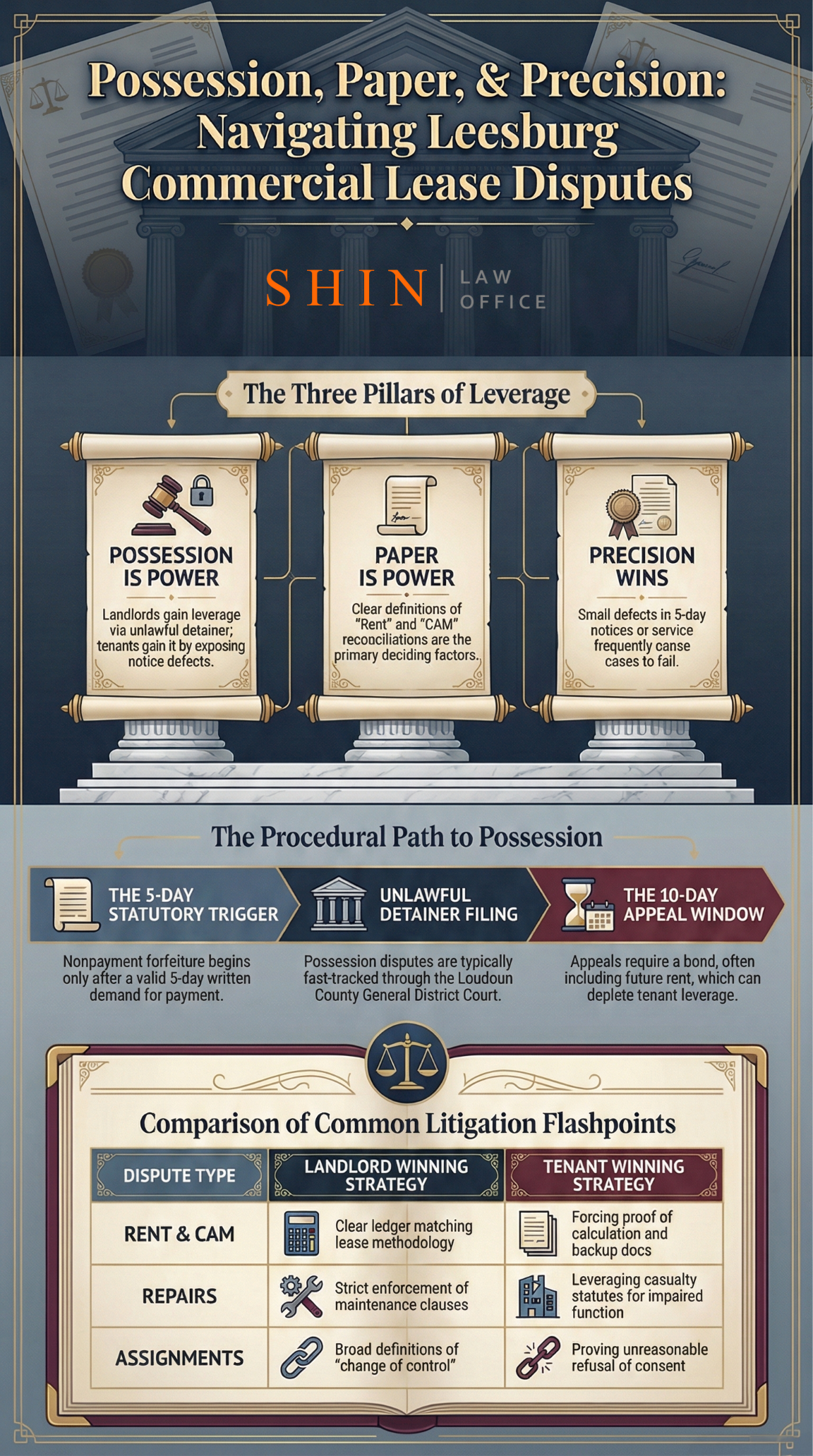
Table of Contents
Chapter 1: Legal Framework That Governs Commercial Lease Disputes
Chapter 2: High Frequency Disputes and Winning Strategies
Chapter 3: Loudoun County Procedure and Litigation Timings
Chapter 4: Financial Leverage, Guaranties, and Damages Modeling
Chapter 5: Prevention Through Drafting and Documentation
Chapter 1: Legal Framework That Governs Commercial Lease Disputes
Commercial lease litigation in Leesburg follows a defined hierarchy:
- The lease agreement
- Virginia Title 55.1 nonresidential tenancy statutes
- Virginia Title 8.01 Civil Procedure Statutes
- Local zoning and permitting ordinances
Nonresidential Termination Tools
Five Day Nonpayment Notice
If rent remains unpaid five days after a written demand for payment or possession, the tenant forfeits possession rights. Eviction may proceed through unlawful detainer. Self-help is permitted only if it does not cause a breach of the peace.
The five day notice fails frequently due to improper service or defective language. Precision matters.
Abandonment
If the premises appear abandoned and rent remains unpaid, statutory posting procedures allow the recovery of possession after the required time periods. Documentation of abandonment is critical.
Month-to-Month Termination
Thirty days’ written notice prior to the next rent due date, unless modified by the lease.
Holdover
Damages are based on use and occupation and actual loss. A holdover does not automatically create a new term absent clear lease language.
Casualty or Destruction
If premises are destroyed without the tenant’s fault, rent obligations may be reduced unless the lease clearly overrides the statute. This becomes central in fire, structural failure, and government shutdown scenarios.
Chapter 2: High Frequency Disputes and Winning Strategies
Rent and CAM Disputes
Most commercial litigation centers on money.
Common flashpoints:
• CAM reconciliations
• Utility allocations
• Insurance pass-through charges
• Property tax escalations
• Late fees and interest
Landlords prevail when the lease clearly defines rent to include additional rent and when billing records match lease methodology.
Tenants prevail by forcing proof of calculation, demanding backup documentation, and identifying deviations from clearly stated allocation formulas.
The ledger often decides the case.
Repairs and Maintenance Conflicts
Disputes arise over:
• HVAC failure
• Roof replacement
• Code compliance
• Aging systems
The outcome depends on the lease allocation language. Courts enforce clear maintenance provisions strictly. Ambiguity benefits the party that did not draft the lease.
Casualty statutes provide tenants with limited statutory leverage when destruction impairs functionality.
Assignment and Change of Control
Commercial leases frequently define assignment to include:
• Asset sales
• Equity transfers
• Corporate restructuring
Landlords succeed when definitions are broad, and notice provisions are enforced.
Tenants succeed by proving compliance with lease consent standards and by documenting unreasonable refusal if the lease includes a reasonableness clause.
Holdover and Possession Leverage
Possession is power.
Unlawful detainer allows landlords to separate possession from money damages through bifurcation.
Tenants must treat the first hearing as decisive. Appeal requires a bond, often including future rent. Many tenants lose leverage at this stage.
Chapter 3: Loudoun County Procedure and Litigation Timing
Where Cases Are Filed
Most possession disputes are handled in Loudoun General District Court due to docket efficiency.
Complex damages or injunction matters may proceed in Circuit Court.
Practical Timeline
Demand Notice
Five-day statutory window for nonpayment if using the forfeiture pathway
Unlawful Detainer Filing
Return date assigned based on court schedule
Possession Hearing
Often resolved at first appearance if uncontested
Appeal
Ten-day deadline. Bond includes rent components
Sheriff Enforcement
Eviction scheduling is dependent on writ issuance
Procedural missteps create delay. Delay reduces leverage.
Chapter 4: Financial Leverage, Guaranties, and Damages Modeling
Acceleration Clauses
Acceleration provisions are enforceable if structured as reasonable liquidated damages and not punitive windfalls.
Courts examine whether the clause allows credit for reletting or avoids double recovery.
Poor drafting converts leverage into liability.
Distress Warrants
Virginia permits recovery of rent by distress warrant.
Requires a sworn petition and a bond. May allow seizure prior to trial, subject to judicial approval.
Used strategically, distress creates pressure. Used carelessly, it creates exposure.
Guaranties
Commercial guarantees must be:
• Written
• Signed
• Supported by consideration
Virginia precedent recognizes continuing guaranties supported by extension of credit.
Jurisdiction rules allow guarantor liability to be litigated alongside unlawful detainer claims.
Guaranties frequently determine settlement value.
Attorney Fees
Virginia follows the American Rule. Fees shift only if authorized by contract or statute.
Courts expect evidentiary support. Fee clauses without proof fail.
Chapter 5: Prevention Through Drafting and Documentation
Strong drafting reduces litigation frequency.
Default Definitions
Define rent to include base rent, additional rent, fees, and pass-through charges.
Ambiguity fuels disputes.
Notice Provisions
Specify:
• Delivery method
• Receipt definition
• Cure periods
• Statutory interaction
Most possession failures trace to defects in notice.
Acceleration Structure
Include offset language to avoid over recovery.
Mirror enforceable liquidated damages standards.
Guaranty Structure
Use standalone signed guarantees.
Clarify continuing obligations.
Avoid reliance on informal assurances.
Permit and Zoning Risk Allocation
Tie the rent commencement to defined approvals if necessary.
Clearly allocate responsibility for signage, historic approvals, and certificates of occupancy.
Many rent disputes originate from zoning misunderstandings.
Final Takeaway
Commercial lease disputes in Leesburg are contests of documentation and procedure.
The party who:
• Moves first
• Documents thoroughly
• Aligns strategy with statute
controls outcome.
Possession is leverage. Paper is power. Precision wins.

Principal Attorney | Shin Law Office
Call 571-445-6565 or book a consultation online today.
(This article is provided for general informational purposes and does not constitute legal advice. For advice on your specific situation, consult with a licensed Virginia attorney.)
References
Cases
Bistro Manila, LLC v. Alvah I, LLC, 83 Va. App. 300 (Va. Ct. App. 2025).
Bank of Southside Virginia v. Candelario, 238 Va. 635 (Va. 1989).
REVI, LLC v. Chicago Title Insurance Co., 290 Va. 203 (Va. 2015).
The Game Place, L.L.C. v. Fredericksburg 35, LLC, 295 Va. 396 (Va. 2018).
TransDulles Center, Inc. v. Sharma, Record No. 951624 (Va. June 7, 1996).
Statutes and regulations
Va. Code Ann. § 8.01‑124 et seq. (Forcible entry and detainer; unlawful detainer).
Va. Code Ann. § 8.01‑128 (Bifurcation in unlawful detainer).
Va. Code Ann. § 8.01‑129 (Appeal and bond mechanics in unlawful detainer).
Va. Code Ann. § 8.01‑130.1 et seq. (Distress warrants).
Va. Code Ann. § 11‑2 (Statute of Frauds; leases > one year; guaranties).
Va. Code Ann. § 55.1‑101 (Lease conveyance not invalid for not being a deed; Feb. 13, 2019 framework).
Va. Code Ann. § 55.1‑1401 (Nonresident commercial owner resident agent; service; filing prerequisite).
Va. Code Ann. § 55.1‑1403 (Perfection of assignments of leases/rents; notice to lessee).
Va. Code Ann. § 55.1‑1404 (Submetering / RUBS; local government fees allocation; records).
Va. Code Ann. § 55.1‑1405 (Security deposit transfer upon sale).
Va. Code Ann. § 55.1‑1410 (Termination of month‑to‑month nonresidential tenancy).
Va. Code Ann. § 55.1‑1411 (Casualty/deprivation; rent reduction; intent requirement).
Va. Code Ann. § 55.1‑1413 (Nonresidential holdover; use/occupation damages).
Va. Code Ann. § 55.1‑1414 (Abandonment; notice; right to possession).
Va. Code Ann. § 55.1‑1415 (Five‑day forfeiture notice; self‑help without breach of peace; UD preserved).
Va. Code Ann. § 55.1‑1416 (Removal/storage/disposal of property after eviction; 24‑hour window).
Local rules / local government sources
Loudoun County Circuit Court. (2024). Loudoun County local rules and procedures (Rev. 04/01/2024).
Loudoun County General District Court. (2026). Local rules, procedures and best practices (Amended 01/01/2026) and docket schedule effective 2026.
Loudoun County, VA. General District Court (contact and location).
Loudoun County, VA. Clerk of the Circuit Court (contact and location).
Town of Leesburg, VA. Certificates of Appropriateness (Zoning Ordinance Section 7.5.6 reference).
Town of Leesburg, VA. Sign permits (Article 15 reference; zoning staff contact).
Town of Leesburg, VA. Zoning ordinance overview/purpose.
Continuing legal education and professional resources
Virginia Continuing Legal Education. Practical Advice: Basics of Advising Clients About Commercial Leasing.
Virginia Continuing Legal Education. Advanced Commercial Lease Negotiations (Annual Advanced Real Estate session).
Loudoun County Bar Association. CLE Committee (program overview).
Virginia State Bar. Mandatory Continuing Legal Education (MCLE) essentials and approved courses search.