
Bottom Line Up Front (BLUF)
If you are in a contract dispute in Alexandria, do not start by arguing breach of contract. Start by proving the contract is enforceable. Most business fights collapse because the deal was never properly formed, the signer lacked authority, key terms were missing, or the Statute of Frauds required a writing you do not have. If we lock down validity first, we control leverage, shape the case, and decide whether this dispute ends fast or turns into expensive litigation.
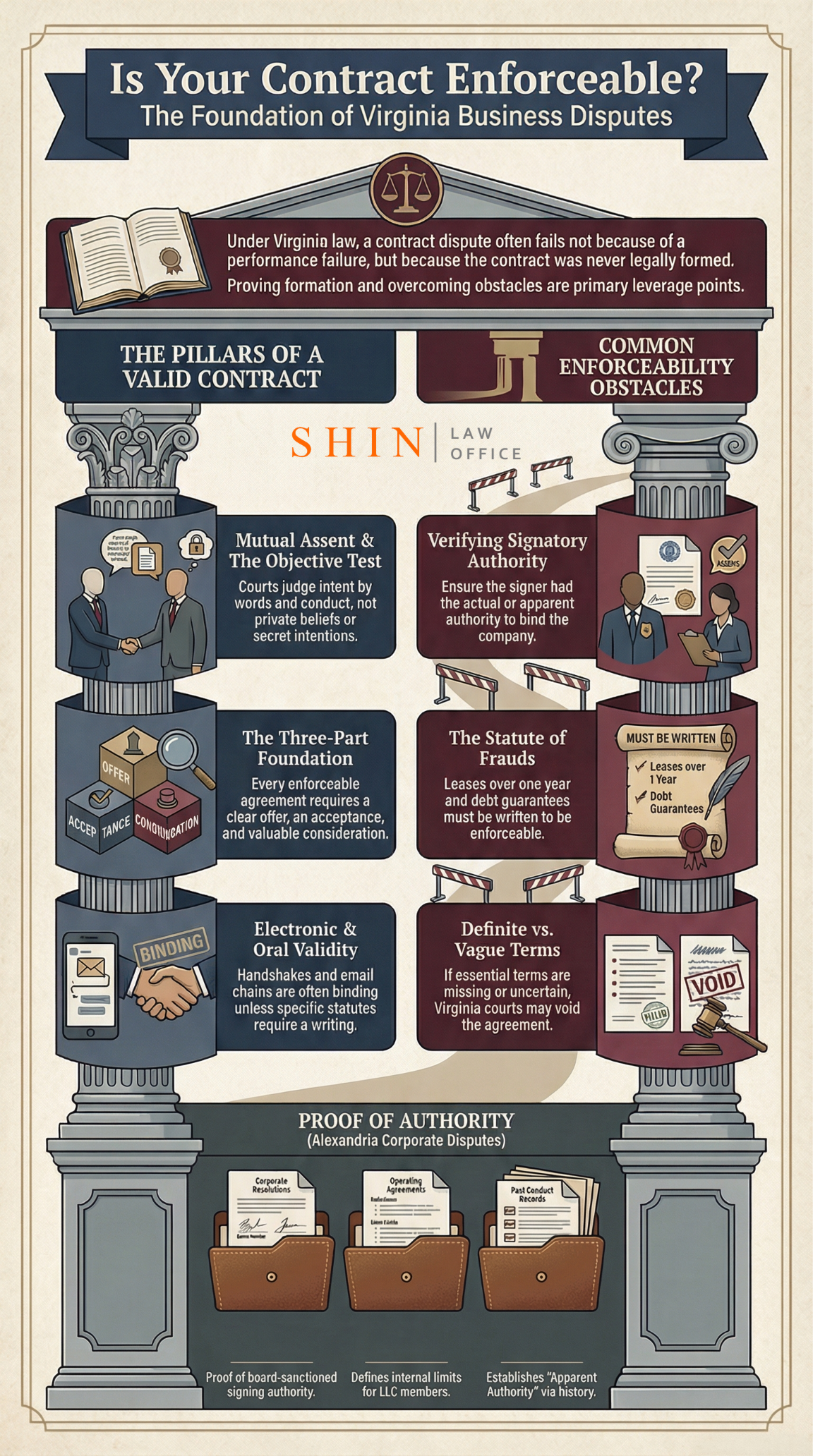
The Foundations of a Valid Contract
Under Virginia law, a valid contract requires offer, acceptance, and consideration. There must also be mutual assent, often described as a meeting of the minds (Cochran v. Norkunas, 2007).
If one of these elements is missing, the agreement may not be enforceable.
When I review a contract validity dispute in Alexandria, I start with simple questions:
• Was there a clear offer?
• Was that offer accepted without major changes?
• Was something of value exchanged?
Virginia courts require objective evidence of agreement. The test is not what one party believed privately, but what a reasonable person would understand from the parties’ words and conduct (Lucy v. Zehmer, 1954).
If there is no mutual assent, there is no contract.
Oral Agreements and Electronic Contracts
Many business disputes start with a handshake deal or a chain of emails. Clients ask me all the time, is this even a contract?
In Virginia, oral contracts can be enforceable unless a statute requires a writing. Courts look at conduct, communications, and performance to determine whether an agreement exists (Reid v. Boyle, 2000).
Electronic contracts can also be valid under the Uniform Electronic Transactions Act (Va. Code Ann. § 59.1 479 et seq.). Emails, electronic signatures, and online click-to-accept agreements can create binding obligations.
Problems usually show up when:
• Terms are incomplete
• Key details are missing
• One party says there was never a final deal
• The messages look like negotiation, not acceptance
If essential terms are uncertain, courts may find no enforceable contract (Allen v. Aetna Casualty & Surety Co., 1970).
Formation must be definite. Vague promises rarely hold up in court.
Authority Challenges and Agency Disputes
Another common validity issue is authority.
Did the person who signed have the authority to bind the company?
Virginia law recognizes actual authority and apparent authority. If an employee or agent lacks authority, the agreement may be voidable unless the company’s conduct created reasonable reliance (Neff Trailer Sales, Inc. v. Dellinger, 1980).
In Alexandria corporate disputes, I look for proof such as:
• Corporate resolutions
• Operating agreements
• Delegations of authority
• Past conduct and representations
If a contract was signed without proper authority, enforcement may be challenged. But if the other side reasonably relied on apparent authority, courts may still enforce the agreement.
Authority disputes often decide leverage early.
The Statute of Frauds and Writing Requirements
Some contracts must be in writing to be enforceable.
Virginia’s Statute of Frauds requires written agreements for:
• Contracts not performable within one year
• Promises to answer for the debt of another
• Leases of real property longer than one year
(Va. Code Ann. § 11 2)
If a required writing is missing, the agreement may be unenforceable.
In limited situations, courts may consider partial performance or equitable doctrines (Ricks v. Sumler, 1997).
In Alexandria commercial lease disputes, the Statute of Frauds often becomes the turning point. If a long-term lease is not properly documented, enforcement may fail.
Formation defects can eliminate entire claims.
Why Validity Matters More Than Breach
Clients often focus on performance. They ask whether the other side breached.
But in many cases, I first evaluate whether a contract ever legally existed.
If formation fails:
• There may be no breach claim
• Damages may be unavailable
• Leverage shifts fast
Virginia courts enforce contracts as written, but they will not create contracts where essential elements are missing (Cochran v. Norkunas, 2007).
Contract validity disputes often decide cases before trial.
Serving Alexandria and Northern Virginia Businesses
Contract validity disputes arise in:
• Partnership agreements
• Commercial leases
• Consulting contracts
• Construction agreements
• Guaranties
• Corporate transactions
These disputes are handled in the Circuit Court for the City of Alexandria when monetary thresholds are met.
The strategy must be precise. Early analysis of formation can save time, reduce costs, and mitigate risk.
Final Thought
In Alexandria contract litigation, performance arguments come second. Formation comes first.
If the agreement was never legally enforceable, the lawsuit may collapse before it begins.
I approach every contract dispute with that principle in mind.
Call to Action
If you are facing a contract dispute in Alexandria, do not assume the agreement is enforceable. Let me evaluate whether a valid contract was formed before you commit to a litigation strategy.

Principal Attorney | Shin Law Office
Call 571-445-6565 or book a consultation online today.
(This article is provided for general informational purposes and does not constitute legal advice. For advice on your specific situation, consult with a licensed Virginia attorney.)
References
Allen v. Aetna Casualty & Surety Co., 222 Va. 361 (1970).
Cochran v. Norkunas, 273 Va. 543 (2007).
Lucy v. Zehmer, 196 Va. 493 (1954).
Neff Trailer Sales, Inc. v. Dellinger, 221 Va. 367 (1980).
Reid v. Boyle, 259 Va. 356 (2000).
Ricks v. Sumler, 253 Va. 56 (1997).
Va. Code Ann. § 11 2.
Va. Code Ann. § 59.1 479 et seq.