
Bottom Line Up Front (BLUF)
Chantilly is the kind of place where commercial construction disputes grow fast. It sits inside the Route 50 and Route 28 development corridors tied to the broader Dulles Suburban Center, an area Fairfax County has planned for flexible, high-intensity economic use near Washington Dulles International Airport. In that environment, disputes between developers and contractors are usually not small misunderstandings. There are fights over money, schedule, scope, design changes, site conditions, approvals, and who carries the risk when a project stops behaving like the original deal.
Why Chantilly Produces Serious Developer Contractor Disputes
Chantilly is not just another suburban market. It is part of a larger western Fairfax development engine, shaped by airport adjacency, access to Route 50 and Route 28, industrial and commercial land demand, infrastructure pressure, and ongoing land-use planning. Fairfax County’s Dulles Suburban Center study covers roughly 5,000 acres along those corridors and was adopted to update future land use recommendations for the area. That matters because where development is active, layered, and heavily regulated, conflict between developers and contractors becomes more likely.
The friction points are easy to spot. A developer is trying to protect budget, financing, delivery dates, leasing plans, and entitlement conditions. A contractor is trying to manage labor, materials, sequencing, inspections, subcontractors, and field reality. Those interests overlap until the job gets stressed. Then they split. Chantilly projects can carry exactly the kind of complexity that triggers that split, especially where site work, utility coordination, parking, access, inspections, and changing county requirements affect the path to completion. Fairfax County’s Land Development Services has continued updating fees, review processes, parking rules, and submission systems, which shows how much of the local development environment turns on procedural compliance as much as field performance.
What These Disputes Usually Look Like
Most developer-contractor disputes in Chantilly start at one of six locations.
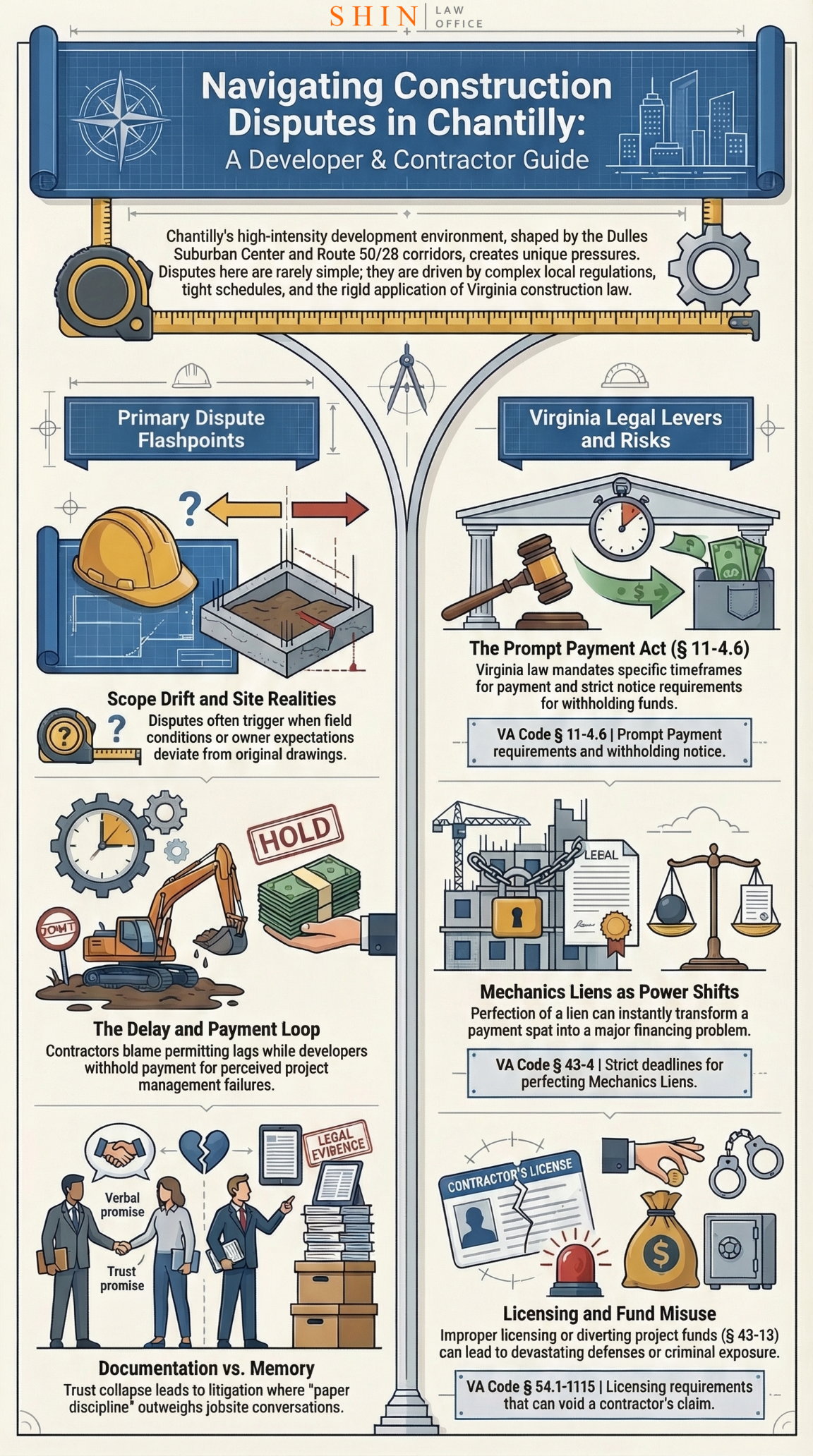
The first is scope drift. The project was priced one way, but the field conditions, drawings, specifications, or owner expectations changed. The second is delay. The contractor blames design revisions, permitting lag, access restrictions, owner decision-making, or other trades. The developer blames poor project management, understaffing, procurement failures, or sequencing mistakes. The third is money. Payment applications are cut back, retainage is withheld, change work is rejected, and everyone starts talking about defaults. The fourth is quality. The developer says the work is defective or incomplete. The contractor says the work complied with the contract or that the alleged defects are design-driven, trade-driven, or exaggerated. The fifth is site conditions. Unexpected utilities, grading problems, drainage issues, unsuitable soils, or inspection failures push the job off its original assumptions. The sixth is termination. Once trust collapses, the parties stop trying to fix the project and start building a record for litigation. These kinds of disputes are especially common in active review environments where county site processes, parking rules, inspection pathways, and submission requirements affect progress.
The Contract Usually Decides Who Wins
In a developer contractor dispute, the contract is not background noise. It is the battlefield.
I look first at the scope language, the schedule provisions, the payment clause, the change order requirements, the notice provisions, the closeout obligations, the warranty language, the default clause, and the dispute resolution section. Then I compare those provisions to what actually happened on the project. A Chantilly case is often decided by whether the parties followed the contract when the job became difficult, not by what they say they meant months later.
Virginia law also matters. Under Code of Virginia section 11.4.6, construction contracts must include prompt payment provisions, including timeframes for payment after receipt of an invoice for work satisfactorily completed. The statute also addresses withholding and notice. That means a dispute about nonpayment is rarely just an emotional fight. It usually turns on whether the work was satisfactorily completed, whether withholding was allowed, and whether the required notice was given.
Developers Often Underestimate Their Own Exposure
Developers sometimes assume that because they control the project, they control the dispute. That is not always true.
A developer can create serious exposure by delaying approvals, issuing informal field directives without proper paper, accelerating the work without formal compensation treatment, withholding payment without a solid contractual basis, or terminating a contractor without building a defensible record first. If the developer keeps pushing the project while ignoring the contract’s change and notice mechanisms, the developer may help create the very claim it later tries to defeat. Virginia’s payment statute makes the timing and basis of withholding matter.
Developers also get exposed when they treat documentation as an administrative burden rather than a litigation asset. On a stressed commercial project, daily reports, meeting minutes, revised schedules, site directives, pay applications, rejection notices, and inspection records can become the difference between a strong case and a weak one. In Fairfax County’s development environment, where site-related submissions, permit guidance, inspection processes, and county procedural changes continue to evolve, paper discipline is not optional.
Contractors Make Their Own Mistakes Too
Contractors lose cases by doing extra work without preserving the right to get paid for it. They lose cases by assuming everyone understands the urgency in the field. They lose cases by falling behind and blaming everything on the owner without proving causation. They lose cases by using the wrong license posture. And they lose cases by waiting too long to protect payment rights.
Virginia contractor licensing law matters more than many businesses realize. Code of Virginia section 54.1.1115 prohibits contracting or bidding on covered construction work without the required license or proper class of license for the value of the work. In the right case, licensing problems can become a devastating defense.
That issue becomes even more dangerous on a commercial Chantilly project because the value of the work, the contract tier, and the permit structure can make licensing arguments far more than technical side issues. A contractor that did real work can still find itself in a deeply compromised position if its licensing posture does not match the job.
Payment Fights Are Usually About More Than One Invoice
When a developer and contractor clash over payment, the surface fight is often not the real fight. One side says the draw was unsupported. The other says the developer is using payment pressure to gain leverage on delay or quality issues. One side says the change work was never approved. The other says the project could not move without it. One side says the work was incomplete. The other says substantial completion was reached and the remaining issues are punch list noise.
Virginia’s prompt payment framework matters here. Section 11.4.6 requires payment timing language in construction contracts and provides rules about withholding and notice. That statute gives contractors leverage when payment is delayed without a valid and properly handled basis. It also gives developers structure when they do have legitimate reasons to reject or reduce a payment demand.
Mechanics Liens Can Change the Power Balance Fast
One of the biggest mistakes in Chantilly construction disputes is assuming the case is only a contract case. Sometimes it is also a lien case.
Virginia mechanics lien law is technical and deadline driven. Section 43.4 governs perfection of certain liens through recordation and notice, and the statutory deadlines are strict. Subcontractors also must comply with additional notice requirements under Virginia lien law. If lien rights are preserved correctly, the dispute changes. What looked like a payment disagreement becomes a title problem, a financing problem, a closing problem, or a development problem. That usually gets attention fast.
Virginia law also gives subcontractors a path, in some circumstances, to make an owner or general contractor personally liable up to the unpaid amount still owed upstream if the statutory notice process is followed correctly. Section 43.11 is one reason developers and contractors cannot casually ignore lower tier payment issues once proper notice lands.
Misuse of Project Funds Can Blow Up the Entire Dispute
Some cases stop being ordinary contract fights.
Under Code of Virginia section 43.13, funds paid to a contractor or subcontractor for a project must be used to pay those performing labor or furnishing materials for that project, and intentional diversion of those funds while project obligations remain unpaid can create criminal exposure. That does not mean every cash flow problem is fraud. It does mean parties should be very careful when project money comes in but project participants remain unpaid.
That statute can radically change the tone of a dispute. A developer may start asking where the draw money went. A contractor may start asking whether withheld funds were leveraged for unrelated concessions. Once fund use becomes part of the case, the dispute often gets sharper, faster, and more dangerous.
Chantilly Projects Add Real World Pressure
Chantilly disputes are not happening in a vacuum. They are unfolding in a local market shaped by development pressure, site review systems, county process changes, and corridor level planning. Fairfax County has continued updating its land development framework through fee changes, review time changes tied to House Bill 2660, customer support changes, inspection guidance, and parking regulation updates. Those are not abstract bureaucratic details. They affect scheduling, submittals, redesigns, approvals, and project cost. When those moving parts collide with a strained contract relationship, litigation becomes much more likely.
That is why Chantilly cases often involve more than labor and materials. They involve entitlement assumptions, county coordination, utility timing, traffic and access concerns, inspection sequencing, and commercial delivery pressure. In a corridor tied to the Dulles Suburban Center’s long term growth framework, those risks are structural, not accidental.
What Businesses Commonly Get Wrong
The first mistake is waiting too long. Developers wait because they think the contractor will catch up. Contractors wait because they think the payment will clear next cycle. While both sides wait, the record gets worse and the leverage starts leaking away.
The second mistake is acting like jobsite conversations are enough. They are not. If the dispute reaches a Fairfax County courtroom, the paper usually matters more than the memory.
The third mistake is treating delay, quality, and payment as separate issues. On real projects, they are usually tied together. A developer withholds payment because of delay or quality. A contractor falls further behind because of nonpayment. Then both sides accuse the other of causing the collapse.
The fourth mistake is ignoring statutory remedies because everyone is too focused on the contract. In Virginia, payment rules, lien rules, notice rules, and licensing rules can reshape the whole case.
My View as a Business Litigation Attorney
When I handle disputes between developers and contractors in Chantilly, I do not start with broad accusations. I start with leverage. I want to know what the contract says, what the record shows, what the county process did to the timeline, what money is actually owed, what notice requirements were triggered, and what remedies were preserved. That is how you separate a real claim from a loud one.
Chantilly is exactly the kind of market where commercial construction disputes can become expensive fast. It sits inside a serious growth corridor. It carries the pressure of dense commercial development and procedural complexity. And when a project turns, the legal issues usually extend far beyond one unpaid bill or one angry email.
Closing Summary
Disputes between developers and contractors in Chantilly usually come down to risk allocation under pressure. Scope changes. Delays. Site problems. Payment withholding. Defect claims. Termination threats. Those are not random events. They are predictable flashpoints in an active commercial construction corridor.
Virginia law gives both sides real tools, but those tools only matter if they are used correctly and on time. If your business is facing a developer contractor dispute in Chantilly, the right move is to evaluate the contract, the record, the payment trail, and the available remedies before the project problem becomes a litigation disaster.

Principal Attorney | Shin Law Office
Call 571-445-6565 or book a consultation online today.
(This article is provided for general informational purposes and does not constitute legal advice. For advice on your specific situation, consult with a licensed Virginia attorney.)
References
Fairfax County, Virginia. (n.d.). Codes and standards. Retrieved March 12, 2026, from https://www.fairfaxcounty.gov/landdevelopment/codes-and-standards
Fairfax County, Virginia. (n.d.). Land Development Services. Retrieved March 12, 2026, from https://www.fairfaxcounty.gov/landdevelopment/
Fairfax County, Virginia. (n.d.). News and information | Land Development Services. Retrieved March 12, 2026, from https://www.fairfaxcounty.gov/landdevelopment/news-and-information
Fairfax County, Virginia. (2023, March 21). 2017 edition of the comprehensive plan, Area III: Dulles Suburban Center, amended through 3 21 2023 [PDF]. https://www.fairfaxcounty.gov/planning-development/sites/planning-development/files/Assets/Documents/ComprehensivePlan/planhistoric/2017/area3/dulles/3-21-2023.pdf
Fairfax County, Virginia. (n.d.). The Dulles Suburban Center study. Retrieved March 12, 2026, from https://www.fairfaxcounty.gov/planning-development/dulles-suburban-center
Virginia Law. (n.d.). § 11 4.6. Required contract provisions in construction contracts. Retrieved March 12, 2026, from https://law.lis.virginia.gov/vacode/title11/chapter1/section11-4.6/
Virginia Law. (n.d.). § 43 4. Perfection of lien by general contractor; recordation and notice. Retrieved March 12, 2026, from https://law.lis.virginia.gov/vacode/title43/chapter1/section43-4/
Virginia Law. (n.d.). § 43 11. How owner or general contractor made personally liable to subcontractor, laborer or materialman. Retrieved March 12, 2026, from https://law.lis.virginia.gov/vacode/title43/chapter1/section43-11/
Virginia Law. (n.d.). § 43 13. Funds paid to general contractor or subcontractor must be used to pay persons performing labor or furnishing material. Retrieved March 12, 2026, from https://law.lis.virginia.gov/vacode/title43/chapter1/section43-13/
Virginia Law. (n.d.). § 54.1 1115. Prohibited acts. Retrieved March 12, 2026, from https://law.lis.virginia.gov/vacode/title54.1/chapter11/section54.1-1115/