A Construction Litigation Guide for Fairfax City
How Contractors Can Pursue Compensation
BLUF
Delays on Fairfax City public works projects can cost contractors millions of dollars — but under Virginia law and municipal contract rules, those losses are recoverable only if the contractor strictly preserves their legal rights early and follows the contract procedures to the letter. Unlike private construction, public works projects operate under rigid procurement rules and notice requirements, and Virginia courts enforce those requirements strictly. Many otherwise valid delay claims fail not because the delay wasn’t justified, but because contractors miss notice deadlines, accept time extensions without reserving cost claims, or fail to document disruption impacts in writing. This guide explains when delays are considered excusable vs. compensable, how change orders and notice requirements affect recovery, what damages can be pursued, and why early legal strategy, not hindsight, separates recoverable claims from waived rights under Fairfax City contracts.
If you are asking questions like these, this article is written for you:
• How do Fairfax City public works delay claims work under Virginia law?
• What’s the difference between excusable and compensable delays?
• When do change orders create a right to financial recovery?
• Why do many delay claims fail before they are considered on the merits?
• How can contractors protect their rights against payment withholding and procedural traps?
This article explains how delays arise on municipal projects, how to preserve claims properly, and what compensation may be available when Fairfax City’s actions impact schedules, productivity, and costs.
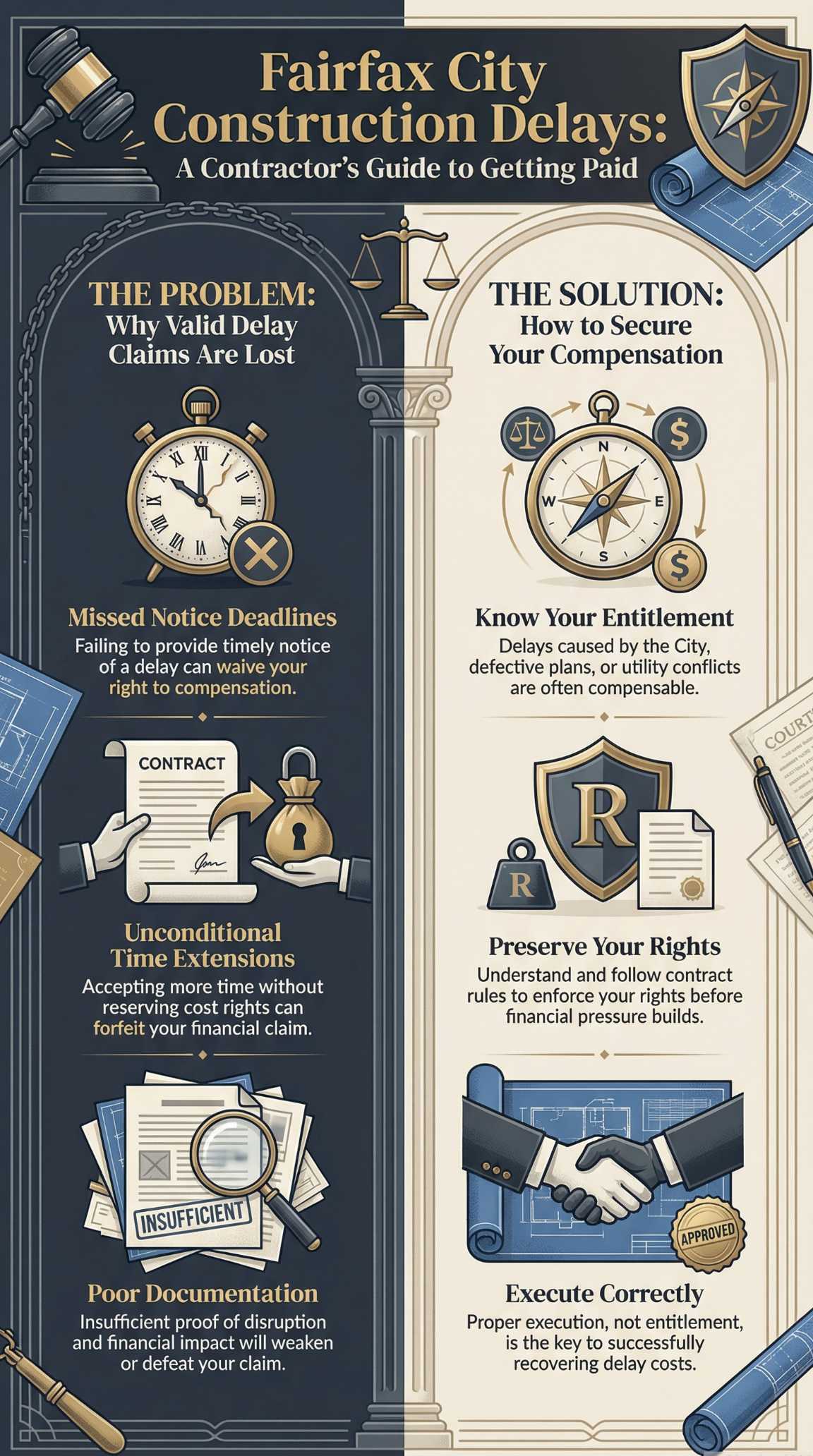
Table of Contents
- Understanding Public Works Construction in Fairfax City
- Common Causes of Delays on Public Projects
- Excusable vs Compensable Delays
- Notice Requirements and Claim Preservation
- Delay Claims Against Fairfax City
- Change Orders and Time Extensions
- Impact and Disruption Claims
- Payment Withholding and Financial Pressure
- Sovereign Immunity and Its Limits
- Litigation and Dispute Resolution
Understanding Public Works Construction in Fairfax City
How Municipal Projects Differ From Private Construction
Public works projects in Fairfax City operate under a fundamentally different legal framework than private construction. The owner is a municipality, not a private developer. Every decision is filtered through procurement rules, standardized contract language, and public accountability. That structure shapes how delays arise and how compensation claims must be pursued.
Unlike private projects, where scope gaps can be negotiated informally, Fairfax City public projects are bound to bid documents and specifications approved before construction begins. City engineers, inspectors, and project managers operate within defined authority. Contractors are not negotiating with decision makers in real time. They are dealing with a layered system where approvals often move slowly and inconsistently.
Delays on public projects frequently originate from design deficiencies, utility conflicts, inspection sequencing, and owner-directed changes. Yet contractors are often discouraged from asserting claims early. There is a persistent fear of being labeled difficult or non-cooperative. That fear causes contractors to miss notice deadlines and inadvertently waive their right to compensation.
Another critical difference is documentation. Public projects demand written records. Verbal directives carry little legal weight. When disputes arise, the contract controls, not field conversations. Courts reviewing Fairfax City disputes focus on compliance with written procedures.
Understanding this environment is essential. Contractors who approach public works projects with private construction instincts often lose legitimate claims before they begin. Those who understand the municipal framework preserve leverage and protect their financial position.
Common Causes of Delays on Fairfax City Public Projects
Where Municipal Construction Timelines Break Down
Most delays on Fairfax City public works projects do not stem from contractor performance. They arise from conditions inherent to public construction.
One frequent source is an incomplete or defective design. Public agencies often bid on projects before plans are fully coordinated. Contractors discover conflicts between civil, structural, and utility drawings only after mobilization. Resolving these issues requires clarification, redesign, and approval cycles that stall progress.
Utility conflicts are another common cause. Underground conditions in Fairfax City frequently differ from records. Relocation approvals involve third-party utilities, each with its own timeline. Contractors cannot control these processes, yet they absorb the schedule impact if claims are not preserved.
Inspection delays also drive significant disruption. Public inspectors manage multiple projects simultaneously. Missed inspections halt work. Failed inspections require rework and rescheduling. These delays compound quickly.
Owner-directed changes are particularly disruptive. Fairfax City may revise the scope to address budget, safety, or community concerns mid-project. These changes often alter sequencing and productivity even when time extensions are granted.
Weather, permitting coordination, and third-party interference also contribute. The key issue is not whether delays occur. It is whether the contractor documents causation and preserves rights before the delay becomes normalized.
Excusable vs Compensable Delays on Municipal Construction Jobs
Understanding the Difference Matters
Not all construction delays are treated the same under Virginia law, and this distinction is where many Fairfax City public works contractors lose significant money without realizing it. I routinely see contractors assume that any delay outside their control automatically entitles them to compensation. That assumption is wrong. Virginia public construction law draws a sharp line between delays that merely excuse late performance and delays that require the public owner to pay.
Fairfax City public works contracts almost always separate delays into two legal categories: Excusable delays and compensable delays. Understanding which category applies is not academic. It determines whether a contractor recovers extended overhead, standby labor, escalation costs, and disruption damages or absorbs those losses entirely.
Excusable Delays
Excusable delays extend the contract completion date but do not entitle the contractor to additional compensation. These delays relieve the contractor from default or liquidated damages but shift the financial burden back onto the contractor.
Common examples include unusually severe weather, certain force majeure events, and delays caused by circumstances beyond the control of both the contractor and the owner. Many Fairfax City contracts expressly define these events and limit recovery to time only.
Virginia courts generally enforce these provisions as written. If a delay falls within an excusable delay clause and the contract disclaims monetary recovery, the contractor may receive additional time but no economic recovery. Accepting a time extension under these circumstances often closes the door to later cost claims.
Compensable Delays
Compensable delays are fundamentally different. These delays entitle the contractor to both additional time and monetary compensation because the delay is attributable to the public owner or conditions the owner is legally responsible for.
In Fairfax City public works projects, compensable delays commonly arise from:
- Owner-directed changes in scope
- Defective or incomplete plans and specifications
- Differing site conditions
- Utility conflicts not disclosed in bid documents
- Interference with sequencing or site access
- Failure to coordinate inspections or approvals
Virginia law recognizes that when a public owner causes a delay, it cannot simultaneously demand performance without consequence. Courts have repeatedly held that an owner breaches the contract when it actively interferes with the contractor’s work or provides defective plans that prevent timely performance.
This principle aligns with long-standing Virginia contract law governing public works and is reinforced by the implied duty not to hinder performance. When Fairfax City actions disrupt the critical path of construction, the delay is no longer neutral. It becomes compensable.
The Hidden Trap of Time Extensions
One of the most common and costly mistakes I see is contractors accepting time extensions without reserving cost impacts. Fairfax City may offer additional days to complete the work, framing the delay as resolved. Contractors accept, relieved to avoid default, and move on.
Legally, that acceptance can be fatal.
Virginia courts often treat unchallenged time extensions as an agreement resolving responsibility for the delay. If the contractor does not expressly reserve the right to seek compensation, the extension may be interpreted as a full settlement of the delay issue. This is where contractors unintentionally waive thousands or millions of dollars in legitimate claims.
Why Early Legal Analysis Matters
Determining whether a delay is excusable or compensable requires more than intuition. It requires analyzing:
- The specific contract language
- Virginia public procurement law
- The cause of the delay
- Whether the delay impacted the critical path
- Whether notice and reservation requirements were satisfied
Virginia Code governing public contracts, including the competitive negotiation and public procurement framework, allows municipalities to define claim procedures but does not permit them to avoid liability for their own interference or breach. Contractors who understand this early preserve leverage. Those who do not are forced into defensive positions later.
Preserving the Right to Compensation
To preserve a compensable delay claim on a Fairfax City project, a contractor must:
- Identify the delay as owner-caused
- Provide timely written notice as required by contract
- Reserve cost impacts when accepting time extensions
- Document schedule and productivity impacts
- Avoid language suggesting waiver or full resolution
This is not about confrontation. It is about protecting contractual rights under Virginia law. In public works construction, the difference between excusable and compensable delay is the difference between surviving a delay and being paid for it. Contractors who understand that difference early place themselves in the strongest possible position when disputes arise.
Notice Requirements and Claim Preservation on Fairfax City Contracts
Why Most Delay Claims Fail Before They Begin
In my experience, most Fairfax City public works delay claims do not fail because the delay was unjustified. They fail because the contractor missed a notice requirement buried in the contract. This is one of the most unforgiving aspects of Virginia municipal construction law, and it is where otherwise valid claims quietly die before they are ever evaluated on the merits.
Fairfax City public works contracts impose strict procedural requirements for asserting delay and cost claims. These requirements are not suggestions. Under Virginia law, courts routinely enforce notice provisions as written, even when the public owner was clearly aware of the problem. Actual knowledge does not replace contractual notice. Silence, delay, or informal communication does not preserve rights.
What Fairfax City Notice Provisions Typically Require
Most Fairfax City construction contracts require contractors to provide written notice within a very short time window after a delay event occurs. That window is often measured in days, not weeks. The notice usually must include:
- A description of the event causing the delay
- An explanation of why the contractor believes the delay is excusable or compensable
- A statement that the contractor intends to seek additional time, money, or both
Critically, Virginia law does not require the contractor to quantify damages at the notice stage unless the contract explicitly says otherwise. The purpose of notice is identification, not calculation.
The Most Common Mistake Contractors Make
The most common and costly mistake I see is waiting until the financial impact is known before providing notice. Contractors understandably want to avoid overreacting. They hope the issue will resolve. They wait to see if the delay grows serious enough to justify a claim.
By the time the costs are clear, the notice deadline has passed. At that point, Fairfax City is legally entitled to argue that the claim is barred, even if the City caused the delay. Virginia courts regularly uphold these defenses. The logic is simple: The contract required notice. The contractor failed to give it. The claim is waived.
Why Informal Communication Is Not Enough
Another misconception is that verbal discussions, meeting minutes, or the inspector’s awareness satisfy the notice requirements. They do not. Virginia law draws a sharp distinction between actual knowledge and contractual notice. A city engineer’s knowledge of a delay does not preserve a contractor’s claim if the contract requires formal written notice delivered in a specific manner.
Emails to project staff may or may not qualify, depending on the contract language. Many contracts require notice to be sent to a designated official, within a defined timeframe, using specific language. Failing to follow that process gives the City a procedural defense that is often dispositive.
Notice Is Not an Accusation
Many contractors hesitate to issue notice because they fear damaging the relationship with the City. That hesitation is understandable but misplaced. Notice is not a claim. It is not litigation. It is not an accusation of wrongdoing. It is a contractual safeguard.
Virginia public procurement law allows municipalities to require notice so they can evaluate impacts, mitigate delays, and manage public funds responsibly. Courts recognize this purpose and enforce notice provisions accordingly. When contractors frame notice as procedural compliance rather than confrontation, disputes are often easier to resolve, not harder.
Reservation of Rights Is Equally Important
Notice alone is not enough. Contractors must also reserve their rights when accepting time extensions, executing change orders, or continuing work under protest. Accepting a time extension or change order without expressly reserving cost impacts can be interpreted as a waiver of delay damages. Virginia courts frequently look at whether the contractor objected contemporaneously or accepted relief as full resolution. Clear reservation language protects against unintended waiver.
Preserving Claims the Right Way
To preserve a delay claim on a Fairfax City public works project, contractors should:
- Issue written notice immediately when a delay event occurs
- Identify the event and its potential impact
- State intent to seek time and/or compensation
- Comply strictly with delivery and timing requirements
- Reserve rights when accepting extensions or partial relief
- Document schedule and cost impacts as the project progresses
This approach aligns with Virginia contract law and protects the contractor’s ability to pursue compensation later. In public works construction, delay claims are won or lost on procedure long before they reach a courtroom. Contractors who understand and respect Fairfax City notice requirements preserve leverage. Those who do not often discover too late that their strongest claims were waived before they ever began.
Delay Claims Against Fairfax City
What Contractors Can and Cannot Recover
When delays occur on Fairfax City public works projects, the most critical question is not whether the project was delayed. It is what the contractor is legally entitled to recover. Under Virginia law, delay damages are real and recoverable in certain circumstances, but they are also tightly constrained by contract language and well-established judicial precedent. Contractors who do not understand these limits often either overreach and lose credibility or underdocument and leave substantial money on the table.
Categories of Delay Damages Contractors May Recover
When a delay is compensable, Virginia law generally allows contractors to recover damages that are the natural and foreseeable result of the owner-caused delay, provided those damages are not contractually barred and are properly proven. On Fairfax City projects, recoverable delay damages commonly include:
Extended field overhead: This includes costs such as project management staff, site supervision, trailers, temporary utilities, safety personnel, and on-site administrative expenses that continue solely because the project duration was extended.
Home office overhead: Under certain circumstances, contractors may recover unabsorbed home office overhead when an owner-caused delay prevents the reassignment of resources. These claims are technical and often require expert analysis.
Escalation costs: Owner-caused delays that push work into later periods can result in higher labor rates, increased material costs, or subcontractor pricing changes. When the delay is compensable, these increased costs may be recoverable.
Standby labor and equipment: When Fairfax City actions force contractors to keep crews or equipment idle but available, those standby costs may be compensable if properly documented and directly tied to the delay event.
Inefficiency and loss of productivity: Disruption caused by resequencing, trade stacking, stop-start conditions, or acceleration can dramatically reduce productivity. Virginia courts recognize these impacts, but they require careful proof and are often the most contested damages.
The critical point is that none of these damages is automatic. Recovery depends on both contract terms and evidence.
Contractual Limits on Delay Recovery
Fairfax City public works contracts frequently include clauses that restrict delay damages. The most common is the so-called no damage for delay clause. These provisions state that the contractor’s sole remedy for delay is additional time, not money.
Virginia courts generally enforce no-damage-for-delay clauses as written. However, they are not absolute. Courts have recognized limited exceptions where enforcement would be unjust or contrary to public policy. These exceptions typically include:
- Active interference by the owner
- Delays not contemplated by the parties at the time of contracting
- Delays caused by defective plans or specifications
- Bad faith or arbitrary conduct by the public owner
When Fairfax City actions rise to the level of active interference, such as directing work out of sequence, failing to provide access, or issuing knowingly defective designs, courts may allow recovery despite a no damage for delay clause. That said, these exceptions are narrowly applied. Contractors must prove more than inconvenience or mismanagement. They must show affirmative conduct that directly hinders performance.
What Contractors Cannot Recover
Equally important is understanding what is generally not recoverable. Purely speculative damages are barred. Contractors must prove actual costs incurred. Lost future profits on unrelated work are typically not recoverable. Emotional frustration and generalized business impact have no place in public contract claims. Additionally, if a contractor causes concurrent delay, recovery may be reduced or eliminated depending on the extent of overlap. Virginia courts carefully examine concurrency arguments, especially on public projects.
Why Early Damage Identification Matters
Delay claims are won or lost on documentation. Contractors who wait until the end of the project to reconstruct damages are at a disadvantage. Courts expect contemporaneous records tying specific delay events to specific cost impacts. Understanding recoverable categories early shapes how contractors track costs. It determines whether time sheets distinguish standby labor, whether equipment logs capture idle time, and whether schedule updates isolate owner-caused delays. This is why early legal guidance matters. When contractors know what they can recover, they document differently. They protect leverage instead of guessing.
Change Orders and Time Extensions on Public Works Projects
When Delays Become Owner’s Responsibility
On Fairfax City public works projects, change orders are one of the most common and misunderstood sources of delay compensation. Contractors often view change orders as routine adjustments to scope and price. Fairfax City usually treats them as administrative housekeeping. Legally, however, change orders can shift responsibility for delays squarely onto the owner and create a right to compensation under Virginia law when handled correctly.
Under most Fairfax City contracts, the City retains the right to direct changes to the work. That authority is not unlimited. When the City issues a change that alters scope, sequencing, or performance requirements, the contractor is typically entitled to an equitable adjustment. An equitable adjustment is intended to place the contractor in the same financial position it would have occupied had the change never occurred. That includes both time and money when the change causes a delay.
Why Time Extensions Alone Are Not Enough
One of the most dangerous misconceptions I see is the belief that a time extension resolves all consequences of a change order. It does not. A time extension only addresses the calendar. It does not address productivity loss, extended overhead, trade resequencing, or increased costs caused by disruption. Yet Fairfax City will often offer additional days to close the issue quickly, sometimes without addressing cost impacts at all.
Accepting a time extension without addressing compensation can be interpreted as agreement that the delay has been fully resolved. Under Virginia contract law, courts often look at whether the contractor objected to inadequate relief at the time it was granted. Silence or acceptance can be construed as a waiver. This is particularly true on public works projects, where courts expect contractors to comply with contract procedures strictly and to assert claims contemporaneously.
When Change Orders Trigger Compensable Delay
Not every change order creates a compensable delay. The key question is whether the change impacted the critical path or caused measurable disruption to the work. Change orders that commonly trigger compensable delay include:
- Late-issued design revisions that affect work already underway
- Changes that force resequencing of trades
- Added work in confined areas that disrupt the planned workflow
- Owner-directed acceleration followed by subsequent scope increases
- Changes that require new permits or inspections
When Fairfax City directs changes under these circumstances, the delay is no longer neutral. It is owner-caused. Under Virginia law, an owner who changes the scope of work and interferes with the contractor’s planned performance cannot shift the resulting costs back onto the contractor.
The Importance of Linking Scope, Schedule, and Cost
The most critical factor in recovering delay compensation tied to change orders is causation. Contractors must explicitly connect:
- The change directive
- To a schedule impact
- To a specific cost consequence
General statements that a change “caused delay” are not enough. Courts require evidence showing how the change altered the critical path or reduced productivity and how that impact translated into additional costs. This is where many contractors fall short. They price the added work but fail to address the ripple effects. Later, when the project runs long and costs increase, they attempt to recover delay damages without having preserved the causal link. Virginia courts are skeptical of after-the-fact reconstructions. They favor contemporaneous documentation created at the time the change occurred.
Change Orders as Evidence of Owner Responsibility
Properly handled, change orders can become robust evidence of owner-caused delay. They document that Fairfax City directed changes, altered the original plan, and required additional work beyond the scope of the bid documents. When combined with schedule updates, daily reports, and correspondence, change orders help establish that the contractor did not cause the resulting delay. They shift responsibility where it belongs.
In Fairfax City public works litigation, change orders are rarely just paperwork. They are the paper trail that determines who pays for the delay. Contractors who understand this treat change orders as legal instruments, not administrative chores. Those who do not often discover too late that they gave away the most substantial evidence of their own entitlement to compensation.
Impact and Disruption Claims on Fairfax City Construction Sites
The Hidden Cost of Delay
Not all delays shut a project down. In fact, the most expensive delays I see on Fairfax City public works projects rarely involve full work stoppages at all. Instead, they show up as impact and disruption, the slow erosion of productivity caused by owner-driven changes, resequencing, and compressed schedules. These are the hidden costs of delay, and they are often the largest unrecovered losses contractors absorb.
Impact claims focus on how work was forced to be performed, not whether work stopped entirely. When Fairfax City actions disrupt the planned sequence of construction, the contractor may still be working every day, but far less efficiently than bid initially. Crews overlap, trades interfere with one another, and work that should have flowed smoothly becomes fragmented.
How Impact and Disruption Occur on Public Projects
On Fairfax City construction sites, impact and disruption commonly arise from:
- Late design changes that force crews to return to completed areas
- Owner-directed resequencing to accommodate inspections or public access
- Multiple trades working simultaneously in confined spaces
- Acceleration directives issued to recover owner caused delays
- Stop-start work caused by late approvals or partial access
None of these conditions necessarily stops work outright. Instead, they degrade productivity. Crews spend more time mobilizing and demobilizing. Supervision demands increase. Work that should have been completed once must be revisited multiple times. From a contractor’s perspective, this is often more damaging than a clean suspension. Labor costs rise. Output drops. The job appears active, but profit quietly disappears.
Why Impact Claims Are Harder to Prove
Virginia courts recognize disruption and loss of productivity as legitimate categories of damages when owner conduct causes them. However, these claims are scrutinized far more closely than straightforward delay claims. The reason is simple. Productivity loss is not always visible. It must be proven, not assumed.
Courts expect contractors to demonstrate:
- What the planned method and productivity were
- How owner actions altered that method
- How productivity was reduced as a direct result
- What additional costs were incurred because of that reduction
General statements that work was “less efficient” are not enough. Courts require a causal connection between specific owner actions and measurable productivity loss. This is where many claims fail. Contractors feel the disruption but cannot prove it with the level of detail the law requires.
The Role of Expert Analysis
In Fairfax City public works litigation, impact and disruption claims almost always require expert support. Schedule experts analyze how resequencing and acceleration affected the critical path. Cost experts evaluate labor inefficiency, trade stacking, and extended supervision. Virginia courts are skeptical of unsupported contractor opinions on productivity loss. Expert testimony translates field realities into defensible legal evidence. That does not mean contractors are powerless without experts early. It means the groundwork must be laid while the project is ongoing.
The Records That Make or Break Impact Claims
Impact claims live and die on documentation. Contractors who preserve the following records place themselves in a far stronger position:
- Daily reports showing manpower by trade and location
- Schedule updates reflecting resequencing and acceleration
- Correspondence documenting owner-directed changes
- Photos showing crowded work areas or rework
- Labor records distinguishing productive work from standby or inefficiency
- Meeting minutes noting coordination conflicts
These records allow experts to reconstruct what happened. Without them, claims rely on memory, which courts view with skepticism.
Preparation Is Everything
Impact and disruption claims are not impossible. They are precise. Contractors who approach them casually lose. Contractors who approach them strategically recover. That strategy starts during construction, not after completion. When contractors recognize that disruption is occurring and begin documenting it correctly, they preserve the ability to prove it later.
Payment Withholding and Delay Related Financial Pressure
When Delays Trigger Cash Flow Disputes
On Fairfax City public works projects, delays rarely exist in isolation. Almost every significant delay dispute eventually turns into a payment dispute. When schedules slip and claims arise, Fairfax City may begin withholding progress payments or retainage, creating immediate cash-flow pressure on the contractor. This financial strain is not accidental. It is leverage.
From the City’s perspective, withholding payment preserves public funds while disputes remain unresolved. From the contractor’s perspective, it can quickly threaten payroll, subcontractor relationships, bonding capacity, and ongoing operations. Understanding how Virginia law governs payment withholding is critical to preventing that pressure from forcing bad decisions.
Virginia Prompt Payment Law and Public Works Projects
Virginia law does not give public owners unlimited discretion to withhold payment. The Virginia Prompt Payment Act, codified at Virginia Code § 2.2-4354 et seq., establishes requirements for timely payment on public contracts and limits improper withholding. Under this statute, public bodies are generally required to:
- Pay contractors within a specified period after receipt of a proper invoice
- Provide written notice identifying specific reasons for any withholding
- Pay interest on amounts improperly withheld
Importantly, withholding must be tied to bona fide disputes. General dissatisfaction or unresolved delay claims do not automatically justify indefinite non-payment. Courts look closely at whether the withholding was reasonable, documented, and proportional. While Fairfax City may assert contractual rights to withhold payment, those rights exist alongside statutory obligations. Contractors who understand this framework are better positioned to push back without prematurely escalating conflict.
Asserting Rights Without Escalating Conflict
Asserting prompt payment rights does not require hostility. Contractors can:
- Request written justification for withholding
- Invoke statutory payment timelines
- Reserve rights while continuing performance
- Separate payment compliance issues from delay claim negotiations
This approach signals seriousness without burning bridges. It also creates a written record that courts value if litigation becomes necessary.
Preventing Leverage Loss
The worst position for a contractor is to be both delayed and unpaid without a strategy. Financial pressure leads to rushed decisions, waived claims, and unfavorable settlements. Strategic handling means:
- Preserving delay claims procedurally
- Asserting payment rights statutorily
- Documenting all withholding reasons
- Avoiding informal concessions under pressure
On Fairfax City public works projects, cash flow is power. Contractors who understand Virginia’s prompt payment law and manage delay-related withholding strategically protect themselves from being forced into outcomes driven by financial stress rather than legal entitlement.
Sovereign Immunity and Its Limits in Fairfax City Construction Claims
What Contractors Need to Know Before Filing Suit
Sovereign immunity is one of the most misunderstood concepts in Virginia public construction disputes. I regularly speak with contractors who assume that because Fairfax City is a municipality, it cannot be sued. That assumption is only partially true. While sovereign immunity protects Fairfax City from certain types of claims, it does not provide the City with blanket immunity from construction contract disputes. Understanding where immunity applies and where it does not is critical before taking any legal action.
How Fairfax City Waives Immunity in Construction Contracts
Contractors often gain traction through contract law. When Fairfax City enters into a public works contract, it voluntarily waives sovereign immunity for breach of contract claims arising out of that agreement. This principle is well established in Virginia law and reflects the basic rule that the government cannot accept the benefits of a contract while avoiding its obligations.
If Fairfax City fails to pay amounts due, causes a compensable delay, issues defective plans, or breaches express contractual duties, the contractor may pursue a breach-of-contract claim despite sovereign immunity. The waiver exists because the City consented to be bound by the contract. This waiver is not unlimited. It applies only to the terms of the contract itself. Claims must be grounded in specific contractual obligations and supported by evidence showing breach and resulting damages.
Procedural Compliance Is Not Optional
Even when sovereign immunity is waived, Virginia courts require strict compliance with procedural requirements. This is where many valid claims are dismissed before the court ever considers the merits. Fairfax City contracts often require contractors to exhaust administrative remedies before filing suit. This may include:
- Submitting claims to a designated City official
- Participating in internal claim review processes
- Waiting a defined period after the final decision before litigation
Failure to follow these steps can result in dismissal, even if the underlying claim is substantial. Courts view these requirements as conditions precedent to suit, not technicalities.
Claims That Commonly Fail Under Sovereign Immunity
Specific claims routinely fail when asserted against Fairfax City. These include:
- Negligence claims based on project oversight
- Claims seeking punitive damages
- Claims based on implied duties not tied to the contract
- Claims against individual City employees acting within official authority
Understanding these boundaries prevents wasted effort and misdirected litigation.
Why Early Legal Strategy Matters
Sovereign immunity is not a defense to be addressed after filing suit. It must be analyzed at the outset. Contractors who misstep procedurally often lose leverage permanently. Early legal strategy ensures that:
- Claims are framed correctly as breach of contract rather than tort
- Administrative remedies are properly exhausted
- Notice and timing requirements are satisfied
- Claims are filed in the correct forum
In Fairfax City construction disputes, the strongest claims fail when contractors assume immunity questions will work themselves out later. They do not. Sovereign immunity is a gatekeeper. Contractors who understand where the gate is and how to pass through it gain access to the courtroom. Those who do not often find the door closed, regardless of how justified their claim may be.
Litigation and Dispute Resolution for Fairfax City Public Project Delays
Protecting Your Rights When Informal Resolution Fails
Most Fairfax City public works disputes do not begin in a courtroom. They begin with meetings, emails, and attempts to work issues out at the project level. That is appropriate and often productive. But when delays escalate, costs mount, and positions harden, informal resolution reaches its limits. At that point, litigation is not a failure of cooperation. It is a necessary step to protect contractual rights under Virginia law.
When Litigation Becomes Necessary
Litigation typically becomes unavoidable when:
- Delay claims are formally denied
- Change order negotiations stall
- Payment or retainage is withheld indefinitely
- Administrative remedies are exhausted without resolution
- Project closeout is conditioned on claim waivers
At that stage, continuing to negotiate without a strategy often weakens the contractor’s position. Fairfax City, like most public owners, will rely heavily on contract defenses and procedural arguments. Litigation forces accountability and compels disclosure of information that informal processes do not.
What Public Works Litigation Actually Involves
Fairfax City construction litigation is evidence-driven. Courts expect precision, not generalities. Successful cases rely on:
- Detailed contract analysis
- Contemporaneous notice documentation
- Schedule analysis identifying critical path impacts
- Cost records tying damages to delay events
- Expert testimony explaining causation and quantifying loss
These cases are not won by narrative alone. They are won by connecting facts to contractual obligations and proving breach and damages methodically. Schedule experts play a central role. Courts rely on forensic schedule analysis to determine whether delays were owner-caused, contractor-caused, or concurrent. Cost experts translate disruption and extended duration into defensible damage calculations. Without this support, even legitimate claims struggle.
Why Early Legal Strategy Improves Outcomes
The most successful public works cases are not improvised. They are planned. Early legal strategy ensures that:
- Claims are framed correctly as breach of contract
- Procedural requirements are satisfied
- Experts are engaged before positions harden
- Evidence is preserved and organized
- Negotiation and litigation paths remain aligned
This approach avoids the panic decisions that often delay disputes. It allows contractors to pursue compensation deliberately rather than reactively.
Closing Summary
Delays on Fairfax City public works projects rarely happen because contractors fail to perform. They happen because public construction is complex, layered, and driven by decisions that unfold long after bids are submitted. Yet time and again, contractors absorb the cost of those delays not because the law requires it, but because the process quietly works against them.
Public contracts are not neutral documents. They reward those who understand procedure and penalize those who rely on good faith alone. Fairfax City is not immune to accountability, but it is protected by rules that demand precision. Miss a notice deadline. Accept a time extension without reservation. Fail to document the disruption as it happens. Each of these choices shifts financial responsibility away from the party that caused the delay and onto the party least able to absorb it.
What separates contractors who recover from those who absorb loss is not aggression or litigation volume. It is awareness. Awareness that delay is a legal issue as much as a scheduling problem. Awareness that public owners operate behind procedural shields that must be navigated deliberately. Awareness that leverage is preserved early or lost forever.
Fairfax City public works litigation is not about fighting the City. It is about enforcing the contract that the City agreed to follow. Contractors who recognize that truth early position themselves to protect cash flow, preserve credibility, and recover compensation without being forced into last-minute concessions. In public construction, the outcome is rarely decided at the end of the project. It is decided in the moments when delays first appear, and choices are made quietly on the jobsite.

Principal Attorney | Shin Law Office
Call 571-445-6565 or book a consultation online today.
Construction Litigation Attorney for Fairfax City, VA
Frequently Asked Questions
What types of delays are most common on Fairfax City public works projects?
The most common delays involve incomplete or defective design documents, utility conflicts, inspection scheduling issues, owner-directed changes, permitting coordination problems, and third-party interference. Many of these delays occur outside the contractor’s control and may support compensation claims if appropriately documented.
Are delays on public projects always the contractor’s responsibility?
No. While contractors are responsible for managing their work, many delays are caused by owner actions, design issues, or external factors. Public contracts distinguish between contractor-caused delays and owner-caused delays, and only the latter may support monetary recovery.
What is the difference between an excusable delay and a compensable delay?
An excusable delay extends the contract completion date without monetary compensation. A compensable delay allows the contractor to recover both additional time and costs. Owner-caused delays, defective plans, and differing site conditions are typical examples of compensable delays.
Can contractors recover money for delays caused by Fairfax City?
Yes, in certain circumstances. If the delay is caused by Fairfax City and the contract allows recovery, contractors may pursue compensation for extended overhead, standby labor, escalation costs, and related impacts. Proper notice and documentation are essential.
Why do many valid delay claims fail on Fairfax City projects?
Most delay claims fail because contractors miss notice deadlines or fail to comply with contractual claim procedures. Even legitimate delays can be barred if notice requirements are not followed exactly as written.
What notice is required to preserve a delay claim on a Fairfax City project?
Most contracts require written notice shortly after the delay event occurs. The notice must identify the cause of the delay, its anticipated impact, and the contractor’s intent to seek compensation. Waiting until costs are known often results in waived claims.
Are time extensions enough to resolve delay issues?
No. Time extensions address schedule impacts but do not compensate contractors for additional costs. Accepting a time extension without reserving cost claims may waive the right to later compensation.
How do change orders affect delay compensation?
Change orders often create or extend delays. When Fairfax City directs changes that disrupt sequencing or productivity, contractors may be entitled to both time and money. Change orders should clearly document schedule and cost impacts.
What are impact or disruption claims in public construction?
Impact or disruption claims involve loss of productivity caused by delays, resequencing, or trade stacking rather than complete work stoppages. These claims require detailed documentation and often expert analysis to prove.
Can Fairfax City withhold payment during a delay dispute?
Fairfax City may withhold payment under specific contract provisions, but payment withholding is not unlimited. Virginia’s prompt payment laws and contract terms may restrict improper withholding. Contractors should assert their rights while preserving claims.
Does sovereign immunity prevent contractors from suing Fairfax City?
Sovereign immunity limits some claims, but Fairfax City generally waives immunity for breach-of-contract claims under its public works contracts. Contractors must follow procedural requirements before filing suit.
Do contractors need expert witnesses to prove delay claims?
In most cases, yes. Courts rely heavily on schedule experts and cost experts to analyze critical path delays, productivity loss, and causation. Early expert involvement strengthens claims.
When should a contractor involve a construction litigation attorney?
Contractors should involve counsel as soon as significant delays, change order disputes, payment withholding, or termination threats arise. Early legal guidance helps preserve evidence, meet notice requirements, and avoid costly missteps.
Can subcontractors pursue delay-related claims on Fairfax City projects?
Yes. Subcontractors may pursue pass-through, bond, or direct claims, depending on the contract terms and statutory deadlines. Coordination with the prime contractor is often required.
How are Fairfax City public works delay disputes typically resolved?
Many disputes are resolved through negotiation or mediation once documentation and responsibility are clear. However, litigation is often necessary to compel disclosure, enforce contractual rights, and recover full compensation.
Disclaimer: The information provided in this article is for educational purposes only and does not constitute legal advice. Every case is unique. If you believe you have a claim, contact a qualified attorney immediately to discuss the specifics of your situation and the applicable statutes of limitation.