
Bottom Line Up Front (BLUF)
As a family law attorney in Northern Virginia, I’ve seen the same themes again and again: child custody disputes and divorce-related questions dominate local residents’ online searches. Potential clients in Loudoun, Fairfax, Prince William, and Arlington Counties consistently seek guidance on custody arrangements, visitation schedules, order modifications, and parental rights issues – in other words, anything related to who gets the kids and when. Likewise, many begin by asking about divorce and its fallout – from dividing property and paying spousal support to how custody and child support will be handled when ending a marriage. The bottom line is simple: child custody and divorce matters top the list of Northern Virginia family law concerns, and understanding these issues is crucial for anyone
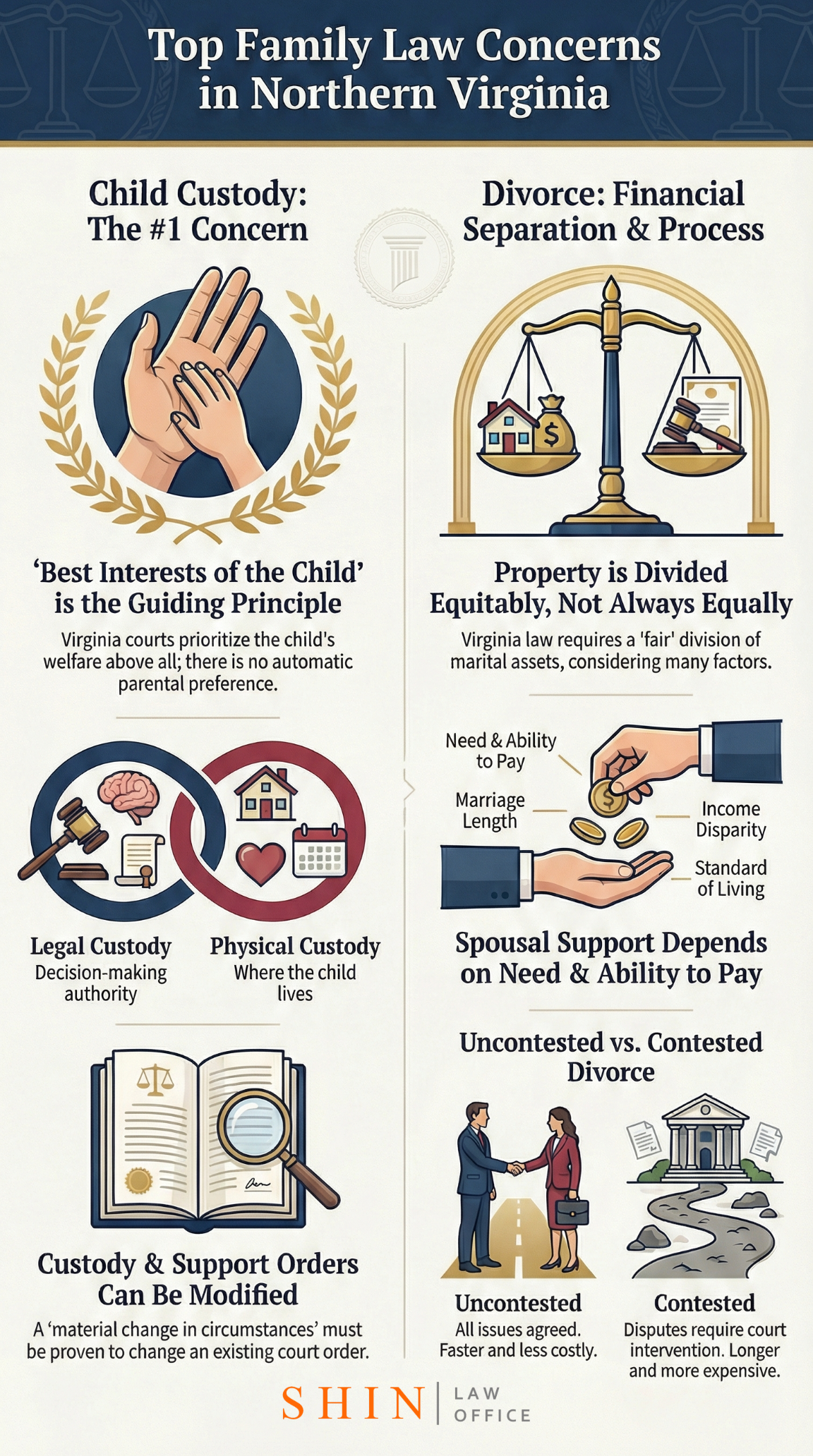
Table of Contents
- Chapter 1: Northern Virginia’s Most Searched Family Law Issues
- Chapter 2: Child Custody Disputes – The Number One Concern
- Chapter 3: Custody Arrangements and Visitation Schedules
- Chapter 4: Modifications and Parental Rights Disputes
- Chapter 5: Divorce and Separation – Frequently Asked Questions
- Chapter 6: Property Division and Spousal Support in Virginia
- References
Chapter 1: Northern Virginia’s Most Searched Family Law Issues
Hello, I’m Anthony I. Shin, Esq. If you’re reading this, you might be facing a family law issue and wondering what concerns people most often have in our area. Let me assure you, you’re not alone. In Northern Virginia, certain family law topics pop up constantly in Google searches and initial consultations. Chief among them are child custody and divorce. In fact, terms like “child custody lawyer Northern Virginia” and “child support lawyer Loudoun County VA” consistently rank among the most searched phrases by local residents looking for legal help. It makes sense – issues involving your children are deeply personal and urgent. Likewise, divorce-related searches are very common, as ending a marriage often raises a host of questions about finances and family arrangements. The legal website Best Lawyers even notes that “the most common family law issue involves divorce, which includes related concerns such as division of marital property, child custody, support, and alimony”. In Northern Virginia, we see that reality reflected online every day.
Why do these topics dominate? From my perspective, it’s because they touch what people value most – their children, their home, their financial stability. By understanding the top issues that others frequently ask about, you’re taking an important step toward navigating your own family law journey. In the chapters that follow, I’ll break down the two biggest categories – child custody disputes and divorce matters – including the sub-issues and questions that come up most often within each. My goal is to give you a clear, practical overview (backed by Virginia law and real cases) so you can approach these challenges with more confidence.
Chapter 2: Child Custody Disputes – The Number One Concern
It’s no surprise that child custody disputes are often the first thing on a parent’s mind during a separation or divorce. In my practice, I’ve found that questions about “who will get custody of the kids?” outweigh almost any other concern. This is echoed by other attorneys – for example, one Loudoun County law firm notes that “child custody is one of the most common causes of disputes in a divorce”. But custody issues aren’t limited to divorcing couples; unmarried parents in Northern Virginia also frequently clash over custody and visitation rights. The stakes are incredibly high: your relationship with your child and their well-being. No wonder these disputes can become emotionally charged and complex.
From a legal standpoint, Virginia courts approach custody by focusing on the best interests of the child above all else. This is codified in Virginia law – there’s no automatic preference for mother or father, no presumption that one parent “wins” custody. Instead, judges must weigh a list of factors (such as each parent’s role in the child’s life, the child’s needs, and any history of abuse) to decide what arrangement best serves the child’s welfare. In practice, this means the court will examine factors such as each parent’s living situation, work schedule, ability to care for the child, and even each parent’s willingness to support the child’s relationship with the other parent. (If one parent is actively undermining the other or refusing visitation unreasonably, that behavior can backfire in court – Virginia explicitly considers a parent’s “tendency to actively support the child’s contact with the other parent” as a factor.)
In a custody dispute, there are actually two types of custody at issue. Legal custody refers to decision-making authority (e.g., decisions about school, healthcare, religion, etc.), while physical custody refers to where the child lives day-to-day. Virginia courts can award these in various forms – for example, parents might share joint legal custody, but one parent could have primary physical custody with the other getting visitation. Or both legal and physical custody might be shared. Every family’s situation is different. The trend in recent years has been toward encouraging cooperative co-parenting when possible, since research (and common sense) shows that children generally do best when they have stable, loving contact with both parents. As a family lawyer, I always advise clients that if they can reach a reasonable parenting plan out of court, they should – it saves time, money, and stress and allows them to retain more control over the outcome. A seasoned attorney can help craft a practical, detailed custody and visitation agreement that protects your rights and your child’s needs.
However, not every case is amicable. Some custody disputes become high-conflict battles – whether due to genuine concerns about a parent’s fitness or simply clashing personalities. I’ve handled cases where one parent feared for the child’s safety with the other parent due to substance abuse issues, and cases where false accusations were thrown about in the heat of anger. In all scenarios, I remind clients that Virginia law’s guiding star is the child’s best interests. Evidence is key: documentation, witnesses (teachers, doctors, etc.), and sometimes expert evaluations (like a Guardian ad Litem for the child) can all play a role in proving what arrangement benefits the child most. If you’re gearing up for a custody fight, know that courts will examine the facts carefully – and any behavior that could put a child at risk will be taken very seriously. For example, if a parent has engaged in reckless or criminal behavior around the child, that will weigh heavily against them. On the flip side, a parent who can show they’ve been the primary caregiver and can provide a stable, loving environment has a strong case.
In sum, child custody disputes are so prevalent because they cut to the heart of parenthood. The law in Virginia gives a framework that prioritizes children’s welfare, but within that framework, every family’s story is unique. As we move to the next chapters, we’ll delve into some specific custody issues – like how visitation schedules are set up, and what happens when you need to modify a custody order or enforce your parental rights.
Chapter 3: Custody Arrangements and Visitation Schedules
One of the first questions parents ask me is, “How will visitation work?” Crafting a fair and workable custody arrangement (also known as a parenting plan or visitation schedule) is often the crux of a family law case. Northern Virginia parents frequently search for guidance on typical schedules – for instance, “What’s normal for weekends and holidays?” or “Can we do 50/50 custody?”. The good news is that Virginia courts give parents quite a bit of leeway to agree on a schedule that fits their lives, and if parents can’t agree, the court will impose one that it believes serves the child’s best interests.
A common baseline many courts use (absent agreement) is every-other-weekend visitation for the non-custodial parent, plus perhaps an evening during the week. But this is far from a one-size-fits-all. In fact, 50/50 joint physical custody arrangements (where the child spends equal time with each parent) have become more common, especially when parents live relatively close to each other and can cooperate. I’ve seen schedules like week-on/week-off, or split weeks (e.g. Parent A has Monday–Wednesday, Parent B has Wednesday night–Friday, alternating weekends). The key is consistency and minimizing disruption to the child’s routine. Courts like to see that the child has a stable schedule (for school, activities, etc.) and is not treated like a ping-pong ball. If parents propose a creative schedule that they both agree on and it seems to work for the child, the judge will usually approve it.
Holidays and special occasions are another frequent concern. Potential clients often ask how things like birthdays, Christmas, or summer vacations are handled. Typically, parents will alternate major holidays each year (for example, one gets Thanksgiving in even years, the other in odd years) or split the holiday break from school. Virginia judges often encourage splitting winter break and longer summer periods so that both parents get substantial time with the kids when school is out. A well-drafted parenting plan should be very specific; it might outline exactly when exchange times occur (e.g., “Fridays at 6 PM”), who drives the child or picks up the child, and how school breaks are divided. Having this clarity prevents confusion and conflict later. I always tell clients to “plan for peace” by addressing details up front.
Another topic that comes up is supervised visitation – in cases where one parent may pose a risk to the child or has been absent for a long time, the court can order that visits happen only under supervision by a third party (sometimes a professional supervisor, or a trusted family member). This is relatively rare and typically temporary. The goal is often to allow a parent-child relationship to continue (or resume) safely. If you’re the parent worried about your child’s safety with the other parent, know that the court can include protective measures in the visitation plan. Conversely, if you’re a parent who’s been denied regular visitation due to past issues, demonstrating your rehabilitation or willingness to abide by conditions (like attending parenting classes or avoiding alcohol) can be key to expanding your time.
I also want to touch on child support, because it goes hand-in-hand with custody arrangements. A common question is: “If we share custody 50/50, is any child support owed?” The answer: often yes, one parent may still pay support, because Virginia’s child support guidelines factor in not only days with each parent but also the income of each parent. Child support is designed to ensure the child’s needs are met and that both parents contribute fairly. Under Virginia law (Code § 20-108.2), support is calculated with an income-share model that assumes both parents should share the cost of raising the child in proportion to their incomes. The formula covers basic needs like housing, food, clothing, education and medical care for the child. In practice, this means that even in a 50/50 custody split, if one parent earns significantly more, that parent will pay some support to the other to balance the child’s standard of living between the two homes. On the other hand, if parenting time is very unequal (say one parent has the child most of the time), the non-custodial parent will generally pay more support, since they’re not directly providing daily care as much. Every case varies, but I emphasize this so parents aren’t surprised – custody and support are interconnected, but having equal time doesn’t automatically eliminate child support obligations. (And note: by law, child support is the right of the child, so parents cannot waive it entirely to strike a bargain over custody.)
In summary, creating custody and visitation schedules is a balancing act. It requires thinking about the child’s day-to-day life, schooling, and emotional well-being, while also being fair to both parents’ desire to be with their child. Northern Virginia parents often work long hours or have commutes, so schedules might need to accommodate that maybe one parent handles school days while the other has more weekend time. Whatever the case, the more cooperative you and the other parent can be, the better the outcome for your child. When clients come to me worried about a visitation schedule, I often say: let’s focus on a solution that your child will look back on and say, “My parents did their best for me.” That mindset usually points us in the right direction.
Chapter 4: Modifications and Parental Rights Disputes
Life isn’t static, and neither are custody and support arrangements. A plan that works for a two-year-old might not work for a ten-year-old. A job loss, a relocation, or a change in a child’s needs can all throw a wrench into the original order. That’s why modifications are another hugely common issue – many people go online searching for “how to change a custody order in Virginia” or “modify child support Loudoun County”. In Northern Virginia, we regularly assist clients in tweaking or overhauling orders when circumstances change. Virginia law allows modifications to custody, visitation, and support, but you must meet certain requirements. Specifically, you must show that since the last order, there’s been a “material change in circumstances,” and that changing the order now would be in the child’s best interest. This two-step rule has been affirmed in case law – for example, a 2024 Virginia Court of Appeals decision reiterated that a parent seeking custody modification must prove both a material change (something significant like a remarriage, move, or change in the child’s situation) and that the proposed new arrangement benefits the child. Minor day-to-day frustrations (“my ex is 10 minutes late to pick up”) usually won’t cut it; the change has to be substantial. If that threshold is met, the court essentially performs a fresh best-interests analysis to decide what the new order should be.
Let me give a typical scenario: Say a couple divorced when their child was a toddler, and the mother had primary physical custody while the father had every-other-weekend visitation. A few years later, the father’s work schedule changes to teleworking, and the child is now in school; he petitions to modify custody to a 50/50 schedule, arguing this is better for the child now. He’ll need to show the court that these new facts (more available time and a child in school) are a material change in circumstances since the last order. If the judge agrees, they’ll then ask: is equal time now in the child’s best interest? Factors might include how well the parents communicate, the child’s adjustment, and so on. If the evidence supports it, the court can modify the order to expand the father’s time. We handle these cases frequently. Job changes, remarrying, relocating to a new city, a child’s academic or medical issues – all are common reasons people seek modifications. And modifications aren’t one-way: sometimes a parent with primary custody might need to relocate out of state, which can trigger a modification (possibly giving the other parent more time in the summers, for instance). Each case is fact-specific.
Now, aside from modifications, I want to address parental rights disputes more broadly. This term can encompass a lot: from parents disputing who gets to make decisions (like one parent making medical choices without consulting the other), to allegations that one parent should lose some rights due to misconduct. In extreme cases, a court can terminate parental rights, but that usually happens in the context of serious abuse/neglect cases or adoption, not typical divorce scenarios. More commonly, the “parental rights disputes” I see involve things like one parent trying to withhold visitation or alienate the child from the other parent. Unfortunately, it’s not uncommon for emotions to lead to bad behavior – a mom might refuse visits because she’s angry at dad, or a dad might badmouth mom in front of the kids. These conflicts can escalate to the point that the compliant parent must seek court intervention to enforce the order or to sanction the violator. I always counsel that violating a court order (like a visitation schedule) is serious. Judges can hold a parent in contempt, impose makeup time, or, in extreme cases, even adjust custody if one parent continually undermines the arrangement. Remember that factor I mentioned earlier: Virginia law looks at whether each parent supports the child’s relationship with the other. If you’re the parent being denied your time, the law is on your side to enforce the order – you can file a Motion to Show Cause (for contempt) against the non-compliant parent, and the court can compel compliance or even modify custody in your favor if warranted. Conversely, if you feel you have a good reason to withhold a child (for instance, you believe the child is in danger during visits), you must go through legal channels ASAP – seek a temporary emergency order, don’t just take unilateral action, or you could be painted as the wrongdoer.
Another kind of parental rights dispute involves disagreements over legal custody. Suppose you have joint legal custody and you fundamentally disagree on a major issue – say, one parent wants the child to attend a private religious school, and the other insists on public school, or one parent wants the child vaccinated and the other does not. These stalemates sometimes require a court to step in as a tiebreaker. The court will again use a best interest analysis to decide the issue. It’s always better if parents can resolve it out of court (through mediation or compromise), but when they cannot, a judge has to make the call. As an attorney, I’ve had to present evidence on such narrow issues within a larger custody case. It’s all part of asserting one’s parental rights and responsibilities.
In sum, modifications recognize that life changes, Virginia courts are willing to adjust orders when it’s truly justified. And parental rights disputes remind us that even after an order is in place, conflicts can continue. The guiding principle remains the child’s welfare. My advice to clients is to document changes carefully (keep records that show how circumstances have evolved) and to keep the child’s best interests front and center in any dispute. That’s not just good legal strategy – it’s the right thing to do for your family.
Chapter 5: Divorce and Separation: FAQs
For many people, divorce is the entry point into the family law system. It’s often said that January is “divorce season” – in fact, statistics show divorce filings tend to increase in January and February and peak in March as couples decide to call it quits after the holidays. In Northern Virginia, I definitely see an uptick in consults around the New Year. Clients usually come in with a mix of emotional turmoil and pressing questions: “How do I file for divorce?” “How long will it take?” “What am I entitled to?” and (if they have children) “What about the kids?” This chapter will cover some of the most common questions local residents have about the divorce process and related issues.
Contested vs. Uncontested Divorce: One of the first terms you’ll encounter is whether your divorce is contested or uncontested. An uncontested divorce means you and your spouse agree on all the major issues – property division, spousal support, child custody/support (if applicable), etc. This is obviously the smoother path. People are very interested in uncontested divorces (nobody relishes a court fight); indeed, searches for “uncontested divorce Fairfax VA” are popular, reflecting the public’s hope for an amicable solution. In Virginia, you can obtain an uncontested, no-fault divorce after a separation period (usually one year, or six months if you have no minor children and a signed separation agreement). If everything is truly agreed, the process can be relatively quick – often just paperwork and perhaps a brief hearing or deposition to finalize it.
A contested divorce, on the other hand, means there are disputes that need resolving – maybe you haven’t agreed on how to split assets or one spouse wants alimony and the other refuses. Contested cases can take much longer, sometimes going to trial in the Circuit Court. Northern Virginia courts (like Fairfax, Loudoun, etc.) have their own scheduling timelines, but it’s not unusual for a contested divorce to take a year or more from filing to finish, especially if complex assets or child custody evaluations are involved. As an attorney, my approach is to attempt negotiation or mediation first – if we can settle the issues, we convert the case to an uncontested divorce. But if not, we prepare for litigation. Either way, having a knowledgeable lawyer is crucial to ensure your rights are protected, because once that final decree is entered, it’s difficult to change (aside from modifications to custody/support as discussed earlier).
Grounds for Divorce: Virginia recognizes both “no-fault” and “fault” grounds for divorce. Most people nowadays proceed on no-fault grounds (based on separation for the required period). However, some are curious about fault grounds like adultery, cruelty, desertion, etc. These can play a role if, for example, someone wants to file immediately (adultery is an immediate ground with no separation period, though proving it is another matter) or if they believe fault will impact the outcome. Here’s an important point: Fault can influence certain aspects like spousal support or equitable distribution in some cases, but it doesn’t directly affect child custody (custody is based on best interests, not which spouse was “at fault” in the marriage). In Northern Virginia, I see fault grounds most often as a tactical consideration – for instance, leveraging a strong adultery claim in negotiations – rather than something that goes to a full trial. Why? Because litigating fault is expensive and often not worth the marginal benefits. Still, it’s an option, and in a few cases, it’s very relevant (like egregious financial or physical misconduct by a spouse).
Local Procedures and Timing: Each county has its quirks. Fairfax County, for instance, has a slightly different process for scheduling uncontested divorce hearings than Loudoun or Prince William. If you’re in Northern Virginia, you benefit from relatively well-funded courts, but also busy dockets. A bit of patience is needed. During COVID and since, we saw a backlog, but courts have adapted (even allowing remote testimony in some uncontested cases). Generally, once the separation period is met and a property/custody agreement (if any) is in place, an uncontested divorce can be finalized in a couple of months. As mentioned, a contested one will vary.
The biggest set of questions I get on divorce consults, though, aren’t about the process itself, they’re about outcomes: “What happens to our stuff? Will I have to pay/spousal support? What about our debts? And of course, what about our children?” This leads us into the next chapter, because divorce is not just a single event of “we’re no longer married” – it’s actually a bundle of issues that all must be resolved either by agreement or by court order. Let’s talk about those, especially property division and spousal support, which, along with child-related matters, form the core of most divorce settlements.
Chapter 6: Property Division and Spousal Support in Virginia
Divorce isn’t just an emotional separation – it’s a financial one. Northern Virginia, being a high-cost-of-living area, often leaves clients very anxious about “Who gets what?” and “Will I be okay financially after this is over?” The two legal concepts at play here are equitable distribution (how marital assets and debts are divided) and spousal support (also known as alimony). These issues are consistently among the top things people search for when divorce is on the horizon – terms like “property division attorney Fairfax VA” and “spousal support lawyer Loudoun County” are commonly Googled, which shows how critical these topics are to divorcing spouses.
Property Division (Equitable Distribution): Virginia is an “equitable distribution” state. This often confuses people who assume everything will be split 50/50. Equitable doesn’t necessarily mean equal – it means fair. Under Virginia law (Code § 20-107.3), the court will classify property as marital, separate, or part-marital, and then divide the marital property in a fair manner considering various factors. These factors include each party’s contributions to the marriage (both economic and non-economic, like raising children or homemaking), the length of the marriage, how and when assets were acquired, and more. The court also looks at each spouse’s future needs and circumstances. So, for example, if one spouse gave up a career to support the family and the other built a business, fairness might dictate an unequal distribution to compensate the non-earning spouse for their contributions. An important point: marital property generally means assets (and debts) acquired during the marriage, regardless of whose name is on the title, with some exceptions. Separate property (like an inheritance kept solely in one person’s name) is usually not divided. The task in a divorce is to identify what’s marital, value it, and then decide distribution. In many cases, couples negotiate this – perhaps by splitting bank accounts and retirement accounts evenly, selling the house or one spouse buying out the other’s equity, etc. But when it goes to court, the judge has a lot of discretion. The result just has to be equitable. As one legal guide succinctly put it, Virginia applies equitable distribution, meaning assets are divided fairly, though not always equally. That’s a good takeaway to remember.
For Northern Virginia families, typical assets on the table include the marital home (often a biggie, given home values), retirement accounts, investments, businesses, and vehicles. Debts such as mortgages, credit cards, and student loans must also be allocated. If you’re heading into a divorce, take stock of everything. One of the first things we do is compile a full inventory of assets/liabilities. Hiding assets is a big no-no; forensic accountants can be brought in if there’s suspicion of that, and it will destroy a person’s credibility in court. Transparency is key to a fair division. Also, note that equitable distribution is largely a one-time deal. Once assets are divided by agreement or order, that part of the divorce is final (it can’t be modified later, except in rare cases of fraud). So it’s critical to get it right the first time.
Spousal Support (Alimony): Alongside property, support for a lower-earning spouse is a major concern. Folks search for answers on whether they’ll have to pay, or conversely, whether they’ll receive support, and for how long. Virginia law (Code § 20-107.1) sets out a bunch of factors for courts to consider in awarding spousal support. These include the obligations, needs, and financial resources of each party; the standard of living during the marriage; the duration of the marriage; each party’s contributions to the family; age and health; and the decisions regarding employment, etc., made during the marriage (for example, one spouse leaving the workforce to raise kids). In short, the court tries to ensure that divorce does not unduly impoverish one spouse when the other can afford to help maintain a reasonably close standard of living post-divorce – at least for some period of time. Searches for local terms like “spousal support Loudoun” are common because this is often the question after custody and property: “How much and for how long?”
In practice, if spouses have roughly equal income and the marriage was short, spousal support may be minimal or not awarded at all. If there’s a large income disparity and the marriage lasted a long time, you can expect some level of support. Virginia doesn’t have a strict formula for long-term spousal support (unlike child support, which is formula-driven). However, some courts use guideline calculations for temporary support or initial estimates. In Northern Virginia, I’ve seen judges use a guideline of around 30% of the higher earner’s income minus 50% of the lower earner’s income (for temporary support), but this is not binding for final orders – it’s just a starting point. Ultimately, the judge weighs those statutory factors. To illustrate, a court will consider that “the duration of the marriage, relative incomes, and the marital standard of living” are important. So if a couple was married 20 years, one stayed home, and the other makes $200k/year, a court might award spousal support to the homemaker spouse, perhaps for a number of years (maybe not forever, but a significant period, possibly half the length of the marriage or even longer if the situation warrants). By contrast, for a 5-year marriage in which both spouses work, spousal support might be short-term or nonexistent. Virginia has also moved toward viewing support as primarily rehabilitative – meant to help the recipient get back on their feet financially, unless it’s a very long marriage, where permanent support might be justified. Statewide, there isn’t a cap on duration except that support usually ends if the recipient remarries or if either party dies (and cohabitation in a marriage-like relationship for a year or more can be grounds to terminate support).
One more thing: Child support and spousal support are separate. Child support gets priority (you can’t bargain it away in exchange for more alimony or vice versa, legally speaking). But in negotiating a divorce settlement, the two can be considered together in the sense that the overall financial arrangement should be something both parties can live with.
Let me briefly address enforcement and modification: Spousal support orders can be modified later if circumstances change (unless you agreed to make them non-modifiable in a settlement). For example, if the paying spouse loses their job or the receiving spouse significantly increases their income, adjustments can be sought. Property division, as noted, cannot be modified after the fact. So it’s all the more reason to negotiate property settlement carefully and consider the trade-offs (sometimes a spouse prefers a larger share of assets in lieu of support, or vice versa – those kinds of deals have pros and cons that a lawyer can explain).
In conclusion, divorce in Northern Virginia involves untangling both emotional bonds and economic ties. Issues of property and support are widely searched because they are central to how you will rebuild your life post-divorce. The law provides principles (fairness in division, reasonableness in support), but there’s plenty of room for advocacy and negotiation. My role as an attorney is often to help clients understand what a fair outcome looks like under Virginia law, and then fight for that outcome – or better – on their behalf. The ultimate goal is to ensure that when the dust settles, you have the financial stability and peace of mind to move forward.
As we wrap up this deep dive into Northern Virginia’s most frequently searched family law issues, I want to leave you with this: knowledge is power when facing a legal battle over your family or your future. Whether you’re up against a custody dispute or navigating a divorce, knowing what to expect and what your rights are under Virginia law will help you make better decisions. The fact that you’ve read this far shows you’re taking initiative, and that’s commendable. If you find yourself needing personalized advice or representation, don’t hesitate to reach out – having an experienced guide in your corner can make all the difference. Remember, you’re not the first to face these issues, and you don’t have to face them alone. As a Northern Virginia attorney, I’m here to help clients turn the often overwhelming tangle of custody schedules, court forms, and legal standards into a clearer path forward. Here’s to resolving your family law matter in a way that sets the foundation for a better future.

Principal Attorney | Shin Law Office
Call 571-445-6565 or book a consultation online today.
(This article is provided for general informational purposes and does not constitute legal advice. For advice on your specific situation, consult with a licensed Virginia attorney.)
References
- Best Lawyers. (n.d.). Family Law in Virginia – Practice Area Overview. BestLawyers.com. Retrieved from https://www.bestlawyers.com/united-states/virginia/family-lawSchwartz Kalina, PLLC. (2023, October 23). Six Common Issues in Virginia Child Custody Cases. Retrieved from https://www.schwartzkalina.com/six-common-issues-in-virginia-child-custody-cases/Virginia Judicial System Court Self-Help. (2025, July 25). Custody, Visitation & Support. Retrieved from https://selfhelp.vacourts.gov/node/13/custody-visitation-supportWeis, J. A. (2025, May 27). Navigating Virginia Family Law in Fairfax and Loudoun County: What You Need to Know. Virginia Family Law Blog. Retrieved from https://www.familylawva.com/navigating-family-law-in-fairfax-and-loudoun-county-what-you-need-to-know/Weis, J. A. (2025, September 22). Virginia Child Support Basics: A Complete Guide for Parents. Virginia Family Law Blog. Retrieved from https://www.familylawva.com/virginia-child-support-basics-a-complete-guide-for-parents/Smith, H. V. (2025). Divorce During the Holidays. Smith Strong, PLC. Retrieved from https://www.smithstrong.com/library/when-to-get-divorced.cfmSmith Strong, PLC. (2025, December 17). Virginia Court Upholds Custody Modification Based on Material Change in Circumstances. Retrieved from https://www.smithstrong.com/library/virginia-court-upholds-custody-modification-based-on-material-change-in-circumstances.cfm