Bottom Line Up Front (BLUF)
Centreville is the kind of Fairfax County market where commercial remodel disputes can escalate fast. It sits in the Bull Run planning area, and Fairfax County’s long-range planning for the Centreville area continues to focus on commercial activity, transportation pressure, redevelopment questions, and suburban center growth. In that environment, remodel projects for offices, retail spaces, restaurants, service businesses, and tenant buildouts often turn into legal fights over scope, permits, inspections, schedules, cost overruns, workmanship, and payment.
Why Centreville Remodel Projects Create So Much Friction
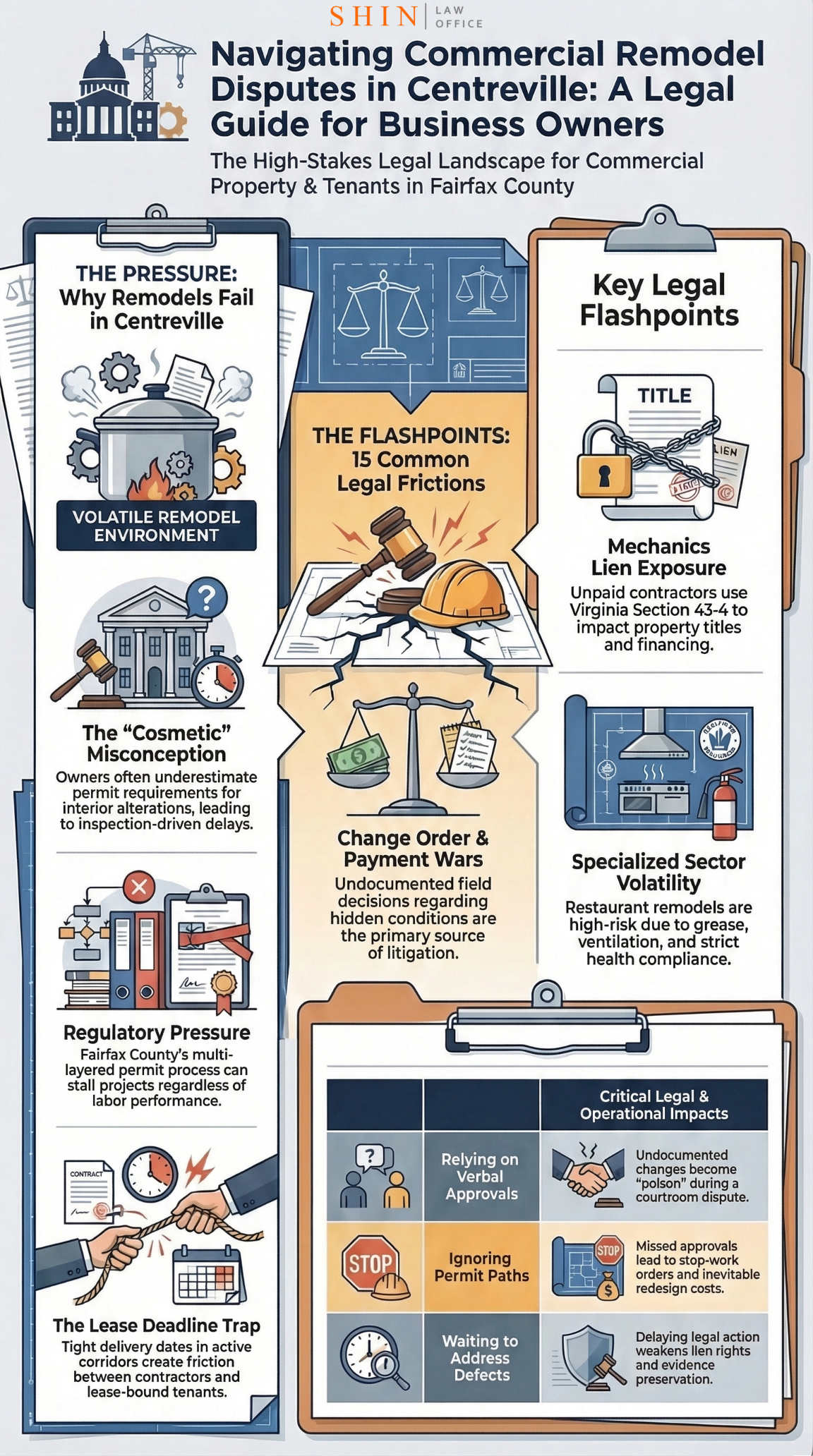
Commercial remodel work looks smaller on paper than new construction, but in practice it can be more volatile. A remodel in Centreville often happens in an occupied building, under a lease deadline, with limited access, aging systems behind walls, and business owners who need the space open or producing revenue as soon as possible. Fairfax County’s permitting framework also makes clear that commercial interior alterations, interior demolition, modular furniture installation, and new tenant layouts typically require a commercial addition or alteration permit, while other projects may also need trade permits, land disturbance approvals, or additional agency signoff. That means remodel disputes are rarely just about construction. They are also about approvals, sequencing, and compliance.
Centreville adds another layer of pressure because it is not a dead corridor. Fairfax County’s area planning materials for Bull Run and current work program materials show the Centreville area remains part of active planning and future land use discussions. That matters because where commercial corridors stay active, remodel work tends to move faster, leases are tighter, and owners push harder for delivery dates that contractors may not fully control.
The 15 Commercial Remodel Dispute Issues That Show Up Most Often in Centreville
1. Tenant buildout disputes for retail spaces
A retail tenant improvement job can go sideways quickly when the landlord, tenant, designer, and contractor all think someone else is responsible for approvals, finishes, or hidden conditions. In Centreville, that often shows up in storefront work, service retail, and quick-turnover spaces where the opening date matters more than the paper trail. The legal fight usually becomes a contract fight over who owned the delay, the redesign, or the added cost.
2. Payment disputes on commercial renovation projects
One of the most common fights is simple on the surface. The contractor says the invoice is due. The owner says the work is incomplete, defective, undocumented, or outside scope. Virginia law matters here. Section 11.4.6 requires construction contracts to include prompt payment provisions and addresses withholding and notice, so the dispute often turns on whether the work was satisfactorily completed and whether the withholding was correct.
3. Change order disputes during office remodels
Office remodel jobs are notorious for change fights. A wall opens, revealing bad wiring. The layout shifts after furniture planning. A conference room becomes a server room. Accessibility changes get added late. The contractor says the work has changed. The owner says it was already included. On many Centreville jobs, change work gets approved in the field long before it is approved on paper. That gap is where the case starts.
4. Delay claims in commercial remodeling projects
Delay disputes are common because remodel schedules are often unrealistic from the start. The owner wants the space delivered before lease obligations kick in. The contractor is waiting on permits, inspections, long lead materials, or trade coordination. Fairfax County’s development and permitting process makes clear that projects can require multiple permit layers and inspection steps, which means delay may come from more than labor performance alone.
5. Defective workmanship claims
Owners often discover workmanship disputes after the project looks done but does not perform correctly. Flooring fails. Doors do not swing properly. Lighting circuits behave erratically. HVAC balancing is off. Walls look fine until cracking shows up. In litigation, defective workmanship claims usually turn on the contract standard, punch list record, closeout documents, and whether the condition is actually a defect or a design issue.
6. Incomplete commercial buildout disputes
An incomplete buildout is one of the most expensive types of remodel disputes because it usually hits the owner from two directions at once. The owner has paid substantial money and still cannot fully use the space. In Centreville, that can mean lost rent, delayed opening, operational disruption, or conflict with a landlord. The contractor may respond that the job is substantially complete and only punch list work remains. That distinction matters.
7. Commercial lease improvement disputes
Lease improvement disputes are different from ordinary owner contractor fights because the lease can distort the construction relationship. The tenant may control the work but need landlord approval. The landlord may provide an allowance but reject design choices. The contractor may be stuck between lease obligations and field conditions. These disputes often become three sided problems even if only two parties signed the construction agreement.
8. Mechanics lien issues tied to commercial remodeling
Many owners assume remodel disputes are only contract disputes. That is a mistake. On qualifying private projects, unpaid contractors and subcontractors may have lien rights, but Virginia’s lien statutes are technical and deadline driven. Section 43.4 governs lien perfection through recordation and notice, and Section 43.11 can create personal liability exposure in some situations if the notice process is followed correctly. That can change a Centreville remodel dispute from a billing fight into a title, refinancing, or lease problem.
9. Permit and inspection disputes during remodels
This is one of the most overlooked issues in commercial remodel litigation. Fairfax County specifically identifies commercial addition and alteration permits for interior alterations, demolition, modular furniture installation, and new tenant layouts, and the county’s broader permit guidance states that additional permits or approvals may also be required. When a project is designed around speed rather than the actual permit path, disputes over inspection failures, missed approvals, stop-work impacts, or redesign costs are almost inevitable.
10. Remodeling cost overrun disputes
Cost overruns rarely come from one dramatic event. They usually come from accumulation. Hidden conditions. Late owner decisions. Material substitutions. Additional code requirements. Rework. Extended general conditions. Extra supervision. Partial redesign. In court, the key question is usually not whether the project cost more than expected. It is whether the extra cost was contractually shifted to the other side and documented in a way that can be proven.
11. HVAC and electrical remodel disputes
Mechanical, electrical, and plumbing work cause a disproportionate share of remodel litigation because the systems are expensive, technical, and easy to disturb when the walls are already closed. In commercial remodel work, HVAC and electrical disputes often involve whether the existing system could support the new layout, whether upgrades were included, and whether failures were caused by design limits or installation errors. These disputes become especially sharp when the business cannot operate normally after turnover.
12. Structural change disputes
Some Centreville remodels start as cosmetic work and turn into structural work the moment demolition exposes the truth. That can mean framing modification, slab issues, header changes, roof support concerns, or unexpected building conditions. Once that happens, the original price and schedule may become fiction. Structural disputes often become major change order and responsibility fights because neither side expected the project to cross that line.
13. Restaurant remodel litigation
Restaurant remodels are some of the most volatile commercial projects in Centreville because they compress multiple risk areas into one job. Tight opening dates. Specialized ventilation. Grease and plumbing requirements. Health related compliance. Utility capacity concerns. Finish standards. Equipment coordination. If a restaurant remodel slips, the business loses more than time. It loses launch momentum and revenue. That is why these cases often become aggressive fast.
14. Punch list disputes after renovation
A punch list sounds minor until it becomes a payment war. The owner says the list proves the project is not complete. The contractor says the remaining items are trivial and do not justify withholding major payment. Virginia’s prompt payment framework makes completion status and withholding notice important, so punch list disputes often become legal disputes over whether the owner is preserving quality or manufacturing leverage.
15. Warranty and post completion disputes
The remodel is “done,” then the callbacks start. Water intrusion. Fixture failures. Finish deterioration. Equipment issues. Code questions. Access problems. The contractor blames misuse or preexisting conditions. The owner blames poor work. These cases often turn on whether the issue was visible at turnover, whether it was accepted, and whether the contract warranty language actually covers the claimed problem.
Why Centreville Makes These Problems Worse
Centreville remodel disputes are shaped by real local conditions, not generic construction theory. Fairfax County’s development process is broad, permit driven, and layered across zoning, building, trade, and related approvals, with PLUS serving as the central online system for applications, fee payment, status tracking, and notifications. That means owners and contractors who underestimate the approval path often create the delay and cost problems they later try to blame on each other.
Local planning context matters too. Fairfax County’s Bull Run comprehensive plan materials describe Centreville as part of a significant suburban area with commercial development, parks, transportation considerations, and ongoing planning attention. The county also has active amendment work touching the Centreville area. That tells me Centreville is exactly the kind of place where commercial remodel pressure, redevelopment pressure, and corridor level planning pressure intersect.
What Businesses Commonly Get Wrong
The first mistake is treating a remodel like a simple cosmetic project. Many commercial owners think they are just moving walls or updating finishes. Then the permit path expands, the systems conflict with the new layout, or the county inspection record starts dictating the pace.
The second mistake is relying on verbal approvals. In remodel disputes, undocumented field decisions are poison. If a change affects cost, sequence, or completion, it matters enough to document.
The third mistake is waiting too long to address nonpayment or defective work. Virginia law gives parties tools, but those tools depend on deadlines, notices, and preserved proof. Lien rights, payment rights, and defenses can all weaken if the record is allowed to drift.
The fourth mistake is ignoring licensing and fund use issues. Virginia law prohibits covered contracting without the required license and requires project funds paid to a contractor or subcontractor to be used to pay those furnishing labor or materials for that project. In the right case, those issues can change the entire tone of the dispute.
My View as a Business Litigation Attorney
When I look at a Centreville commercial remodel dispute, I do not treat it like a generic construction disagreement. I want to know the deal structure, the lease context, the permit path, the inspection history, the hidden conditions, the payment trail, the change documentation, and the actual business damage caused by the breakdown. That is how real commercial litigation gets built.
A Centreville remodel dispute is often a pressure test of the whole project. It shows whether the owner priced the job honestly, whether the contractor managed the work honestly, and whether the parties documented the truth while the project was moving. By the time the remodel fails, the legal problem is usually much larger than one unpaid invoice or one bad punch list.
Closing Summary
Commercial remodel disputes in Centreville are usually not random. They follow patterns. Tenant buildout fights. Payment disputes. Change order problems. Delay claims. Defective workmanship. Incomplete buildouts. Lease improvement conflicts. Lien pressure. Permit and inspection issues. Cost overruns. HVAC and electrical failures. Structural surprises. Restaurant remodel breakdowns. Punch list battles. Warranty claims.
That is why Centreville businesses need to treat remodel disputes as serious commercial risk, not just jobsite frustration. If your project is breaking down over payment, schedule, scope, defects, or compliance, the right move is to evaluate the contract, the permits, the record, and the available remedies before the dispute hardens into something more expensive.

Principal Attorney | Shin Law Office
Call 571-445-6565 or book a consultation online today.
(This article is provided for general informational purposes and does not constitute legal advice. For advice on your specific situation, consult with a licensed Virginia attorney.)
References
Fairfax County, Virginia. (n.d.). Addition/Alteration (ALTC) Commercial. Retrieved March 12, 2026, from https://www.fairfaxcounty.gov/landdevelopment/permit-library/addition-alteration-commercial
Fairfax County, Virginia. (n.d.). Does my project require a permit? Retrieved March 12, 2026, from https://www.fairfaxcounty.gov/landdevelopment/when-permit-required
Fairfax County, Virginia. (n.d.). What is PLUS? Retrieved March 12, 2026, from https://www.fairfaxcounty.gov/plan2build/plus
Fairfax County, Virginia. (2025, November 18). 2017 edition of the comprehensive plan, Area III, Bull Run Planning District, amended through 11 18 2025 [PDF]. https://www.fairfaxcounty.gov/planning-development/sites/planning-development/files/Assets/Documents/comprehensiveplan/planhistoric/2017/area3/bullrun/11-18-2025.pdf
Virginia Law. (n.d.). § 11-4.6. Required contract provisions in construction contracts. Retrieved March 12, 2026, from https://law.lis.virginia.gov/vacode/title11/chapter1/section11-4.6/
Virginia Law. (n.d.). § 43-4. Perfection of lien by general contractor; recordation and notice. Retrieved March 12, 2026, from https://law.lis.virginia.gov/vacode/title43/chapter1/section43-4/
Virginia Law. (n.d.). § 43-11. How owner or general contractor made personally liable to subcontractor, laborer or materialman. Retrieved March 12, 2026, from https://law.lis.virginia.gov/vacode/title43/chapter1/section43-11/
Virginia Law. (n.d.). § 43-13. Funds paid to general contractor or subcontractor must be used to pay persons performing labor or furnishing material. Retrieved March 12, 2026, from https://law.lis.virginia.gov/vacode/title43/chapter1/section43-13/
Virginia Law. (n.d.). § 54.1-1115. Prohibited acts. Retrieved March 12, 2026, from https://law.lis.virginia.gov/vacode/title54.1/chapter11/section54.1-1115/