
BLUF (Bottom Line Up Front)
Commercial real estate purchase, sale, and development disputes in Loudoun County, particularly those in Ashburn, Leesburg, Sterling, South Riding, and along the Route 28, Route 7, and Dulles Greenway corridors of development, are among the highest‑stakes cases I litigate. Cases can involve millions of dollars and complex contracts, and they often involve zoning and land‑use constraints, environmental risks and hazards, and strict statutory deadlines. Virginia law strictly enforces written real estate agreements. It also provides powerful remedies when sellers, buyers, developers, or partners breach their agreements, misrepresent facts, fail to meet conditions to closing, or misuse control.
If you are asking questions like these, this article is written for you:
What happens in Loudoun County if a buyer or seller breaches a commercial real estate purchase agreement?
How do Loudoun County courts resolve commercial real estate disputes involving zoning, land use, and development approvals?
What legal options are available when title defects or boundary issues are discovered after closing on commercial property in Loudoun County?
When can a buyer enforce a commercial real estate contract through specific performance in Virginia?
How do contract contingencies and due diligence protect buyers and sellers in Loudoun County real estate deals?
Key Takeaways
Commercial Real Estate Disputes in Loudoun County are Complex and Varied — Loudoun County’s hot spots of commercial real estate development, like Ashburn, Leesburg, Sterling, and South Riding, have all seen such rapid growth that more commercial real estate sales, leases, and construction are inevitable. Disputes result from breaches of contract, zoning and land-use problems, title and boundary disputes, and conflicts with government regulations. Winning such disputes requires knowledge of the legal causes of action and the facts that lead to litigation.
Virginia Courts Construe Written Contracts Strictly — In accordance with the Statute of Frauds (which mandates that contracts for the sale of land be in writing) and Virginia case law, courts will look to the plain language of commercial purchase and sale agreements to determine their meaning. Liquidated damages and specific performance provisions are powerful tools if well-drafted, and they both enhance enforceability and decrease the risk of litigation.
Zoning and Entitlement Decisions Are Frequently Litigated — The local zoning boards have very broad discretion in Loudoun County, and it is not uncommon for a zoning decision, special exception, or variance to be litigated. Challenges to these decisions must be brought in a timely and specific manner. Administrative procedures and statutory time limits (typically 30 days for appeals) govern whether the Circuit Court can review a decision.
Remedies in Real Estate Disputes Include Legal and Equitable Remedies — In Virginia, remedies include specific performance (courts can compel performance of a contract), monetary damages, rescission, injunctive relief, and quiet title actions to resolve title defects. Each remedy has unique requirements and strategic considerations for litigants.
Plan & Engage Counsel Early – Disputes are much easier to prevent or resolve if the parties’ contract is clear, contingencies are clearly stated, due diligence is reasonable, and legal counsel is engaged early in the process. Risk allocation, dispute resolution provisions (mediation/arbitration), and “problem” negotiation all help minimize litigation risk and make the CRE transaction smoother.
This article explains how Loudoun County courts handle commercial real estate disputes involving zoning, land-use approvals, and development conflicts, so you understand the process, key legal issues, and how local zoning laws impact your property rights.
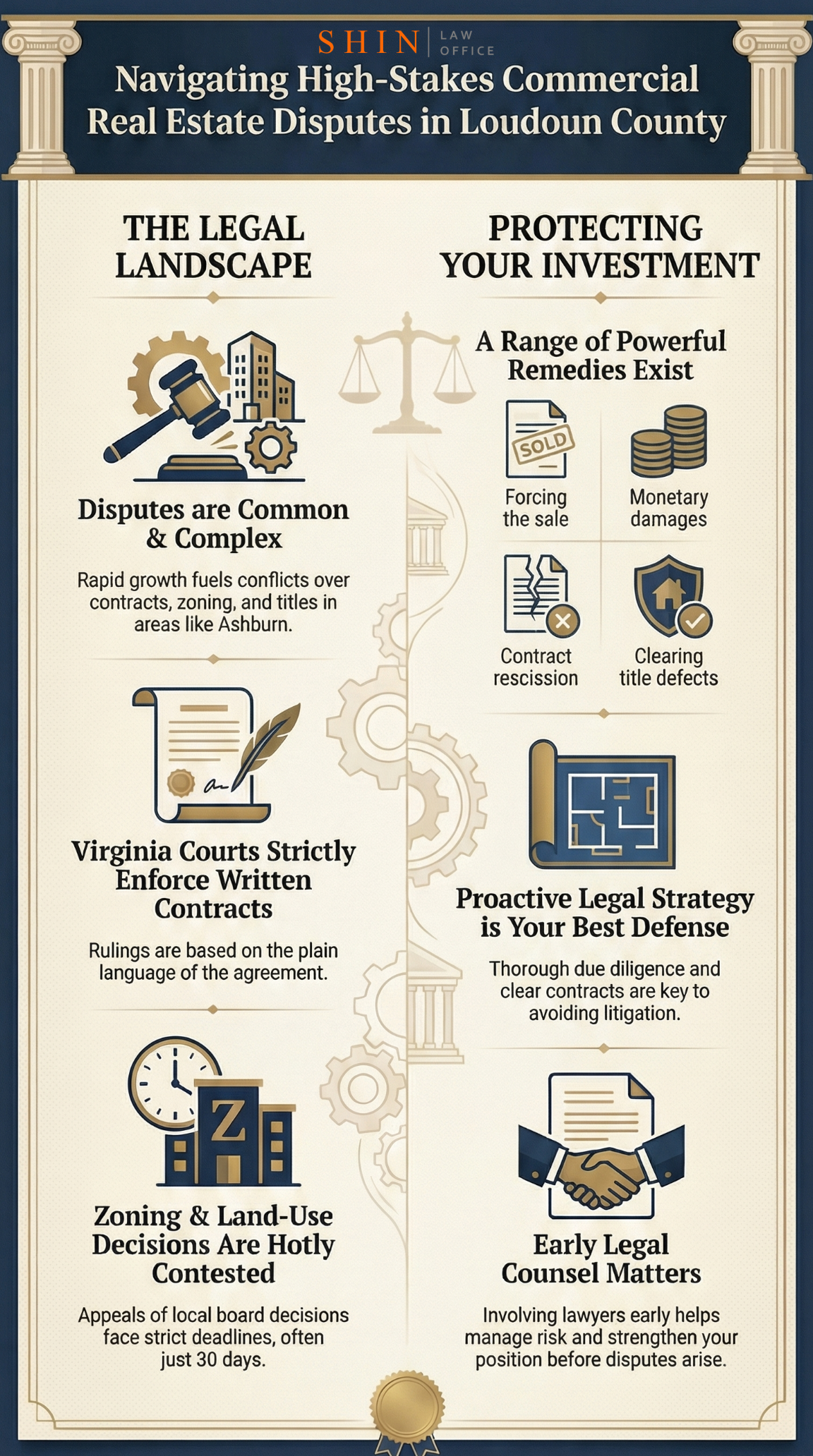
Table of Contents
- Why Commercial Real Estate Disputes Are So Common in Loudoun County
- Contract Formation, Due Diligence, and Misrepresentation Claims
- Zoning, Entitlement, and Development‑Related Litigation
- Earnest Money, Deposits, and Failed Closings
- How Loudoun County Courts Litigate Commercial Real Estate Cases
- Remedies, Damages, and Long‑Term Risk Management
- Legal Citations & Case Law
Chapter 1: Why Commercial Real Estate Disputes Are So Common in Loudoun County

I have litigated commercial real estate disputes across Northern Virginia for years, and there is a clear pattern in Loudoun County: disputes are not isolated incidents; they are systematic consequences of rapid development, dense capital flows, evolving zoning codes, and complex transactional expectations. In Ashburn, Leesburg, Sterling, South Riding, and emerging growth areas like Brambleton (a planned community with thousands of residences and significant commercial parcels), commercial properties are constantly being bought, sold, developed, and repurposed.
Those commercial real estate transactions generate disputes for predictable reasons. First, parties frequently assume deals are simple and fail to account for legal complexity—especially as documents and expectations outpace due diligence. Second, the legal framework governing commercial real estate in Virginia is dense, technical, and unforgiving. Statutes such as the Virginia Statute of Frauds (Va. Code § 11-2) require specific contracts to be in writing and signed to be enforceable. Failure to comply can outright negate claims. Third, local land-use and zoning codes in Loudoun County, as outlined in the county’s comprehensive zoning ordinance, create layers of administrative approvals and permit conditions that routinely become points of litigation.
From a legal perspective, commercial real estate disputes in Loudoun County fall into several interrelated categories:
1. Breach of Contract and Failed Deals
One of the most frequent triggers for litigation involves outright breach of purchase-and-sale contracts or development agreements. In commercial contexts, these contracts are highly negotiated and contain detailed provisions on purchase price, due diligence periods, financing, closing conditions, and indemnities. When a buyer suddenly backs out after due diligence, or when a seller refuses to convey because a contingency is not met, expectations collide with enforceable terms. Under general Virginia contract principles, these disputes turn on the interpretation of the writing itself: Virginia courts enforce the plain language of agreements. As the Supreme Court of Virginia held in Ward’s Equipment, Inc. v. New Holland North America, Inc., 254 Va. 379, 384 (1997), “where a contract is clear and unambiguous, its meaning is determined from the words used, not from what the parties intended to say but did not say.” These cases often end in motions for summary judgment if the contract language clearly dictates the outcome.
Beyond the contract language, commercial litigants also consider equitable remedies such as specific performance, a court order requiring the breaching party to fulfill its contractual obligation (e.g., close on the sale) rather than merely pay damages. Virginia courts routinely grant specific performance in real estate contexts when the property is unique and monetary damages are inadequate, as reaffirmed in Hale v. Fawcett, 214 Va. 583 (1974). Fairfax and Loudoun trial judges are careful to ensure that equitable prerequisites are met: explicit agreement, mutual definiteness, and readiness to perform on the plaintiff’s part.
2. Zoning and Land-Use Approvals
Another fertile ground for disputes is zoning and land-use approvals. Loudoun County’s Zoning Ordinance governs permissible uses for parcels based on district classifications, and noncompliance—whether real or alleged—can derail a development even after purchase. Local rules strictly regulate commercial vehicle use, structure permits, setbacks, and allowable uses within each zoning category. For example, a property owner cannot operate a commercial use in a residential zoning district without proper approvals.
Developers often assume that because a parcel is large or economically viable, entitlements will follow. That assumption is legally dangerous. Zoning boards, planning commissions, and boards of zoning appeals have broad discretion, and their decisions can be challenged only within short statutory periods. For example, in Virginia, challenges to zoning decisions (rezoning or special exceptions) must typically be filed in circuit court within 30 days of the decision, a deadline that is fatal if missed.
Zoning disputes typically involve special exceptions, variances, conditional use permits, or compliance with the comprehensive plan. A denied variance or rezoning triggers administrative appeals, followed by potential litigation in Loudoun County Circuit Court. These disputes are inherently technical because they require familiarity with both the zoning code and local planning policy. Attorneys assisting clients in these matters, including myself, prepare extensive administrative records, participate in hearings, and file petitions when necessary to protect client interests.
3. Title Defects and Boundary Disputes
Title and boundary issues arise when title searches do not uncover underlying interests, easements, or recorded restrictions that affect ownership rights. In some cases, pre-closing due diligence is rushed or incomplete, leaving parties surprised by defects only after closing. These defects may include unresolved liens, conflicting easements, or errors in the chain of title. Litigation over title often involves “quiet title” actions in Loudoun County Circuit Court to clear clouds on title and confirm rightful ownership.
Boundary disputes are equally contentious. Loudoun’s mix of new developments and historic rural parcels means that recorded plats may not reflect actual physical demarcations on the ground. As a result, parties may find fences, sheds, or improvements encroaching on adjacent parcels, leading to litigation if negotiations fail.
4. Easement and Right-of-Way Issues
Commercial properties frequently involve easements or rights-of-way for utilities, ingress/egress, or shared access drives. When these are not correctly recorded, or their scope is ambiguous, disputes follow. Failure to understand or identify rights of way during due diligence can impair the use and value of a property, leading to claims for breach of contract or fraud.
5. Development Agreements and Entitlement Litigation
Finally, development disputes often involve disagreements over performance obligations under development or subdivision agreements, proffer commitments, or conditions imposed by local governments. These disputes are at the intersection of private contract law and public regulation, making them especially complex. In such matters, lawyers must not only understand contract drafting but also administrative law and local land-use procedures.
Why These Disputes Are Particularly Acute in Loudoun County
Loudoun County has seen rapid commercial growth, particularly in areas like Ashburn the “data center capital of the world” and Leesburg, where mixed-use developments and suburban commercial corridors account for extensive investment activity. As a result:
- Deal volume is high: More transactions mean more points of potential conflict.
- Regulation is dense: Land-use codes, comprehensive plans, and zoning ordinances create numerous procedural requirements.
- Capital stakes are large: High property values increase pressure when disputes arise.
The legal system in Loudoun County, especially the Circuit Court, expects precise pleadings, accurate interpretation of contracts, and strict compliance with statutory deadlines and local ordinance requirements. Failure in any of these areas dramatically increases litigation risk.
Case Law Deep Dive: Ward’s Equipment, Inc. v. New Holland North America, Inc., 254 Va. 379 (1997)
Facts: A buyer alleged misrepresentation and breach arising from a commercial transaction involving reliance on pre‑contract statements.
Holding: The Supreme Court of Virginia emphasized the primacy of written contracts and rejected reliance on extrinsic assurances that contradicted contractual terms.
Application in Loudoun County: Judges routinely cite Ward’s Equipment to defeat claims based on “what was promised” during negotiations when the purchase agreement says otherwise. Buyers in Ashburn and Sterling frequently lose these arguments when diligence contingencies are waived.
Commercial real estate disputes are rarely about surprise—they are about risk allocation.
FAQs
Why do commercial real estate disputes arise so frequently in Loudoun County?
Commercial real estate disputes in Loudoun County commonly arise because the region has experienced rapid growth in development, especially in areas like Ashburn, Leesburg, Sterling, and South Riding, leading to high-stakes land transactions and conflicting expectations. These disputes typically involve breach of purchase agreements, boundary conflicts, easement rights, title defects, and complex zoning issues under Loudoun County’s zoning ordinances. Virginia courts enforce written contracts and statutory requirements narrowly, making disputes over contract language, entitlements, and compliance particularly common.
What types of legal issues most often trigger commercial real estate litigation in Loudoun County?
The most frequent legal issues that trigger commercial real estate litigation in Loudoun County include breaches of commercial purchase and sale agreements, boundary and easement disputes, zoning and land-use challenges, title defects and conflicting ownership claims, and disagreements over development approvals and proffers. Attorneys often must interpret complex contracts and resolve entitlement conflicts arising from local regulations to protect their clients’ investments.
How does Loudoun County’s growth influence real estate disputes?
Loudoun County’s rapid economic and population growth, especially around major commercial corridors like the Dulles Greenway and Route 7, increases real estate activity and litigation because high property values and frequent redevelopment mean more deals, more complex contracts, and more regulatory hurdles. The county’s detailed zoning ordinances and frequent entitlement applications create opportunities for disputes when parties’ expectations, documentation, or compliance do not align.
Chapter 2: How Virginia Courts Interpret and Enforce Commercial Real Estate Contracts

In commercial real estate disputes in Loudoun County—whether in Ashburn, Leesburg, Sterling, South Riding, or along the Route 28 development corridor—the heart of almost every dispute is a contractual document. Whether it’s a purchase agreement, an amendment, a purchase option, or a development contingency, everything turns on how the contract is written and how Virginia law interprets it.
Understanding how Virginia courts interpret and enforce commercial real estate contracts is not optional; it often determines whether you win your case or walk away empty-handed. In many disputes I’ve litigated, parties think they have a “good case” based on what someone said during negotiation or what they “intended,” but the judge looks first at the four corners of the written document and applies well-settled interpretive rules long recognized in Virginia jurisprudence.
Contracts Are Enforced as Written
Virginia law treats a commercial real estate contract like any other contract: if it’s clear, unambiguous, and enforceable, its plain language controls. Virginia courts consistently hold that they must interpret the language as written, not rewrite the parties’ deal under the guise of fairness.
In Loudoun County litigation, I often cite the Supreme Court of Virginia’s ruling in Ward’s Equipment, Inc. v. New Holland North America, Inc., 254 Va. 379 (1997). In Ward’s Equipment, the Court emphasized that where a contract is unambiguous, the courts must enforce the parties’ agreed terms rather than speculate about what the parties “meant.” This “plain meaning” rule is the first line of analysis in contract disputes, including commercial real estate purchase-and-sale disagreements.
The practical effect of this rule in Loudoun County is profound: a poorly drafted contract, whether missing essential elements such as contingencies, conditions precedent, price adjustments, or remedies, can doom a case before any evidence is presented. Judges routinely grant summary judgment when contractual terms are unambiguous and dispositive of the dispute.
The Statute of Frauds and Writing Requirements
Commercial real estate contracts must satisfy Virginia’s Statute of Frauds to be enforceable. Under Va. Code § 11-2, contracts for the sale of land must be in writing and signed by the party to be charged. If a purported contract lacks these formalities, a party has no enforceable contract to argue about in the first place. This rule means that handshake deals or oral promises—even if witnessed or confirmed by email—generally have zero legal effect in commercial purchases or development agreements unless they fall under a narrow exception recognized (and rarely applied) by the courts.
Because of the Statute of Frauds, one of the first issues I address with new clients is whether the contract at issue is signed, complete, and properly formalized. Without that, it doesn’t matter how unfair the result feels; the judge won’t enforce it.
Specific Performance and Commercial Real Estate
One of the most powerful remedies in real estate disputes is specific performance—a court order that compels the breaching party to perform the contract rather than pay damages. In Virginia, real estate is considered unique, which makes specific performance more likely than in other contract contexts.
Virginia’s statutory law explicitly recognizes when specific performance may be ordered under certain agreements. Specifically, Va. Code § 59.1-508.11 allows a court to order specific performance “if the agreement provides for that remedy,” and in other proper circumstances where the subject matter is unique, and money damages are inadequate.
In practical terms, this means that if a buyer and a seller have a legally enforceable purchase agreement for commercial property and the buyer is ready and able to close, a court may order the seller to proceed with closing even if the seller refuses. Conversely, specific performance may be unavailable if the contract is ambiguous, lacks essential terms, or enforcement would require constant court supervision. For example, closing an office park transaction requires clear terms about price, property description, title quality, and environmental obligations.
Loudoun County judges often see motions for specific performance in commercial deals, particularly when the property is unique to a buyer’s business plan—such as a parcel adjacent to a company’s headquarters in Ashburn or space near a major transit corridor where substitutes are not readily available.
Ambiguity and Construction of Contract Language
When a contract contains ambiguous provisions, Virginia courts may resort to extrinsic evidence, such as communications outside the written agreement, to determine the parties’ intentions. However, courts will only consider extrinsic evidence if the contract’s language reasonably is susceptible to more than one meaning. If the terms are unambiguous on their face, outside evidence is off limits as a matter of law.
In Loudoun County, I regularly see disputes hinge on seemingly small language choices, defined terms, contingencies, or deliverables. Drafters who fail to define terms or incorporate clear definitions invite litigation. As one contract law treatise notes, defined terms reduce ambiguity by replacing long phrases with clear singular concepts, but they must be used consistently.
For instance, a development contract that uses “approved plans” without defining approval standards may lead to dueling interpretations. Without a clear definition, a Loudoun County judge will decide what those words mean based on surrounding language, industry standards, or evidence introduced at trial.
Misrepresentation and Fraud in Contract Negotiation vs Contract Terms
Contract disputes often involve overlapping claims, such as alleged misrepresentation or fraud. But Virginia courts draw clear lines between mere breaches of contractual promises and independent tort claims like fraudulent inducement.
Under Abi-Najm v. Concord Condominium, LLC, 280 Va. 350 (2010), the Supreme Court of Virginia allowed fraud claims to proceed when the misrepresentations occurred before contract formation (such as during negotiation), even when related terms were later captured in a written agreement. The Court rejected the argument that any fraud claim was extinguished simply because the matter was addressed in the contract, so long as the false statement was of a pre-contractual, existing fact.
This case is crucial in Loudoun County litigation because buyers sometimes learn after closing that material facts they relied upon were false—such as representations about zoning approvals, environmental conditions, or lease roll-overs. If that evidence exists, a fraud claim can survive a demurrer and lead to a damages or rescission remedy, in addition to contractual rights. But where the alleged misstatement is simply a broken promise or failure to perform under the written terms, Virginia’s economic loss rule precludes a separate tort claim absent an independent duty beyond contract. (This principle was addressed in Dunn Constr. Co. v. Cloney, though in a different context involving property defects, emphasizes that duties arising only from the contract typically do not support tort liability.
Due Diligence and Conditions Precedent in Loudoun County Transactions
Commercial real estate contracts often include conditions precedent—events that must occur before a party’s obligation to perform arises. Typical contingencies include zoning approvals, environmental clearances, financing commitments, or title insurance commitments. If these conditions are not met, the parties’ obligations may never ripen to enforceability.
Due diligence in these areas is both a contractual and legal obligation. Failure to include or properly satisfy due diligence contingencies is one of the leading causes of disputes I see in Loudoun County. Buyers who waive inspections or rush the review process often find themselves unable to enforce the contract later.
Key Takeaways for Loudoun County Practitioners
- Contracts govern outcomes. The written agreement is primary; extrinsic evidence is often excluded if the terms are clear.
- Statute of Frauds matters. Oral deals are risky and often unenforceable.
- Specific performance is real. Loudoun courts can order performance of commercial real estate contracts if the prerequisites are met.
- Ambiguity invites litigation. Precise drafting is essential.
- Fraud claims must stand outside the scope of contract duties. Only pre-contract misrepresentations often survive.
Virginia law provides powerful contractual remedies, but success in court depends on disciplined drafting, structured negotiations, and strategic thinking before execution. In Loudoun County’s fast-paced commercial market, failing to understand these principles can cost clients their property rights, leverage, or investment.
FAQs
How do Virginia courts interpret commercial real estate contracts?
Virginia courts interpret commercial real estate contracts based on the plain language of the document and principles of contract law, giving effect to clear and unambiguous terms as written rather than speculative intent. Contracts involving land must be in writing and signed under the Statute of Frauds (Va. Code § 11-2) to be enforceable, and courts generally refuse to consider extrinsic evidence unless language is reasonably susceptible to more than one meaning.
When can specific performance be ordered in a Virginia real estate contract dispute?
Specific performance, an equitable remedy forcing the breaching party to fulfill the contract, may be ordered under Va. Code § 59.1-508.11, when the agreement provides for that remedy, the contract involves unique property, and monetary damages are inadequate. Virginia courts commonly grant specific performance in real property disputes because each parcel is considered unique.
What role does the Statute of Frauds play in commercial real estate disputes in Virginia?
The Statute of Frauds requires that contracts for the sale of real estate be in writing, signed by the party to be charged, and include essential terms; without satisfying these requirements under Va. Code § 11-2, a court will not enforce the agreement or grant remedies such as specific performance. This rule prevents disputes based on unwritten or informal agreements in high-value real estate transactions.
Chapter 3: Zoning, Entitlement, and Development‑Related Litigation

In Loudoun County’s fast-growing commercial market, zoning and land-use disputes are not peripheral; they are central to how property rights are deployed, leveraged, and protected. From Ashburn and Brambleton to Leesburg and Sterling, commercial developments often run head-on into local zoning codes and entitlement processes that can make or break a project. These disputes are not merely bureaucratic; they are legal battlegrounds where entitlement rights, legislative authority, and property expectations collide.
How Zoning Works in Loudoun County
Zoning is the regulatory framework that defines what can be built on a parcel of land, whether it is zoned for office, retail, industrial, mixed-use, or another category. In Loudoun County, the Zoning Administration Division oversees zoning compliance, maintains the official zoning map, and interprets zoning ordinances for landowners.
The Zoning Ordinance itself outlines permissible uses, setback requirements, height limits, environmental setbacks, overlay districts, and special conditions such as historic preservation or watershed protections. A property’s zoning classification affects virtually all aspects of commercial development: site design, permitted uses, parking obligations, setbacks, and environmental requirements.
Because the stakes are so high, disputes routinely arise when:
- A commercial project is denied a rezoning request
- A proffer or condition is imposed that affects financial viability
- A variance application is refused
- Administrative interpretations differ from developer expectations
- A permit is delayed or revoked
Even when everything seems compliant on paper, zoning officials may interpret the ordinance differently, causing developers to incur months of delay or millions in lost revenue.
Administrative and Judicial Paths for Challenging Zoning Decisions
Disputes over zoning decisions typically begin administratively before evolving into full-blown litigation. In Loudoun County, landowners first engage with:
- Zoning administrators
- Boards of Zoning Appeals (BZA)
- Planning Commissions
- Board of Supervisors
If those bodies deny relief—such as a variance, special exception, or rezoning—the decision may be appealed to court.
Under Virginia law (Virginia Code § 15.2-2280 et seq.), local governments have broad authority to enact zoning ordinances promoting health, safety, and welfare. Those ordinances are presumed valid. An appeal from a local zoning decision must be filed in the circuit court with jurisdiction over the land affected within a short time after the decision. Typically, this must occur within 30 days of the final decision.
In my experience litigating in Loudoun County Circuit Court, these deadlines are fatal if ignored, because the courts will not consider the merits of a zoning complaint filed late even if the underlying decision appears unjust on its face.
Standing is another key threshold issue. Only an “aggrieved” person may challenge zoning decisions. This often includes property owners directly affected by the decision or nearby neighbors who demonstrate a particularized harm. General objections from the public at large rarely suffice in circuit court unless a legally cognizable injury is proven.
Legal Standards in Zoning Appeals
Once in court, zoning decisions are generally upheld under a presumption of validity. This means the government’s action is presumed reasonable and lawful unless the challenger can show otherwise. The burden typically shifts to the challenger to prove that the decision was arbitrary, capricious, unreasonable, or not supported by substantial evidence.
Virginia courts interpret zoning powers broadly, consistent with the local governmental police power historically recognized in Village of Euclid v. Ambler Realty Co., 272 U.S. 365 (1926) the seminal U.S. Supreme Court case that upheld the constitutionality of zoning as an exercise of local police power. Although Euclid is not a Virginia decision, its logic underpins much of American zoning jurisprudence and is reflected in Virginia practice.
In local litigation, judges often defer to the technical expertise of planning staff and the legislative judgments of boards unless the challenger presents clear evidence that the board failed to comply with statutory requirements, ignored its own procedures, or interpreted the ordinance in a way that violates fundamental principles of law.
Common Types of Zoning and Land-Use Disputes
1. Special Exception and Variance Applications
Commercial projects often require exceptions to strict zoning categories. These special exceptions are discretionary and may be denied if the board finds that granting them would conflict with the comprehensive plan or harm neighbors. Appeals of these denials are frequent and often require deep factual records and expert testimony.
2. Rezoning and Conditional Zoning
Changes to zoning classifications are political and legal decisions. A denial of rezoning can make a project economically unviable. Attorneys challenge such decisions on procedural grounds (e.g., notice failures) or argue that the board’s conclusion lacks supporting evidence.
3. Interpretation Disputes
Sometimes the dispute revolves around how a code provision should be interpreted. For example, whether a mixed-use development qualifies under a particular district’s definitions may require litigation to resolve statutory meaning.
4. Enforcement and Compliance
Developers also face enforcement actions related to zoning compliance—either in pre-development stages (e.g., violations assessed by county inspectors) or post-approval (e.g., cease-and-desist actions). Failure to resolve these issues can halt construction entirely.
The Practical Realities of Loudoun Litigation
Zoning and land-use disputes in places like Ashburn and Leesburg often involve multiple overlapping legal and factual issues:
- How strictly must the local comprehensive plan be followed
- Whether the proffers imposed on developers are reasonable
- Whether adjacent property owners will suffer undue harm
- Whether a governing body complied with procedural notice requirements
Courts will examine administrative records, agency decisions, and transcripts from local hearings. Without a robust administrative record, appellate review in circuit court can be minimal.
It is also common for disputes to involve multiple layers of legal challenges: administrative petitions (e.g., appeals of administrative interpretations), BZA appeals, and ultimately, petitions for declaratory judgment or injunctive relief in circuit court.
Specific Loudoun Examples and Development Patterns
Loudoun County’s explosive commercial growth, especially in Brambleton’s mixed-use developments planned around extensive retail, office, and industrial space near Ashburn, intensifies zoning conflict because developers and local governments must balance robust economic growth with infrastructure capacity, traffic impacts, and citizen concerns.
In practice, developers often engage land-use counsel before they completean acquisition to anticipate legal risk, structure contingency clauses, and understand how to navigate administrative processes. Attorneys usually work with planners and engineers to craft proposals that align with county codes and broader regional planning goals.
Key Takeaways for Loudoun County Property Owners and Developers
- Zoning laws dictate what you can build, and they are strictly enforced.
- Appeals of zoning decisions to circuit court must be timely and demonstrate specific legal injury.
- Local decisions are presumed lawful; challengers bear the burden of proof.
- Administrative records are critical to litigation success.
- Strategic zoning counsel can make the difference between entitlement success and costly litigation.
Zoning and land-use litigation are complicated, technical, and highly consequential. Understanding how Virginia law, local government codes, and Loudoun County procedures intersect is essential to protecting commercial real estate investments.
FAQs
How can I challenge a zoning decision in Loudoun County?
If a zoning administrator, Board of Zoning Appeals (BZA), or local governing body denies your zoning permit, variance, special exception, or interpretation in Loudoun County, you can file an administrative appeal with the Board of Zoning Appeals or file a petition in Loudoun County Circuit Court within a strict statutory deadline—typically 30 calendar days from the decision you are challenging. Appeals begin with the BZA and may ultimately be reviewed by the circuit court through a writ of certiorari, in which the court determines whether the BZA applied the law correctly.
What does the Board of Zoning Appeals do in Loudoun County?
The Board of Zoning Appeals (BZA) in Loudoun County is a quasi-judicial body appointed by the Circuit Court that hears and decides appeals from administrative decisions made under the zoning ordinance, applications for variances, and appeals regarding interpretations of the zoning map. If you disagree with how a zoning administrator applied or interpreted zoning laws, the BZA provides an initial forum to seek reversal or modification before a court challenge.
What are the deadlines for zoning appeals in Loudoun County?
Under Virginia law, most zoning appeals must be filed within 30 days of the final decision being appealed. This includes appeals to the Board of Zoning Appeals and subsequent petitions for judicial review in Loudoun County Circuit Court. Failure to appeal within this statutory window typically results in forfeiture of your right to challenge the zoning decision.
Chapter 4: Earnest Money, Deposits, and Failed Closings

In Loudoun County commercial real estate transactions—whether you’re buying office space in Leesburg, industrial acreage near Dulles Airport, or retail parcels in Ashburn—the issue of earnest money deposits (EMDs) and what happens when a deal fails is often the real dispute. However, earnest money may seem like a preliminary deposit; under Virginia law, it usually functions as a form of liquidated damages or security that may be forfeited, retained, or returned depending on how the contract is drafted and what the parties do (or fail to do) during due diligence and closing.
Understanding how deposits work is crucial because when closings fail, parties rarely agree about who keeps the earnest money. These disputes often end up in Loudoun County Circuit Court, and the judge deciding the case will start by examining the contract language, statutory requirements, case law precedent, and how clearly the parties expressed their intentions.
What Earnest Money Deposits Are and How They Function
An earnest money deposit is typically a sum of money tendered by the buyer at the execution of a commercial purchase agreement to show good faith. It is held in escrow by a neutral party, such as a title company, real estate broker, or attorney, until closing. Parties agree in advance on how EMDs will be handled if the transaction closes successfully or fails.
In commercial contracts, a deposit is not merely a symbolic gesture—it can have real consequences under Virginia contract law. If a buyer fails to close without an acceptable contractual excuse, the seller may retain the deposit as compensation for the buyer’s breach. Whether the seller may retain it or must is dictated by the language of the contract.
The Supreme Court of Virginia has upheld provisions that treat a deposit or promissory note as liquidated damages in real estate transactions when the parties expressly designate it as such, and the amount is reasonable relative to anticipated harm. In Taylor v. Sanders, 233 Va. 73 (1987), the Court confirmed that a note designated as “full damages” in the event of breach of a real estate contract was enforceable as liquidated damages where actual damages were uncertain and the amount was not disproportionate. There, a $3,000 note on a $63,900 sale that functioned as a buyer’s deposit was upheld against attack as an unlawful penalty.
This decision illustrates two key points:
- Virginia enforces liquidated damages clauses when they reflect a reasonable estimate of harm at the time of the contract, and
- Sellers can enforce these clauses to retain deposits when buyers breach.
Lower courts and practice materials (including analyses of deposit disputes) reiterate that where a deposit is reasonably related to probable loss and not grossly excessive, it will be upheld rather than treated as a penalty.
Contract Terms Are Everything
The most decisive factor in any dispute over deposits is what the parties actually agreed to in writing. Many deposit disputes hinge on subtle wording:
- Is the deposit labeled “liquidated damages”?
- Is it refundable if contingencies fail?
- Is the deposit to be applied to the purchase price at closing?
- What happens if title issues arise?
- Must the seller return it if closings are delayed?
A Loudoun County contract that says the EMD will be forfeited upon buyer default is usually enforceable as a liquidated damages provision if the amount is reasonable. But if the contract includes clear contingencies such as zoning approvals, environmental due diligence, or financing, and the buyer’s inability to close results from a failure of a specified contingency, the deposit must be returned under the contract terms.
For example, many contracts state that if a buyer cannot secure financing by a firm date, the deposit is refundable. If that contingency is clearly drafted, a seller’s attempt to retain the deposit after the buyer’s good-faith financing failure is likely to be denied by a Virginia court.
Escrow Agent Obligations and the Virginia Real Estate Board
In practice, earnest money is typically held by an escrow agent. That agent must abide by the contract terms regarding release. Improper handling of EMDs—such as failing to deposit them timely into an escrow account or releasing them without proper authorization—can trigger regulatory scrutiny under the Virginia Real Estate Board’s regulations. A case study in the Virginia Realtors legal resource library highlights that when a licensee violates contractual terms regarding delivery and holding of EMD, it can constitute a violation of regulatory standards.
While regulatory issues are separate from private contract disputes, they matter in Loudoun County transactions because the professionals involved (agents, brokers, attorneys) must ensure that the contract clearly designates the escrow agent and the conditions for release to avoid disputes and regulatory exposure.
What Happens When a Deal Fails
When a commercial real estate deal fails to close in Loudoun County, the resolution depends heavily on the contract’s contingency and default clauses:
1. Buyer Default Without Contractual Excuse.
If a buyer fails to close for reasons not permitted by a contingency (for example, a simple change of mind after due diligence has concluded), the seller is usually entitled to retain the earnest money deposit under a liquidated damages provision. In cases upholding such provisions, including Taylor v. Sanders, Virginia has held that the deposit constitutes a valid measure of anticipated harm.
2. Failure Due to Contingencies.
When the contract contains a well-drafted contingency—such as failure to secure zoning approval or financing—and the buyer acts in good faith, the deposit ordinarily must be returned. Sellers who attempt to retain the deposit in these circumstances face strong arguments against forfeiture.
3. Title, Survey, or Due Diligence Problems.
Sometimes a deal collapses because a title defect or survey issue arises late in the process. If the contract provides that the buyer may terminate for unsatisfactory title or survey results, the seller must return the deposit. If the contract is ambiguous, however, Virginia courts may construe the ambiguity against the drafter (often the seller or the seller’s attorney).
4. Multiple Offers and Competing Contracts.
If a seller accepts another offer while an EMD deposit remains under the first contract, disputes can arise over priority. Though there’s no publicly accessible Virginia appellate case directly on this precise scenario, transactional practitioners treat priority disputes as fact-intensive and often resolve them through contract interpretation and equitable principles.
In some jurisdictions, different outcomes can occur if a seller accepts a second offer without formally terminating the first, potentially exposing the seller to claims for specific performance, return of the deposit, or damages.
Virginia’s Statutory and Equitable Backdrop
Virginia courts view real estate transactions as requiring a precise expression of remedies. The Statute of Frauds (Va. Code § 11-2) requires written contracts for the sale of land, but once a contract exists, the courts enforce deposit and remedy provisions if they are clear and reasonable.
In addition, Virginia’s statute allows for equitable remedies such as specific performance under Va. Code § 59.1-508.11 supports the idea that parties can negotiate and agree on varied remedies, including deposits that operate as liquidated damages or partial payment toward price or damages.
Practical Tips for Loudoun County Parties
From my experience litigating these disputes:
- Always define earnest and remedies clearly. Don’t leave deposits silent on whether they are refundable or forfeited.
- Structure contingencies precisely. The difference between refundable and nonrefundable earnest money often depends on how contingencies are drafted.
- Use escrow instructions that match the contract. Include specific triggers for release.
- Document defaults carefully. If you’re a seller claiming buyer breach, document the buyer’s failure to satisfy contingencies or to close on time.
- Prepare for litigation early. Most earnest money disputes pivot on the written agreement, so bringing a case early (via demurrer or motion to strike on contract interpretation) can be decisive.
In Loudoun’s competitive real estate market, how earnest money and deposits are handled can make the difference between a smooth closing and a multi-month litigation over who keeps the money.
FAQs
What happens to earnest money if a commercial real estate deal fails in Virginia?
When a commercial real estate transaction fails in Virginia and the buyer defaults without meeting contract contingencies, the seller may retain the earnest money deposit as liquidated damages if the contract clearly provides for that remedy. Liquidated damages clauses compensate the non-breaching party by estimating harm in advance, and the Supreme Court of Virginia has upheld such provisions as enforceable when the amount is reasonable and not a penalty.
Can a buyer get their earnest money refunded if they cancel for a valid reason?
Yes. If a buyer in Virginia cancels a commercial real estate contract by properly exercising a contractual contingency, such as financing, zoning, or inspection, within the timelines and notice requirements specified in the agreement, the earnest money deposit is typically refundable. Otherwise, failure to comply with contingencies can result in forfeiture.
Is the seller required to keep the earnest money as full compensation in the event of a breach?
Not always. Even if a contract allows the seller to keep the earnest money as liquidated damages, well-drafted agreements may give the seller the option to retain the deposit or pursue additional remedies such as actual damages or specific performance. However, if the contract’s liquidated damages clause is clear and reasonable, Virginia courts will enforce it as the agreed remedy for breach.
Chapter 5: How Loudoun County Courts Litigate Commercial Real Estate Cases

Once a commercial real estate dispute lands in Loudoun County Circuit Court—whether over contract interpretation, zoning approvals, title defects, earnest money disputes, or development obligations the litigation strategy becomes just as important as the legal merits of the underlying claim.
Fairfax and Loudoun County courts are Circuit Courts, part of the unified Virginia trial court system with general jurisdiction over high‐value civil matters, including commercial real estate lawsuits. These courts do not just decide cases on substantive law; they enforce procedural rules that affect timing, evidence, and ultimately, the outcome of disputes.
In my practice, I have observed that the difference between a successful claim or defense and an early loss often has nothing to do with the underlying contract, zoning law, or title issue itself—but with a disciplined litigation strategy.
1. Filing the Complaint and Responses
The litigation process begins with the filing of a civil complaint in Loudoun County Circuit Court. The complaint must clearly identify the legal basis for the claim (e.g., breach of contract, quiet title, specific performance, or declaratory judgment), the relevant parties, and the relief sought.
Once the complaint is filed, the defendant typically has 21 days to respond with a demurrer or an answer. If the defendant fails to respond at all, the plaintiff may move for a default judgment.
A demurrer challenges the legal sufficiency of the complaint without going into the facts. In commercial real estate disputes, demurrers are common because claims often hinge on contract interpretation or statutory requirements. If a demurrer succeeds, the case may be dismissed before discovery even begins.
An answer raises defenses and may also include counterclaims—for example, a seller might counterclaim for unpaid deposits or damages if the buyer improperly terminated a contract.
2. Discovery Strategy and Timing
Discovery is the process of gathering evidence from the opposing party, third parties, and public records. In commercial real estate cases, discovery often includes:
- Production of contracts, amendments, and correspondence
- Title records and survey documents
- Zoning and planning commission records
- Emails and communications between parties or representatives
- Appraisal and expert reports
- Deposition testimony from principals, brokers, and expert witnesses
Virginia’s discovery rules, particularly Rule 4:1, emphasize proportionality. That means discovery must be reasonably calculated to lead to admissible evidence and proportionate to the stakes and needs of the case.
Depositions are especially important in real estate disputes. They allow counsel to probe:
- What parties understood about contingencies
- Whether representations were true
- Who made key decisions or approvals
- Whether regulatory or zoning compliance was genuinely pursued
Discovery disputes are often litigated themselves, with motions to compel or protective orders shaping what evidence is available at trial.
3. Motions Practice: Demurrers and Summary Judgment
After initial pleadings and during discovery, both sides often file pre-trial motions to narrow the issues or even secure judgment without a full trial.
Demurrer (Rule 3:10)
A demurrer attacks the legal sufficiency of the opponent’s claims or defenses. In Virginia, demurrers are used to test whether a complaint states a cause of action at all. For example, if a commercial purchase agreement lacks essential contract elements, a defendant may demur to force the judge to dismiss the case early.
Summary Judgment (Va. Code § 8.01-420)
Once discovery has begun, either party can move for summary judgment a motion asserting there is no genuine dispute of material fact and that the moving party is entitled to judgment as a matter of law.
Virginia’s rules on summary judgment differ from federal practice. Historically, there was no requirement that affidavits or depositions support factual assertions, though 2019 amendments have clarified that depositions and affidavits may be presented to support or oppose summary judgment.
In commercial real estate cases, summary judgment motions are often directed at:
- Contract interpretation (purely legal issues)
- Enforceability of liquidated damages clauses
- Validity of zoning or entitlement conditions
- Statute-of-frauds compliance
- Applicability of statutory protections (e.g., declaratory judgment statutes)
Judges in Loudoun County are generally cautious about granting summary judgment when there are unresolved factual disputes (e.g., about intent, performance, or due diligence), but they will grant it where the contract language or statute clearly dictates the outcome.
4. Expert Witnesses and Real-Estate Valuation Issues
One of the unique complexity layers in commercial real estate litigation is the need for expert testimony. Cases involving valuation, land use, environmental risk, or economic damages often require:
- Real estate appraisers
- Land-use planners
- Survey experts
- Zoning compliance experts
- Financial analysts
Disclosure requirements under Rule 4:7 require that expert witnesses be identified and their opinions explained well before trial. Failure to disclose experts appropriately can result in exclusion of their testimony.
Judges rely heavily on expert evidence in commercial disputes because these cases often involve industry standards or technical analyses beyond the courtroom’s common knowledge.
5. Mediation and Alternative Dispute Resolution
While Loudoun County Circuit Court does not require mediation in every real estate case, many judges strongly encourage or order mediation as part of pre-trial management. ADR can help narrow issues, preserve relationships, and potentially avoid costly trial litigation.
Experienced litigators often prepare for mediation by identifying:
- Settlement value ranges
- Best and worst case litigation outcomes
- Risk factors and exposure assessments
- Litigation cost vs. settlement benefit analyses
A strong ADR strategy can dramatically reduce time and cost while achieving better results for clients.
6. Trial and Judgment
If a case cannot be resolved through motions or ADR, it proceeds to trial. In commercial real estate cases, trials are usually bench trials (decided by a judge), although jury trials are available for specific issues like damages.
During the trial, each side presents evidence, expert testimony, and legal argument. Judges make factual findings and legal rulings, often issuing written opinions that reference:
- Contract language
- Statutory provisions
- Precedent from Virginia appellate decisions
After judgment, the losing party may file motions to alter or amend the judgment, or file a notice of appeal to the Virginia Court of Appeals or Supreme Court of Virginia.
Loudoun County Circuit Court clerks also docket judgments for recording in land records when they affect property interests. For example, a money judgment resulting from a breach of contract or a decree of specific performance may be recorded in the land records.
7. Strategic Litigation Tips from Practice
From my direct experience in commercial real estate litigation across Northern Virginia:
- Draft for enforcement: A clear, unambiguous contract reduces litigation risk.
- Document everything: Communications, approvals, and contingency steps become critical evidence.
- Start early on evidence: The best cases develop documentation at the outset, not at discovery.
- Manage deadlines: Missing a response deadline, summary judgment timing, or appeal window can be fatal.
- Leverage experts early: Expert reports often shape litigation posture and settlement value.
Successful litigation strategy is as much about compliance with procedural rules as it is about substantive legal analysis.
FAQs
What is the role of demurrers and answers in Virginia commercial real estate litigation?
In Virginia commercial real estate litigation, a demurrer lets a defendant challenge the legal sufficiency of a complaint before trial, arguing that even if all allegations are factual, the law does not recognize the claimed cause of action. If a demurrer is sustained, the plaintiff typically must amend the complaint or risk dismissal. Alternatively, a defendant may file an answer within 21 days of service, responding to each allegation and asserting defenses, counterclaims, or special pleas under Virginia procedure.
How does discovery work in Loudoun County Circuit Court commercial cases?
In Loudoun County Circuit Court, discovery in commercial real estate disputes follows Virginia civil practice rules. Parties may seek written discovery, depositions, requests for production, and interrogatories relevant to material issues. Discovery is governed by Rule 4:1 of the Rules of the Supreme Court of Virginia and is designed to gather evidence for trial or pre-trial motions. Unlike federal practice, Virginia has specific rules limiting the use of depositions and affidavits in support of motions for summary judgment unless certain conditions are met.
Why is summary judgment difficult to obtain in Virginia commercial litigation?
In Virginia, summary judgment is historically difficult to obtain because judges are cautious about deciding cases without a full trial when factual issues exist. Under Va. Code § 8.01-420, motions for summary judgment generally cannot be based solely on discovery depositions unless the parties agree or under specific conditions (such as business entities with large stakes). This rule means that even in commercial real estate disputes, many cases proceed to trial unless the legal issues are clear and undisputed.
Chapter 6: Remedies, Damages, and Long‑Term Risk Management

In Loudoun County commercial real estate disputes—whether they involve failed transactions, title challenges, zoning issues, or breach of purchase agreements the ultimate question is not just who is right, but what remedies are available and how effectively they can be enforced. Virginia law offers a blend of legal and equitable remedies, and understanding how courts apply these remedies is essential to both litigating and resolving disputes.
This chapter closely examines available remedies under Virginia law, including specific performance, rescission, damages, liquidated damages, and strategic tools like quiet title actions and injunctions, all with a Loudoun County context. These remedies are grounded in statutory authority and decades of case law, and they shape how commercial real estate disputes are resolved in Circuit Court.
1. Overview of Remedies Available Under Virginia Law
When a commercial real estate dispute arises, the non-breaching party may seek one or more of the following remedies:
- Specific Performance (Equity)
A court-ordered remedy requiring the breaching party to perform what the contract obligated them to do. This is often available in real estate deals because each parcel is considered unique and “money isn’t enough.” Courts may grant specific performance when a contract is valid and enforceable, and the requesting party has shown readiness and willingness to perform. - Damages (Legal Relief)
Monetary awards are intended to compensate a non-breaching party for losses incurred due to breach of contract. This includes compensatory damages—such as the difference between the contract price and the market value—and restitution for expenses incurred. Rescission (Equity)
A remedy that cancels the contract and seeks to restore parties to their pre-contract position, often used in situations involving material breach or fraud. - Liquidated Damages
Contractually agreed-upon amounts set in advance, enforceable if they reasonably estimate anticipated harm. - Quiet Title Actions
A judicial action to clear title defects or remove clouds on title, confirming rightful ownership. - Injunctions
Court orders to prohibit or compel specific actions are often used to preserve the status quo pending litigation or to enforce covenants.
2. Specific Performance: When Courts Order Performance Instead of Damages
Specific performance is one of the most powerful remedies in commercial real estate litigation because it compels a party to honor its contractual obligations. While damages compensate with money, specific performance effectively enforces the contract.
Virginia courts recognize that real estate is unique, and monetary compensation may be inadequate to make the non-breaching party whole. For this reason, a buyer or seller may petition the court to grant specific performance, especially in high-stakes deals where substitute properties are impractical or impossible to find.
However, specific performance is not a matter of right; it is an equitable remedy granted at the court’s discretion. In Reutt v. Jordan, 207 Va. ___ (1967), the Supreme Court of Virginia emphasized that a party seeking specific performance must demonstrate they have been ready, able, and willing to perform their contractual obligations—particularly by closing the deal and tendering performance in a timely and unconditional manner.
Key Points About Specific Performance in Virginia:
- The contract must be clear and enforceable.
- The requesting party must show readiness and willingness to perform.
- The breaching party must have refused without legal justification.
- Monetary damages must be inadequate, a typical situation in real estate, because parcels are unique.
In Loudoun County, specific performance is frequently sought when sellers attempt to back out after receiving better offers, or when buyers fail to close after due diligence despite binding contractual obligations.
3. Damages: Compensatory, Consequential, and Restitution
Where specific performance is inappropriate—such as when monetary compensation can adequately compensate the non-breaching party Virginia law provides for damages as a primary remedy. Damages aim to put the non-breaching party in the position they would have been in had the breach not occurred.
Under Virginia practice, damages may include:
- Compensatory damages covering direct losses from a breach.
- Consequential damages address exceptional circumstances beyond direct loss.
- Restitution, which restores the non-breaching party to the prior position (e.g., return of deposits or payments).
Commercial contracts often include provisions limiting or clarifying available damages, including liquidated damages clauses, which set a predetermined amount for breach. These clauses are enforceable so long as the amount is a reasonable estimate of the anticipated harm at the time of contract formation and is not a penalty. Virginia Code § 8.2-718 specifically allows for enforceable liquidated damages when reasonable in light of the anticipated harm, the difficulty of proof, and the availability of adequate remedies.
In real estate contexts, this most often appears as an earnest money deposit provision that the contract states may be retained by the non-breaching party in the event of a material breach. Courts enforce such provisions where clearly drafted and reasonable.
4. Rescission and Cancellation
Rescission is an equitable remedy that unwinds a contract entirely, returning the parties to their prior positions as if the contract never existed. It is typically available when there has been a material breach of contract or fraud in the formation of the contract.
Under Va. Code § 59.1-508.2, an aggrieved party may cancel a contract if there is a material breach that has not been cured or waived, or if the contract itself expressly allows cancellation. The statute provides that cancellation may occur upon reasonable notice and that claims for other remedies (such as damages) are not precluded simply because a contract is cancelled.
In practice, rescission is most commonly sought when one party misrepresented material facts or when the breach is so fundamental that it goes to the essence of the contract—such as failures in title, zoning entitlements, or false representations about property conditions.
5. Quiet Title and Title Remedies
When disputes involve ownership or competing claims to title, such as when a party asserts adverse claims or clouds on title, a quiet title action is a primary remedy. This is a lawsuit in the Loudoun County Circuit Court seeking a determination of the rightful owner and clearing encumbrances that cloud marketable title.
A successful quiet title action removes uncertainty from the public record and ensures the property’s marketability. This is especially crucial in commercial real estate, where lenders and investors require a clean title for development financing.
6. Injunctive Relief
Injunctions are equitable orders that either require a party to do something (mandatory injunctive relief) or stop a party from doing something (prohibitory injunctive relief). They are often used to preserve the status quo while litigation is pending, to enforce covenants, or to prevent irreparable harm.
While injunctions are less common in routine purchase-and-sale disputes, they may be necessary, for example, when a zoning administrative decision threatens ongoing development rights or when a party seeks to prevent the transfer of property during litigation.
Virginia courts may grant injunctions in real property cases, and historically, they have also enforced real covenants under equitable principles.
7. Strategic Risk Management for Loudoun County Commercial Players
For property owners, developers, and investors, proactive risk management is as essential as litigation strategy. Key strategic considerations include:
- Draft clear remedies in contract language. Well-crafted liquidated damage and specific performance provisions reduce ambiguity.
- Include contingencies and conditions precedent. Avoid disputes by defining thresholds for financing, environmental, title, and zoning approvals.
- Document readiness and performance. Parties seeking equitable remedies, such as specific performance, must show readiness to perform.
- Use title insurance and escrow safeguards. Quiet title actions are costly; a clean title reduces litigation risk.
- Consult counsel early. Early legal guidance before disputes crystallize often avoids expensive litigation.
What remedies are available in commercial real estate contract disputes in Virginia?
In Virginia commercial real estate cases, parties can seek equitable remedies such as specific performance to compel completion of a sale, damages to compensate for financial loss, rescission to unwind a defective contract, and liquidated damages if the contract includes a reasonable pre-agreed amount for breach. Courts may also grant injunctions or order quiet title actions to resolve disputes over property rights and records. Specific performance may be ordered when the contract provides for it, when the property is unique, or when money damages are inadequate.
How does specific performance work in a real estate dispute in Virginia?
Specific performance is an equitable remedy where a Virginia court orders a party to fulfill their contractual obligations rather than pay money. In real estate, because each parcel is unique, courts may grant specific performance under Va. Code § 59.1-508.11 if the contract permits it and the property cannot be easily replaced, and if the party seeking it has been ready, willing, and able to perform.
What are liquidated damages, and when are they enforced in Virginia real estate contracts?
Liquidated damages are specified amounts agreed upon in a contract that a non-breaching party may collect if the other party defaults. Under Virginia law, such clauses are enforceable only if they represent a reasonable estimate of anticipated harm and not a penalty. In commercial real estate deals, a well-drafted liquidated damages provision often allows the seller to keep an earnest money deposit to compensate for the buyer’s breach, provided the amount and terms are clearly set out.
Closing Insight on Remedies
Commercial real estate transactions and development projects in Loudoun County, from Ashburn and Leesburg to Sterling and South Riding, are among the most dynamic and high-stakes legal matters in Virginia. With property values rising and development pressures mounting, disputes over purchase agreements, zoning approvals, title defects, boundary issues, and contract enforcement are not only common but often complex. Virginia law treats commercial real estate contracts as strict legal instruments, enforces them based on their written terms, and provides a range of legal and equitable remedies when disputes arise. Remedies such as specific performance, which may be ordered under Va. Code § 59.1-508.11, when contracts are clear, and performance is unique, and liquidated damages are upheld when reasonable, as in traditional contract jurisprudence, shape the resolution landscape. Virginia’s Statute of Frauds (Va. Code § 11-2), rigorous procedural rules in Circuit Court, and the intricate zoning and entitlement processes in Loudoun County all influence outcomes. Whether the issue is a failed closing, an earnest money dispute, a zoning board denial, or an entitlement conflict, strategic legal planning and disciplined litigation are essential. By understanding the interplay of contract law, equity, statutory requirements, and local development regulations, property owners, developers, and investors can navigate disputes with confidence and protect their rights, investments, and long-term plans in one of Virginia’s most competitive real estate markets.

Principal Attorney | Shin Law Office
Call 571-445-6565 or book a consultation online today.
Civil Litigation | Commercial Real Estate Attorney for Loudoun County
Sources:
Virginia Statutory Law
Virginia General Assembly. (2024). Virginia Code § 11-2: Statute of frauds.
https://law.lis.virginia.gov/vacode/title11/chapter2/section11-2/
Virginia General Assembly. (2024). Virginia Code § 55.1-600: Recordation of deeds and priority of interests.
https://law.lis.virginia.gov/vacode/title55.1/chapter6/section55.1-600/
Virginia General Assembly. (2024). Virginia Code § 8.01-184: Declaratory judgment act.
https://law.lis.virginia.gov/vacode/title8.01/chapter25/section8.01-184/
Virginia General Assembly. (2024). Virginia Code § 15.2-2280: Local zoning authority.
https://law.lis.virginia.gov/vacode/title15.2/chapter22/section15.2-2280/
Supreme Court of Virginia Decisions
Abi-Najm v. Concord Condominium, LLC, 280 Va. 350 (2010).
Board of Supervisors of Fairfax County v. Southland Corp., 224 Va. 514 (1982).
Hale v. Fawcett, 214 Va. 583 (1974).
PMI Mortgage Insurance Co. v. American International Specialty Lines Insurance Co., 276 Va. 294 (2008).
Taylor v. Sanders, 233 Va. 73 (1987).
Ward’s Equipment, Inc. v. New Holland North America, Inc., 254 Va. 379 (1997).
Government and Local Authority Sources
Loudoun County Department of Planning and Zoning. (2024). Zoning ordinance and land use regulations.
https://www.loudoun.gov/zoning
Loudoun County Circuit Court. (2024). Civil case procedures and filing requirements.
https://www.vacourts.gov/courts/circuit/loudoun/home.html
Secondary Legal Authority
Virginia Supreme Court. (2024). Rules of the Supreme Court of Virginia.
https://www.vacourts.gov/courts/scv/rulesofcourt.pdf
Disclaimer: The information provided in this article is for educational purposes only and does not constitute legal advice. Every case is unique. If you believe you have a claim, contact a qualified attorney immediately to discuss the specifics of your situation and the applicable statutes of limitation