BLUF
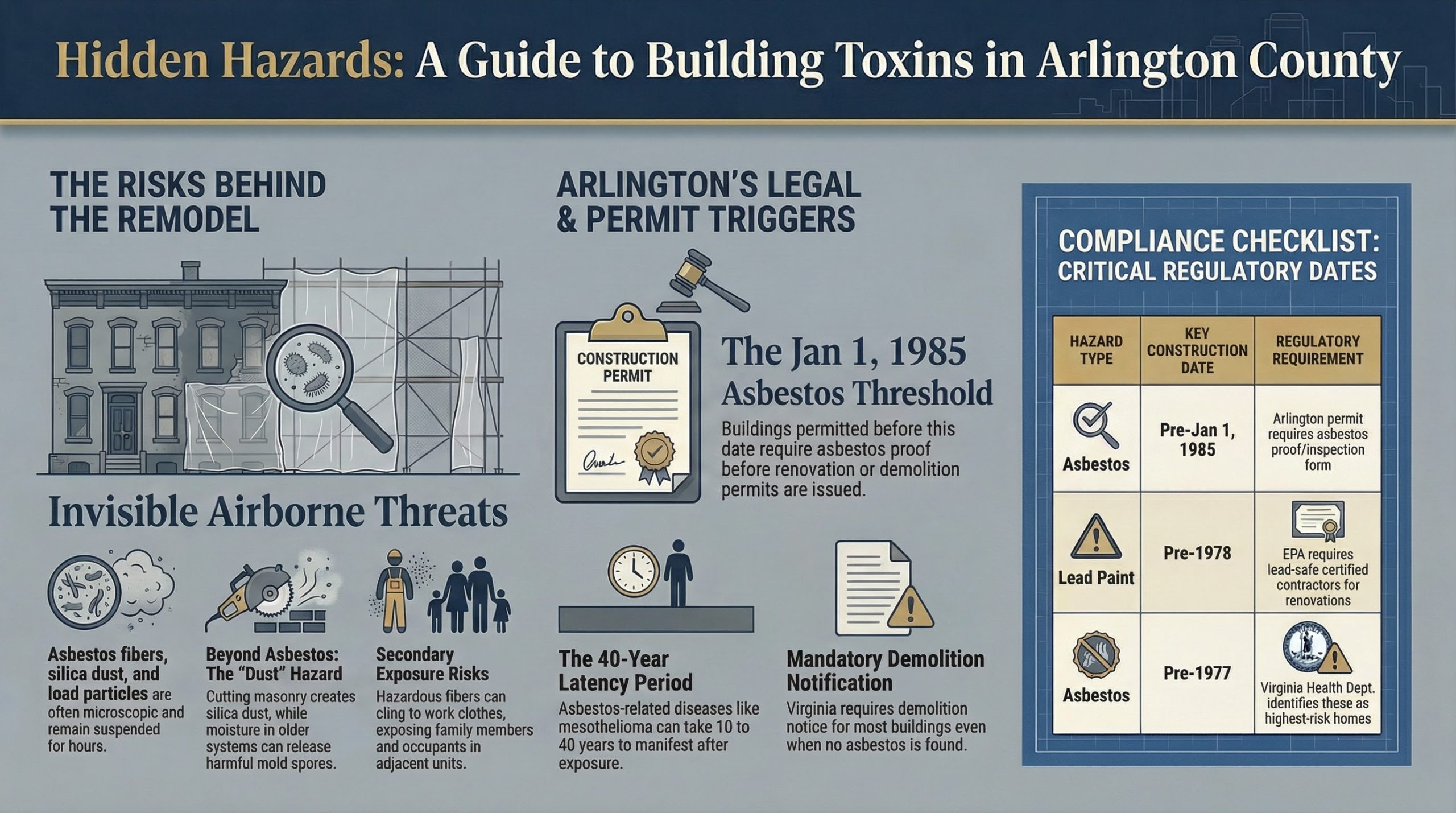
In Arlington County, the danger is often not the building itself. It is what happens when someone cuts into it, drills through it, tears it open, or rushes to modernize it without treating old materials like a live hazard. Arlington’s own permit process flags buildings originally permitted before January 1, 1985, for asbestos proof before renovation or demolition permits are issued, and every demolition permit application requires an asbestos awareness form. At the same time, Virginia says demolition notification is required for most buildings even when no asbestos is found, because the law is built around inspection, not assumptions. In a county with dense redevelopment corridors, a large multifamily housing stock, and 44.4 million square feet of rentable building area, renovation, demolition, and major maintenance can expose workers, tenants, students, patients, and nearby occupants to asbestos fibers, silica dust, lead dust, mold-related airborne contaminants, and other irritants if the job is handled carelessly.
- Table of Contents
- Chapter 1: Why this issue is bigger than most people realize
- Chapter 2: What materials are actually at issue
- Chapter 3: How exposure happens in Arlington County
- Chapter 4: What these exposures can do to people
- Chapter 5: Why these cases are often underestimated at the start
- Chapter 6: What I would want Arlington residents and workers to remember
Chapter 1: Why this issue is bigger than most people realize
Arlington is built on constant change
Arlington is only about 26 square miles, but it is intensely developed. The County reports that 63 percent of its population lives in planning corridors, 73 percent of its 126,540 housing units are multifamily, and the county contains 44.4 million square feet of rentable building area. Its major planning areas include Rosslyn, Courthouse, Clarendon, Virginia Square, Ballston, Pentagon City, Crystal City, Columbia Pike, Cherrydale, East Falls Church, Nauck, and Shirlington. That combination matters because it means Arlington is constantly renovating offices, rehabbing apartments, demolishing structures, reconfiguring schools, modernizing utilities, and turning over residential units at a pace that keeps exposure risk alive.
The threat is often invisible until work begins
Asbestos is dangerous in part because it does not announce itself. Virginia’s health department explains that asbestos fibers are tiny, not generally visible to the human eye, and were used in thousands of products, including insulation, ceiling and floor tiles, cement sheet, coatings, fireproofing textiles, and insulating papers. When disturbed, those fibers can remain suspended in air for hours, stick to clothing, and be inhaled or swallowed. The same basic truth applies to other building-related airborne hazards. Silica dust can be released when cutting concrete, brick, block, or mortar. Lead dust can be generated by renovation in older painted spaces. Damp, water-damaged materials can release spores, fragments, microbial compounds, and irritating airborne chemicals.
This is a human problem, not a paperwork problem
The most thought-provoking part of these cases is how ordinary they look before they become life-changing. A tenant hears grinding in the hallway during a unit turnover. A maintenance worker opens a ceiling chase above an old boiler room. A school undergoes phased renovation over the summer. A doctor’s office buildout cuts through old floor tile and wallboard. A demolition crew starts fast because the schedule is already behind. Nobody sees themselves as part of a toxic exposure event. Then the dust settles, the symptoms appear, and everyone starts pretending the risk was theoretical. It rarely feels theoretical to the person breathing it. This is exactly why EPA, OSHA, Virginia regulators, and Arlington’s own permit system all focus on inspection, control, notification, and management before the work gets messy.
Chapter 2: What materials are actually at issue
Asbestos is still a live issue in older buildings
The public often talks about asbestos as if it belongs entirely to the past. That is not how the law treats it. Virginia says homes built before 1977 are most likely to contain asbestos-containing materials, though some newer homes may also contain it because stockpiled or imported materials continued to be used. EPA says federal renovation and demolition rules still apply to many buildings that contain asbestos, and Virginia requires written notice for asbestos projects at or above 10 linear feet or 10 square feet, submitted 20 calendar days before the work begins. Even more important, Virginia states that demolition notification is required for most regulated buildings even when no asbestos is found, and there are no exemptions based on the date of construction or age of the structure.
Dust is not just dust
That sentence matters because “dust” is often used to make a hazard sound harmless. OSHA’s respirable crystalline silica standard for construction exists because work such as cutting, grinding, drilling, milling, or sawing concrete, brick, stone, block, and mortar can generate respirable silica that reaches deep into the lungs. OSHA requires written exposure control plans, a competent person, training, housekeeping limits, and other protective measures for construction employers. In a place like Arlington, where tenant improvements, sidewalk work, garage repairs, lobby overhauls, façade work, and mechanical retrofits happen constantly, silica exposure is not an exotic problem. It is a recurring one.
Airborne toxins can come from paint, moisture, and damaged systems too
EPA warns that renovation, repair, or painting in pre-1978 homes and buildings can easily create dangerous lead dust, which is why its Lead Renovation, Repair, and Painting program requires lead-safe certified contractors for covered work in homes, child care facilities, and preschools built before 1978. CDC also notes that indoor dampness and mold are associated with respiratory and non-respiratory health problems, and that moisture-damaged building materials can release spores, fungal fragments, volatile organic compounds, and other irritating airborne chemicals. So when people talk about “airborne toxins” in buildings, they often refer to multiple sources of exposure at the same time. A single Arlington project can involve asbestos in insulation or tile mastics, silica from cutting masonry, lead dust from painted surfaces, and mold-related airborne contaminants from long-hidden leaks.
Chapter 3: How exposure happens in Arlington County
Scenario 1: The Columbia Pike apartment turnover that moves too fast
Imagine an aging multifamily building along Columbia Pike. A unit turns over after years of deferred maintenance. The owner wants it back on the market quickly. Flooring comes up. Kitchen walls are opened. Pipe insulation in a service chase is disturbed. Old painted trim is sanded. A crew without the right containment treats the work like a cosmetic refresh.
The tenant next door starts noticing dust on the windowsill and a gritty smell in the air. A maintenance worker spends hours in the corridor without meaningful protection. The owner later says it was only a small job.
That is the problem. Even small jobs in older buildings can still disturb hazardous materials. Arlington’s permit process specifically requires asbestos proof for buildings originally permitted before January 1, 1985, before renovation or demolition permits are issued, and Arlington’s asbestos inspection and awareness form states that buildings to be renovated or demolished shall be inspected for the presence of asbestos-containing materials, subject to exemptions. EPA separately warns that pre-1978 renovation can create dangerous lead dust. In other words, the law does not assume a quick turnover is harmless simply because it is routine.
Scenario 2: The Rosslyn or Ballston office retrofit that treats the building like clean drywall
Now picture a tenant improvement project in Rosslyn or Ballston. Arlington identifies Rosslyn through Ballston as one of its major high density planning corridors, with development concentrated near station areas. A law office, medical practice, or tech tenant takes space in an older tower. The project team focuses on speed, acoustics, mechanical upgrades, and aesthetics. Then crews start opening fireproofed structural areas, drilling through old penetrations, and disturbing legacy flooring and adhesives.
Everyone on the project sees modern furniture boards and polished renderings. Few people picture friable legacy materials, old fireproofing, or hidden dust pathways through return air systems. Yet EPA’s guidance for owners and managers of buildings with asbestos specifically addresses office buildings, shopping centers, apartment buildings, hospitals, and similar facilities, and recommends an operations and maintenance program to minimize exposure of all building occupants to asbestos fibers. The reason is simple. The cleanest-looking building can still contain dangerous materials above the ceiling and below the finish layer.
Scenario 3: The Cherrydale or Lyon Village renovation, where the house looks charming, and the materials are not
Arlington’s building history resources remind people that “house cards” document the history and physical evolution of nearly every building in the county, with permit information from 1935 through the late 1980s and, in some cases, records for earlier structures that were later altered. That means a homeowner in Cherrydale, Lyon Village, Bluemont, or another older neighborhood can often trace a long chain of alterations without realizing what each generation of work left behind. A bathroom reno can expose old floor tile. A basement mechanical update can disturb pipe wrap. An attic conversion can put workers into dusty insulation and old fire-resistant materials.
Virginia’s health department says products such as ceiling and floor tiles, insulation, cement sheet, and fireproofing commonly contain asbestos, and recommends against even minor home repairs without a licensed professional if asbestos is suspected. It specifically warns not to saw, sand, scrape, or drill asbestos-containing materials, and not to dust, sweep, or vacuum debris that contains asbestos. That guidance matters because many exposures happen during work that people describe as light renovation rather than demolition.
Scenario 4: The school modernization project, where compliance exists because the risk is real
Schools are a critical example because the law treats them as special for a reason. EPA says public school districts and nonprofit schools covered by AHERA must inspect for asbestos containing materials, maintain management plans, perform reinspections, and provide annual notice about the plan and asbestos related actions. Arlington Public Schools states that it strictly complies with AHERA regulations, and its maintenance division notes responsibilities for indoor air quality and water quality across school facilities. This is not evidence of wrongdoing. It is evidence that the risk is real enough to require structured, recurring management.
That matters in the toxic tort context because a family may assume a school exposure case would only exist if somebody acted recklessly. Not always. Sometimes the issue is not reckless intent. Sometimes it is a breakdown in surveillance, communication, containment, contractor controls, or response to damaged materials during renovation or maintenance. The systems exist because buildings age, materials deteriorate, and construction activity can turn a managed hazard into an airborne one.
Scenario 5: The demolition project where everyone says “no asbestos was found” as if that ends the inquiry
This is one of the most revealing moments in a case. A structure comes down in or near Nauck, Shirlington, East Falls Church, or another active planning area. Nearby workers, residents, or business occupants complain about dust, respiratory irritation, or visible debris. The response comes back quickly: no asbestos was found.
That answer may or may not end anything. Virginia says demolition notification is required for most buildings under asbestos NESHAP even when no asbestos is involved, because the purpose of reporting even when no asbestos is found is to ensure facilities are inspected and removal is performed consistent with the standard. Arlington also requires an asbestos awareness form with demolition permit applications. The real question is often not whether someone uttered the words “no asbestos found.” The real questions are who inspected, what was sampled, what areas were inaccessible, what materials were disturbed, and what other airborne hazards were generated by the job.
Chapter 4: What these exposures can do to people
Asbestos disease does not care whether the exposure felt brief
Virginia says inhalation of asbestos fibers at high occupational levels has been shown to cause asbestosis, lung cancer, and mesothelioma, with symptoms often appearing 10 to 40 years after exposure. ATSDR similarly states that breathing asbestos can increase the risk of lung cancer and mesothelioma, and notes that disease does not develop immediately. This is one reason asbestos cases feel so morally unsettling. The dangerous act can be over in a day. The disease may not reveal itself for decades.
Silica dust and mold-related exposures may show up faster
Silica is different. OSHA’s construction standard exists because respirable crystalline silica can be generated during common building tasks, and the required controls recognize that the hazard is acute enough to require immediate planning, training, restricted housekeeping, and medical surveillance in certain circumstances. Mold-related exposures can also become apparent more quickly. CDC says occupants in damp buildings may develop respiratory symptoms and disease, and that moisture-damaged building materials can release volatile organic compounds and other irritating airborne chemicals. Some toxin cases are latency cases. Others are early symptom cases. Arlington buildings can produce both.
Secondary exposure is part of the story
Another thought-provoking truth is that the person who did not swing the saw may still bear the harm. Virginia notes that asbestos fibers can stick to clothes. ATSDR has long recognized that family members historically have been exposed through fibers brought home on work clothing. In a building exposure case, the injured person may be the maintenance worker, the adjacent tenant, the child in the next room, the patient in the suite below, or the spouse washing contaminated clothes. Toxic exposure law becomes difficult partly because the zone of harm does not always stop at the work area boundary.
Chapter 5: Why these cases are often underestimated at the start
People confuse compliance language with safety
A project file can look organized and still hide a dangerous story. There may be a permit. There may be a demolition notification. There may be a consultant report. There may be a contractor insisting the work was ordinary. None of that automatically answers the exposure question. EPA’s guidance for owners and managers emphasizes building specific inspection, management, and maintenance. Virginia’s rules emphasize notice thresholds and demolition reporting. Arlington’s permit system emphasizes proof, forms, and safe handling before issuance. These are tools, not magic. If the work was poorly scoped, sampled, communicated, or controlled, the paperwork may be the beginning of the investigation, not the end of it.
Aging buildings create false confidence because people think familiarity equals safety
Arlington’s archived house cards and permit history make one thing very clear: buildings evolve. A property can carry layers of work from different eras, each leaving behind materials, coverings, patched systems, and hidden cavities. A superintendent, landlord, facilities manager, or homeowner may think they know the building because they know the visible finishes. Exposure cases often begin when that confidence meets the concealed history of the structure. The older the building, and the more times it has been altered, the more dangerous assumptions can become.
People wait for certainty when they should be preserving evidence
The first instinct after an exposure event is often to wait and see. Wait for symptoms. Wait for the other side’s explanation. Wait for the project to finish. Wait until the dust settles, literally and legally. That delay can be costly. Evidence in these cases includes work orders, permits, demolition notices, consultant reports, abatement invoices, contractor scopes, daily logs, safety plans, tenant notices, maintenance records, photographs, surveillance, and the building’s own permit history. Arlington’s records and historical building documentation can be unusually useful in reconstructing what a property was and how it changed. Waiting does not make that story clearer. It usually makes it harder to prove.
Chapter 6: What I would want Arlington residents and workers to remember
Renovation is not permission to aerosolize a problem
The core issue is simple. Renovation, demolition, and major maintenance are moments when hidden building hazards become airborne people hazards. Arlington’s corridors are active. Its schools are maintained. Its apartments turn over. Its offices are refit. Its older homes are expanded and modernized. None of that is inherently wrongful. But the legal and human line is crossed when the project is planned or executed as if old material is harmless until proven otherwise. Arlington, Virginia, EPA, OSHA, CDC, and Arlington Public Schools all have visible compliance frameworks because the risk is known.
The case is usually bigger than a single room
An asbestos, dust, or airborne toxin case in Arlington County may begin in one apartment, one school wing, one utility chase, one tenant suite, or one demolition site. But the impact can extend to neighboring units, adjacent workers, building staff, children, patients, contractors, and families at home. That is why these cases deserve more than a shrug and a cleanup. They deserve a serious look at what the building was, what the owner knew, what the contractors did, what controls were used, what regulations applied, and who was exposed when the work disturbed dangerous material.
My view
What makes these cases compelling is that they are really about trust in the built environment. People assume the ceiling above them, the hallway outside them, the school wall next to them, and the renovation crew below them are being managed with basic competence. Most of the time, that trust is deserved. When it is not, the consequences can outlast the project by years. That is the thought that should stay with property owners, contractors, managers, tenants, workers, and families in Arlington County: the most dangerous building material is often the one everyone treated like ordinary dust.
If renovation, demolition, or repair work in an Arlington County building exposed you or your family to asbestos, hazardous dust, or airborne toxins, contact Shin Law Office to discuss what happened, what records should be preserved, and whether the exposure may support a toxic tort claim.

Principal Attorney | Civil Litigation | Shin Law Office
Call 571-445-6565 or book a consultation online today.
(This article is provided for general informational purposes and does not constitute legal advice. For advice on your specific situation, consult with a licensed Virginia attorney.)
Arlington’s official permit materials specifically address asbestos review for many older renovation and demolition projects, and federal safety rules recognize that construction activity can generate dangerous exposures to silica and lead dust during common work tasks.
Search Intent Notes
This page can target users searching for asbestos exposure in Arlington County, renovation dust exposure in Arlington County, demolition dust lawsuits in Virginia, silica dust injury claims, toxic building exposure, and airborne contaminant claims tied to older apartments, offices, schools, and mixed-use buildings.
References
- Arlington County. (2016, June 6). Find your building’s history online: It’s in the cards. Arlington County Government.
- Arlington County. (2025). Profile 2025. Department of Community Planning, Housing, and Development.
- Arlington County. (n.d.). Asbestos inspection and awareness form. Arlington County Government.
- Arlington County. (n.d.). Asbestos removal and abatement permit. Arlington County Government.
- Arlington County. (n.d.). Demolition permit. Arlington County Government.
- Arlington County. (n.d.). Planning areas. Arlington County Government.
- Arlington Public Schools. (n.d.). Maintenance services. Arlington Public Schools.
- Centers for Disease Control and Prevention, National Institute for Occupational Safety and Health. (2025, February 25). Mold in the workplace.
- Occupational Safety and Health Administration. (n.d.). Silica, crystalline: Construction. U.S. Department of Labor.
- U.S. Environmental Protection Agency. (2025, July 23). Information for owners and managers of buildings that contain asbestos.
- U.S. Environmental Protection Agency. (2026, March 5). Lead renovation, repair and painting program.
- U.S. Environmental Protection Agency. (n.d.). Asbestos and school buildings.
- Virginia Department of Health. (2026, March 17). Asbestos.
- Virginia Department of Labor and Industry. (n.d.). Asbestos, lead and demolition notification requirements.