
BLUF
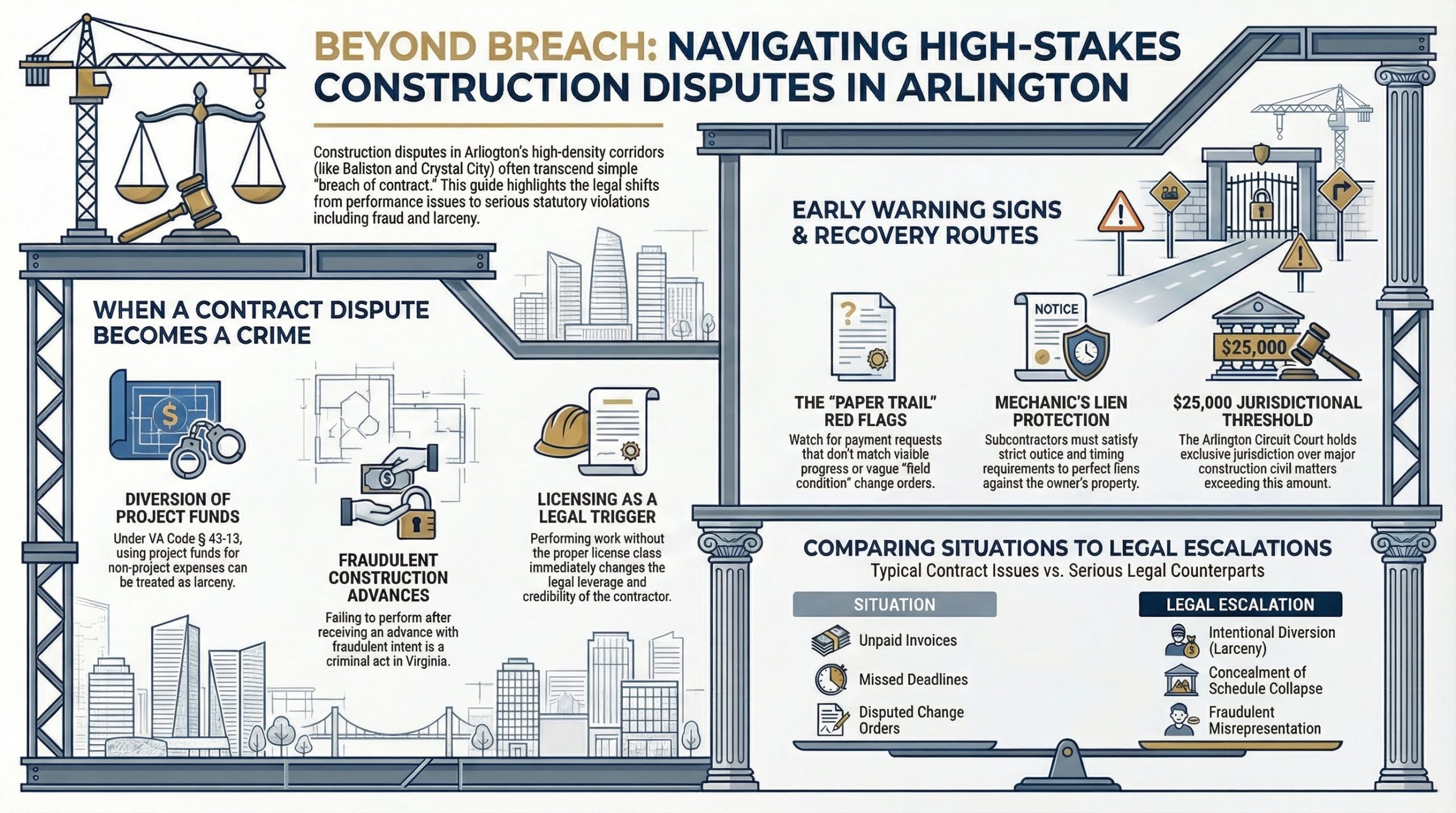
Construction disputes in Arlington County are not always simple breach-of-contract cases. A project that starts with delayed work, unpaid invoices, change order fights, or finger-pointing can also raise deeper issues involving fraud, diverted project funds, licensing problems, mechanic’s lien rights, or false promises made to secure deposits. Arlington itself is made up of more than 60 neighborhoods and major planning corridors and areas, including Rosslyn, Courthouse, Clarendon, Ballston, Pentagon City, Crystal City, Columbia Pike, Shirlington, Lyon Village, and Aurora Highlands, which means these disputes can arise in everything from single-family residential renovations to mixed-use commercial work and redevelopment projects. Arlington Circuit Court handles contract and other civil matters, with exclusive jurisdiction over civil cases above $25,000.
-
I am Anthony I. Shin, Esq. When I look at a construction dispute in Arlington County, I do not start with who is the loudest. I start with the money trail, the scope trail, the approval trail, and the truth trail. Who promised what. Who got paid. Who approved the change. Who knew the schedule was slipping. Who kept asking for money while withholding the real status of the job. That is usually where the case stops looking like a routine contract problem and starts looking far more serious.
Why construction disputes in Arlington County escalate so fast
Arlington is not a sleepy market. It is a dense, active county with major planning corridors such as Rosslyn-Ballston, Columbia Pike, Richmond Highway, and Langston Boulevard, as well as other planning areas like Shirlington, Cherrydale, East Falls Church, and Nauck. That means projects often involve tight timelines, layered contractors, design constraints, permit pressure, financing concerns, tenant expectations, and serious reputational stakes.
When that kind of pressure hits a project, the same patterns keep showing up. A contractor blames the owner. The owner blames the architect. The subcontractor says nobody paid him. The supplier says materials were delivered but invoices are still open. The general contractor says extra work was outside the scope. Then someone starts asking whether the draw money actually went where it was supposed to go.
That is where the dispute’s legal character changes.
Not every project breakdown is just a breach claim
A breach of contract claim usually asks a direct question. Did someone fail to do what the contract required. That matters. But in Virginia construction disputes, the facts may also support other theories or legal consequences.
For example, Virginia law makes it a criminal act for a contractor or subcontractor, with intent to defraud, to use funds paid for a construction project for something other than paying the persons who performed labor or furnished materials while those project obligations remain unpaid. Virginia also criminalizes obtaining an advance for construction work with fraudulent intent, then failing or refusing to perform and failing to substantially make good the advance after a proper certified mail demand. Virginia further prohibits contracting without the required license or proper class of license.
That means a case that begins as “they did not finish the work” can evolve into something much more serious if the evidence shows misrepresentation, diversion of funds, sham billing, concealed insolvency, or work performed without proper licensing.
Scenario one: The kitchen gut in Lyon Village that turns into a fraud fight
Imagine a homeowner in Lyon Village hires a contractor for a high end full renovation. The contractor asks for a large upfront payment and promises that demolition will begin within ten days, cabinets are already on hold, and the electrician is lined up. The written agreement looks polished. The homeowner wires the deposit.
Three weeks pass. No real work begins. The contractor keeps giving reasons. A permit issue. A sick crew lead. A delayed delivery. Then the homeowner learns from a supplier that no cabinet order was ever placed. Soon after, one of the supposed subcontractors says he has never even been hired for the job.
Now the owner is no longer looking at a simple delay problem. The real question becomes whether the upfront money was taken based on false representations and whether there was fraudulent intent from the start. In Virginia, failure to perform a written promise for construction in return for an advance, combined with fraudulent intent and failure to substantially make good the advance after certified mail demand, can trigger far more than a routine payment dispute.
In a case like this, the timeline matters. The texts matter. The proposal version history matters. The bank records matter. If the contractor took the deposit while knowing labor was unavailable, materials were not ordered, and the job could not be performed as promised, the facts may support more than breach.
Scenario two: A mixed use buildout near Clarendon that becomes a diverted funds case
Take a commercial tenant improvement project near Clarendon or Courthouse. The owner funds periodic draws to the general contractor. The framing crew works. The HVAC subcontractor mobilizes. The electrical supplier delivers equipment. Then the project starts stalling. Subcontractors begin threatening to walk. One says he has not been paid in six weeks. Another says the GC told him payment is coming after the next draw.
The owner is confused because the owner already paid the draw that was supposed to cover that phase.
This is one of the most dangerous patterns in construction litigation. Virginia Code § 43 13 states that funds paid under a construction contract must be used to pay persons performing labor or furnishing materials, and intentional diversion of those funds while project obligations remain unpaid can be treated as larceny.
That does not mean every cash flow problem is fraud. Construction businesses do face real pressure. But if project-specific money was knowingly used elsewhere while subs and suppliers on that same job remained unpaid, the dispute has moved beyond poor management. It may support a far more aggressive legal approach.
Scenario three: A Columbia Pike renovation where “change orders” become camouflage
Along Columbia Pike, where Arlington describes a long corridor with dense housing, businesses, and ongoing revitalization pressure, renovation work can quickly become complicated.
Imagine a property owner hires a contractor to renovate a small commercial building. The original contract is manageable. Then the contractor starts flooding the owner with change order demands. Some may be legitimate. Hidden conditions happen. Owner driven revisions happen. But then the pattern shifts. Charges appear for work the owner never approved. Labor hours suddenly spike. The contractor begins using vague phrases like “field conditions” and “coordination burden” without backup.
At first, the owner sees this as a billing fight. But let’s say later discovery shows the contractor knew many of those charges were inflated or unsupported and used them to keep the project financially afloat. That may support claims built around misrepresentation, not just nonperformance. A contract case focuses on what was promised. A fraud based case asks whether someone knowingly made false statements to obtain money or approval.
That distinction matters because the litigation strategy, leverage, and settlement value can change sharply when the facts move from sloppy documentation into deliberate deception.
Scenario four: A Ballston subcontractor that did the work but never got paid
Now picture a subcontractor on a multifamily or office project in Ballston or Virginia Square. The subcontractor finishes drywall, punch work, and corrections. The GC keeps promising payment next week. The owner says the GC has already been paid. The subcontractor starts hearing rumors that the project money is gone.
This is where Virginia lien law becomes important. Virginia’s mechanic’s lien statutes provide routes for contractors and subcontractors to perfect liens, and for subcontractors the extent of the lien is tied to the amount the owner is indebted to the general contractor at the relevant time. Virginia law also provides notice based procedures that can create personal liability up to the amount still owed in certain circumstances.
So the subcontractor’s problem is not only “I was not paid.” The real questions become these. Was lien timing preserved. Was proper notice given. What amount was still owed upstream when notice went out. Was the subcontractor induced to keep working through false payment promises. Did the GC use project funds elsewhere.
That is how a basic collection matter can develop into a more complex construction dispute with multiple moving parts.
Scenario five: An Aurora Highlands homeowner learns the contractor was not properly licensed
Suppose a homeowner in Aurora Highlands hires someone for a substantial addition, structural rework, and finish improvements. The bid is attractive. The sales pitch is confident. The contractor starts work. Halfway through, defects begin showing. Then the homeowner learns the person who took the job may not have held the proper license or class of license for the value and type of work being performed.
Virginia law prohibits contracting for construction, removal, repair, or improvements to real property without a license or without the proper class of license.
That fact does not automatically answer every civil issue, but it changes the dispute immediately. It affects credibility. It affects leverage. It affects how the job was procured. It may affect what representations were made to get the contract signed. And when licensing problems are combined with false statements about qualifications, staffing, insurance, or project readiness, the case can become much more than a simple workmanship claim.
Scenario six: A Crystal City office buildout where delay becomes concealment
Crystal City and Pentagon City are major Arlington planning areas with significant development and redevelopment activity.
Consider an office buildout in Crystal City with a hard opening date because a tenant’s lease elsewhere is ending. The contractor knows early that lead times, manpower shortages, and coordination failures have made the schedule unrealistic. But instead of disclosing the real status, the contractor issues optimistic progress updates to keep the owner calm and keep applications for payment moving.
By the time the truth comes out, the owner has lost tenant goodwill, incurred temporary relocation costs, and paid for progress that did not exist in the form represented.
A pure delay claim asks whether the contractor missed the deadline. A deeper case asks whether the contractor knowingly concealed schedule collapse while continuing to seek money and maintain the illusion that completion remained on track. That difference matters. Delay alone is frustrating. Delay paired with deception can reshape the entire litigation posture.
Scenario seven: A Shirlington retail project that becomes a chain reaction of nonpayment
Shirlington is one of Arlington’s recognized planning areas and mixed use community hubs.
Imagine a restaurant buildout there. The owner hires a GC. The GC hires a mechanical subcontractor, flooring subcontractor, millwork provider, and hood installer. Midstream, the GC falls behind. Subs get nervous. One walks off. Another files notice. The owner says the GC is breaching. The GC says the owner caused delay. The subs say the GC took the draw and never paid them.
This kind of dispute spirals because every participant sees a different problem.
The owner sees unfinished work.
The GC sees a cash squeeze and disputed extras.
The subs see diverted funds and broken promises.
The project becomes a chain reaction. Work slows. The opening date dies. Each unpaid party becomes a potential claimant. Suddenly the owner is defending against delay claims, payment claims, and lien issues all at once.
These are the moments where disciplined fact development matters most. You need to know the draw sequence, the payment applications, the percent complete representations, the subcontract payment status, and what was said each time new money was requested.
What fraud can look like in a construction case
Fraud in construction is rarely announced. It usually hides inside paperwork, progress language, and project optimism.
It can look like a contractor requesting a deposit while already knowing there is no real capacity to perform.
It can look like a payment application that overstates percent complete.
It can look like a promise that subcontractors have been paid when they have not.
It can look like fabricated material orders.
It can look like backdated change approvals.
It can look like false statements about licensure, staffing, insurance, or permits.
It can also look like using one project’s funds to plug holes on another project while continuing to assure everyone that things are under control.
That is why I do not treat construction disputes as document only cases. They are evidence pattern cases.
What owners, contractors, and subcontractors should watch early
In Arlington County, early warning signs usually appear before the project fully breaks.
If you are an owner, watch for repeated payment requests that do not match visible progress, changing explanations for delay, refusal to provide backup, or sudden tension from subcontractors you did not even know were unpaid.
If you are a subcontractor, watch for repeated promises of payment after owner draws, vague excuses tied to paperwork, and pressure to continue performing while your invoices age.
If you are a contractor trying to protect your own position, watch for informal owner directives, undocumented scope expansion, design changes issued verbally, and any project team behavior that leaves the paper trail weaker than the money trail.
The earlier the facts are preserved, the better.
Why local context matters in Arlington County
Arlington’s development environment matters because project types vary sharply by area. In Rosslyn, Clarendon, Ballston, Pentagon City, and Crystal City, disputes may involve office, hospitality, multifamily, tenant improvement, and mixed use work. Along Columbia Pike and in communities like Shirlington, Lyon Village, and Aurora Highlands, the fact pattern may involve smaller commercial redevelopment, residential renovation, additions, and neighborhood scale construction issues. Arlington also actively reviews significant private development through site plan processes, which adds another layer of complexity for some projects.
The legal theory may be statewide, but the project pressures are local.
When these cases end up in the Arlington Circuit Court
Once the dispute grows in size, complexity, or consequence, Arlington Circuit Court is often the venue for serious construction litigation. The court has exclusive jurisdiction over civil cases above $25,000 and handles contracts and other civil matters.
In practical terms, that means a project fight in Arlington County can move quickly from angry emails and withheld payments into formal litigation involving breach claims, fraud-based claims, records battles, lien issues, and business loss allegations.
My view on these disputes
The hard truth is simple. Construction cases often get mislabeled.
People call them delay cases when the real issue is concealment.
People call them payment disputes when the real issue is diverted funds.
People call them breach claims when the real issue is fraudulent inducement.
People call them project mismanagement when the real issue is that someone was never qualified or properly licensed to take the job in the first place.
That is why I look past the first accusation and go straight to the dispute’s structure. Who asked for money? What they said to get it. What the records show. What work was actually performed? What project funds were supposed to pay for. And whether the facts point to mere nonperformance or something more deliberate.
If you are dealing with a construction dispute in Arlington County involving fraud, delay, or nonpayment, the right legal analysis starts with understanding that not every project breakdown is just a breach-of-contract case.
Do not assume your Arlington County construction dispute is just a payment fight. If your project involves delay, nonpayment, false promises, diverted funds, or serious contractor misconduct, speak with Anthony I. Shin, Esq. at Shin Law Office.

Principal Attorney | Civil Litigation | Shin Law Office
Call 571-445-6565 or book a consultation online today.
(This article is provided for general informational purposes and does not constitute legal advice. For advice on your specific situation, consult with a licensed Virginia attorney.)
FAQs
1. When does a construction dispute become more than a breach of contract case in Virginia?
It becomes more than a contract case when the facts suggest deception rather than mere nonperformance. That can include false statements made to win the job, inflated payment requests, concealed delays, diverted project funds, fake progress reports, or work performed without the required license. In those situations, the dispute may involve fraud-related issues, lien issues, or statutory violations in addition to breach of contract.
2. Can a contractor in Virginia get in trouble for diverting project funds?
Yes. Virginia law states that funds paid under a construction contract must be used to pay the people performing labor or furnishing materials, and intentional diversion of those funds while those obligations remain unpaid can be treated as larceny.
3. What happens when a contractor takes an advance and does not perform?
Virginia has a specific statute for that scenario. If someone takes an advance with fraudulent intent on a promise to perform construction work, then fails or refuses to perform and also fails to substantially make good the advance within 15 days after a certified mail demand, the statute treats that as larceny of the advance.
4. Can an unlicensed contractor still create a serious legal dispute?
Yes. Virginia law prohibits contracting or bidding without the required license or proper class of license for the value of the work, and doing so is a Class 1 misdemeanor under the statute. In a civil dispute, that can become an important fact because it affects how the job was obtained, what representations were made, and how the project was performed.
5. What rights do subcontractors have when they are not paid?
Subcontractors may have mechanic’s lien rights if they satisfy the statute’s notice and perfection requirements, and Virginia law also provides a route for personal liability in certain circumstances after proper notice. The exact remedy depends on timing, notice, the amount still owed upstream, and the contract chain.
6. How do delay and fraud overlap in a construction case?
Delay becomes more serious when someone knowingly misrepresents why the project is behind, overstates percent complete, keeps requesting money while hiding the real status of the work, or falsely claims materials or labor are lined up. Delay by itself is usually a performance issue. Delay paired with deception can change the legal theory and the leverage in the case. That is an inference from Virginia’s fraud related construction statutes, not a separate delay statute.
7. Which court handles major construction disputes in Arlington County?
For larger civil cases in Arlington County, the Circuit Court is usually the key court. Arlington Circuit Court has concurrent jurisdiction with General District Court over claims from $4,500 to $25,000 and exclusive original jurisdiction over civil cases above $25,000. It also handles contracts and other civil matters.
8. What evidence matters most in a construction fraud case?
The most important evidence usually includes the written contract, change orders, draw requests, invoices, bank records, payment applications, project schedules, inspection history, emails, text messages, licensing records, and communications showing what was promised versus what was actually true. That evidence matters because the Virginia statutes focus heavily on fraudulent intent, use of funds, and failure to perform after taking money.
9. Can residential and commercial construction disputes both involve fraud claims?
Yes. The Virginia construction advance statute applies broadly to promises to perform construction, removal, repair, or improvement of buildings or other improvements to real property. The project type changes the facts, but both residential and commercial disputes can involve fraudulent inducement, false billing, diverted funds, or concealment.
10. What should owners and subcontractors do when project payments stop?
They should move quickly to preserve the paper trail. That usually means collecting the contract, change orders, invoices, proof of work, draw requests, bank records, project communications, and notice history, then evaluating lien deadlines, upstream payment status, and whether the facts point to ordinary nonpayment or possible diversion of funds or fraud. Speed matters because lien rights and proof issues can get weaker with delay.
References
Arlington County. Neighborhoods. Arlington is comprised of more than 60 neighborhoods and includes major planning corridors such as Columbia Pike, Rosslyn Ballston, Richmond Highway, and Langston Boulevard.
Arlington County. Planning Areas. Official planning areas include Rosslyn, Courthouse, Clarendon, Virginia Square, Ballston, Pentagon City, Crystal City, Columbia Pike, Cherrydale, East Falls Church, Nauck, and Shirlington.
Arlington County. Neighborhood Signs Photo Gallery. Official neighborhood signage includes places such as Aurora Highlands, Ballston Virginia Square, and Lyon Village.
Arlington County. Private Development. Significant private and public private projects may proceed through Arlington’s site plan review process.
Arlington County Circuit Court. Civil Actions and FAQs. The court has concurrent jurisdiction from $4,500 to $25,000 and exclusive jurisdiction over civil cases above $25,000, and handles contracts and other civil matters.
Code of Virginia § 18.2 200.1. Failure to perform promise for construction in return for advances.
Code of Virginia § 43 13. Funds paid to general contractor or subcontractor must be used to pay persons performing labor or furnishing material.
Code of Virginia § 43 7. Perfection of lien by subcontractor.
Code of Virginia § 43 11. Personal liability after notice in certain mechanic’s lien contexts.
Code of Virginia § 54.1 1115. Prohibited acts involving contracting without required licensure.