
Bottom Line Up Front (BLUF)
Hello, I’m Anthony I. Shin, Esq., a family law attorney serving Loudoun County, Fairfax County, Prince William County, Arlington County, Clarke County, and Frederick County in Northern Virginia. Adoption is one of the most rewarding areas of family law – it gives children the chance at a safe, stable, and permanent home, and it often fulfills a family’s dream of parenthood. But adoption is also a legal process that requires careful steps and compliance with Virginia law. Bottom line: with the right guidance, adopting a child in Virginia is very achievable. As an experienced adoption attorney, I’m here to walk you through the essentials, from the basic requirements under Virginia law to the court process and how we can work together to welcome a new member into your family. In this guide, I’ll cover the key points you need to know about adoption in our area, in a conversational, client-friendly way. Let’s get started on making your adoption journey as smooth and joyful as possible!
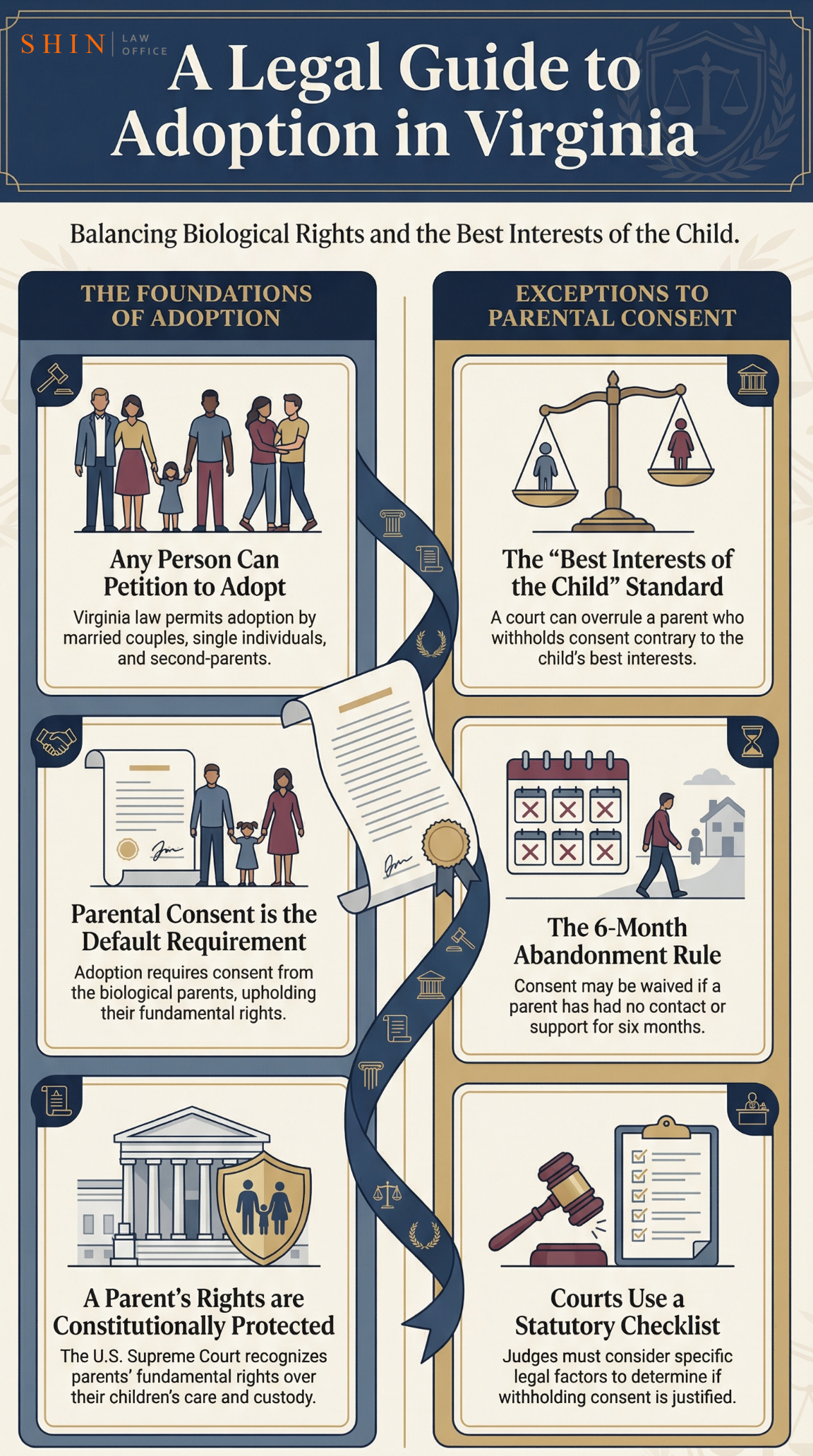
Table of Contents
Chapter 1: Adoption Basics in Virginia
In Virginia, adoption is the legal process by which a child becomes your own, with all the rights and responsibilities of a biological child. When an adoption is finalized, the adoptive parent is legally recognized as the child’s parent, and the biological parents’ rights are terminated. This means a new birth certificate is issued listing the adoptive parents, and the child gains inheritance rights and all other parent-child legal ties with the adoptive family. Adoptions are handled in the Virginia circuit courts, and the proceedings must strictly follow Virginia’s adoption statutes. The law requires that any adoption of a minor child be initiated by filing a petition in the circuit court of the appropriate county or city (typically the county or city where the adopters live or where the child’s placing agency is located).
Who typically adopts? Many of my clients are stepparents seeking to adopt a stepchild, especially when a biological parent is absent or has passed away. Others are relatives (like grandparents, aunts/uncles) stepping in to give a child a permanent home. We also see families who adopt through agencies or the foster care system, as well as couples adopting infants through private arrangements. Some adoptions involve bringing a child from another state or even internationally into a Virginia home. In every case, the goal is to provide the child with a loving, permanent family.
Adoption isn’t just a happy ending; it’s also a legal procedure. Virginia law has specific requirements to protect the best interests of the child and the rights of everyone involved. For example, the Commonwealth mandates background checks, home studies (in most cases), and court approvals before an adoption can be finalized. One or both biological parents must either consent to the adoption or have their rights lawfully terminated before the court will approve the adoption. In many cases, birth parents voluntarily consent when they believe adoption is best for the child. In other cases – such as when a child is removed from an unsafe situation – the court may have to terminate parental rights without consent. I’ll discuss consent and what happens if a parent objects in Chapter 4.
Adoption is deeply meaningful not just for the family but for our community. Every year, hundreds of Virginia children find “forever homes” through adoption, and the numbers are growing. (In fact, recent state reports show a significant increase in finalized adoptions in Virginia, thanks in part to awareness efforts during National Adoption Month.) At the same time, there are still many children waiting in foster care for permanent families – more than 1,700 Virginia foster children are currently eligible for adoption. This means your decision to adopt can truly change a child’s life. It’s a heartwarming process, but it must be done correctly to ensure the child’s welfare and to fully secure your rights as the new parent.
Chapter 2: Who Can Adopt and Be Adopted in Virginia?
Virginia’s adoption laws set out clear guidelines on who may adopt a child and who may be adopted. The good news is that the laws are fairly inclusive. Any adult (age 18 or older) who is a Virginia resident can generally petition to adopt. You can be single or married – Virginia allows single individuals to adopt, and married couples can adopt jointly (in fact, if you’re married, you’ll file a joint petition with your spouse). Stepparents are explicitly permitted to adopt their stepchildren, and intended parents in surrogacy arrangements can adopt to formalize parental rights. There’s even provision for certain situations, such as former stepparents: for example, a man and woman who were previously married and stood in loco parentis (acted as parents) to a child during the marriage can still adopt that child after divorce.
Who can be adopted? In Virginia, most adoptions involve minor children (under 18). However, adults can also be adopted in specific circumstances. For instance, a stepchild over 18 can be adopted by a stepparent if the stepparent had a parent-like relationship with them for at least 3 months while a minor. Other examples of adult adoption include close relatives or former foster children – Virginia law permits adult adoptions when it’s appropriate, often to formalize a parent-child relationship that already exists in practice. The key point is that adoption creates a legal parent-child relationship, so even adults may choose to be adopted for emotional and legal benefits (such as inheritance or official recognition of a parent-child bond).
It’s worth noting that Virginia does have some limits on who can adopt jointly. Notably, unmarried couples cannot petition to adopt a child together under current Virginia law. In other words, if you are a couple that isn’t married, only one of you can be the adopting parent in the initial process. The law was designed this way historically, and although marriage equality is recognized now (so same-sex married couples absolutely can adopt jointly just like any married couple), two partners who aren’t married must use a workaround. Virginia now offers what’s called a “second-parent” adoption: after one partner adopts the child, the other partner (who could not initially jointly petition) can then apply to adopt the child as a second parent. This allows unmarried partners – or others with a legitimate interest in the child’s life – to gain parental rights without terminating the first adoptive parent’s rights. For example, if you’re in a long-term domestic partnership, one of you would adopt the child first, and then the other could go through a second-parent adoption to also become a legal parent. This relatively new option in Virginia law has been a game-changer for many modern families, including same-sex couples who aren’t married or those who simply choose not to marry but still want to co-parent legally.
To summarize this chapter, Virginia welcomes a wide range of people to adopt. Singles, married couples, stepparents, grandparents or other relatives, and even former spouses or partners in certain cases can all become adoptive parents under the right conditions. And children who need families range from infants to teenagers – even some young adults – who can all be “adopted” legally. What matters is that the legal criteria are met and that the adoption is in the best interests of the child, which is the golden rule for all family law matters.
Chapter 3: Types of Adoptions in Virginia
Not all adoptions are alike. Virginia law outlines several types of adoption, and the process can vary slightly depending on which category your case falls into. Here are the main types:
- Agency Adoptions: These occur when a child is placed for adoption through a licensed child-placing agency or the local Department of Social Services. Many infant adoptions (where a birth mother places a baby for adoption) and most foster care adoptions are handled via agencies. In an agency adoption, the agency typically has legal custody of the child and consents to the adoption instead of the birth parents. Foster-to-Adopt is a common route here – a child is fostered with the intent to adopt if reunification with birth parents isn’t possible. In Virginia, nearly 5,000 children are in foster care and over 1,700 of them are waiting for adoption, highlighting the importance of foster-to-adopt families.
- Parental Placement (Private) Adoptions: These are independent adoptions arranged directly between the birth parent(s) and the adoptive parent(s), often with the help of an attorney. For example, a birth mother may choose a family to adopt her newborn, without agency involvement. In Virginia, this is called a “parental placement” adoption. The law has special procedures for these, including the requirement of adoption counseling for birth parents and possibly the appointment of a guardian ad litem for the child to ensure the placement is appropriate (especially if it’s a non-relative situation). Private adoptions still require court approval and a home study by social services or a licensed agency in most cases, to investigate and report on the adopting family’s suitability (unless the court waives the investigation because it’s a close relative or stepparent case).
- Stepparent Adoptions: This is one of the most common scenarios I see. A stepparent adoption happens when a stepparent (the spouse of one of the child’s biological parents) seeks to legally adopt their stepchild. Usually, the child is already living with the parent and stepparent, so it’s often a natural next step for the family. Stepparent adoptions in Virginia can be more streamlined: for example, the court can waive the home study and visitation requirements if the child has lived with the stepparent for an extended period. The biggest hurdle in stepparent cases is typically obtaining consent from the other biological parent (the one who is not in the child’s life) or meeting the criteria to waive that parent’s consent (more on the consent issue in the next chapter). Stepparent adoptions are joyful because they solidify a bond that’s often already there – the child can even take the stepfather’s or stepmother’s last name as part of the process if desired.
- Close Relative Adoptions: Sometimes a child’s grandparent, aunt, uncle, adult sibling, or other relative may adopt the child. Virginia law calls these “close relative” adoptions. There are slightly different procedures for close relatives. In fact, a close relative adoption can begin in the Juvenile & Domestic Relations District Court and may have simplified steps, especially if the child has been living with the relative for 3 or more months. The idea is to make it easier for kinship caregivers to become the legal parents when it’s in the child’s best interest. An example would be grandparents adopting a grandchild because the parents cannot care for the child – Virginia allows this and usually it’s smoother since the family connection is already there (often the home study requirement can be relaxed if the child has been in the relative’s home for a long time).
- Adult Adoptions: As mentioned earlier, Virginia permits the adoption of adults in certain cases. Typically, this might happen if, say, a former foster child who aged out at 18 wants to be legally adopted by their foster parents, or situations like a stepfather who helped raise a now-adult stepchild still wants the legal parent-child relationship. Adult adoptions require the consent of the person being adopted (since they’re an adult) but do not require the termination of anyone’s parental rights (because an adult can keep their legal ties to their birth family and still be adopted – it’s more about creating new legal ties without severing the old in some cases). Adult adoptions are relatively straightforward legally, usually just requiring consent, a petition, and a brief hearing.
- International Adoptions (Re-Adoption): If you adopt a child from another country, you may go through an adoption process abroad. However, when you bring the child to Virginia, it’s often recommended (and sometimes required) to do an official re-adoption or confirmation of foreign adoption in a Virginia court. This ensures that your foreign adoption is recognized under U.S. and Virginia law, and allows you to get a Virginia birth certificate for the child. The process for an international re-adoption in Virginia will depend on the specifics of the foreign adoption and whether the child has already been granted U.S. citizenship. I help clients navigate that additional step so that everything is legally solid here at home.
Each type of adoption has its own nuances, but the end result is the same – you become the legal parent of your child. No matter which path brings you to adoption, Virginia courts will look to ensure that proper procedures are followed and, most importantly, that the adoption is truly in the child’s best interests. In the next chapter, we’ll go through the step-by-step process you can expect as you move through an adoption in Virginia.
Chapter 4: The Virginia Adoption Process: Step by Step
While every family’s story is unique, the adoption process in Virginia generally follows a series of common steps. Here’s an overview of what to expect:
- Decision and Preparation: First, you’ve made the heartfelt decision to adopt – congratulations! At this stage, it’s important to consult with a family law attorney (like me) early on. We’ll discuss your specific situation (e.g., stepparent vs. agency adoption) and ensure you understand the requirements. If it’s an agency or foster adoption, you will also be working with that agency on pre-adoption requirements. For private adoptions, you may need to identify a child or birth mother. Remember that paying money for a child is illegal (beyond paying for allowable expenses), so be sure to work closely with professionals to do everything above board. You’ll also want to complete any necessary pre-adoption training or orientation (often required for foster/adoptive parents through DSS or agencies).
- Home Study and Background Checks: In most adoptions (except some close family or stepparent adoptions that can waive this), you’ll need a home study by a licensed social worker or agency. This involves interviews, home visits, background checks (including criminal record and child abuse registry checks), and gathering documents like medical reports and references. Don’t let this step intimidate you – the goal is to ensure the child is going to a safe, stable home, not to interrogate your every move. I often tell clients to see the home study as an opportunity to learn and prepare for parenting, as social workers provide guidance, too. Once the home study report is completed and recommends you for adoption, it will be submitted to the court later as part of your case.
- Filing the Petition: When you’re ready to formally start the adoption (and usually after the child has been placed in your home, if it’s not a stepchild, you’re already living with), we will file an adoption petition in the Circuit Court for your county. The petition is a legal document that includes information about you (the petitioner(s)), the child, and the circumstances of the adoption. We will attach required documents, which may include the birth parents’ consents or documentation of why consent isn’t needed, the home study report (or a request to waive it, if applicable), and other relevant papers (like a copy of the child’s birth certificate, any marriage certificate if you’re married, etc.). Virginia law also requires a filing fee that includes funding for the Virginia Birth Father Registry in most cases.
- Notice and Consent: Once the case is filed, we must ensure that all necessary parties are notified. If a birth parent’s rights have not yet been terminated, they must be given notice of the adoption proceedings (unless they signed a notarized consent or their consent is legally not required as per the law). Consent is a critical part of the process. In an uncontested adoption, the birth parent(s) have voluntarily consented. They do this by signing a legal consent form (after the child is at least 3 days old, in the case of newborns, to prevent rushed decisions) in front of a judge or via an elaborate notarized and witnessed procedure. If a birth parent is unknown or cannot be found, we may publish a notice in a newspaper as a form of legal notice. If a parent refuses to consent but hasn’t been involved in the child’s life, we might proceed on the basis that consent is being unreasonably withheld – this is essentially a contested adoption scenario, which leads to the next step.
- Termination of Parental Rights: Before an adoption can be finalized, the legal relationship between the child and their biological parent(s) must be severed (except in second-parent adoptions or other special cases in which one parent retains their rights). Termination can occur in two ways: voluntarily (by consent, as mentioned) or involuntarily (by a court order). In involuntary cases, the court will hold a hearing to decide if there are legal grounds to terminate a parent’s rights without consent. Virginia law outlines specific grounds, such as abandonment (e.g., a parent going at least 6 months without any contact or support for the child), or if the parent is proven unfit and it’s in the child’s best interest to proceed with adoption. This is where evidence is presented – for example, proof of no contact, or testimony about neglect or abuse. It’s often the most sensitive part of the process. As your attorney, I would prepare thoroughly for this stage because the burden is on the adoptive petitioner to show the court that the criteria are met to dispense with the required consent. If the court is convinced (or if the birth parent ultimately consents or fails to appear), the result is an order terminating the birth parent’s rights, clearing the way for the adoption to proceed.
- Interlocutory Order and Supervision (if required): In some cases, Virginia requires an interlocutory order of adoption, which is like a temporary adoption order. The child is placed with you under court supervision for a period (usually 6 months), after which the final adoption hearing is held. During this time, a social worker might visit once or twice to ensure the placement is going well and then report to the court. However, this step is often waived if the child has already been living with you for a long time (such as in stepparent or relative adoptions) or if the court determines it’s unnecessary to wait. Many agency adoptions nowadays go straight to final order if everything is in order, especially for foster parents who have already been caring for the child for months.
- The Final Adoption Hearing: This is the big day! Once all the pieces are in place, consents or termination, home study, etc., we’ll schedule a final hearing in the circuit court. In some jurisdictions, this can be a fairly quick and joyful proceeding, sometimes even held virtually or in the judge’s chambers, depending on the county. I always encourage families to bring loved ones and cameras (where allowed) because it’s truly a celebration. The judge will review the file to ensure all legal requirements are satisfied. If everything looks good, the judge signs the Final Order of Adoption. I’ve seen judges let the new adoptive child bang the gavel or take a photo with the family – it can be very heartwarming. Once that final order is signed, the adoption is official!
- Post-Adoption Steps: After the final order, I help my clients with a few loose ends. We will apply for an amended birth certificate for the child through the Virginia Department of Health’s Division of Vital Records, which will list the new parent(s) (and the child’s new name, if changed). If it’s an international adoption, we’ll also ensure citizenship papers are in order. I remind clients to update their will or estate plans to include the new child (since adoptions confer inheritance rights, but it’s good practice to update documents). Additionally, if the child was in foster care, the family might be eligible for adoption assistance (financial subsidies or services), and we’ll ensure those agreements are handled before finalization. Lastly, many families choose to celebrate “Adoption Day” each year as a second birthday of sorts a lovely tradition to mark the occasion.
Throughout this process, my role as your attorney is to guide and advocate at every step: preparing legal documents, ensuring all parties’ rights are respected, representing you in court hearings, and troubleshooting any hurdles (for example, if a required document is missing or a birth parent suddenly contests, we handle it). While the legal steps might sound daunting, I strive to make it as straightforward as possible for you, so you can focus on the excitement of welcoming a child.
Chapter 5: Parental Consent and Legal Hurdles in Adoption
One of the most common concerns new clients have is: “What if the biological parent won’t agree to the adoption?”. Adoption law in Virginia balances the adoptive family’s interests with the fundamental rights of birth parents. The U.S. Supreme Court has long held that a parent’s right to raise their child is a fundamental liberty interest protected by the Constitution. Virginia’s statutes reflect this by generally requiring the consent of any living legal parent before an adoption can proceed. However, the law also recognizes that there are situations where a parent’s consent isn’t obtainable or is being unreasonably withheld in a way that’s harmful to the child. In those cases, the court can waive the need for that consent, but strict conditions must be met.
Here are the key points about consent and termination of parental rights in Virginia adoptions:
- When Consent is Required: If the child has two living parents who still have parental rights, typically both must consent to the adoption (unless one’s rights have already been terminated by a court). In a stepparent adoption, this means the parent married to the stepparent is obviously on board (indeed, they are a petitioner in the case), and the other biological parent must consent – unless an exception applies. In an agency adoption, the agency will have obtained the birth parents’ consents or a prior court termination. In a direct parental placement, the birth mother and any legal father must consent. Virginia law allows a birth parent to sign a consent after the baby is at least 3 days old, and there’s a 7-day revocation period for consents taken outside of court (or up to the moment the court confirms the consent in a parental placement). This is to prevent hasty decisions; it gives a short window for a birth parent to change their mind.
- Exceptions – When Consent Can Be Waived: Virginia Code § 63.2-1202 lists specific scenarios in which a parent’s consent is not required. The most commonly used exception is abandonment: if a parent has wilfully failed to visit, contact, or support the child for at least six months prior to the filing of the adoption petition, the court may dispense with that parent’s consent. Essentially, the law equates such prolonged abandonment with consent by silence (and indeed with parental unfitness). Another example is if the parent is mentally or physically unable to care for the child and likely to remain so indefinitely, the court can decide that consent is not required from that parent. If a parent has been convicted of certain serious crimes (for example, a crime involving the child or a sibling), the court may waive the consent requirement. Additionally, if the parent is unknown (e.g. an unwed birth father who didn’t establish paternity or register in the putative father registry) or cannot be found after diligent search, the court can proceed without that consent. The death of a parent obviously removes the need for consent as well.
- Contested Adoptions and Best Interests Test: When a parent refuses to consent, the adoption can become contested. Virginia law provides a pathway for contested cases: the court must determine if the withholding of consent is “contrary to the best interests of the child.” This is a high standard – it’s not enough that adoption would be better for the child; it must be that staying with the objecting parent would be detrimental to the child. The Supreme Court of Virginia in Copeland v. Todd (2011) upheld the constitutionality of this approach, making clear that courts have to carefully weigh specific statutory factors before overriding a parent’s lack of consent. Under Virginia Code § 63.2-1205, the court will consider factors such as: the birth parent’s efforts to maintain a relationship with the child, the parent’s ability and willingness to care for the child, any history of the other parent or others thwarting the birth parent’s attempts to be involved, the age and needs of the child, the existing relationship between parent and child, the stability of the current home environment, and the impact on the child of changing custody. All relevant factors are weighed to decide if the parent is unfit or has forfeited their parental rights, and if adoption serves the child’s best interests. For instance, if a father has not contacted a child in years and has provided no support, and the child is thriving with a stepfather who’s the only “dad” the child knows, a court may find that the father’s refusal to consent is against the child’s best interests and approve the adoption without that consent. These cases are very fact-specific and can be emotionally charged. Courts do not take terminating parental rights lightly – it’s often said that it’s the “civil death penalty” in family law because of its permanence.
- Revocation and Appeal: If a birth parent initially consents but then changes their mind within the allowed time frame (typically 7 days if outside court consent), they can revoke their consent, and the adoption cannot proceed. After that period, a signed consent is irrevocable except in rare circumstances like fraud or duress. If a parent contests and loses (meaning the court approves the adoption over their objection), that parent does have the right to appeal the decision to higher courts. However, the appeal must be filed quickly (usually within 30 days), and the appellate courts will review whether the law was correctly applied and evidence properly considered. Not every contest goes to appeal, but we prepare for it if it’s a possibility.
Navigating the consent issue is where having an experienced attorney is absolutely crucial. I help my clients by first evaluating whether we can proceed as an uncontested adoption (which is always simpler and preferred). If a missing parent’s consent needs to be waived, we gather evidence to meet the statutory criteria – for example, documenting lack of contact through testimony or affidavits, or showing the parent’s inability to care for the child. We might hire a private investigator to locate an absent parent or to serve them notice, satisfying the court that we did our due diligence. In cases where a biological parent is known and fit but initially hesitant, sometimes discussions (or mediation) can lead them to see that adoption truly is best for the child, and they may consent voluntarily (occasionally with agreements for some level of post-adoption contact or updates, though Virginia does not enforce open adoption agreements unless very specific conditions are met). Each situation is unique, but rest assured I approach these sensitive matters with the utmost care and with the child’s welfare as the guiding light.
Chapter 6: Working with a Family Law Attorney in Northern Virginia (Next Steps)
Adoption is a legal journey as much as it is an emotional one, and you don’t have to navigate it alone. Working with a knowledgeable family law attorney can make all the difference in ensuring your adoption goes smoothly and that your rights (and the child’s rights) are protected at every step. As a practitioner in Loudoun, Fairfax, Prince William, Arlington, Clarke, and Frederick Counties, I am deeply familiar with the local court procedures and judges in these jurisdictions. While Virginia’s adoption laws are the same statewide, each circuit court may have slight variations in how cases are scheduled or in what paperwork it expects. For example, the filing process in Fairfax County’s Circuit Court might involve different local forms or timing considerations than those in a smaller jurisdiction like Clarke County. Part of my job is to handle those procedural nuances so you don’t have to worry about them.
What can you expect when you come to my office to pursue an adoption? First, I’ll listen to your story – every adoption truly does start with a story. Whether you’re a stepparent who has been “Mom” or “Dad” to a child for years, a couple yearning to start a family through adoption, or a relative stepping up for a child in need, I want to understand your situation and goals. I’ll then explain the specific legal requirements for your case: for instance, if you’re adopting a stepchild, I’ll outline how we will address the other parent’s rights (perhaps that other parent has vanished – we’ll use the six-month no-contact rule and show the court it applies). If you’re adopting through an agency, I’ll coordinate with the agency to ensure all court documents (such as the agency’s consent and home study report) are properly obtained. If you’re in a parental placement adoption, I’ll walk you through the consent process for the birth mother and birth father, and ensure all the statutory safeguards (like the required counseling session and the appointment of a guardian ad litem for the child) are fulfilled under Virginia Code § 63.2-1232 et seq. (the parental placement adoption procedures).
One thing I emphasize to clients is that adoption is a team effort. You’ll have me as your legal advocate, but I’ll likely also involve other professionals: social workers for home studies, perhaps counselors or therapists if helpful (especially in older child adoptions or foster transitions), and even other attorneys if needed (for example, occasionally a birth parent might get their own attorney, which can actually help streamline an agreement). My role is also part project manager – I keep track of all the moving parts and deadlines (like when the post-placement report is due, or when the 7-day revocation period expires, etc.). This allows you to focus on preparing your home and heart for the new addition to your family, rather than stressing over legal minutiae.
Local experience matters. Northern Virginia courts are efficient and generally very supportive of adoptions, but each county may schedule hearings slightly differently. In Fairfax County, for instance, the Circuit Court handles a high volume of cases, so I know to file paperwork promptly and request hearings with enough lead time. In Loudoun County, the clerks and judges are familiar faces to me – having practiced there, I know the folks who will be processing your petition and can often anticipate any requests they might have. This familiarity helps prevent delays. It’s like knowing the terrain when you’re going on a journey; I can guide you through the shortcuts and avoid the pitfalls.
Finally, I want to highlight the emotional support and confidentiality you get when working with a dedicated adoption attorney. Adoption can stir up a lot of emotions: excitement, anxiety, impatience, and sometimes fears (especially around the consent issues discussed earlier). My job isn’t just paperwork – it’s also to reassure and counsel you through those ups and downs. If you’re ever unsure about something you read online or heard from a friend, you can call me and get clarity. I keep all your information confidential, and I’m sensitive to situations like needing to communicate carefully if a birth parent is involved or if there are other children who don’t yet know about the adoption plans.
Targeting new clients like you means I want to speak to you directly: If you’re considering adoption in Northern Virginia, I invite you to reach out for a consultation. Whether you ultimately choose me or just need some direction, I’m happy to help answer your questions and outline a game plan. There’s a saying that “children are brought into this world in many different ways, but they come into a family through love.” If adoption is your way of growing your family, I’d be honored to assist in making it a legal reality. Every step of the way, from our first meeting to the day you stand before a judge and legally become a parent, I’ll work to make the process clear, positive, and successful for you.
In conclusion, adoption is a beautiful journey that involves legal complexities – but with the right support, those complexities become manageable. In Virginia, we have solid laws and procedures that, while detailed, are all oriented towards ensuring that each adoption is truly in the best interest of the child and fair to the biological parents. I hope this guide has demystified adoption for you and given you a clear picture of how it works in Loudoun, Fairfax, Prince William, Arlington, Clarke, Frederick, and surrounding areas. When you’re ready to take the next step toward adopting, as a seasoned family law attorney and an advocate for growing families, I am ready to help you make your dream come true.
Thank you for reading, and I look forward to the possibility of working with you on your adoption journey!

Principal Attorney | Shin Law Office
Call 571-445-6565 or book a consultation online today.
(This article is provided for general informational purposes and does not constitute legal advice. For advice on your specific situation, consult with a licensed Virginia attorney.)
References
- Child Welfare Information Gateway. (2020, January). Who May Adopt, Be Adopted, or Place a Child for Adoption – Virginia. U.S. Department of Health & Human Services. (Retrieved from childwelfare.gov)Code of Virginia § 63.2-1201 (2026). Filing of petition for adoption; venue; jurisdiction; and proceedings.Code of Virginia § 63.2-1202 (2026). Parental consent required for adoption; exceptions (e.g., abandonment defined as 6 months without contact).Code of Virginia § 63.2-1205 (2026). Best interests of the child; standards for determining when consent is withheld contrary to child’s best interests.
- Copeland v. Todd, 282 Va. 183, 715 S.E.2d 11 (Va. 2011). (Virginia Supreme Court case affirming courts must consider statutory factors under §63.2-1205 and that the statute is constitutional in contested adoptions).
Troxel v. Granville, 530 U.S. 57 (2000). (U.S. Supreme Court case recognizing parents’ fundamental rights in care, custody, and control of their children).
Livesay & Myers, P.C. (2024, February 5). Contested Adoption and Consent. [Family Law Article]. (Discusses Virginia law on contested adoptions, parental unfitness standards, and factors courts consider).
Melone Hatley, P.C. (n.d.). Adoption and Termination of Parental Rights: How the Court Decides. [Blog post]. (Describes the importance of addressing parental rights in adoption and the rewarding nature of adoption).
Quinn, C. (2024). What Are the Requirements for Adopting a Child? Quinn Law Centers. (Provides an overview of Virginia adoption requirements, including who can adopt and second-parent adoption provisions).
Smith Strong, PLC. (2025, November 12). Biological Father Consent Not Needed if No Contact for More Than Six Months. [Library Article]. (Covers Virginia’s 6-month no-contact rule for waiving parental consent in stepparent adoptions and discusses Graves v. Jones case).
AdoptionVA. (2025). Virginia Foster Care & Adoption Statistics. Virginia Department of Social Services & Adoptive Family Recruitment. (Highlights number of children in foster care and those awaiting adoption in Virginia).