
BLUF (Bottom Line Up Front)
When you’re involved in a protective order matter in Virginia, whether you’re seeking protection from harm or defending against a petition, the legal process moves fast, the stakes are high, and the consequences can touch every part of your life, from personal safety and your home to employment, firearms rights, and your reputation. Protective orders are powerful civil tools designed to keep people safe from violence, threats, stalking, or harassment, but they are also complex legal instruments that judges scrutinize closely under Virginia law. Understanding how protective orders work, what types exist (emergency, preliminary, final), what evidence matters, and how courts evaluate claims is essential to protect your rights and safety.
If you are asking questions like these, this article is written for you:
• What are the different types of protective orders in Virginia?
• How do Virginia courts decide whether to grant or deny a protective order?
• What evidence is required to support or defend against a protective order?
• What rights and restrictions come with a protective order?
• How can I prepare effectively for a protective order hearing?
This guide explains the legal standards, practical steps, and courtroom expectations for protective order cases in Virginia, whether you’re seeking protection or defending yourself against a petition you believe is false or exaggerated. It provides the clarity and strategy you need in one of the most urgent and personal areas of Virginia law.
Table of Contents
- Introduction: Emergency, Preliminary, and Final Orders
- Chapter 1: How Protective Orders Work Under Virginia Law
- Chapter 2: When You Should Seek a Protective Order
- Chapter 3: When You Need to Defend Yourself Against a Protective Order
- Chapter 4: The Protective Order Litigation Process
- Chapter 5: Protective Orders in the Digital Age
- Chapter 6: After the Court’s Decision
- Closing Summary & Contact Info
Emergency, Preliminary, and Final Protective Orders Explained
Introduction
Protective order cases are some of the most emotionally charged and high-risk matters that come through my office. No one plans to stand in front of a judge explaining the most private and painful moments of their life, yet here you are facing fear, confusion, or accusations that could alter everything from your home and family to your employment and reputation. Whether you are seeking protection from escalating threats or defending yourself against a petition that is exaggerated, retaliatory, or completely false, you need more than information you need a strategic advocate who knows exactly how these cases unfold in Northern Virginia courtrooms. I guide you through every step with clarity and urgency, because in these cases, delays are dangerous and preparation is everything.
Chapter 1: How Protective Orders Work Under Virginia Law
Understanding What You Are Facing and What the Court Needs to See
When someone walks into my office asking about a protective order, they are usually experiencing one of the most stressful moments of their life. I see the fear, the exhaustion, and the uncertainty in their face. Some are seeking protection because the situation at home has spiraled into danger. Others come to me because they were just served with a protective order they believe is false, exaggerated, or strategically motivated during a breakup or custody dispute.
Regardless of which side you are on, the reality is the same.
A protective order hearing in Virginia is not just a routine court date.
It can affect your safety, your children, your home, your reputation, your job, your firearms rights, and your future.
My job is to walk you through this process with clarity. Protective orders are powerful tools the courts use, but they come with equally powerful consequences. To advocate effectively for you in the circuit courts of Loudoun, Fairfax, Arlington, Clarke, Prince William, and Frederick Counties, I begin with one essential step. You need to understand what the court must see before issuing, extending, or denying a protective order.
What a Protective Order Really Is in Virginia
More Than a Piece of Paper
Under Virginia Code sections 16.1-279.1 and 19.2-152.10, a protective order is a civil order that restricts contact and behavior to prevent further acts of violence, threat, force, or intimidation. Judges take these cases seriously because protective orders exist to prevent harm before it happens.
But here is something important to understand.
A protective order is not a finding of guilt.
It does not require proof beyond a reasonable doubt.
But it does require evidence that the petitioner has experienced, or is likely to experience, harm that the court cannot ignore.
The standard is a preponderance of the evidence, which means “more likely than not.” That standard gives the judge significant discretion. This is why the way we organize your evidence and testimony matters so much.
The Three Types of Protective Orders in Virginia
Why Each One Has a Different Purpose
You will encounter three types of protective orders, and each serves a different legal role.
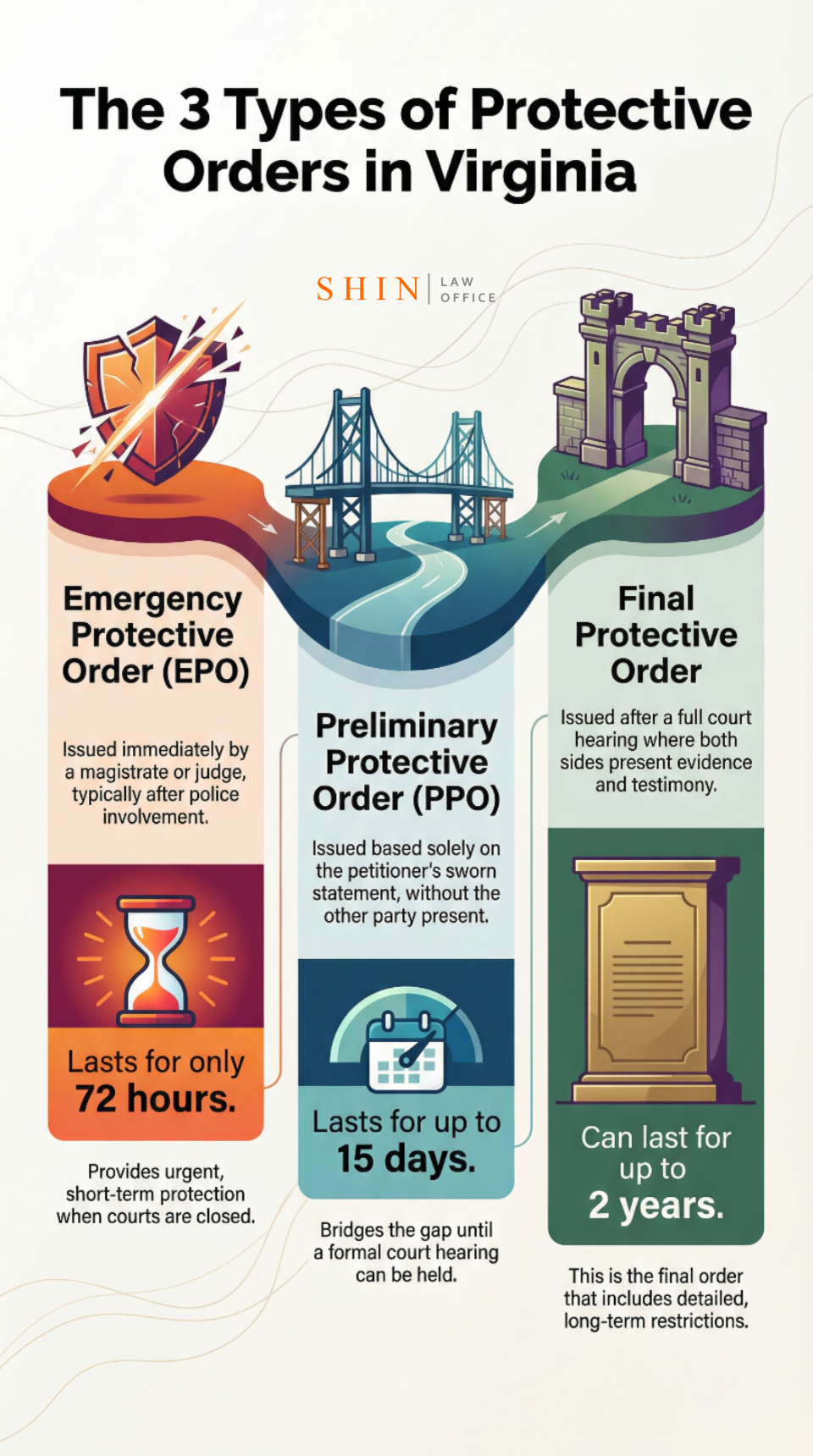
Understanding the Three Types of Protective Orders in Virginia and How Each One Works
Emergency Protective Order Issued by a magistrate or judge after an arrest or police response.
- It lasts only 72 hours.
- These are often issued at night or on weekends when courts are closed.
Preliminary Protective Order This is the step that catches people off guard. It can be issued without the defendant even being present, based solely on the petitioner’s sworn statement.
- It lasts up to 15 days, until a formal hearing is held.
Final Protective Order This is the order that can last up to two years and includes detailed restrictions.
- This is where litigation becomes critical.
- This is the hearing where witnesses, evidence, digital messages, police reports, and testimony matter most.
In Northern Virginia, these hearings move quickly. Judges in Loudoun, Fairfax, Arlington, Prince William, Clarke, and Frederick County expect both sides to be prepared. I make sure my clients are.
What Judges Actually Look For
The Truth About How Courts Evaluate Threats, Harassment, and Violence
Courts do not issue protective orders simply because two people had an argument.
Nor do they issue one just because the relationship has become stressful or unpleasant.
Judges look for four primary categories:
- Physical Violence Any unwanted touching or act intended to cause physical harm, even without visible injuries.
- Threats or Intimidation Words, messages, or actions that create reasonable fear of harm.
- Stalking A pattern of conduct, digital or physical, that causes fear or emotional distress.
- Cyber Harassment or Cyberbullying Repeated messaging, posting, impersonation, doxxing, GPS tracking, or online threats.
I have represented clients across all six counties whose cases were won or lost based on one critical factor: credibility. Judges watch closely. They look at demeanor, consistency, specific details, and any supporting evidence that confirms the story.
The Real Emotional Weight Behind These Cases
Protective Order Court Is Not Just a Legal Battle — It Is a Human One
Every time I stand beside someone at a protective order hearing, I remind myself that people do not end up in these cases casually. Something major has happened. Or at least, something significant is being alleged.
These cases typically involve….
- A mother trying to protect her children from escalating household violence
- A father wrongly accused during a custody dispute
- A young professional who was stalked by an ex-co-worker online
- A husband was falsely accused after a misinterpreted text exchange
- A teenager targeted by relentless cyberbullying
- A woman is terrified after repeated threats from an ex-partner
And in every case, the legal question is not simply what happened, but whether what happened meets Virginia’s legal threshold for protection.
Civil vs Criminal Consequences
How a Civil Hearing Can Turn Into Criminal Trouble
Some clients are shocked to learn that violating a protective order is not a civil matter.
It is a criminal offense under Virginia Code § 18.2 60.4.
Even accidental violations can lead to arrest. For example:
- Calling the petitioner “just to talk”
- Responding to a text they sent
- Driving by a home or workplace without realizing it
- Liking or reacting to a social media post
I have defended clients in Prince William and Fairfax County who were criminally charged for violations they did not even realize were violations. This is why I take time to break down each restriction and ensure my clients know exactly what they can and cannot do. Ignorance will not protect you in court.
What Makes These Courts Unique
Local Judges, Local Rules, Local Expectations
Each county handles protective order cases slightly differently.
- Loudoun County: Judges expect well-organized timelines and clear factual evidence. Loudoun is strict regarding credibility and consistency.
- Fairfax County: High volume docket. You need concise, focused evidence, and judges move quickly.
- Arlington County: Judges pay close attention to digital harassment and online threats.
- Prince William County: Detailed testimony matters. Judges expect thorough explanations and supporting documentation.
- Clarke County: Smaller docket, but judges examine family dynamics closely and ask probing questions.
- Frederick County: Judges often focus on the immediate risk of harm and the likelihood of escalation.
I will structure your case based on the tendencies of the court where your hearing will be held. Protective orders are not “one size fits all.” Your strategy must match the venue.
Why Preparation Is Everything
The Court Will Not Fix a Case That Is Poorly Presented
Protective order cases move fast often too fast for people to prepare on their own. A poorly organized case can dramatically change the outcome. I help clients build:
- A clear timeline of events
- A well-structured narrative
- Screenshots, messages, emails, call logs, and digital evidence
- Witness statements
- Police reports
- Medical records, if any
- Consistent and credible testimony
Because in these cases, clarity is power. And confusion is costly.
Final Thoughts
Why Understanding the Law Is the First Step Toward Protecting Your Future
Whether you are seeking protection or defending yourself, protective orders are life changing legal events. They require strategy, preparation, and a clear understanding of how Virginia courts evaluate danger, credibility, and evidence.
In Chapter 2, I will walk you through the moment where most protective order cases begin: the decision to seek help. That decision is never easy, but with the right understanding of the law and the court’s expectations, you can take action with confidence.
Chapter 2: When You Should Seek a Protective Order
Recognizing the Moment When Safety Must Come First
One of the most challenging conversations I have with clients is helping them decide whether to seek a protective order. For many people, the idea of standing in a courtroom and describing private, painful events feels overwhelming. Others worry about making things worse, damaging a relationship, or escalating a situation they hoped would resolve quietly.
And then some come to me after they’ve already minimized dangerous behavior for far too long.
I always tell my clients the same thing.
A protective order is not about punishing someone. It is about protecting you.
If you are reading this chapter, you may be somewhere on that spectrum between uncertainty and fear, asking yourself whether what you’re experiencing crosses the legal threshold for protection under Virginia law. My job is to help you see the situation clearly, without judgment, and to show you how the courts in Loudoun, Fairfax, Arlington, Clarke, Prince William, and Frederick Counties evaluate these cases.
Understanding What “Family Abuse,” Stalking, and Harassment Mean in Virginia
The Legal Threshold Is Clearer Than You Think
Many people assume that they cannot file for a protective order unless there is visible physical injury. But under Virginia Code § 16.1 228, the legal definition of family abuse includes:
- Force
- Violence
- Threats
- Any act that makes you reasonably fear bodily injury
In other words, you do not need broken bones, bruises, or a police report to qualify.
Fear itself can be enough, if supported by facts the court considers credible.
The same is true for stalking under Virginia Code § 18.2 60.3. If someone’s repeated actions cause you fear or emotional distress, and those actions serve no legitimate purpose, the law considers that stalking, whether it happens in person, online, or through a series of unwanted messages.
Harassment doesn’t always look dramatic. Sometimes it’s subtle:
- Dozens of text messages demanding to know where you are
- Showing up at your workplace
- Monitoring your social media
- Driving by your home
- Emotional manipulation that escalates when boundaries are set
If these behaviors leave you fearful, anxious, or unsafe, the courts will listen.
How Fear Shows Up in Real Life
What I See Every Week in My Office
When someone asks me, “Do I need a protective order?” the answer usually lies in how their story begins.
It often begins with:
- “I thought it would stop.”
- “I didn’t want to get them in trouble.”
- “I didn’t think anyone would believe me.”
- “I feel like I’m walking on eggshells.”
- “I didn’t realize how bad it was until recently.”
When fear begins shaping your decisions your sleep, your interactions with friends, your daily routine that is the moment you should seek legal guidance.
I’ve worked with clients across all six counties who described:
- Hiding in a locked bathroom while someone pounded on the door
- Being threatened during arguments that “never got physical” until they did
- Emotional abuse that slowly escalated into intimidation
- Cyberbullying from an ex partner that affected their job and mental health
- Stalking behavior that felt “strange at first” but quickly turned frightening
- Threatening messages that left them afraid to check their phone
None of these scenarios are insignificant. Each one is a warning sign the court takes seriously.
The Moment You Decide to Seek Protection
Understanding Your Motivation and the Court’s Perspective
Seeking a protective order is a powerful act. But it is also a personal one. I ask clients three questions:
- Has the situation escalated over time? Patterns matter more than isolated moments. Courts scrutinize escalation.
- Do you genuinely feel unsafe? If your instincts are telling you something is wrong, listen to them.
- Are you afraid of what might happen next? Predictive fear, the fear of what could happen, is central to protective order law.
Virginia courts look at whether violence or intimidation is likely to occur again, not only whether something happened before. If the answer to these questions is yes, it is time to act.
What Evidence Helps – Even If You Think You Have “Nothing”
Your Story, Told Clearly, Is Evidence
Many people hesitate because they believe they lack evidence. But here is the truth I tell everyone.
You do not need “perfect” evidence. You need honest, organized evidence.
Courts in Northern Virginia commonly accept:
- Text messages
- Voicemail recordings
- Social media posts
- Photos of damage to property
- Police reports
- Statements from witnesses
- Hospital or medical documentation
- Timeline entries written while events were happening
I have had cases where a single voicemail tipped the scales. And other instances in which screenshots painted a picture of escalating threats that the judge could not ignore. Your testimony is evidence. Your fear is evidence when supported by facts. Your timeline is evidence. Do not underestimate your own voice. The court won’t.
Filing for an Emergency Protective Order
When the Situation Cannot Wait
If the police respond to your home and believe you are at risk, the magistrate can issue an Emergency Protective Order (EPO) immediately. It lasts 72 hours, or until the next court day.
In Loudoun and Prince William Counties, I have seen EPOs granted within minutes after officers described the danger they observed. An EPO:
- Prohibits contact
- Can remove the respondent from the home
- Can protect children
- Provides breathing room for your next legal step
If you are ever unsure whether you qualify for an EPO, ask the responding officers. They know the standard. And they know how rapidly these situations can escalate.
Preparing for a Preliminary Protective Order Hearing
This Is Where Your Story Must Be Clear
A Preliminary Protective Order (PPO) can be issued without the respondent present, based solely on your sworn statement. This is an enormous privilege under the law because it allows the court to act quickly to protect you.
But it also means that your affidavit and testimony must be structured clearly. Judges in Fairfax and Arlington, in particular, expect:
- Specific events
- Dates and times, if remembered
- The nature of threats
- Your emotional reaction
- Any attempts to stop or avoid the behavior
- Why you fear future harm
When your case moves to the final hearing, the other party will be present, and they will have the right to testify. This is why preparation is everything.
You Are Not Alone in This
Fear Is Common, But You Don’t Have to Navigate It Alone
The most relatable truth about protective orders is this: People often wait too long to protect themselves.
They hope the person will change. They hope things will calm down. They hope the fear will go away. But protective orders exist because danger rarely resolves itself.
Over the years, I have watched clients transform from fearful, uncertain individuals into people who reclaim their sense of control the moment we file. Not because a piece of paper magically fixes everything, but because the law recognizes their right to safety. The court process may feel intimidating, but you do not have to walk into that courtroom alone.
Final Thoughts
You Deserve Protection, Not Permission
You do not need permission to feel afraid. You do not need permission to seek help. And you do not need permission to put your safety first.
A protective order is a legal shield. But more importantly, it is a statement that your life, your peace, and your future matter.
In Chapter 3, I’ll shift perspectives and explain what happens when someone is wrongfully accused and must defend themselves a situation that carries its own set of fears, consequences, and legal challenges.
Chapter 3: When You Need to Defend Yourself Against a Protective Order
When the Accusation Is Not the Truth You Live With
I have represented countless clients who came to me terrified, confused, and stunned because they were just served with a protective order. Some describe it as a punch to the gut. Others say everything suddenly felt unreal. Many fear losing their job, their children, or their reputation before they even have a chance to tell their side of the story.
A protective order is not a small thing. It is not a “misunderstanding” you can simply clear up. It is a legal restriction that immediately alters your life.
Whether the accusation arises out of a breakup, an argument, a custody dispute, or a misunderstanding that spiraled out of control, being served with a protective order is one of the most stressful situations someone can face. And unfortunately, some people misuse the protective order system as leverage, retaliation, or a tactic during a family law battle.
My role in these cases is straightforward but critical. I make sure your voice is heard and your rights are protected in a legal process that moves incredibly fast.
Understanding What You Are Up Against
Protective Orders Move Faster Than Most People Realize
In Virginia, once a Preliminary Protective Order (PPO) is issued, the clock starts ticking. A final hearing is usually scheduled within 15 days. That does not leave much time to prepare testimony, gather evidence, or secure witnesses.
In the circuit courts and Juvenile and Domestic Relations District Courts of Loudoun, Fairfax, Arlington, Prince William, Clarke, and Frederick, I have seen cases where the outcome was determined not by the truth, but by which side was better prepared. You must take the process seriously immediately from the moment you are served.
A protective order can:
- Remove you from your home
- Restrict contact with your children
- Affect your employment
- Suspend your firearms rights under federal law
- Impact professional licenses, security clearances, and public safety careers
- Become part of your public record
Even if the accusations are false, the consequences are real. And they begin the moment the order is issued.
Your Rights When You Are Served
You Still Have a Voice, Even If It Doesn’t Feel Like It
When the sheriff hands you that paperwork, the system is not declaring you guilty. But you do need to understand what to do next. You have the right to:
- Attend the hearing
- Present evidence
- Cross examine the petitioner
- Bring witnesses
- Show digital and physical evidence
- Testify on your own behalf
- Appeal the decision to Circuit Court if necessary
But rights only matter if you exercise them correctly. And in protective order cases, mistakes happen quickly.
The Most Common Mistakes People Make
And Why They Can Cost You Everything
Over the years, I’ve seen many people unintentionally harm their own defense because they did not understand the legal boundaries created by a protective order. Here are the mistakes I warn every client about:
Contacting the Petitioner Even one text, one message, one comment, one “I just want to talk” call is a violation. And violations in Virginia are criminal offenses.
Trying to “Fix Things” or Apologize Anything you say can be used as evidence against you. Trying to talk your way out of the situation almost always backfires.
Posting on Social Media Courts look closely at online behavior. A single emotional post, even one that does not mention the petitioner by name, can be misinterpreted and used against you.
Ignoring the Restrictions Even accidental violations count. “I forgot” is not a defense.
Showing Up Without an Attorney, Protective order cases are often misunderstood as “simple hearings.” They are not. They involve evidence rules, credibility judgments, and legal standards that require strategic preparation.
In the final hearing, the judge will scrutinize everything: your story, your demeanor, your consistency, your conduct. Preparation is not optional. It is essential.
How I Approach Protective Order Defense
This Is Where Strategy Matters
When someone hires me to defend against a protective order, I begin with three fundamental steps.
Step 1: Understand the Accusations Completely. The petition you receive is often vague. I read between the lines. I analyze the alleged timeline, the emotional tone, the specific claims, and the type of evidence they might present. I also consider the judge’s tendencies in that particular courthouse and any external motives such as custody or divorce. People often tell stories that reveal more about motive than truth. My job is to uncover that.
Step 2: Build Your Evidence Before the Hearing. Even when clients think they have nothing, they usually have something. Evidence may include:
- Text messages that show regular, calm communication
- Screenshots that reveal selective editing by the petitioner
- GPS or location data that disproves accusations
- Social media messages showing mutual contact
- Witnesses who saw the interaction
- Voicemails or calls that contradict the allegations
- Evidence of the petitioner contacting you first
Sometimes the most substantial evidence is not dramatic; it’s logical. Once, I helped a client in Fairfax disprove a stalking allegation because timestamps showed he was at work during the alleged incident. Another time in Prince William County, a series of text messages showed the petitioner repeatedly initiating contact despite claiming fear. Facts matter. And the court respects clearly presented, organized facts.
Step 3: Prepare You for Testimony. What You Say and How You Say It Matters. Judges evaluate credibility carefully. They are trained to notice inconsistency, defensiveness, evasion, and emotional tone. I prepare my clients for the exact questions they are likely to face in each county.
- In Loudoun County: Judges often ask for very specific details and expect concise explanations.
- In Fairfax County: You must be prepared to speak clearly and quickly because the docket moves fast.
- In Arlington County: Expect detailed questions about digital behavior, online messages, and electronics.
- In Prince William County: Judges evaluate the overall relationship dynamic and look for patterns.
- In Clarke and Frederick Counties: Judges ask probing questions about family interactions and history.
When False Accusations Are Used as Leverage
The Court Must See the Truth Clearly
Unfortunately, some people misuse protective orders to gain leverage in custody disputes, remove someone from a shared home, retaliate after a breakup, or damage someone’s reputation.
I have defended clients in every one of these situations. When protective orders are used improperly, my role is not only to defend you, but to show the court the broader context the motive behind the accusation, the inconsistencies in the story, and the lack of evidence supporting genuine fear. Judges take misuse of protective orders seriously because it undermines the purpose of the law. They want to see the truth.
What Happens if You Lose
And Why You Still Have Options
If the judge grants a final protective order, your world changes immediately. But that is not the end. You have the right to:
- Appeal the decision to the Circuit Court within 10 days
- Request a full trial de novo (a brand new hearing)
- Present entirely new evidence
I have won many cases on appeal because Circuit Court judges have more time to examine evidence closely and because clients finally have the opportunity to present their case fully. A loss is not final. Not if you act quickly.
Final Thoughts
You Deserve a Fair Hearing and a Clear Path Forward
Being accused does not make you guilty. Being served does not make you dangerous. Being frightened or overwhelmed does not make you powerless. A protective order case is one of the few moments in life where preparation, clarity, and legal strategy can genuinely change the trajectory of your future.
In Chapter 4, I will walk you through the protective order litigation process itself step by step so you know exactly what to expect in the courtroom and how each stage affects your case.
Chapter 4: The Protective Order Litigation Process
Understanding Each Step So You Are Never Surprised
One of the most important things I tell any client involved in a protective order case whether they are seeking protection or defending against allegations is this: The process moves quickly, but the impact lasts a long time.
Protective order cases are unlike any other civil matter. They are emotional, urgent, and intensely personal. They involve two people with very different versions of the same relationship, standing before a judge who must decide not just what happened in the past but what is likely to happen in the future. Because of that, the protective order process in Virginia demands preparation, clarity, and strategic thinking from the very beginning.
What I am going to walk you through in this chapter is precisely how these cases move through the courts in Loudoun, Fairfax, Arlington, Prince William, Clarke, and Frederick Counties so you understand what to expect and how I guide clients through every single step.
Where the Case Begins
Emergency Situations and First Court Contact
Protective order cases often begin in one of two ways:
- Scenario 1: You are seeking safety after an incident, escalation, or threat.
- Scenario 2: You have been served with a Preliminary Protective Order and are required to appear in court.
In either scenario, your first legal contact may be a magistrate, a police officer, a Juvenile and Domestic Relations District Court (JDR) clerk, or the sheriff’s office serving you paperwork. The speed at which these cases move can feel overwhelming. It is not unusual for someone to go from a frightening incident at night to a courthouse hearing the next morning. This is why understanding the process is essential.
Filing the Petition
What Judges Expect at the Start
If you are filing for a protective order, the petition asks you to describe what happened, why you fear future harm, the relationship between you and the respondent, any prior incidents or patterns, and what protection you need.
If you are defending against a petition, this document is your roadmap. It tells you what accusations you must be ready to rebut. Judges in Fairfax and Loudoun often rely heavily on the clarity of this initial filing. If the petition is vague, inconsistent, or lacking detail, it weakens the case. If it is specific and compelling, the court pays close attention. I help clients craft or analyze this document because it sets the tone for everything that comes next.
The Preliminary Protective Order Hearing
The First Major Turning Point
A Preliminary Protective Order (PPO) hearing is typically held within 15 days of the petition being filed. The stakes are enormous because this hearing determines whether temporary protections remain in place while the case is on appeal.
- If You Are the Petitioner: You must show the judge that an act of violence, threat, or force occurred and that you fear it will happen again.
- If You Are the Respondent: You must challenge credibility, context, or the accuracy of the accusations.
Judges in these counties approach PPO hearings differently:
- Loudoun County: Judges want facts, not emotion. Timelines matter tremendously.
- Fairfax County: The docket is heavy. You must be concise and clear. Evidence must be easily identifiable.
- Arlington County: Expect questions about digital communication. Screenshots and message logs matter.
- Prince William County: Judges examine relationship dynamics closely and look for escalation patterns.
- Clarke and Frederick Counties: Judges may ask probing questions about family interactions and prior history.
This hearing shapes the rest of the case. I do not let my clients walk into this hearing unprepared.
Evidence Preparation
How Proof Is Gathered and Organized
Evidence is the heartbeat of a protective order case. But the most substantial evidence is not always the most dramatic. It is the most organized.
For petitioners, evidence may include: Photos or videos of injuries, threatening messages or voicemails, police reports, screenshots of social media harassment, witness testimony, medical records, and evidence of stalking behavior.
For respondents, evidence may include: Messages showing peaceful communication, proof the petitioner initiated contact, evidence of motive, GPS or work records disproving allegations, witnesses who saw the interaction, and social media posts that contradict claims.
I build binders of evidence for my clients so that when we walk into court, the judge sees exactly what happened, not a confusing pile of papers.
The Final Protective Order Hearing
Where Everything Is Decided
The Final Protective Order hearing is the most critical moment in the case. This is where both sides present their evidence, testify, and call witnesses. The judge must decide whether to issue a protective order that can last up to two years. This hearing feels like a trial because it is one. There are rules, structure, cross-examination, and legal strategy.
Here’s how I break it down:
Step 1: Opening and Framing the Issues. Each side outlines what they intend to prove. For petitioners, the focus is safety and future risk. For respondents, the focus is on credibility, context, and inconsistencies.
Step 2: Testimony and Direct Examination. The petitioner usually testifies first, describing what happened, how they felt, why they fear future harm, and what they want the court to do. If you are the respondent, this is where we poke holes in the narrative.
Step 3: Cross-Examination — Where Credibility Is Won or Lost. I approach cross-examination with precision. This is not about being aggressive; it is about being strategic. Inconsistencies, missing details, exaggeration, and motive matter. Judges across Northern Virginia watch for shifting stories, contradictions, and emotional manipulation. A single contradiction can change the outcome.
Step 4: Defense Testimony. If you are defending against the order, this is where your story becomes clear. I prepare clients extensively for this moment because judges study tone, clarity, honesty, and logical consistency.
Step 5: Witnesses and Evidence. Witnesses can strengthen or weaken a case. I never bring a witness unless they are truly helpful. Evidence is presented in an organized, methodical way.
Step 6: Closing Arguments. This final moment is where everything comes together. I summarize the key facts, the credibility issues, the legal standard, and the risk (or lack of risk) of future harm.
The Judge’s Decision
What Influences the Final Outcome
Judges across Northern Virginia are trained to look for patterns, credibility, specific details, and future risk. The judge may grant the complete protective order, modify it, deny it, limit its duration, or issue mutual orders (rare, but possible). Whatever the outcome, the following steps depend on your situation.
If You Lose or If You Win
Appeals, Enforcement, and Next Steps
You have the right to appeal within 10 days to the Circuit Court. A circuit court appeal is a brand new trial, with new evidence and new testimony. I have overturned many JDR decisions this way.
If you win as the petitioner, I help you enforce violations, document new incidents, and prepare for modifications. If you win as the respondent, you may still face reputation damage, employment concerns, and ongoing family litigation repercussions. I help clients rebuild clarity and stability in either case.
Final Thoughts
Confidence Comes From Knowing the Process
The protective order process is frightening when you do not understand it. It becomes manageable the moment you do. When clients know what to expect, when to speak, how to present themselves, and how judges think, they walk into the courtroom with far more confidence and far less fear.
In Chapter 5, I will explain a rapidly growing area of protective order litigation: cyberbullying, digital threats, online stalking, impersonation, and harassment cases that are now appearing in nearly every Northern Virginia courtroom.
Chapter 5: Protective Orders in the Digital Age
How Cyberbullying, Online Threats, and Digital Harassment Are Changing Virginia Courtrooms
Over the last decade, I’ve watched a dramatic shift in how protective order cases unfold in Northern Virginia. Ten years ago, most of these cases involved in-person confrontations, phone calls, or physical stalking. Today, however, many of the most serious cases I handle begin with something far more subtle and far more pervasive: A notification on a phone.
- A message.
- A social media post.
- A tagged photo.
- A disappearing story.
- A location check-in.
- A vague threat in a group chat.
- An app that shouldn’t know where you are.
- A fake profile pretending to be you.
Digital harassment has become one of the most common reasons individuals come to me for legal help. And courts across Loudoun, Fairfax, Arlington, Prince William, Clarke, and Frederick Counties are now evaluating protective order cases through a very different lens because abuse no longer happens only at someone’s front door. It happens in their pocket. Every hour. Every day.
How Digital Abuse Begins
It Often Looks Harmless at First
I’ve seen countless cases where clients ignored red flags simply because the behavior didn’t feel “serious enough” at the beginning. It often starts with:
- A few too many texts
- A social media comment that feels invasive
- A friend request from a fake account
- Someone showing up online where they shouldn’t be
- A location tag you never posted
- A message sent through an unexpected platform
Digital harassment rarely starts with a threat. It starts with access. And access becomes control.
One client from Fairfax came to me only after receiving dozens of messages across five platforms in a single morning once the relationship ended. Another client in Loudoun noticed her ex had created a fake profile using her photos. A young man in Arlington realized someone was tracking his location through a shared app long after the relationship ended. The form changes, but the experience is the same: Your digital space no longer feels safe.
Understanding Virginia Law on Digital Harassment
The Court Does Not Ignore Online Threats
Under Virginia Code §§ 18.2-60, 18.2-152.7:1, and 16.1-253.1, threats, harassment, or stalking do not need to occur in person to qualify for a protective order. Screenshots are evidence. Metadata is evidence. Repeated attempts to contact you online are evidence.
Judges care about impact, not just medium. If the digital behavior causes fear, intimidation, emotional distress, or a reasonable sense of danger, the law treats it just as seriously as physical harassment. In some counties, such as Arlington and Fairfax, judges scrutinize online behavior even more closely than physical interactions because digital evidence often shows a pattern, timestamps, and clear escalation.
What Digital Evidence Courts Take Seriously
Not All Screenshots Are Equal
One of the most essential parts of my job is helping clients gather, preserve, and authenticate digital evidence correctly. Courts take the following evidence seriously:
Text Messages: Not just the threatening ones, the pattern matters. Gaps, context, timestamps, and tone all tell a story.
Social Media Messages and Comments: Harassment does not have to be private. Public humiliation is a growing form of abuse.
Fake Profiles: If someone is impersonating you, attacking your reputation, or attempting to manipulate your friends or employer, the court wants to see it.
GPS or App Tracking: Unauthorized tracking is a major red flag and often raises immediate judicial concern.
Emails: Judges care about unwanted contact across multiple channels.
Call Logs: Even missed calls show repeated attempts at intrusion.
Posts Directed at You, Even Indirectly: Courts look at coded messages, implied threats, or content intended to embarrass, intimidate, or provoke fear.
Digital evidence matters. But only if it is appropriately collected.
How I Help Clients Gather and Authenticate Digital Evidence
The Difference Between “Having Proof” and “Being Able to Use It”
People often come to me with hundreds of screenshots dumped in their phone gallery. My job is to turn that chaos into a coherent story the judge can follow. I help clients:
- Preserve Evidence: Never delete anything. Never crop screenshots. Never alter timestamps.
- Organize Evidence: I arrange messages chronologically so the court clearly sees escalation.
- Authenticate Evidence: Virginia requires proper authentication for digital exhibits. I prepare affidavits or testimony explaining where the screenshot came from, who sent it, when it was received, and how we know the account belongs to the other person.
- Contextualize Evidence: A single message may look harmless until you see the fifty that came before it. Context makes evidence meaningful.
Online Stalking
A New Form of Fear the Courts Understand Well
Stalking no longer requires following someone physically. Under Virginia Code § 18.2-60.3, stalking includes monitoring someone, tracking their movements, gathering personal information, appearing online where they don’t want you to be, and repeated digital contact that causes fear.
I’ve worked with clients who discovered their ex was monitoring their Instagram stories within seconds of posting, a partner had installed a tracking app without permission, a coworker was sending unwanted messages across multiple platforms, or someone used mutual online groups to monitor their behavior. Courts take stalking seriously, even when it is entirely digital.
Deepfakes, Impersonation, and Digital Smear Campaigns
The Fastest Growing Category of Protective Order Cases
This is an area where my background in technology and online evidence has become essential. I now see cases involving deepfake photos, AI-generated videos, fake text message threads, fraudulent social media accounts, and false allegations spread anonymously online. These cases require meticulous preparation because the evidence is often complex.
But judges in Northern Virginia are increasingly familiar with digital manipulation, and I walk them through exactly how the abuse occurred and what tools were used. The digital world has created new forms of abuse, and protective orders now play a critical role in stopping them.
How Judges Evaluate Digital Harassment
What Really Influences Their Decisions
Judges across Loudoun, Fairfax, Arlington, Prince William, Clarke, and Frederick Counties often look for repetition, escalation, clear intent or implied intimidation, emotional impact, credibility, and consistency between testimony and digital records. If what you are experiencing online causes genuine fear or emotional distress, judges are increasingly willing to issue protective orders based solely on digital evidence.
How I Present Digital Harassment Cases in Court
Turning Screenshots Into Persuasive, Powerful Narratives
I build a digital timeline that shows the origin of the harassment, how it escalated, the psychological impact, and why the petitioner reasonably fears ongoing harm. For respondents, I highlight lack of evidence, innocent explanations, mixed messages, mutual communication, fabricated or manipulated screenshots, and alternate motives. Digital cases are won by clarity and organization.
Final Thoughts
The Digital World Changed Abuse, and Protection Must Evolve With It
Abuse rarely looks the way it used to. It is quieter. Smarter. More persistent. And harder for victims to avoid. But the law is adapting. The courts are adapting. And so must our approach. Digital harassment can be just as damaging as physical threats and sometimes even more so because it follows you everywhere. When you understand your rights, gather evidence correctly, and present your story clearly, the court can and will protect you.
In Chapter 6, I will explain what happens after the court issues or denies a protective order, including enforcement, modification, appeals, long-term consequences, and how clients rebuild their lives after litigation.
Chapter 6: After the Court’s Decision
What Happens Next and How You Protect Your Future
The moment the judge finishes speaking at a protective order hearing, people often feel a wave of emotion that is difficult to describe. Relief. Fear. Shock. Confusion. Sometimes all of those at once. Whether the judge grants or denies the protective order, the impact does not end in the courtroom. Protective orders change people’s lives. They change family dynamics, housing situations, employment, custody arrangements, and even someone’s reputation in the community.
As an attorney practicing in Loudoun, Fairfax, Arlington, Clarke, Prince William, and Frederick Counties, one of the most essential parts of my job begins after the judge issues the ruling. That is when clients often ask the question they were too overwhelmed to ask earlier: “What happens now?”
This chapter answers that question in detail so that you leave the courtroom knowing exactly what steps you must take next, what risks you must avoid, and what opportunities you have to protect or rebuild your future.
If the Protective Order Is Granted
Understanding Your Rights and Responsibilities Going Forward
If you are the petitioner, the moment the judge signs the order, you now have the protection of the court behind you. But protection is only effective if you understand how to use it. If you are the respondent, the moment the order is granted, your legal obligations begin immediately. Not in an hour. Not when you “get home.” Not when you “have time to think.” Immediately.
Understanding what the order requires is essential because violations bring swift and serious consequences under Virginia Code § 18.2-60.4.
What the Protective Order May Include
Restrictions That Apply Immediately
Depending on the facts of the case, the judge may order:
- No contact of any kind
- No harassment or threats
- No third-party contact
- No proximity to the petitioner’s home, workplace, or school
- Custody or visitation modifications
- Firearm surrender
- Exclusive possession of a shared residence
- Counseling or treatment requirements
Judges in Fairfax and Prince William Counties are particularly strict about firearm restrictions. Loudoun and Arlington courts often place detailed boundaries on digital contact. Clarke and Frederick judges carefully evaluate living arrangements and family dynamics. Whatever the restrictions are, they are not suggestions. They are binding court orders.
If You Are the Petitioner
How to Stay Safe and Document Violations
A protective order is a shield, but it is not a guarantee. When you leave the courtroom, your job is to use the order correctly and document anything that concerns you.
Notify Law Enforcement Immediately: If the respondent violates the order, even slightly, call the police. A violation is a criminal offense. You do not need to prove intent; the act itself is enough.
Document Every Incident: Keep a record of text messages, calls, social media contact, drive-by incidents, third-party communication, and unexpected appearances at work or home. Screenshots, timestamps, and witness observations matter.
Modify the Order if Circumstances Change: If you feel unsafe or the harassment escalates, you can request extensions, additional restrictions, or emergency hearings. The court’s job is to protect you, and that protection adapts to new risks.
If You Are the Respondent
Understanding the Weight of Compliance
One of the biggest misconceptions I hear from respondents is that a “minor violation” won’t matter. In reality, even accidental violations are treated seriously. This means you must avoid replying to messages (even if the petitioner contacts you first), commenting on social media, visiting shared spaces, having friends pass along messages, or posting publicly about the case.
Violations result in criminal charges that can lead to arrest, jail time, permanent criminal records, and loss of employment or security clearance. I have defended many violation cases across Northern Virginia, and one pattern is consistent: the judge will not excuse conduct simply because the respondent “misunderstood” the terms. You cannot afford misunderstandings. You must follow the order exactly as written.
Modifying or Dissolving a Protective Order
When Life Changes and the Court Needs to Reevaluate
Protective orders are not permanent unless a judge specifically extends them. Life changes. Circumstances shift. Either party can ask the court to modify the terms, remove restrictions, adjust child visitation, or dissolve the order entirely.
But modifications require evidence. The court will look for stability, changed circumstances, genuine resolution, mutual agreement, and ongoing safety concerns. Each court (Loudoun, Fairfax, Arlington, Prince William, Clarke, Frederick) has its own procedural quirks, and knowing how each judge evaluates these cases helps us present the strongest possible request.
Appeals to Circuit Court
Starting Fresh with a Clean Slate
If you lose a protective order hearing in the Juvenile and Domestic Relations District Court, you have the right to appeal to Circuit Court within 10 days. The appeal is not a review of the earlier decision it is a brand-new trial called a trial de novo. That means new testimony, new evidence, new witnesses, a new judge, and a fresh evaluation.
I have overturned many protective order rulings on appeal because Circuit Court judges have more time to carefully examine the evidence. If you believe the decision was unfair, biased, or unsupported by the evidence, an appeal gives you a second chance.
Long-Term Consequences of Protective Orders
How They Affect Your Life Even After They Expire
Protective orders affect far more than just your immediate contact with the other person.
- Employment: Employers, especially federal contractors and government agencies, often review protective orders when evaluating roles involving trust, security, or public interaction.
- Security Clearance: Protective orders can trigger an adjudicative review, particularly in Fairfax and Loudoun counties, where many residents hold clearances.
- Firearm Rights: Federal law prohibits individuals subject to specific protective orders from possessing firearms.
- Custody: Family courts often consider protective orders as evidence of instability or risk.
- Reputation: Even if a protective order case is dismissed, its existence may appear in online court records.
- Housing: Landlords sometimes refuse to rent to individuals with active protective orders.
- Professional Licenses: Teaching, nursing, law enforcement, real estate, and other licensed fields may conduct background checks.
These long-term consequences are why I focus not only on winning the case but also on planning for your future.
Emotional Aftermath
Healing, Rebuilding, and Moving Forward
Legal outcomes are only part of the story. Protective order cases take a deep emotional toll. Petitioners often feel relief, guilt, anxiety, empowerment, or fear of retaliation. Respondents often feel shame, anger, confusion, isolation, or stigma. Both sides have a path forward, but that path requires clarity and support. I help clients connect with counselors, mediators, community resources, and in some cases, restorative justice professionals to rebuild stability after the legal process ends.
Final Thoughts
The Court’s Decision Is Not the End of Your Story
When a protective order is issued or denied, your life does not freeze in place. You still have choices. You still have rights. You still have control over what happens next. My job is not only to represent you in court but to guide you through the aftermath with clarity, strategy, and compassion. Every protective order case tells a personal story. Sometimes that story is one of survival. Sometimes it is one of defense. And sometimes it is one of misunderstanding and reconciliation. But no matter the outcome, you do not have to navigate the next chapter alone.
Conclusion
When a protective order is on the line, there is no room for hesitation and no margin for error.
These cases move fast, they cut deep, and they reshape lives in ways most people never anticipate. Whether you are fighting to stay safe or fighting to clear your name, you deserve an attorney who understands not only the law but the human impact behind every allegation, every piece of evidence, and every ruling.
I bring that level of commitment to every client I represent across Loudoun, Fairfax, Arlington, Prince William, Clarke, and Frederick Counties. I will stand with you, guide you, and fight for you at every step, because no one should face the weight of a protective order alone.
Your story matters. Your future matters. And together, we will take back control of both.

Principal Attorney | Shin Law Office
Call 571-445-6565 or book a consultation online today.
Disclaimer: The information provided in this article is for educational purposes only and does not constitute legal advice. Every case is unique. If you believe you have a claim, contact a qualified attorney immediately to discuss the specifics of your situation and the applicable statutes of limitation.