
BLUF (Bottom Line Up Front)
When a business contract breaks in Northern Virginia, hesitation can be your worst enemy. Missed deadlines, unspoken assumptions, or waiting to “work it out” quietly, hand leverage to the other side, and under Virginia contract law, silence and continued performance can be interpreted as acceptance or waiver of your rights. In Loudoun, Fairfax, Arlington, Prince William, Clarke, and Frederick Counties, businesses that act early, strategically, and with legal precision protect their leverage, preserve evidence, and position themselves for the best possible outcome. A breach of contract is more than a disappointment; it’s a legal turning point that requires clarity on what constitutes a breach, documentation of damages, and decisive action backed by a tailored litigation strategy. Strategic legal counsel is not about escalating conflict; it’s about protecting your business from lasting harm when agreements go off track.
If you are asking questions like these, this article is written for you:
• What legally counts as a breach of contract in Virginia?
• How do Virginia companies respond when a contract goes off the rails?
• What steps should my business take to protect and leverage early?
• What damages can a business recover from a breach?
• Why does timing matter so much in contract disputes?
This guide walks through what breaches look like, why early action matters, how litigation unfolds, what damages businesses can seek, and how Virginia companies can fight back rather than surrender to operational chaos.
Table of Contents
- Introduction
- Chapter One: Understanding What Constitutes a Breach of Contract
- Chapter Two: Common Types of Breach of Contract Cases
- Chapter Three: How Virginia Businesses Typically Respond
- Chapter Four: How Virginia Businesses Pursue Legal Action
- Chapter Five: Damages Virginia Businesses Can Recover
- Chapter Six: Why Strategic Legal Counsel Is Critical
- Closing Summary
Introduction
When a contract breaks, it rarely announces itself with clarity. It begins with a missed deadline, a vague excuse, a sudden shift in tone, or a promise that “everything will be fine.” I have watched countless Virginia businesses in Loudoun, Fairfax, Arlington, Prince William, Clarke, and Frederick Counties lose critical time and leverage because they assumed the problem was temporary, the breach was minor, or the relationship was too important to confront directly.
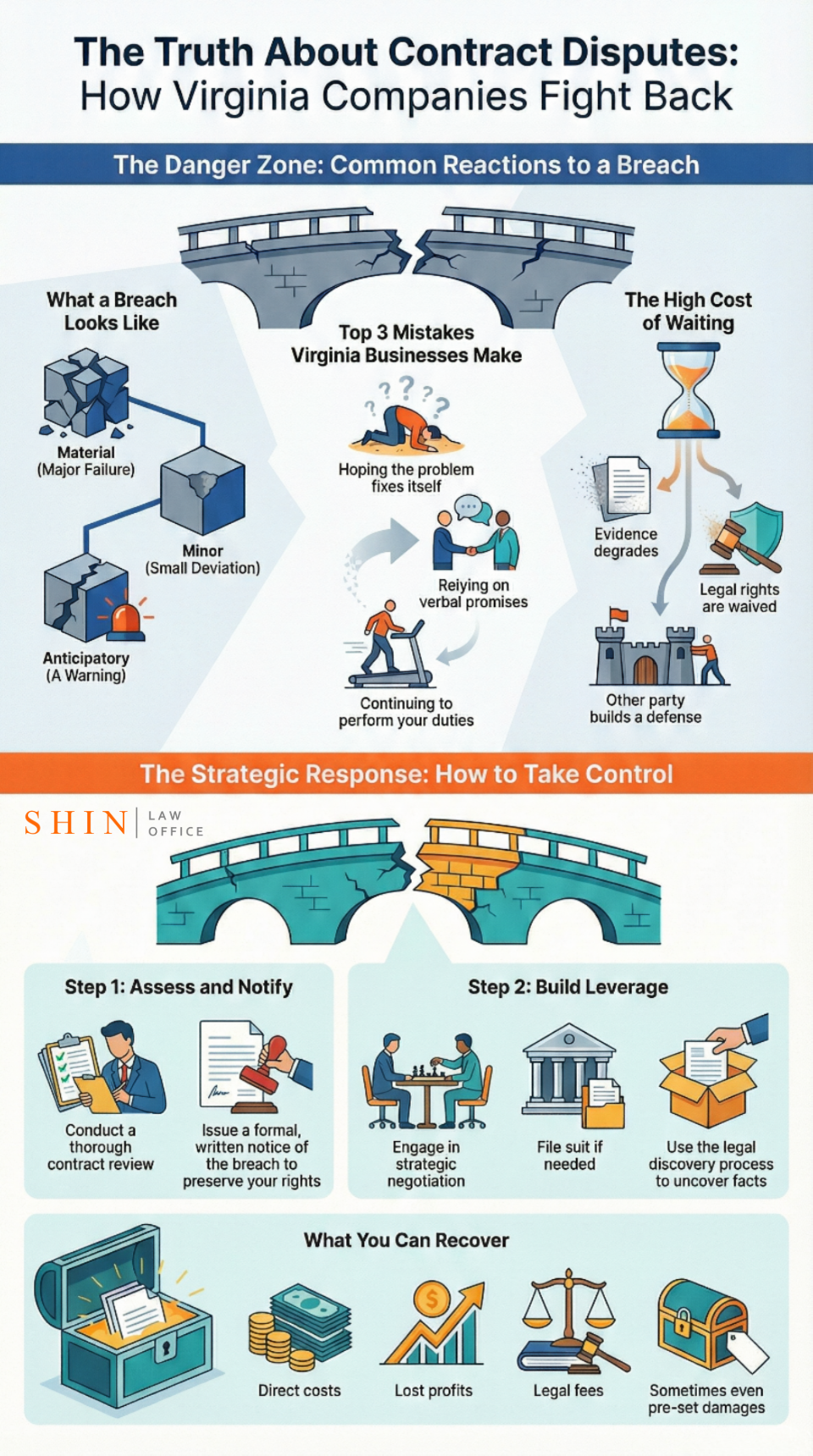
But here is the truth I’ve learned after years of litigating contract disputes.
A breach is not a moment. It is a turning point.
And how you respond in those first days determines whether you control the outcome or lose it entirely.
Most clients come to me frustrated, confused, or blindsided. They know something is wrong, but they don’t yet know what to call it. They don’t know whether it’s legally actionable. They don’t know how much damage has already been done. And they don’t realize how quickly the situation can deteriorate if they wait too long.
That is why I built this guide.
I want you to understand exactly what a breach looks like, why it happens, how it escalates, what damages you may recover, and the steps you need to take to protect your rights under Virginia law. Each chapter breaks down the process from a practical, real-world perspective, the same strategic lens I use when I evaluate disputes for businesses across Northern Virginia.
This is not a theory.
This is what actually happens when a contract fails, and you need to make decisions that will protect your company, your finances, and your future.
If you are facing a contract that has gone off the rails or a business partner, vendor, or contractor who is no longer holding up their end of the deal, you do not have to navigate the confusion alone. You need clarity. You need a strategy. And you need to take back control before the breach grows into something far more damaging.
These chapters will show you how.
Chapter One
Understanding What Constitutes a Breach of Contract in Virginia
When a deal collapses, a partner stops performing, or a vendor silently changes the terms, most Virginia business owners feel the same immediate frustration. Something is wrong, but is it legally a breach? And what exactly does Virginia law require before a court will intervene?
Understanding what constitutes a breach of contract is the foundation of every successful civil litigation strategy. Without clarity at this stage, companies often wait too long, lose leverage, or accidentally waive rights they never knew they had.
What Makes a Contract Enforceable
In Virginia, a breach of contract claim only exists if there is an enforceable agreement. That does not mean the contract must be perfect, long, or drafted by attorneys. It simply must contain:
- An offer
- An acceptance
- Consideration (value exchanged)
- A meeting of the minds
Virginia law recognizes written contracts, verbal agreements, email exchanges, digital forms, and even agreements implied by conduct, depending on the context. This is particularly important for businesses in Loudoun, Fairfax, Arlington, Prince William, Clarke, and Frederick County, where transactions range from government subcontracting chains to handshake agreements between builders and landowners.
A surprising number of disputes begin when one party believes a contract doesn’t “count” because it wasn’t signed in ink. Virginia courts have repeatedly held that agreements can be binding even without formal signatures if both parties clearly intended to be bound.
What Legally Constitutes a Breach
A breach occurs when one party fails to do something they were contractually required to do. But not every failure is equal, and not every breach gives rise to a lawsuit. Virginia recognizes several types of violations, each requiring a different strategic response.
Material Breach
A material breach goes to the heart of the agreement. It destroys the purpose of the contract and excuses the non-breaching party from further performance. Examples include:
- A contractor abandoning work mid-project
- A vendor delivering fundamentally defective goods
- A partner withholding revenue owed under an operating agreement
Material breaches almost always require immediate action because the longer a business waits, the harder it becomes to quantify and prove damages.
Minor Breach
A minor breach involves a small deviation that does not destroy the contract’s value. Examples include:
- Slight delays in delivery
- Administrative errors
- Partial performance that is late but still functional
Even minor breaches must be documented. Under Virginia law, a pattern of small breaches may collectively become material.
Anticipatory Breach
This occurs when a party signals they will not perform before the deadline. Example: A subcontractor emails that they “will not be able to complete the job” next month.
Businesses often underestimate the power of anticipatory breach. In Virginia, once the other party communicates clear intent not to perform, you may pursue legal remedies immediately.
Actual Breach
This is the straightforward failure to perform on time or as promised. Non-payment, missed deadlines, unauthorized changes, and refusal to complete services all fall under actual breach.
Why So Many Virginia Businesses Misjudge Breach Scenarios
Northern Virginia’s business ecosystem is built on speed, trust, and long-term relationships. Because of this, many businesses:
- Continue operating despite apparent contractual violations
- Rely on verbal assurances instead of formal notices
- Fear that asserting their rights will harm the relationship
- Assume the issue isn’t “serious enough” to involve counsel
Unfortunately, Virginia courts look closely at conduct. If a business continues to perform after a breach, the other party may argue that the breach was accepted, waived, or cured. This is one of the most common mistakes companies make, particularly in Loudoun, Fairfax, and Arlington, where high-value service agreements and government subcontracts require strict documentation.
The Four Legal Elements of a Virginia Breach of Contract Claim
To succeed in litigation, a plaintiff must prove:
- A valid, enforceable contract
- Performance by the plaintiff
- A breach by the defendant
- Resulting damages
Each element must be supported by clear evidence. The contract need not be perfect, but the claim must be precise.
Why Understanding Breach Is Your First Line of Defense
Before pursuing litigation or demanding performance, businesses must correctly identify the nature of the breach and understand the legal impact of their next move. A single email, invoice, or phone call can shift the leverage in a dispute.
This is the moment where strategic counsel becomes critical.
Miscalculations here can cost months, weaken negotiation power, and create defenses for the opposing party that did not previously exist.
Chapter Two
Common Types of Breach of Contract Cases for Virginia Businesses
Contract disputes in Virginia often appear simple at first glance. A vendor is late. A contractor stops responding. A business partner makes decisions without consent. But beneath the surface, each type of breach brings unique legal challenges shaped by industry, county, and the relationship between the parties.
In Loudoun, Fairfax, Arlington, Prince William, Clarke, and Frederick Counties, certain patterns recur. Understanding these patterns helps businesses spot problems early and prepare for decisive action when a breach occurs.
Vendor and Supplier Breaches
Northern Virginia’s economy relies heavily on technology, data infrastructure, government contracting, and fast-moving supply chains. When a supplier or vendor breaks its commitments, the ripple effects can be catastrophic.
Common breaches include:
- Delivering non-conforming goods
- Failing to meet service level agreements
- Replacing specified products with cheaper substitutes
- Unjustified price increases
- Chronic delays that disrupt operations
- Refusal to honor warranties
These cases are prevalent in Fairfax, Loudoun, and Prince William, where subcontracting networks and procurement chains are highly interconnected.
The Danger: A business may continue to accept late or defective deliveries in hopes of preserving the relationship. Under Virginia law, repeated acceptance without objection can weaken a breach claim.
Commercial Lease and Property Use Breaches
From Tysons office towers to Leesburg industrial parks, commercial lease disputes are among the most complex contractual conflicts in Virginia.
Frequent breaches include:
- Failure to maintain premises as required
- CAM (standard area maintenance) overcharges
- Unauthorized renovations
- Subleasing in violation of the lease
- Refusal to vacate
- Landlords failing to deliver promised build-out or repairs
- Early termination without cause
These disputes escalate quickly because a business’s ability to operate is often at stake.
Counties with the highest incidence:
- Arlington (dense commercial tenants)
- Fairfax (Tysons, Reston, Fairfax City)
- Loudoun (expanding office and industrial corridors)
The Stakes: Preserving evidence, documenting conditions, and issuing proper breach notices are critical. One missed step can jeopardize the right to recover damages.
Employment Contract and Confidentiality Breaches
Northern Virginia’s workforce is specialized and competitive. When employees or executives leave, disputes often follow.
Common scenarios:
- Violating non-solicitation clauses
- Taking proprietary data to competitors
- Misusing confidential information
- Breaching severance or compensation agreements
- Breaking fixed-term employment contracts
These conflicts are particularly prevalent in Arlington, Fairfax, and Loudoun, where companies depend on intellectual property and client relationships. Virginia courts scrutinize employer conduct, so improperly written or overly broad restrictions may be unenforceable. Strategic drafting and enforcement make all the difference.
Construction Contractor and Subcontractor Breaches
Contractors failing to deliver on time or within scope is one of the oldest forms of business conflict, and it remains a major issue across Virginia.
Typical breaches include:
- Defective workmanship
- Abandonment of the project
- Unauthorized change orders
- Mismanagement of subcontractors
- Exceeding budgets without approval
- Failure to meet industry standards
- Violation of safety requirements
These cases are common in:
- Loudoun County (ongoing commercial and residential expansion)
- Prince William County (industrial growth corridors)
- Clarke and Frederick Counties (mixed residential and agricultural development)
Construction contracts often contain detailed procedures for notice, cure periods, and dispute resolution. Missing one step can impact the entire case.
Partnership, LLC, and Shareholder Agreement Breaches
As businesses grow, partnership conflicts become almost inevitable. Minor disagreements can erupt into major legal battles if not addressed early.
Examples include:
- Misuse of company funds
- One member excluding others from management
- Breach of fiduciary duties
- Violating voting or decision-making procedures
- Failure to distribute profits properly
- Unilateral changes to the operating agreement
Fairfax, Loudoun, and Arlington see these disputes most often due to dense networks of startups, government contractors, and professional firms. These disputes require more than contract analysis; they usually involve corporate governance, accounting, and fiduciary principles.
Government Contracting and Subcontract Breaches
Northern Virginia is one of the largest government contracting hubs in the country. Breaches in this sector often involve:
- Failure to meet performance standards
- Non-compliance with FAR or DFARS flow-down clauses
- Missed delivery timelines
- Improper invoicing
- Withholding payment without justification
- Subcontractors failing to pass down required documentation
- Prime contractors changing scope without compensation
Jurisdictions where this is most common:
- Arlington
- Fairfax
- Loudoun
When federal requirements become part of the dispute, litigation can be far more complicated. Businesses must preserve all documentation, including statements of work, task orders, and internal communications.
Why Identifying the Type of Breach Matters
Each type of breach requires a different legal strategy. For example:
- A vendor breach may require immediate mitigation to prevent operational collapse.
- A lease breach may demand photographic evidence and formal notices.
- A partnership breach may call for injunctive relief to stop ongoing harm.
- A government contracting breach may require strict compliance with FAR procedures.
Treating every breach the same is one of the biggest mistakes Virginia businesses make.
A targeted strategy starts with identifying the exact category of the breach, the legal consequences, and the appropriate procedural steps to preserve your rights.
Chapter Three
How Virginia Businesses Typically Respond to Contract Breaches
And Why Delay Can Be Dangerous
When a breach of contract occurs, most Virginia businesses do not immediately seek legal intervention. Instead, they try to “work it out,” hoping the situation will resolve itself without conflict. This instinct is understandable. Business relationships matter. Reputations matter. And litigation carries a level of formality that many prefer to avoid.
But in Northern Virginia’s high-stakes business environment, delayed action is often more damaging than the breach itself.
Across Loudoun, Fairfax, Arlington, Prince William, Clarke, and Frederick Counties, companies repeatedly fall into predictable patterns when a contract begins to unravel. Understanding these patterns can help businesses avoid common mistakes that weaken their position before the dispute even begins.
The Four Most Common Business Responses (And Their Risks)
1. Hoping the Problem Fixes Itself
Many businesses hesitate to raise concerns, fearing it will create tension or harm a strategic partnership.
The Problem: Virginia courts examine conduct closely. Silence, continued performance, or acceptance of defective work can be interpreted as waiver, consent, or acceptance of noncompliance. In other words, the longer you wait, the more leverage you lose.
2. Relying on Verbal Promises or Informal Assurances
A contractor might say: “We’ll get it done next week.” A supplier might say: “Don’t worry, we’ll make it right.”
Without documented notices or written agreements, these promises mean very little in litigation. In Fairfax and Arlington, where government contracting is prevalent, relying on undocumented verbal commitments can violate flow-down requirements and jeopardize future performance claims.
3. Continuing to Perform Despite the Breach
Businesses often believe that continuing to perform shows “good faith.”
The Truth: In Virginia, ongoing performance after a breach can be used against you. It may suggest:
- The breach was not serious
- You accepted the defective performance
- You waived your right to claim damages
This is especially dangerous in construction projects, vendor relationships, and technology services contracts where performance is ongoing and multifaceted.
4. Waiting Until Damages Become Severe
Some companies wait until the financial harm becomes overwhelming before seeking assistance. By then, the damages may be harder to quantify, evidence may be compromised, and the other party may have developed a competing narrative.
In jurisdictions like Loudoun and Fairfax, where sophisticated parties frequently litigate, failing to act early creates uphill battles.
The Hidden Consequences of Delayed Action
Businesses often assume that as long as the breach is documented, they will be able to recover damages later. Unfortunately, this is rarely the case. Delay carries legal, financial, and tactical consequences.
Evidence Degrades Quickly
- Emails get deleted
- Digital logs overwrite automatically
- Texts are lost when employees change phones
- Physical conditions change
- Key witnesses leave the company
In Clarke and Frederick Counties, where construction disputes are common, failing to document conditions immediately can destroy the strongest part of the claim.
Damages Become Harder to Isolate
Courts require proof that the breach directly caused the harm. The longer a business continues operating after the breach, the more the opposing party can argue that:
- Damages were your fault
- Losses were unrelated to the breach
- You failed to mitigate harm
In litigation, causation is everything.
Opposing Counsel Gains Time to Build a Defense
If the breaching party senses hesitation, they may:
- Restructure their business
- Move assets
- Alter internal communications
- Manufacture explanations
- Preemptively prepare defenses
Delay gives the other side a strategic head start.
Contractual Rights Can Be Lost
Many contracts in Fairfax, Loudoun, and Arlington contain:
- Notice provisions
- Cure periods
- Dispute escalation steps
- Mediation requirements
- Waiver clauses
Missing a required deadline can eliminate your ability to sue, even if the breach is clear.
The Power of Early Legal Intervention
Most businesses think contacting an attorney means they are preparing for battle. In reality, the opposite is often true.
Strategic counsel early in the process can:
- Preserve evidence before it disappears
- Prevent further financial loss
- Clarify obligations and rights under the contract
- Draft a notice of breach that protects your position
- Avoid unintentional waiver
- Force the other party to respond professionally
- Strengthen negotiation leverage
Early involvement does not escalate conflict. It prevents disaster.
Why Businesses in Northern Virginia Must Be Especially Proactive
Loudoun County’s tech corridors, Fairfax’s commercial centers, and Arlington’s government contracting hubs all involve:
- High-value services
- Multi-phase projects
- Continuously evolving scopes of work
- Strict timelines
- Dependency on subcontracting performance
- Confidential information and intellectual property
These environments amplify the impact of even a small breach. A minor vendor failure in Prince William County can cascade into a significant operational shutdown. A missed deadline in Arlington may jeopardize a federal contract. A faulty partnership decision in Loudoun can destabilize an entire business.
In these counties, waiting is not neutral. Waiting is a strategic mistake.
The Moment a Breach Occurs, the Clock Begins to Run
From the very first sign of trouble, a business must ask:
- Has this breach harmed us?
- Are our rights protected?
- Are we unintentionally waiving claims?
- Are our damages growing?
- Do we need documentation immediately?
The companies that act decisively preserve their advantage. The companies that hesitate give it away.
Chapter Four
How Virginia Businesses Pursue Legal Action for Breach of Contract
A Step-by-Step Guide for Loudoun, Fairfax, Arlington, Prince William, Clarke, and Frederick County
Once a breach is identified, the next question is critical but straightforward: “What do we do now?”
In Northern Virginia’s business environment, responding to a breach is not just about proving wrongdoing. It is about choosing a strategy that protects your company, preserves your options, and positions you for the strongest possible outcome—whether inside or outside of court.
Businesses that take a structured approach almost always fare better than those that react informally. Below is the step-by-step roadmap that governs most breach-of-contract disputes in Virginia.
Step One: Contract Review and Legal Risk Assessment
Every breach case starts with a single, indispensable action: reviewing the contract. An attorney must examine:
- The original contract terms
- All amendments, modifications, and email changes
- Payment records and performance history
- Internal communications
- Industry standards relevant to the agreement
- Any required notice periods or dispute procedures
Virginia courts interpret contracts based heavily on the written language. Ambiguity matters.
Missing clauses matter. Silence matters. An early review often reveals that the business has more rights than they realized, or that the opposing party is already in deeper violation than expected.
This step also helps determine whether the breach is:
- Material
- Minor
- Anticipatory
- Ongoing
- Waived through conduct
Correct classification defines the entire strategy that follows.
Step Two: Issuing a Formal Notice of Breach
Most contracts require written notice before any legal action can proceed. Even when not required, issuing a formal notice is essential for strengthening your position.
A properly drafted notice should:
- Identify the specific breached provision
- Describe how and when the breach occurred
- Demand correction, if the contract requires a cure period
- Reserve all rights and remedies
- Stop the opposing party from claiming ignorance later
A weak or informal notice can undermine the entire case. A strategic notice sets the stage for substantial litigation and meaningful negotiation.
Counties where notice errors frequently cause problems:
- Loudoun (construction and vendor contracts)
- Fairfax (technology and government contracting agreements)
- Arlington (professional services contracts)
Step Three: Negotiation and Pre-Litigation Strategy
Courts in Virginia expect parties to attempt to resolve the matter before proceeding to trial. But negotiation should never be approached casually.
An effective pre-litigation strategy includes:
- Determining whether early settlement is beneficial
- Assessing whether the breach is fixable or irreversible
- Evaluating the opposing party’s motives and financial situation
- Using structured communication to create leverage
- Considering mediation when appropriate
- Identifying risks of escalating too quickly
In Fairfax and Arlington, where relationships between contractors, subcontractors, consultants, and prime contractors are tightly interwoven, skilled negotiation often prevents lengthy and costly litigation.
But negotiation without leverage is simply a conversation.
Legal counsel provides the clarity and strength needed to make negotiation meaningful.
Step Four: Filing Suit in the Proper Virginia Circuit Court
If settlement efforts fail or if the breach causes immediate and substantial harm, litigation becomes necessary. Businesses typically file breach claims in:
- Loudoun County Circuit Court
- Fairfax County Circuit Court
- Arlington County Circuit Court
- Prince William County Circuit Court
- Clarke County Circuit Court
- Frederick County Circuit Court
Each jurisdiction has different:
- Timelines
- Judicial preferences
- Procedural nuances
- Discovery expectations
- Scheduling speeds
Selecting the correct venue can influence the case’s complexity, cost, and timeline.
Experienced litigation counsel will often know which jurisdiction is more efficient, more predictable, or more appropriate based on the nature of the dispute.
Step Five: The Discovery Phase: Where the Real Case Begins
Once a lawsuit is filed, both sides enter the discovery process.
This is where evidence is exchanged, and where most contract disputes are won or lost.
Discovery may include:
- Email records
- Internal communications between employees
- Contracts and purchase orders
- Text messages
- Accounting records and payment logs
- Photographs of defective work
- Expert inspections or evaluations
- Depositions of key witnesses
Discovery exposes the truth. It also exposes weaknesses.
This phase often reveals that one party has been withholding information, misrepresenting performance, or documenting the situation more thoroughly than expected.
Discovery forces transparency. And transparency creates leverage.
Step Six: Settlement Negotiations or Trial
Most breach-of-contract cases settle before trial. But the strength of your discovery evidence determines whether settlement occurs on your terms or theirs.
A strong settlement position involves:
- Clear documentation of the breach
- Well-supported damage calculations
- Strong procedural compliance
- Credible witnesses
- A demonstrated willingness to proceed to trial
A weak position encourages low offers, delay tactics, and incomplete remedies.
If the case proceeds to trial, the court will evaluate:
- The written contract
- The conduct of both parties
- The credibility of witnesses
- The quantifiable damages
- The foreseeability of harm
- Whether the breach was material
Trials in Virginia are fact-driven and highly dependent on the quality of documentation.
Businesses that fail to preserve evidence early often face an uphill battle.
Step Seven: Enforcement and Compliance
Winning a judgment is only half the battle. Enforcement requires:
- Locating assets
- Securing liens or garnishments
- Forcing compliance with injunctions
- Ensuring specific performance when ordered
In partnership disputes, employment breaches, and intellectual property misuse cases, enforcing the court’s orders may be just as important as winning them.
Chapter Five
Damages Virginia Businesses Can Recover in a Breach of Contract Case
Understanding What Your Company May Be Entitled To
When a contract breaks, the financial harm is often immediate, costly, and disruptive. But many Virginia businesses do not realize the full scope of damages they may recover in a breach-of-contract claim. Some assume they can only recover unpaid invoices. Others believe they cannot pursue losses that extend beyond the contract itself. Both assumptions are incorrect.
Virginia law provides a wide range of remedies designed to make the injured party “whole.” The key is understanding what types of damages apply, how to quantify them, and how to prove they were caused by the breach.
Below is a breakdown of the primary categories of damages available to businesses in Loudoun, Fairfax, Arlington, Prince William, Clarke, and Frederick County, and how each plays a role in real contract disputes.
Compensatory Damages: Restoring What You Lost
Compensatory damages are the backbone of most breach-of-contract cases. These damages reimburse the injured business for losses directly caused by the breach.
Examples include:
- Costs to replace defective workmanship
- Payments made for goods or services never delivered
- Expenses incurred to hire a new contractor or supplier
- Out-of-pocket losses due to delays or nonperformance
These damages must be proven with evidence such as invoices, financial records, logs, or expert estimates. In Northern Virginia’s business environment, where contracts often involve significant investment, compensatory damages can be substantial.
Consequential Damages: Losses That Naturally Flow From the Breach
Consequential damages go beyond direct loss. They account for the ripple effects of the breach.
Examples:
- Lost profits from operational downtime
- Customer cancellations due to delayed deliveries
- Production slowdowns caused by vendor failure
- Business interruption costs
- Reputational harm tied to contract nonperformance
Virginia courts will award consequential damages if the harm was reasonably foreseeable when the contract was formed.
This category is especially important for:
- Government contractors in Arlington and Fairfax
- Tech companies in Loudoun
- Retail and service businesses in Prince William
- Agricultural and construction operations in Frederick and Clarke
These businesses often depend on strict timelines and interconnected supply chains.
A single breach can trigger losses across multiple departments or customers.
Liquidated Damages: Pre-Negotiated Damages for Delays or Failures
Many contracts contain liquidated damages clauses that specify a pre-determined amount the breaching party must pay if they fail to meet specific obligations.
These clauses are often used in:
- Construction contracts
- Commercial leases
- Technology and software agreements
- Government subcontracting
- Vendor and supply chain contracts
Virginia enforces liquidated damages clauses if the pre-set amount is reasonable and not punitive.
A well-drafted clause can simplify litigation significantly because damages do not need to be calculated; they are already built into the agreement.
Specific Performance: Forcing the Other Party to Honor Their Commitments
In some instances, monetary damages are not enough. Virginia courts can order a breaching party to perform exactly as the contract requires.
Common scenarios include:
- Real estate transactions where the property is unique
- Contracts involving specialized equipment
- Agreements with irreplaceable intellectual property or proprietary work
- Long-term commercial leases
- Partnership or membership obligations
Specific performance is often used in Clarke and Frederick County for land-related disputes, and in Fairfax and Arlington for high-value commercial agreements.
Injunctive Relief: Stopping Ongoing Harm Before It Becomes Irreversible
Some breaches cannot wait for a lawsuit to conclude. They require immediate court intervention.
Examples include:
- A former employee soliciting clients in violation of a contract
- A business partner misusing funds or intellectual property
- A contractor causing active damage to a worksite
- A member of an LLC excludes others from management decisions
Virginia courts can issue temporary or permanent injunctions requiring the breaching party to stop harmful activity. This tool is essential when waiting for a trial, as it would cause irreparable damage.
Attorney’s Fees: Recoverable When the Contract Allows
Virginia follows the “American Rule,” meaning each party typically pays its own attorney’s fees.
However, many contracts include fee-shifting clauses that allow the winning party to recover attorney’s fees.
These clauses are standard in:
- Commercial leases
- Supplier agreements
- Technology and software contracts
- Employment contracts
- Construction and subcontractor agreements
Fee recovery is especially important in Northern Virginia disputes because litigation can be lengthy and complex.
Punitive Damages: Rare in Contract Cases but Possible When Fraud Is Involved
Virginia does not award punitive damages for ordinary breach of contract. However, they may be available in cases where the breach is accompanied by:
- Fraud
- Deceit
- Willful misconduct
- Malicious behavior
For example, if a business deliberately falsifies records or knowingly misrepresents performance, punitive damages may be considered. These cases require careful legal framing and substantial evidence.
Why Damage Calculation Is Critical to Your Case
A breach claim is only as strong as the damages that can be proven. Businesses often underestimate the value of their claim or fail to document losses properly.
Common mistakes include:
- Not tracking the full economic impact of delays
- Failing to preserve receipts or invoices
- Not documenting employee time spent resolving problems
- Ignoring downstream financial harm
- Not hiring experts to quantify losses in complex cases
These oversights weaken the case and reduce potential recovery.
The Role of Strategic Counsel in Maximizing Damages
Skilled litigation counsel ensures that damage calculations are:
- Thorough
- Mathematically sound
- Supported by evidence
- Legally recognized
- Presented persuasively in negotiations or trial
The right legal strategy can transform a modest claim into a strong, well-supported case that secures full compensation.
Chapter Six
Why Strategic Legal Counsel Is Critical When a Contract Breaks
Protecting Virginia Businesses From Escalating Damage
A breach of contract is not just a business inconvenience. It is a legal and financial turning point that determines whether your company absorbs the damage or transfers it to the party who caused it.
In Northern Virginia, where the business landscape is fast-moving, interconnected, and high-stakes, the difference between acting quickly and hesitating can determine the outcome of the entire dispute.
Too many businesses assume they can “wait and see,” negotiate informally, or fix the problem through goodwill alone. But contract breaches rarely resolve themselves. They escalate. They spread. They trigger additional failures in operations, finances, and customer relationships.
Strategic legal counsel is not about conflict. It is about control.
Why Businesses in Loudoun, Fairfax, Arlington, Prince William, Clarke, and Frederick Face Unique Risks
Each of these counties has its own business profile and contractual vulnerabilities:
- Loudoun County: Features technology corridors, data centers, and construction expansion that rely on strict vendor performance and timely deliverables.
- Fairfax County: Includes government contractors, Fortune 500 companies, and professional firms where even slight deviations from contract terms can trigger compliance or regulatory issues.
- Arlington County: Holds dense clusters of government contractors, consultants, subcontractors, and specialized service providers, where breaches can carry federal implications.
- Prince William County: Blends industrial growth with commercial development, increasing the volume of construction, leasing, and vendor disputes.
- Clarke and Frederick Counties: Have expanding residential, agricultural, and commercial development where land use, construction contracts, and partnership agreements often collide.
In these jurisdictions, contract disputes aren’t simple disagreements. They are structural risks that threaten ongoing operations.
When a Breach Occurs, Every Decision Matters
Businesses often underestimate how early choices shape the entire legal landscape. Your response to a breach influences:
- What damages can you claim
- Whether the breach is considered waived
- How much leverage you have in negotiations
- What evidence remains available
- Whether the case strengthens or weakens over time
- How the opposing party behaves moving forward
A single careless email, continued performance under protest, or missed notice requirement can change the outcome of the case.
Strategic Counsel Helps You Avoid Self-Inflicted Damage
Without legal guidance, businesses often make mistakes that harm their own case, including:
- Accepting late or incomplete performance
- Failing to document communications
- Missing contractual notice deadlines
- Allowing the breaching party to “fix” issues informally
- Not quantifying damages correctly
- Communicating frustration instead of legal position
- Trying to renegotiate without leverage
- Ignoring early opportunities for injunctions or evidence preservation
Counsel ensures every step protects the business, not the breaching party.
Litigation Is Not About Fighting. It Is About Positioning.
When handled correctly, litigation is strategic, not emotional. It is designed to:
- Create leverage
- Clarify obligations
- Stop ongoing harm
- Preserve evidence
- Establish a compelling factual record
- Force compliance
- Recover full damages
At Shin Law Office, litigation is not approached as a blunt instrument. It is a deliberate tool used to fix problems, protect assets, and secure justice.
Early Intervention Changes the Outcome
The earlier legal counsel becomes involved, the stronger the case becomes. Early counsel can:
- Diagnose the breach correctly
- Outline all available remedies
- Draft notices that preserve rights
- Identify evidence that must be secured immediately
- Prevent waiver or acceptance through conduct
- Quantify damages before they compound
- Strengthen negotiation leverage before conflict escalates
Legal strategy does not begin when a lawsuit is filed. It begins the moment performance stops, deadlines pass, or promises break.
Protecting What You Built Requires More Than Hope
Contracts are the backbone of every business. They control cash flow, govern partnerships, define expectations, and allocate risk. When a contract is breached, the integrity of that entire business relationship collapses.
Strategic legal counsel ensures:
- Your rights are enforced
- Your damages are documented
- Your leverage is protected
- Your company is not blamed for the breaching party’s failures
- The opposing side cannot rewrite history
- You have a path to resolution, compensation, or enforcement
Without counsel, businesses are left vulnerable to manipulation, delay tactics, and hidden defenses.
Litigation With Purpose, Precision, and Resolve
At Shin Law Office, contract disputes are not handled passively. They are approached with:
- A clear roadmap
- A deep understanding of Virginia’s legal environment
- Experience with complex business relationships
- Knowledge of local courts across Loudoun, Fairfax, Arlington, Prince William, Clarke, and Frederick Counties
- Relentless focus on results
You are not hiring someone to file paperwork. You are hiring someone to protect your business from lasting harm.
When a contract breaks, the stakes are real. The damage is real. And the need for strategic action is immediate.
Silence does not protect companies. Strategy does.
Closing Summary
As I bring these chapters together, I want you to remember one central truth about contract disputes: you are not powerless.
Whether the breach involves a vendor who failed you, a contractor who cut corners, a partner who crossed the line, or a subcontractor who put your entire project at risk, you have clear rights under Virginia law and clear pathways to protect your business.
What determines the outcome is not how unfair the breach feels.
It is how quickly and strategically you respond.
Throughout this guide, I have shown you what a breach looks like, how it escalates, why delays are dangerous, what damages you may be entitled to, and how the litigation process unfolds across Loudoun, Fairfax, Arlington, Prince William, Clarke, and Frederick Counties.
These are not abstract concepts; they are the exact steps I walk my clients through when the stakes are real and the clock is already ticking.
My goal is simple.
I want you to understand that you do not have to accept financial loss, operational chaos, or broken promises as the cost of doing business. Contracts are enforceable. Agreements have consequences. And when someone violates the terms that protect your company, you have every right to take action.
If you are facing a dispute right now, or you suspect a breach is forming, do not wait for the damage to spread.
Get clarity. Get direction. And take control of the situation before the other side dictates the outcome.
This guide gives you the foundation.
When you are ready for the next step, I am here to help you protect what you built and make sure the breach does not define your future.

Principal Attorney | Shin Law Office
Call 571-445-6565 or book a consultation online today.
Disclaimer: The information provided in this article is for educational purposes only and does not constitute legal advice. Every case is unique. If you believe you have a claim, contact a qualified attorney immediately to discuss the specifics of your situation and the applicable statutes of limitation.