
Bottom Line Up Front (BLUF)
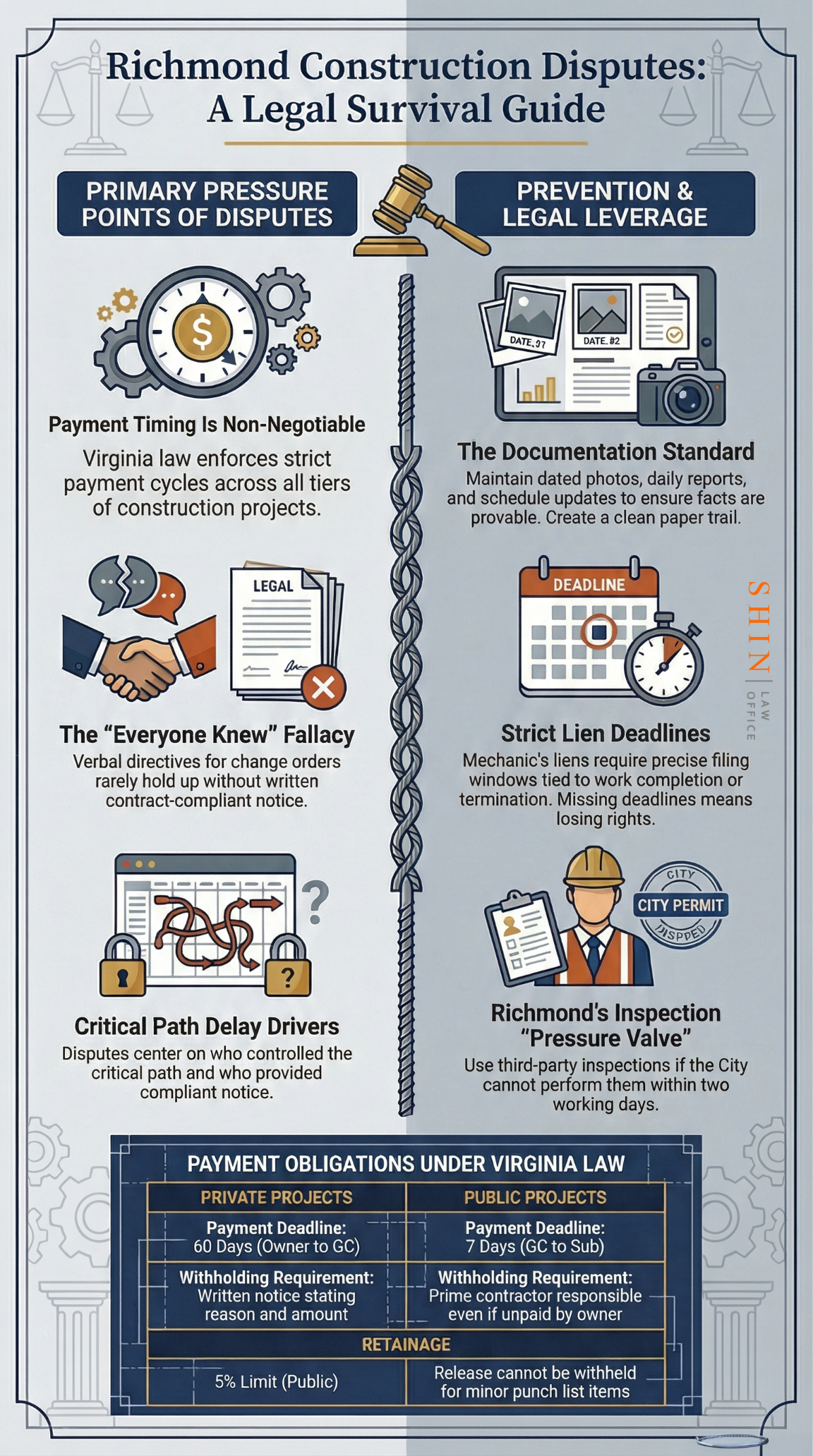
Most Richmond construction disputes come from six pressure points: money, scope, schedule, permits, quality, and paperwork. Virginia’s payment rules for construction contracts now set hard timing and notice requirements, so “we will pay you when we get paid” is far less protective than many companies think. Mechanic’s lien deadlines are also strict, and Richmond permitting and inspection friction can turn a normal delay into a claim if your contract notice trail is weak.
Why do disputes in Richmond happen so often
Richmond has a heavy mix of renovations, commercial buildouts, multifamily work, and public work. That means tight schedules, multiple trades stacked on top of each other, and owners who want certainty on price and delivery. The dispute usually starts small, then escalates when one party stops trusting the other’s numbers or timeline.
In my experience, the real trigger is rarely one mistake. It is a chain: unclear scope, undocumented directives, late decisions, missed notice requirements, then a payment freeze.
Payment fights, withholding, and retainage
Private projects: timing and notice are now center stage
Virginia law requires construction contracts to include payment timing and written withholding notice rules. Owners generally must pay a general contractor within 60 days of receiving an invoice upon satisfactory completion of the invoiced work. If the owner withholds payment, the owner must provide written notice within a set window stating the reason and amount withheld.
For subcontractors, the statute drives a common flashpoint in Richmond: the general contractor must pay a subcontractor within the earlier of 60 days after invoice, following satisfactory completion, or seven days after the contractor receives payment for that subcontractor’s work.
What this means in real life: the party that documents completion cleanly and sends a clean invoice often controls leverage.
Public projects: pay when paid defenses are limited
For many public contracts, Virginia requires payment clauses that make the prime contractor responsible for paying subcontractors even if the public owner has not paid the prime, and it also requires quick action after the prime receives payment: pay the subcontractor or issue a written withholding notice.
Retainage disputes
In public construction contracts, Virginia limits retainage on progress payments to 5%.
Retainage fights in Richmond usually show up as:
- The owner refuses release until every minor item is done
- Contractor refuses to close out until retainage is released
- The owner claims defects and holds far more than the real cost to cure
- Subcontractor is fully complete, but is still being carried for someone else’s deficiency
Change orders and scope creep
The most common change order failures
- Work starts on a verbal directive
- Pricing is “to be determined” and never gets finalized
- Notice provisions are missed
- The schedule impact is not documented
- The owner accepts the benefit, then disputes payment
Richmond reality: field decisions become legal issues
When a superintendent is trying to keep momentum, the temptation is to move fast and paper it later. That is exactly how disputes are created. If the contract requires written approval, do not rely on “everyone knew” as your proof. “Everyone knew” does not pay invoices.
Delays, sequencing, and liquidated damages
Delay claims usually come down to three questions
- Who controlled the critical path
- Who created the delay event
- Who gave contract compliant notice
Typical Richmond delay drivers
- Long lead materials and late deliveries
- Trade stacking conflicts and resequencing
- Late design answers and slow approvals
- Site access problems and unsafe conditions
- Rework caused by coordination failures
If liquidated damages are in play, the schedule becomes a courtroom exhibit. If your updates are inconsistent or missing, you lose credibility fast.
Permits, inspections, and certificate of occupancy risk
Plan review timelines and expectation gaps
Richmond’s Planning and Development Review materials publish plan review timing ranges by project size and complexity. Those posted timeframes shape expectations, but they do not eliminate real-world friction when resubmittals, corrections, and trade coordination hit at once.
Inspection scheduling problems
Even when inspection turnaround is expected to be fast, a single missed inspection can delay multiple trades. The result is usually a domino effect: lost days, overtime, rework, then a fight over who pays.
Third-party inspection pressure valve
Richmond has a third-party inspection program that can be used when the City is unable to perform a scheduled inspection within two working days. Knowing when and how to use this tool can save a schedule that is otherwise sliding into dispute territory.
Defective work, rework, and warranty battles
The defect categories that trigger the biggest Richmond disputes
- Building envelope and water intrusion
- Structural deviations and framing issues
- Roofing and flashing failures
- MEP clashes and inaccessible installs
- Life safety and inspection failures
- Finish quality disputes that block closeout
Defect disputes are rarely about one photo. They are about standards: contract specs, manufacturer requirements, code compliance, and the terms the parties agreed to during the job.
Subcontractor default and workforce gaps
What subcontractor default looks like on the ground
- Crew disappears mid scope
- Work slows to a crawl, and milestones are missed
- Quality drops and rework spikes
- Safety issues cause stoppages
- The replacement cost becomes a claim
When a subcontractor defaults, the prime contractor’s cure notices, documentation, and mitigation steps become the center of the case.
Differing site conditions and hidden problems
Renovation-heavy markets like Richmond generate hidden conditions: unknown utilities, bad substrate, moisture issues, prior unpermitted work, and structural surprises. The dispute is not just “what we found.” It is “who took the risk in the contract” and “did you give timely notice.”
Termination, replacement, and completion cost claims
Termination disputes usually blow up because one side thinks termination is a negotiation tactic. It is not. Once a party issues a default notice and then terminates, the math follows: cost to complete, backcharges, extended overhead, and counterclaims.
If you are considering termination, you need a contract clean record: written notices, cure opportunities, documented deficiencies, and a defensible completion plan.
Mechanic’s liens and deadline traps
Filing deadlines are strict
Virginia requires a memorandum of lien within a tight window, tied to the last day of the month when work or materials were last furnished, with additional timing limits tied to completion or termination of the work.
Enforcement deadlines are also strict
Even a properly recorded lien can die if the enforcement suit is not timely.
Residential lien agent notice issues
On one or two family residential projects, failing to give timely notice to a listed mechanic’s lien agent can limit lien rights.
In Richmond disputes, liens are often the leverage tool that forces a real negotiation, but only if the paperwork and deadlines are right.
The paperwork failures that sink good cases
These are the mistakes I see again and again:
- No daily reports or incomplete daily reports
- No written change order trail
- No schedule updates that show critical path impact
- Missing inspection records and turnover documentation
- Emails exist, but they do not match the contract notice requirements
- Photos exist, but they are not dated or organized by location and scope
Good facts without good documentation become expensive facts to prove.
A simple prevention checklist
- Lock the scope early and define exclusions
- Create a change directive process that gets signatures fast
- Send a written notice the same day a delay event hits
- Update the schedule consistently and archive versions
- Invoice immediately when a milestone is achieved
- If withholding, send the written reason and amount in the required timeframe
- Track permit and inspection requests and outcomes
- If lien rights may matter, calendar the filing and enforcement deadlines on day one
Closing thought
If you are in a Richmond construction dispute, the fastest path to leverage is usually not the loudest threat. It is a clean timeline, clean notices, clean invoices, and contract-compliant documentation. That is what forces the other side to take your claim seriously.

Principal Attorney | Shin Law Office
Call 571-445-6565 or book a consultation online today.
(This article is provided for general informational purposes and does not constitute legal advice. For advice on your specific situation, consult with a licensed Virginia attorney.)
References
Code of Virginia. (2026). Required contract provisions in construction contracts, section 11 4.6.
Code of Virginia. (2026). Payment clauses to be included in contracts, section 2.2 4354.
Code of Virginia. (2026). Retainage on construction contracts, section 2.2 4333.
Code of Virginia. (2026). Perfection of lien by general contractor, section 43 4.
Code of Virginia. (2026). Limitation on suit to enforce lien, section 43 17.
Code of Virginia. (2026). Posting of building permit and mechanic’s lien agent notice, section 43 4.01.
City of Richmond Planning and Development Review. (2026). Permits and inspections information, and plan review timing.
City of Richmond Planning and Development Review. (2026). Third-party program and inspection options.