Bottom Line Up Front (BLUF)
Public transit accidents in Northern Virginia involving WMATA Metro, Virginia Railway Express (VRE), and Amtrak are not routine injury cases. When a Metro train derails, a VRE commuter train crashes, or an Amtrak passenger is injured, victims are immediately pulled into a complex legal landscape shaped by government immunity, federal liability limits, multiple injured passengers, and unforgiving notice deadlines. These cases move fast, and early missteps can permanently bar recovery. The good news is that Virginia law and federal transportation safety rules hold transit operators to an exceptionally high duty of care. When that duty is breached, injured passengers, pedestrians, and families can pursue meaningful compensation. This guide explains the liability rules that matter, highlights real transit disasters across Fairfax, Loudoun, Arlington, Prince William, Clarke, and Frederick counties, and shows how victims can protect their rights before time and technicalities close the door.
Public Transit Accident Claims in Northern Virginia
Public transit accident claims in Northern Virginia are governed by strict deadlines and special rules because many transit systems are government-operated. Injured passengers may recover compensation if they prove the transit operator’s negligence, but claims often require early notice and careful handling due to sovereign immunity and Virginia’s contributory negligence law.
What makes public transit accident cases different from regular injury claims?
Public transit accident cases are more complex because they often involve government agencies such as WMATA or VRE, federal rail laws governing Amtrak, multiple injured passengers, and strict notice deadlines. Unlike ordinary car accidents, missing a procedural step can permanently bar a claim.
Can I sue WMATA Metro, VRE, or Amtrak after an accident?
Yes. Injured passengers can sue WMATA Metro, VRE, or Amtrak for negligence, but special rules apply. WMATA and VRE claims are affected by sovereign immunity and notice requirements, while Amtrak claims are governed by federal law and subject to an aggregate liability cap.
What deadlines apply to public transit accident claims in Northern Virginia?
Deadlines are shorter than normal injury cases. Claims against cities or counties often require written notice within six months, state-related transit claims typically require notice within one year, and lawsuits generally must be filed within two years. Missing a notice deadline can eliminate the claim entirely.
Are transit operators held to a higher safety standard in Virginia?
Yes. Under Virginia law, bus and train operators are considered common carriers and are subject to one of the highest duties of care. Even minor negligence by a transit operator can create liability if it causes passenger injuries.
Does contributory negligence apply to Metro, VRE, or Amtrak accidents?
Yes. Virginia follows strict contributory negligence, meaning if an injured person is found even one percent at fault, recovery may be barred. Transit agencies frequently raise this defense, making early legal strategy critical.
What compensation can victims recover after a bus or train accident?
Injured passengers may recover medical expenses, future care costs, lost wages, reduced earning capacity, and pain and suffering. Wrongful death claims may also be available for families when a transit accident is fatal.
Why is early legal action important after a transit accident?
Evidence such as onboard cameras, data recorders, and maintenance logs can be overwritten or lost quickly. Early legal action helps preserve evidence, meet notice requirements, and prevent transit agencies from shaping the narrative before victims are protected.
Do federal laws affect Amtrak and VRE accident claims?
Yes. Federal law imposes an aggregate liability cap on passenger rail accidents and requires rail operators to carry substantial insurance. These federal rules can limit total recovery in mass-casualty train accidents.
What counties are covered by Northern Virginia transit accident laws?
Northern Virginia transit accident claims commonly arise in Fairfax, Loudoun, Arlington, Prince William, Clarke, and Frederick counties, and Virginia law applies statewide regardless of where the accident occurs.
Should I hire a lawyer for a public transit accident injury?
Yes. Public transit accident cases involve government immunity, strict deadlines, and aggressive defenses. An experienced transit injury lawyer can protect your rights, preserve evidence, and pursue full compensation before procedural barriers take effect.
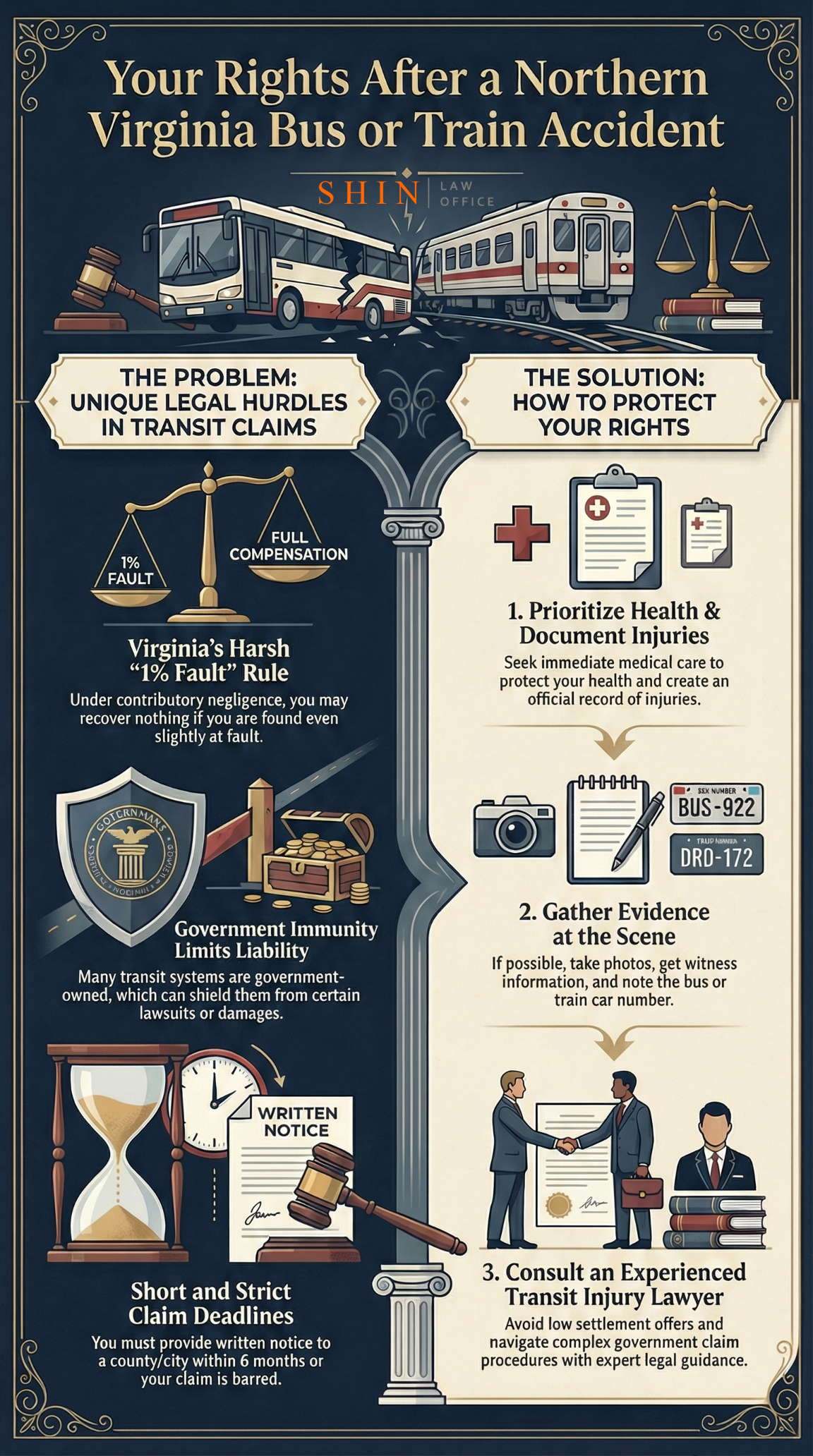
Table of Contents
- Overview of Public Transit Injury Liability in Virginia
- Notable Bus and Train Accident Cases in Northern Virginia
- Legal Complexities in Multi-Victim Transit Cases
- Shin Law Office’s Approach to Mass Transit Injuries
- Litigation Strategies for WMATA, VRE, and Amtrak Incidents
- Protecting Passenger Rights: What Injured Riders Should Know
- References
1. Overview of Public Transit Injury Liability in Virginia
Public transportation injury claims in Virginia are governed by a mix of common-carrier law, state immunity statutes, and strict time limits. Common carriers (e.g. bus and train operators carrying passengers for a fee) owe their passengers an elevated duty of care. In Virginia, courts have held that a carrier must exercise the “utmost care and diligence” to protect passenger safety. This higher standard means transit agencies can be liable for even slight negligence that causes an injury. For example, if a Metrobus or VRE train operator is careless and a rider is hurt, the law recognizes the passenger’s trust in the carrier’s skill and imposes a correspondingly high duty on the carrier.
At the same time, Virginia’s contributory negligence rule can bar an injured person from any recovery if they are found even 1% at fault. Virginia is one of only a few jurisdictions with this harsh rule. Transit companies (and their insurers) often try to invoke contributory negligence – for instance, claiming a victim “should have been holding the handrail” or, in a pedestrian case, wore dark clothes and was hard to see. If such arguments succeed, the injured person may recover nothing. Overcoming these defenses requires strong evidence and legal advocacy to show the sole cause was the transit operator’s negligence.
Another complication arises when a government entity is involved. Many public transit systems are government-owned or operated, which can limit liability. For example, WMATA (the Washington Metropolitan Area Transit Authority) is a multi-jurisdictional entity that generally waives immunity for torts by its employees in the course of transportation operations. This means injured passengers can sue WMATA for negligence (a “proprietary” function) despite its government status. However, purely governmental functions or punitive damages claims may be immune – WMATA cannot be sued for punitive damages, for instance. Local government-run transit (such as county school buses or city bus services) also enjoys immunity for governmental functions, though it typically carries insurance. In Virginia, if you sue a county or city for an injury (for example, a county school bus crash), you must file a formal notice of claim within six months of the injury. Failing to give this written notice can forever bar the claim against the locality. Claims against the Commonwealth or a state “transportation district” (e.g. a state-run rail authority) require notice within one year. These deadlines are much shorter than the standard two-year statute of limitations for injury suits. In practice, an injured transit passenger must move quickly to preserve their rights.
Finally, note that while Virginia law doesn’t generally cap personal injury damages, special caps may apply in transit cases. For instance, under federal law, Amtrak’s total liability for a single accident is capped (currently at $295 million for all claims from one incident). This could limit recovery in a mass-casualty train derailment. Overall, Virginia transit injury law balances the need to hold carriers accountable as common carriers against doctrines that protect government agencies. Navigating these rules requires careful legal strategy from the outset.
2. Notable Bus and Train Accident Cases in Northern Virginia
Northern Virginia’s highways and rail lines have seen several high-profile transit accidents. Below are a few notable bus and train incidents in the region’s six counties, along with their outcomes or investigations:
- Fairfax County: A Greyhound bus crash in Lorton (Fairfax) exemplified a mass-injury event: a Greyhound bus collided with a truck on Route 123, sending 10 people to the hospital (one with life-threatening injuries). In another Fairfax incident, a spectator shuttle bus at a high school sports event violently jolted a passenger, leading to a $285,000 settlement for her injuries. (The shuttle’s driver lacked a commercial license and sped over a speed bump, throwing the client from her seat.) These cases show that both large common-carrier crashes and smaller-scale bus negligence can have serious consequences.
- Loudoun County: In December 2025, a Loudoun County Transit bus struck a pedestrian in Ashburn, tragically killing a 34-year-old woman in a crosswalk. The bus driver (a contractor employed by transit operator Keolis) was later charged with a misdemeanor for failing to yield. This fatal incident prompted an investigation by the Sheriff’s crash reconstruction unit. It underscores that even in outer suburbs like Loudoun – now connected by Metro’s Silver Line – transit accidents can be deadly for pedestrians and passengers alike.
- Arlington County: A notable incident occurred in 2005: the school bus crash on Columbia Pike. An Arlington County school bus, carrying 15 elementary students, collided head-on with a trash truck on a busy morning commute. Two people were killed, and three were seriously injured. The NTSB investigated and found that driver distraction (a student standing up and a dropped clipboard) and a slight lane encroachment by the bus, combined with the truck’s deviation from the center line, led to the violent crash. This incident led to safety improvements in school transportation. Arlington is also part of the Metrorail system – notably, on October 12, 2021, a WMATA Blue Line train derailed between Rosslyn and Arlington Cemetery. Although none of the 187 passengers were injured, the incident prompted a high-profile safety investigation. The NTSB’s 2024 report concluded the derailment was “100% preventable” and blamed WMATA’s poor safety culture – a wheel defect had been known for years but not properly addressed. The incident prompted federal oversight intervention and costly repairs to Metro’s 7000-series railcar wheels.
- Prince William County: The county has experienced commuter rail incidents. In January 2006, a Virginia Railway Express (VRE) train derailed near Quantico, on the Prince William/Stafford border. Several passengers were injured when cars left the tracks. The NTSB determined the cause was an excessively worn track switch that the host railroad (CSX) failed to replace in a timely manner. This VRE accident underscores how third-party maintenance (by freight railroads that own the tracks) can lead to transit disasters. Prince William’s busy I-95 corridor has also seen charter bus crashes. (While just outside our six-county focus, the 2011 Sky Express bus crash on I-95 in Caroline County – which killed four and injured dozens – reverberated throughout Virginia’s transit industry.)
- Clarke and Frederick Counties: These more rural counties have fewer mass-transit systems, but serious accidents still occur. Frederick County, for example, witnessed a deadly collision when a 17-year-old driver’s car crashed head-on into a school bus, killing the teen in 2019. School bus crashes in less urban areas are often caused by other drivers’ errors or challenging road conditions. Clarke County, though it does not have Metro or VRE service, lies along intercity bus routes and major highways (like Route 340 and Route 7). A private tour bus traveling through Clarke could be involved in a rollover or collision, and local first responders would suddenly be handling a mass-casualty incident. In short, no county is completely immune from transit accidents – whether it’s a commuter train derailment in a populous suburb or a school transportation accident in a rural community.
Each of these cases demonstrates different causes and legal outcomes – from multi-million dollar injury settlements to safety overhauls following NTSB investigations. They collectively show that public transit accidents can strike anywhere in Northern Virginia, and they often lead to complex legal inquiries into fault.
3. Legal Complexities in Multi-Victim Transit Cases
Mass transit accidents often injure numerous people at once, which introduces complex legal dynamics beyond a typical two-car accident. When many victims are hurt in a single incident (for example, 20 passengers on a bus, or a train full of riders), several challenges arise:
- Multiple Injury Claims: The more people injured, the more claims and lawsuits will be filed. If a bus crashes and dozens are hurt, the at-fault party’s insurance may be quickly exhausted. Buses and trains typically carry high liability coverage, but it may not be sufficient to fully compensate everyone. For instance, a private charter bus company may have a $5 million policy, which can be inadequate if many passengers have serious injuries. In those situations, victims may have to negotiate a pro rata share or pursue other liable parties to find additional coverage. (By contrast, public entities like WMATA are self-insured or have large reserves, but even they face aggregate caps for rail accidents, as noted with Amtrak’s $295 million federal cap.)
- Coordinating Lawsuits and Investigations: When dozens of plaintiffs sue, courts often consolidate cases for pretrial purposes or treat them as a “mass tort.” This is not a class action (each victim’s injuries differ), but the lawsuits may be consolidated into multi-district litigation (MDL) in federal court or into a coordinated proceeding in state court. Additionally, a major accident triggers official investigations – local police, the National Transportation Safety Board (NTSB), perhaps the Federal Railroad Administration (for train crashes) – and those findings can influence the civil cases. However, NTSB reports are generally not admissible to prove fault in court (to encourage frank safety findings), so attorneys must gather independent evidence even while the NTSB work is underway. Government involvement can help by preserving evidence (recordings, black box data), but can also complicate timing – civil cases might be stayed until an investigation is complete.
- Government Immunity and Notice Issues: If a public transit authority is involved, all the immunity rules discussed earlier apply for each claimant. In a multi-victim WMATA accident, each injured passenger must meet the notice deadline (for example, WMATA requires notice of a claim within 6 months under DC/MD/VA law, depending on venue). A person who fails to provide timely notice or file on time may be excluded, even if fellow victims recover. Also, Virginia’s contributory negligence defense could potentially be raised against each plaintiff individually – the transit agency might claim one passenger was standing up (contributory negligence) or a pedestrian was distracted, etc. These defenses must be overcome on a case-by-case basis. The doctrine of sovereign immunity can also fragment a case: imagine a public school bus is hit by a private truck, injuring students. The school (government) might be immune from suit, but the truck company is not, so victims pursue the truck company exclusively. Multiple defendants with different legal protections require careful navigation.
- Insurance and Indemnification Disputes: Multi-victim accidents often lead to disputes between insurance carriers. A transit operator’s insurer may try to deny coverage or claim another party was at fault. In train crashes, the railroad owning the track, the transit agency, and equipment manufacturers might all point fingers. They may have contracts apportioning liability (for example, VRE’s agreements with host railroads or WMATA’s maintenance contracts). Resolving who ultimately pays – and how much each pays – can involve complex litigation or arbitration behind the scenes of the victims’ claims.
- Criminal Proceedings: Particularly egregious transit accidents may result in criminal charges against the operator or company officials. This occurred in the 2011 Sky Express bus crash in Virginia, where the driver fell asleep at the wheel of an interstate bus. Four passengers were killed, and dozens were hurt when the bus overturned. The driver was convicted on four counts of involuntary manslaughter for those deaths and received a lengthy prison sentence. From a civil standpoint, a parallel criminal case can complicate matters – evidence from the criminal trial might be used in civil suits, but defendants might invoke the Fifth Amendment, etc. However, a criminal conviction (such as a DUI or safety violation) can also strengthen victims’ civil claims by establishing negligence per se or even gross negligence.
In summary, mass transit accidents often become high-stakes, complex litigation. There may be many injured plaintiffs, multiple defendants (each with their own lawyers and insurers), and layers of state and federal law. An experienced attorney will know how to handle the consolidation of cases, work with expert witnesses (such as accident reconstructionists or biomechanical experts for injury causation), and engage in settlement negotiations that account for all present and future claims. They’ll also navigate any government claims procedures to avoid procedural traps. These complexities mean victims should seek knowledgeable counsel – it’s not a DIY situation when dozens of lives have been upended by a single catastrophic incident.
4. Shin Law Office’s Approach to Mass Transit Injuries
Handling a bus or train injury case requires not only legal knowledge but also rapid, strategic action. At Shin Law Office, we recognize that time is of the essence in transit accident cases. Our approach centers on immediate investigation, thorough evidence gathering, and aggressive representation of injured clients’ interests.
Rapid Response and Investigation: Attorney Anthony I. Shin and his team move quickly to investigate transit accidents before critical evidence disappears. This can mean visiting the crash scene within hours or days, taking photos, and preserving any video footage (buses and trains often have surveillance cameras). We coordinate with private accident reconstruction experts when needed to examine vehicle damage or track conditions. For example, in a bus or shuttle crash near a Metro station, Shin Law Office will promptly subpoena transit records, driver logs, maintenance records, and other data to determine exactly what went wrong. By acting fast, we prevent valuable evidence from being lost or overwritten – a key step, especially if a government agency has custody of the vehicles or will be conducting its own investigation.
Knowledge of Transit Entities: Mass transit cases often involve unique entities such as WMATA, VRE, city transit authorities, or private charter companies. Shin Law Office is well-versed in dealing with these organizations. We understand WMATA’s claims procedures, the limitations of its interstate compact, and the insurance frameworks for commuter railroads and school bus operators. Our attorneys will ensure the proper notices are filed on time (meeting Virginia’s 6-month or 1-year claim notice requirements) and that lawsuits are filed in the correct jurisdiction. We also know which parties to pursue: sometimes an injured client has a claim against multiple defendants – for instance, against WMATA and a negligent third-party driver who caused a Metrobus crash. We ensure all responsible parties are included to maximize the available compensation.
Client-Centered Representation: Even in a mass-injury event, each victim’s situation is unique. We take a client-centered approach, giving individual attention to each injured passenger or family. Our firm has experience representing passengers, pedestrians, and commuters across Northern Virginia in high-stakes injury cases. We guide clients through medical treatment, help document their injuries, and consult medical experts to fully assess harms like traumatic brain injuries or spinal damage. In past transit injury cases, Anthony Shin has fought for full compensation by demonstrating the long-term impact of injuries – whether it’s rehab and disability after a train derailment or the emotional trauma a child suffers from a school bus crash. We don’t hesitate to take on government entities or large insurance companies; our goal is to level the playing field for injured riders.
Comprehensive Legal Strategy: Shin Law Office’s approach also involves crafting a robust legal strategy from day one. We send spoliation letters to transit companies, demanding that evidence (such as onboard video or black box data) be preserved. We utilize Freedom of Information Act (FOIA) requests if necessary to obtain government investigation reports. When multiple victims are involved, we may collaborate with other plaintiffs’ counsel on certain aspects while still vigorously advocating for our client’s unique damages. If the transit agency tries to deny liability or invoke contributory negligence, we counter with witness testimony, expert analysis, and where available, the transit agency’s own safety records to show patterns of negligence. Our team’s familiarity with transit regulations and standards (such as Federal Motor Carrier Safety Rules for buses or Federal Transit Administration guidelines for rail systems) enables us to identify violations that strengthen our client’s case.
In essence, Shin Law Office approaches mass transit injury cases with a blend of urgency, expertise, and compassion. We understand that these accidents can be life-changing, and we work tirelessly to ensure our clients are not overwhelmed by the legal complexities. From the moment of the crash investigation to the final resolution – whether through settlement or trial – we stand by our clients to secure the justice and compensation they deserve.
5. Litigation Strategies for WMATA, VRE, and Amtrak Incidents
Public transit systems each have their own legal nuances. Here, we examine how an attorney strategically approaches cases involving three major transit entities in Northern Virginia: WMATA (Metro buses and trains), VRE (Virginia Railway Express commuter trains), and Amtrak intercity trains.
WMATA (Metro) Incidents: The Washington Metropolitan Area Transit Authority operates Metrorail trains and Metrobus services throughout Northern Virginia (as well as D.C. and Maryland). Lawsuits against WMATA involve an interplay of state and federal law. Notably, WMATA was created by an interstate compact and is considered a quasi-governmental agency; it has sovereign immunity for certain functions but has waived immunity for ordinary torts (negligence by its employees in operations). This means if you are injured due to a Metrobus collision or a Metrorail accident, you can sue WMATA for negligence, but you typically cannot recover punitive damages and may have to sue in certain courts (often federal court). A key strategy in WMATA cases is to quickly identify and comply with WMATA’s procedural requirements. For instance, WMATA often requires notice of a claim within a short period (e.g., six months). The legal team will file a detailed notice letter preserving the claim. Evidence preservation is also critical: WMATA vehicles are equipped with data recorders and cameras. An attorney will immediately send a demand for evidence preservation to WMATA after an accident to secure footage, 911 recordings, maintenance logs, and operator records. Since WMATA is self-insured and vigorously defends cases, litigation may be necessary if a settlement isn’t reached. Strategies include relying on WMATA’s safety policies and prior incident history to establish negligence. For example, in a train derailment case, internal WMATA maintenance reports (obtained through discovery) might show they ignored a known wheel defect – powerful evidence of breach of duty. It’s also strategic to leverage findings from agencies like the NTSB when available (even if not admissible in court, they guide discovery). Overall, litigating against WMATA requires thorough knowledge of its structure and prior cases, as well as skilled navigation of its immunity provisions.
VRE (Virginia Railway Express) Incidents: VRE is a commuter railroad connecting Northern Virginia suburbs to Washington, D.C. It is operated through a partnership of two transportation commissions and contracts a private company (Keolis Rail Services) to run the trains. When a VRE train crash or derailment occurs, an attorney must consider multiple potential defendants: VRE’s governmental commissions, the operating contractor (Keolis), and possibly the track owner (often CSX or Norfolk Southern, since VRE trains run on freight railroad tracks). Each of these might bear some responsibility. For instance, in the 2006 VRE derailment near Quantico, the track owner (CSX) was at fault for poor track maintenance. In a VRE injury case, a smart strategy is to cast a wide net initially – sue all entities that could be liable and sort out their respective fault through the litigation process. One might allege, for example, that Keolis (the operator) negligently operated the train, CSX negligently maintained the rails, and the VRE commission negligently failed to oversee safety. The defendants may then dispute indemnification among themselves, but the victim ensures that no liable party is omitted. Venue is another consideration: VRE cases can be brought in state court (e.g., in the county where the accident occurred or where VRE’s offices are) and sometimes end up in federal court due to the railroad’s multi-state nature. A tactical decision is whether to pursue the case in Virginia state court (which some plaintiffs prefer for local jury pools and potentially more favorable procedural rules) or accept removal to federal court. Additionally, since VRE is a public agency, notice of claim might be required as with other Virginia government entities – so the legal team must meet any notice deadline for the VRE commission (often one year, treating it as a “transportation district” under Virginia’s Tort Claims Act). During litigation, we also examine federal rail safety standards. If the train engineer violated Federal Railroad Administration regulations (such as speed limits or signaling rules) or the train cars failed to meet crashworthiness standards, that can establish negligence per se or product liability. In summary, VRE cases are multifaceted – our strategy is to leave no stone unturned in assigning fault and to coordinate with counsel for the various entities to pursue a fair settlement (or, if necessary, take the case to trial with all evidence marshaled).
Amtrak Incidents: Amtrak runs intercity passenger trains through Northern Virginia (for example, the Amtrak Northeast Regional and Auto Train routes traverse Fairfax, Prince William, and beyond). Amtrak is a federally chartered corporation, and lawsuits arising from Amtrak crashes present unique considerations. One major factor is the federal liability cap mentioned earlier – under 49 U.S.C. § 28103, total damages for any single passenger rail accident are capped (currently $295 million). In practice, this cap has been applied in mass tragedies (such as the 2015 Philadelphia derailment). In a Northern Virginia Amtrak crash with many victims, a plaintiff’s attorney must be mindful that, if it’s catastrophic, pro-rata distribution of the capped fund could occur. Strategically, however, unless the injuries are extremely widespread, individual cases can often be settled without approaching the cap. Litigation against Amtrak typically will be in federal court (since Amtrak is a federal entity for jurisdiction purposes). An important strategy is to investigate all possible contributing causes: Was the Amtrak train engineer negligent (e.g., distracted or speeding)? Did a signal or crossing gate malfunction? Was a car or truck driver to blame (as in some grade-crossing collisions)? Or was there a product failure (like a brake defect)? Amtrak cases can thus involve multiple theories – negligence, and occasionally product liability if a component failed. Another key aspect is the choice of law – if an Amtrak crash happens in Virginia, Virginia negligence law (including contributory negligence) will usually apply, but if there’s a US government angle (for example, if a federal employee contributed or if the claim involves Amtrak’s compliance with federal law), some nuances of federal law come in. Our litigation approach with Amtrak is to conduct thorough discovery: we obtain locomotive event recorder data, dispatch communications, crew training records, and the railroad’s internal investigative reports. Amtrak, like WMATA, will have a team of lawyers and experts, so we ensure our client is on equal footing by engaging railroad engineering experts and others as needed. We also keep our client informed about parallel investigations – for instance, if the NTSB is investigating an Amtrak wreck, we explain that the NTSB’s conclusions, while not for use in court, might prompt Amtrak to settle if fault is clearly established. Lastly, if multiple passengers are represented by different firms, we often cooperate in something like a joint prosecution group to share costs for expert analyses (especially since the facts for all will overlap regarding liability), while still advocating separately for each client’s damages.
Across WMATA, VRE, and Amtrak cases, a common thread is meticulous preparation and specialized expertise. These are not typical auto accident cases; they involve industry-specific regulations, large institutional defendants, and sometimes federal oversight. By anticipating defenses (such as WMATA’s immunity or Amtrak’s cap) and crafting the case early to counter them, we put our clients in the strongest position to obtain justice from even the largest transit entities.
6. Protecting Passenger Rights: What Injured Riders Should Know
A transit accident can leave passengers dazed and unsure of what to do next. Here are key steps and rights injured riders should know to protect themselves:
- Prioritize Safety and Health: Your first step is to get to a safe location and seek medical attention. Report the accident to the authorities (transit police, local police, or transit staff). For example, if you’re in a bus crash, call 911 or ensure someone has notified emergency services. Getting a prompt medical evaluation not only safeguards your health but also creates documentation of your injuries. Many injuries (like concussions or whiplash) may not be fully apparent at the scene, so it’s wise to be examined as soon as possible.
- Document the Incident: If possible, collect information at the scene. Take photos or videos of the surroundings, vehicle damage, and any visible injuries. On a train, note the car number; on a bus, note the bus number or license plate. Get the names and contact information of any witnesses (fellow passengers or bystanders). These details can be invaluable later. Also, keep records of related items: save your ticket or SmartTrip card record (to prove you were a passenger), and retain medical bills and reports. Personal notes about what you remember (time of day, how the crash happened, statements the driver or others made) can bolster your case when memory fades. Preserving evidence is critical – once the train is cleared or the bus is repaired, it may be too late to capture those details.
- Be Mindful of Legal Deadlines and Procedures: As discussed, claims against government transit agencies are subject to special rules. If your injury was on a county school bus or a city bus system, Virginia law requires you to send a written notice of claim to the city/county within 6 months of the accident. If you miss that deadline, your claim can be barred forever. Likewise, for claims against WMATA, VRE, or state agencies, you may need to file notice within 1 year. Do not delay – it often takes time for a victim (or their family) to gather information, but these notices are time-sensitive. It’s usually best to consult an attorney well before these deadlines so they can send the proper notices on your behalf. Also, the general statute of limitations for personal injury in Virginia is two years, meaning a lawsuit must be filed within two years of the accident (unless settled beforehand). Mark these dates on your calendar. Missing a deadline can prevent your claim from moving forward, regardless of how meritorious it is, so this is a crucial step in protecting your rights.
- Don’t Rush into Settlements or Statements: In the aftermath, representatives from insurance companies or the transit agency may approach victims with settlement offers or request recorded statements. Be cautious. Do not sign any settlement release or give a detailed statement without legal advice. Early offers are often “low-ball” amounts aimed at closing the case cheaply before you understand the full extent of your injuries and rights. Similarly, if you are asked to fill out an incident report or speak to an investigator, stick to the facts and do not speculate about fault. It’s okay to say “I’m not sure” if you don’t know the answer. Remember, anything you say can later be used by the transit company to minimize your claim. It’s wise to have an attorney engage with these entities on your behalf. Also, avoid posting details about the accident or your injuries on social media, as those can be taken out of context and used against you.
- Know Your Rights – Common Carriers Owe You a High Duty: As a paying passenger (or even a free passenger, in many cases) on a bus, train, or other transit, you are owed a duty of extraordinary care. This means you have the right to expect the operator to drive safely, the equipment to be properly maintained, and the carrier to take reasonable precautions for your safety. If they failed in that duty and you were hurt, you have the right to seek compensation for all your damages. This includes medical expenses, lost wages, pain and suffering, and other losses (and in tragic cases of death, the family can seek wrongful death damages). Don’t let a transit agency or its insurer tell you that you “assumed the risk” by riding or that “accidents just happen.” If negligence was involved, the law is on your side to recover damages. Even if you’re unsure whether the transit agency was at fault (maybe a third-party driver caused the crash by hitting the bus, for example), you still have rights as a passenger – you may have claims against multiple parties. An attorney can sort out fault and make sure the responsible parties compensate you.
- Consult an Experienced Transit Injury Attorney: Perhaps most importantly, reach out for legal help from someone experienced in mass transit injury cases. These claims are more complex than a standard car accident. There may be multiple layers of government and corporate immunity to navigate, along with industry-specific regulations. A knowledgeable attorney (like those at Shin Law Office) will know how to investigate the accident, preserve crucial evidence, and advocate effectively on your behalf. Most personal injury lawyers offer a free initial consultation, so it costs nothing to learn your options. And if you do hire a lawyer, they typically work on contingency (no fee unless you win), which allows you to pursue justice regardless of financial situation. Having legal counsel also signals to the transit company that you are serious about your rights, which can often prompt fairer treatment. Ultimately, an experienced lawyer’s guidance can make the difference in securing a full and fair recovery.
Bottom line: If you’re hurt in a bus, train, or other transit accident, take care of your health first, but as soon as possible, start thinking about your legal rights. Follow the steps above to position yourself for a successful recovery, both physically and financially. Public transportation is meant to be safe – and when it isn’t, the law provides remedies. By being proactive and informed, you can ensure that a transit accident does not derail your and your family’s future.

Principal Attorney | Shin Law Office
Call 571-445-6565 or book a consultation online today.
(This article is provided for general informational purposes and does not constitute legal advice. For advice on your specific situation, consult with a licensed Virginia attorney.)
References
-
Cochran Firm, D.C. (2016). 10 hospitalized in Fairfax, Virginia Greyhound bus crash. Retrieved from Cochran Firm website.
-
Cochran Firm, D.C. (2019). Family of pedestrian struck in Fairfax, Virginia receives $975,000 settlement. Retrieved from Cochran Firm website.
-
National Transportation Safety Board (2006). Railroad Accident Brief RAB-06/06: Derailment of Virginia Railway Express Train 304-05 near Quantico, VA. Washington, DC: NTSB.
-
National Transportation Safety Board (2008). Highway Accident Brief HAB-08/01: Collision Between a School Bus and Trash Truck, Arlington, VA. Washington, DC: NTSB.
-
National Transportation Safety Board (2023). Derailment of WMATA Train 407 near Rosslyn Station, Arlington, VA (Oct. 12, 2021). Washington, DC: NTSB (Accident Report Summary).
-
Roth, M. (2024, January 5). NTSB Releases Report on 2021 Metro Derailment, Says Incident Was Preventable. Northern Virginia Magazine.
-
Sky Express Bus Crash – Kin Yiu Cheung conviction. (2012). CBS News / Associated Press. Retrieved from CBSNews.com.
-
Virginia Code § 15.2-209 (2007, amended 2016). Notice to be given to counties, cities, and towns of tort claims for damages.
-
Virginia Code § 8.01-195.7 (1981, amended 2016). Statute of limitations for claims against Commonwealth or transportation district (one-year notice).
-
Waterman, J. (2009). Virginia Special Duties of Protection: Elevated – a Lawyer’s Overview. Waterman Law Centers Blog. (Discussion of Taboada v. Daly Seven, common carrier duty of utmost care).
-
WMATA Compact – Washington Metropolitan Area Transit Authority Compact, § 80 (Liability for Contracts and Torts; sovereign immunity waiver). (1966, Pub.L. 89-774; as amended). Establishes WMATA’s waiver of immunity for torts in performance of proprietary functions..
-
WMATA v. Barksdale, 278 Va. 653 (2009). (Virginia Supreme Court case noting WMATA’s status as a common carrier and upholding notice requirement compliance).
-
Loudoun County Sheriff’s Office (2025). News Release: LCSO Investigating Fatal Pedestrian-Involved Crash (Dec. 2, 2025). Leesburg, VA.
-
Loudoun County Sheriff’s Office (2026). News Release: LCSO Charges Bus Driver in Fatal Crash. Leesburg, VA.
-
Shin, A. I. (2023). Brain Trauma from Bus and Shuttle Accidents Near Franconia-Springfield Metro Station. Shin Law Office Blog.
-
49 U.S.C. § 28103 (2015). Limitations on rail passenger transportation liability. (Amtrak liability cap set to $295 million per incident by the FAST Act).