
BLUF (Bottom Line Up Front)
In Loudoun County, protective orders are powerful legal tools designed to prevent harm before it happens, not just respond after an injury. Under Virginia law, a protective order can be issued when conduct such as domestic abuse, stalking, harassment, threats, or escalating intimidation creates a reasonable fear of future harm, even if no physical violence has yet occurred. Protective order proceedings move quickly, with emergency, preliminary, and permanent orders available on short notice, and judges focus on credible evidence and patterns of behavior rather than isolated incidents. Understanding how these orders are obtained, what legal standards courts apply, and the consequences they carry; including restrictions on contact, firearms, custody, employment, and reputation- is essential whether you are seeking protection or defending against a petition.
If you are asking questions like these, this article is written for you:
• What counts as a protective order in Loudoun County and Virginia?
• How do emergency, preliminary, and permanent protective orders differ?
• When can someone seek protection for stalking, harassment, or threats?
• What happens at a protective order hearing in Loudoun County?
• How can a protective order affect custody, work, or firearms rights?
This guide explains how protective orders work under Virginia law, how judges in Loudoun County evaluate risk and evidence, and what you must know strategically and procedurally when time matters most.
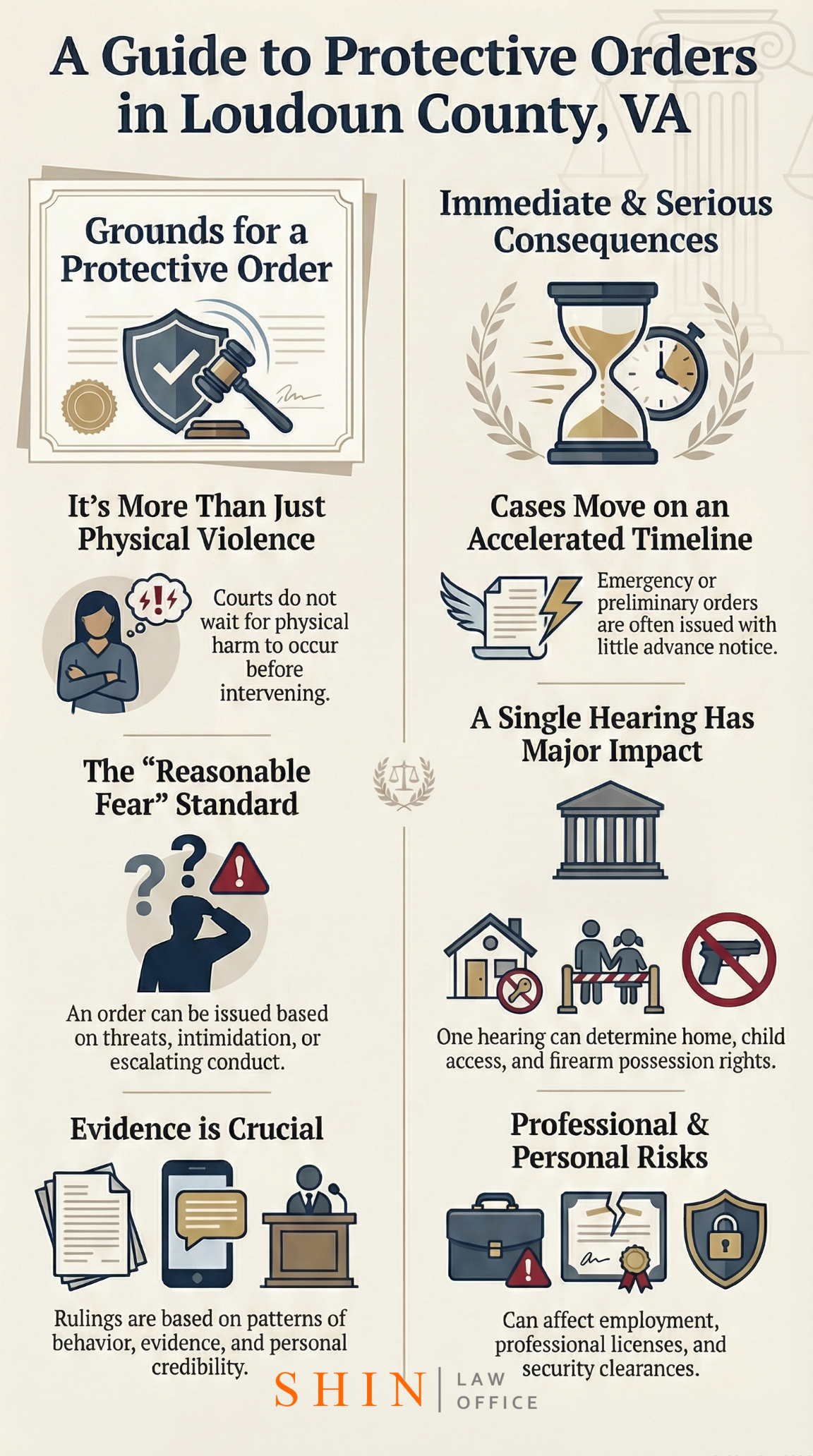
Table of Contents
- Why Protective Orders Matter in Loudoun County
- Domestic Violence and Intimate Partner Threats
- Stalking and Obsessive Conduct
- Harassment and Repeated Unwanted Contact
- Cyber Harassment and Digital Intimidation
- Threats of Violence and Escalating Intimidation
- Protective Orders Involving Children
- Separation, Divorce, and Post Relationship Retaliation
- False Allegations and Defensive Cases
- Workplace and Business Related Protective Orders
- Neighbor and Acquaintance Conflicts
- Virginia Standards and Loudoun Court Procedure
- Why Legal Representation Determines Outcomes
Chapter One
Why Protective Orders Matter in Loudoun County

Safety, Stability, and Legal Urgency in One of Virginia’s Fastest Growing Communities
Loudoun County is not a single community. It is a complex blend of historic towns, global corporate hubs, federal contractors, data centers, rural farmland, and rapidly expanding residential developments. That mix creates unique pressures that often sit beneath protective order cases long before a court filing ever happens.
From Leesburg, Ashburn, and Sterling to Brambleton, South Riding, Aldie, Middleburg, Purcellville, Round Hill, Hamilton, Lovettsville, Waterford, Hillsboro, Paeonian Springs, and Bluemont, the reasons people seek protective orders in Loudoun County reflect the county’s diversity, pace, and economic intensity.
Protective orders here are not limited to physical violence alone. Many cases begin with threats, coercion, stalking, digital harassment, or escalating intimidation tied to work, relationships, finances, or custody disputes. In a county where reputations, security clearances, and professional standing carry enormous weight, the consequences of these cases are immediate and serious.
Loudoun County’s Economic Pressure and Relationship Conflict
Loudoun County is home to major corporate campuses, government contractors, technology firms, defense industry suppliers, and one of the largest concentrations of data centers in the world. Residents commute to Washington DC, Tysons, Reston, and federal facilities across Northern Virginia. High income households exist alongside working class families and long established rural communities.
These pressures often surface in protective order cases involving:
- Workplace relationships that deteriorate into harassment
- Threats tied to corporate disputes or termination
- Control issues fueled by financial imbalance or professional leverage
- Abuse that escalates when someone fears reputational or career damage
In towns like Ashburn, Sterling, and Leesburg, it is common to see protective order cases involving professionals whose careers depend on background checks, security clearances, or corporate codes of conduct. In South Riding and Brambleton, rapidly growing planned communities bring close proximity, shared spaces, and neighbor disputes that can quickly escalate into stalking or harassment allegations.
Family, Domestic, and Dating Violence Across Loudoun Towns
Protective orders are frequently sought in domestic and dating relationships across Loudoun County. These cases arise in historic homes in Middleburg, in newer developments in Aldie, on rural properties near Round Hill, and in townhomes in Sterling and Leesburg.
Common Loudoun County scenarios include:
- Domestic violence following separation or divorce
- Threats after a breakup when one party refuses to disengage
- Escalating control tied to housing, finances, or immigration status
- Fear of retaliation during custody or visitation disputes
In smaller towns like Hamilton, Lovettsville, Waterford, Hillsboro, Paeonian Springs, and Bluemont, community visibility adds another layer. Victims often fear reporting because everyone knows everyone. At the same time, false or exaggerated allegations can spread quickly and cause lasting damage.
Technology, Surveillance, and Cyber Harassment in Loudoun County
Loudoun County’s technology footprint changes how protective order cases develop. Cyber harassment and digital stalking appear frequently in court filings.
Examples include:
- Location tracking through shared devices or apps
- Monitoring communications tied to corporate IT access
- Threats delivered through social media, messaging platforms, or email
- Online impersonation or harassment affecting employment
In technology centered areas like Ashburn and Sterling, these behaviors often blend into workplace disputes or post relationship retaliation. What begins as online harassment can quickly cross into real world fear, triggering the need for immediate court protection.
Why Loudoun County Courts Take These Cases Seriously
Protective order proceedings in Loudoun County move quickly. Emergency and preliminary orders can be issued with little notice. Final hearings determine whether restrictions remain in place for up to two years. Judges evaluate credibility, patterns of behavior, and the likelihood of future harm, not just isolated incidents.
A protective order can impact:
- Where someone lives
- Whether they can possess firearms
- Custody and visitation rights
- Employment and security clearance eligibility
- Professional licensing and background checks
For residents of Leesburg, Ashburn, Sterling, Purcellville, Middleburg, Round Hill, Aldie, South Riding, Brambleton, Hamilton, Lovettsville, Waterford, Hillsboro, Paeonian Springs, and Bluemont, the stakes are often higher than people realize until they are already in court.
The Purpose of This Guide
This chapter begins a comprehensive Loudoun County guide that explains the primary reasons someone may need a protective order. Each chapter will examine specific scenarios rooted in Loudoun County life, including business-related disputes, family dynamics, cyber harassment, stalking, false allegations, and defense strategies.
Whether someone is seeking protection or defending their rights, understanding how these cases unfold in Loudoun County is the first step toward making informed, strategic decisions when time matters most.
When you are ready, I will proceed with Chapter Two, focusing on domestic violence and intimate partner threats across Loudoun County towns, with real world scenarios unique to this region.
Chapter Two
Domestic Violence and Intimate Partner Threats Across Loudoun County

How Relationships Escalate Into Court Intervention
Domestic violence remains one of the most common and most urgent reasons someone seeks a protective order in Loudoun County. These cases are not limited to physical assaults. They often involve escalating threats, coercive control, intimidation, and fear that builds over time until court protection becomes unavoidable.
Because Loudoun County blends high pressure professional environments with rapidly growing residential communities and long established rural towns, intimate partner violence takes many forms depending on where and how people live.
Patterns Seen Across Loudoun County Relationships
Domestic and dating violence cases in Loudoun County frequently follow a predictable pattern. Tension rises during a relationship or after separation. Control becomes more overt. Communication turns threatening. The victim begins to fear what may happen next.
Common warning signs include:
- Threats of physical harm or property damage
- Isolation from friends, family, or coworkers
- Monitoring movements, communications, or finances
- Escalation after a breakup, separation, or filing for divorce
Courts look closely at patterns, not just single incidents. Loudoun County judges evaluate whether the conduct shows a real risk of future harm.
High-Density Communities and Escalation
In towns like Ashburn, Sterling, South Riding, and Brambleton, many families live in close proximity. Shared walls, common areas, parking lots, schools, and community centers mean victims cannot simply avoid an abusive partner.
Protective orders in these areas are often sought after:
- Repeated confrontations in shared spaces
- Threats delivered during child exchanges
- Unwanted appearances at homes or workplaces
- Escalation triggered by custody or support disputes
Planned communities can unintentionally trap victims in repeated contact unless a court order creates enforceable boundaries.
Professional Pressure and Control
Loudoun County’s economy adds another layer to domestic violence cases. Many residents work in technology, defense contracting, government services, and corporate leadership roles. In towns such as Leesburg and Ashburn, abusive partners may weaponize professional status or financial control.
This can include:
- Threats to report someone to an employer
- Using access to corporate systems to monitor communications
- Withholding financial resources or access to joint accounts
- Intimidation tied to security clearances or professional licenses
These tactics may not leave visible injuries, but courts recognize them as serious indicators of coercive control and danger.
Rural and Historic Town Challenges
In quieter towns like Middleburg, Purcellville, Round Hill, Hamilton, Lovettsville, Waterford, Hillsboro, Paeonian Springs, and Bluemont, domestic violence can be harder to report.
Victims often face:
- Fear of community gossip or retaliation
- Limited anonymity
- Long response times due to geography
- Dependence on shared property or family networks
In these areas, protective orders provide a crucial legal boundary when social pressure discourages speaking out.
Dating Violence Without Shared Housing
Many Loudoun County cases involve dating partners who never lived together. This is common among younger professionals and commuters throughout the county.
Dating violence cases may involve:
- Threats after a breakup
- Obsessive texting or calling
- Unwanted visits to workplaces or gyms
- Attempts to control new relationships
Courts do not require cohabitation for protection. If fear and credible threats exist, a protective order may be appropriate.
Why Early Court Action Matters
Domestic violence rarely de escalates on its own. Loudoun County courts see cases where warning signs were ignored until the risk became extreme. Protective orders are designed to interrupt that trajectory before serious injury occurs.
For some, the order provides safety. For others, it creates clear legal limits and accountability. Either way, early action can prevent irreversible harm.
The next chapter will examine stalking and obsession-driven behavior in Loudoun County, including how repeated conduct crosses the legal threshold into protective order territory and why courts respond decisively when patterns emerge.
Chapter Three
Stalking and Obsessive Behavior in Loudoun County

When Repeated Conduct Becomes a Legal Emergency
Stalking is one of the fastest-growing reasons people seek protective orders in Loudoun County. Unlike isolated arguments or one-time conflicts, stalking involves a pattern of behavior that creates fear, anxiety, and a reasonable belief that harm may occur. Loudoun County courts treat these cases with urgency because stalking almost always escalates if it is not stopped.
Stalking cases here often begin quietly. What appears to be persistence or unwanted attention gradually turns into surveillance, intimidation, or control. By the time a victim files for a protective order, the fear is usually well founded.
What Stalking Looks Like in Real Loudoun County Cases
Courts focus on patterns, not intentions. A person does not need to claim violent intent for conduct to qualify as stalking. The question is whether repeated actions cause fear or emotional distress.
Common stalking behaviors include:
- Repeated uninvited appearances at home, work, or school
- Following or monitoring movements
- Excessive calls, texts, emails, or messages
- Refusal to accept the end of a relationship
- Watching, waiting, or lingering near known locations
These behaviors appear across the county, from dense neighborhoods to rural roads.
High-Density Areas and Constant Exposure
In towns like Ashburn, Sterling, South Riding, and Brambleton, stalking often feels inescapable.
Victims report:
- Being followed through grocery stores, gyms, or parking garages
- Repeated encounters in shared community spaces
- Unwanted presence during child drop-offs or activities
- The stalker uses proximity to create fear without direct contact
Planned communities and mixed-use developments make avoidance nearly impossible without a court order establishing boundaries.
Professional and Corporate Related Stalking
Loudoun County’s workforce includes federal contractors, corporate executives, technology professionals, and government employees. In Leesburg and Ashburn, stalking cases often overlap with workplace access.
Examples include:
- Former partners showing up at offices or job sites
- Using corporate directories or systems to locate someone
- Threats tied to employment status or reputation
- Following someone during commutes or business travel
These cases raise immediate concerns because stalking at work can endanger coworkers and expose employers to risk.
Rural Towns and Surveillance Behavior
In quieter towns like Middleburg, Purcellville, Round Hill, Hamilton, Lovettsville, Waterford, Hillsboro, Paeonian Springs, and Bluemont, stalking can take a different form.
Victims often describe:
- Vehicles parked near their home repeatedly
- Being watched from a distance
- Following on rural roads
- Knowledge of movements that feels impossible to explain
Because these towns have fewer witnesses and longer response times, courts recognize the heightened risk stalking creates in rural settings.
Technology-Enabled Stalking
Technology plays a major role in Loudoun County stalking cases. Many involve digital surveillance layered on top of physical presence.
Courts see cases involving:
- GPS tracking through shared vehicles or devices
- Monitoring through smart home systems
- Accessing cloud accounts or shared passwords
- Using social media to track location or contacts
What matters is not how sophisticated the technology is, but how it is used to maintain control and create fear.
Why Courts Intervene Quickly
Stalking rarely resolves on its own. Research and court experience show that obsessive behavior often intensifies when ignored or challenged informally. Protective orders give courts the power to enforce distance, prohibit contact, and intervene before violence occurs.
For victims, the order provides safety and clarity. For the accused, it establishes clear legal boundaries that must be followed.
The next chapter will focus on harassment and repeated unwanted contact in Loudoun County, explaining how conduct that may seem minor at first can legally justify a protective order once it crosses the line into intimidation or fear.
Chapter Four
Harassment and Repeated Unwanted Contact in Loudoun County

When Persistence Crosses the Line Into Intimidation
Harassment is one of the most misunderstood reasons someone seeks a protective order in Loudoun County. Many people believe harassment must involve physical threats or violence. In reality, courts focus on whether repeated conduct is intended to intimidate, alarm, or seriously disrupt someone’s life. When that threshold is met, court intervention becomes appropriate even without physical contact.
Harassment cases often begin with behavior that feels annoying rather than dangerous. Over time, persistence becomes pressure. Pressure becomes fear. By the time a protective order is filed, the pattern is usually well established.
What Qualifies as Harassment Under Court Scrutiny
Loudoun County judges evaluate harassment by looking at frequency, intent, and impact. One unwanted message rarely qualifies. Dozens do. Conduct that continues after clear requests to stop weighs heavily in court.
Typical forms of harassment include:
- Repeated calls, texts, emails, or messages
- Unwanted contact at home, work, or school
- Messages designed to intimidate, humiliate, or provoke
- Persistent contact after a breakup or dispute
- Using third parties to relay messages or pressure
Courts examine whether a reasonable person would feel threatened, alarmed, or distressed by the behavior.
Harassment in High-Density Communities
In areas like Ashburn, Sterling, South Riding, Brambleton, and Leesburg, harassment often becomes unavoidable because of shared spaces. Community pools, parking garages, walking trails, schools, and shopping centers become points of repeated contact.
Victims describe:
- Running into the same person repeatedly without consent
- Harassing messages are sent immediately after encounters
- Pressure during child exchanges or community events
- Escalation when informal boundaries are ignored
Protective orders provide enforceable limits when personal requests fail.
Business and Corporate Related Harassment
Loudoun County’s strong corporate presence adds a professional dimension to harassment cases. Disputes between coworkers, supervisors, contractors, or former business partners sometimes spill into personal harassment.
Examples include:
- Repeated communications after termination or resignation
- Threats tied to performance reviews or references
- Harassment using corporate email or messaging systems
- Pressure related to contracts, commissions, or intellectual property
In these cases, harassment may threaten not only personal safety but also employment, professional reputation, and corporate compliance obligations.
Harassment After Separation or Divorce
Many Loudoun County harassment cases arise after a relationship ends. What begins as attempts to reconnect can become coercive when one party refuses to accept separation.
Common scenarios include:
- Constant messaging demanding explanations or reconciliation
- Showing up uninvited at homes or workplaces
- Using children or finances as leverage
- Threatening legal or social consequences
Courts recognize that harassment often intensifies during emotionally charged transitions and intervene to prevent escalation.
Small Town Visibility and Harassment
In towns like Middleburg, Purcellville, Round Hill, Hamilton, Lovettsville, Waterford, Hillsboro, Paeonian Springs, and Bluemont, harassment can feel amplified by community visibility.
Victims may experience:
- Public confrontations in familiar places
- Rumors spread through social circles
- Repeated encounters that feel intentional
- Fear of reporting due to social pressure
Protective orders offer a private legal remedy when social solutions fail.
Why Harassment Is Taken Seriously
Harassment cases are not about hurt feelings. They are about safety, autonomy, and mental well-being. Courts understand that repeated unwanted contact often precedes stalking or violence. Intervening early reduces the risk of more serious harm.
For those seeking protection, the law provides a clear path to stop behavior that has crossed the line. For those accused, understanding the seriousness of repeated contact is critical to avoiding severe legal consequences.
The next chapter will examine cyber harassment and online intimidation in Loudoun County, including how digital conduct triggers protective orders even when there is no face-to-face contact.
Chapter Five
Cyber Harassment and Digital Intimidation in Loudoun County

When Online Conduct Creates Real World Fear
Cyber harassment has become one of the most common reasons people seek protective orders in Loudoun County. Loudoun County’s deep connection to technology, data centers, corporate networks, and remote work environments means disputes increasingly unfold online before they ever reach a courthouse.
Courts no longer treat digital conduct as separate from physical safety. Messages, posts, impersonation, and online threats can be just as intimidating and dangerous as in person encounters. When online behavior creates fear or threatens harm, judges act.
What Cyber Harassment Looks Like in Loudoun County Cases
Cyber harassment is rarely a single message. It is persistent, targeted, and intentional. Courts evaluate whether the behavior shows a pattern meant to intimidate, control, or distress.
Common forms include:
- Repeated threatening or aggressive messages
- Harassment through multiple platforms
- Impersonation or fake accounts
- Posting private information without consent
- Online campaigns meant to damage reputation or employment
The digital trail often becomes the strongest evidence in court.
Technology Focused Communities and Digital Abuse
In towns like Ashburn, Sterling, Leesburg, South Riding, and Brambleton, many residents work in technology, government contracting, or corporate environments where digital access is part of daily life.
Cyber harassment cases in these areas often involve:
- Use of corporate messaging systems or email
- Threats tied to professional standing
- Access to shared cloud accounts or devices
- Monitoring through work-related platforms
What may start as workplace communication can quickly cross into harassment when boundaries are ignored.
Post Relationship Digital Control
After breakups or separations, cyber harassment often becomes the primary method of continued control. This is especially common among professionals who rely on constant connectivity.
Examples include:
- Hundreds of messages demanding responses
- Threats sent late at night or during work hours
- Monitoring online status or activity
- Using social media to pressure or intimidate
Courts recognize that digital access allows harassment to follow someone everywhere, making protective orders essential.
Online Harassment in Smaller Loudoun Towns
In towns like Middleburg, Purcellville, Round Hill, Hamilton, Lovettsville, Waterford, Hillsboro, Paeonian Springs, and Bluemont, cyber harassment can feel even more invasive.
Victims report:
- Local social media posts targeting them by name
- Community gossip amplified online
- Threats sent privately but discussed publicly
- Fear of reputation damage in close-knit towns
Digital harassment spreads quickly in small communities and courts understand the lasting impact.
Impersonation and Reputation Attacks
One of the most serious forms of cyber harassment involves impersonation. Creating fake profiles or sending messages pretending to be someone else can destroy trust, relationships, and careers.
Loudoun County courts see cases involving:
- Fake emails sent to employers or clients
- Social media accounts mimicking the victim
- False allegations were posted publicly
- Threats to release private communications
These actions often push cases from civil disputes into criminal territory.
Why Courts Act Decisively
Digital harassment does not stay online. It creates fear that spills into daily life, work, and family relationships. Loudoun County judges understand that unchecked cyber harassment often escalates into stalking or physical confrontation.
Protective orders allow courts to prohibit contact across all platforms and impose immediate consequences for violations.
The next chapter will focus on threats of violence and intimidation in Loudoun County, explaining how words alone can justify court intervention when they create a credible risk of harm.
Chapter Six
Threats of Violence and Intimidation in Loudoun County

When Words Alone Trigger Court Protection
Threats of violence are among the most urgent reasons someone seeks a protective order in Loudoun County. Courts do not wait for someone to be injured before acting. When words create a credible fear of harm, judges intervene to prevent violence rather than respond after it occurs.
In Loudoun County, threats often emerge during emotionally charged moments such as breakups, custody disputes, workplace conflicts, or financial pressure. What matters legally is not whether the threat was carried out, but whether it caused reasonable fear and demonstrated a risk of escalation.
What Courts Consider a Threat
A threat does not have to be shouted or delivered face-to-face. It can be subtle, implied, or communicated digitally. Loudoun County judges evaluate the context, the history between the parties, and whether the words suggest an ability or willingness to cause harm.
Common examples include:
- Threats to cause bodily injury
- Statements implying someone will be hurt
- Threats involving weapons
- Language suggesting retaliation or revenge
- Threats directed at family members or children
Courts focus on how a reasonable person in the same situation would perceive the threat.
Threats in High-Pressure Professional Environments
Loudoun County has a strong presence of corporate offices, technology firms, government contractors, and defense related businesses. In towns such as Ashburn, Sterling, Leesburg, South Riding, and Brambleton, threats sometimes arise from workplace disputes or professional fallout.
These cases often involve:
- Threats made after termination or discipline
- Intimidation tied to performance reviews or contracts
- Statements suggesting professional ruin paired with harm
- Threats delivered through work email or messaging systems
Because these environments involve shared offices and coworkers, courts act quickly to prevent threats from becoming workplace violence.
Domestic and Relationship-Based Threats
Many threat-based protective orders stem from intimate partner relationships. After separation, threats may be used to regain control or punish the other person.
Common scenarios include:
- Threats after being told the relationship is over
- Statements made during custody or support disputes
- Threats tied to access to the home or finances
- Promises of harm if police or courts are involved
Even a single serious threat can justify immediate court protection when fear is reasonable.
Threats in Smaller Loudoun County Towns
In towns like Middleburg, Purcellville, Round Hill, Hamilton, Lovettsville, Waterford, Hillsboro, Paeonian Springs, and Bluemont, threats often carry added weight due to isolation and visibility.
Victims may fear:
- Delayed law enforcement response
- Limited witnesses
- Being easily located
- Community pressure to stay quiet
Courts recognize that threats in rural or close-knit areas can feel more dangerous because escape options are limited.
Digital Threats and Escalation Risk
Many threats in Loudoun County are delivered electronically. Text messages, emails, social media posts, and voice messages are common evidence in protective order hearings.
Courts frequently see:
- Late-night threatening messages
- Threats combined with stalking behavior
- Escalating language over time
- Statements referencing past violence
Digital threats leave a record and judges treat them seriously.
Why Immediate Court Action Matters
Threats are often the final warning sign before violence occurs. Loudoun County courts are tasked with preventing harm, not reacting after it is too late. Protective orders allow judges to impose immediate restrictions, create distance, and enforce consequences before a threat becomes reality.
For those seeking protection, the order creates safety and clarity. For those accused, it establishes strict legal boundaries that must be respected.
The next chapter will examine protective orders involving children and family safety in Loudoun County, including how courts respond when threats or abuse place minors at risk.
Chapter Seven
Protective Orders Involving Children and Family Safety in Loudoun County

When Courts Step In to Protect the Most Vulnerable
Protective orders involving children are among the most serious cases heard in Loudoun County courts. When a child’s safety is at risk, judges move quickly and decisively. These cases often overlap with custody disputes, separations, divorces, and domestic conflict, but the legal focus is always the same: protecting the child from harm.
In Loudoun County, family dynamics are shaped by demanding careers, long commutes, blended households, and rapid population growth. When conflict escalates, children are often caught in the middle, prompting urgent court intervention.
When a Protective Order Is Sought to Protect a Child
Courts issue protective orders involving children when there is evidence that a parent, guardian, household member, or dating partner poses a risk to a minor. Physical abuse is not the only trigger. Emotional harm, threats, exposure to violence, and coercive behavior all matter.
Common situations include:
- Domestic violence occurring in the presence of a child
- Threats directed at a child or made in front of a child
- Using a child as leverage during disputes
- Attempts to intimidate the other parent through the child
- Escalating behavior during custody exchanges
Judges assess not only what has already happened, but what is likely to happen next if boundaries are not imposed.
Custody and Visitation Flashpoints
Many Loudoun County protective order cases arise during custody or visitation conflicts. Child exchanges can become emotionally charged, especially when relationships end poorly.
Courts see cases involving:
- Confrontations during pickups or drop-offs
- Threatening language during exchanges
- Refusal to return a child
- Using visitation to harass or intimidate
These situations frequently occur in high-density communities such as Ashburn, Sterling, South Riding, Brambleton, and Leesburg, where exchanges happen in parking lots, school grounds, or shared community spaces.
Professional Pressure and Family Conflict
Loudoun County parents often hold positions that carry professional risk, including government clearances, corporate leadership roles, or contract based employment. In some cases, a parent may use that pressure to control the other.
Examples include:
- Threats tied to employment or background checks
- Using financial power to influence custody decisions
- Intimidation related to housing stability
- Leveraging professional status to silence concerns
Courts are alert to these dynamics and focus on the child’s safety rather than the parents’ power imbalance.
Rural and Small Town Family Dynamics
In towns like Middleburg, Purcellville, Round Hill, Hamilton, Lovettsville, Waterford, Hillsboro, Paeonian Springs, and Bluemont, family protective order cases often carry added complexity.
Factors include:
- Limited anonymity
- Fear of community judgment
- Longer emergency response times
- Shared family or social networks
In these settings, protective orders can provide a clear legal structure where informal solutions fail or are unsafe.
Using Children as Instruments of Control
One of the most evident warning signs for courts is when a child becomes a tool of manipulation. This behavior often signals a higher risk of escalation.
Courts see:
- Threats to take or hide a child
- Interference with schooling or medical care
- Using a child to deliver messages
- Exposing children to ongoing conflict intentionally
Protective orders can restrict contact, impose supervised exchanges, and create enforceable rules that prioritize the child’s well being.
Why Courts Act Quickly in Child-Related Cases
Children cannot protect themselves. Loudoun County judges understand that exposure to violence, threats, or severe conflict can cause lasting harm even without physical injury. Early court action can prevent trauma, instability, and danger.
For parents seeking protection, a protective order creates safety and structure. For those accused, it establishes clear legal limits that must be followed to avoid severe consequences.
The next chapter will examine protective orders arising from separation, divorce, and post relationship retaliation in Loudoun County, where conflict often escalates after relationships legally or emotionally end.
Chapter Eight
Separation, Divorce, and Post-Relationship Retaliation in Loudoun County

When Conflict Escalates After a Relationship Ends
A significant number of protective orders in Loudoun County are filed after a relationship has already ended. Separation and divorce are often the most volatile phases of any relationship. Emotions run high, financial pressure increases, and uncertainty about the future can push unstable behavior into dangerous territory.
Loudoun County’s fast paced professional environment and high cost of living amplify these stresses. When one party feels they are losing control, protective orders become a necessary legal tool to stop retaliation before it escalates.
Why Breakups Trigger Protective Order Cases
After separation, some individuals struggle to accept boundaries. What begins as emotional distress can turn into intimidation, threats, stalking, or harassment.
Common post-relationship behaviors include:
- Repeated attempts to re-establish contact
- Threats tied to housing or finances
- Retaliation after divorce filings
- Using legal processes to intimidate
- Escalating behavior when boundaries are enforced
Courts understand that this phase presents a heightened risk and evaluate cases with urgency.
High Conflict Separations in Growing Communities
In towns like Ashburn, Sterling, Leesburg, South Riding, and Brambleton, many couples live in proximity even after separation. Shared neighborhoods, schools, and routines create repeated contact points.
Protective orders in these areas often arise from:
- Unwanted visits to former residences
- Confrontations in parking lots or shared spaces
- Escalation during custody or property disputes
- Pressure applied during child exchanges
Court orders provide enforceable distance when informal arrangements fail.
Financial Leverage and Retaliation
Loudoun County households often involve complex finances, professional compensation, bonuses, stock options, or business interests. During separation, financial leverage can be used as a form of control.
Courts see cases involving:
- Threats to cut off financial support
- Using access to accounts or credit to intimidate
- Manipulation involving shared businesses
- Retaliation tied to property division
These tactics may not involve physical violence but can create real fear and instability.
Small Town Retaliation Dynamics
In towns like Middleburg, Purcellville, Round Hill, Hamilton, Lovettsville, Waterford, Hillsboro, Paeonian Springs, and Bluemont, post separation conflict often unfolds in public view.
Victims report:
- Public confrontations
- Community gossip used as pressure
- Repeated encounters in familiar locations
- Fear of reputational harm
Protective orders help limit contact and prevent escalation in close-knit environments.
Retaliation Through Threats and Harassment
Retaliation can take many forms, including threats, stalking, harassment, and digital abuse. Courts look for patterns that indicate an intent to punish or control rather than to resolve conflict.
Common examples include:
- Threatening legal action without basis
- Harassment disguised as necessary communication
- Threats involving employment or reputation
- Escalating language after court filings
Judges are alert to retaliation and intervene when behavior crosses legal lines.
Why Early Legal Boundaries Matter
Separation is often when violence or serious threats first appear. Loudoun County courts use protective orders to establish immediate boundaries that prevent retaliation from becoming harm.
For those seeking safety, the order provides stability amid chaos. For those accused, it sets clear rules that must be followed while disputes are resolved through lawful channels.
The next chapter will focus on false allegations and defensive protective order cases in Loudoun County, examining how and why some orders are sought strategically rather than for safety and how courts evaluate credibility.
Chapter Nine
False Allegations and Defensive Protective Order Cases in Loudoun County

When Court Protection Is Sought as a Strategy Rather Than for Safety
Not every protective order filed in Loudoun County is driven by genuine fear. Loudoun County courts also see cases where protective orders are used strategically during divorce, custody disputes, housing conflicts, or employment related disagreements. These cases are just as serious because the consequences of a protective order can permanently alter someone’s life even when allegations are exaggerated or false.
Judges are trained to distinguish between legitimate safety concerns and filings designed to gain leverage. Credibility, evidence, and context matter.
Why False or Exaggerated Claims Occur
Protective orders offer immediate advantages. When granted, they can remove someone from their home, restrict contact with children, suspend firearm rights, and damage employment prospects. In high conflict situations, these outcomes can motivate misuse.
Common motivations include:
- Gaining leverage in custody or visitation disputes
- Forcing someone out of a shared residence
- Strengthening a divorce or support position
- Creating a record to influence future litigation
- Retaliation after separation or rejection
Courts recognize these dynamics and scrutinize filings.
High Stakes in Loudoun County Professional Life
Loudoun County residents often hold positions where a protective order has far-reaching consequences. Security clearances, government contracts, professional licenses, and corporate policies can all be affected.
Defensive protective order cases frequently involve:
- Government or defense contractors
- Technology professionals with access credentials
- Corporate executives or managers
- Licensed professionals are subject to reporting requirements
An unfounded order can jeopardize careers built over decades, which is why these cases demand aggressive, strategic defense.
Custody and Divorce-Driven Allegations
Many defensive cases arise during divorce or custody disputes. Allegations may surface suddenly after years of no reported abuse, often coinciding with court filings or disagreements over children.
Warning signs courts look for include:
- Timing aligned with custody hearings
- Inconsistent or vague allegations
- Lack of corroborating evidence
- Contradictions in testimony
- Prior friendly or cooperative behavior
While courts prioritize safety, they also evaluate whether claims align with the broader factual record.
Community Visibility and Reputation Harm
In smaller Loudoun County towns such as Middleburg, Purcellville, Round Hill, Hamilton, Lovettsville, Waterford, Hillsboro, Paeonian Springs, and Bluemont, false allegations can spread quickly.
Accused individuals may face:
- Damage to personal and professional reputation
- Social isolation
- Employment consequences
- Long-term stigma
Even when an order is later dismissed, the impact can linger.
The Importance of Immediate Defense
Protective orders often begin with emergency or preliminary hearings where the accused may not be present. By the time a final hearing occurs, restrictions may already be in place.
Effective defense focuses on:
- Challenging credibility
- Presenting evidence and witnesses
- Exposing inconsistencies
- Demonstrating lawful conduct
- Clarifying context and motives
Courts rely on this information to reach fair outcomes.
Why Courts Take Defense Seriously
False allegations undermine the integrity of the protective order system and divert resources from genuine victims. Loudoun County judges understand this balance. They aim to protect those in danger while preventing abuse of the legal process.
For those falsely accused, defending a protective order is about more than clearing a name. It is about protecting housing, employment, parental rights, and future freedom.
The next chapter will examine workplace, business, and corporate-related protective orders in Loudoun County, including disputes involving coworkers, supervisors, contractors, and professional retaliation.
Chapter Ten
Workplace, Business, and Corporate-Related Protective Orders in Loudoun County

When Professional Disputes Become Personal Safety Issues
Protective orders tied to workplace and business conflicts are increasingly common in Loudoun County. This county sits at the intersection of technology, federal contracting, data centers, defense related industries, corporate headquarters, and a growing small business ecosystem. When professional relationships deteriorate, the fallout does not always stay inside conference rooms or email threads.
Courts intervene when business disputes cross the line into threats, harassment, stalking, or intimidation that creates real fear.
How Workplace Conflicts Escalate Into Protective Order Cases
Many professional relationships involve power imbalances. Supervisors, executives, contractors, and business partners often have access to sensitive information, systems, or reputations. When conflict arises, that access can be misused.
Common escalation patterns include:
- Threats following termination or discipline
- Harassment after a failed contract or deal
- Repeated unwanted contact outside business hours
- Intimidation tied to professional reputation
- Attempts to control or silence through fear
Judges evaluate whether the conduct moved beyond legitimate business communication into personal intimidation.
Corporate and Technology-Driven Disputes
In towns like Ashburn, Sterling, and Leesburg, many residents work in data centers, technology firms, defense contracting, and corporate offices. These environments introduce unique risks when disputes arise.
Courts see cases involving:
- Misuse of corporate email or messaging platforms
- Threats tied to access credentials or systems
- Monitoring through workplace tools
- Harassment disguised as business communication
Once fear enters the picture, courts do not treat these as simple HR matters.
Small Business and Partnership Conflicts
Loudoun County also has a strong entrepreneurial presence, particularly in Purcellville, Middleburg, Round Hill, Hamilton, Lovettsville, and Waterford. Small businesses and partnerships often blur the line between professional and personal relationships.
Protective order cases arise from:
- Business breakups between partners
- Financial disputes tied to shared ownership
- Threats involving equipment, property, or customers
- Harassment after one party exits the business
When personal safety is at risk, courts step in regardless of the business context.
Contractor and Vendor Related Intimidation
Government contractors and subcontractors operate throughout Loudoun County. Failed bids, contract disputes, or performance issues can trigger retaliation.
Examples include:
- Threats after contract termination
- Harassment tied to payment disputes
- Intimidation involving reporting or compliance threats
- Repeated contact meant to pressure a settlement
Courts recognize that professional disputes do not justify intimidation or fear.
Professional Reputation and Retaliation
One of the most damaging forms of workplace-related harassment involves threats to reputation. In a county where careers depend on trust, background checks, and clearances, reputational harm can feel existential.
Courts frequently see:
- Threats to report false allegations to employers
- Harassment aimed at professional networks
- Intimidation involving licensing bodies
- Pressure campaigns meant to isolate someone professionally
These tactics often push disputes into protective order territory.
Why Courts Treat Workplace Cases Seriously
Workplace-related protective orders protect more than individuals. They prevent escalation that could endanger coworkers, clients, or the public. Loudoun County judges understand that unchecked professional retaliation can spiral quickly.
For those seeking protection, the court provides a legal boundary that stops intimidation. For those accused, understanding the seriousness of conduct outside traditional business channels is critical to avoiding severe consequences.
The next chapter will focus on protective orders involving neighbors, acquaintances, and non-family relationships in Loudoun County, where repeated unwanted interactions often escalate into fear despite no romantic or professional connection.
Chapter Eleven
Neighbor, Acquaintance, and Non-Family Protective Orders in Loudoun County

When Everyday Interactions Become a Source of Fear
Protective orders in Loudoun County are not limited to family, dating, or workplace relationships. Many cases arise between neighbors, acquaintances, or individuals with no close personal connection. These situations often surprise people because the conflict begins in ordinary, everyday settings before escalating into something far more serious.
In a county experiencing rapid growth, close-proximity living, and expanding mixed-use developments, repeated unwanted interactions can quickly turn into intimidation or fear.
How Neighbor Disputes Escalate
Most neighbor disputes start small. Noise complaints, property boundaries, parking issues, pets, or HOA disagreements are common triggers. When one party refuses to disengage, behavior can escalate beyond a civil dispute.
Courts see cases involving:
- Repeated confrontations at homes or driveways
- Harassing messages or notes
- Surveillance or monitoring of property
- Threats tied to property or personal safety
Once fear replaces disagreement, courts may intervene.
High-Density Neighborhoods and HOA Conflict
In towns like Ashburn, Sterling, South Riding, Brambleton, and Leesburg, many residents live in communities governed by homeowner associations. Shared rules and enforcement actions can inflame tensions.
Protective order cases arise from:
- Harassment after HOA violations or fines
- Repeated confrontations in common areas
- Retaliation after complaints
- Threats tied to parking, pets, or noise
Courts distinguish between lawful enforcement and personal intimidation.
Rural Property and Boundary Disputes
In towns like Middleburg, Purcellville, Round Hill, Hamilton, Lovettsville, Waterford, Hillsboro, Paeonian Springs, and Bluemont, disputes often involve land, access, or long standing boundaries.
Common issues include:
- Disputes over fences or easements
- Conflicts involving shared driveways
- Surveillance on rural property
- Threats related to hunting, animals, or equipment
Isolation and fewer witnesses can heighten fear, prompting court action.
Acquaintance-Based Harassment
Protective orders also arise from conflicts between acquaintances, including parents at schools, members of community organizations, or individuals connected through social circles.
Examples include:
- Repeated unwanted contact after a falling out
- Harassment through mutual friends
- Threats at community events
- Intimidation linked to local organizations
Courts focus on behavior, not the nature of the relationship.
Escalation Through Digital Channels
Neighbor and acquaintance disputes often spill into digital spaces. Community forums, neighborhood apps, and social media can magnify conflict.
Courts see:
- Targeted online posts
- Doxxing within local groups
- Harassment through community messaging apps
- Threats made publicly and privately
Digital conduct strengthens the case when fear is created.
Why Courts Intervene in Non-Family Cases
Protective orders exist to stop patterns of intimidation regardless of relationship type. Loudoun County judges understand that fear does not require a family or romantic connection.
For those seeking protection, a court order creates an enforceable distance. For those accused, it establishes clear boundaries that must be respected.
The next chapter will conclude the guide by examining why legal representation matters in Loudoun County protective order cases and how strategic action affects outcomes.
Chapter Twelve
Virginia Specific Standards and Court Procedures

How Protective Orders Work in Loudoun County Courts
Protective orders in Loudoun County are governed by Virginia law and follow strict procedures. These cases move quickly, apply defined legal standards, and place significant discretion in judges’ hands. Understanding how Virginia courts handle protective orders is critical, whether you are seeking protection or defending against one.
Types of Protective Orders Under Virginia Law
Virginia recognizes three primary protective orders. Each serves a different purpose and follows a specific timeline.
Emergency Protective Order
Issued by a magistrate or judge, often after a police response or arrest. Typically lasts up to 72 hours. Designed to provide immediate protection when courts are closed. Often issued without the respondent present.
Preliminary Protective Order
Issued by a judge based on sworn testimony or written allegations. The respondent may not be present at the time of issuance. Typically lasts up to 15 days. Acts as a bridge between emergency relief and a full court hearing.
Final Protective Order
Issued after a full hearing where both sides may present evidence. It can last up to two years. Imposes long-term restrictions and legal consequences.
Legal Standards Virginia Courts Apply
Virginia courts do not issue protective orders casually. Judges must find that the legal threshold has been met based on evidence and credibility.
Courts evaluate:
- Whether the conduct qualifies as abuse, threats, stalking, or harassment under Virginia law
- Whether there is a reasonable fear of future harm
- Whether the behavior shows a pattern rather than an isolated event
- The credibility of each party and supporting evidence
Physical violence is not required. Threats, intimidation, stalking, and cyber harassment may all meet the standard.
Burden of Proof at Each Stage
The burden of proof changes as a case progresses.
Emergency and preliminary orders rely on sworn statements, initial credibility assessments, urgency, and risk.
Final protective order hearings require live testimony, documentary evidence, witnesses when available, and cross-examination. Judges weigh all evidence before deciding whether long-term restrictions are justified.
What Loudoun County Judges Focus On
Judges in Loudoun County look beyond emotional narratives. They focus on facts, patterns, and risk.
Key considerations include:
- The history between the parties
- Escalation over time
- Prior warnings or requests to stop
- Use of technology or surveillance
- Impact on children
- Likelihood of future conflict
Consistency and documentation often determine outcomes.
Court Procedures in Loudoun County
Protective order cases are handled on an expedited docket. Hearings are typically brief but intense.
Procedural realities include:
- Strict time limits for testimony
- Formal rules of evidence
- Limited tolerance for irrelevant information
- Immediate rulings at the conclusion of hearings
Preparation matters because judges expect concise, focused presentations.
Consequences of a Granted Protective Order
A final protective order in Virginia can:
- Prohibit all contact including digital communication
- Require distance from homes, workplaces, or schools
- Remove a respondent from a shared residence
- Restrict firearm possession
- Affect custody and visitation
- Trigger employment and licensing consequences
Violating any term of the order is a criminal offense.
Firearm Restrictions Under Virginia Law
When a protective order is issued, Virginia law restricts firearm possession for the duration of the order. This applies regardless of ownership status or prior lawful possession. Courts take enforcement seriously and violations carry severe penalties.
Appeals and Modifications
Protective orders can sometimes be modified or dissolved, but not casually.
Courts require:
- A material change in circumstances
- Formal motions and hearings
- Legal justification
Appeals must follow strict deadlines and procedural rules.
Why Procedure Is Often the Deciding Factor
Many protective order cases are won or lost on procedure rather than emotion. Missed deadlines, poorly presented evidence, or misunderstanding the standard of proof can permanently alter outcomes.
Virginia courts expect parties to understand:
- What evidence is relevant
- How to present it properly
- What legal standard applies
- What consequences flow from the ruling
Bottom Line
Virginia’s protective order law is precise, fast-moving, and unforgiving of mistakes. In Loudoun County, judges balance urgent safety concerns with serious long term consequences. Knowing the standards and procedures is essential to protecting your safety, your rights, and your future.
Chapter Thirteen
Why Legal Representation Matters in Loudoun County Protective Order Cases

How Strategy, Speed, and Local Knowledge Shape Outcomes
Protective order cases in Loudoun County move faster than almost any other civil matter. Decisions are often made within hours or days, not weeks. A single hearing can determine where someone lives, whether they can see their children, whether they can possess firearms, and whether their career survives intact.
Because of what is at stake, these cases demand immediate, strategic legal action grounded in Loudoun County realities.
Loudoun County Courts Move Quickly and Decisively
Emergency and preliminary protective orders can be issued with little notice. In many cases, the respondent is not present when restrictions are first imposed. By the time a final hearing occurs, damage may already be underway.
Judges expect:
- Clear, organized evidence
- Credible testimony
- Focused legal arguments
- An understanding of patterns and risk
There is little room for confusion or delay.
Why Local Context Matters
Loudoun County is not generic Virginia. Judges here routinely handle cases involving:
- Government and defense contractors
- Technology professionals and data center employees
- Corporate executives and managers
- High net worth households
- Complex custody and relocation issues
Legal arguments must reflect how a protective order affects security clearances, employment policies, background checks, housing, and parental rights in this specific county.
The Risk of Handling These Cases Alone
People who attempt to navigate protective order hearings without legal representation often underestimate the process. Courts are formal. Evidence rules apply. Emotional narratives without structure or proof carry little weight.
Common mistakes include:
- Oversharing irrelevant details
- Failing to present digital evidence correctly
- Underestimating the impact of prior messages
- Ignoring credibility issues
- Missing deadlines or procedural steps
These missteps can permanently alter outcomes.
Strategic Representation for Those Seeking Protection
For individuals seeking a protective order, legal counsel helps:
- Frame conduct as a pattern rather than isolated incidents
- Present evidence in a way courts rely on
- Anticipate defense arguments
- Request appropriate protections involving children, housing, and contact
- Ensure enforceable and realistic terms
The goal is safety that actually works in real life, not just on paper.
Strategic Defense for Those Accused
For those defending against a protective order, representation is critical. A granted order can affect:
- Custody and visitation
- Housing and relocation
- Firearm rights
- Employment and licensing
- Professional reputation
Defense requires:
- Challenging credibility where appropriate
- Presenting context, courts need to see
- Introducing contradictory evidence
- Preventing overbroad or unnecessary restrictions
- Protecting long-term rights and record
Silence or delay often works against the accused.
Why These Cases Are Not One Size Fits All
A protective order involving a tech executive in Ashburn looks very different from one involving a neighbor dispute in Purcellville or a family matter in Leesburg. Loudoun County courts expect arguments tailored to the facts, the people involved, and the risks presented.
Judges evaluate:
- The history between the parties
- Likelihood of escalation
- Community and workplace impact
- Child safety considerations
- Ability to comply with restrictions
Effective advocacy speaks directly to those concerns.
The Bottom Line
Protective orders are not just paperwork. They are powerful court tools with immediate and lasting consequences. Whether someone is seeking safety or protecting their rights, the outcome often depends on what happens in a single hearing.
In Loudoun County, preparation matters. Evidence matters. Strategy matters.

Principal Attorney | Shin Law Office
Call 571-445-6565 or book a consultation online today.
Protective Orders Attorney for Loudoun County
Frequently Asked Questions
What is a protective order in Loudoun County?
A protective order is a court order designed to stop behavior that creates fear, intimidation, or risk of harm. In Loudoun County, protective orders can restrict contact, require distance, address child safety, and impose immediate legal consequences.
Do I need physical violence to get a protective order?
No. Courts issue protective orders for threats, stalking, harassment, cyber harassment, intimidation, and patterns of behavior that create reasonable fear, even if no physical harm has occurred.
How fast can a protective order be issued?
Emergency and preliminary protective orders can be issued very quickly, sometimes the same day. Final hearings usually occur within a short time frame and determine whether the order remains in place.
Can a protective order affect my job or security clearance?
Yes. Protective orders can impact employment, professional licensing, background checks, and security clearances, especially in Loudoun County where many residents work in government, defense, or technology roles.
Can a protective order affect custody or visitation?
Yes. Courts may limit or restructure contact with children if safety concerns exist. Child protection is a top priority in protective order cases.
Do protective orders apply to online contact?
Yes. Courts can prohibit contact through text messages, email, social media, messaging apps, and other digital platforms.
What happens if a protective order is violated?
Violating a protective order is a criminal offense. Arrest, additional charges, and jail time are possible consequences.
Can someone get a protective order without the other person being present?
Yes. Emergency and preliminary orders are often issued without the respondent present. The respondent has the right to contest the order at the final hearing.
Can protective orders be based on false allegations?
Yes, some orders are filed strategically during disputes. Courts evaluate credibility, evidence, timing, and consistency when deciding whether to grant or dismiss an order.
What evidence is used in protective order hearings?
Common evidence includes text messages, emails, call logs, social media posts, photos, witness testimony, police reports, and prior court records.
How long does a protective order last?
Emergency orders are short term. Final protective orders can last up to two years depending on the circumstances and court findings.
Can a protective order remove someone from their home?
Yes. Courts can order someone to leave a shared residence, even if their name is on the lease or deed.
Do protective orders only apply to family or dating relationships?
No. Protective orders can involve coworkers, neighbors, acquaintances, former business partners, or anyone whose behavior creates fear or intimidation.
Should I have a lawyer for a protective order case?
Yes. These cases move quickly and have serious consequences. Legal representation helps ensure evidence is presented properly and rights are protected.
What should I do if I am considering filing or defending a protective order?
Act quickly. Document all relevant behavior, preserve evidence, avoid direct contact, and seek legal guidance immediately. Protective order outcomes often hinge on preparation for a single hearing.
Disclaimer:The information provided in this article is for educational purposes only and does not constitute legal advice. Every case is unique. If you believe you have a claim, contact a qualified attorney immediately to discuss the specifics of your situation and the applicable statutes of limitation.