
Bottom Line Up Front (BLUF)
Direct contact with an energized power line can end a career in a split second. In Northern Virginia, these incidents most often occur during construction, tree work, roof work, utility-adjacent projects, and roadside operations where clearance planning breaks down. The results are often catastrophic burns, cardiac injury, amputations, paralysis, and wrongful death. OSHA treats power line contact as one of the most lethal jobsite hazards for a reason.
When a boom, bed, or mast rises into an overhead power line, the entire machine can become energized in an instant. That is why crane and boom contact events are one of the most frequent fatal patterns in construction and utility adjacent work, and why these incidents often injure more than one person on the ground.
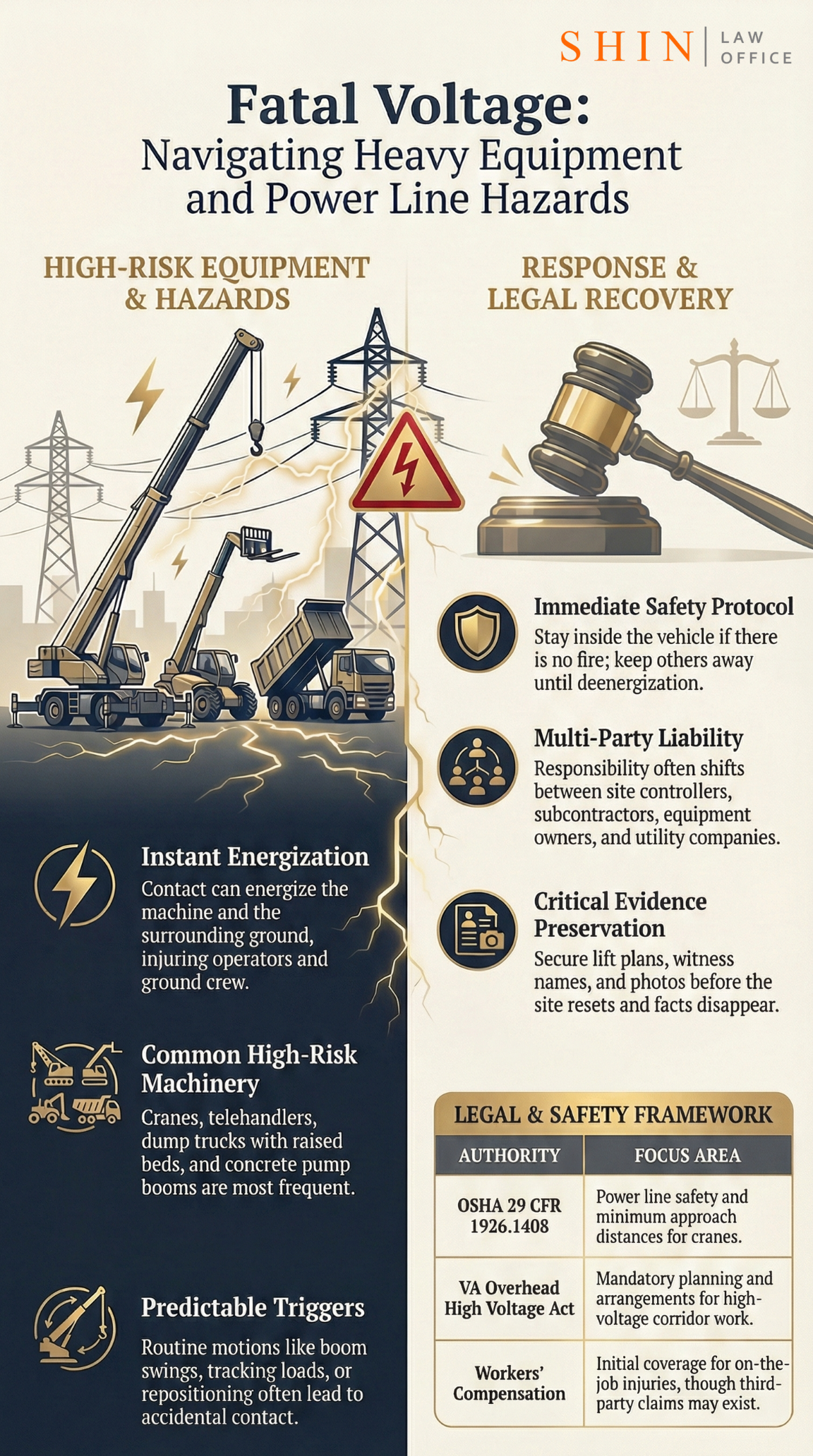
Table of Contents
- Why this happens so often in Northern Virginia
- What direct contact really looks like in the field
- The most common machines involved and the failure points
- The injury patterns I see most often
- What to do immediately after a power line contact
- The legal path for injured workers in Virginia
- Why clearance rules matter in Virginia
- Who may be responsible beyond the employer
- County specific realities across Northern Virginia
- Evidence that wins or loses these cases
- How I handle these cases at Shin Law Office
- References
Why this happens so often in Northern Virginia
Fairfax, Loudoun, Prince William, Arlington, Clarke, and Frederick counties are rife with conditions that increase the risk of power line contact.
- Dense development with tight easements, especially near commercial corridors and older neighborhoods
- Constant road, fiber, and utility expansion
- High volume tree trimming and storm cleanup
- Heavy use of aerial equipment and material staging near overhead lines
- Fast-paced job sites where crews change daily and safety assumptions get copied without verification
OSHA warns that overhead and buried lines on construction sites are especially hazardous because of the voltage involved and the severe burn and fall risks that follow a contact event.
What direct contact really looks like in the field
When most people hear “power line contact,” they picture a crane coming into contact with a power line. Direct contact is different. This is bodily contact with an energized conductor or an energized piece of hardware.
Here are the direct contact scenarios I see most often.
Touching an overhead conductor during access or movement
- A worker steps off a ladder, roof edge, or platform and brushes a line
- A worker reaches up to steady themselves, not realizing the line is within reach
- A worker carries materials and their body drifts into the conductor path
Touching a downed conductor or energized line on the ground
- A crew assumes the line is dead because it is on the ground
- A worker tries to move the line out of the way to “open the road”
- A worker approaches too close in wet grass, mud, or pooled water
Touching energized components attached to structures
Direct contact can happen at service drops, weatherheads, meter bases, risers, and transformer-related hardware. The worker never comes into contact with an overhead span. They touch the energized point of connection.
Touching an energized object that should not be energized
A fence, a metal handrail, scaffolding, or a structure can become energized if a line is resting on it. A worker believes they are touching a normal object and becomes the path to ground.
Why raised equipment and overhead lines are a deadly mix
Overhead lines carry high voltage. OSHA warns that contact is often fatal, and that burns and falls are common even when the worker survives.
Here is what makes raised equipment so dangerous.
- The operator may not see the line from the cab.
- A small swing or bounce can close the last few feet.
- The load line, rigging, or boom tip can be the first point of contact.
- Once contact is made, the machine can energize the ground around it, potentially injuring nearby workers.
How these incidents happen in seconds
Most power line contact events are not a dramatic crash. They are routine motions on a busy site.
Common real-world triggers include:
- Setting up too close because the crew is trying to save time or space
- A boom swinging while the operator is tracking a load or repositioning
- A telehandler raising forks to place material near a corridor
- A dump bed lifting during unloading under the lines
- A concrete pump boom unfolding into the work zone
- An excavator lifting a bucket or pipe near an overhead run
OSHA has a specific crane power line rule because this pattern is so predictable and so deadly.
The most common machines involved and the failure points
Cranes, derricks, boom trucks, bucket trucks, telehandlers
These machines combine reach, movement, and blind spots.
- The boom swings and the tip drifts
- The load line or tag line moves unexpectedly
- Outriggers and setup decisions place the machine too close at the start
NIOSH has repeatedly warned that crane operators and crew members can be electrocuted when working near overhead power lines, especially when basic controls are not followed.
Dump trucks with raised beds
This happens during unloading, often when the driver is focused on the load.
- The bed rises into the line path
- The truck becomes energized
- Ground workers get hurt when they touch the truck or step into energized ground zones
Concrete pump trucks
Concrete pump booms can reach far and move fast.
- Boom deployment can start within a safe area and end inside the danger zone
- Operators may be tracking the pour, not the overhead clearance
- Spotter communication failures are common
Excavators and loaders near overhead corridors
Even when the plan is focused on digging, the boom can rise into the line zone during repositioning or lifting.
- Lifting pipe, trench boxes, or spoils changes the height profile
- Uneven terrain causes sudden shifts
- Operators may not realize how close they are until it is too late
The injury patterns I see most often
These incidents cause violent injuries, and they often create multiple victims.
Electrical injuries are often worse than they look at first. Electricity can damage the heart, lungs, nerves, muscles, and internal tissue even when the visible burns seem limited.
Common injury outcomes include:
- Electrocution and cardiac arrest
- Severe electrical burns requiring grafting and long wound care
- Arc flash burns and blast trauma
- Falls after shock or muscle lockup
- Secondary injuries to the ground crew from energized equipment or energized ground surfaces
- Cardiac arrest or a dangerous heart rhythm disruption
- Deep burns that require grafting, debridement, and long-term wound care
- Nerve damage with loss of sensation, chronic pain, or loss of function
- Compartment syndrome and muscle death requiring emergency surgery
- Amputation of fingers, hands, arms, toes, or feet
- Traumatic brain injury from a fall after contact
- Eye and hearing damage from the blast and heat effects
- Permanent disability and inability to return to trade work
OSHA consistently links power line contact to fatal electrocution, severe burns, and secondary fall injuries.
What to do immediately after a power line contact
When a power line contact happens, the first few minutes matter. The wrong rescue attempt can create a second victim.
The safer steps are simple.
- Call 911 immediately
- Do not touch the injured person if there is any chance they are still energized
- Keep everyone back and treat the area as energized until the utility confirms deenergization
- If you are inside the vehicle or cab and there is no fire, stay put until help arrives
- If the contact involved a vehicle or equipment, do not exit unless there is an immediate life threat like fire
- Get the line owner or operator on scene as fast as possible through emergency dispatch
After emergency care starts, document the scene as safely as possible. Photos and video taken early can preserve facts that disappear when crews clear the hazard.
The legal path for injured workers in Virginia
Most workers hurt on the job start with workers’ compensation. Virginia law generally makes workers’ compensation the exclusive remedy against the employer for a covered workplace injury.
That does not mean the story ends there.
In many power line contact cases, there may be viable third-party claims against entities other than the employer. That is where full damages become possible, including pain, suffering, future earnings loss, and other categories that workers’ compensation typically does not cover.
Why clearance rules matter in Virginia
For crane and derrick work, OSHA requires employers to prevent equipment, load line, and load from getting too close to power lines. The standard includes options such as deenergizing and grounding or maintaining minimum approach distances.
Virginia has a specific safety statute focused on work near overhead high voltage lines. It is designed to protect workers and requires planning and safety arrangements when work occurs near those lines.
In plain English, the law exists because too many people were getting killed and permanently burned when projects were planned as if the overhead lines were not there.
When the required notice, coordination, and safety arrangements are ignored, it often becomes a key liability issue.
Who may be responsible beyond the employer
If you were injured on the job, workers compensation may be part of the picture. But raised equipment power line cases often involve more than one company and more than one duty holder.
Every case is different, but these are common third party targets in direct contact incidents.
Depending on the facts, responsibility can involve:
- Utility owner or operator, when line placement, maintenance, marking, or deenergization decisions were negligent
- General contractor or site controller, when coordination and safety planning failed
- Subcontractor, when their actions created the hazard zone or pushed a worker into danger
- Property owner, when a dangerous condition was known and ignored
- Equipment manufacturer, when a defect or missing safety feature contributed to the injury
- Staffing or project management entities, when training, supervision, or safety compliance was mishandled
- The site controller or general contractor who controlled layout and sequencing
- A subcontractor whose operation created the hazard zone
- The equipment owner or rental chain if maintenance or safety features were an issue
- The utility when coordination, warnings, or safety arrangements were required
- A separate operator team, such as a pump truck crew or crane service crew
The liability question usually turns on duty, control, knowledge of the hazard, and whether basic safety requirements were followed.
County specific realities across Northern Virginia
These cases are local. The hazard may be statewide, but the work environment and litigation realities vary by county.
Fairfax County
Dense commercial redevelopment and tight suburban work sites mean clearance mistakes happen fast. Fairfax Circuit Court is the 19th Judicial Circuit and regularly handles personal injury cases, which matters for civil litigation strategy and scheduling.
Loudoun County
Rapid growth zones, data center corridors, and constant utility work create frequent overhead line exposure, especially on expanding roadways and new construction.
Prince William County
Large scale residential development, roadway projects, and industrial sites create repeated power line interaction risks for trades and delivery crews.
Arlington County
Urban constraints, narrow staging areas, and vertical work increase the odds that a worker ends up within reach of lines while moving between elevations.
Clarke County
A mix of rural and corridor development means crews often work near roadside lines with limited shoulder space, especially during storm response and vegetation management.
Frederick County
Growth, transportation projects, and mixed use development increase the number of crews working near overhead distribution lines across changing terrain.
Evidence that wins or loses these cases
Power line contact cases are evidence heavy. The facts disappear quickly once the utility secures the scene and the job site moves on.
Here is what I want preserved early.
Evidence that often matters:
- Photos and video of line location, work area, and access points
- Measurements or documented clearances if they exist
- Names of witnesses on every crew present
- Job safety plans, tailgate meeting notes, and training records
- Utility coordination records, including any notice under the Overhead High Voltage Line Safety Act
- Incident reports, EMS records, and hospital intake notes
- Equipment inspection and maintenance logs
- Contract documents defining who controlled safety, staging, and sequencing
- Photos and video of the line, machine position, and work zone
- Witness names and who was acting as spotter
- Lift plans, job hazard analyses, and daily safety brief notes
How I handle these cases at Shin Law Office
When a direct contact injury happens, you are not dealing with a routine personal injury claim. You are dealing with life altering harm, complex causation, and multiple parties trying to shift blame.
I treat raised equipment power line cases as urgent, because evidence and witness access can vanish within days. My goal is to lock down the facts, identify every responsible party, and build damages the right way so the claim reflects the true cost of the injury.
My approach is simple.
- Secure the evidence before it disappears
- Identify every responsible third party early
- Build damages with real medical and vocational proof, not guesswork
- Push the case toward resolution only when the facts are locked down
In Summary
If you or a family member suffered a power line contact injury in Fairfax, Loudoun, Prince William, Clarke, Frederick, or Arlington, you need a plan that accounts for both workers’ compensation realities and third-party liability.
If you or a family member was hurt in a power line contact incident involving a crane, boom truck, bucket truck, telehandler, dump truck, concrete pump, excavator, or loader in Virginia, Maryland, or Washington DC

Principal Attorney | Shin Law Office
Call 571-445-6565 or book a consultation online today.
(This article is provided for general informational purposes and does not constitute legal advice. For advice on your specific situation, consult with a licensed Virginia attorney.)
References
- National Institute for Occupational Safety and Health. (1995, May). Preventing electrocutions of crane operators and crew members working near overhead power lines (DHHS (NIOSH) Publication No. 95-108). Centers for Disease Control and Prevention. Retrieved February 25, 2026, from https://www.cdc.gov/niosh/docs/95-108/default.html
- Occupational Safety and Health Administration. (n.d.). eTool: Construction electrical incidents. U.S. Department of Labor. Retrieved February 25, 2026, from https://www.osha.gov/etools/construction/electrical-incidents
- Occupational Safety and Health Administration. (2011, April). Construction focus four: Electrocution hazards. U.S. Department of Labor. https://www.osha.gov/sites/default/files/electr_ig.pdf
- Occupational Safety and Health Administration. (n.d.). 29 CFR 1926.1408: Power line safety (up to 350 kV): Equipment operations. U.S. Department of Labor. Retrieved February 25, 2026, from https://www.osha.gov/laws-regs/regulations/standardnumber/1926/1926.1408
- Commonwealth of Virginia. (n.d.). § 65.2-307. Employee’s rights under Act exclude all others; exception. Code of Virginia. Retrieved February 25, 2026, from https://law.lis.virginia.gov/vacode/title65.2/chapter3/section65.2-307/
- Commonwealth of Virginia. (n.d.). Chapter 30. Overhead High Voltage Line Safety Act. Code of Virginia. Retrieved February 25, 2026, from https://law.lis.virginia.gov/vacode/title59.1/chapter30/
- Virginia General Assembly. (n.d.). Chapter 30: Overhead High Voltage Line Safety Act, Va. Code Ann. §§ 59.1-406–59.1-414. Code of Virginia. Retrieved February 25, 2026, from https://law.lis.virginia.gov/vacode/title59.1/chapter30/
- Fairfax County, Virginia. (n.d.). Circuit Court. Retrieved February 25, 2026, from https://www.fairfaxcounty.gov/circuit/
- Virginia Judicial System. (n.d.). Fairfax Circuit Court: 19th Judicial Circuit of Virginia. Retrieved February 25, 2026, from https://www.vacourts.gov/courts/circuit/fairfax/home