
Bottom Line Up Front (BLUF)
Tysons Corner is one of Virginia’s busiest employment hubs, with around 115,000 workers commuting in daily. Both employees and employers here must navigate a complex web of federal and state employment laws. Recent changes – such as expanded anti-discrimination protections and a new ban on non-compete agreements for many workers – mean rights and obligations are evolving fast. The bottom line: understanding key issues like discrimination, wages, non-competes, and wrongful termination is crucial to protecting your interests and resolving workplace disputes fairly.
This article analyzes landmark federal and Virginia court decisions, including Bostock v. Clayton County and Bowman v. State Bank of Keysville, alongside sweeping statutory reforms such as the Virginia Overtime Wage Act and the non-compete ban for low-wage workers. It is designed to help employers and employees in Tysons and across Northern Virginia understand compliance risks, litigation exposure, and evolving workplace rights.
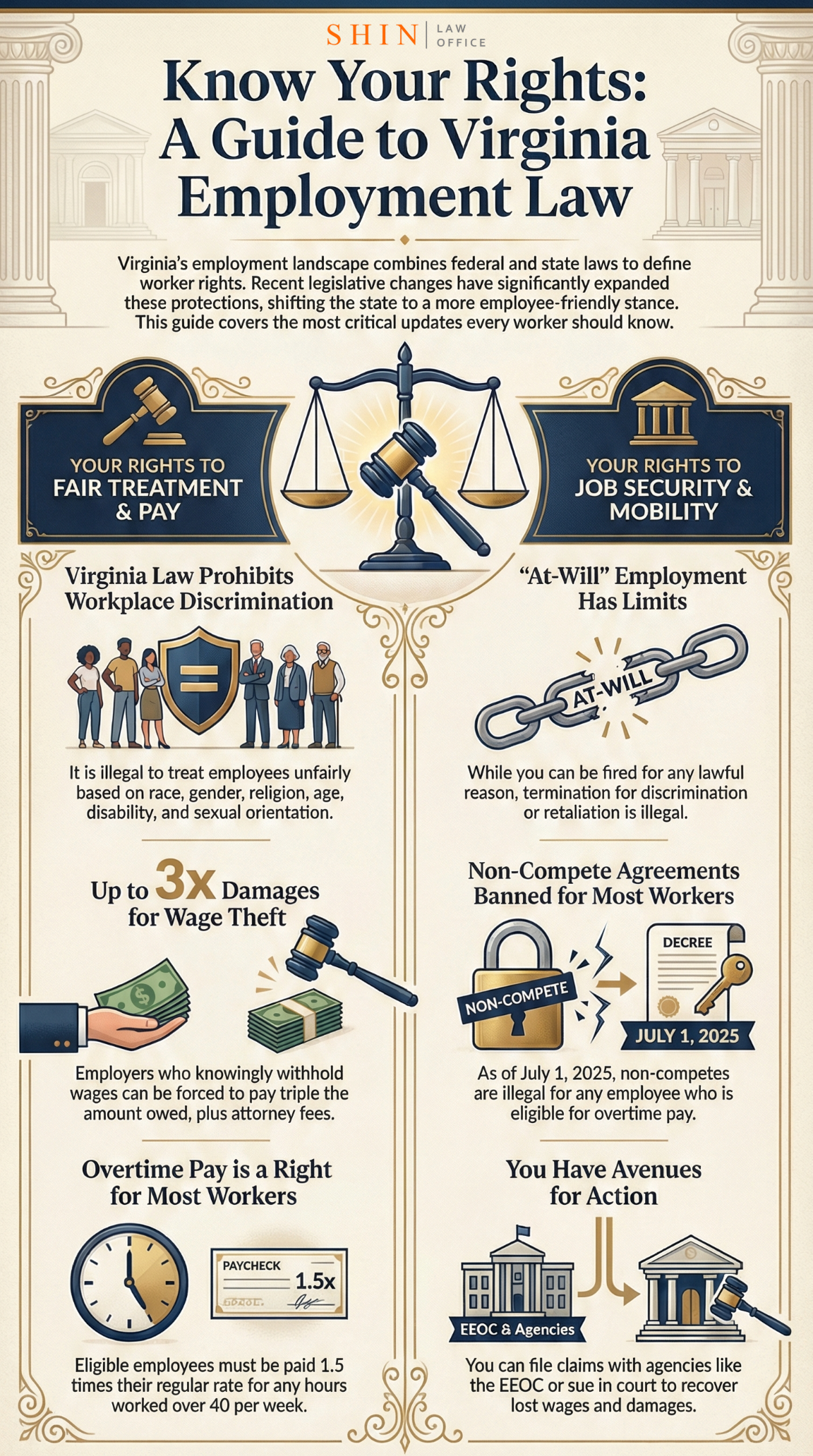
Table of Contents
Chapter 1: Understanding Employment Law in Virginia
Virginia’s employment law landscape is a blend of federal and state rules that define the rights and responsibilities of employers and employees. At the federal level, laws like Title VII of the Civil Rights Act of 1964 prohibit employment discrimination based on race, color, religion, sex, or national origin. Other federal statutes, such as the Age Discrimination in Employment Act (for workers age 40 and over) and the Americans with Disabilities Act, provide additional protections. These federal laws generally apply in Tysons Corner as they do nationwide. In addition, Virginia’s own laws – notably the Virginia Human Rights Act (as expanded by the Virginia Values Act of 2020) – mirror and sometimes extend federal protections by adding traits like sexual orientation, gender identity, marital status, and veteran status as protected categories. Virginia’s Human Rights Act now covers most employers and allows employees to sue in state court for discrimination with substantial remedies. In short, both federal and state law govern how employers must treat their workforce.
Another foundational concept in Virginia employment is the “at-will” employment doctrine. Virginia strongly adheres to employment-at-will, meaning that, in the absence of a contract stating otherwise, either the employer or the employee can end the relationship at any time, for any lawful reason or no reason at all. This default rule gives employers flexibility but is limited by the law – an employer cannot terminate someone for an illegal reason without consequences. That’s where employment laws come in: they carve out exceptions to at-will freedom by protecting employees from unfair treatment. For example, anti-discrimination statutes make it unlawful to fire or mistreat someone because of a protected characteristic, and other laws shield employees who engage in protected activities (like reporting violations or taking medical leave). In recent years, Virginia has shifted from an employer-friendly stance to a more employee-protective approach. The state legislature enacted sweeping changes effective July 1, 2020, expanding workers’ rights in discrimination cases, wage payments, and other areas. In Tysons Corner’s dynamic business environment, where Fortune 500 companies and tech startups coexist, staying up-to-date with these legal changes is critical. Both employers and employees must understand this legal framework – the interplay of federal standards and Virginia-specific rules – to know what is required, what is prohibited, and what steps to take when workplace conflicts arise.
Chapter 2: Workplace Disputes – Discrimination and Harassment
Workplace discrimination is one of the most common and serious employment law issues. Discrimination means an employer treats an employee or job applicant unfairly because of a protected characteristic. Under federal law, no employer with 15 or more employees may discriminate based on race, color, religion, sex, or national origin. Virginia law aligns with these categories and also explicitly protects attributes like age (if 40+), disability, pregnancy and childbirth, marital status, and military/veteran status. The landmark Virginia Values Act of 2020 significantly broadened the state’s anti-discrimination law, making it comparable to federal law and even adding sexual orientation and gender identity protections before the U.S. Supreme Court did so in Bostock v. Clayton County (2020). In practical terms, this means an employer in Tysons Corner cannot refuse to hire, deny a promotion, pay less, or fire someone because of who they are (e.g. because of their race or gender). Such actions are illegal. Employees who believe they have been discriminated against can file a charge with the U.S. Equal Employment Opportunity Commission (EEOC) or the Virginia Division of Human Rights, which will investigate the claim. The EEOC has authority to enforce federal anti-discrimination laws and can attempt mediation or take legal action on the employee’s behalf. Often, the EEOC or state agency will issue a “right-to-sue” letter after investigation, allowing the individual to bring a lawsuit in court. The key point for workers is that you do not have to tolerate unfair treatment based on personal characteristics – the law provides remedies to hold employers accountable if they violate these rights.
Harassment and hostile work environments are closely related to discrimination. Harassment is a form of illegal discrimination when it is based on a protected trait (such as sexual harassment, racial harassment, etc.) and is severe or pervasive enough to create an abusive work environment. No one should have to face slurs, offensive jokes, unwelcome sexual advances, or other mistreatment on the job because of their identity. Both federal and Virginia law recognize that a “hostile work environment” caused by discriminatory harassment is unlawful. For example, repeated derogatory comments about an employee’s religion or ethnicity that make it hard for them to do their job could qualify as a hostile environment. Employers are legally responsible for preventing and addressing harassment. This means companies should have policies against harassment, provide training to employees, and establish clear reporting procedures. If an employee does report harassment, the employer must take prompt corrective action to stop it. Failure to do so can lead to liability. In fact, an employer can be held liable for harassment by supervisors, or even co-workers and customers in some cases, especially if management knew about the behavior and failed to intervene. From an employee’s perspective, it’s important to report harassment through the channels your company provides (such as HR). Not only does this give the employer a chance to fix the problem, it also creates a record in case legal action becomes necessary. Remember that retaliation by the employer for reporting discrimination or harassment is itself illegal – laws explicitly prohibit punishing someone for complaining about discrimination. Ultimately, a workplace should be safe and respectful. If harassment creates a workplace so hostile that a reasonable person would find it abusive, the law views that as a form of discrimination and provides relief to the victim.
Chapter 3: Wage and Hour Claims
Getting paid fairly for one’s work is a fundamental employment right, yet wage and hour disputes are common. Both federal and state laws set standards for minimum wage, overtime pay, and other wage-related issues. The federal Fair Labor Standards Act (FLSA) requires that covered, non-exempt employees receive overtime pay at “time and a half” (1.5 times their regular pay rate) for any hours worked over 40 in a given week. Virginia law mirrors this requirement. The Virginia Overtime Wage Act (Va. Code § 40.1-29.3) was enacted to reinforce overtime protections, essentially adopting the FLSA’s rules into state law. In practical terms, if you are an hourly worker or a salaried worker who doesn’t fall into a special exemption, you must be paid overtime when you work more than 40 hours in a week. A common issue is misclassification – some employers mistakenly (or intentionally) label workers as “exempt” managers or professionals to avoid paying overtime. But job titles alone do not determine exempt status; it depends on actual duties and salary basis. For instance, just because your title is “Assistant Manager” doesn’t automatically mean you’re exempt from overtime if your primary duties are routine tasks like stocking shelves rather than true management. Likewise, being paid a salary doesn’t automatically disqualify you from overtime – you must meet specific criteria under the law to be exempt. If your employer in Tysons has you working 50 hours but only pays for 40, you should question whether that’s lawful. Workers who have been denied proper overtime pay can file a complaint with the U.S. Department of Labor or Virginia’s Department of Labor and Industry, or they can sue to recover unpaid wages. Employers who violate overtime rules can be liable for not only the unpaid overtime wages but also additional damages.
Minimum wage and wage theft are other critical wage issues. Virginia’s minimum wage is higher than the federal minimum and has been gradually increasing in recent years. As of 2026, Virginia’s minimum wage is indexed to rise with inflation – it reached $12.77 per hour on January 1, 2026. Employers in Tysons Corner must pay workers at least this state minimum wage (or any higher applicable rate for federal contractors or local laws) for all hours worked. Failing to pay the required minimum, or forcing employees to work off-the-clock without pay, constitutes wage theft. In 2020, Virginia enacted a Wage Theft law that strengthened workers’ ability to recover unpaid wages. Under the Virginia Wage Payment Act (Va. Code § 40.1-29), employees now have a private right of action to sue their employers for unpaid wages (previously, they could only file an administrative complaint). Crucially, if the employer is found to have knowingly withheld wages, the court can award liquidated damages up to triple the amount of the unpaid wages, plus the employee’s attorney’s fees and costs. This is a big deterrent against wage theft – an employer who cheats a worker out of $1,000 could end up owing $3,000 in damages, making it costly to violate the law. Virginia also lengthened the statute of limitations for wage claims to 3 years, giving employees more time to bring claims. What does this mean for workers and businesses in Tysons? Essentially, employers must be meticulous in paying employees what they are owed – whether it’s regular pay, overtime, or commissions – on time and in full. And employees who suspect wage violations have strong legal tools to recover their earnings. For any substantial pay dispute, it’s wise to consult with an employment lawyer or reach out to state/federal labor agencies. Given the potential penalties (including criminal penalties for intentional wage theft in extreme cases), employers should err on the side of compliance – it’s both legally required and the right thing to do.
Chapter 4: Non-Compete Agreements and Restrictive Covenants
Tysons Corner is home to many companies on the cutting edge of technology, consulting, and government contracting. In these industries, employers often worry about employees jumping ship to competitors and taking valuable know-how or client relationships with them. Enter the non-compete agreement – a contract clause that restricts a former employee’s ability to work for a competitor or start a competing business for a certain time and within a certain region after leaving the company. While non-compete agreements are common in employment contracts, their enforceability in Virginia is limited. Historically, Virginia courts have enforced non-competes only if they are reasonable in scope and properly protect a legitimate business interest (like trade secrets or customer goodwill) without being unduly harsh on the employee’s ability to earn a living. If a non-compete is too broad – for example, a clause that bans a worker from taking any job at a competing company, even one unrelated to the work they did for the former employer – Virginia courts will likely deem it unenforceable. A notable case illustrating this is Home Paramount Pest Control Cos. v. Shaffer (Va. 2011), where the Virginia Supreme Court struck down a non-compete that prohibited the employee from working for a competitor in any capacity. The court made clear that an enforceable agreement can only bar the employee from roles that truly pose a competitive threat to the former employer’s business. Employers cannot use a non-compete as a blanket barrier to all employment opportunities at other companies. Moreover, unlike some states, Virginia does not allow courts to “blue pencil” (rewrite or narrow) an overbroad covenant – the non-compete stands or falls on its written terms. This means employers have one shot to get the scope right. Restrictions on competition should be no greater than necessary in duration, geographic area, and scope of activities, or they will be invalid. Related restrictive covenants, such as non-solicitation agreements (which prevent a former employee from poaching the company’s clients or staff) and confidentiality agreements (which protect trade secrets), are generally more enforceable if tailored appropriately. In fact, Virginia’s law explicitly notes that agreements aimed at protecting confidential information or trade secrets (through nondisclosure clauses) are not affected by the non-compete ban.
In recent years, Virginia has taken dramatic steps to limit the use of non-compete agreements, especially for lower- and mid-level workers. Virginia Code § 40.1-28.7:8, first enacted in 2020, outlawed non-compete covenants for “low-wage” employees. Initially, “low-wage” was defined by a salary threshold (for example, an employee earning below approximately $60,000 per year, which was the average weekly wage in Virginia at the time) and included hourly workers, interns, and certain contractors. Under this law, an employer could not enforce or even threaten to enforce a non-compete against a low-wage worker. An employee subjected to an unlawful non-compete could sue the employer, and courts could void the covenant and award damages, lost wages, and attorney’s fees to the employee. There’s even a civil penalty of $10,000 per violation that the state can impose on employers who break this law. This was a game-changer for employees in sectors like retail, food service, or entry-level tech jobs who previously might have been forced to sign non-competes that limited their future job options. But Virginia didn’t stop there. In 2025, the state expanded the non-compete ban even further. Effective July 1, 2025, an amendment to § 40.1-28.7:8 broadened the definition of “low-wage employee” to include any employee who is classified as non-exempt under the FLSA (Fair Labor Standards Act). In plain English, this means that if you are eligible for overtime pay (which covers the vast majority of workers who are not high-level executives, professionals, or administrators), your employer cannot require you to sign a non-compete agreement as a condition of employment – and any such agreement is unenforceable by law. This change effectively prohibits non-competes for a huge segment of Virginia’s workforce, including many mid-level employees and skilled workers in Tysons Corner who earn above the old “low-wage” threshold but are still non-exempt. Notably, the new law does not apply retroactively – it won’t invalidate non-compete agreements signed before July 1, 2025, for non-exempt employees. But going forward, employers in Virginia can only use non-competes with workers who meet the FLSA exemption tests (like true executives or certain professionals). Even for those high-level employees who can still be subject to non-competes, the agreement must remain reasonable in scope to be enforceable under Virginia case law. Overly broad restrictions have no chance in court. Employers also must post a notice about this non-compete law in the workplace, and violating the law can lead to lawsuits and penalties. For employees, this is very empowering – it means most workers can change jobs within their field without fear of being sued by a past employer for simply pursuing their career. For employers, it underscores the importance of using other methods to protect legitimate interests (like nondisclosure agreements, trade secret laws, or narrow non-solicitation clauses) rather than broad non-competes. The trend in Virginia is clear: employee mobility and free labor market competition are being favored over companies locking down employees with post-employment restrictions.
Chapter 5: Employment Contracts, Severance, and Wrongful Termination
Most employment relationships in Virginia are not governed by a detailed contract – they are at-will by default, as mentioned earlier. However, there are situations in which an employment contract exists or specific promises alter the at-will arrangement. An employment contract can be a written agreement (or sometimes an oral promise, though that’s harder to enforce) that sets out terms like job duration, grounds for termination, salary, bonuses, and possibly post-employment restrictions. In Tysons Corner, high-level executives, technical specialists, and some sales employees might have offer letters or contracts that guarantee employment for a term or state they can be fired only for cause. When such a contract exists, those terms override at-will, meaning the employer must abide by the contract (for example, only terminating for the reasons listed, or giving a certain notice or severance pay). Breaching an employment contract can lead to a lawsuit for breach of contract, in which the employee may recover lost pay or other damages as specified. That said, the majority of workers remain at-will, which, as Virginia courts have noted, means an employer can terminate the relationship “for any reason upon reasonable notice” as long as the reason is not legally forbidden. It’s important to emphasize that even at-will employers cannot fire someone because of discrimination or retaliation, as that would violate statutes. Nor can an at-will employee be fired for a reason that contravenes a clear mandate of public policy – this is the narrow public-policy exception recognized by Virginia common law.
Virginia’s Supreme Court carved out this exception in the landmark case Bowman v. State Bank of Keysville (1985), allowing a tort claim for wrongful discharge when the firing violates public policy. Such “Bowman claims” are rare but important. The courts have identified only a few scenarios that qualify. One classic example is firing an employee for refusing to engage in an illegal act – if your boss orders you to do something unlawful (say, falsify records or dump toxic waste) and you refuse, they cannot retaliate by firing you without risking a wrongful discharge claim. Another example is terminating an employee for exercising a statutory right or duty that public policy encourages, such as filing a workers’ compensation claim, serving on a jury, or reporting violations to authorities (whistleblowing). Virginia courts require that the public policy be clearly expressed in a statute and that the discharged employee is among the class of persons the statute was designed to protect. In other words, you have to point to a specific Virginia law that expresses a policy, and show that your firing offends that policy. Because “virtually every statute expresses a public policy of some sort,” the courts maintain this exception as a very narrow one. For most wrongful termination claims, the basis will not be common-law Bowman claims but rather statutory protections. For instance, if you were fired one week after reporting sexual harassment, that looks like retaliation in violation of Title VII and the Virginia Human Rights Act, which is expressly illegal. Or if an employer fires someone for taking qualified medical leave under the Family and Medical Leave Act (FMLA), that’s unlawful interference with a protected right. Likewise, terminating an employee for complaining about unpaid wages or overtime violations would violate the Fair Labor Standards Act and Virginia law, giving the employee a claim for retaliation. Retaliatory discharge is one of the most common forms of wrongful termination litigation today. The big picture is that while an employer in Tysons can fire an at-will employee for most reasons (including unfair or arbitrary ones), they cannot fire someone for discriminatory reasons, in retaliation for exercising legal rights, or in violation of an employment agreement. If they do, the fired employee has legal recourse.
When a termination does happen – whether it’s a layoff, firing, or mutual parting – the topic of severance agreements often comes up. Severance pay is money (or benefits) given to an employee upon departure, usually in exchange for the employee signing a release of claims. Many employers in Tysons Corner offer a severance package, especially for higher-level or long-term employees, as a gesture of goodwill and to reduce the risk of lawsuits. The severance agreement typically provides a sum of money (such as a few weeks’ or months’ salary) and possibly other perks (continued health insurance for a period, outplacement services, etc.). In return, the employee almost always must agree not to sue the employer for anything relating to their employment. These agreements often contain legal language waiving any claims under discrimination, wage, or wrongful termination laws, up to the date of signing. It’s crucial for employees to read these agreements carefully – you may be giving up your right to pursue valid legal claims. For instance, if you believe you were terminated due to age discrimination, but you sign a severance deal that waives all age bias claims, you likely cannot later bring an Age Discrimination in Employment Act lawsuit. (Notably, federal law (the OWBPA) requires specific steps for a valid waiver of age claims, including giving the employee time to consider and consult an attorney, and a revocation period, to ensure it’s knowing and voluntary.) The key point is that severance agreements are contracts that can alter your rights, so getting legal advice before signing can be very important. From the employer’s side, a well-drafted severance agreement can provide peace of mind that a departing employee won’t drag the company into court – but it must provide something of value (usually monetary) in exchange for that peace.
Finally, let’s talk about enforcing rights and seeking remedies when things go wrong. If you find yourself in a serious workplace dispute in Tysons – be it harassment, discrimination, unpaid wages, or wrongful termination – there are several avenues for action. Many employment law claims begin with filing an administrative complaint. For discrimination or harassment, this means filing a charge with the EEOC or the Virginia Division of Human Rights. These agencies will investigate the allegations and, in some cases, attempt mediation between you and your employer. If they find evidence of a violation, they might pursue action against the employer, or more commonly, they will issue a “right-to-sue” letter after which you can file a lawsuit in court. For wage issues, an employee can file a claim with the Virginia Department of Labor and Industry or the U.S. Department of Labor’s Wage and Hour Division. These agencies can order employers to pay back wages and penalties. In many situations, however, the ultimate resolution may come through the courts. Lawsuits allow an employee to recover a range of remedies. Under federal and Virginia anti-discrimination laws, a successful plaintiff can obtain back pay (lost wages and benefits), front pay (future lost earnings if reinstatement isn’t feasible), compensatory damages for emotional distress, punitive damages if the employer’s conduct was especially egregious, and reimbursement of their attorney’s fees and costs. Virginia’s updated Human Rights Act, for example, now lets employees recover unlimited compensatory damages and up to $350,000 in punitive damages for discrimination, along with uncapped attorneys’ fees, and even injunctive relief like getting their job back (reinstatement) if appropriate. For wage claims, remedies might include unpaid wages, liquidated damages (often 100% of unpaid wages under federal law, or up to 300% under Virginia law for willful violations), and attorneys’ fees. In cases of wrongful termination in violation of public policy (Bowman claims), the employee can sue in tort and seek damages for lost wages and sometimes for pain, suffering, or even punitive damages if malice is shown. It’s worth noting that litigation can be lengthy and complex, and most cases settle before trial. However, the possibility of these substantial remedies is what encourages employers and employees to negotiate settlements in many disputes.
In conclusion, employment law in Tysons Corner, Virginia, is a broad and evolving field that touches on nearly every aspect of the work relationship. From ensuring a workplace free of discrimination and harassment, to getting paid every dollar you earn, to being able to move to a new job without an unfair non-compete, these legal issues have real impact on people’s lives and businesses in our community. Both employees and employers should strive to be informed about their rights and obligations. For employees, knowing your rights means you can speak up or take action when those rights are violated – whether by filing a complaint about unpaid overtime or reporting harassment to HR – and you can do so with the confidence that the law is on your side. For employers, staying compliant with the law isn’t just about avoiding lawsuits; it’s about fostering a fair, safe, and productive work environment that attracts and retains talent in a competitive market like Tysons Corner. Given the pace of legal change (for example, the new 2025 non-compete restrictions and recent expansions of Virginia’s employment laws), it’s wise for anyone facing a serious workplace problem to seek guidance from an experienced employment law attorney. An attorney can help navigate the process – from filing charges to negotiating severance or litigating claims – and ensure that your rights are protected. By understanding the key employment law issues outlined in these chapters, workers and employers in Tysons Corner can better prevent conflicts where possible, and resolve disputes effectively when they do arise, ultimately contributing to a fair and thriving workplace for all.

Principal Attorney | Shin Law Office
Call 571-445-6565 or book a consultation online today.
(This article is provided for general informational purposes and does not constitute legal advice. For advice on your specific situation, consult with a licensed Virginia attorney.)
References
- Bostock v. Clayton County, 590 U.S. ___, 140 S. Ct. 1731 (2020).Bowman v. State Bank of Keysville, 229 Va. 534, 331 S.E.2d 797 (Va. 1985).Home Paramount Pest Control Cos. v. Shaffer, 282 Va. 412, 718 S.E.2d 762 (Va. 2011).Jackson Lewis. (2025, April 25). Expanded Definition of “Low-Wage” Employees in Virginia Non-Compete Ban: Employers Need to Act Now. Retrieved from https://www.jacksonlewis.com/insights/expanded-definition-low-wage-employees-virginia-non-compete-ban-employers-need-act-nowMelehy & Associates. (2025, November 30). Who Gets Overtime Pay in Virginia?. Retrieved from https://www.melehylaw.com/blog/who-gets-overtime-pay-in-virginiaParker Poe. (2011, December 2). Non-Competes Must Be Tied to Actual Competitive Threat. Retrieved from https://www.parkerpoe.com/news/2011/12/non-competes-must-be-tied-to-actual-competitive
Pender & Coward. (2020, June 30). New Virginia Employment Laws Effective July 1, 2020. Retrieved from https://www.pendercoward.com/resources/blog-opinions-and-observations/new-virginia-employment-laws-effective-july-1-2020/
Rees Broome. (2020, June 12). Substantial Changes to Virginia Employment Law on July 1, 2020. Retrieved from https://reesbroome.com/news/substantial-changes-to-virginia-employment-law-on-july-1-2020
Virginia Code Ann. § 2.2-3900 et seq. (Virginia Human Rights Act).
Virginia Code Ann. § 40.1-28.7:8 (2023) (Covenants not to compete prohibited for low-wage and non-exempt employees).
Virginia Code Ann. § 40.1-29 (2020) (Virginia Wage Payment Act, Wage Theft provisions).
Virginia Code Ann. § 40.1-29.3 (2021) (Virginia Overtime Wage Act).
Tysons, Virginia. (2023, November 20). In Wikipedia. Retrieved from https://en.wikipedia.org/wiki/Tysons,_Virginia