Bottom Line Up Front (BLUF)
The Virginia Public Procurement Act is no longer just a set of technical bidding rules. Recent Virginia and U.S. Supreme Court decisions have fundamentally shifted the balance of power between government agencies and contractors. Today, Virginia contractors have real legal leverage to challenge unfair contract awards, pursue claims against state agencies despite sovereign immunity defenses, and hold public bodies accountable for procurement violations. At the same time, federal enforcement trends have raised the stakes dramatically: false statements in bids, unmet cybersecurity requirements, and noncompliant certifications can now trigger severe civil or criminal liability even without proof of economic harm. For contractors operating in or around Tysons Corner, success in government contracting now depends as much on legal strategy and compliance discipline as on technical performance.
This article serves as an authoritative explainer on public procurement law affecting Virginia and federal government contractors. It covers statutory requirements under the Virginia Public Procurement Act, contractor protest rights, limits on sovereign immunity, fraud and cybersecurity liability, and recent Supreme Court and Virginia court decisions reshaping procurement enforcement and defenses.
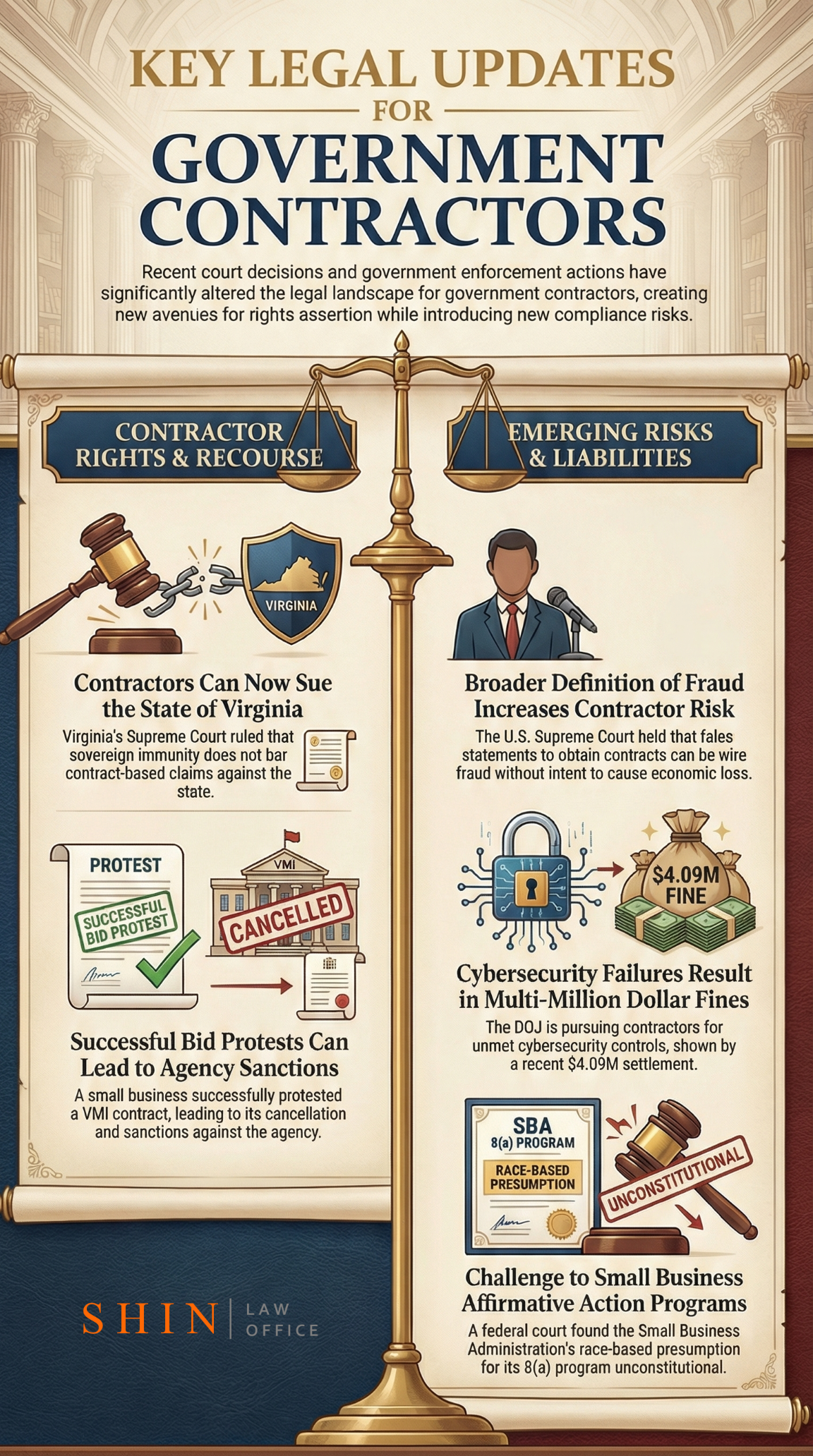
Table of Contents
1. Tysons Corner – A Hub for Government Contractors
Tysons Corner, VA, is often called the “Silicon Valley of Government Contractors.” This Northern Virginia business district hosts numerous small and mid-sized federal contractors supporting agencies such as the Department of Defense (DoD), the intelligence community, and civilian agencies. Its proximity to Washington, D.C., the Pentagon, and key intelligence facilities means many local businesses handle sensitive government projects, including classified programs that require cleared personnel. The concentration of defense and technology firms in Tysons has created a vibrant but highly regulated contracting ecosystem.
Real-World Context (Anonymized): For example, a small tech startup in Tysons (let’s call it “AlphaTech LLC”) quickly grew by winning a DoD software contract. However, the founder soon realized that succeeding as a government contractor required navigating a maze of rules – from the Federal Acquisition Regulation (FAR) to strict security clearance procedures for his employees. AlphaTech’s story reflects a common theme in Tysons Corner: companies must balance innovation with rigorous legal compliance to meet government standards.
Tysons contractors operate under intense scrutiny. Both federal and Virginia state laws govern their operations. While federal law governs most contracting issues, Virginia’s legal landscape also matters, especially when state or local public contracts are involved. Virginia prides itself on fair and open public procurement – the Virginia Public Procurement Act (VPPA) explicitly requires that “all procurement procedures be conducted in a fair and impartial manner” and that no qualified bidder “be arbitrarily or capriciously excluded”. In practice, this means contractors in the Commonwealth can expect competitive, transparent bidding processes – and they have legal recourse if they suspect unfair treatment (as we’ll see in later chapters).
2. Navigating the Legal and Regulatory Landscape
Government contracting is governed by a complex web of statutes and regulations. Contractors in Tysons Corner must understand and comply with rules at multiple levels:
- Federal Acquisition Regulation (FAR) and Agency Supplements: The FAR is the primary rulebook for federal contracts, covering everything from competition requirements to contract administration. Defense contractors must also follow the DFARS (Defense Federal Acquisition Regulation Supplement) for DoD-specific rules, and other agencies have their own supplements. Many Tysons companies hold GSA Schedule contracts, which come with unique clauses (e.g. pricing disclosures and the Price Reductions Clause) that must be scrupulously followed. Non-compliance with flow-down clauses (contract provisions that primes must pass to subcontractors) or other FAR requirements can lead to breaches and disputes. Common issues include failure to meet performance standards, missed delivery deadlines, improper invoicing, and noncompliance with quality and safety requirements.
- Small Business Programs and Recent Developments: Tysons is home to many small and emerging contractors, including those in the 8(a) program, service-disabled veteran-owned businesses, and other set-aside categories. These programs open doors to federal work but come with strict eligibility and compliance requirements. Recent legal developments have made waves in this area. In 2023, a federal court case Ultima Servs. Corp. v. USDA challenged the SBA’s 8(a) program, specifically its use of race-based presumptions for social disadvantage. The court, applying the logic of the U.S. Supreme Court’s Students for Fair Admissions (SFFA) decision, held that certain racial preference components in the 8(a) program violated equal protection. While that Tennessee decision is not binding nationwide, it signaled potential changes to how the 8(a) program operates. Contractors in programs like 8(a) or those utilizing Disadvantaged Business Enterprise (DBE) partners should stay alert: the legal definition of “social disadvantage” and set-aside eligibility criteria are evolving.
- Cybersecurity and Data Protection Requirements: In today’s environment, compliance isn’t just about paperwork – it’s also about cyber hygiene. Many Tysons contractors provide IT services or handle sensitive data, making them subject to regulations like NIST SP 800-171 standards for protecting controlled unclassified information and upcoming CMMC (Cybersecurity Maturity Model Certification) requirements for DoD contracts. Failing to implement required cybersecurity controls can lead to severe consequences. A recent example involved a Virginia-based federal contractor that settled allegations of False Claims Act violations arising from its knowing failure to meet cybersecurity contract standards. In that 2023 case, an Ashburn, VA company agreed to pay over $4 million after the Department of Justice (DOJ) alleged it did not fully implement three required cybersecurity controls on a GSA contract. The DOJ’s new Civil Cyber-Fraud Initiative makes it clear: if contractors misrepresent their cyber compliance or don’t report breaches, they can face fraud liability. For Tysons firms, this means investing in robust cybersecurity programs is not just IT best practice but a legal necessity.
- Ethics, Transparency, and Certifications: Federal contractors must also comply with laws on ethics and truthful disclosures. This includes certifying current, accurate and complete data in proposals (per the Truthful Cost or Pricing Data Act, formerly TINA) for certain contracts, avoiding conflicts of interest, and adhering to gift and hiring restrictions when interacting with government officials. Even seemingly minor missteps—such as a bid misrepresentation—can lead to accusations of fraud. In fact, the U.S. Supreme Court recently underscored this in Kousisis v. United States (2025). In Kousisis, a government contractor was convicted of wire fraud for false statements made to win a contract, even though the government agency suffered no financial loss. The Supreme Court held that fraudulent inducement (making false promises to obtain a contract) falls within the wire fraud statute, regardless of economic harm to the government. In plain terms, lying to get a contract is a crime, even if you perform the work well and at cost. The takeaway for Tysons Corner contractors: always be truthful and meticulous in bids and compliance certifications – the stakes include potential criminal liability.
Real-World Context (Anonymized): Consider “Beta Analytics Corp,” a fictitious Tysons-based data contractor. Beta Analytics landed a multi-agency IDIQ contract but struggled with the myriad compliance checks – from ensuring subcontractors met FAR flow-down clauses to keeping up with quarterly reporting requirements. At one point, a well-meaning project manager overstated the company’s compliance with a new cybersecurity mandate. That misrepresentation, though quickly corrected, triggered a government inquiry. Beta Analytics learned the hard way that in government contracting, credibility is everything – it invested in a comprehensive compliance training program to prevent even inadvertent false claims. This story echoes through Tysons: successful contractors build a culture of compliance, knowing that regulations are rigorously enforced.
3. Procurement Disputes and Bid Protests
Even with diligent compliance, disputes can arise in the competitive world of government procurement. Tysons Corner companies often find themselves either protesting a contract award or defending against a protest. Understanding the avenues for disputes and the legal standards involved is crucial:
- Federal Bid Protests: If a contractor believes a federal contract was awarded improperly – say, an agency failed to follow the solicitation criteria or overlooked a proposal – they can file a bid protest. Common protest forums are the Government Accountability Office (GAO) and the U.S. Court of Federal Claims. In the GAO, protests generally must be filed within 10 days of knowing the basis of the protest, or before award in certain cases of solicitation improprieties. Bid protests in the GAO are typically resolved within 100 days. Tysons contractors frequently use these mechanisms to ensure fairness in award decisions, given the region’s high volume of contracts. While many protests are denied, the mere process can lead agencies to take corrective action. Importantly, small businesses have additional recourse: for example, a company can challenge the awardee’s size or status (8(a), HUBZone, etc.) via the SBA’s Office of Hearings and Appeals if it suspects a competitor is misrepresenting its eligibility.
- State and Local Contract Disputes: In Virginia, state and local government contracts are governed by the VPPA and related regulations. If a Virginia agency (or public university, etc.) makes an arbitrary or unlawful contract award, an aggrieved bidder can file a protest and potentially sue in state court for injunctive relief. However, unlike federal contracts, monetary damages for disappointed bidders are not available in Virginia – the usual remedy is cancellation of the contract or a re-bid. A recent Virginia case illustrates this well. In Center for Applied Innovation, LLC v. Virginia Military Institute (2023), a small consulting firm in Lexington, VA protested a public contract award for diversity training services. The firm alleged that VMI’s award decision was arbitrary and capricious and violated the VPPA’s requirements. During litigation, VMI chose to abandon the challenged procurement rather than continue defending it. Notably, the court imposed sanctions on VMI for making false representations during the case, ordering the institute to pay the protesting contractor’s attorney fees. The contractor ultimately got what it wanted – the improper award was nullified – but the “victory” was the opportunity to compete again, not a windfall of lost profits. This story (with names changed here) shows that Virginia courts will intervene when a public body violates procurement laws, but only to ensure fairness, not to award damages. As the VPPA declares, the goal is that “no offeror be arbitrarily or capriciously excluded” from a fair competition.
- Contract Performance Disputes: Once a contract is awarded, performance can give rise to disputes. Federal contracts have built-in dispute processes under the Contract Disputes Act – typically, a contractor must file a claim with the Contracting Officer and can appeal to boards like the Armed Services Board of Contract Appeals (ASBCA) or to the Court of Federal Claims. Common performance disputes include disagreements over scope, schedule delays, or payment (e.g., if the government withholds payment due to alleged non-compliance). In Northern Virginia’s fast-paced contracting scene, an all-too-common scenario is a subcontractor dispute: for instance, a Tysons prime contractor withholding payment from a sub claiming the sub’s work was deficient, or a subcontractor claiming the prime didn’t flow down a modification. Many contracts also require strict compliance with notice provisions – a contractor who misses a deadline to notify the government of a change or claim can lose the right to compensation. Virginia law similarly emphasizes the need to follow contractually agreed-upon dispute steps. Practical tip: Always document performance issues and communicate formally. One of the biggest mistakes Virginia companies make is continuing performance without protest or documentation when the other party is in breach – this can be interpreted as a waiver of the breach. In the words of one legal guide, Northern Virginia businesses sometimes “rely on verbal assurances instead of formal notices” due to close relationships, but later find that courts will hold them to the contract’s written terms.
- Sovereign Immunity and the State as a Party: When the dispute is with a government entity, unique issues arise. Sovereign immunity can limit lawsuits against the government. However, Virginia has carved out clear waivers of immunity in contract cases. In 2024, the Supreme Court of Virginia issued a landmark decision in Montalla, LLC v. Commonwealth. In that case, a contractor (Montalla) sued the Virginia Department of Transportation (VDOT), seeking to rescind a settlement and claim breach of contract after a contentious payment dispute. The lower courts dismissed the suit, finding it barred by sovereign immunity because the contractor sought “equitable” relief (rescission of a settlement) rather than money damages. But the Virginia Supreme Court reversed, holding that sovereign immunity “has no application in actions based upon valid contracts” entered by the state’s agents. It didn’t matter that the contractor’s lawsuit asked for non-monetary remedies – what mattered was the nature of the dispute was contractual. The court emphasized that if the state enters into a valid contract, it cannot use immunity to avoid claims arising from that contract. For Tysons Corner businesses contracting with Virginia agencies, Montalla is reassuring: the Commonwealth must answer for its contractual commitments, and even innovative legal theories (like suing to void a settlement for duress) will get their day in court if they stem from a state contract. The legal landscape now clearly confirms that Virginia contractors can overcome sovereign immunity when litigating valid contract disputes with the state.
Real-World Context (Anonymized): Picture “Gamma Engineering,” a Tysons-based construction firm that took on a VDOT project. Midway, a billing dispute arises – VDOT refuses to pay certain charges citing a federal regulation, and the company feels cornered into a low settlement. After learning about the Montalla case, Gamma’s owners realize they have leverage: if the state isn’t honoring the deal in good faith, they can fight back in court without being shut down by immunity. They reopen negotiations, armed with Virginia Supreme Court precedent, and ultimately get a fair resolution. The lesson for contractors is clear – know your rights in disputes. Whether it’s protesting a bad award decision or enforcing a contract’s terms, the law provides tools to ensure fairness. The key is to act timely (don’t sleep on protest deadlines or claim notice requirements) and gather evidence (documents, emails, and more) so you can make a strong case if needed.
4. Security Clearance Challenges
Tysons Corner’s government contracting community is deeply intertwined with the national security sector. Many contracts, especially with DoD, intelligence agencies, or homeland security, require companies (and their employees) to hold security clearances (Confidential, Secret, Top Secret, and specialized accesses such as SCI). Maintaining security clearances is often mission-critical for these businesses – yet the clearance process introduces unique legal challenges and risks.
Why Clearances Matter: If a key employee loses their clearance, they may be unable to work on the project, potentially leaving the contractor in breach if no replacement is available. If a company loses its facility clearance (the organization’s authorization to handle classified info), it can be barred from classified contracts altogether. Thus, clearance issues can quickly become existential threats to a contracting firm’s performance and reputation.
The Clearance Process and Pitfalls: Clearances are granted by the government after background investigations and adjudications under guidelines covering areas like allegiance, foreign influence, financial responsibility, drug use, etc. In Tysons, it’s common for even non-defense firms to need some cleared staff, since contracts often involve sensitive government data. The process is rigorous and doesn’t end once a clearance is granted – employees undergo reinvestigations periodically and must report life changes (foreign travel, new contacts, financial troubles).
For example, financial problems (like heavy debt or bankruptcy) are a leading cause of clearance denials or revocations, on the theory that they make one susceptible to coercion. A hypothetical “Delta Security Solutions” in Tysons learned this when their lead engineer’s clearance was revoked due to significant gambling debt. Suddenly, Delta Security had a personnel crisis. They had to pull the engineer off a contract immediately and navigate the clearance appeal process to try to reinstate him.
Limited Legal Recourse: One striking aspect of clearance law is that normal judicial review does not apply. Security clearance decisions are considered the purview of the Executive Branch for national security reasons. The U.S. Supreme Court in Department of the Navy v. Egan (1988) established that courts generally cannot second-guess clearance denials or revocations, even if the individual claims it’s unfair. In a recent case, a plaintiff tried to circumvent this rule by framing a clearance revocation as religious discrimination under Title VII, but the court still found Egan barred the claim – even an injunction against future discrimination would “require review of a security clearance decision,” which “Egan flatly prohibits”. In other words, if your clearance is denied or pulled, you cannot sue in court to get it back. The only remedy is the administrative appeal within the agency.
Administrative Appeals: Each agency has its own appeals process for clearance. Many Tysons contractors deal with the DoD’s clearance process, which involves the Defense Office of Hearings and Appeals (DOHA) for contractor personnel. If DoD proposes to deny or revoke a clearance, the individual gets a Statement of Reasons (SOR) outlining concerns and can respond in writing and request a hearing before an administrative judge. Evidence can be presented (e.g., mitigating circumstances, character letters), and a decision is made whether to grant or deny clearance. Similarly, intelligence agencies (such as the NSA or CIA) have their own processes – often a multi-tier review with a final appeal to an internal panel. These proceedings are non-public and confidential due to the sensitive information involved.
In the Delta Security scenario, the engineer appealed through DOHA, providing evidence of a debt-repayment plan and financial counseling to demonstrate he had mitigated the concern. Many contractors in Tysons have faced such behind-closed-doors battles to save an employee’s clearance (and their project). Companies often engage specialized security clearance attorneys to help navigate this process because the arguments require aligning with the Adjudicative Guidelines (e.g., showing that foreign contacts are minimal, or that past drug use was an isolated incident and won’t recur, etc.).
Proactive Measures: Since waiting for a clearance problem to arise can be fatal to contract performance, savvy government contractors take proactive steps. This includes:
- Pre-screening and monitoring: Many firms do preliminary background checks to flag issues before sponsoring someone for a clearance. They also encourage employees to self-report potential issues early (for instance, if someone is facing financial hardship or gets arrested for a DUI, addressing it upfront is better than letting it emerge during a polygraph or reinvestigation).
- Maintaining backup personnel: It’s wise to have more than one person cleared for key roles or have subcontractor/consultant options, so if one clearance falls through, the work doesn’t stop.
- Facility Clearance Compliance: For companies, maintaining a facility clearance means appointing a Facility Security Officer (FSO), following the National Industrial Security Program Operating Manual (NISPOM) rules, and ensuring all classified handling is by the book. A security violation (like mishandling classified info) could jeopardize the company’s clearance status. Tysons contractors often invest heavily in security training and infrastructure (secure rooms, IT systems, etc.) to avoid any clearance-related violations.
Real-World Context (Anonymized): “Epsilon Analytics”, a fictional Tysons firm working on an intelligence analysis contract, faced a scare when one of its analysts posted something on social media that raised a red flag. The post was innocuous but mentioned frustration with a client (a government agency). This led to a security review. While the analyst ultimately kept her clearance (after counseling and demonstrating a clear understanding of social media policies), the incident prompted Epsilon to tighten its internal policies. They introduced annual briefings on clearance obligations and even social media dos and don’ts for cleared staff. This illustrates how cultural awareness and training within a company can be as important as legal know-how. In Tysons Corner, where a casual slip could be viewed through a national security lens, businesses have learned that security compliance is a daily discipline.
5. Strategic Risk Management and Best Practices
With the myriad of legal challenges discussed – regulatory compliance, bid disputes, clearance issues – how can government contractors in Tysons Corner succeed? The answer lies in strategic risk management and in adopting best practices gleaned from both the law and others’ hard-earned experience. This final chapter provides an overview of strategies and actionable tips:
1. Build a Culture of Compliance: It’s often said that compliance should be part of a contractor’s DNA. For Tysons contractors, this means educating your workforce on key rules that apply to their jobs. Regular training sessions on topics such as ethics in contracting, cybersecurity protocols, Timekeeping and billing accuracy, and handling sensitive information can prevent violations before they occur. Companies should implement internal controls and compliance programs similar to those in larger firms. This isn’t just bureaucratic overhead – it’s a safety net. In fact, DOJ officials have repeatedly noted that strong compliance programs can lead to leniency in enforcement. For instance, the DOJ gives credit to companies with robust compliance when resolving investigations. A solid compliance program is like insurance – it may reduce penalties or even prevent a violation from escalating into a legal case.
2. Stay Informed on Legal Updates: The legal landscape for government contracting is dynamic. We’ve highlighted recent cases like Montalla (2024) and Kousisis (2025) that directly affect contractors’ rights and risks. It’s important for businesses (and their legal counsel or compliance officers) to stay up to date on new regulations and court decisions. For example, each year the National Defense Authorization Act (NDAA) brings changes – from raising acquisition thresholds to imposing new requirements (like supply chain security or restrictions on using certain foreign technologies). In 2023-2024, contractors grappled with changes such as the ban on TikTok on devices used in federal contracts and new Buy American Act rules increasing U.S.-content requirements. A Tysons contractor with GSA Schedule contracts might need to adjust pricing strategies if rules change, or a defense contractor might need to implement new cybersecurity measures as they become mandatory. Subscribe to industry newsletters, attend local government contract lawyers’ briefings (Tysons has several), and consider joining professional groups (such as the Northern Virginia Technology Council or govcon industry associations) to stay on top of the pulse.
3. Use Expert Advice Strategically: While day-to-day compliance is often handled in-house, don’t hesitate to seek outside counsel or consultants when specialized issues arise. For instance, if facing a potential False Claims Act issue (maybe a billing error that could be construed as overbilling), consulting a government contracts attorney early can help you decide whether to disclose it to the government and mitigate liability. Likewise, if an employee’s clearance is at risk, a lawyer experienced in clearance law can guide written responses and prepare for hearings, significantly improving the chances of a favorable outcome. The cost of prevention is far less than the cost of litigation or lost contracts. As one Tysons CEO quipped (after a painful protest loss he might have avoided with better advice), “I’d rather pay lawyers to keep me out of trouble than to get me out of trouble.”
4. Document and Implement Internal Procedures: Treat compliance and risk management as formal parts of your business processes. This could mean having standard operating procedures (SOPs) for proposal development (with a compliance checklist to ensure all certifications are reviewed), for contract kickoff (team meeting to review key clauses and deliverable timelines), and for handling government interactions (like how to respond to a contracting officer’s request or a government audit). Documenting and enforcing these procedures provides consistency. It also protects you; for example, if an issue arises, being able to show you had a policy and training in place can demonstrate any lapse was an anomaly, not willful misconduct. Consider conducting periodic internal audits – perhaps an annual mock compliance audit – to identify and address weaknesses. Small businesses might think this is only for big primes, but even a two-day self-audit of, say, timesheets and expense claims can catch problems before a Defense Contract Audit Agency (DCAA) audit ever does.
5. Learn from (Anonymized) Stories: Nothing drives home lessons like real scenarios. Throughout this article, we’ve shared anonymized versions of actual cases and client stories: a contractor challenging an unfair award and getting it canceled, a company pushed into settling with a state agency and later fighting back, firms entangled in clearance dilemmas, and more. These accounts show that mistakes happen even to well-intentioned businesses, and that the law provides remedies but only for those who assert their rights properly. Make these stories part of your team’s learning. For example, in staff meetings or newsletters, include a “lesson learned” segment: one month you might discuss a case of an overbilling False Claims Act settlement (to remind everyone why accurate billing matters), another month discuss a bid protest outcome (to illustrate why attention to detail in proposals is critical), and so on. By normalizing this continuous learning, you create an organization that’s always anticipating risks rather than reacting to them.
Finally, be mindful that Tysons Corner’s government contracting community, while large, is tightly knit. Reputation travels fast. Companies known for ethical practices, reliability, and compliance will find it easier to win business and form partnerships. On the flip side, a compliance scandal or a pattern of protests against you can tarnish your brand. Thus, good legal compliance is not just about avoiding fines or jail – it’s about building a trusted business that agencies want to work with.
Conclusion (BLUF Revisited): In summary, government contracting in Tysons Corner offers tremendous opportunity at the intersection of federal missions and private innovation. But those opportunities come bundled with significant regulatory responsibilities. By staying informed about laws and recent case developments, fostering a compliance-oriented culture, and proactively managing risks (from bid formation to project execution to security clearances), contractors can not only avoid pitfalls but turn compliance into a competitive advantage. The bottom line is that legal compliance and strategic risk management are as critical to success as technical expertise or competitive pricing in this arena.
With the right approach, Tysons Corner businesses can navigate procurement mazes, stand on solid legal ground in any dispute, protect their security clearances, and thrive in serving the government’s needs — all while sleeping better at night knowing they are on the right side of the rules.

Principal Attorney | Shin Law Office
Call 571-445-6565 or book a consultation online today.
(This article is provided for general informational purposes and does not constitute legal advice. For advice on your specific situation, consult with a licensed Virginia attorney.)
References
- Code of Virginia § 2.2-4300 (2026). Virginia Public Procurement Act – Purpose. (Virginia law mandating fair and impartial public procurement procedures.)
- Montalla, LLC v. Commonwealth, 303 Va. 150, 900 S.E.2d 290 (2024). (Virginia Supreme Court case allowing contractor’s suit against VDOT to proceed, holding that sovereign immunity does not bar contract-based claims against the state.)
- Center for Applied Innovation, LLC v. Virginia Military Institute, No. CL22-215 (Va. Cir. Ct. Oct. 4, 2023). (Virginia state court case in which a small business successfully protested a VMI contract award, leading to the contract’s cancellation and sanctions against the agency.)
- Kousisis v. United States, 145 S. Ct. 1382 (2025). (U.S. Supreme Court decision holding that wire fraud under 18 U.S.C. § 1343 does not require intent to cause economic loss, applied to a contractor’s false statements to obtain government contracts.)
- Ultima Services Corp. v. U.S. Dept. of Agriculture, No. 2:20-CV-00041 (E.D. Tenn. July 19, 2023). (Federal court decision extending the Supreme Court’s SFFA affirmative action reasoning to the 8(a) small business program, finding the SBA’s race-based presumption unconstitutional.)
- U.S. Department of Justice, Office of Public Affairs. (2023, September 5). Cooperating Federal Contractor Resolves Liability for Alleged False Claims Caused by Failure to Fully Implement Cybersecurity Controls [Press release]. (DOJ Civil Cyber-Fraud Initiative case – Verizon Business Network Services LLC settlement for $4.09M related to unmet cybersecurity requirements.)
- Venable LLP (Insights). (2024, May 9). Virginia Contractors Can Overcome Sovereign Immunity and Sue the State Government, Even Where the Remedy Is “Equitable” Relief (Analysis of Montalla v. Commonwealth decision).
- Virginia Lawyers Weekly. (2024, January 21). VMI sanctioned in suit over abandoned procurement — $15,286.49 verdict. (News article summarizing the CAI v. VMI case and its outcome under the Virginia Public Procurement Act.)
- Womble Bond Dickinson (US) LLP. (2025). Recent Supreme Court Activity with Major Implications for Government Contractors. (Client alert discussing cases like Kousisis and their impact on government contract liability and defenses.)
- Berry & Berry, PLLC. (2023, September 7). Representing government contractors before the NSA in security clearance cases. FFXnow. (Sponsored column outlining the NSA’s security clearance appeals process for contractors.)
- Shin, A. I. (n.d.). The Truth About Contract Disputes: How Virginia Companies Fight Back. Shin Law Office (blog). (Practical guide on common breach scenarios and litigation strategies for Virginia businesses, including government contract disputes.)