
Bottom Line Up Front (BLUF)
If you lose a civil case in Fairfax Circuit Court, the appeal process is deadline-driven and record-driven. You start the appeal in Fairfax, but you prosecute it in Richmond, and a missed step can end the case before the Court ever reaches the merits.
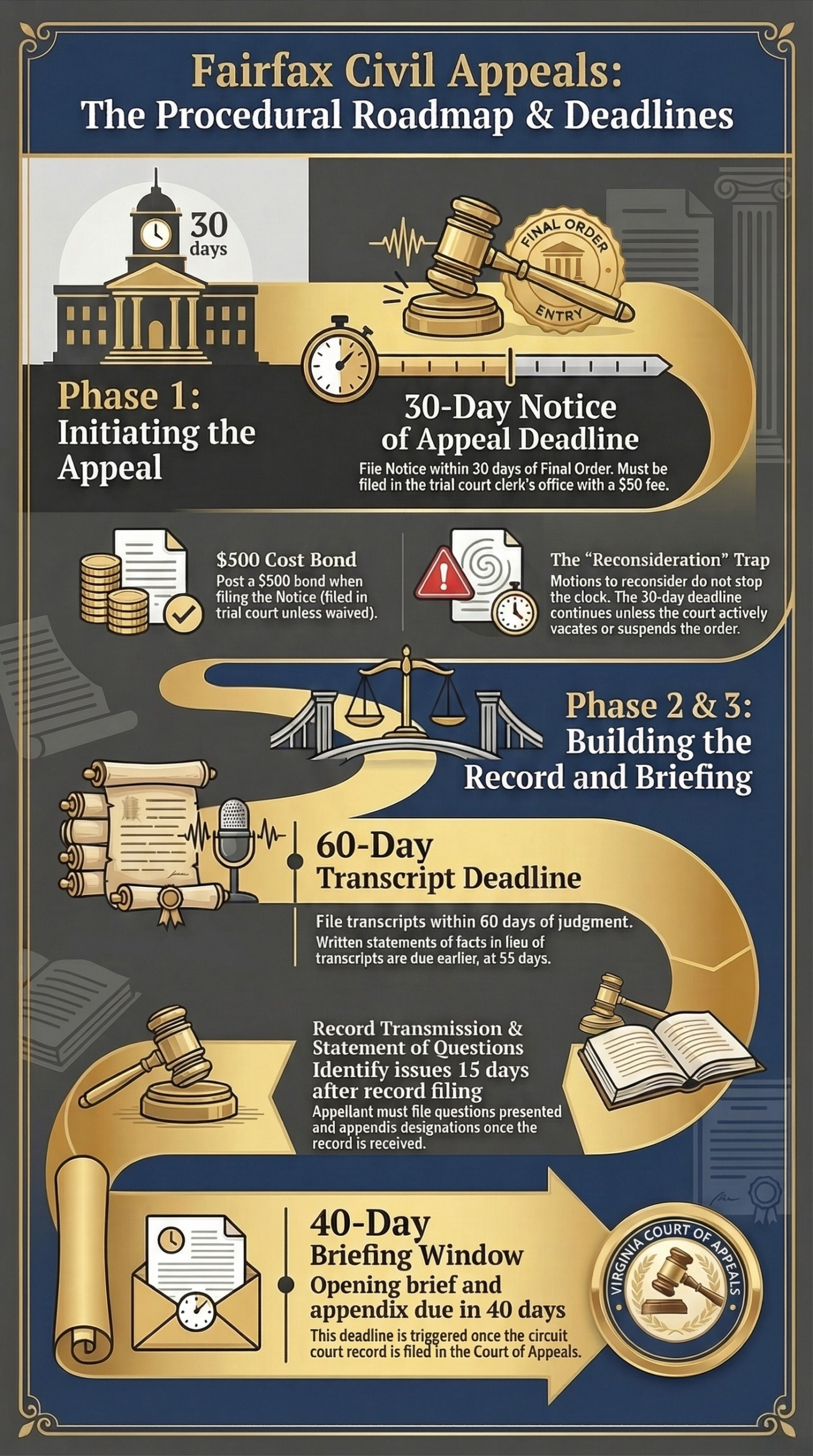
Table of Contents
What court hears a Fairfax civil appeal
Court of Appeals of Virginia is the usual first stop
Virginia expanded appellate jurisdiction so most civil appeals from circuit court go to the Court of Appeals as a matter of right, rather than requiring a petition process.
The Notice of Appeal is filed in Fairfax
Fairfax Circuit Court directs civil Notices of Appeal for the Court of Appeals to be filed with its Case Status Team in Suite 321.
The appeal timeline at a glance
The clock starts at entry of the final order
Your key deadlines are calculated from the entry date of the final judgment or other appealable order.
The big deadlines most people miss
- Notice of Appeal due in 30 days.
- Cost bond due when the Notice of Appeal is filed, typically $500 unless reduced or waived for indigency.
- Transcript due in 60 days after entry of final judgment, with extensions only by the Court of Appeals if properly requested.
- Written statement of facts in lieu of transcript due in 55 days after entry of judgment in the Fairfax civil guide.
- Statement of questions presented and designation of appendix contents due within 15 days after the record is filed in the Court of Appeals.
- Opening brief and appendix due 40 days after the circuit court record is filed in the Court of Appeals.
Phase 1: Start the appeal in Fairfax Circuit Court
Step 1: Confirm appealability and the order you are appealing
An appeal usually starts from a final judgment, but some orders are appealable earlier. If you appeal the wrong order or miss the appealable event, jurisdiction can fail.
Step 2: File the Notice of Appeal in Fairfax within 30 days
The Notice of Appeal must be filed with the clerk of the trial court within 30 days after entry of the final judgment or other appealable order or decree. Fairfax’s civil appeal checklist restates this deadline and confirms the original Notice is filed in the trial court clerk’s office.
Step 3: Serve copies and send a courtesy copy to the Court of Appeals with the filing fee
Fairfax’s civil appeal checklist states a copy of the Notice must be mailed or delivered to opposing counsel and to the Clerk of the Court of Appeals, and the copy sent to the Court of Appeals must include a $50 filing fee.
Step 4: File the cost bond when you file the Notice of Appeal
The Fairfax civil appeal checklist states that the bond for costs is due when the Notice of Appeal is filed with the trial court clerk’s office and lists the amount as $500 unless reduced or waived for indigency.
Step 5: Do not assume a motion to reconsider stops the appeal clock
The Court of Appeals self-represented guide warns that the 30-day Notice of Appeal period continues to run even if a motion to reconsider is filed, unless the circuit court vacates or suspends the final order, so the safer approach is to protect the Notice deadline.
Phase 2: Build the record and lock in the issues
The record controls the appeal
The Court of Appeals decides the issues you raise based on the circuit court record, not on new evidence or new arguments that were not preserved.
Step 1: Order and file transcripts on time
The Fairfax civil appeal checklist states transcripts must be filed in the trial court clerk’s office within 60 days after entry of final judgment, and it notes that any extension requires a motion to a judge of the Court of Appeals filed within that same 60 day window.
Step 2: Give the required transcript filing notice
Fairfax’s checklist states that within 10 days of filing the transcript, written notice must be sent to all counsel or parties stating the date the transcript was filed, and a copy of that notice must be filed with the trial court.
Step 3: Use a written statement of facts if no transcript is available
Fairfax’s checklist states that a written statement of facts in lieu of transcript must be filed within 55 days after entry of judgment appealed, and Rule 5A:8 governs the details. This is often the difference between having a viable record and having an appeal that cannot be won.
Step 4: Watch for objections and hearings on statements of fact
Rule amendments effective March 17, 2025 address timing and hearing procedures for objections and judicial handling of transcript or statement issues, which matters when the parties disagree about what the record should contain.
Step 5: Record transmission and filing in the Court of Appeals
Fairfax’s checklist explains the trial court clerk transmits the record to the Court of Appeals and the Court of Appeals clerk notifies the parties of the date the record was filed, which triggers the next set of deadlines.
Phase 3: Briefing, appendix, and argument in the Court of Appeals
Step 1: File the questions presented and designate appendix contents
Fairfax’s checklist states the appellant must file a statement of questions presented and designation of the contents of the appendix no later than 15 days after the record is filed.
Step 2: File the opening brief and appendix on the 40 day deadline
Fairfax’s checklist states the opening brief and appendix are due 40 days after the circuit court record is filed in the Court of Appeals. The Court of Appeals also publishes an appellate process guide that ties the opening brief due date to the record’s receipt and explains that a paper record requires an appendix with the opening brief.
Step 3: Expect oral argument unless it is waived or the Court summarily affirms
Fairfax’s checklist states oral argument is automatically scheduled unless counsel waives it in writing or the Court summarily affirms under its rules.
What the Court can do
The Court can affirm, reverse, vacate, modify, or remand. What you ask for should match the legal error and the record support.
Common failure points I see in Fairfax civil appeals
Missing the 30 day Notice deadline
This is the fastest way to lose an appeal before it starts.
Failing to post the cost bond when required
The Court of Appeals guide warns that failure to file an appeal bond when required can result in dismissal, and Fairfax’s checklist ties the bond to the Notice filing date.
Trying to argue facts without a transcript or statement of facts
If the record cannot support your assignment of error, the appeal becomes argument without proof.
Overloading the appeal with too many issues
Appellate judges do not reward volume. A focused set of outcome moving legal errors almost always performs better than a long list of complaints.
Waiting too long to plan the appendix and questions presented
Fairfax’s checklist imposes a 15 day deadline tied to record filing. If you do not plan early, you will rush, and rushed appellate work is expensive and risky.
Summary
A Fairfax civil appeal to the Virginia Court of Appeals is a structured process with strict deadlines. File the Notice of Appeal in Fairfax within 30 days, file the cost bond at the same time, build the record with transcripts or a proper written statement of facts, then brief and append on the deadlines triggered by the record’s filing in the Court of Appeals.

Principal Attorney | Shin Law Office
Call 571-445-6565 or book a consultation online today.
(This article is provided for general informational purposes and does not constitute legal advice. For advice on your specific situation, consult with a licensed Virginia attorney.)
References
- Fairfax County Circuit Court. (2026). Court of Appeals of Virginia: Civil appeals procedure (CCR A 15b, February 2026) [PDF]. Fairfax County Government.
- Fairfax County Circuit Court. (n.d.). Appeal procedures: Civil case information. Fairfax County Government.
- McGuireWoods LLP. (2021, June 30). Big changes ahead for civil appeals in Virginia.
- Supreme Court of Virginia. (n.d.). Rule 5A:6, Notice of appeal [PDF]. Virginia’s Judicial System.
- Supreme Court of Virginia. (2025, January 15). Amendments to Rules 1:17, 1:27, 5:11, and 5A:8 (effective March 17, 2025) [PDF]. Virginia’s Judicial System.
- Virginia Court of Appeals. (2025, March 3). A guide to self representation in the Court of Appeals of Virginia [PDF]. Virginia’s Judicial System.