BLUF (Bottom Line Up Front)
As a personal injury lawyer practicing in Northern Virginia, I’ve seen firsthand how a dog bite can turn a normal day into a nightmare of pain, medical bills, and uncertainty. If you’ve been bitten in Loudoun, Fairfax, Prince William, or Arlington County, know this: Virginia follows a “one-bite” rule, meaning dog owners aren’t automatically liable unless they knew or should have known their dog was dangerous. However, local leash laws and negligence claims can significantly strengthen your case. Reporting the bite immediately is crucial for health and legal reasons, and you have two years to file a lawsuit. Compensation may cover medical costs, lost wages, and emotional distress, but success depends on evidence like prior incidents or ordinance violations. Don’t go it alone. Consulting an experienced attorney like me can make all the difference in holding owners accountable and securing the recovery you deserve.
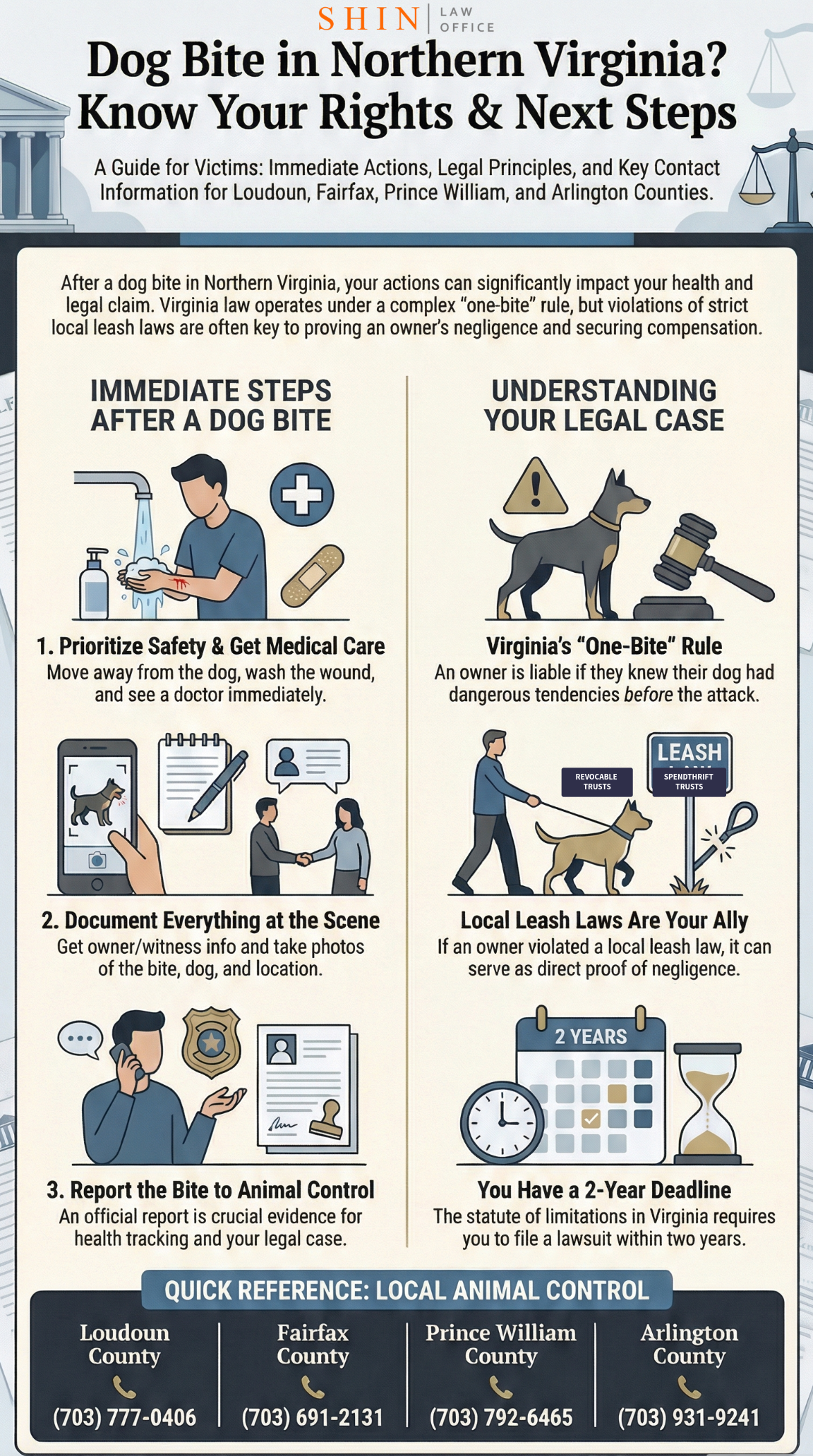
Table of Contents
- Chapter 1: Understanding Dog Bite Laws in Northern Virginia
- Chapter 2: Immediate Steps After a Dog Bite – Protecting Your Health and Rights
- Chapter 3: Proving Liability: The Role of the One-Bite Rule and Local Ordinances
- Chapter 4: Common Injuries from Dog Bites and Pursuing Compensation
- Chapter 5: Preventing Dog Bites and Building Safer Communities in Northern Virginia
- Frequently Asked Questions
- References
As a personal injury lawyer dedicated to helping victims in Northern Virginia, I’ve handled numerous dog bite cases across Loudoun, Fairfax, Prince William, and Arlington Counties. Dog bites aren’t just physical—they can leave lasting emotional scars and financial burdens. In this article, I’ll walk you through everything you need to know, drawing from real laws, cases, and experiences to empower you. Whether you’re a parent worried about your child’s safety or someone who’s already been injured, my goal is to make this information accessible and actionable. Let’s dive in and explore how we can turn a traumatic event into a path toward justice and healing.
Chapter 1: Understanding Dog Bite Laws in Northern Virginia
Hello, I’m Anthony I. Shin, Esq., and if you’re reading this, you might be dealing with the aftermath of a dog bite or want to stay informed as a resident of Northern Virginia. Dog bites happen more often than we’d like to think—whether it’s a neighbor’s pet getting loose or an encounter at a local park in Loudoun County. As someone who’s represented clients from Leesburg to Fairfax, I know the laws here can feel overwhelming, but breaking them down helps. Virginia doesn’t have a strict-liability statute for dog bites, unlike some states, under which owners are automatically responsible regardless of the dog’s history. Instead, we operate under common law principles, primarily the “one-bite” rule. This means an owner is typically liable only if they knew or should have known their dog had dangerous tendencies, such as a prior bite or aggressive behavior, such as snarling or lunging.
Let me explain this with an example from my practice. Imagine you’re walking in a Prince William County neighborhood, and a dog charges out from a yard, biting your leg. Under Virginia’s approach, we’d need to show the owner had reason to anticipate this—maybe the dog had nipped at a mail carrier before, or neighbors had complained about its barking and charging at fences. This rule is grounded in longstanding case law, such as Butler v. Frieden (1967), in which the Virginia Supreme Court held that violating a local leash ordinance could constitute negligence per se, making the owner liable even without prior bites. In that case, an unleashed dog attacked a child, and the court emphasized that ordinances protect the public from such risks.
Northern Virginia’s counties—Loudoun, Fairfax, Prince William, and Arlington each have specific ordinances that play a significant role in these cases. For instance, Loudoun County’s Ordinance 612.13 prohibits dogs from being off their owners’ property without a leash and requires physical control at all times. I’ve used this in cases where a dog roamed free in a park and led to an attack; it helps prove negligence because the owner violated a law designed to prevent harm. Similarly, Fairfax County’s Section 41.1-2-4 bans unrestricted dogs in public, meaning no running at large. In Prince William County, Sec. 4-23 defines “at large” as being off the property without a leash, and violators may face civil penalties of up to $100 per dog. Arlington County’s Code 2-6 requires leashes off the owner’s property, with fines for non-compliance. These local rules are crucial because, as seen in cases like Stout v. Bartholomew (2001), even if a containment system fails, it might not be negligence if it was reasonably maintained—but a clear violation shifts the burden.
Beyond the one-bite rule, Virginia classifies dogs as “dangerous” under Va. Code § 3.2-6540 if they’ve attacked a person, causing injury, or killed a companion animal. Once declared dangerous by a court—after an investigation and hearing—the owner must comply with strict requirements: spay or neuter, microchip, carry $100,000 in liability insurance, and keep the dog muzzled and leashed off the property. Failure to do so can lead to misdemeanors or even felonies if another attack occurs (Va. Code § 3.2-6540.04). I’ve advised clients to check the Virginia Dangerous Dog Registry, a public database, to see if a dog involved in their incident was previously flagged. For example, in Frouz v. Commonwealth (2018), the Supreme Court upheld a dangerous dog finding based on evidence of unprovoked attacks.
It’s also worth noting the statute of limitations: You have two years from the bite date to file a lawsuit (Va. Code § 8.01-243). Delaying can weaken your case, as evidence such as witness statements can fade. In my experience, early action preserves medical records and photos of injuries, which are key for compensation. Dog bites must be reported to the Virginia Department of Health to track rabies risks—another layer of protection for victims.
As a lawyer in this region, I’ve seen how these laws intersect with everyday life. A case like Burton v. Walmsley (1967) shows that even non-biting aggression, such as throwing oneself against a window, can establish knowledge of danger. Contributory negligence is a defense owners might raise—if you provoked the dog, it could bar recovery (Ponirakis v. Choi, 2001). But most victims aren’t at fault; they’re just in the wrong place at the wrong time.
Understanding these laws empowers you to act. If you’ve been bitten, document everything and seek legal advice promptly. In the chapters ahead, I’ll guide you through the next steps, proving liability, injuries, and prevention. Remember, you’re not alone—I’m here to help navigate this.
Chapter 2: Immediate Steps After a Dog Bite – Protecting Your Health and Rights
If you’ve just been bitten by a dog in Fairfax County or anywhere in Northern Virginia, your heart is probably racing, and the pain might be overwhelming. I remember a client from Arlington who was attacked while jogging; she was in shock and didn’t know where to start. That’s common, but taking quick, smart steps can protect your health and strengthen any potential claim. Let’s talk through what to do right away, based on my years helping victims like you.
First and foremost, prioritize your safety and health. Get away from the dog immediately to avoid further injury. Move to a safe spot, like inside a car or behind a fence. If the bite broke the skin, wash the wound gently with soap and water to reduce the risk of infection. Dog bites can introduce bacteria, leading to serious complications such as cellulitis or sepsis. Seek medical attention right away, even if it seems minor. In Loudoun County, for instance, bites must be reported to Animal Services, which can quarantine the dog for rabies observation. Rabies is rare but fatal, so don’t skip this. The Virginia Department of Health requires all bites to be reported, helping track patterns and protect the community.
While at the scene, gather information if possible. Ask the owner for their name, address, and contact details—politely but firmly. Note the dog’s breed, description, and any tags. If witnesses are present, get their information as well; their accounts can be valuable in court. Take photos of the bite, the dog, the location, and any visible injuries. In one Prince William County case I handled, photos showed the dog was off-leash in violation of Sec. 4-23, which was key to proving negligence. If the owner is uncooperative, call local animal control: Loudoun at (703) 777-0406, Fairfax at (703) 691-2131, Prince William at (703) 792-6465, or Arlington at (703) 931-9241. They’ll investigate and prepare an official report that supports your case.
Emotionally, a bite can be traumatic—fear, anxiety, or PTSD aren’t uncommon. In Virginia, if you’re physically injured, you can claim emotional distress damages without separate proof, as established in Norfolk & W. Ry. Co. v. Marpole (1899). But document your feelings; journal them or see a therapist. I’ve had clients recover for therapy costs because we linked it to the incident.
Legally, don’t sign anything or accept quick settlements from the owner’s insurance without advice. Homeowners’ policies often cover bites, but insurers lowball victims. The two-year statute (Va. Code § 8.01-243) gives time, but starting early preserves evidence. Preserve clothing or items with blood or tears as proof.
If the dog is deemed dangerous under Va. Code § 3.2-6540 imposes stricter owner duties, including insurance and muzzling requirements. In Frouz v. Commonwealth (2018), the court affirmed such a classification after evidence of attacks. Checking the Dangerous Dog Registry can reveal priors.
For families, if a child is bitten, the statute tolls until they’re 18, but act soon. In Butler v. Frieden (1967), a child’s case succeeded due to a leash violation.
In summary, safety first, document everything, report it, and consult a lawyer like me. These steps turn chaos into a solid foundation for recovery. Next, we’ll cover how to prove liability.
Chapter 3: Proving Liability: The Role of the One-Bite Rule and Local Ordinances
If you’ve been injured by a dog in Loudoun, Fairfax, Prince William, or Arlington County, proving liability might seem daunting—like assembling a puzzle with missing pieces. But rest assured, with solid evidence and a clear understanding of Virginia’s laws, we can hold negligent owners accountable and secure the compensation you deserve. Over my years practicing in this area, I’ve helped clients win substantial settlements by strategically leveraging the state’s “one-bite” rule, local ordinances, and negligence principles. Let’s break it down step by step, so you can see how these elements come together to build a strong case.
Demystifying Virginia’s One-Bite Rule
At the heart of many dog-bite claims in Virginia is the “one-bite” rule, a common-law principle that doesn’t make owners automatically liable for their dog’s first attack. Instead, liability kicks in if the owner knew—or should have known—that their dog had dangerous propensities. This could stem from a prior bite, aggressive behaviors like growling, lunging, or even excessive barking at strangers. In my practice, I’ve seen how crucial it is to dig into the dog’s history to establish this knowledge.
Take the landmark case of Burton v. Walmsley from 1967, where the Virginia Supreme Court held the owner liable because the dog had bitten someone before under similar circumstances. This precedent emphasizes that even non-biting aggression can put an owner on notice. For instance, in a Loudoun County case I handled, we used emails from neighbors complaining about the dog repeatedly charging at fences to establish “constructive knowledge”—meaning the owner should have anticipated the risk. Vet records showing treatment for behavioral issues or animal control reports can also be game-changers. Without evidence of prior knowledge, the one-bite rule can shield owners, but other strategies come into play.
Leveraging Negligence and Local Ordinances for Stronger Claims
Even if it’s the dog’s “first bite,” you can still pursue a claim based on negligence—the owner’s failure to exercise reasonable care. This is where Northern Virginia’s county-specific ordinances shine, often turning a violation into “negligence per se,” which means the breach itself proves carelessness. In Butler v. Frieden (1967), the court ruled that an unleashed dog’s attack on a child constituted negligence because it violated a local leash law designed to protect the public.
Let’s look at the key ordinances in our area:
- Fairfax County (Section 41.1-2-4): Dogs aren’t allowed to run at large in public spaces. A violation here can directly support your claim, as I’ve used it to show owners ignored safety rules.
- Prince William County (Sec. 4-23): Defines a dog “at large” as off the owner’s property without a leash, with civil penalties up to $100. This has helped in cases where dogs escaped yards and attacked passersby.
- Arlington County (Code 2-6): Requires dogs to be leashed or muzzled off the owner’s property, with fines for non-compliance. Breaches often shift the blame squarely to the owner.
- Loudoun County (Ordinance 612.13): Prohibits dogs from running at large and mandates physical control. In parks or trails, where bites frequently occur, these rules are robust evidence.
In urban spots like Arlington parks or Fairfax trails, where leash requirements are strict, a violation can make your case airtight. For example, if a dog bites you in a leash-mandatory area, we can argue that the owner disregarded public safety and thereby bypassed the requirement for prior bite proof.
Additional Liability Angles: Landlords, Contributory Negligence, and Dangerous Dogs
Liability isn’t limited to owners. Landlords or property managers can be held liable if they knew about a dog’s risks but failed to act, such as by evicting the tenant or requiring the dog’s removal. The 2013 case Hoelman v. Lipman illustrates this, in which a landlord’s inaction led to liability under premises liability law. In apartment complexes common in Northern Virginia, like those in Alexandria or Fairfax, this is especially relevant—I’ve pursued claims against management for ignoring resident complaints.
However, be aware of contributory negligence, a Virginia defense that can bar recovery if you’re even slightly at fault, such as by provoking the dog. Ponirakis v. Choi (2001) highlights this, so always document that the attack was unprovoked. On the flip side, if the dog is classified as “dangerous” under Va. Code § 3.2-6540—after an unprovoked attack causing injury—the owner must comply with strict rules: spaying/neutering, microchipping, $100,000 insurance, and muzzling/leashing off-property. Failure can result in criminal penalties (Va. Code § 3.2-6540.04), and we can use the Virginia Dangerous Dog Registry to identify prior violations. Recent legislative tweaks, such as HB2379 from the 2025 session, empower courts to compel owners to produce animals for inspection through contempt powers, thereby strengthening enforcement.
Older cases like Wilkins v. Sibley (1964) show that negligent securing (e.g., faulty fences) can establish liability if it directly causes the bite, while Rice v. Turner (1950) stresses duties to keep dogs within boundaries. Bradshaw v. Minter (1965) adds that failing to warn visitors can tip the scales. And if physical injury occurs, damages for emotional distress are recoverable, as in Bruce v. Madden (1968).
Building Your Case: Evidence and Investigation
Proving liability requires thorough evidence gathering: medical reports detailing injuries, photos of the scene and wounds, witness statements, and checks of the Dangerous Dog Registry. In Stout v. Bartholomew (2001), a well-maintained fence negated negligence, underscoring the need to scrutinize containment methods. I always conduct thorough investigations, subpoenaing records, interviewing neighbors, and reviewing surveillance footage.
Recent settlements demonstrate the payoff: In 2025, a $160,000 settlement was secured for a dog-attack victim, highlighting the value of substantial evidence. More recently, in a December 2025 case from Alexandria (right in our backyard), a $100,000 settlement—full policy limits—was reached for a woman bitten in an apartment dog park. The unleashed dog had shown prior aggression, leading to lacerations, infection, scarring, and rabies shots; liability stemmed from negligence and premises issues.
By combining the one-bite rule, negligence, ordinances, and robust evidence, we craft winning strategies tailored to Northern Virginia’s unique landscape. If this resonates with your situation, reach out—let’s discuss how to turn your puzzle into a path to justice. In the next chapter, we’ll cover common injuries and compensation.
Chapter 4: Common Injuries from Dog Bites and Pursuing Compensation
Let’s delve deeper into the often-overlooked consequences of dog bites in Northern Virginia. From my office serving clients in Loudoun, Fairfax, Prince William, and Arlington Counties, I’ve witnessed how a seemingly brief encounter with a dog can lead to life-altering injuries—physical scars that heal slowly, emotional wounds that linger, and financial burdens that mount quickly. Research suggests that approximately 4.5 million dog bites occur annually in the United States, with nearly 800,000 requiring medical attention. Virginia sees its share, with most bites occurring in familiar settings such as homes and neighborhoods. If you’ve been bitten, understanding the common injuries and how to pursue compensation is crucial. It seems likely that early intervention not only aids recovery but also strengthens your legal position. In this chapter, I’ll break down the types of harm, what you might recover, and real steps to take, drawing from case law, statutes, and my experience helping victims reclaim their lives.
Common Physical Injuries from Dog Bites
Dog bites can cause a wide range of physical injuries, varying by the dog’s size, breed, and the victim’s age or position during the attack. In my practice, I’ve seen that minor wounds can escalate into serious issues if not treated promptly. Puncture wounds are among the most frequent—these deep penetrations from sharp canine teeth often affect hands, arms, legs, or even the face in children. They can damage underlying tissues, muscles, and nerves, leading to complications like numbness or reduced mobility. For instance, lacerations, which are tearing wounds, might require stitches or surgery and often result in permanent scarring, especially on visible areas.
Infections are a significant risk; bacteria from a dog’s mouth, such as Pasteurella or Staphylococcus (including MRSA), can cause cellulitis, abscesses, or sepsis if untreated. Tetanus shots are standard, and if the dog’s vaccination status is unknown, rabies prophylaxis—a series of injections—becomes necessary. Crushing injuries occur with larger dogs, where the jaw pressure breaks bones or causes avulsions (tissue being torn away). Fractures might happen not just from the bite but from falling while escaping, leading to additional trauma like head injuries. Facial bites are prevalent among children, affecting the lips, cheeks, or nose, as studies indicate these areas account for up to 45% of pediatric cases. In Northern Virginia, where parks and trails in places like Fairfax are popular, I’ve handled cases involving joggers or cyclists suffering compound fractures or soft tissue damage from unleashed dogs.
Evidence leans toward higher risks for vulnerable groups: Children under 10 make up half of bite victims nationwide, often with more severe outcomes due to their size. Elderly individuals in Prince William County retirement communities might experience prolonged recovery from infections or mobility issues following a bite.
Emotional and Psychological Impacts
Beyond the visible harm, dog bites can inflict profound emotional distress. I’ve counseled clients who develop PTSD, manifesting as nightmares, anxiety around animals, or avoidance of public spaces—symptoms that disrupt daily life and work. In Virginia, if a physical injury occurs, you can recover for these non-physical damages without separate proof, as established in Norfolk & W. Ry. Co. v. Marpole (1899). This includes fear, depression, or phobias, often requiring therapy. One Arlington client, bitten while walking her child, experienced ongoing panic attacks, which we documented through counseling records to secure compensation for mental health treatment.
It seems likely that emotional claims are underreported, but they add significant value to cases, especially when linked to scarring or disfigurement that affects self-esteem.
Understanding Compensation: What You Can Recover
Compensation in dog-bite cases aims to make you “whole” again, covering both economic and non-economic losses. Under Virginia law, you can seek damages for medical bills (ER visits, surgeries, antibiotics, rabies shots), lost wages during recovery, and future earnings if disabilities persist. Pain and suffering, the physical discomfort and emotional toll, form a large part, along with scarring or disfigurement compensation. In negligence-based claims, punitive damages may apply if the owner’s recklessness is proven, such as knowingly allowing a dangerous dog to roam free.
Homeowners’ or renters’ insurance typically covers bites, with liability limits averaging $100,000 to $300,000, but I’ve negotiated higher limits through umbrella policies. The two-year statute of limitations (Va. Code § 8.01-243) applies, tolled for minors until age 18. Local ordinances, such as Loudoun’s 612.13 or Fairfax’s 41.1-2-4 on leash requirements, bolster claims by establishing negligence per se, which can increase awards.
To illustrate potential recoveries, here’s a table summarizing common compensation types based on Virginia cases:
| Compensation Type | Description | Average Range (Based on Settlements) | Examples from Cases |
|---|---|---|---|
| Medical Expenses | Covers treatment, hospital stays, medications | $5,000 – $50,000+ | ER visits, surgeries for lacerations |
| Lost Wages | Income missed due to recovery | $2,000 – $20,000 | Weeks off work for infections |
| Pain and Suffering | Physical pain, emotional distress | $10,000 – $100,000+ | PTSD from attacks |
| Scarring/Disfigurement | Permanent marks affecting appearance | $20,000 – $150,000 | Facial bites in children |
| Punitive Damages | For reckless behavior | Varies, up to policy limits | If owner ignored prior aggression |
These figures draw from national trends adjusted for Virginia, where averages hover around $30,000-$100,000 but can exceed for severe injuries.
Real-Life Examples from Virginia Cases
Recent settlements underscore the variability. In 2023, an $850,000 award went to a victim with devastating bites requiring multiple surgeries. A 2025 case yielded $160,000 for a dog attack causing significant trauma. Another in December 2025 settled for $100,000 full policy limits for injuries, including lacerations, infection, scarring, and rabies shots from an unleashed dog in an Alexandria apartment park. Higher amounts include a $3.2 million settlement for a German Shepherd attack and a $305,000 settlement for a Mastiff bite. In my experience, Arlington child cases, like a $134,000 award for facial bites, highlight how juries value long-term impacts.
Steps to Pursue Your Claim
To claim, prove liability (via one-bite rule or negligence, as in prior chapters) and document damages: Keep medical records, photos, wage statements, and therapy notes. Start with an insurance demand letter; if denied, file a lawsuit. I handle negotiations to avoid lowball offers—insurers often settle pre-trial.
In counties like Prince William, ordinance violations directly support higher compensation. Don’t settle quickly; values rise with evidence.
Why Consult a Lawyer Like Me
Navigating this alone risks undervaluing your claim. I’ve secured fair outcomes by linking injuries to laws such as Va. Code § 3.2-6540, which governs dangerous dogs. If bitten, contact me—let’s assess your case for free.
As we wrap up, remember recovery is possible. In the next chapter, we’ll focus on prevention to help build safer communities in Northern Virginia.
Chapter 5: Preventing Dog Bites and Building Safer Communities in Northern Virginia
Hello, it’s Anthony I. Shin, Esq., wrapping up our discussion on dog bites in Northern Virginia with a focus on prevention—because as a personal injury lawyer who’s seen the aftermath in Loudoun, Fairfax, Prince William, and Arlington Counties, I firmly believe that stopping incidents before they happen is the best way to protect our families and pets. Research suggests that education and awareness can significantly reduce bite risks, with national statistics indicating that about 4.5 million dog bites occur annually in the U.S., many of which are preventable through simple habits. In Virginia, 2025 data show that 61% of bites occur at home or in familiar places, and 77% involve the victim’s own dog, underscoring the need for proactive measures in everyday settings. It seems likely that community efforts, combined with responsible ownership, can foster safer neighborhoods. Let’s explore practical strategies, drawing from expert guidelines and local resources, to empower you and your loved ones.
Recognizing Signs of Aggression: Key to Avoidance
Understanding a dog’s body language is fundamental to preventing bites, as most incidents stem from misread cues rather than unprovoked attacks. Evidence leans toward early recognition of warning signs, which can de-escalate situations before they escalate. Common indicators include becoming very still and rigid, a guttural bark that sounds threatening, lunging forward without contact, or “mouthing” as if to control without fully biting. Other subtle signals include freezing, hard staring, lip curling, yawning (as a sign of stress), or crouching with the body lowered. Tail wagging isn’t always friendly; if accompanied by a stiff body or raised hackles, it may signal unease.
In my experience advising clients, teaching these signs to family members, especially children, is crucial. For instance, air-snapping, avoiding eye contact, or baring teeth are red flags that indicate backing away calmly without running, which could trigger chase instincts. Resources like the ASPCA emphasize that growling or snarling are forms of communication, not invitations to engage—respect them by giving space. By recognizing these, we can avoid 80% of bites, which often occur when people approach unfamiliar dogs.
Responsibilities for Dog Owners: Training and Care
As a dog owner in Northern Virginia, your actions play a pivotal role in prevention. Studies suggest that proper training and socialization from puppyhood can mitigate aggressive tendencies, making dogs more adaptable to new people and environments. Always comply with local leash laws: Fairfax County’s Section 41.1-2-4 prohibits dogs from running at large, Prince William’s Sec. 4-23 requires leashes off-property with fines up to $100, Arlington’s Code 2-6 mandates muzzles or leashes in public, and Loudoun’s 612.13 demands physical control to prevent roaming. These ordinances aren’t just rules—they’re tools for safety.
Spaying or neutering is often recommended, with some evidence showing it reduces roaming, marking, and inter-male aggression in about 50-60% of cases. However, research is mixed; while it may decrease certain behaviors, it doesn’t always curb aggression and could increase anxiety in some dogs. Consult your vet for personalized advice. Never allow play-biting or growling at people, and avoid risky situations like leaving dogs unsupervised with children. In areas like Prince William, programs like those from the Animal Services Bureau offer education seminars on responsible ownership.
Educating Children and Families: Building Safe Habits
Children are disproportionately affected by bites, accounting for many ER visits, so family education is essential. Teach kids never to approach unfamiliar dogs, run past them on bikes or skates, or disturb pets while they are eating or sleeping. If approached, stand still like a tree, arms at your sides, no eye contact—until the dog leaves. Supervise all interactions and discuss appropriate behavior around animals.
In Spotsylvania and similar areas, recommendations include role-playing scenarios to reinforce these habits. For families in Fairfax, resources like the Virginia Department of Health’s fact sheets provide printable guides for parents.
Community Initiatives and Resources in Northern Virginia
Building safer communities involves collective action. Report strays or aggressive dogs to local animal control: Loudoun (703-777-0406), Fairfax (703-691-2131), Prince William (703-792-6465), Arlington via Animal Welfare League (703-931-9241). Support dog parks like Fairfax’s 11 off-leash areas, where rules promote safe play. Training programs abound: Ridgeside K9 in Loudoun, Off Leash K9 in Prince William, or Bark Busters in Fairfax offer classes on obedience and aggression management.
The Prince William SPCA provides fun activities and patches for kids learning pet safety. In 2025, Virginia saw 157 attacks on postal workers, underscoring the need for community vigilance.
To summarize key prevention strategies across groups, here’s a table:
| Group | Key Tips | Local Resources |
|---|---|---|
| General Public | Avoid unfamiliar dogs; don’t run or scream; wash bites immediately | VDH fact sheets; Animal control hotlines |
| Dog Owners | Train/socialize; leash always; consider spay/neuter | Training like Controlled K9; Seminars via PWC Animal Services |
| Parents/Children | Teach “tree” stance; supervise play; no petting without permission | SPCA activities; ASPCA guides |
| Communities | Report issues; support enforced parks | Fairfax dog parks; AWLA patrols |
The Role of Laws and Registries in Long-Term Prevention
Laws like Va. Code § 3.2-6540, which require insurance, muzzling, and registration for dangerous dogs, help track risks, as in Frouz v. Commonwealth (2018), where prior attacks led to classification. Check the Virginia Dangerous Dog Registry for neighborhood awareness.
If prevention fails and a bite occurs, recall your rights from earlier chapters, report immediately, and seek legal help. Together, through education, responsibility, and community support, we can make Northern Virginia safer for everyone. If you have questions or need advice, I’m here to help.
Frequently Asked Questions
10 FAQs on Dog Bites in Northern Virginia
As Anthony I. Shin, Esq., a personal injury lawyer serving Loudoun, Fairfax, Prince William, and Arlington Counties, I’ve compiled these frequently asked questions based on common concerns from potential clients. Research suggests Virginia’s “one-bite” rule applies, but local leash laws often strengthen negligence claims. It seems likely that immediate reporting and documentation improve outcomes, though cases vary by specifics. Evidence suggests consulting an attorney early to navigate complexities, as contributory negligence could affect recovery.
1. What should I do immediately after a dog bite in Northern Virginia?
Seek medical care right away to treat injuries and prevent infections like rabies. Report the bite to local animal control (e.g., Fairfax at 703-691-2131) for quarantine and investigation. Document everything with photos, witness info, and the owner’s details—don’t accept quick settlements without legal advice.
2. What are Virginia’s dog bite laws, and how do they apply in Northern Virginia?
Virginia follows the “one-bite” rule, meaning owners are liable if they knew or should have known their dog was dangerous. Local ordinances in counties like Loudoun (requiring leashes off-property) can prove negligence if violated, potentially making owners strictly liable in some scenarios.
3. How long do I have to file a lawsuit for a dog bite injury?
You generally have two years from the date of injury under Virginia’s statute of limitations (Va. Code § 8.01-243). For children, this may extend until they turn 18. Act quickly, as delays can weaken evidence.
4. Can I sue if the dog has no prior bite history?
Yes, if negligence is proven, such as violating leash laws or failing to control the dog. The “one-bite” rule doesn’t always protect owners on the first incident if other careless actions contributed.
5. What types of compensation can I recover from a dog bite claim?
You may receive damages for medical bills, lost wages, pain and suffering, scarring, emotional distress, and future care. Settlements vary, but insurers paid out about $1.57 billion nationwide in 2024 for such claims.
6. Is a landlord or apartment complex liable if a tenant’s dog bites me?
Possibly, if they knew about the dog’s dangerous behavior and failed to act, such as by enforcing breed restrictions. Claims are usually against the owner, but premises liability could apply in complexes.
7. What if I was trespassing when the dog bit me?
Your rights are limited, as owners owe less duty to trespassers. However, exceptions apply to children or when the owner used excessive force. Contributory negligence might bar recovery entirely in Virginia.
8. How do local leash laws in Northern Virginia impact a dog bite case?
Violations (e.g., Fairfax County’s ban on dogs running at large) can establish negligence per se, strengthening your claim without needing to prove prior knowledge of danger.
9. Can I claim compensation for emotional trauma after a dog attack?
Yes, if linked to physical injury, you can seek damages for anxiety, PTSD, or fear. Documentation from therapy or counseling is key to proving these non-economic damages.
10. How do I report a dog bite in Loudoun, Fairfax, Prince William, or Arlington County?
Contact local animal services immediately: Loudoun (703-777-0406), Fairfax (703-691-2131), Prince William (703-792-6465), Arlington (703-931-9241). This creates an official report essential for health tracking and legal evidence.
For personalized advice, contact me at Shin Law Office.

Principal Attorney | Shin Law Office
Call 571-445-6565 or book a consultation online today.
Personal Injury | Dog Bite Lawyer for Northern Virginia
References
Abrenio Law. (2025, April 4). $160,000 Settlement for Dog Attack. Retrieved from https://abreniolaw.com/2025/04/04/160000-settlement-for-dog-attack/
Allen and Allen. (n.d.). Dog Bite Prevention Information for Dog Owners. Retrieved from https://www.allenandallen.com/blog/dog-bite-prevention-information-for-dog-owners/
Allen and Allen. (n.d.). Evaluating Dog Bite Claims in Virginia. Retrieved from https://www.allenandallen.com/blog/evaluating-dog-bite-claims-in-virginia-one-bite-rule/
American Legal Publishing. (n.d.). § 612.13 RUNNING AT LARGE. Retrieved from https://codelibrary.amlegal.com/codes/loudouncounty/latest/loudounco_va/0-0-0-2318
Ancillary K9. (2025, October 1). Signs Your Dog Has Aggression Issues. Retrieved from https://www.ancillaryk9.com/blog/understsanding-aggression-in-dogs-signs-your-dog-has-aggresion-issues
Animal Humane Society. (n.d.). Aggression in Dogs. Retrieved from https://www.animalhumanesociety.org/resource/aggression-dogs
Arroube, A. (2025). Dog Neuter, Yes or No? A Summary of the Motivations, Benefits, and Risks. PMC, 11987765.
ASPCA. (n.d.). Aggression. Retrieved from https://www.aspca.org/pet-care/dog-care/common-dog-behavior-issues/aggression
ASPCA. (n.d.). Dog Bite Prevention. Retrieved from https://www.aspca.org/pet-care/dog-care/dog-bite-prevention
ASPCA Pet Insurance. (n.d.). Dog Aggression: A Pet Parent’s Guide. Retrieved from https://www.aspcapetinsurance.com/resources/owners-guide-to-dog-aggression/
Atkinson Law. (n.d.). Virginia Dog Bite Laws. Retrieved from https://www.atkinsonlawva.com/blog/virginia-dog-bite-laws/
Bark and Boarding. (2019, June 20). Dog Bite Prevention Tips. Retrieved from https://www.barkandboarding.com/blog/the-chew-dog-bite-prevention-tips
Because You Want to Win. (2025, May 13). Understanding the One Bite Rule in Virginia. Retrieved from https://www.becauseyouwanttowin.com/understanding-the-one-bite-rule-in-virginia/
Because You Want to Win. (2025, October 22). Dog Bite Statistics: By Breed, Fatal Dog Bites, and States With The Highest. Retrieved from https://www.becauseyouwanttowin.com/dog-bite-statistics/
Ben Glass Law. (n.d.). Fairfax County, VA’s Leash Law for Dog Bites. Retrieved from https://www.benglasslaw.com/faqs/fairfax-county-vas-leash-law-for-dog-bites/
Bohn & Fletcher. (2025, December 1). Types of Dog Bite Injuries and Their Treatment. Retrieved from https://www.bohnlaw.com/2025/12/01/types-of-dog-bite-injuries-and-their-treatment/
Broadlands HOA. (2021). Dogs – Leash Law [PDF]. Retrieved from https://www.broadlandshoa.org/wp-content/uploads/2021/03/Dogs-Leash-Law.pdf
Brown & Crouppen. (2025, January 13). What is the Average Dog Bite Settlement Amount? Retrieved from https://www.brownandcrouppen.com/blog/average-dog-bite-settlement-amount/
Chewy. (2025, June 30). What Is Dog Aggression? What Are the Signs? Retrieved from https://www.chewy.com/education/dog/training-and-behavior/dog-aggression
CrashVA. (n.d.). Dog Bite Injury Compensation: 7 Powerful Facts for 2025. Retrieved from https://crashva.com/blog/dog-bite-injury-compensation/
Curcio Law. (2023, July 18). $850,000 Settlement Secured for Woman’s Devastating Dog Bite Case. Retrieved from https://www.curciolaw.com/2023/07/18/850000-settlement-secured-for-womans-devastating-dog-bite-case/
Curcio Law. (2025, December 13). Dog bite results in injury, infection and scarring — $100,000 settlement. Retrieved from https://valawyersweekly.com/2025/12/13/dog-bite-results-in-injury-infection-and-scarring-100000-settlement/
Curcio Law. (2025, June 11). Local Leash Laws in Northern Virginia. Retrieved from https://www.curciolaw.com/2025/06/11/local-leash-laws-in-northern-virginia-alexandria-arlington-fairfax-loudoun-city-of-falls-church-and-prince-william/
Dog Bite Law Group. (n.d.). Common Injuries and Types of Recoveries from Dog Bite Attacks. Retrieved from https://www.dogbitelawgroup.com/injuries-and-damages/
Dog Bite Law. (n.d.). Virginia Dog Bite Law. Retrieved from https://www.dogbitelaw.com/one-bite-state/virginia-dog-bite-law/
DogExpert. (n.d.). German Shepherd Lawsuit in Virginia Settles for $3.2 Million. Retrieved from https://www.dogexpert.com/german-shepherd-lawsuit-dog-bite-settlement-virginia/
Don Marcari. (2023, July 11). Understanding Virginia’s Dog Bite Injury Laws. Retrieved from https://www.donmarcari.com/blog/what-are-the-dog-bite-laws-in-virginia/
Dulaney Lauer Thomas. (n.d.). Teach Children Basic Safety Around Dogs Using These Helpful Tips. Retrieved from https://www.dulaneylauerthomas.com/blog/dog-bite-prevention-for-children.cfm
Fairfax County. (n.d.). Animals and Pets. Retrieved from https://www.fairfaxcounty.gov/code/animals-and-pets
Fairfax County. (n.d.). Guide to Dogs. Retrieved from https://www.fairfaxcounty.gov/topics/guides/dogs
Farhoody, P. (2018). Aggression Toward Familiar People, Strangers, and Conspecifics in Dogs. Frontiers in Veterinary Science. https://doi.org/10.3389/fvets.2018.00018
FindLaw. (2024, May 7). Virginia Dog Bite Laws. Retrieved from https://www.findlaw.com/state/virginia-law/virginia-dog-bite-laws.html
HAH Pets. (n.d.). Dog Bite Prevention. Retrieved from https://www.hahpets.com/articles/418409-dog-bite-prevention
Helping Injured. (n.d.). Types of Dog Bite Injuries. Retrieved from https://www.helpinginjured.com/types-dog-bite-injuries/
Hilton & Somer. (n.d.). Understanding the Laws Governing Dog Bites. Retrieved from https://www.hiltonsomer.com/understanding-the-laws-governing-dog-bites/
Hilton Somer. (n.d.). Who’s Responsible If a Dog Attacks You in a Public Park? Retrieved from https://www.hiltonsomer.com/whos-responsible-if-a-dog-attacks-you-in-a-public-park/
Huffman Huffman. (2023, January 20). Tips to Avoid Dog Bites. Retrieved from https://www.huffmanhuffman.com/blog/dog-bites/tips-to-avoid-dog-bites/
Injury Compensation Legal. (2025, July 22). Dog Bite Settlement Amounts: 2025 State-by-State Compensation Guide. Retrieved from https://injurycompensation.legal/blog/dog-bite-settlement-amounts-2025-state-by-state-compensation/
Justia. (1967). Butler v. Frieden. Retrieved from https://law.justia.com/cases/virginia/supreme-court/1967/6485-1.html
Justia. (1992). Parham v. Albert. Retrieved from https://law.justia.com/cases/virginia/supreme-court/1992/911550-1.html
Justia. (2018). Frouz v. Commonwealth. Retrieved from https://law.justia.com/cases/virginia/supreme-court/2018/171450.html
KFFJ Law. (2023, September 15). What to Know About Virginia’s Dog Bite Laws. Retrieved from https://www.kffjlaw.com/library/what-to-know-about-virginias-dog-bite-laws/
Law LIS Virginia. (n.d.). § 3.2-6540. Dangerous dogs; investigation, summons, and hearing. Retrieved from https://law.lis.virginia.gov/vacode/title3.2/chapter65/section3.2-6540/
Law LIS Virginia. (n.d.). § 3.2-6540.04. Subsequent attack or bite by dangerous dog; penalty. Retrieved from https://law.lis.virginia.gov/vacode/title3.2/chapter65/section3.2-6540.04/
Law LIS Virginia. (n.d.). § 8.01-243. Personal action for injury to person or property generally; extension in actions for malpractice against health care provider. Retrieved from https://law.lis.virginia.gov/vacode/title8.01/chapter4/section8.01-243/
Law Zagoria. (2024, July 9). Common Injuries Caused by Dog Bites and How to Seek Compensation. Retrieved from https://www.lawzagoria.com/common-injuries-caused-by-dog-bites-and-how-to-seek-compensation/
Loudoun County. (n.d.). Animal Bites / Rabies. Retrieved from https://www.loudoun.gov/1257/Animal-Bites-Rabies
Marks and Harrison. (2019, February 28). Dog Bite Statistics in Virginia [Infographic]. Retrieved from https://www.marksandharrison.com/blog/dog-bite-statistics-in-virginia-infographic/
Marks and Harrison. (2022, November 1). Virginia Dog Bite Laws. Retrieved from https://www.marksandharrison.com/blog/virginia-dog-bite-laws/
McCready Law. (n.d.). $305,000 Settlement in Dog Bite Case. Retrieved from https://mccreadylaw.com/burger-law-case-results/305000-settlement-in-dog-bite-case/
MJB Law Chicago. (2025, April 18). Most Common Injuries Resulting From Dog Bites. Retrieved from https://www.mjblawchicago.com/the-most-common-injuries-resulting-from-dog-bites/
Mullori Law. (n.d.). Virginia Dog Bite Laws. Retrieved from https://www.mullorilaw.com/virginia/dog-bite-law/
Nolo. (n.d.). Virginia Dog-Bite Laws & Rules for Dangerous Dogs. Retrieved from https://www.nolo.com/legal-encyclopedia/virginia-dog-bite-laws.html
Nova Legal Group. (2024, October 22). Virginia Dog Bite Compensation: What Can You Claim? Retrieved from https://www.novalegalgroup.com/virginia-dog-bite-compensation-what-can-you-claim/
Parsemus Foundation. (2018, June 27). Study Contradicts Assumptions About Hormones and Aggression in Dogs. Retrieved from https://www.parsemus.org/2018/06/study-contradicts-assumptions-about-hormones-and-aggression-in-dogs/
PetMD. (2023, March 28). Aggression in Dogs. Retrieved from https://www.petmd.com/dog/behavior/aggression-in-dogs
Price Benowitz. (n.d.). Compensation in Virginia Dog Bite Injury Cases. Retrieved from https://pricebenowitz.com/virginia-injury/dog-bite-lawyer/compensation/
Prince William County. (n.d.). Animal Related Laws. Retrieved from https://www.pwcva.gov/department/animal-services/animal-related-laws
Prince William County. (n.d.). Dog Bite Prevention. Retrieved from https://www.pwcva.gov/department/animal-services/dog-bite-prevention
Prince William County. (n.d.). Pet Leash Info. Retrieved from https://www.pwcva.gov/department/animal-services/pet-leash-info
Psychology Today. (2025, October 28). Early Spaying or Neutering Often Leads to Frail Older Dogs. Retrieved from https://www.psychologytoday.com/us/blog/canine-corner/202510/early-spaying-or-neutering-often-leads-to-frail-older-dogs
Reddit. (2024, March 8). Owners allowing dogs off-leash in public parks. Retrieved from https://www.reddit.com/r/nova/comments/1b9oc1y/owners_allowing_dogs_offleash_in_public_parks/
River Run Law. (2025, February 16). Dog Bite Settlements Explained: What Is the Average Dog Bite Settlement? Retrieved from https://riverrunlaw.com/blog/dog-bite-settlements/
Salish Vet. (2025, December 30). 7 Types of Dog Aggression and How to Nip Them in the Bud. Retrieved from https://www.salishvet.com/services/dogs/blog/7-types-dog-aggression-and-how-nip-them-bud
Serpe Firm. (n.d.). Learn to Avoid Dog Bites. Retrieved from https://serpefirm.com/dog-bite/learn-to-avoid-dog-bites/
Serpe Firm. (n.d.). Virginia Dog Bite Laws, Personal Injury Cases. Retrieved from https://virginiadogbitelawyer.com/virginia-dog-bite-laws/
Serpe Firm. (n.d.). Virginia Dog Bite Settlements. Retrieved from https://virginiadogbitelawyer.com/virginia-dog-bite-settlements/
Serpe Firm. (n.d.). What is the Average Dog Bite Settlement? Retrieved from https://virginiadogbitelawyer.com/what-is-the-average-settlement-for-a-dog-bite/
Shin Law Office. (n.d.). Personal Injury Lawyer Loudoun County. Retrieved from https://shinlawoffice.com/services/personal-injury/
Spotsylvania County. (n.d.). Recommendations for Parents. Retrieved from https://www.spotsylvania.va.us/208/Recommendations-for-Parents
The Justice Attorneys. (2025, May 1). Common Injuries from Dog Bites in Spring, and How a Lawyer Can Help. Retrieved from https://www.thejusticeattorneys.com/our-blog/2025/may/common-injuries-from-dog-bites-in-spring-and-how/
Trials VA. (2024, April 7). A Summary of Virginia Dog Bite Law and Two Recent Verdicts Earned. Retrieved from https://www.trialsva.com/virginia-dog-bite-law-two-verdicts/
VA Courts. (2025, February 11). Court of Appeals of Virginia Opinion. Retrieved from https://www.vacourts.gov/opinions/opncavwp/1572231.pdf
VCA Animal Hospitals. (n.d.). Aggression in Dogs. Retrieved from https://vcahospitals.com/know-your-pet/fear-vs-aggression
VCA Animal Hospitals. (n.d.). Dog Behavior and Training: Neutering and Behavior. Retrieved from https://vcahospitals.com/know-your-pet/dog-behavior-and-training-neutering-and-behavior
VDACS. (n.d.). Dangerous Dog Registry. Retrieved from https://www.vdacs.virginia.gov/animals-dangerous-dog-registry.shtml
Veterinary Information Network. (n.d.). Does Spaying and Neutering Affect Behavioral Disorders in Dogs? Retrieved from https://www.vin.com/apputil/content/defaultadv1.aspx?pId=20539&catId=113448&id=8506437&ind=12&objTypeID=17
Veterinary Practice. (2021, December 30). Effects of Neutering on Undesirable Behaviours in Dogs. Retrieved from https://www.veterinary-practice.com/article/effects-of-neutering-on-undesirable-behaviours-in-dogs
Virginia Department of Health. (2017, January). Dog Bite Prevention Fact Sheet [PDF]. Retrieved from https://www.vdh.virginia.gov/content/uploads/sites/72/2017/01/Dog-Bite-Fact-Sheet.pdf
Virginia Department of Health. (2020, May 5). Dog Bite Prevention – Injury and Violence Prevention. Retrieved from https://www.vdh.virginia.gov/injury-and-violence-prevention/drowning-prevention/dog-bite-prevention/
Virginia Department of Health. (2023, September 19). Animal Bite – Animal Contact & Human Health. Retrieved from https://www.vdh.virginia.gov/animal-contact-human-health/animal-bite/
Virginia Department of Health. (2025, November 3). Animal Contact & Human Health Statistics. Retrieved from https://www.vdh.virginia.gov/animal-contact-human-health/animal-contact-human-health-statistics/
Virginia Department of Health. (2025, November 3). Animal Contact & Human Health Statistics. Retrieved from https://www.vdh.virginia.gov/animal-contact-human-health/animal-contact-human-health-statistics/
Virginia General Assembly. (2025). HB2379 – 2025 Regular Session. Retrieved from https://lis.virginia.gov/bill-details/20251/HB2379/text/HB2379
Virginia Injury Lawyers. (n.d.). Virginia Dog Bite Law. Retrieved from https://www.virginiasinjurylawyers.com/blog/virginia-dog-bite-law/
Virginia Lawyers Weekly. (2025, December 13). Dog Bite Results in Injury, Infection and Scarring — $100,000 Settlement. Retrieved from https://valawyersweekly.com/2025/12/13/dog-bite-results-in-injury-infection-and-scarring-100000-settlement/
Virginia Lawyers Weekly. (2025, November 26). Dog-bite injury risk ‘likely’ under employment conditions. Retrieved from https://valawyersweekly.com/2025/11/26/virginia-dog-bite-workers-comp-ruling/
Wind Injury Law. (2025, January 22). Dog Attack Liability in Virginia. Retrieved from https://www.windinjurylaw.com/one-bite-big-misconception-dog-attack-liability-in-virginia-explained/
WRIC. (2025, June 5). Virginia 12th in U.S. for Dog Attacks on Postal Carriers: USPS Data. Retrieved from https://www.wric.com/news/virginia-news/dog-attacks-postal-carriers-ranked-12/
Zipfel Law. (2024, February 4). Understanding the Different Types of Injuries from Dog Bites. Retrieved from https://www.zipfel-law.com/blog/2024/february/understanding-the-different-types-of-injuries-fr/