
Business Litigation and Transactions in Montgomery County, Maryland: The Complete Guide for Owners, Executives, and Investors
Shin Law Office
BOTTOM LINE UP FRONT
Montgomery County is one of the wealthiest and most heavily regulated business markets in the United States, and disputes here look nothing like disputes in less sophisticated jurisdictions. Whether you run a biotech company on the I-270 corridor, a family restaurant in Wheaton, a construction firm in Gaithersburg, a medical practice in Rockville, or a professional services group in Bethesda, your contracts, partnerships, and competitive position can collapse quickly when something goes sideways. In my experience, the outcome of a Montgomery County business dispute usually turns on three things: getting the facts documented before memories fade, picking the correct court before the other side does, and moving before Maryland’s short statutes of limitations close the door on otherwise winnable claims. If you are facing a brewing dispute or want to put protections in place before one starts, call Shin Law Office at 571-445-6565 or contact us to talk through your situation.
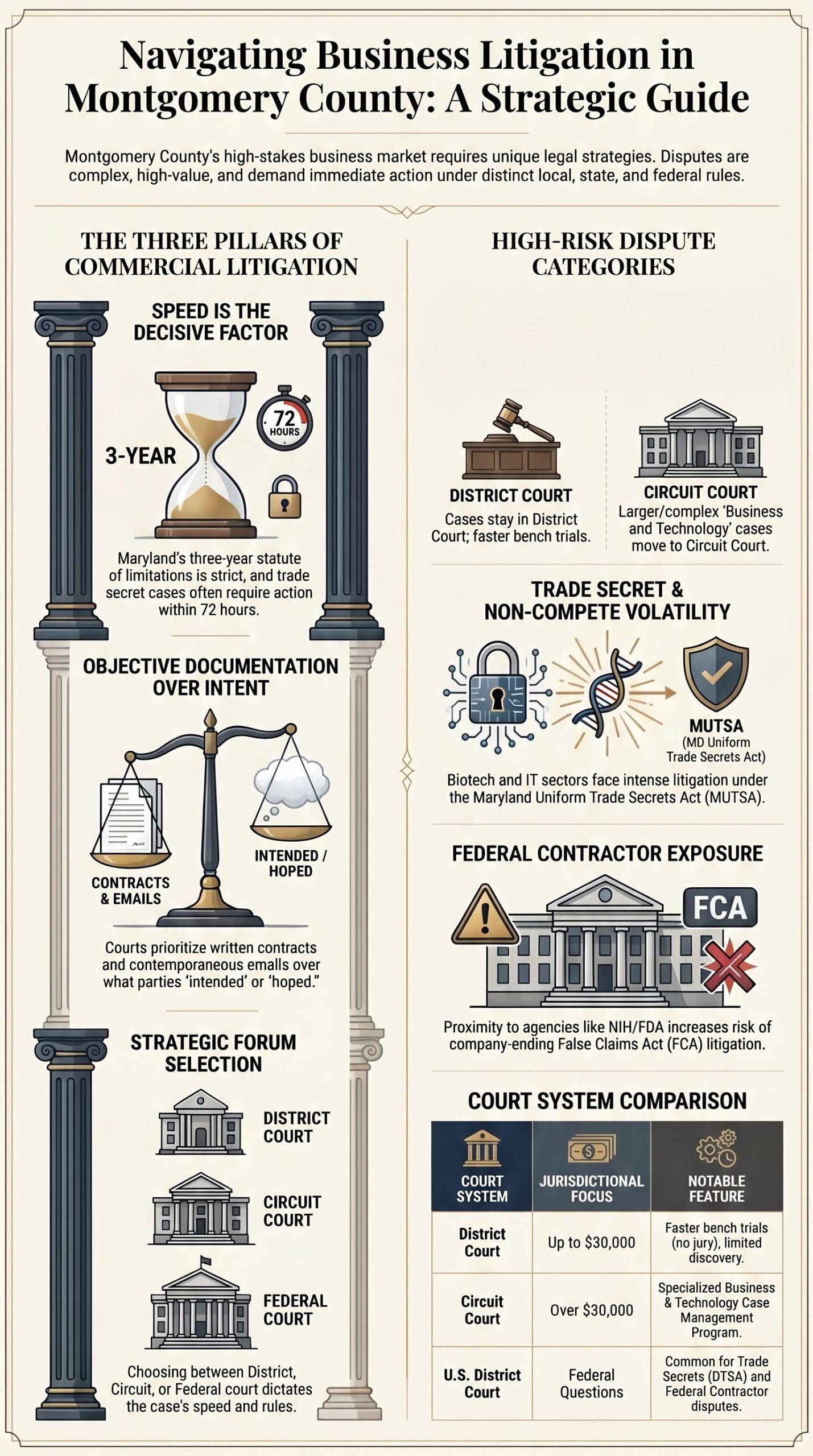
Table of Contents
- Why Business Disputes Look Different in Montgomery County
- Contract Disputes: From Bethesda Towers to Damascus Storefronts
- Business Torts: Interference, Fraud, and Civil Conspiracy
- Trade Secrets and Restrictive Covenants
- Partnership, LLC, and Shareholder Disputes
- Commercial Real Estate and Lease Litigation
- Federal Contractor and Regulatory Disputes
- Maryland Substantive Business Law
- Navigating Montgomery County Courts
- How Shin Law Office Resolves Business Disputes
- Summary
- Frequently Asked Questions
- References
Chapter 1: Why Business Disputes Look Different in Montgomery County
Montgomery County packs more sophisticated business activity into its 507 square miles than most states do. The I-270 biotech corridor between Rockville and Germantown sits a short drive from the National Institutes of Health, the Food and Drug Administration in Silver Spring, and the National Institute of Standards and Technology in Gaithersburg. Bethesda hosts national law firms, investment managers, and the headquarters of multiple Fortune 500 companies. Chevy Chase, Potomac, and Kensington are home to senior federal officials, lobbyists, and the families of executives who commute into the District. Wheaton, Silver Spring, Takoma Park, and Aspen Hill anchor some of the most diverse small business communities on the East Coast, with owners from Ethiopia, El Salvador, Korea, Vietnam, India, and dozens of other countries. Olney, Damascus, Poolesville, Burtonsville, Sandy Spring, and Brookeville add the construction trades, agriculture, and family services that keep the county running.
All of that wealth and complexity create a specific type of business litigation. Contract values are higher, which means breach claims are larger and the parties have more to fight about. Companies use sophisticated counsel from the start, which means transactional documents are detailed, and litigation gets technical fast. Regulatory exposure is greater because the county imposes its own employment, environmental, and zoning rules on top of Maryland and federal law. The Montgomery County minimum wage runs higher than the state floor, the county has its own paid sick and safe leave statute, and the Alcohol Beverage Services controls the wholesale liquor pipeline. Because so many local players have ongoing business relationships across the region, disputes rarely stay quiet. A partnership breakup at a Rockville medical practice can reach customers, referral sources, and lenders within days.
There is also a procedural dimension that catches out-of-area counsel by surprise. Three court systems handle commercial disputes here: the District Court of Maryland sitting in Rockville and Silver Spring, the Circuit Court for Montgomery County in Rockville, and the United States District Court for the District of Maryland in Greenbelt. Each has different jurisdictional limits, different rules, and different cultures. The Circuit Court runs a Business and Technology Case Management Program for complex commercial cases that moves disputes faster but imposes stricter scheduling and disclosure obligations. Mediation is mandatory in most Circuit Court cases under Maryland Rule 17-202, so building a trial-ready record while still leaving room for settlement is part of the discipline from day one.
Why this matters in Montgomery County specifically:
Choosing the wrong forum, missing a notice deadline, or sleeping on a short statute of limitations can cost you the case before you ever argue the facts. Local counsel who already knows the judges, the chambers, and the mediation programs starts every dispute with that advantage built in.
For a broader survey of how civil cases move through this jurisdiction, see our Ultimate Guide to Civil Litigation in Montgomery County, Maryland. For property-specific issues that often overlap with business disputes, our Real Estate Dispute FAQs for Montgomery County, Maryland covers the patterns we see most often.
Chapter 2: Contract Disputes from Bethesda Towers to Damascus Storefronts
Breach of contract drives most of the business cases that come into my office. The pattern is consistent across industries and across the country: two parties strike a deal, performance breaks down somewhere along the way, and one side ends up out of pocket. What changes is the dollar value, the complexity of the document, and the negotiating position available to each side once the dispute is in court.
Vendor and Service Agreements
A Bethesda asset manager hires a software firm in Gaithersburg to build a custom portfolio dashboard. Six months in, the platform still does not deliver the reporting promised in the statement of work, and the client withholds payment. The vendor sues for the unpaid balance; the client counterclaims for the cost of cover and lost confidence in the product. Cases like this turn on the four corners of the agreement, the email record showing what was actually delivered, and whether either side gave timely notice of the alleged breach. Maryland courts apply the objective theory of contracts, which means the words on the page and the parties’ conduct carry far more weight than what either side privately intended.
Construction Contracts
Construction work is a constant source of litigation in the county, especially in Gaithersburg, Germantown, Clarksburg, and the rapidly developing parts of North Bethesda. The disputes typically involve change orders that were not properly documented, payment applications that the general contractor disputes, and defects that surface after substantial completion. Mechanics’ liens are recorded in the Land Records of the Circuit Court for Montgomery County, and the strict notice and filing deadlines under the Maryland Mechanics Lien Statute (Md. Code, Real Prop. Title 9) are not forgiving.
Customer Nonpayment and Collections
A Wheaton catering company delivers ten weeks of corporate lunches to a Rockville startup, then watches the invoices age past 90 days while the customer dodges calls. The instinct to pile on fees and interest is understandable, but the smarter move is usually a clean demand letter, a clear deadline, and, if necessary, a swift District Court action up to the $30,000 small-claims limit and the standard civil limit. The District Court resolves most of these cases within a few months, and a judgment can be domesticated and enforced through wage garnishment, bank attachment, or a judicial lien against real property.
For a deeper look at how breach of contract claims play out across the county, our companion guide, Breach of Contract Litigation in Montgomery County, walks through proof, defenses, and remedies in detail. For Bethesda-specific commercial breach patterns, see When Bethesda Businesses Break Their Promises.
Chapter 3: Business Torts: Interference, Fraud, and Civil Conspiracy
Not every commercial dispute lives inside a contract. When a competitor poaches your top sales rep and steers her book of business to a new venture, or a former vendor lies its way into a deal it could not have closed honestly, the cause of action sounds in tort. Tort theories matter because they unlock remedies that pure contract claims cannot reach, including punitive damages and, in some cases, attorneys’ fees.
Tortious Interference
Maryland recognizes two distinct torts here. Tortious interference with contract requires proof that an existing contract was disrupted by an outside party’s intentional and unjustified conduct. Tortious interference with prospective economic advantage applies where there was no signed contract yet, but a reasonable expectation of business that the defendant intentionally and improperly destroyed. The Court of Appeals (now the Supreme Court of Maryland) has held that the prospective interference tort requires conduct that is independently wrongful, meaning conduct that violates a statute, a regulation, a recognized common law rule, or established business ethics. Simple competition, even aggressive competition, does not qualify. We see these claims most often in Kensington, Silver Spring, and Bethesda, where small-business communities turn on a dime when a competitor crosses the line. For a closer look, see Kensington Tortious Interference Cases.
Fraud and Negligent Misrepresentation
Maryland fraud requires a false representation of a material fact, made with knowledge of its falsity or reckless indifference to the truth, with intent to deceive, on which the plaintiff justifiably relied to its detriment. Negligent misrepresentation lowers the mental state requirement but adds a tighter privity and reliance analysis. These claims often start as contract disputes and shift into tort when discovery reveals that the breach was not just an honest failure to perform but a misstatement that induced the deal in the first place. I have written about this dynamic in Misrepresentation as a Tort Escape Hatch in Maryland Professional Disputes. Silver Spring’s healthcare and technology economy generates a steady stream of these matters; see Silver Spring Business Fraud for industry-specific patterns.
Civil Conspiracy and Aiding and Abetting
Maryland treats civil conspiracy as a derivative tort. Two or more people must agree to commit an underlying tort, and at least one overt act in furtherance must occur. The same goes for aiding and abetting liability. These theories matter when the bad actor is judgment-proof, but the people who helped have assets. In family business and partnership cases, we use these doctrines to reach the cousin, the in-law, or the new business partner who quietly funded a wrongful exit.
Chapter 4: Trade Secrets and Restrictive Covenants
Few categories of business litigation move as fast as trade secret and non-compete cases, and few jurisdictions concentrate as much intellectual property value as Montgomery County. Biotech companies in Rockville and Gaithersburg, federal IT contractors along the I-270 spine, and specialty consulting firms in Bethesda all live or die on confidential information that can walk out the door inside a single laptop or USB drive.
The Maryland Uniform Trade Secrets Act
The Maryland Uniform Trade Secrets Act (MUTSA), codified at Md. Code, Com. Law § 11-1201 et seq., is the workhorse statute. It defines a trade secret as information that derives independent economic value from not being generally known, and that is the subject of reasonable efforts to maintain its secrecy. The statute provides for injunctive relief, actual damages, unjust enrichment recovery, and exemplary damages of up to twice compensatory damages where willful and malicious misappropriation is proven. The federal Defend Trade Secrets Act of 2016 (18 U.S.C. § 1836) overlays a parallel federal cause of action with similar remedies and an interstate commerce hook, and most of our trade secret cases get filed in the U.S. District Court for the District of Maryland in Greenbelt to take advantage of federal procedure and the federal bench’s familiarity with the statute.
Non-Competes After the 2020 and 2024 Amendments
Maryland has tightened the rules on non-compete agreements meaningfully in recent years. Md. Code, Lab. & Empl. § 3-716 prohibits non-compete and conflict-of-interest provisions for employees earning at or below a defined wage threshold, with the threshold expanded by the General Assembly to cover veterinary and healthcare professionals under specified conditions. Employers who try to enforce non-competes against workers covered by the statute lose and may face fee-shifting consequences. For workers above the threshold, Maryland courts apply the traditional reasonableness analysis, which weighs the legitimate business interest, the geographic and temporal scope, the burden on the employee, and the public interest. Non-solicitation provisions tied to actual customer relationships and confidential information generally fare better than blanket restrictions on competition. I cover the analysis in detail in Noncompete and Nonsolicitation Litigation in Maryland.
Speed Matters
In trade secret and restrictive covenant matters, the first 72 hours often determine the outcome. We move quickly to preserve forensic evidence, send cease and desist correspondence, and where appropriate file for a temporary restraining order or preliminary injunction. Waiting weeks to act gives the defendant time to integrate stolen information into a competing business, diluting the case for emergency relief.
Chapter 5: Partnership, LLC, and Shareholder Disputes
Closely held businesses dominate the Montgomery County economy, from family-run restaurants in Wheaton and Aspen Hill to multigenerational construction firms in Damascus and Olney to professional partnerships in Bethesda and Chevy Chase. When the relationship between owners breaks down, the legal framework that controls the dispute is a combination of the operating or partnership agreement, the relevant Maryland statute, and the common law of fiduciary duty.
The Maryland LLC Act and General Corporation Law
The Maryland Limited Liability Company Act, Md. Code, Corps. & Ass’ns Title 4A, governs the rights of members and managers in a Maryland LLC, with most default rules subject to override by a written operating agreement. The Maryland General Corporation Law, Md. Code, Corps. & Ass’ns Titles 1 through 3 govern corporations and provide the framework for shareholder rights, director duties, and statutory remedies for oppression. Maryland is one of the more management-friendly jurisdictions in the country, particularly for publicly traded REITs headquartered in the state, but in closely held companies, the courts will enforce minority protection where the conduct crosses the line into oppression.
Common Disputes
The recurring fact patterns include freeze-outs of minority owners, capital contribution disputes, undisclosed self-dealing by managing members, deadlock between equal owners, and post-departure competition by an exiting partner. Buy-sell agreements that lock in valuation methodology and mandate dispute resolution often prevent these situations from spiraling into open-ended litigation. When no buy-sell exists, we often pursue judicial dissolution under § 4A-903 or, in the corporate context, the statutory remedies for oppression and deadlock under § 3-413.
Fiduciary Duties
Members of a Maryland LLC and officers and directors of a Maryland corporation owe duties of loyalty and care, the contours of which depend on the entity type and the operating agreement. Operating agreements can modify or even eliminate fiduciary duties to the extent permitted by statute, but they cannot waive the implied covenant of good faith and fair dealing. When a controlling member uses control to drain value from the company or steer opportunities to a side venture, those duties become the spine of the case.
Chapter 6: Commercial Real Estate and Lease Litigation
Commercial real estate disputes in Montgomery County run the full range, from triple-net retail leases in Bethesda Row and Pike & Rose to ground leases under apartment towers in Rockville Town Center to defective construction claims on mixed-use projects in Silver Spring. Property values are high, the regulatory overlay is heavy, and the contract documents are dense, which means even straightforward disputes turn on careful drafting and procedural discipline.
Lease Disputes
Common lease disputes include rent abatement claims tied to building defects, contested CAM and tax pass-through reconciliations, contested tenant build-out obligations, holdover and surrender disagreements, and the enforcement of personal guaranties when the operating tenant fails. Maryland’s commercial eviction process moves through the District Court of Maryland’s Failure to Pay Rent and Tenant Holding Over dockets, and a well-prepared landlord can move from filing to possession in as few as weeks. A poorly prepared landlord can lose months. Tenants facing eviction need to know their rights to cure, their right to counsel, and the strict timing rules for posting redemption money. For more on lease and property disputes, see Lease Conflicts and Property Disputes in Montgomery County.
Construction Defects in Mixed-Use Projects
North Bethesda, downtown Silver Spring, and the White Flint corridor have seen a wave of mid-rise and high-rise construction over the last decade. When water intrusion, envelope failure, mechanical defects, or fire safety problems emerge after substantial completion, the resulting litigation involves owners, contractors, design professionals, and product manufacturers all at once. Maryland’s statute of repose, codified at Md. Code, Cts. & Jud. Proc. § 5-108, generally bars claims arising from improvements to real property after the period set by the statute, with carve-outs for asbestos and certain latent defects. Knowing where the clock is can make or break a defect case.
Zoning and Land Use
Montgomery County’s zoning code is among the most detailed in the region, administered through the Maryland-National Capital Park and Planning Commission and enforced through the Office of Zoning and Administrative Hearings. Disputes over special exceptions, conditional uses, and determinations of adequate public facilities frequently end up in the Circuit Court for Montgomery County on petitions for judicial review. For property litigation that crosses into emergency relief, see Rockville Real Estate Litigation and Olney Emergency Relief and Declaratory Judgments.
Chapter 7: Federal Contractor and Regulatory Disputes
Few counties in the country host as many federal contractors as Montgomery County. The proximity to NIH, FDA, NIST, the Department of Energy, the Nuclear Regulatory Commission in Rockville, and the National Oceanic and Atmospheric Administration in Silver Spring means that thousands of local companies do most or all of their work with federal funding. The disputes that arise from that environment look very different from purely private commercial cases.
Bid Protests and Contract Disputes
A losing bidder in a federal procurement can file a bid protest with the Government Accountability Office under 31 U.S.C. § 3551 et seq., or with the Court of Federal Claims under the Tucker Act, 28 U.S.C. § 1491. The deadlines are strict, the records are tightly controlled, and the standards of review are deferential to the agency. Protest decisions can return procurements to fair competition or, in some cases, hand the contract to the protester outright. Disputes over performance under an awarded contract route through the Contract Disputes Act, 41 U.S.C. § 7101 et seq., starting with a contracting officer’s final decision and moving on appeal to the Civilian Board of Contract Appeals or the Court of Federal Claims.
False Claims Act Exposure
The federal False Claims Act, 31 U.S.C. § 3729 et seq., is the single largest source of catastrophic liability for federal contractors. Treble damages plus per-claim civil penalties can transform a small invoicing error into a company-ending case, particularly when a qui tam relator (often a former employee) files under seal in the District of Maryland. The biotech and healthcare clusters in Rockville, Gaithersburg, and Silver Spring face heightened exposure under the Anti-Kickback Statute and the Stark Law, both of which intersect with the False Claims Act. Strong compliance programs and immediate, careful response to subpoenas and Civil Investigative Demands are the difference between a manageable resolution and an existential threat.
Maryland Consumer Protection Act and County Employment Rules
Consumer-facing businesses operating in Wheaton, Silver Spring, Aspen Hill, and the rest of the county are subject to the Maryland Consumer Protection Act (MCPA), Md. Code, Com. Law § 13-101 et seq., which prohibits unfair, abusive, or deceptive trade practices and authorizes private enforcement with attorneys’ fees. The Office of the Attorney General’s Consumer Protection Division and Montgomery County’s Office of Consumer Protection both bring enforcement actions, and immigrant-owned businesses are sometimes the target of complaints they could have avoided with better disclosure practices. See Wheaton Consumer Protection Violations for a closer look.
On the employment side, the Montgomery County Earned Sick and Safe Leave Law, the county minimum wage ordinance, and the Maryland Wage Payment and Collection Law (Md. Code, Lab. & Empl. § 3-501 et seq.) all impose obligations that exceed federal floors. Mistakes here lead to treble damages and fee awards under the Wage Payment statute, and enforcement is aggressive.
Chapter 8: Maryland Substantive Business Law
A practical command of Maryland substantive law is what separates effective business litigation from generic motion practice. The doctrines below come up in nearly every commercial case I handle in Montgomery County.
Elements of Breach of Contract
A Maryland breach of contract claim requires proof of a contractual obligation, its breach, and resulting damages. Courts apply the objective theory of contracts, looking at outward expressions of assent rather than the parties’ undisclosed mental states. Even where damages cannot be quantified, a plaintiff can recover nominal damages on proof of breach.
Statute of Limitations
The general statute of limitations for civil actions in Maryland is three years, codified at Md. Code, Cts. & Jud. Proc. § 5-101. Specialty contracts under seal extend the period to twelve years under § 5-102. Sales-of-goods cases governed by Article 2 of the Maryland Uniform Commercial Code carry a four-year limitations period under Md. Code, Com. Law § 2-725. Trade secret claims under MUTSA carry a three-year period from the date the misappropriation was or should have been discovered. Tort claims, including fraud and tortious interference, generally run three years, with the discovery rule extending accrual in fraud cases.
Statute of Frauds
Maryland’s general statute of frauds, Md. Code, Cts. & Jud. Proc. § 5-901, requires writings for contracts that cannot be performed within one year, agreements answering for the debt of another (suretyship), and contracts in consideration of marriage. The UCC statute of frauds at § 2-201 requires a writing for sales of goods of $500 or more, with merchant exceptions. Real estate contracts require a writing under § 5-104 of the Real Property Article. Failures here are common in handshake deals between long-term business partners and routinely doom otherwise meritorious claims.
Remedies
Maryland recognizes compensatory damages (direct and consequential), liquidated damages where reasonable at the time of contracting, restitution and disgorgement, specific performance for unique subject matter (most often real estate), and injunctive relief. Consequential damages must be reasonably foreseeable at the time of contracting, the rule traceable to Hadley v. Baxendale and applied consistently by Maryland appellate courts. Attorneys’ fees follow the American Rule absent contractual or statutory authorization, with significant exceptions under MUTSA, the Wage Payment statute, and the MCPA.
Punitive Damages and Mitigation
Maryland sets a high bar for punitive damages. The plaintiff must prove actual malice, defined as conduct characterized by evil motive, intent to injure, ill will, or fraud, by clear and convincing evidence. Pure breach of contract will not support punitive damages, no matter how egregious. Plaintiffs in tort cases must also mitigate damages where reasonable, and a failure to take reasonable steps to limit losses can substantially reduce a recovery.
Chapter 9: Navigating Montgomery County Courts
Choosing the right court is not a clerical decision. It frames the entire trajectory of the case, and the wrong choice often forces a refile after the limitations period has run.
District Court of Maryland for Montgomery County
The District Court is a court of limited jurisdiction with locations in Rockville and Silver Spring. The civil jurisdictional limit is $30,000, with concurrent jurisdiction up to $30,000 with the Circuit Court. There is no jury at the District Court level; trials are bench trials, and the rules are streamlined. The court is well-suited for collections, smaller commercial disputes, and landlord-tenant matters. Either party can demand a jury if the amount in controversy exceeds $20,000, which removes the case to the Circuit Court.
Circuit Court for Montgomery County
The Circuit Court sits in the Judicial Center on Maryland Avenue in Rockville and handles civil cases over $30,000, equity matters, and any case in which a jury trial is sought. The Business and Technology Case Management Program, established under Maryland Rule 16-308, channels designated complex commercial cases to a specialized track with a single assigned judge, fixed scheduling orders, and tight discovery management. Mandatory ADR under Maryland Rule 17-202 channels most cases through mediation early in the litigation, often before significant discovery is complete.
U.S. District Court for the District of Maryland
Federal cases involving Montgomery County parties are heard in the Southern Division of the District of Maryland in Greenbelt. Federal jurisdiction in commercial cases typically rests on diversity of citizenship under 28 U.S.C. § 1332, federal question jurisdiction under 28 U.S.C. § 1331 (most often Defend Trade Secrets Act, Lanham Act, or False Claims Act cases), or a federal contractor’s right of removal. The federal bench’s familiarity with the Federal Rules of Civil Procedure, the local rules’ aggressive Rule 16 conferences, and the standing pretrial orders create a fast-moving environment that favors well-prepared parties.
Removal and ADR
Defendants with an out-of-state principal place of business often weigh removal to federal court within the 30-day window under 28 U.S.C. § 1446. The choice between state and federal forum can affect the speed of the case, the procedural posture for early motion practice, and the jury pool. Many commercial contracts include arbitration clauses tied to the American Arbitration Association or JAMS, and the Federal Arbitration Act, 9 U.S.C. § 1 et seq., generally compels enforcement of those clauses where the parties have agreed.
Time matters more than people realize:
Once a complaint is served, the responding party has 30 days under Maryland Rule 2-321 in state court, and 21 days under Federal Rule 12(a) in federal court. Removal must occur within 30 days of service. Missing any of these deadlines forfeits substantive rights that may not be recoverable.
Chapter 10: How Shin Law Office Resolves Business Disputes
Every matter that comes through our doors starts with a focused intake. We want to understand what happened, what the documents say, what the deadlines are, and what outcome the client is willing to accept. From there, we move quickly to investigate, preserve evidence, and identify the legal theories that fit the facts. In trade secret and restrictive covenant matters, the first 72 hours often determine the case. In contract disputes and partnership breakups, the first 30 days matter most.
Once we have a clear picture, we present a strategy: pre-suit demand and negotiation when settlement is realistic, mediation when the relationship is salvageable, or litigation when the other side is not engaging in good faith. We carefully pick the forum, draft pleadings that frame the case the way we want a judge or jury to see it, and pursue discovery that produces documents and depositions our client actually needs at trial. We do not run up bills on motions that will not move the case forward, and we tell clients honestly when settlement is the right answer, even if continued litigation would be lucrative for the firm.
Communication with our clients is direct. We return calls. We explain what we are doing and why. We send copies of every meaningful filing and make sure the people paying for the case understand the strategy. Business litigation is stressful enough without an attorney who disappears between hearings.
Our practice covers Bethesda, Rockville, Silver Spring, Gaithersburg, Germantown, Wheaton, Chevy Chase, Potomac, Kensington, Takoma Park, Olney, Damascus, Poolesville, Burtonsville, Sandy Spring, Brookeville, Aspen Hill, North Bethesda, Clarksburg, and the surrounding communities. We handle matters in the District Court of Maryland for Montgomery County, the Circuit Court for Montgomery County, and the U.S. District Court for the District of Maryland in Greenbelt. We also represent Maryland-based clients in matters that cross into the District of Columbia or Northern Virginia, where many of our cases naturally land.
Summary
Business disputes in Montgomery County are not garden-variety cases. The county’s combination of high contract values, dense regulatory overlay, sophisticated counterparties, and three available court systems means that strategic decisions made in the first weeks of a dispute can determine whether you recover what you are owed, hold a competitor accountable, or get out of a bad partnership with your business intact.
Three principles run through almost every case I handle. First, time matters. Maryland’s three-year general statute of limitations is shorter than many business owners assume, and trade secret and restrictive covenant matters require action in days, not months. Second, documentation matters. Courts apply the objective theory of contracts, weighing what was written and what was done over what was meant or hoped. Contemporaneous emails, signed change orders, and clean accounting records often decide cases. Third, forum matters. The District Court, the Circuit Court, and the federal court in Greenbelt each have their own procedural and cultural realities, and choosing the right one is a strategic decision, not a clerical one.
If you are facing a brewing dispute, considering a transaction with significant downside risk, or trying to clean up a partnership that has stopped working, the right time to consult counsel is now, while options are still open. Once a deadline passes or a wrongful exit is complete, the available remedies narrow considerably.
Frequently Asked Questions
What is the statute of limitations for a breach of contract claim in Maryland?
The general statute of limitations for breach of contract in Maryland is three years from the date the cause of action accrues, under Md. Code, Cts. & Jud. Proc. § 5-101. Contracts under seal carry a twelve-year period. Sales of goods governed by the UCC carry a four-year period. The clock typically starts on the date of the breach, not the date the breach is discovered, although exceptions apply in fraud and certain professional negligence contexts.
Are non-compete agreements enforceable in Maryland?
It depends on the worker and the agreement. Md. Code, Lab. & Empl. § 3-716 prohibits non-compete and conflict-of-interest provisions for employees earning at or below the statutory wage threshold and for certain healthcare workers. For workers above the threshold, courts apply a reasonableness analysis weighing the legitimate business interest, the geographic and temporal scope, the burden on the employee, and the public interest. Non-solicitation provisions tied to actual customer relationships generally fare better than blanket non-competes.
Can I sue in Montgomery County if my business is based elsewhere?
Yes, in many cases. Montgomery County is a proper venue under Md. Code, Cts. & Jud. Proc. § 6-201 if the defendant resides, carries on a regular business, or is regularly employed in the county, or if the cause of action arose there. Forum selection clauses in contracts can also direct disputes to Montgomery County regardless of where the parties are headquartered.
What is the difference between the District Court and the Circuit Court in Montgomery County?
The District Court of Maryland, which sits in Rockville and Silver Spring, has a $30,000 jurisdictional limit and conducts bench trials without juries. The Circuit Court for Montgomery County in Rockville handles cases over $30,000, all equity matters, and any case in which a jury is demanded. The Circuit Court runs a Business and Technology Case Management Program for designated complex commercial matters.
How long does business litigation usually take in Montgomery County?
A District Court collection case can resolve in three to six months. A Circuit Court commercial case typically runs 12 to 18 months from filing to trial, with mandatory mediation under Maryland Rule 17-202 occurring earlier in that timeline. Federal cases in the District of Maryland often move on a similar schedule, though discovery can significantly extend complex matters.
Can I recover attorneys’ fees in a Maryland business case?
Generally, no, under the American Rule. Each side pays its own fees unless a contract or a statute provides otherwise. Common exceptions include the Maryland Wage Payment and Collection Law, the Maryland Consumer Protection Act, the Maryland Uniform Trade Secrets Act, and the federal False Claims Act. Many commercial contracts include prevailing party fee provisions, which Maryland courts enforce.
What is the Maryland Consumer Protection Act, and does it apply to my B2B dispute?
The Maryland Consumer Protection Act, Md. Code, Com. Law § 13-101 et seq., prohibits unfair, abusive, or deceptive trade practices in consumer transactions and authorizes private actions with attorneys’ fees. It applies to businesses dealing with consumers (defined to include certain small-business goods and services), but generally not to disputes between sophisticated commercial parties, unless one is purchasing goods or services for personal, household, or family use.
How are trade secrets protected in Maryland?
The Maryland Uniform Trade Secrets Act, Md. Code, Com. Law § 11-1201 et seq., provides for injunctive relief, actual damages, unjust enrichment, and exemplary damages of up to twice compensatory damages where the misappropriation is willful and malicious. Attorneys’ fees may also be awarded. The federal Defend Trade Secrets Act, 18 U.S.C. § 1836, provides parallel federal remedies. Both require that the information be subject to reasonable efforts to maintain secrecy, which means a written confidentiality program backed by access controls.
Should I sue or arbitrate?
If your contract contains an arbitration clause, the Federal Arbitration Act, 9 U.S.C. § 1 et seq., generally requires arbitration unless the clause is unconscionable or otherwise invalid. Where the choice is open, arbitration tends to be faster and more private but limits appellate review and can be expensive in complex commercial cases. Litigation in the Circuit Court or in federal court provides full discovery and appeal rights but moves more slowly. The right answer depends on the dispute, the documents, and each side’s negotiating position.
What happens at mandatory mediation in the Circuit Court?
Maryland Rule 17-202 authorizes the Circuit Court to order mediation in most civil cases. Mediations typically last a half-day to a full day, with a court-appointed or party-selected mediator. The mediator does not impose a result; the parties either reach agreement or return to litigation. Effective preparation, including a focused mediation statement and authority from decision makers, is the difference between a productive session and wasted time.
Talk to a Montgomery County Business Litigation Attorney
Get Sound Counsel Before the Next Deadline Passes
Whether you are dealing with an unpaid invoice in Wheaton, a partnership freeze-out in Rockville, a trade secret theft on the I-270 corridor, or a federal contracting dispute that puts the company itself at risk, the next move you make will shape the case for the rest of its life.
Shin Law Office handles business litigation and transactional matters across Montgomery County and the broader DC, Maryland, and Virginia region. Tough cases require tough attorneys, and we approach every matter with the discipline, candor, and preparation the situation calls for.
Call 571-445-6565 or contact Shin Law Office to talk through your situation.

ATTORNEY
Practice Areas
Meet Our Team
Shin Law Office, PLC
References
Code of Maryland (Md. Code), Courts and Judicial Proceedings Article. Statutes of limitations and procedural rules. https://mgaleg.maryland.gov/mgawebsite/Laws/StatuteText?article=gcj
Code of Maryland (Md. Code), Commercial Law Article. Maryland Uniform Commercial Code, Maryland Uniform Trade Secrets Act, and Maryland Consumer Protection Act. https://mgaleg.maryland.gov/mgawebsite/Laws/StatuteText?article=gcl
Code of Maryland (Md. Code), Corporations and Associations Article. Maryland General Corporation Law and Maryland Limited Liability Company Act. https://mgaleg.maryland.gov/mgawebsite/Laws/StatuteText?article=gca
Code of Maryland (Md. Code), Labor and Employment Article. Maryland Wage Payment and Collection Law and non-compete restrictions. https://mgaleg.maryland.gov/mgawebsite/Laws/StatuteText?article=gle
Code of Maryland (Md. Code), Real Property Article. Maryland Mechanics Lien Statute and statute of frauds. https://mgaleg.maryland.gov/mgawebsite/Laws/StatuteText?article=grp
Maryland Judiciary. Maryland Rules of Procedure. https://mdcourts.gov/legalhelp/marylandrules
Circuit Court for Montgomery County. Business and Technology Case Management Program. https://www.montgomerycountymd.gov/cct/
District Court of Maryland. Locations and civil jurisdiction. https://mdcourts.gov/district
United States District Court for the District of Maryland. Local Rules and Standing Orders. https://www.mdd.uscourts.gov
Defend Trade Secrets Act of 2016, 18 U.S.C. § 1836. https://www.law.cornell.edu/uscode/text/18/1836
False Claims Act, 31 U.S.C. § 3729 et seq. https://www.law.cornell.edu/uscode/text/31/3729
Federal Arbitration Act, 9 U.S.C. § 1 et seq. https://www.law.cornell.edu/uscode/text/9/1
Government Accountability Office. Bid Protest Regulations and Annual Reports. https://www.gao.gov/legal/bid-protests
U.S. Court of Federal Claims. Procurement Protest Procedures. https://www.uscfc.uscourts.gov
Montgomery County, Maryland. Office of Consumer Protection. https://www.montgomerycountymd.gov/ocp/
Maryland-National Capital Park and Planning Commission. Montgomery County Planning Department. https://montgomeryplanning.org