
BLUF (Bottom Line Up Front)
In Fairfax County, business disputes often go beyond mere contract disagreements; they can become business fraud and tortious interference claims that significantly impact a company’s financial health and competitive standing. Virginia law provides strong remedies for companies harmed by dishonest competitors, disloyal partners, or unlawful conduct, but courts require precision, strong evidence, and clear legal duties before allowing these claims to proceed. Fraud, interference with contracts, interference with business expectancies, and statutory business conspiracy are powerful tools when they arise from intentional misconduct proven with specific facts, not hindsight or speculative assertions. Understanding what constitutes actionable misconduct, how courts evaluate these claims, and how to plead them correctly can make the difference between dismissal and decisive recovery.
If you are asking questions like these, this article is written for you:
• What legally qualifies as business fraud in Virginia and Fairfax County?
• When does competition cross the line into tortious interference?
• What elements does a court require to prove tortious interference with contract or business expectancy?
• How do Virginia courts treat business conspiracy and enhanced damages?
• What remedies can a business recover when fraud or interference succeeds?
This guide explains how fraud and tortious interference claims are evaluated, pleaded, and proven in Fairfax County courts, what distinguishes lawful competition from unlawful conduct, and what practical steps businesses should take to protect their rights under Virginia law.
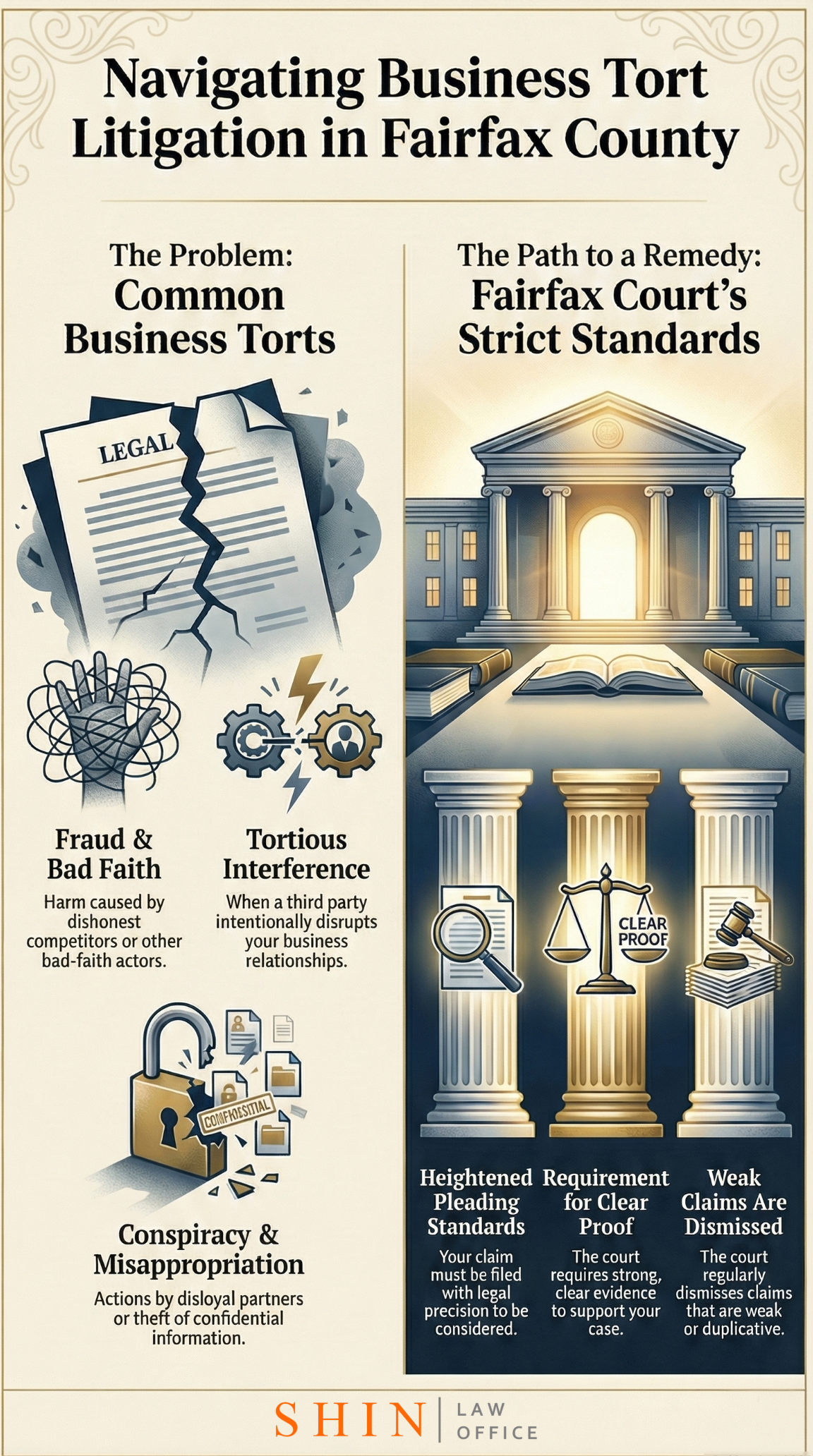
Table of Contents
- What Is Driving the Rise of Business Fraud and Tort Claims in Fairfax County?
- What Counts as Business Fraud Under Virginia Law?
- When Does Competition Become Tortious Interference in Fairfax County?
- What Is a Virginia Business Conspiracy and When Do Treble Damages Apply?
- How Do Fairfax County Judges Actually Evaluate Business Tort Lawsuits?
- What Remedies Can Fairfax County Businesses Recover and How Do They Reduce Future Risk?
What Is Driving the Rise of Business Fraud and Tort Claims in Fairfax County?
Business fraud and tortious interference cases in Fairfax County demand precision, evidence, and a deep understanding of Virginia law. This comprehensive article breaks down how Fairfax County courts handle business tort claims, including fraud, interference with contracts, and statutory business conspiracy, and explains what companies must prove to protect their interests and recover damages.
Chapter 1
Why Business Torts Are Increasing in Fairfax County
Fairfax County is one of the most commercially dense jurisdictions in the Commonwealth of Virginia. From Tysons Corner and McLean to Reston, Herndon, and Merrifield, businesses operate in close proximity, compete aggressively for the same clients, and often rely on overlapping employees, vendors, and referral networks. In this environment, competition frequently escalates into conduct that goes beyond sharp dealing and into legally actionable misconduct.
Under Virginia law, business torts are civil wrongs independent of contract obligations. They arise when a party uses deception, coercion, or improper means to gain an unfair advantage. Common examples include fraudulent inducement, interference with existing contracts, interference with prospective business relationships, and statutory business conspiracy under Virginia Code §§ 18.2-499 and 18.2-500.
A critical reason these claims are increasing is the limitation of contract remedies. Virginia courts consistently hold that a plaintiff cannot convert a breach of contract into a tort unless the defendant violated a duty independent of the contract. The Supreme Court of Virginia firmly established this principle in Filak v. George, 267 Va. 612 (2004). As a result, businesses harmed by intentional misconduct must carefully plead tort-based claims or risk being confined to limited contract damages.
Case Law Deep Dive: Station #2, LLC v. Lynch, 280 Va. 166 (2010)
In Station #2, the Supreme Court of Virginia addressed whether fraudulent inducement claims could proceed alongside breach-of-contract claims. The defendant argued that the economic loss rule barred the plaintiff’s claims. The Court rejected that argument, holding that fraud occurring prior to contract formation involves a breach of duty separate from contractual obligations.
The Court emphasized that when a party intentionally misrepresents material facts to induce another into a contract, that conduct supports an independent tort claim. Fairfax County judges routinely rely on Station #2 when evaluating fraud pleadings at the demurrer stage.
The takeaway for Fairfax County businesses is straightforward: when misconduct precedes or exists independently of a contract, tort claims are not only viable—they are often essential to full recovery.
Chapter 2
What Counts as Business Fraud Under Virginia Law?
Fraud claims are among the most powerful—and most dangerous—claims in Virginia civil litigation. They carry the potential for punitive damages but are subject to heightened pleading and proof standards. In Fairfax County Circuit Court, fraud claims are frequently attacked through demurrers and motions to strike.
Under Virginia law, the elements of fraud are well established:
- A false representation
- Of a material fact
- Made intentionally and knowingly
- With intent to mislead
- Reliance by the plaintiff
- Resulting damage
See Evaluation Research Corp. v. Alequin, 247 Va. 143 (1994).
Virginia Supreme Court Rule 1:4(d) requires that fraud be pleaded with particularity. General allegations of deception are insufficient. Plaintiffs must allege the who, what, when, where, and how of the misrepresentation.
Case Law Deep Dive: Abi-Najm v. Concord Condo., LLC, 280 Va. 350 (2010)
In Abi-Najm, condominium purchasers alleged that the developer misrepresented material facts about the quality of the flooring before the contract was executed. The developer argued that the source-of-duty rule barred the claims. The Supreme Court of Virginia disagreed.
The Court held that pre-contractual misrepresentations of existing fact support independent fraud claims even where a contract later governs the relationship. Notably, the Court clarified that fraud claims are not defeated simply because the subject matter is later addressed in a contract.
Fairfax County courts regularly cite Abi-Najm when denying demurrers in fraud cases involving business acquisitions, franchise agreements, and professional services contracts in areas like Tysons and Reston.
For businesses, this means fraud claims must be surgically precise. Sloppy pleadings fail quickly. Well-crafted fraud claims survive early dismissal and dramatically increase settlement leverage.
Chapter 3
When Does Competition Become Tortious Interference in Fairfax County?
Tortious interference claims are especially common in Fairfax County, where competitors often target the same customers and talent pool. Virginia recognizes two distinct causes of action: tortious interference with contract and tortious interference with business expectancy.
To prove tortious interference with contract, a plaintiff must establish:
- Existence of a valid contractual relationship
- Knowledge of the contract by the defendant
- Intentional interference inducing or causing a breach
- Resulting damage
See Chaves v. Johnson, 230 Va. 112 (1985).
Interference with business expectancy requires proof of a reasonable probability—not mere hope—of future economic benefit.
Case Law Deep Dive: Dunlap v. Cottman Transmission Systems, LLC, 287 Va. 207 (2014)
In Dunlap, franchisees alleged that the franchisor intentionally undermined their businesses by diverting customers and misusing confidential information. The Supreme Court of Virginia held that tortious interference claims were viable where the defendant used improper methods, including deceit and misuse of information.
The Court reaffirmed that competition alone is not wrongful, but competition becomes tortious when it involves improper means such as fraud, misrepresentation, or intimidation.
In Fairfax County, courts apply Dunlap rigorously, particularly in disputes involving departing employees, non-solicitation clauses, and client poaching in McLean and Vienna professional services markets.
Chapter 4
What Is a Virginia Business Conspiracy and When Do Treble Damages Apply?
Virginia’s business conspiracy statute is one of the most potent—and most misunderstood—tools available to plaintiffs. Under Virginia Code §§ 18.2-499 and 18.2-500, a plaintiff may recover treble damages and attorney’s fees if two or more persons conspire to injure a business through unlawful means.
The statute requires proof of:
- A combination of two or more persons
- For the purpose of willfully and maliciously injuring another in business
- Resulting damage
Malice, in this context, means intentional, purposeful conduct without lawful justification.
Case Law Deep Dive: Commercial Business Systems, Inc. v. BellSouth Services, Inc., 249 Va. 39 (1995)
In Commercial Business Systems, the Supreme Court of Virginia clarified that the statute requires proof of concerted action and an underlying unlawful act. Mere breach of contract is insufficient. However, tortious conduct such as fraud or interference can satisfy the unlawful act requirement.
Fairfax County courts frequently dismiss weak conspiracy claims at the pleading stage. When properly pleaded, however, these claims significantly increase litigation exposure and settlement value.
Chapter 5
How Do Fairfax County Judges Actually Evaluate Business Tort Lawsuits?
Fairfax County Circuit Court is a fast-paced, sophisticated forum. Judges expect precise pleadings, disciplined discovery, and efficient presentation of evidence. Business tort cases often hinge at the demurrer stage.
Virginia remains a fact-pleading jurisdiction. Conclusory allegations are fatal. Plaintiffs must plead specific facts supporting each element of each tort.
Discovery is tightly managed. Courts disfavor overbroad fishing expeditions and require proportionality under Rule 4:1. Electronic discovery, particularly emails and internal messaging, is often decisive in fraud and interference cases.
Case Law Deep Dive: Ward’s Equipment, Inc. v. New Holland North America, Inc., 254 Va. 379 (1997)
In Ward’s Equipment, the Court addressed the intersection of contract and tort claims, reaffirming that tort remedies require proof of independent duties. Fairfax County judges frequently rely on this case to evaluate whether tort claims improperly duplicate contract claims.
Effective litigation strategy focuses on early motion practice, targeted discovery, and clear damages theories tied directly to the alleged misconduct.
Chapter 6
What Remedies Can Fairfax County Businesses Recover and How Do They Reduce Future Risk?
Virginia law provides a range of remedies for business torts, but courts are conservative and evidence-driven. Compensatory damages must be proven with reasonable certainty. Lost profits are recoverable but require reliable financial evidence.
Punitive damages are available in fraud cases but capped at $350,000 under Virginia Code § 8.01-38.1. Injunctive relief is frequently sought to stop ongoing interference or misuse of confidential information.
Case Law Deep Dive: Advanced Marine Enterprises, Inc. v. PRC Inc., 256 Va. 106 (1998)
In Advanced Marine, the Supreme Court of Virginia emphasized that speculative damages are not recoverable. Fairfax County courts consistently exclude damages theories lacking solid financial grounding.
Risk management begins before litigation. Clear confidentiality agreements, employee exit protocols, and early legal intervention reduce exposure and preserve claims.
Closing Summary
Business tort litigation in Fairfax County is not about punishing competition—it is about enforcing legal boundaries. Virginia courts provide powerful remedies, but only to businesses that plead precisely, prove diligently, and litigate strategically. Understanding how Fairfax County judges apply Virginia law is the difference between dismissal and decisive recovery.

Principal Attorney | Shin Law Office
Call 571-445-6565 or book a consultation online today.
Business Litigation Attorney for Fairfax County, VA
Frequently Asked Questions
What is a business tort under Virginia law?
A business tort is a civil wrong that causes economic harm to a business outside of a pure breach of contract. These claims arise when someone violates a legal duty imposed by law rather than by agreement. Common examples include fraud, tortious interference with contracts or business expectancy, business conspiracy, defamation affecting a business, and misuse of confidential information. Business torts often involve intentional misconduct and can expose defendants to enhanced damages.
Can I sue for fraud and breach of contract together?
Yes, but only under specific circumstances. Virginia allows both claims when the fraud arises from a duty independent of the contract itself. This typically includes pre contract misrepresentations, concealment of material facts, or intentional deception used to induce the agreement. If the alleged misconduct is simply a failure to perform contractual duties, courts will usually dismiss the fraud claim under the economic loss rule.
What court hears business tort cases in Fairfax County?
Most high value or complex business tort cases are filed in the Fairfax County Circuit Court. This court is known for sophisticated commercial litigation, strict pleading standards, and active case management. Lower dollar claims may be filed in General District Court, but significant business disputes almost always belong in Circuit Court.
How hard is it to prove fraud in Virginia?
Fraud is one of the most difficult civil claims to prove in Virginia. Plaintiffs must establish a false representation of a material fact, made intentionally and knowingly, with intent to mislead, reasonable reliance, and resulting damages. Courts require clear and convincing evidence, and pleadings must state the who, what, when, where, and how of the alleged fraud with precision.
Are punitive damages available?
Yes, punitive damages may be awarded in fraud cases and certain other intentional torts. However, Virginia law imposes a statutory cap of $350,000 on punitive damages. Courts apply this remedy sparingly and only when the defendant’s conduct is willful, wanton, or malicious.
What is tortious interference?
Tortious interference occurs when a party intentionally disrupts an existing contract or a valid business expectancy through improper means. The focus is not merely on competition, but on whether the defendant used unlawful or unethical methods such as fraud, intimidation, or misuse of confidential information to interfere.
Is competition illegal in Virginia?
No. Virginia strongly protects fair competition. Competition becomes unlawful only when a competitor uses improper methods. Aggressive but honest competition is allowed. Deceptive practices, false statements, or coercive tactics can turn lawful competition into tortious conduct.
What is business conspiracy?
Business conspiracy is a statutory cause of action under Virginia law that targets coordinated efforts by two or more parties to intentionally harm a business through unlawful acts. This claim is powerful because it allows recovery of treble damages and attorney’s fees if proven. Courts strictly scrutinize these claims due to their severity.
Can I recover attorney’s fees?
Generally, Virginia follows the American Rule, meaning each party pays its own attorney’s fees. However, business conspiracy claims are a major exception. If proven, the statute allows recovery of reasonable attorney’s fees and costs, which can significantly increase leverage.
What damages are recoverable?
Recoverable damages may include direct economic losses, lost profits, loss of business value, reputational harm in limited cases, and injunctive relief. In fraud or conspiracy cases, punitive or treble damages may also apply. All damages must be proven with reasonable certainty.
How long do these cases take?
Most business tort cases take between 12 and 24 months from filing to resolution. Complex discovery, expert testimony, and contested motions can extend timelines. Early motions may narrow or dismiss claims, while injunctions can accelerate certain proceedings.
Are emails enough to prove fraud?
Emails can be powerful evidence, especially when they show knowledge, intent, or misrepresentation. However, they must be properly authenticated and placed in context. Courts rarely rely on a single email in isolation. Patterns of communication and corroborating evidence matter.
What is the statute of limitations?
Most business tort claims, including fraud and tortious interference, are subject to a two year statute of limitations in Virginia. The clock usually starts when the injury is discovered or reasonably should have been discovered, not necessarily when the misconduct occurred.
Can former employees be sued?
Yes. Former employees can be liable if they engage in fraud, misuse confidential information, breach fiduciary duties, or participate in business conspiracy. Claims often arise when employees leave and attempt to divert customers or proprietary data unlawfully.
What is the economic loss rule?
The economic loss rule prevents plaintiffs from converting contract disputes into tort claims. If the alleged harm arises solely from a failure to perform contractual duties, tort claims are usually barred. Independent duties imposed by law are required to proceed in tort.
Do I need expert witnesses?
In many cases, yes. Experts are commonly required to prove damages, lost profits, valuation issues, or industry standards. Fraud elements may be proven without experts, but damages almost always require professional analysis.
Can claims be dismissed early?
Yes. Defendants often challenge business tort claims through demurrers or motions to strike. Fairfax courts are known for dismissing inadequately pled claims early, which makes precise drafting critical.
Is injunctive relief common?
Yes, especially when misconduct is ongoing. Courts may issue injunctions to stop misuse of trade secrets, interference with contracts, or continued fraudulent conduct. Injunctions can be temporary or permanent depending on the case.
What is improper means?
Improper means include fraud, misrepresentation, intimidation, threats, bribery, misuse of confidential information, defamation, or violation of statutes or regulations. This element is often the deciding factor in tortious interference cases.
Can competitors be liable?
Yes. Competitors are frequently defendants in business tort cases when they cross the line from fair competition into unlawful conduct. Liability depends on the methods used, not the competitive motive.
How specific must pleadings be?
Extremely specific. Fairfax courts expect detailed factual allegations, particularly for fraud and conspiracy claims. Vague accusations or conclusory statements are routinely dismissed.
Are settlement discussions common?
Yes. Many cases settle after early motions or during discovery once strengths and weaknesses become clear. Strong early pleading and motion practice often drives favorable settlements.
What role does intent play?
Intent is central to most business tort claims. Fraud, interference, and conspiracy all require proof that the defendant knowingly and intentionally engaged in wrongful conduct. Negligence alone is usually insufficient.
Can damages be speculative?
No. Virginia courts strictly reject speculative damages. Plaintiffs must provide concrete evidence and reliable calculations. Assumptions without data or expert support are unlikely to survive.
When should a lawyer be contacted?
Immediately. Early legal intervention helps preserve evidence, assess claims before limitations expire, and avoid strategic missteps. Delay often weakens otherwise valid business tort claims.
Disclaimer:The information provided in this article is for educational purposes only and does not constitute legal advice. Every case is unique. If you believe you have a claim, contact a qualified attorney immediately to discuss the specifics of your situation and the applicable statutes of limitation.