
Bottom Line Up Front (BLUF)
Wrongful Death FAQs from Personal Injury Lawyer
What is the difference between wrongful death law in Virginia and Maryland?
Virginia requires the case to be filed by the personal representative of the estate, while Maryland’s wrongful death claim is brought for the benefit of specific family members, like a spouse, child, or parent.
How long do I have to file a wrongful death case in Virginia?
In most cases, you have two years from the date of death to file a wrongful death lawsuit in Virginia.
How long do I have to file a wrongful death case in Maryland?
In most cases, you have three years from the date of death to file a wrongful death lawsuit in Maryland, with limited exceptions for certain situations.
Who can file a wrongful death lawsuit in Virginia?
The personal representative of the deceased person’s estate files the lawsuit in Virginia, even though the recovery is for eligible family members under the statute.
Who can file a wrongful death lawsuit in Maryland?
Maryland’s wrongful death claim is for the benefit of the deceased person’s spouse, children, and parents, and if none exist, certain dependent relatives may qualify.
What damages can a family recover in a Virginia wrongful death case?
Families may pursue damages for loss of companionship, mental anguish, lost income and services, medical bills related to the final injury, funeral expenses, and potentially punitive damages in limited situations.
What damages can a family recover in a Maryland wrongful death case?
Families may seek damages for economic losses and certain non-economic losses, such as mental anguish and loss of companionship, but Maryland imposes legal limits on many non-economic damages.
Which state’s law applies if the crash happened in Virginia but the victim lived in Maryland?
Usually, the law of the state where the fatal injury happened applies, even if the victim and family live in another state.
Can one death lead to more than one wrongful death lawsuit?
Typically no. Both states generally require the wrongful death claim to be handled as a single action, with rules controlling who may bring it and how recovery is shared.
What should I do first if I think my family has a wrongful death claim in Virginia or Maryland?
Start by confirming where the incident occurred, preserving reports and records, avoiding detailed statements to insurers, and seeking legal guidance early to ensure deadlines and evidence issues are handled correctly.
Start here: which state controls the case
In most cases, the applicable law is the law of the jurisdiction where the injury occurred. That sounds simple until you see how many cases live on the border.
A bridge crash can change everything. A hospital transfer can change everything. A workplace death tied to a jobsite can change everything.
If you are unsure, treat it as an emergency from a legal standpoint. The wrong filing plan can burn months.
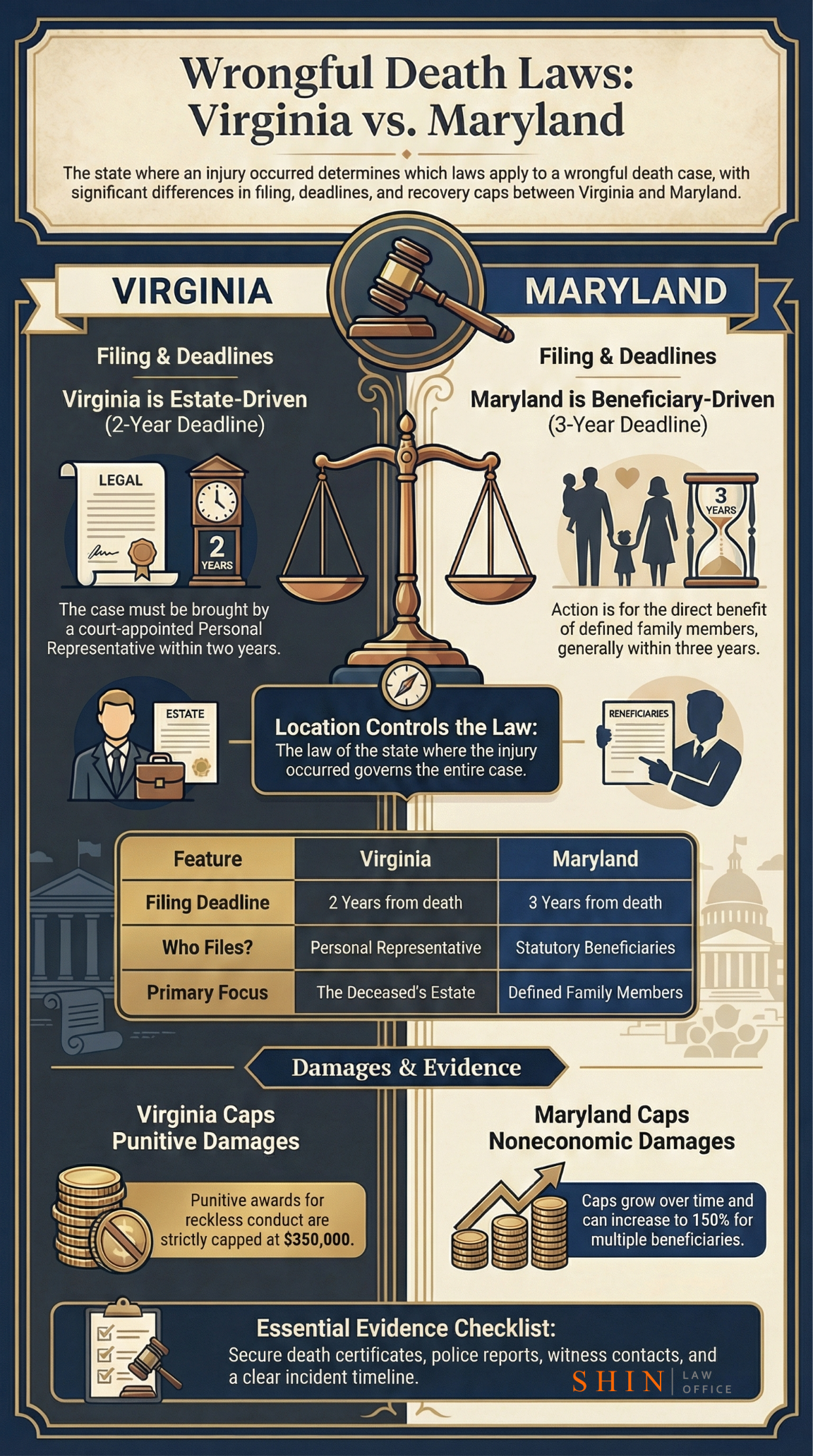
Who can bring the case: Virginia is estate-driven, Maryland is beneficiary-driven
Virginia
In Virginia, a wrongful death case is brought by the personal representative of the deceased person.
That means the estate side matters early. Someone has to be appointed. Paperwork has to be clean.
Virginia then distributes any recovery to statutory beneficiaries in classes that prioritize close family first, then expand outward depending on who is living and who was dependent.
In plain terms, Virginia is structured like this:
• The case is filed by the personal representative
• The money is distributed by statute, not by whoever files first
Maryland
Maryland starts from a different place. The wrongful death action is for the benefit of the spouse, parent, and child of the deceased.
If none of those people exist, the law may allow a blood or marriage relative to be a beneficiary.
Maryland also makes clear that only one wrongful death action lies for a death.
In plain terms, Maryland is structured like this:
• The law defines who benefits first
• If there are no primary beneficiaries, dependency can matter
• You do not get multiple bites at the apple
Deadlines: two years in Virginia, three years in Maryland
This is one of the easiest ways good claims die.
Virginia deadline
Virginia generally requires that a wrongful death action be brought within two years of death by the personal representative.
Maryland deadline
Maryland generally requires filing within three years after the death.
Maryland also has specific timing rules for certain occupational disease cases and homicide-related situations.
Damages: both states allow meaningful recovery, but they measure it differently
Virginia damages
Virginia lists the major categories a jury can consider, including:
• Sorrow, mental anguish, and loss of companionship
• Loss of expected income and services
• Medical and hospital expenses tied to the fatal injury
• Funeral expenses
• Punitive damages for willful or wanton conduct, or reckless disregard for safety
Virginia also caps punitive damages at 350,000.
Maryland damages
Maryland allows damages to be awarded based on the injury resulting from the death, and it expressly allows damages beyond strict financial loss, including mental anguish and loss of companionship, care, and guidance where applicable.
Here is the big practical difference: Maryland limits noneconomic damages in many wrongful death cases, and that cap grows over time.
If there are two or more beneficiaries, Maryland allows up to 150 percent of the applicable limit, regardless of how many beneficiaries share it.
What this means in real life
If I am evaluating a Virginia wrongful death case, I am thinking early about:
• Who will serve as personal representative
• Who the statutory beneficiaries are and how distribution works
• Whether the facts justify punitive damages, and what the punitive cap means in settlement strategy
If I am evaluating a Maryland wrongful death case, I am thinking early about:
• Who qualifies as a beneficiary under the statute
• How noneconomic damages caps shape the settlement range
• How to present the story of loss clearly, because the case is still about human impact even when a cap exists
Two fast mistakes I see families make
Mistake one: waiting to open the estate side when Virginia law applies
In Virginia, the personal representative is the one who brings the case. If that step is delayed, the calendar does not stop.
Mistake two: assuming the same damages rules apply in both states
Maryland caps noneconomic damages in many wrongful death cases. Virginia caps punitive damages. Those are not the same, and they affect how insurers evaluate risk.
A quick checklist if your family is dealing with a wrongful death
Death certificate and any medical records you can get quickly:
- Police report or incident report
- Names and contact info for witnesses
- Photos, videos, and location details
- Insurance information for all involved parties
- A simple timeline of what happened and where it happened
Talk to a lawyer early
Wrongful death cases move on deadlines, not emotions. If the incident touches Virginia or Maryland, you want a plan that picks the right state, the right plaintiff, and the right damages strategy from day one.

Principal Attorney | Shin Law Office
Call 571-445-6565 or book a consultation online today.
(This article is provided for general informational purposes and does not constitute legal advice. For advice on your specific situation, consult with a licensed Virginia attorney.)
References
Maryland Code Annotated, Courts and Judicial Proceedings § 3 904 (2026).
Maryland Code Annotated, Courts and Judicial Proceedings § 11 108 (2026).
Virginia Code Annotated § 8.01 50 (2026).
Virginia Code Annotated § 8.01 52 (2026).
Virginia Code Annotated § 8.01 53 (2026).
Virginia Code Annotated § 8.01 244 (2026).
Virginia Code Annotated § 8.01 38.1 (2026).