
Bottom Line Up Front (BLUF)
Losing a loved one due to someone else’s negligence or wrongdoing is a devastating experience. As a Virginia wrongful death attorney, I want families to know that our laws provide a path to seek justice and accountability in these tragedies. Virginia allows the deceased’s personal representative to bring a lawsuit on behalf of the family, and wrongful death claims can arise from many situations – from car accidents to medical mistakes to intentional crimes. In this article, I’ll explain 20 common types of wrongful death cases in Virginia, how the law handles each scenario, and what families in communities like Fairfax, Loudoun, Prince William, Arlington, Clarke, and Frederick Counties should understand. The bottom line: while no lawsuit can bring back your loved one, a wrongful death claim is a tool to hold the responsible party accountable, obtain answers, and secure financial support for those left behind. Importantly, Virginia law has unique rules – such as a two-year filing deadline and a “pure contributory negligence” standard that can bar recovery if the victim was even slightly at fault – so understanding your rights is critical. Let’s explore each type of case in detail so your family can make informed decisions in the pursuit of justice.
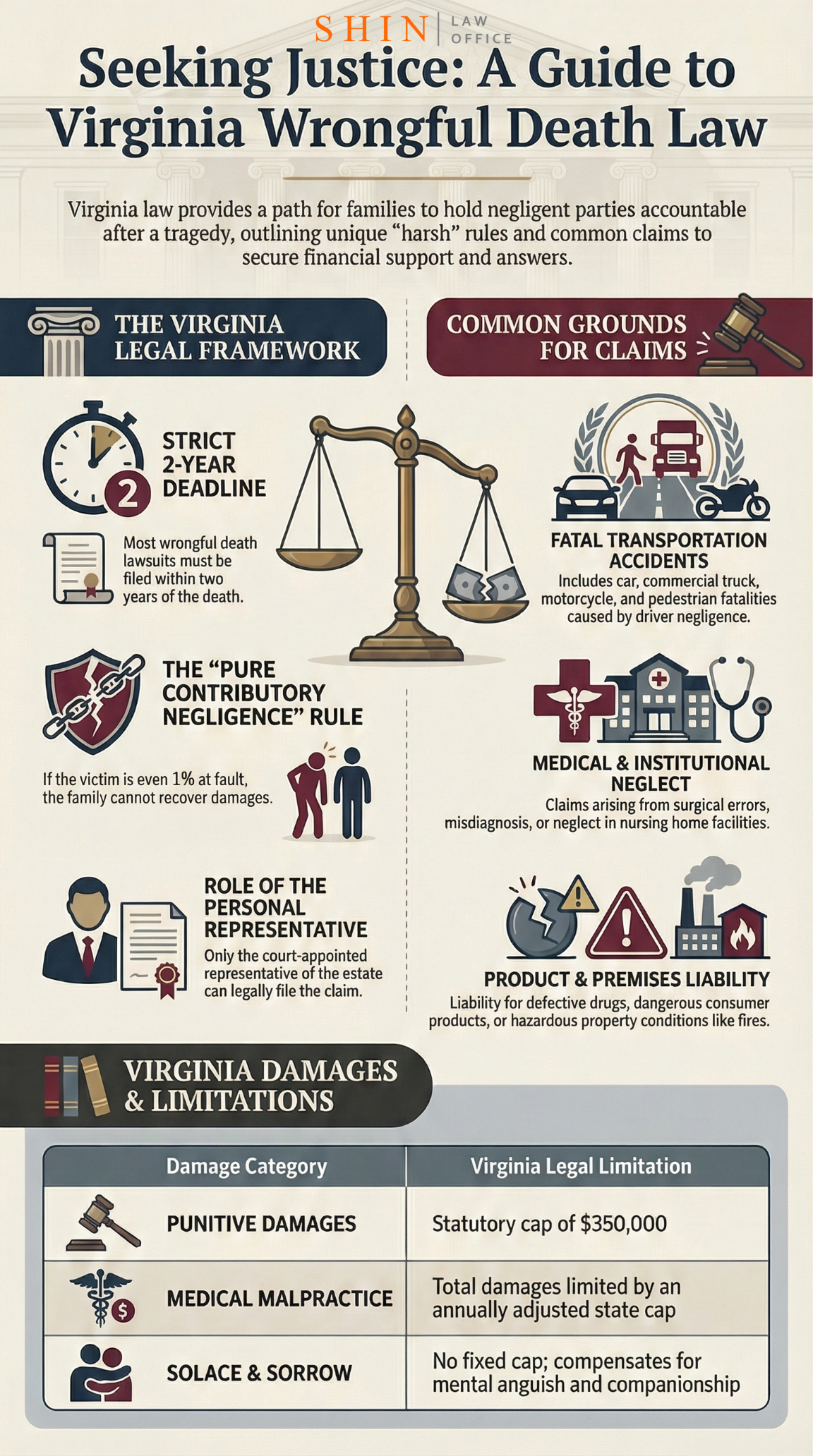
Table of Contents
- Fatal Car Accidents
- Deadly Truck and Commercial Vehicle Accidents
- Motorcycle Crash Wrongful Deaths
- Pedestrian and Bicycle Fatalities
- Drunk Driving and DUI-Related Deaths
- Medical Malpractice Wrongful Deaths
- Nursing Home Neglect and Abuse Cases
- Defective Product Liability Cases
- Dangerous Drug and Medical Device Cases
- Premises Liability (Fatal Slip and Fall or Hazards)
- Fatal Fires and Explosions
- Workplace and Industrial Accidents
- Construction Site Accidents
- Child Care and School Negligence Cases
- Negligent Security and Crime Victim Deaths
- Intentional Violent Acts (Homicide Wrongful Deaths)
- Police Brutality and Misconduct Cases
- Public Transportation and Aviation Accidents
- Boating and Recreational Accident Deaths
- Fatal Animal Attacks (Dog Maulings)
- Summary and Seeking Justice
- References
Fatal Car Accidents
Car accidents are one of the leading causes of wrongful death claims in Virginia. Every year, hundreds of families across the Commonwealth – including in bustling areas like Fairfax County and Prince William County – lose loved ones in traffic crashes. These tragedies most often result from driver negligence, such as:
-
Speeding and Reckless Driving: Drivers going well above the speed limit or aggressively weaving through traffic cause high-impact collisions that frequently prove fatal. Virginia considers driving 20+ mph over the limit or over 80 mph as reckless driving, a criminal offense, underscoring how dangerous this behavior is.
-
Distracted Driving: Texting, using a phone, or other distractions behind the wheel lead to deadly crashes. A momentary glance at a phone on I-66 or Route 7 in Loudoun County can mean a life lost.
-
Failure to Yield or Obey Traffic Signals: Running red lights or stop signs, making improper left turns, or not yielding to oncoming traffic causes many fatal intersection accidents. For example, a driver running a red light at a busy Fairfax intersection can T-bone another car with catastrophic results.
-
Other Traffic Violations: Tailgating, improper passing, drowsy driving, or any breach of traffic laws can turn deadly on Virginia roads.
In a fatal car accident wrongful death case, the at-fault driver is the primary liable party. If they were driving in the scope of employment (for instance, a delivery driver in Arlington), their employer may also be liable under Virginia’s respondeat superior doctrine. Determining fault is critical because Virginia follows a pure contributory negligence rule – if the investigation finds that the victim driver was even 1% at fault (perhaps by also speeding or not wearing a seatbelt), the family’s claim could be barred entirely. This harsh rule makes it essential to gather strong evidence showing the defendant’s sole responsibility. I often work with accident reconstruction experts to prove exactly how a crash happened.
Virginia law permits recovery of many damages in a wrongful death suit, including lost income of the deceased, medical bills, funeral expenses, and the family’s sorrow and mental anguish. In especially egregious cases – like a fatal crash caused by a driver who was street racing – the family can also seek punitive damages for willful or wanton conduct. (Virginia caps punitive damages at $350,000 by statute, but they are still important to punish reckless drivers.)
Hypothetical Scenario: Imagine a family from Fairfax County is driving home on I-95 when another car, going 90 mph and weaving between lanes, slams into them. The crash kills the father in the family vehicle. Police cite the other driver for reckless driving and find evidence of texting while driving. The victim’s spouse, as personal representative of the estate, files a wrongful death lawsuit in Fairfax County Circuit Court against the at-fault driver. Through this claim, the family can present evidence of the driver’s negligence – such as phone records and traffic camera footage – to hold them accountable. If successful, a jury could award damages for the father’s lost income to support his children, the medical efforts before he died, funeral costs, and the family’s grief. This civil action proceeds separately from any traffic or criminal charges. By filing in Fairfax (a busy jurisdiction that regularly handles such cases), the family also benefits from local court practices – for example, Fairfax’s well-established system for scheduling civil jury trials ensures their case moves forward efficiently with a judge experienced in wrongful death matters.
Deadly Truck and Commercial Vehicle Accidents
Crashes involving tractor-trailers, semi-trucks, and other commercial vehicles are another major category of wrongful death cases in Virginia. Northern Virginia’s interstates (I-95, I-81, I-66, the Dulles Toll Road, etc.) see heavy truck traffic, and when an 18-wheeler collides with a smaller vehicle, the results are often fatal. In my experience, families in places like Prince William County and Frederick County have faced tragedies when trucks failed to stop in time or lost control on the highways. Common causes of fatal truck accidents include:
-
Driver Fatigue or Impairment: Truck drivers on long overnight hauls may doze off or drive while overly fatigued. Despite federal hours-of-service rules, fatigue-related crashes happen on corridors like I-81 through Frederick County. Some crashes also involve truckers under the influence of drugs or alcohol, with deadly consequences.
-
Speeding or Reckless Maneuvers: A speeding tractor-trailer needs a long distance to brake. In Loudoun or Fairfax, a loaded truck barreling down a hill too fast can rear-end cars in traffic, causing multi-vehicle pileups. Unsafe lane changes or tailgating by truckers can be disastrous as well.
-
Overloaded or Improperly Loaded Cargo: Misloaded trailers (too heavy or unbalanced loads) can cause a truck to jackknife or tip over. For example, on a windy stretch of Route 17 in Clarke County, an improperly secured load could shift and lead to a rollover that crushes other vehicles.
-
Poor Maintenance and Mechanical Failures: Defective brakes, tire blowouts, or trailer hitch failures often stem from negligent maintenance. A trucking company’s failure to maintain its fleet can lead to a deadly mechanical failure on the road.
In a wrongful death claim from a truck accident, there may be multiple liable parties. The truck driver is often the first focus, but the trucking company that hired or trained the driver can be liable as well – especially if they pushed the driver to violate safety rules or neglected maintenance. Virginia law permits holding an employer accountable for an employee’s negligence on the job. Additionally, if a mechanical defect contributed (like faulty brakes), a maintenance contractor or parts manufacturer might share fault. Complex cases may involve federal trucking regulations too. For instance, logbook records and electronic driver logs (mandated for interstate truckers) can show if a driver violated hours-of-service rules. I will obtain those records early, since a trucking company operating in Virginia is legally required to preserve certain evidence after a fatal crash.
One challenge is Virginia’s contributory negligence doctrine – if a car driver was killed in a collision with a truck but was found to have, say, changed lanes abruptly, the defense will argue the car driver’s small mistake bars the claim. We counter this by emphasizing the truck’s primary fault and using expert testimony on trucking safety standards. These cases often end up in federal court (if the trucking company is out-of-state) or in Virginia circuit courts where the incident occurred. For example, a deadly truck crash on I-95 in Prince William County might be filed in the Prince William Circuit Court in Manassas, where judges are familiar with trucking litigation nuances.
Illustrative Case: A Loudoun County family loses a loved one in a crash on Route 15 near Leesburg when a speeding semi-truck failed to brake at a traffic light. The investigation reveals the truck’s brakes were severely worn out, and the driver had been on duty for 14 hours (beyond the legal limit). The personal representative files a wrongful death suit against both the truck driver and the trucking company. The lawsuit alleges the company’s negligence in maintaining the truck and forcing the driver’s long hours. During litigation, it’s discovered that the company ignored safety inspections – powerful evidence of recklessness. A Loudoun jury could not only compensate the family for their losses, but might also award punitive damages for the company’s willful disregard for safety (though any punitive award would be capped at $350,000 in Virginia). By bringing the case locally, the family’s attorney can invoke Virginia wrongful death statutes and local court procedures to expedite discovery (for example, Loudoun courts may issue swift subpoenas for company records). The outcome of such a case would send a clear message to trucking companies about safety on our roads.
Motorcycle Crash Wrongful Deaths
Motorcycle riders are especially vulnerable on the road, and unfortunately motorcycle accidents account for a significant share of wrongful deaths in Virginia. I have represented families in Fairfax and Arlington who lost a loved one riding a motorcycle due to another driver’s carelessness. Motorcycles offer little protection in a crash, so even a low-speed collision can be fatal. Common scenarios leading to a motorcyclist’s wrongful death include:
-
Right-of-Way Violations: A very typical tragedy occurs when a car or SUV fails to see a motorcycle and turns left in front of it at an intersection. For instance, on a two-lane road in Clarke County, a driver might misjudge an oncoming bike’s speed and turn across its path, causing a deadly collision.
-
Lane Changes and Blind Spots: Drivers who do not check blind spots on highways like I-495 or I-66 can sideswipe a motorcycle while changing lanes. A motorcyclist forced off the road at high speed often suffers fatal injuries.
-
Tailgating or Sudden Stops: Following a motorcycle too closely in traffic is extremely dangerous – a minor rear-end bump that a car driver could shrug off might throw a motorcyclist from the bike. Sudden stops by vehicles ahead without giving motorcycles adequate space also lead to fatal outcomes.
-
Road Hazards: While not involving another driver, it’s worth noting that potholes, debris, or poor road design can cause a fatal single-bike crash. A motorcyclist hitting an unmarked construction gravel patch in Frederick County could lose control. (However, holding a government accountable for road hazards is difficult due to sovereign immunity, as discussed later.)
In motorcycle wrongful death cases, the negligent automobile driver is typically liable if they violated traffic laws or failed to keep a proper lookout for motorcycles. Virginia law requires drivers to “change lanes safely” and yield to oncoming traffic when turning – violations of those rules that result in a death can be negligence per se (automatic evidence of negligence). It’s also important to counter biases: unfortunately, some jurors may have biases against motorcyclists (viewing riding as inherently “risky”). As the family’s attorney, I make sure to humanize the rider (e.g., describing them as a cautious rider with proper training and gear) and focus on the defendant’s clear fault.
Virginia’s contributory negligence rule looms large in these cases. Insurance companies often argue, for example, that a motorcyclist was speeding or “should have seen” the danger, to claim the rider was partially at fault. We combat this by using accident reconstruction and eyewitness testimony. If we show the car driver’s negligence was the sole cause, the family can recover full damages under the wrongful death statute. Damages may include the decedent’s lost earning capacity, which can be significant if the motorcyclist was a primary family breadwinner, as well as compensation for the spouse and children’s emotional losses.
Case Example: A Prince William County resident is riding his motorcycle through an intersection on Route 234 when a pickup truck makes a left turn without yielding, striking him. The rider, a 40-year-old father of two, dies at the scene. His wife brings a wrongful death claim against the pickup driver. In investigating, we find the driver simply “didn’t see” the motorcycle – a clear failure to keep a proper lookout. We file suit in Prince William Circuit Court (which, like many Virginia courts, allows victims’ families to request a jury trial for wrongful death claims). At trial, we present evidence that the motorcyclist was going the speed limit and had the right-of-way, while the defendant violated Virginia Code § 46.2-825 (requiring yielding when turning left). The jury finds the driver fully at fault. They award damages covering the family’s loss of the man’s income (he was a local electrician), the medical helicopter and hospital bills before he passed, and $1 million for sorrow and loss of companionship to his wife and young children. Although nothing can erase their loss, the verdict provides financial stability and a sense of justice. It also serves as a reminder in the community that drivers must be vigilant in looking out for motorcycles on the road.
Pedestrian and Bicycle Fatalities
Tragically, pedestrians and bicyclists are often victims of fatal accidents in urban and suburban areas of Virginia. As our communities in Northern Virginia become more walkable and bike-friendly, we’ve seen cases where a moment of driver negligence cost someone’s life while they were simply walking or cycling. These wrongful death cases involve people on foot or on bicycles struck by motor vehicles. Common causes of pedestrian or cyclist fatalities include:
-
Crosswalk Collisions: A driver may run a red light or fail to yield to pedestrians in a crosswalk. In places like Arlington or Alexandria, with busy intersections, it’s not uncommon for impatient or distracted drivers to hit someone legally crossing the street.
-
Distracted Driving Near Roadsides: A driver veering off the road while texting can strike a jogger on the shoulder or a family biking on a neighborhood street. For example, a tragic case in Fairfax County could involve a distracted driver swerving onto a bike lane on Gallows Road, hitting a cyclist.
-
Passing Too Closely: Virginia law requires drivers to give at least three feet of clearance when passing a bicycle. When drivers ignore this, sideswipe collisions can throw a cyclist into traffic.
-
Backing or Turning Incidents: Drivers backing out of driveways or making turns in parking lots may not see a pedestrian or child on a bike until it’s too late. A slow-speed vehicle can still cause fatal injuries to an elderly pedestrian or a small child on a tricycle, for instance.
In these cases, the vehicle driver is usually liable if they violated traffic laws or were otherwise negligent (speeding, not paying attention, etc.). Virginia imposes duties on drivers to exercise due care to avoid hitting pedestrians and those on bicycles. If a pedestrian had the walk signal or a cyclist was obeying road rules, the driver’s failure to yield or to keep a proper lookout is strong evidence of negligence. We often use the police accident report, witness statements, or even surveillance video (in urban areas) to establish exactly what happened.
A unique challenge: Virginia’s contributory negligence can be a defense if, for example, the defense claims the pedestrian was jaywalking or the bicyclist swerved suddenly. If proven, any slight contributory fault by the victim would bar recovery. I scrutinize such claims closely – often, what the defense labels “jaywalking” might actually be the driver’s failure to see a pedestrian already in the road. In one case, I represented a family of a pedestrian killed at dusk; the driver said the victim wasn’t in a crosswalk, but we showed the area had no nearby crosswalk and the driver was speeding and had time to avoid the person. The key is to prove the driver had the last clear chance to avoid the accident, a doctrine in Virginia that can overcome contributory negligence in some pedestrian cases.
From a legal process standpoint, these cases in densely populated counties (e.g., Arlington, Fairfax) might involve claims against government entities if road design was partly to blame (like a malfunctioning crossing signal). However, suing a city or county in Virginia requires special notice and faces sovereign immunity hurdles. Usually, we focus on the driver and their insurance. The wrongful death damages available – such as the family’s emotional anguish, lost financial support, and funeral costs – are the same as in other cases. If the driver was drunk or grossly reckless, punitive damages may be pursued as well.
Example Scenario: In Arlington County, a 70-year-old pedestrian is walking her dog and crossing a neighborhood street in a marked crosswalk. A delivery van driver, looking at his GPS and not paying attention, blows through the stop sign and fatally strikes her. The woman’s adult children file a wrongful death claim against the driver and his delivery company employer. Arlington’s streets have a lot of foot traffic, and the law is clear that drivers must yield to pedestrians in crosswalks (Va. Code § 46.2-924). The company may also face liability since the driver was on duty delivering packages – the employer can be held accountable for the negligence of its employee. In this lawsuit, I would gather evidence like the van’s GPS data (to show speed and route), any doorbell camera or traffic cam footage from the intersection, and witness testimony from neighbors. This evidence can show the driver’s negligence unmistakably. The case could be filed in Arlington County Circuit Court, known for handling many pedestrian injury cases given the urban environment. The local jurors, likely familiar with the dangers pedestrians face, might be sympathetic. If the evidence shows the driver was grossly negligent (say he was also speeding in a residential zone), we would ask for punitive damages to send a message about community safety. Ultimately, a verdict or settlement would provide the family with compensation for the loss of their mother’s companionship and possibly create pressure for better driver training by the delivery company in Arlington.
Drunk Driving and DUI-Related Deaths
Few types of wrongful death cases are as heartbreaking – or as anger-inducing – as those caused by drunk driving. When someone chooses to drive while intoxicated and ends up killing an innocent person, the legal system allows the family to pursue damages not just for negligence, but often for willful and wanton misconduct. In Virginia, drunk driving fatalities unfortunately number in the hundreds each year (for instance, 359 Virginians were killed by drunk drivers in 2004 alone). In Northern Virginia, we see DUI-related tragedies on major roads (I-495, I-66, Route 50, etc.) typically late at night or on weekends. Key points in DUI wrongful death cases include:
-
Clear Negligence and Criminal Violation: Driving under the influence (DUI) is illegal and considered grossly negligent behavior. If a driver’s BAC (blood alcohol content) was well above the legal limit (0.08% in VA), or if they were driving erratically, that evidence powerfully demonstrates breach of duty. Often the at-fault driver faces criminal DUI manslaughter charges in parallel to the civil case. A criminal conviction can even be used as evidence of negligence per se in the civil suit (since drunk driving violates statute).
-
Punitive Damages Potential: Virginia specifically allows punitive damages in wrongful death cases for **“willful or wanton” conduct or a conscious disregard of others’ safety. Drunk driving is a classic example. Juries in Virginia have not hesitated to award punitive damages against egregiously drunk drivers – for example, if the driver had an extremely high BAC or a history of DUIs. However, remember Virginia’s cap: even if a jury awarded, say, $1 million in punitive damages to make a point, the court would reduce it to $350,000 by law. Still, the threat of punitive damages can pressure the at-fault driver’s insurer to settle for higher amounts.
-
No Dram Shop Liability: A crucial Virginia-specific factor is that you generally cannot sue a bar or restaurant for serving the drunk driver, unlike in some states. Virginia has no dram shop law and does not recognize bar liability for overserving alcohol. Our courts view the drunk individual as solely responsible for their actions, not the establishment that served them. This means the wrongful death claim will focus on the drunk driver (and perhaps the owner of the vehicle or their employer, if applicable), but not a third-party alcohol provider in most cases. An exception is if an employer provided alcohol in a work setting or a social host served a minor – those scenarios are rare and legally complex in Virginia.
-
Criminal Restitution vs Civil Damages: Families often ask about the difference between the criminal case and their civil wrongful death case. In a DUI fatality, the Commonwealth’s Attorney will prosecute the driver for crimes (like involuntary manslaughter or DUI maiming). That can result in jail time, fines, and sometimes restitution orders. However, restitution typically covers only out-of-pocket costs (e.g., funeral bills) and is limited. It’s not a substitute for a wrongful death lawsuit, which can yield broader damages for things like loss of future income and the family’s emotional suffering. I coordinate with any criminal proceedings – for example, using the guilty plea or conviction as evidence of the driver’s wrongdoing in our civil case.
Illustrative Story: A young professional in Fairfax City is driving home at 1 AM after meeting friends. His car is hit head-on by a wrong-way driver on Fairfax Boulevard. The wrong-way driver was extremely intoxicated – later found to have a BAC of 0.20% – after leaving a bar. The crash instantly kills the innocent driver. The family, grieving the loss of their 30-year-old son, pursues a wrongful death claim. The at-fault driver is charged criminally, and eventually pleads guilty to aggravated manslaughter. In the civil lawsuit, filed in Fairfax County (where jury pools tend to be educated and intolerant of drunk driving), we present evidence from the criminal case: the driver’s high BAC, eyewitnesses describing him swerving earlier, and the fact that he drove the wrong way down a divided road. Such evidence establishes gross negligence or even implied malice. The jury can award the usual compensatory damages (loss of income, funeral expenses, solace to the parents) and we also ask for punitive damages. Even though any punitive award is capped, the message is important. Fairfax juries have been known to be generous in DUI cases, given the outrageous nature of the conduct. This case also highlights a local practice: Fairfax County has a dedicated victim services unit due to the high number of DUI cases, and they coordinate with families. While that’s on the criminal side, it often helps families emotionally cope, which in turn sometimes leads to a more resolute civil case. Ultimately, holding the drunk driver fully accountable in civil court provides a sense of justice that goes beyond what the criminal sentence alone can achieve.
Medical Malpractice Wrongful Deaths
Medical professionals hold our lives in their hands, and when medical malpractice leads to a patient’s death, the law treats it as a wrongful death case. These are often complex and hotly contested claims in Virginia. As an attorney, I’ve guided families in places like Loudoun and Fairfax County through the aftermath of losing a loved one due to a preventable medical error. Common examples of fatal medical malpractice include:
-
Misdiagnosis or Delayed Diagnosis: A doctor’s failure to diagnose a life-threatening condition can have fatal consequences. For instance, missing signs of a heart attack, stroke, or cancer until it’s too late. If a Loudoun County ER sends a patient home who was actually suffering a heart attack, and the patient dies that night, it may be malpractice for misdiagnosis.
-
Surgical Errors: Mistakes during surgery – operating on the wrong site, puncturing an organ, leaving a surgical instrument inside the patient – can lead to deadly complications. In Northern Virginia’s many hospitals, such errors, while rare, do occur and can be grounds for a wrongful death claim.
-
Anesthesia Errors: Overdosing anesthesia or failing to monitor a patient can cause fatal oxygen deprivation or cardiac arrest.
-
Medication Mistakes: Providing the wrong medication or dose, or failing to check for dangerous drug interactions, might cause a lethal reaction.
-
Childbirth and Labor Negligence: Errors during delivery can lead to the death of an infant or mother – for example, not performing a needed C-section in time, or mishandling a newborn’s breathing issues. (Virginia law also allows a wrongful death action for a fetus that dies from negligence, brought by the mother.)
These cases involve professional negligence, meaning we must prove the healthcare provider failed to follow the applicable standard of care – essentially, that a reasonably competent doctor/nurse/hospital would not have made the same mistake under similar circumstances. Virginia requires that we have a qualified medical expert support the claim. In fact, for a wrongful death based on medical malpractice, state law mandates a certification from an expert at the time of filing (with some exceptions) stating that the defendant deviated from the standard of care and caused the death. This “certification” rule (Virginia Code § 8.01-20.1) is meant to filter out frivolous med mal lawsuits, so one of the first steps I take is consulting with medical experts to review the records.
Another Virginia-specific aspect: capped damages for medical malpractice. Virginia has a statutory cap on total damages in medical malpractice cases (covering both survival and wrongful death damages together). This cap increases each year; for example, for deaths in 2026, the cap might be around $2.65 million (the exact figure is set by statute). This cap can limit the recovery no matter how egregious the malpractice. It’s a tough reality I explain to families – even if a jury awards, say, $5 million, it will be reduced to the cap. (Notably, the cap applies per patient, so if multiple family members sue, it’s still one cap to share).
Despite caps, families pursue these cases for accountability. We often also look for systemic failures: e.g., if a hospital had inadequate policies or understaffing that contributed to the error. In one case, a hospital in Norfolk (Bon Secours DePaul Medical Center) was found liable for an 86-year-old patient’s death after he fell from an improperly secured stretcher; the Virginia Court of Appeals upheld a $2 million verdict for his family. That case showed that even something as basic as not locking a stretcher wheel, if it leads to a fall and death, can be malpractice.
Wrongful death suits for malpractice often name multiple defendants: the treating physician, the hospital or clinic, perhaps nurses or pharmacists involved. In Virginia, if the doctor is an employee of the hospital, you can sue the hospital for the employee’s negligence. If the doctor is independent, the hospital might still be liable for its nursing staff or for negligent policies. These distinctions matter in counties like Fairfax or Arlington with large hospital systems (Inova, Virginia Hospital Center, etc.).
Example: A 55-year-old woman in Fairfax County goes to the hospital ER with symptoms of a stroke. The ER doctor misreads her CT scan and sends her home, diagnosing vertigo. She suffers a massive stroke at home the next day and dies. Her husband files a wrongful death lawsuit against the ER doctor and the hospital. In the lawsuit, we allege that the standard of care for stroke-like symptoms required admission and administration of clot-busting medication. Our expert neurologist testifies that any reasonable physician would have recognized the stroke signs. The defense will likely argue that the stroke was unforeseeable or that earlier treatment might not have saved her (causation is often contested – we must show with medical testimony that the negligence more likely than not caused the death). Fairfax County juries can be tough on plaintiffs in med mal cases (many jurors have ties to the federal government or science fields and may be skeptical of suing doctors). But with strong expert evidence and sympathetic facts, the family can prevail. If the jury awards, say, $3 million, Virginia’s cap might reduce it to the statutory maximum (which we would cite to the court post-verdict). Even with the cap, the financial recovery helps cover lost income and provides for the family’s future. And importantly, the case can prompt changes: hospitals often review and improve their ER stroke protocols after such a lawsuit, meaning a tragedy in Fairfax might lead to better care for others.
(Legal Note:) It’s worth noting that **only the personal representative of the deceased’s estate can file a wrongful death suit in Virginia, and any recovery goes to statutory beneficiaries (like spouse, children, etc.). In medical malpractice deaths, this usually means a spouse or adult child serves as executor and plaintiff, but the damages ultimately benefit all eligible family members.
Nursing Home Neglect and Abuse Cases
When we entrust a loved one to a nursing home or assisted living facility, we expect they will be cared for with dignity and professionalism. Unfortunately, I have handled cases where that trust was broken, and a family member died because of nursing home neglect or abuse. Virginia’s wrongful death law applies fully to these situations – if an elderly (or disabled) resident dies due to the facility’s negligence or intentional harm, the family can seek justice. Common types of nursing home wrongful death cases include:
-
Fatal Falls: Many cases involve an elderly resident who falls and sustains a fatal injury (like a hip fracture leading to complications or a brain bleed). These falls often happen because the facility failed to assist the resident or didn’t have proper safety measures (e.g., bed rails, fall alarms). For instance, a memory care unit in Prince William County might negligently leave a high-fall-risk patient unattended, resulting in a fatal fall.
-
Bedsores and Infections: Severe, untreated pressure ulcers (bedsores) can lead to deadly infections (sepsis). Bedsores that progress to Stage IV are virtually always a sign of neglect – it means the patient was left in one position for far too long. If such an infection causes death, the nursing home may be liable.
-
Malnutrition or Dehydration: Some residents who can’t feed themselves depend entirely on staff. If staff neglect to ensure proper nutrition and hydration, a resident can literally waste away or suffer organ failure. Deaths from malnutrition or dehydration are preventable and considered egregious neglect.
-
Medication Errors: In long-term care, giving the wrong medication or dosage, or missing critical doses (like heart medicine or insulin), can precipitate a fatal medical crisis.
-
Physical Abuse or Assault: Although rarer, there are horrifying cases of staff members abusing patients, or violent residents harming others due to lack of supervision. If a caregiver’s abuse or a known violent resident’s attack leads to a death, that’s grounds for a wrongful death claim (and likely criminal charges too).
Proving a nursing home’s liability often involves showing systemic failings: inadequate staffing ratios, poor training, or falsified care logs. Virginia has specific regulations for nursing homes (state licensing rules and federal Medicare regulations) – a violation of these can bolster a negligence claim. For example, if records show a facility in Fairfax County was cited for not having enough aides on the night shift, and then a resident died from choking when no staff responded, that citation helps establish negligence per se (violation of a regulation meant to protect residents). I frequently obtain the Virginia Department of Health inspection reports for the facility, which can reveal prior deficiencies.
Another aspect is expert testimony. We usually work with nursing home care experts or geriatric physicians to explain how the standard of care was breached. They can testify, for instance, that proper care would have prevented the pressure ulcer that led to sepsis, or that the resident should have been on fall precautions with a bed alarm, etc.
From a legal perspective, many nursing homes try to force disputes into arbitration (via admission contracts). If a family member signed an arbitration agreement on admission, we may have to fight its enforceability. Virginia courts will enforce arbitration clauses if they’re deemed validly agreed, but sometimes we can challenge them (for example, if the person who signed lacked authority). Assuming we proceed in court, the wrongful death suit is usually against the facility’s corporate entity. Some counties, like Arlington or Loudoun, have juries that can be sympathetic to elders’ rights, but also consider that the elderly victim may not have high economic damages (if they were not working and had a shorter life expectancy, much of the claim is for non-economic losses like solace). Virginia’s wrongful death statute allows recovery for the loss of care, comfort, and guidance the decedent provided – even an elderly parent provides adult children with companionship and advice that have value.
Hypothetical: In a Winchester (Frederick County) nursing home, a 88-year-old Alzheimer’s patient named Mary is known to be at high risk of falls. The care plan says she needs assistance when walking. One evening, there’s only one aide for 20 residents (an understaffing issue). Mary tries to go to the bathroom herself, falls, and breaks her hip. She isn’t found for an hour. Due to complications from the hip fracture (perhaps a clot or pneumonia), Mary passes away a week later. Mary’s two adult children can bring a wrongful death claim against the nursing home operator. In preparing the case, we uncover that state inspection reports cited this facility for inadequate staffing and call bell response delays. Nursing logs also show gaps in the rounds that night. This evidence paints a picture of neglect. We file in Frederick County Circuit Court; the local community is aware of prior issues at this home, which could influence a jury. The defense might argue the fall was just an accident or due to Mary’s dementia (contributory negligence isn’t really applicable since Mary lacked capacity and was under their care – plus contributory negligence doesn’t generally apply in a custodial care context where the duty is on the facility to protect the person). The jury could award damages for Mary’s pain and medical costs (via a survival action component) and for the loss of their mother – even though she was elderly, the law recognizes the solace her children lost. Importantly, cases like this also push reforms: after such lawsuits, facilities often boost their staffing and training to avoid future tragedies.
Virginia law underscores that vulnerable nursing home residents deserve protection – and if a facility’s neglect causes a death, they can and should be held accountable under wrongful death statutes. It’s not just about compensation; it’s about dignity for our elders and justice for families who trusted a care home with their loved one’s life.
Defective Product Liability Cases
Some wrongful death cases arise not from an individual’s negligence, but from defective or dangerous products that turn everyday situations deadly. Under Virginia law, a company that designs, manufactures, or sells a defective product can be held liable if that defect causes someone’s death. These are often called product liability wrongful death cases. In my practice, I’ve seen families blindsided by a fatal accident caused by something they trusted – a car, an appliance, a tool – malfunctioning in a lethal way. Common categories of defective products that lead to wrongful death include:
-
Automotive Defects: Faulty car parts are a major cause of product-related fatalities. Examples include defective airbags that rupture (spraying shrapnel), ignition switches that shut off the engine (disabling airbags and brakes), or tire failures causing blowouts. A well-known example involved faulty ignition switches that could cut off power and airbags – if such a defect causes a crash death in Virginia, the automaker can be liable.
-
Household Appliances and Electronics: Products like space heaters, stoves, or electrical systems that have defects can start fires or electrocutions. For instance, a defective space heater that ignites a house fire in Loudoun County leading to a death could be the basis for a suit against the manufacturer. Similarly, faulty wiring in an appliance might cause a lethal electric shock.
-
Industrial Equipment and Tools: Workers (or consumers) may be killed by defective machinery – e.g., a power saw without proper guards, or a factory machine that malfunctions. Families can sue the equipment manufacturer if a design or manufacturing flaw caused the fatal injury.
-
Recreational Products: Defective firearms (e.g., a rifle that misfires), off-road vehicles with design flaws, or even safety equipment (like a smoke detector that fails to alarm due to defect) can all lead to death. The product maker or seller can be held liable for those outcomes.
-
Children’s Products: Tragically, defective cribs, car seats, or toys can cause infants’ or children’s deaths (through strangulation hazards, choking hazards, etc.). Product cases can be filed on behalf of a child’s estate in such events.
Virginia does not have a strict liability statute for products, meaning we typically proceed under negligence or breach of warranty theories. Essentially, we must prove the product was unreasonably dangerous and the company knew or should have known it, or that it failed to meet warranties of safety. Many product cases in Virginia use an “implied warranty of merchantability” claim under the Uniform Commercial Code (UCC) – that the product was not fit for ordinary purposes. We may also claim negligence in design or failure to warn users of dangers. A classic example: if a car manufacturer knew that a certain airbag inflator could explode (as in the Takata airbag recalls) but didn’t recall it in time, that failure can be negligence. Evidence often comes out in these cases showing what the company knew internally (through documents, recalls, etc.).
One important Virginia statute to note is the statute of repose for products: if a product is more than 10 years old, Virginia generally bars claims for defects (with some exceptions). This can unfortunately block some claims if the product was really old – say, a 15-year-old furnace that exploded. However, if the product had a warranty or expected useful life beyond 10 years, there are arguments around that. It’s a technical area I navigate case by case.
These cases frequently end up in federal court if we’re suing an out-of-state manufacturer (via diversity jurisdiction). But they can also be filed in state court, e.g., a case against a retailer in Virginia might stay in a county circuit court. For instance, a wrongful death from a defective ladder bought at a local Home Depot could be filed in Fairfax County Circuit Court naming both the ladder company and the retailer.
Example: A family in Frederick County loses their 42-year-old father in a single-vehicle accident. He had swerved off the road to avoid a deer, and his SUV rolled over. During the rollover, the roof collapsed more than it should have, and the seat belt failed to restrain him properly; he was ejected and killed. Investigation finds that the SUV’s roof did not meet safety standards (it was later subject to a recall) and the seatbelt latch was defective (prone to unlatching in crashes). The family files a wrongful death suit against the vehicle manufacturer, claiming design defects in the roof and seatbelt. We hire engineering experts to reconstruct the crash and test the components. They testify that with a properly designed roof and functioning seatbelt, the man likely would have survived. The manufacturer might argue the crash forces were unsurvivable or blame driver error, but the physical evidence (perhaps black box data from the SUV, and tests showing the seatbelt failure) points to the product flaws. A Virginia jury can hold the manufacturer accountable, and even though the case is complex, jurors tend to understand the basic point: if a safety feature in a car doesn’t work as it should, the maker is responsible for the consequences. The verdict would include damages for the family’s loss of the father’s income and companionship. These cases also often spur broader changes – manufacturers recall products or improve designs when faced with such lawsuits (indeed, many auto safety improvements arose after tragic cases). Virginia’s wrongful death law becomes a mechanism not only for compensation but also for consumer safety accountability.
In handling product cases, I always keep empathy at the forefront: a family bought or used a product believing it was safe, and now they are grieving a loved one. Through the legal process, we can get answers – sometimes the internal documents revealing what went wrong – and a measure of justice from the companies that profited from a dangerous product.
Dangerous Drug and Medical Device Cases
A related subset of product cases involves dangerous pharmaceuticals and medical devices that cause fatal harm. These deserve special mention because they often involve complex science and sometimes mass tort litigation. In Virginia, if a loved one dies due to a defective drug or a faulty medical device, the family can bring a wrongful death claim against the manufacturer, the distributor, and sometimes the prescribing physician (if there was malpractice in prescribing). Here are some examples of these cases:
-
Defective or Recalled Drugs: Medications that were supposed to heal can sometimes kill. For instance, certain prescription drugs have been found to have lethal side effects (like heart attacks, strokes, or organ failure) that were not properly disclosed. If a drug company failed to warn doctors and patients of a known risk and someone died from the drug, it’s a strong basis for a lawsuit. A real-world example is the opioid crisis – some families have pursued wrongful death claims against opioid manufacturers for deaths by overdose, alleging the companies downplayed addiction risks. Another example: a diabetes medication that is discovered to cause fatal liver damage. Virginia law allows these suits under theories of failure to warn or misrepresentation.
-
Contaminated Drugs or Pharmacy Errors: Sometimes the drug itself is fine, but a batch was contaminated or a pharmacy compounded it incorrectly. If a patient in Loudoun County died because a compounding pharmacy made a dosage error in their chemo drug, the pharmacy could be liable for negligence.
-
Faulty Medical Devices: Medical devices implanted or used in patients can be defectively designed. Examples include defective heart pacemakers or defibrillators that fail, leading to death, or faulty insulin pumps delivering incorrect doses. Another notorious example was defective artificial hips that could cause toxic metal poisoning. If an implanted device fails and causes death, the maker can be sued. We might see this in a case where, say, a patient’s defibrillator didn’t deliver a life-saving shock due to a known circuitry defect.
-
FDA-Approved vs Off-market Issues: A challenge in these cases is federal preemption – some device manufacturers argue that if the FDA approved the device or drug, they’re immune from suit (especially for devices with pre-market approval). However, there are often ways around this, like claiming the company failed to report problems to the FDA or that the product was manufactured not in accordance with FDA approval. It gets technical, but we pursue every angle to hold them accountable.
These lawsuits can be individually filed in Virginia, but often they become part of multi-district litigation (MDL) if many people nationwide were harmed. For instance, if a dangerous drug causes deaths nationwide, Virginia families might join a larger MDL against the pharmaceutical company. Even so, I guide my clients through that and ensure Virginia’s wrongful death elements (like our damages categories) are not overlooked.
In terms of local considerations: Northern Virginia has many residents who rely on prescription meds and devices (we have large medical centers, military hospitals, etc.). For example, Arlington or Fairfax might have cases stemming from treatments at local hospitals. If we sue a physician or hospital along with the manufacturer (for example, if a doctor implanted a device incorrectly and the device was faulty, a dual claim), those would be in Virginia state court. If it’s purely against Big Pharma, likely federal court in the Eastern District of Virginia (“Rocket Docket”) – which is known for moving cases quickly. The EDVA judges are experienced in complex litigation, which can benefit a timely resolution.
Case Snapshot: A patient in Arlington was on a new blood-thinning medication. The drug was marketed as superior to warfarin, but it turns out it had no antidote to stop bleeding. The patient suffers an injury, develops an internal bleeding and, because the drug’s effects couldn’t be reversed, dies from hemorrhage. The family files a wrongful death suit against the pharmaceutical company, claiming it failed to warn that in the event of bleeding, there was no reversal agent (something that was known in clinical trials but perhaps downplayed in marketing). We would gather evidence like FDA correspondence, expert pharmacologist opinions, and the drug’s label information. If internal memos show the company knew of fatalities and still pushed the drug, punitive damages could even be on the table (subject to the cap). The lawsuit might proceed in federal court in Alexandria (EDVA) given the large corporation, or if there are enough Virginia victims, possibly a state consolidated action. Ultimately, a settlement or verdict could provide significant funds to the family (covering lost future earnings if the patient was middle-aged, for example, and solace for the sudden loss). It could also force better warnings or even removal of a dangerous drug from the market, potentially saving other lives.
It’s sobering that medicines and devices meant to save lives can sometimes end lives. My role is to stand with Virginia families against powerful medical companies, using wrongful death law to demand accountability. This includes proper legal citations to regulations and leveraging any Virginia-specific consumer protection laws if applicable. Families should know: even against a giant pharmaceutical company, you have rights, and Virginia’s courts can be a forum for justice in these complex cases.
Premises Liability (Fatal Slip and Fall or Hazards)
When a death occurs because of a dangerous condition on someone’s property, it falls under premises liability wrongful death. Property owners (or occupiers) in Virginia have a duty to keep their premises reasonably safe for visitors. If they fail to fix or warn of hazards and someone dies as a result, the family can pursue a claim. Over the years, I’ve helped families after horrific incidents like fatal falls, building fires, or other property-related accidents in Virginia. Some examples of premises liability wrongful deaths:
-
Slip/Trip and Fall Leading to Death: While many slip-and-fall injuries aren’t fatal, for the elderly or in severe cases they can be. A head injury from a fall on a wet floor, an unmarked step, or broken stairs can eventually prove fatal (e.g., a brain hemorrhage). If a grocery store in Fairfax left a spill unaddressed, and a customer fell and later died of complications, that’s a potential wrongful death case. Likewise, a crumbling staircase at an apartment in Alexandria could cause a tenant to fall to their death.
-
Fires and Carbon Monoxide Poisoning: This overlaps with the next section, but is definitely a premises issue. Landlords are required to have working smoke detectors and safe wiring. If a rental house in Arlington catches fire due to an electrical defect the landlord knew about, or if missing smoke alarms meant a family didn’t wake up in time, the landlord can be liable for resulting deaths. Carbon monoxide from a faulty furnace with no detector can similarly lead to a premises liability death.
-
Drownings in Pools: A pool owner (private or a hotel) can be liable if someone drowns due to lack of proper fencing, lack of supervision, or unsafe pool conditions. In Virginia, pools must be fenced by law. I handled a case where a toddler wandered into a neighbor’s unfenced pool and drowned – the neighbor faced liability for not securing the pool area. Also, a hotel in Loudoun with no lifeguard but an “open pool” could be in trouble if a guest drowned and there were unsafe conditions (like no life rings or slippery tiles).
-
Negligent Security / Criminal Acts: I will detail this more in its own section (Negligent Security), but note that if someone is killed by a third-party criminal on a business’s property due to lack of security (like an assault in a parking garage), that’s a type of premises liability claim as well. We often categorize it separately because it involves crime, but legally it stems from the property owner’s negligence in providing security.
-
Falling Objects or Building Collapse: Imagine a heavy sign or piece of building facade falling and striking someone, or a deck collapse during a family gathering. Property owners and managers can be held liable for structural failures if they neglected maintenance. A well-known Virginia case involved an apartment balcony collapse. If a landlord ignored structural warnings and tenants died, there’s strong liability.
In Virginia, the duty a property owner owes depends on the status of the visitor (invitee, licensee, trespasser). Typically, wrongful death plaintiffs are invitees (customers, tenants, etc.) who are owed the highest duty of care – to fix hazards or warn about them if not obvious. We must prove the owner knew or should have known of the dangerous condition and failed to address it. So a big part of these cases is evidence of notice: Did the landlord get complaints about the faulty furnace? Did store employees see the spill and ignore it for 2 hours? In one case, we got maintenance records showing a landlord knew of a loose handrail weeks before a fatal fall on the stairs.
Virginia is also one of the states with contributory negligence, which defense will raise if, say, they claim the victim “should have seen” the hazard (like a bright orange cone the person walked past). In a premises context, it means we have to show the hazard wasn’t open and obvious, or that even if the decedent was a bit careless, the doctrine of last clear chance might apply (the owner had the last opportunity to prevent harm).
Another nuance: sovereign immunity can arise if the premise is government-owned. If someone dies on government property (like slipping in a state-run building due to negligence), suing the government involves the Virginia Tort Claims Act (with notice requirements and the $100,000 damages cap). For example, a death at a public school or a city-run pool might be subject to those limits.
Scenario: A family in Clarke County rents a farmhouse. The landlord, for years, neglected a known issue: the front porch railing was rotten and unstable. One day, the tenant (a 60-year-old grandmother) leans on the railing while greeting a visitor; it gives way, and she falls eight feet off the porch, hits her head, and later dies of a traumatic brain injury. The family can sue the landlord for wrongful death, claiming a breach of duty to maintain safe premises. Evidence could include emails where the tenants had informed the landlord of the shaky railing, or an inspection report noting it. Because Clarke County is more rural, landlords sometimes think informality is fine – but legally, if they had notice of a defect, they must fix it or warn. The landlord might argue the tenant should have been more careful (contributory negligence), but a counter would be that the grandmother had no reason to expect the railing to collapse – that’s the landlord’s duty to ensure structural safety. The case, filed in Clarke County, may even involve local building code violations (maybe the code enforcement had cited the property, which would strongly support negligence per se). The jury could award damages for the family’s loss (she may have helped babysit grandkids – that service can be given a dollar value in damages). The case also sends a message to other landlords in the community to maintain their properties.
In premises liability wrongful death cases, empathy for the victim’s family is key – they often feel the death was so senseless and avoidable. As their advocate, I channel that into a clear story: “If the property owner had done what the law required – a basic minimum of care – this beloved person would still be here.” Virginia law backs them up, expecting property owners to act responsibly or answer in court if they don’t.
Fatal Fires and Explosions
Fires and explosions can cause multiple fatalities and are often linked to negligence or code violations. These cases sometimes overlap with premises liability, product liability, or even workplace negligence, but they merit their own discussion due to the catastrophic nature of fire incidents. In Virginia, if a person dies in a fire or explosion that was caused (even in part) by someone’s negligence, a wrongful death claim can be brought. I have consoled families after deadly house fires, gas explosions, and industrial blasts, helping them uncover the truth of what happened. Here are some contexts for these cases:
-
Residential Fires (Landlord Negligence): In rental properties, Virginia law requires landlords to provide working smoke detectors and comply with fire codes. If a tenant or their family member dies in a fire and the investigation finds there were no functioning smoke alarms, or perhaps a barred window with no safety release (trapping the victim), the landlord can be held liable. Similarly, if an electrical wiring issue known to the landlord causes a fire (e.g., an overloaded circuit that had previously sparked), that’s negligence. These cases often cite building code violations as evidence. For example, a fatal fire in a Richmond apartment building where the fire exits were blocked led to a successful wrongful death claim because the code violation directly contributed to tenants’ deaths.
-
Gas Explosions: Natural gas or propane explosions in homes or businesses can level buildings and kill occupants. Causes might include negligent installation or maintenance of gas lines, failure of a gas company to address a reported leak, or defective equipment (like a water heater that explodes). In Northern Virginia, we’ve had incidents of gas leaks in older neighborhoods. If a utility company was warned about gas odor and didn’t promptly shut off gas, they could be liable for any explosion. Or if an HVAC contractor improperly installed a furnace leading to a gas build-up, they could be on the hook.
-
Electrical Fires: Faulty electrical work can spark fires. An electrician or contractor who did substandard work could be liable. Or if a product like a lithium-ion battery pack spontaneously ignites (as has happened with some e-cigarettes or hoverboards), it could be a product liability matter. The key is tracing the cause – often fire marshals or forensic investigators are needed to pinpoint origin and cause of a fire.
-
Industrial/Workplace Explosions: Think of a factory explosion, a mining accident, or a chemical plant fire. These can kill workers (raising worker’s comp issues) but also sometimes nearby residents or non-employee victims. A wrongful death suit might target a third-party contractor or equipment manufacturer. For instance, if a pressure vessel at a plant exploded due to a design defect, families of those killed can sue the manufacturer of that vessel. Even if the victims are workers (whose families normally only get workers’ comp from the employer), a third-party’s fault allows a civil suit. In Virginia, one notable case involved a dust explosion at a feed mill; investigations often reveal multiple layers of negligence.
-
Vehicle Fires: A car accident may cause a fire that traps and kills someone, possibly due to a design flaw (as discussed under product cases). For example, Ford Pintos famously had exploding fuel tanks – a classic wrongful death product case from decades ago. In modern times, lithium battery fires in electric cars have raised concerns, though rare.
Proving causation in fire cases can be complex. We rely on fire experts to testify about the cause and origin. Sometimes evidence is literally burned to ashes, so experts piece together clues – burn patterns, witness accounts of how the fire spread, etc. Virginia courts accept such expert testimony, and many fire experts come from our state’s Fire Marshal offices or private engineering firms.
Another thing I emphasize: County Fire Code and Practices. Different counties might have slightly varying codes or enforcement. For instance, Fairfax County has one of the more robust fire code enforcement divisions and a history of requiring sprinklers in certain buildings beyond state minimums. If a building in Fairfax wasn’t up to those standards, that’s powerful evidence. Meanwhile, rural counties might have volunteer fire departments and less stringent inspection regimes, which sometimes means hazards slip through – but negligence is negligence, regardless of urban or rural setting.
Example Situation: In Loudoun County, a historic bed-and-breakfast is operating in an old house. One night, a fire breaks out, and two guests on the second floor perish from smoke inhalation. The investigation finds that the B&B had no fire sprinkler system (not required in older buildings by law, but something many install for safety) and that the smoke alarms were either missing or non-functional. Moreover, the fire started because of outdated knob-and-tube wiring in the attic that the owner knew about but never replaced. The families of the guests have a strong wrongful death claim against the B&B owner. We would argue multiple negligence points: failure to maintain safe premises, violation of basic safety standards (smoke alarms are legally required), and possibly negligence per se for any code violations. Loudoun’s fire marshal report would be key evidence, likely detailing the code infractions. A local jury in Loudoun might be shocked that a business invited paying guests without addressing known fire risks. The defense could try to say the fire was an accident or “act of God,” but clearly human negligence increased the harm. The damages could be significant, especially if the guests were in their prime earning years – their families can claim lost future income, in addition to the mental anguish of losing a loved one in such a horrific manner. Cases like this often settle once negligence is clearly documented, but if not, they proceed to trial where those dramatic facts speak loudly.
Fatal fire cases have an element of advocacy beyond the case at hand: pushing for better fire safety compliance. Every successful suit reminds property owners and companies that safety saves lives – and cutting corners can cost lives and lead to legal and financial consequences. The Virginia wrongful death statute gives families the means to demand answers and change after these fiery tragedies.
Workplace and Industrial Accidents
Fatal accidents in the workplace or industrial settings present a unique intersection of workers’ compensation and wrongful death law. In Virginia, when a worker is killed on the job, their dependents typically receive death benefits via workers’ comp (which is a no-fault system). However, workers’ comp is usually the exclusive remedy against the employer, meaning the family cannot sue the employer in a wrongful death lawsuit except in very limited circumstances (like an employer’s willful misconduct, which is hard to prove). So how do wrongful death cases arise from workplace accidents? Through third-party liability. If someone other than the employer (or a co-worker) contributed to the death, the family can sue that third party for wrongful death, in addition to receiving workers’ comp. Here are examples:
-
Defective Equipment or Machinery: If a worker in a factory is killed because a machine malfunctioned (due to a design defect or manufacturing flaw), the family can bring a wrongful death claim against the machine’s manufacturer. For instance, a sawmill worker in Frederick County might die if a saw blade guard fails. The employer pays comp, but the blade manufacturer can be sued for a defective design. In Evans v. NACCO, a notable Virginia case, the widow sued a forklift manufacturer after her husband, a factory worker, was crushed – alleging design flaws and lack of safety features (that case went to the Virginia Supreme Court on contributory negligence issues).
-
Negligence of Contractors or Subcontractors: On construction sites and other multi-contractor settings, one company’s employees might be injured or killed by another company’s negligence. For example, on a construction site in Arlington, a general contractor might leave an open elevator shaft unguarded; an electrician employed by a subcontractor falls to his death. The electrician’s family can sue the general contractor (since that’s a separate entity) for negligence in site safety. This is common in large projects – and Virginia law encourages general contractors to maintain safe sites or face such liability.
-
Vehicle Accidents on the Job: If a delivery driver is killed in a crash caused by a third-party driver, the family can sue that third-party (like any car accident wrongful death) even though it happened “at work.” Or if a worker driving a company truck is hit by another company’s truck, both comp and a lawsuit against the other company are in play.
-
Toxic Exposure / Mesothelioma: Some workers die years later from job-related toxic exposures (like asbestos). They or their families might sue product manufacturers or premises owners who exposed them to the toxin. Virginia has had many asbestos wrongful death cases, for instance, against manufacturers of asbestos insulation (those often become federal multidistrict cases, but Virginia law still provides for the wrongful death cause of action).
-
Employers’ Gross Negligence or Intentional Harm: Virginia does have an exception if an employer engaged in deliberate misconduct that intended to injure or something akin to that, which is exceedingly rare. There’s also sometimes a narrow window if the employer didn’t carry workers’ comp insurance as required – then they can be sued in civil court. But typically, we don’t sue employers directly due to the comp bar.
It’s important in these cases to coordinate with the workers’ comp benefits. If we recover from a third party, the employer’s comp insurance may have a lien (right to be reimbursed) out of the recovery for what they paid in benefits, minus a share of legal fees. I explain to families that a wrongful death lawsuit can significantly exceed the modest comp benefits (which are capped by weekly wage formulas and don’t cover non-economic losses). For example, comp might pay funeral expenses and some wage replacement, but it puts no value on pain and suffering or the family’s grief – whereas a wrongful death suit does.
Jurisdictionally, many workplace cases end up in federal court if the third party is out-of-state, or in the circuit court where the accident happened. I’ve litigated these in Fairfax and Prince William circuits due to lots of commercial activity there (e.g., warehouse accidents).
Safety regulations, like OSHA standards, play a big role as well. A violation of an OSHA regulation by a third party can be strong evidence of negligence. For instance, OSHA requires certain lockout-tagout procedures on machinery; if a contractor fails that and a worker is killed, the OSHA violation report will bolster the wrongful death case.
Illustration: A Prince William County warehouse has multiple companies operating inside (one company owns the warehouse, another runs forklift operations). A worker employed by Company A is struck and killed by a reversing forklift driven by an employee of Company B. OSHA investigates and finds Company B’s driver had no spotter and the forklift’s backup alarm was broken – safety violations. The deceased worker’s family gets workers’ comp death benefits from Company A’s insurer, but they also sue Company B for wrongful death. In the lawsuit, we demonstrate Company B’s negligence: failing to maintain the forklift’s warning alarm and not following standard safety practices to watch for pedestrians. Company B might argue contributory negligence, claiming the deceased should have heard or seen the forklift. However, we counter that in a loud warehouse, and given he had the right to be in that area, it was on the forklift operator to ensure no one was in harm’s way. Prince William juries, familiar with the logistics industry in our area (there are many distribution centers along I-95), understand that safety rules exist for a reason. The jury could award substantial damages given the worker was, say, 35 and supporting a young family – lost future earnings, plus the children’s loss of a father’s care. The comp lien gets paid, but that’s a small portion compared to the total award.
By holding third parties accountable, these cases also indirectly enforce workplace safety. No company wants to be responsible for a worker’s death. Through wrongful death litigation, it reinforces that every contractor on a site, every manufacturer of equipment, has a duty to keep workers safe – not just their own employees, but anyone who could be harmed by their actions or products. For grieving families in Virginia, knowing that their case might prevent another tragedy can be a source of some solace amid the pain.
Construction Site Accidents
Construction sites are inherently dangerous places, and sadly, fatal accidents on construction sites are a common source of wrongful death cases. Northern Virginia’s growth (new buildings, road projects, etc.) means lots of construction – and I’ve represented families of construction workers and even bystanders who were killed amid such projects. While construction fatalities are technically workplace accidents (discussed above), I separate them here to delve into scenarios unique to construction and county-specific practices for these cases:
-
Falls from Heights: One of the leading causes of construction deaths is falls. A roofer might fall off an improperly secured scaffold, or a steel worker might plunge from a high-rise with inadequate fall protection. OSHA requires guardrails, harnesses, etc., and failure to provide those can be clear negligence. For example, on a project in Tysons (Fairfax County), if a subcontractor didn’t give their worker a harness and he fell 10 stories, that subcontractor (and potentially the general contractor) can be sued for wrongful death by the family.
-
Struck-by Accidents: Construction sites have heavy equipment and moving materials. Fatalities occur from things like a crane dropping a load, a backing dump truck hitting a worker, or flying debris. In one case, a pedestrian walking by a site in Alexandria was killed when a tape measure dropped from 50 stories above struck his head – a freak accident, but one where the construction company was liable for not securing tools at height. Similarly, if a crane collapse in Arlington kills someone, you look at crane operator error or mechanical failure (third-party maintenance co.).
-
Electrocutions: Contact with power lines or faulty electrical setups can be deadly. If a contractor fails to de-energize lines or provide warnings, and a worker (or passerby) is electrocuted, that’s negligence. In rural areas like Clarke or Frederick County, we sometimes see farm construction where workers hit overhead lines; utilities can be involved if they didn’t mark lines.
-
Trench Collapses: Excavation for pipelines or foundations can cave in and bury workers if proper shoring isn’t used. Trench collapse cases often point to safety lapses (lack of trench boxes, etc.) by the contractor in charge.
-
Highway Work Zone Accidents: Construction on roads is dangerous for the crew and motorists. A flagger might be struck by a speeding car, or a driver might crash due to improper signage in a work zone. If a motorist is killed because a contractor didn’t set up a proper warning pattern on I-66, the contractor could be liable. Conversely, if a construction worker is hit by a third-party driver in a work zone, the worker’s family could sue that driver (with possibly some blame to the contractor if the setup was poor).
In construction fatality cases, typically multiple companies are on site. One challenge is identifying who had responsibility for safety at the spot and time of the accident. General contractors often have site-wide safety duties, even if a subcontractor’s employee was the victim. They might not escape liability by saying “that was the sub’s job,” especially if the hazard was evident. We comb through contracts, safety manuals, and incident reports. Also, OSHA investigation results are crucial – OSHA will assign blame in citations (though OSHA fines are small, the report is gold in a civil case).
County-specific angle: If the project is big (like constructing a new office in Fairfax or roadwork in Prince William), the case could draw media attention. Sometimes local governments investigate too (if it’s a public project, e.g., VDOT road construction). For instance, if a fatal accident happens on the Silver Line Metro extension in Loudoun, it may involve federal OSHA and also local authorities. From a court practice view, urban counties like Fairfax have seen many construction cases, and they may have longer dockets (so scheduling a jury trial can take time, but judges are familiar with complex multi-defendant litigation). In contrast, a smaller county like Clarke might schedule a trial faster due to a lighter docket, but the judge and jurors might not have seen as many construction cases, which means the attorney must clearly explain industry standards and safety rules.
Example: In Fairfax County, a new commercial building is going up. A 30-year-old electrician, working for an electrical subcontractor, is on a ladder wiring the ceiling. Another subcontractor’s employee operating a forklift below accidentally knocks the ladder, causing the electrician to fall head-first onto concrete. He later dies of head injuries. The electrician’s family receives workers’ comp death benefits from his employer, but they also sue the forklift operator’s employer (the drywall company). The general contractor might also be named if site coordination was poor. OSHA cited the drywall company for not having a spotter while moving materials. In the wrongful death lawsuit, we use that OSHA citation as evidence of negligence. Fairfax Circuit Court will likely treat this as a complex case (multiple defendants), and there might be cross-claims between them (each pointing finger). Perhaps evidence shows the general contractor failed to enforce a rule that areas be cleared during overhead work. Virginia’s contributory negligence likely won’t be an issue here, as the deceased was just doing his job and had no fault. The jury could assign fault between companies – Virginia is a joint and several liability state, meaning the family can recover the full judgment from any defendant found liable, who then sorts out contribution. The damages would include the loss of the man’s future earnings as an electrician (significant over a lifetime), and the loss to his young family of his care and guidance. Beyond compensating the family, such a verdict pressures all contractors on Fairfax job sites to double down on safety – a result that protects other workers.
In summary, construction wrongful death cases in Virginia weave together workplace law and general negligence principles. They require diligent investigation and an understanding of industry standards. My goal in these cases is to ensure that the family’s sacrifice – losing a loved one who was building our community – is honored by holding the responsible parties fully accountable, thereby hopefully preventing the next tragedy on a construction site.
Child Care and School Negligence Cases
Few cases are more heart-wrenching than those involving the death of a child due to negligence by those entrusted with their care. In Virginia, if a child dies because a daycare, school, or other caregiver was negligent or reckless, the family can file a wrongful death claim on behalf of the child. I write this not just as a lawyer, but as a parent – these cases truly hit home. The law views children’s wrongful death cases somewhat differently, especially in terms of damages (since children have no earnings, the focus is on the value of lost companionship and mental anguish). Here are common scenarios:
-
Daycare Negligence: Young children (infants, toddlers) are vulnerable, and daycares must strictly supervise them. Fatal incidents at daycares might include an infant dying due to improper sleep positioning or environment (e.g., a baby suffocates because they were put to sleep on their stomach on a soft pillow – violating safe sleep standards). Another example is a toddler choking on a small object because staff weren’t watching, or a child wandering off (elopement) and drowning or getting hit by a car. In one recent Virginia case, a 10-week-old infant died at an unlicensed daycare, allegedly after being left unsupervised in a mechanical swing for 30 minutes. The lawsuit claimed the daycare’s negligence – such as lack of proper support for the baby’s head – led to the tragedy.
-
School Negligence: Schools (K-12) have a duty to keep students reasonably safe during school hours and activities. Fatal scenarios could be: a child with a known severe allergy dies because the school failed to administer an EpiPen in time; a student dies from an asthma attack during recess where teachers delayed calling 911; a shop class accident due to lack of supervision around dangerous equipment; or even sports-related deaths (e.g., a coach forcing excessive drills leading to heatstroke). There are also sadly cases of school bullying leading to suicide – though wrongful death suits on suicide are challenging, some have been pursued on theories of negligence in preventing bullying.
-
Summer Camps or Youth Programs: Similar to schools, if a child drowns on a summer camp outing due to lack of life jackets, or is struck by lightning because organizers didn’t react to weather, those could be wrongful death claims.
-
Foster Care or Group Home Negligence: If a child in foster care or a juvenile group home dies due to the facility’s negligence (say, inadequate medical care or abuse), that’s actionable. These often involve suing state agencies or contractors, raising sovereign immunity issues, but gross negligence can sometimes overcome that.
Legal considerations:
-
Statutory Beneficiaries: Typically, the parents are the beneficiaries of a wrongful death recovery for a child (and the ones who usually serve as personal representatives). Virginia’s hierarchy puts surviving parents in line to recover when a child (with no spouse or kids, obviously) dies.
-
Damages: As mentioned, a child has no wage loss to claim, so damages focus on solace (the emotional loss to the parents) and sometimes the services the child might have provided (though for a small child, not much). Virginia’s wrongful death statute allows recovery for “loss of companionship, comfort, guidance, etc.” which is fitting for the loss of a child. Funeral expenses and any medical bills (like ER attempts to save the child) are also recoverable.
-
Contributory Negligence: Virginia law generally recognizes that very young children cannot be negligent. A common rule is kids under 7 are incapable of negligence; ages 7-14 are presumed incapable but it could be rebutted; over 14 might be treated more like adults depending on maturity. In practice, defendants rarely assert contributory negligence against a small child (that would not sit well with a jury). They may, however, argue it against a teenager in some scenarios (“the 16-year-old knew better,” etc.). But in supervised settings, it’s the adults’ duty to anticipate kids being kids.
-
Sovereign Immunity: If the negligence was by a public school or government employee, immunity issues arise. Virginia gives school districts some immunity for discretionary acts, but not for gross negligence. Also, there are notice requirements if suing a school board. Many times, these cases proceed against individuals (like a negligent teacher or coach) for gross negligence. There’s also the Virginia Tort Claims Act cap of $100k for suits against the Commonwealth (e.g., if it’s a state-run facility). Suing localities (like a county school board) has its own complexities. We often explore if there were any private contractors involved (for instance, a private bus company, or a third-party after-school program) to avoid the immunity cap.
Illustrative Story: A Chesapeake family’s 3-year-old son, Bodie, dies tragically at a home daycare. As reported in news, Bodie was found unresponsive in a swing and the lawsuit alleges he was left unsupervised for a significant period. An autopsy labeled it “Sudden Unexplained Infant Death associated with unsafe sleep surface.” The parents file a wrongful death suit against the daycare owners (who ran an unlicensed daycare out of their home). Key issues: Did the daycare violate state regulations (it was unlicensed – likely illegal if over a certain number of children)? Did they ignore safe sleep guidelines (infants that young should be in cribs, on their backs)? The lawsuit would emphasize the recklessness of leaving a 10-week-old unattended. In such a case, the community is usually very sympathetic – jurors are often parents or grandparents themselves. A challenge might be collecting a judgment if the daycare owners don’t have substantial insurance or assets; however, many homeowner insurance policies do cover home daycare operations if declared. The suit’s goals are holding them accountable and highlighting the importance of childcare safety. (This is based on a real scenario – the Toohey case mentioned in Chesapeake in Dec 2023).
Another example: A 7-year-old in Fairfax County with a severe peanut allergy attends a public elementary school. Despite clear instructions, a substitute teacher gives out candy with peanuts. The child goes into anaphylactic shock; the school nurse is out that day and no one uses the EpiPen in time. The child dies at the hospital. Here, because it’s a public school, the family might face the $100k cap if they sue the school board under the Tort Claims Act. But what if the teacher’s conduct was egregious? Perhaps they can sue the teacher personally for gross negligence (though teachers usually are defended by the school’s insurance). The claim would be that failing to follow the known allergy plan was gross negligence. Even if capped, the family might pursue it to drive changes in policy (ensuring all staff are trained on EpiPens, etc.). Sometimes the publicity and policy changes are as important to families as the monetary award.
In any child death case, compassionate advocacy is paramount. These families are shattered, and the legal process can be a means to extract some sense of meaning – e.g., “we held them responsible so this won’t happen to someone else’s child.” Virginia’s wrongful death law provides the mechanism, and as their attorney (and as a fellow parent in the community), I ensure that empathy and justice guide every step of the case.
Negligent Security and Crime Victim Deaths
When a person is killed by a criminal act (such as assault, robbery, or shooting) on someone else’s property, the focus often turns to whether that tragedy could have been prevented by reasonable security measures. Negligent security wrongful death cases involve holding property owners or businesses liable for failing to protect patrons or residents from foreseeable crimes. This is a sensitive area: obviously, the primary blame lies with the criminal, but that person may not be financially accountable or even identifiable. Virginia law, as in other states, recognizes that in certain situations, landowners do have a duty to take precautions against third-party crimes – especially if similar crimes have happened before or the location is in a high-crime area. Examples of cases I’ve seen:
-
Apartment or Hotel Attacks: Suppose a person is murdered in their apartment complex because the complex had broken locks or non-functioning security gates. If the management knew about prior break-ins or assaults in the area and failed to fix these issues or provide guards, they might be liable. A well-known Virginia case is Taboada v. Daly Seven, Inc., where a hotel guest was killed by a criminal intruder at a motel with a history of crime; the Virginia Supreme Court allowed the lawsuit, recognizing an “innkeeper-guest” special relationship that can require reasonable security measures.
-
Parking Lot or Garage Crimes: A person leaving a mall or office building at night in Fairfax gets attacked in a dimly lit parking garage. If that garage had no security cameras, no patrols, and numerous prior incidents of mugging, the owner could be liable for not addressing a known danger.
-
Bar or Nightclub Violence: If a patron is stabbed or shot in a bar, sometimes the bar is sued for negligent security – maybe they lacked bouncers or didn’t check for weapons, or they kept serving an aggressively drunk customer who then killed someone. Virginia doesn’t have dram shop liability for serving alcohol (as discussed), but there could be negligence if the bar had a duty to break up fights or eject violent individuals. For example, if a club in Arlington had repeated violent fights and one night a patron is beaten to death, the club might be held responsible for inadequate security staff.
-
School or Workplace Shootings: These are complex and often involve sovereign immunity (if a public school) or employer issues. The Virginia Tech massacre case is illustrative – families sued, claiming the university failed to warn students after the first shootings. The trial jury found Virginia Tech negligent, but the Virginia Supreme Court overturned it, saying the university had no duty because the criminal act wasn’t deemed foreseeable enough under those facts. Generally, it’s hard to hold institutions liable for mass shootings unless there were clear warnings (e.g., threats ignored). However, there have been cases where, say, a company didn’t handle an employee’s known violent tendencies and that employee killed a co-worker – possibly negligent retention.
-
Criminal Acts by Employees: If an on-duty employee (like a security guard or a truck driver) commits a crime that kills someone, the employer might face direct liability for negligent hiring if they hired someone with violent criminal history for a sensitive job. Or vicarious liability if, arguendo, the act was in course of employment (though intentional crimes usually are outside employment scope, except maybe excessive force by a security guard which could loop in the employer).
Virginia law regarding duty in third-party crime cases often hinges on foreseeability and “special relationships.” Generally, as the Supreme Court said in Thompson v. Skate America and reaffirmed in Tech, there’s no duty to protect another from a criminal act by a third person absent a special relationship or imminent knowledge. Special relationships include business-invitee, employer-employee, landlord-tenant, etc., but even then you need foreseeability of the specific type of harm. Evidence we gather includes prior crime stats, police reports of incidents on or near the premises, security expert evaluations of the property’s measures, etc.
It’s also worth noting damages and defendants: The perpetrator, if caught, is typically criminally prosecuted. The family can also sue the perpetrator for wrongful death (discussed next in Intentional Acts), but criminals often have no assets or are in prison. So negligent security cases target the deep pockets – property owners, management companies, security firms. These are often covered by liability insurance.
Local considerations: If a case happens in, say, Loudoun County, which historically had lower violent crime, proving foreseeability might be harder unless that area had a spike or specific prior incidents. Meanwhile, in parts of Prince William or Richmond City, one might have ample evidence of foreseeable crime risk at certain locations (e.g., a gas station in a high-crime neighborhood with prior robberies). Juries may also be influenced by local crime perceptions – a juror in a low-crime area might think an attack was a freak occurrence (favoring the defense), whereas jurors in a city might more readily say “the business should have known and had a guard.”
Case Example: A young woman in Henrico County (near Richmond) is kidnapped and killed in the parking lot of a shopping mall at night. Investigation reveals the mall had no active security patrol that night and many lights in the lot were burnt out. Moreover, there had been two armed robberies in that same lot in the past month. Her parents file a wrongful death suit against the mall owner for negligent security. The case would argue that the mall knew or should have known about the pattern of violent crime and failed to take basic precautions (fix lighting, hire security or off-duty police patrols). The defense might respond that the crime was not predictable or that the assailant’s actions were so sudden that no security could have prevented it. We would bring in a security expert, maybe a former police chief or security consultant, to testify that proper measures would likely have deterred the crime or at least improved response time. If the assailant was caught, we might also glean from him how he targeted a dark, unguarded lot – reinforcing the foreseeability. A jury could find the mall negligent and award damages to the family for the incalculable loss of their daughter. Such a case often results in the mall upgrading its security – extra lighting, cameras, maybe a shuttle escort service at night – which the family takes solace in as potentially saving someone else.
Negligent security cases straddle civil and criminal worlds. The family often has gone through a criminal trial of the perpetrator, then relives it in civil court. My role is to handle the civil side with sensitivity, making sure to not re-traumatize them unnecessarily, and to use the criminal evidence effectively. Virginia’s stance (no duty without special relationship) sets a high bar, but with the right facts, we can overcome it by showing that the tragedy was preventable with reasonable care. That premise – that a life could have been saved if the responsible parties had acted – is what drives these cases and, ultimately, can drive changes in safety practices.
Intentional Violent Acts (Homicide Wrongful Deaths)
While many wrongful death claims are based on negligence, Virginia law also allows civil suits for intentional acts that cause death – essentially, the civil counterpart to murder or manslaughter. When someone deliberately kills or fatally harms another, the family has the right to sue the perpetrator for wrongful death (usually under the intentional torts of battery or assault resulting in death). The most famous example of this type of case nationally is the O.J. Simpson civil case, where he was found liable for wrongful death of his alleged victims despite acquittal in criminal court. In Virginia, I have pursued such claims, though one practical issue is often the collectible assets of the wrongdoer. Key points:
-
Parallel Criminal and Civil Proceedings: If the killer is caught, they will face criminal charges (murder, etc.). The civil case can run in parallel or after the criminal trial. A criminal conviction (especially of murder or manslaughter) can be used as conclusive evidence of wrongful act in the civil case under the doctrine of collateral estoppel – essentially, if they were proven guilty beyond a reasonable doubt, it’s established for the civil claim. However, even if the person is acquitted or not prosecuted, the family can still sue, since civil burden of proof is lower (preponderance of evidence). For example, if someone was found “not guilty” in criminal court due to a technicality, we could still bring a wrongful death suit and potentially win on the same facts.
-
Damages and Purpose: These cases are often less about the money (since an intentional killer might be in prison or have limited funds) and more about principle or obtaining a sense of justice and closure. Damages can include everything in a normal wrongful death (solace, lost support, etc.), and also punitive damages since the conduct was willful and wanton by definition. In fact, juries may award punitive damages in intentional death cases to send a message, even though collection might be moot. Virginia’s $350k punitive cap still applies, but a jury’s verdict can be symbolically powerful. Also, note: if the wrongdoer died as well (say a murder-suicide), punitive damages can’t be collected from a deceased tortfeasor’s estate under Virginia law.
-
Insurance Issues: Insurance typically does not cover intentional wrongful acts. Liability policies exclude intentional harm. So any recovery is usually from the individual’s assets or perhaps some third party. Are there other third parties? Possibly, if someone else enabled the killing (e.g., gave the murderer a gun knowing his intent – could be negligent entrustment, or if a bar bouncer used excessive force and intentionally killed a patron, the bar might be vicariously liable). But generally, an intentional act case is the family versus the individual wrongdoer.
-
Notable Scenarios: Domestic violence killings can lead to these suits – a victim’s family suing the abusive partner for wrongful death. Sometimes it may be strategic for accessing life insurance; for instance, if the murderer is a beneficiary on a life insurance policy of the victim, Virginia’s “slayer statute” prevents them from benefiting, and a civil finding of wrongful death by that person can solidify that they don’t get any such benefits, which then go to alternate beneficiaries (this is more estate law, but connected).
-
Statute of Limitations: Still 2 years in Virginia for intentional acts causing death (from date of death). Families often wait until the criminal case is done (which can be more than 2 years if appeals, etc.). But if needed, we file to preserve rights and can seek a stay of civil proceedings pending criminal outcome.
Example: A Fairfax County woman is tragically killed by her estranged boyfriend. He is charged with first-degree murder. While the criminal case is ongoing, the woman’s parents (if she has no spouse/kids) file a wrongful death suit against the boyfriend. The evidence is strong – eyewitnesses, forensic evidence – but let’s say he pleads not guilty and is claiming some defense in criminal court. Our civil suit can run concurrently, but we might strategically wait for the criminal verdict to use that outcome. In due course, he is convicted and imprisoned. In the civil action, we move for summary judgment on liability because of the conviction. The court agrees he’s liable as a matter of law. We then have a hearing on damages. The parents testify about their immense grief. The decedent was young and had future earning potential, but the killer’s ability to pay is limited. The jury (or judge) awards $5 million in total damages, including the maximum $350,000 in punitives. Realistically, the family may never collect much (though perhaps the guy had some assets, or maybe his family might step in to pay something to avoid further shame). The judgment stands as a moral victory and can provide a sense of official acknowledgment of the harm beyond the criminal conviction. It also ensures he cannot profit from the act in any way (if he, say, wrote a book about it, the family could lien those profits via the judgment).
Another scenario: A mentally ill relative intentionally kills a family member. The survivors sometimes sue to access homeowner insurance if, for instance, they argue the act was a result of negligence in handling the mentally ill person’s care (a stretch, but sometimes tried). Generally though, intentional killings are by individuals who face just their personal liability.
While these intentional tort wrongful death suits may not always yield financial recovery, they are an important part of the justice system – they give families their day in court against the murderer, under their control (since in criminal cases the state is in charge). The first-person voice I use with clients here is one of cautious empowerment: “We likely won’t see money from this person, but your daughter’s life had value, and we will establish that on the record.” It’s part of the holistic approach to helping victims’ families heal.
Police Brutality and Misconduct Cases
Wrongful deaths caused by police misconduct or excessive force present a very complex and emotionally charged area of law. Families who lose a loved one at the hands of law enforcement often seek accountability through both civil rights law and wrongful death statutes. In Virginia (and generally), these cases are usually brought as federal civil rights claims under 42 U.S.C. § 1983 for violation of the decedent’s constitutional rights (such as the Fourth Amendment right against unreasonable seizures), with wrongful death as the state law vehicle for damages. I have been involved in cases where police actions – a shooting, a chokehold, a high-speed chase – resulted in death, and the family wanted answers and change.
Important facets of these cases:
-
Qualified Immunity: Police officers (and other officials) have a defense called qualified immunity in §1983 cases. It can shield them from liability if their conduct didn’t violate “clearly established” law. In practice, it’s a big hurdle – we must show that any reasonable officer would know their actions were unlawful in that scenario. For example, if an officer shot an unarmed, non-threatening person, there’s strong case law that such force is excessive (clearly established). But if circumstances are gray (the officer claims he thought the person had a weapon), courts often side with the officer absent clear proof to the contrary. We often fight this in motions; surviving summary judgment on qualified immunity is a key milestone.
-
Sovereign Immunity for State Claims: If we include state wrongful death claims like assault/battery, Virginia’s sovereign immunity might protect a police officer for negligence (though not for gross negligence or intentional wrongdoing). Usually we stick to the federal claim for intentional excessive force. Municipalities (cities/counties) can be liable under §1983 only if the death was caused by a policy or custom of the department (Monell liability) – e.g., a pattern of excessive force or failure to train. That’s harder to prove, but sometimes evidenced by prior incidents or DOJ investigations.
-
Notice of Claim: Virginia requires notice to counties, cities, etc., within 1 year of the incident for claims against them (a procedural hoop). This must be done if we even might have state-law claims or want to ensure no procedural bar.
-
Recent Examples in NoVA: Fairfax County had a notorious case: the shooting of John Geer in 2013 by an officer while Geer was standing unarmed in his doorway. The family sued in federal court and settled for ~$2.95 million. Fairfax eventually also criminally charged that officer. Another example: the death of Natasha McKenna in Fairfax jail in 2015 after deputies used a Taser multiple times – her family filed suit (I recall immunity issues there). Each case had unique factors, but they show that these suits, while difficult, can lead to substantial settlements and policy changes.
-
Jury attitudes: Northern Virginia juries, especially in federal court (Eastern District VA), can be conservative in the sense of giving benefit of doubt to police. But egregious facts can overcome that. Visual evidence (body cam or dash cam) is often crucial. If a video starkly contradicts the police account, it can turn the tide. In absence of video, it often becomes a battle of forensic evidence and witness testimony.
-
Damages: These cases often involve significant punitive damages potential due to the intentional/reckless nature of misconduct, but punitive damages against government entities are barred (under §1983, you can get punitives against individual officers personally, but they rarely have to pay personally – usually the locality indemnifies compensatory damages, not punitives). Still, a jury could award them against an officer; Virginia’s cap might not strictly apply to a federal §1983 punitive award, since that cap is a state law (it’s an unsettled area, but typically federal law controls for §1983 damages). Regardless, families mainly seek accountability: a recognition their loved one’s rights were violated and some measure of justice outside the criminal system.
-
Intersection with Wrongful Death Statute: If a §1983 claim is successful, Virginia’s wrongful death statute can govern the allocation of damages to beneficiaries and the types of damages recoverable (like a federal court might look to state law for survival vs wrongful death distinctions). Typically, one claim covers both the constitutional violation and the wrongful death damages.
Illustrative Case: Imagine in Arlington County, police respond to a call about a mentally ill man behaving erratically but not threatening anyone. An officer arrives, and within minutes, uses a chokehold or suffocating restraint that results in the man’s death (similar to some infamous cases nationally). The man was unarmed and, say, already handcuffed. The family sues the officer (and Arlington County) in federal court for excessive force and wrongful death. The officer claims he feared for his safety, etc. If bodycam footage or witnesses indicate the man was not resisting sufficiently to warrant lethal force, the officer can be found to have violated clearly established rights (people have a right not to be subjected to deadly force when they aren’t a threat). The county might not be directly liable unless the family shows, e.g., Arlington failed to train its officers on dealing with mentally ill suspects (a Monell claim). Those are tougher, but maybe there’s evidence of a pattern. Through litigation, perhaps we uncover prior complaints about that officer’s use of force. If we get past immunity, a jury could award, say, $1 million in compensatory damages (for the man’s lost life, including perhaps a bit for pre-death suffering if evidence he struggled and suffered) and some punitive amount against the officer. The message sent can prompt the police department to change policies (like ban chokeholds, invest in crisis intervention training, etc.).
For the family, there’s often no criminal charge (prosecutors seldom charge officers in dubious cases, or they fail to convict), so the civil case is the avenue for truth and accountability. I always stress that we respect law enforcement’s role, but nobody is above the law – when an officer’s actions are unreasonable and take a life, our system provides a remedy through wrongful death claims.
These cases require careful navigation of law and a balance between being assertive and acknowledging the sensitivities. In Northern Virginia, law enforcement agencies also tend to settle strong cases to avoid jury trials, as seen with Fairfax settling the Geer case. Ultimately, a successful suit can bring not just compensation but also a measure of reform, which many families find important so that their loved one’s death might spur changes to save others.
Public Transportation and Aviation Accidents
Fatal accidents involving planes, trains, and other public transportation can result in wrongful death claims with some additional legal wrinkles. In our region, we have a busy Metro system, Amtrak and VRE trains, public buses (like WMATA Metrobus or local DASH/ART buses), and major airports (Reagan National, Dulles). When these transit systems fail, multiple lives can be lost at once, and the defendants are often government entities or large companies, introducing issues like sovereign immunity or federal law preemption. Let’s break down a few categories:
-
Train Accidents (Railroad Fatalities): Virginia has seen train derailments and grade-crossing accidents. If a passenger on a train (like Amtrak) is killed in a derailment, the train operator (Amtrak or freight line) could be liable for negligence (e.g., excessive speed, poor track maintenance). There was a high-profile derailment near DC some years back; those cases often get consolidated federally. If a person in a car is killed by a train at a crossing, potential issues: was the crossing properly designed? Were signals working? Federal law can preempt some claims against railroads (they are heavily regulated). But gross negligence or specific failures can be pursued. For instance, if a Norfolk Southern train crew failed to blow the horn or a gate malfunctioned due to poor upkeep, the railroad could owe damages. Railroad companies often argue contributory negligence (e.g., the driver tried to beat the train), which if true can bar recovery.
-
Metro/Subway Accidents: WMATA (Washington Metropolitan Area Transit Authority) operates the DC-area Metrorail and Metrobus. It’s an interstate compact entity, which means it has partial sovereign immunity – in Virginia, WMATA generally has immunity for “governmental” functions but not for “proprietary” functions. Running a transit system is considered a governmental function, but there’s waiver for some torts under the WMATA Compact. For example, after the 2009 Red Line Metro crash (in DC, affecting Virginia riders), WMATA did pay settlements. If, say, a Virginia resident dies in a Metro derailment or a crash due to a signal failure, WMATA can be sued, but limitations apply (the WMATA Compact has a notice requirement and choice-of-law issues). Another example: someone pushed onto the tracks in Arlington—if the claim is WMATA didn’t have sufficient safety protocols, that might be harder due to the intentional criminal element, but maybe station design issues could be argued.
-
Bus Crashes: If a public bus (e.g., Fairfax Connector, Metrobus) causes a fatal accident, the transit agency (which is typically a government or quasi-government body) can be liable. However, sovereign immunity might limit claims if it’s considered a government function. Often, though, transit authorities carry insurance and will settle clear-cut cases (like a bus running a red light and hitting a pedestrian). We also have private intercity buses (Greyhound, etc.) and tour buses; those are straightforward negligence cases against companies (with federal safety regs possibly coming into play, similar to trucking).
-
Aviation Accidents: This covers everything from major commercial airline crashes to small private plane accidents. Major airline disasters involve federal investigations (NTSB) and often multi-district litigation. Virginia residents on a flight that crashes could sue in Virginia or where the crash occurred or where the airline is based. Airlines are common carriers with a high duty of care; wrongful death suits against them often resolve in large settlements through MDL or international treaties (like the Montreal Convention for international flights which sets certain limits). For small plane crashes in Virginia (say a Cessna goes down in Clarke County), the estate might sue the pilot’s estate (if pilot error) or the plane manufacturer (if a defect) or maintenance provider.
-
Military or Government Aviation: If the death involves a military aircraft or something like that, claims might be barred by the Feres doctrine (military can’t sue the government for service-related death) or by sovereign immunity of the federal government (Federal Tort Claims Act has exceptions for military/combat activity or discretionary functions). A civilian killed by a military jet crash (rare but happened in other states) could bring an FTCA claim, with special rules (bench trial, no punitive damages, etc.).
-
Boat/Ferry Accidents: Not many ferries in VA (aside from Jamestown ferry). But boating is next section.
One common thread: these accidents often involve multiple victims. That can lead to either class actions or at least coordinated actions. Virginia’s wrongful death statute still applies per victim, but sometimes total damages could be capped if suing certain entities (e.g., claims against the Commonwealth via Tort Claims Act cap at $100k per claim, which is painfully low if, say, a state-operated ferry had a disaster – Virginia generally doesn’t run such systems, but imagine VRE train which is a part of VRE/VPRA that might have sovereign protections).
Local example: The 2015 Washington Metro smoke incident where a train filled with smoke and a woman died from asphyxiation – her family sued WMATA for wrongful death, alleging negligence in response and maintenance. WMATA settled reportedly for ~$5 million. WMATA’s immunity is waived for torts committed in its proprietary function (operating a transit service qualifies). They likely settled to avoid a trial that would expose more safety failures.
Another local example: VRE (Virginia Railway Express) is a commuter rail. If a VRE train collided with a car in Prince William and killed the car’s driver, liability might fall on the car driver (if they went around gates) or VRE (if signals failed). But VRE is managed by a commission of local governments, possibly giving it some immunity – unclear, but they do have liability insurance.
Scenario: An Amtrak train derails in rural Virginia (say in Halifax County) due to a switch left open improperly by a CSX employee. Among the deceased is a Loudoun County resident traveling for work. The family sues Amtrak (which operated the passenger train) and CSX (which controls the tracks) for negligence. Because Amtrak is quasi-federal (though not exactly a government agency in immunity terms), it can be sued like a corporation, and CSX is a private company. The case might go to federal court. The family would use the NTSB accident report which likely identifies human error or mechanical failure. These cases can also involve federal caps – for instance, Congress has at times capped total damages for a single railroad accident (after a big crash in 2008, there was a $200 million cap per incident for passenger rail, later raised). We’d navigate those issues. The family can recover traditional wrongful death damages; if multiple family members were dependent, distribution comes into play. Often these are resolved in settlement funds among all victims.
Public transport and aviation cases require knowledge of multiple laws (state tort law, federal statutes, possibly maritime law for boats, etc.). They can be technical, but as an attorney I also never forget the personal: a train or plane crash victim’s family is grappling with a sudden, often horrific loss. I guide them through investigations by agencies like NTSB, making sure their loved one’s story isn’t lost among the numbers. In court, I frame it as everyone owes a duty to prioritize safety – when companies or agencies get complacent, disaster strikes, and families like my clients pay the price. Virginia’s wrongful death laws give those families a voice and a means to demand safer skies and rails moving forward.
Boating and Recreational Accident Deaths
Virginia, bordered by the Chesapeake Bay and criss-crossed by rivers (Potomac, James, etc.), has its share of boating accidents. We also have many lakes for recreation (Lake Anna, Smith Mountain Lake) and even ocean outings. When a fun day on the water turns into tragedy, wrongful death cases can arise from negligence on boats similar to car accidents on roads. Additionally, other recreational activities (jet skis, ATVs, hunting accidents, etc.) fit in here. Let’s discuss scenarios:
-
Boating Collisions: Just like cars, boats can crash due to operator negligence. Two speedboats might collide on the Potomac if one operator is reckless or intoxicated. Or a boat might strike a smaller vessel or a swimmer. Virginia requires boat operators to follow navigation rules (like “rules of the road” for waterways). If someone dies because a boater was speeding in a no-wake zone or not keeping a proper lookout, that boater can be liable. Often alcohol is involved – boating under the influence (BUI) is illegal and can underpin a negligence (or even punitive damages) claim much like DUI on land.
-
Lack of Safety Equipment: Boaters are required to have life jackets, lights at night, etc. If a passenger falls overboard and drowns, and the boat lacked enough life vests or had defective safety gear, the operator/owner could be considered negligent. For instance, a fatal incident at Smith Mountain Lake where a child wasn’t provided a life jacket could lead to liability for the boat owner.
-
Commercial Boating/Maritime: In rare cases, maybe a ferry accident or a fishing charter boat capsizes. Maritime law might apply (Jones Act or Death on the High Seas Act) if in certain waters, which can change how damages are calculated (sometimes limiting them to pecuniary loss for high seas incidents). If the deceased was working on a vessel, that gets into workers’ comp or Jones Act territory. But for recreational passengers, state wrongful death typically applies unless preempted.
-
Jet Skis and Personal Watercraft: These are common on lakes and bays. Collisions or flips can be deadly, especially if renters are inexperienced. A wrongful death could target the operator who caused a collision or even the rental company if they rented to someone obviously unfit or failed to provide basic instruction.
-
ATV and Off-Road Vehicle Accidents: On land, ATVs, dirt bikes, snowmobiles – these recreational vehicles also cause fatalities. Often, it’s single-vehicle (rider error), but if due to a defect (product liability) or landowner’s negligence (say an ATV tour guide leads people into dangerous terrain without warning), there could be a case. If minors are involved, renting ATVs to underage or without helmets could be negligence.
-
Swimming/Diving Accidents: Outside of pools (covered in premises), if someone dives from a boat and dies (maybe due to propeller strike because the boat driver didn’t cut the engine, or diving into unsafe waters on someone’s advice), there might be liability. Also, water sports: a water-skier or tuber killed because the boat operator towed them unsafely or in crowded waters. Or a parasailing accident at the beach if the operators were negligent (though VA’s beach is limited, parasailing often in tourist spots like Virginia Beach).
-
Hunting Accidents: Virginia has hunting in rural counties; a wrongful death can arise if a hunter accidentally shoots another person thinking it’s game. The shooter can be liable for recklessness or failing to identify the target. Sometimes these involve tricky insurance questions (homeowners insurance might cover a hunting accident off premises if negligence, unless excluded).
Legal considerations:
Virginia’s boating laws require reporting accidents and the Department of Wildlife Resources (DWR) often investigates serious boat accidents. Their reports can provide evidence of speeding, intoxication, etc. Unlike cars, there’s typically no insurance requirement for private boats (though many have liability policies). We often find coverage through homeowner’s umbrella policies. If a boat operator was on the job (like a tour boat captain), then the employer’s insurance comes in.
Jurisdiction: If an accident is on navigable waters, sometimes federal admiralty jurisdiction is invoked. We can still bring cases in state court under saving-to-suitors clause, but a defendant might try to limit liability under admiralty rules (e.g., a boat owner invoking the Limitation of Liability Act to cap damages to the vessel’s value – that’s an arcane maritime procedure that occasionally arises). On lakes wholly in Virginia, state law straightforwardly applies.
Statute of limitations remains 2 years.
Case Example: A family from Henrico County rents a pontoon boat on Lake Anna for a summer weekend. The rental company provides the boat but doesn’t give much safety briefing. That evening, the father, operating the boat, has had a couple of beers (not intoxicated per se, but not fully sober). It’s getting dark, the boat’s navigation lights are dim. Meanwhile, a speedboat driven by a local resident is going too fast in a cove. The speedboat t-bones the pontoon boat. A 5-year-old child on the pontoon is fatally injured. Here, multiple negligence angles: the speedboat driver obviously for reckless operation, possibly BUI if he was partying (leading to potential punitive claim). The pontoon rental company might be looked at – was the boat equipped with working lights? Did they caution the renters about nighttime operation? The father operator might have some contributory fault (drinking, maybe not very experienced). In Virginia, contributory negligence of a supervising parent might not bar the child’s estate claim if suing a third party – the child’s claim isn’t imputed with the parent’s negligence usually. So the family could sue the speedboat driver and the rental company. The rental company could be local, maybe with a hefty liability waiver in the rental contract – but wrongful death claims might overcome certain waivers, and waivers don’t cover gross negligence at all. A local jury in Spotsylvania (Lake Anna spans counties) might sympathize with the family and be upset at out-of-towners drinking or rental companies being lax. The case could result in a settlement funded by the speedboat owner’s boating insurance or umbrella policy and possibly the rental company’s insurance.
Another quick note: Life jackets for kids – Virginia requires children 13 and under to wear life vests on moving boats. If a kid drowns and wasn’t wearing one, there could be contributory negligence arguments against the parent (for failing to put it on) or negligence per se against the boat operator. It’s a delicate issue, but law and safety standards come into play.
Boating and rec cases bring to mind that fun and danger are often two sides of the same coin. My job is to hold accountable those who turn a fun outing into a tragedy by ignoring safety rules. Whether on road, rail, water, or trail – if someone’s negligence causes a death, Virginia law provides a remedy. These cases often lead my clients to become safety advocates (e.g., pushing for stricter boating DUI enforcement or better training). It’s inspiring to see families channel grief into improving community safety, and often our case results support that mission financially and through increased awareness.
Fatal Animal Attacks (Dog Maulings)
When we think of wrongful death, we might not immediately think of animal attacks – but tragically, they do occur. In Virginia, if someone is killed by an animal (most often a dog attack), the law allows the family to pursue the owner or handler of the animal for negligence or statutory violation. These cases can be emotionally charged, especially if the victim is a child. I’ve consulted on cases where a normally peaceful neighborhood was shaken by a fatal dog mauling. Key legal points in Virginia:
-
One Bite Rule: Virginia follows a version of the “one bite rule” for dog owner liability. This doesn’t literally mean a dog gets one free kill, but it means an owner isn’t automatically liable just because their dog bit someone. The family must show the dog had known vicious propensities – that the owner knew or should have known the dog was dangerous, yet failed to restrain it. Evidence of this can be prior bites, frequent aggressive behavior (growling, lunging), or even breed and training (though breed alone is not enough legally, any dog can bite).
-
Negligence per se via Leash Laws: Many localities in Virginia have leash laws or ordinances requiring dogs to be confined. If a fatal attack happened while the dog was roaming free in violation of such an ordinance, that violation can establish negligence per se. For example, Fairfax County requires dogs off the owner’s property to be leashed. If an owner let their aggressive dog run loose and it killed someone, that ordinance breach strengthens the case.
-
Owner vs. Keeper Liability: Typically we sue the dog’s owner. If someone else was in control of the dog (e.g., a dog walker, a kennel, or a property owner who allowed a dangerous dog on premises), they might be liable as well.
-
Animals Other Than Dogs: It’s rarer, but fatal attacks by other domesticated animals could happen – e.g., a horse trampling someone due to negligent handling, or an escaped exotic pet. Virginia law would treat it similarly: did the keeper know of the animal’s dangerous propensity? Exotic animals (like say someone’s pet python that escapes and strangles a neighbor’s child) – keeping such an animal is inherently dangerous, so liability would likely attach strongly.
-
Criminal Aspect: Often, when a dog kills someone, authorities consider criminal charges (especially if the owner was reckless). Virginia has a felony for dangerous dogs that kill or seriously injure people, I believe. Regardless of criminal outcomes, the civil case focuses on compensating the family.
Because these cases require proving prior knowledge, we investigate the dog’s history: animal control records, neighborhood testimony (“that dog chased me last month”), any previous incidents of aggression. If the dog was from a shelter or had known breed-specific issues, that can come in. Some insurance policies (homeowner’s) cover dog bites, but many have breed exclusions (like for pit bulls or rottweilers). If insurance is denied, we have to go after the owner’s assets, which sometimes are limited. But often, homeowners insurance does pay out for dog attacks, even fatal ones, unless gross negligence exclusions apply.
Damages in these cases can be complicated by the fact the victim might be a young child or an elderly person (common victims of fatal dog attacks). Children: their death yields mainly solace and potentially lifetime lost income (though speculative if very young). Elderly: less economic but high solace for family. Also, punitive damages could be sought if an owner’s conduct was egregious (like training a dog to be vicious or siccing a dog on someone intentionally). However, punitive in animal cases would need really willful behavior by the owner.
Real Example Adaptation: In 2016, there was a case of a 90-year-old woman in Virginia Beach killed by her neighbor’s two pit bulls that entered her yard. The dogs had a history of escaping and aggressive behavior. The family could sue the neighbor, alleging they knew the dogs were dangerous (maybe they’d bitten other dogs or people before) and failed to secure their fence. With fatal attacks, Virginia law might also consider declaring the dogs as dangerous or euthanizing, but that’s separate from the civil damages. In such a suit, we’d gather witnesses who’d seen the dogs growling or roaming, and perhaps animal control citations (if any). That evidence would show the owners were on notice of the risk. If the owners carried homeowners insurance, likely that policy would respond up to its limit (commonly $100k-$300k; some go higher). The family’s damages – the terror and pain the victim experienced, funeral costs, and the loss to children/grandchildren of her companionship – would be presented. Juries can be quite sympathetic in these cases because there’s often a feeling of “this was preventable if the owner had been responsible.”
Another scenario: A child is killed by a dog at a babysitter’s house. Say the babysitter knew their dog was not good with kids (maybe snapped before), yet left the child unattended with the dog. The parents could sue the babysitter for wrongful death on the theory of negligent supervision and negligent failure to control the dog. That might also implicate renters or homeowners insurance. And since the victim is a child, juries often are very emotional about such negligence.
Virginia does not allow recovery for animal-on-animal harm (like if a pet is killed, that’s property damage, not wrongful death). Our focus is human death by animals.
In presenting these cases, I often have to overcome any jury bias like “sometimes bad things just happen with animals.” By showing clear evidence of the owner’s prior knowledge and ability to prevent it (better fencing, leash, muzzle, etc.), we frame it as a tragic consequence of negligence, not mere bad luck. I also often find that after such a tragedy, communities push for stricter enforcement of leash laws or designation of dangerous dogs (there’s a registry in VA for dangerous dogs). The civil case can support that push by highlighting the consequences of not taking prior incidents seriously.
Summary and Seeking Justice
In the aftermath of a wrongful death, families in Virginia face unimaginable grief, but also important decisions if they seek justice through the legal system. We’ve explored 20 types of wrongful death cases – from car crashes on I-95 to medical errors in Fairfax hospitals, from construction accidents in Arlington to tragic dog attacks in our neighborhoods. Each type has its unique legal framework, but they all share a common thread: someone’s wrongful conduct – whether negligent, reckless, or intentional – caused a needless loss of life.
Virginia’s wrongful death statutes and case law provide a roadmap for holding those at fault accountable. As we’ve seen, this involves understanding special rules (like contributory negligence, or the two-year statute of limitations), identifying all potential defendants (individuals, companies, even government entities) and navigating any immunities or caps, and gathering the evidence – often with expert help – to prove the claim in court. Actual Virginia cases, such as the nursing home verdict upheld for a priest’s fall or the Virginia Tech case on duty to warn, illustrate how courts handle these complex questions of fault and duty.
Each chapter of this guide defined a scenario and broke down who could be held liable, what laws and precedents apply, and how a case might proceed in practice. I also included hypothetical or real-life illustrations to show how these principles play out for families in places like Fairfax, Loudoun, Prince William, Arlington, Clarke, and Frederick Counties. Whether it’s a family suing a drunk driver in Prince William, a Loudoun County mother taking action against a defective car seat maker, or a Winchester widow seeking answers after a workplace tragedy – the goal is the same: to obtain accountability, compensation, and a sense of closure.
Empathetic Guidance: As the first person voice in this article, I hope I conveyed not just the technical legal information, but also a sense of empathy and understanding. Having served as a wrongful death attorney, I know these cases are about real people and real pain. I often tell my clients: No one can truly make it right or fill the void in your life, but our civil justice system can at least ensure the wrongdoers face consequences and that you are not left bearing the financial burden alone. In many situations, a wrongful death lawsuit also shines a light on hazards and can prompt changes (safer medical practices, better corporate policies, improved road safety measures, etc.), so that others are spared a similar fate. In that way, pursuing a claim can honor your loved one’s memory by making the world a bit safer.
County-Specific Considerations: I also highlighted some local practices – for example, how a case might move through Fairfax’s busy courts versus a rural county’s court, or how juror attitudes can vary. Northern Virginia’s courts are known for their efficiency and skilled judges, and each county (Fairfax’s large courthouse, Loudoun’s growing docket, etc.) has its nuances, but all apply the same Virginia law. Having an attorney experienced with these local venues can help navigate scheduling, local rules, and even understanding how to connect with a local jury. I make it a point to be familiar with each community I serve – because a jury in Winchester might relate to a case differently than one in Arlington, and tailoring the approach can be key.
Legal Citations and References: Throughout this article, I’ve included references to Virginia statutes (like Code § 8.01-50, our wrongful death act) and case decisions or analyses. For those interested in deeper research, see the References below. I’ve aimed to keep the explanations clear in plain language even as we touched on legal concepts. If you’re a grieving family reading this, you shouldn’t need a law degree to grasp your rights – and I hope I’ve empowered you with knowledge that is both accessible and accurate.
In closing, I want to express that writing this in the first person isn’t just a stylistic choice – it reflects how I personally engage with my clients. I stand with you as your advocate. I’m not an aloof commentator; I’m the attorney who will roll up his sleeves and fight in court for your family. Each of these “20 types” of cases is more than a category – it represents someone’s story, someone’s tragedy. As your lawyer, my job is to give that story a voice in the legal system and to demand justice in the name of your loved one.
If you or someone you know is facing such a tragedy in Virginia, I encourage you to reach out for legal guidance. Time matters (remember the two-year filing deadline, and even shorter notice windows for claims against governments). Consultation with a compassionate and experienced attorney can clarify your options and start the process of holding the responsible party accountable.
No amount of money can replace a life – we all know that. But Virginia’s wrongful death laws, applied with care and skill, can at least provide financial stability for those left behind and a measure of accountability that can aid in emotional healing. It’s about justice, closure, and protecting others in the future. As an attorney and a neighbor in the community, that is my commitment to every family I have the honor to represent.

Principal Attorney | Shin Law Office
Call 571-445-6565 or book a consultation online today.
(This article is provided for general informational purposes and does not constitute legal advice. For advice on your specific situation, consult with a licensed Virginia attorney.)
References
Code of Virginia § 8.01-50 (Wrongful death statute – cause of action); § 8.01-52 (Damages recoverable, including solace, lost income, medical and funeral expenses, and punitive damages for willful/wanton conduct); § 8.01-53 (Beneficiaries of wrongful death claims); § 8.01-38.1 (Punitive damages cap of $350,000 in Virginia).
Cooper Hurley Injury Lawyers – Understanding Virginia’s Wrongful Death Statute. Explains who can file (personal representative) and the two-year statute of limitations, as well as contributory negligence rule in Virginia.
River Run Law – “Common Types of Wrongful Death Cases in Virginia.” Overview of frequent scenarios: car accidents as leading cause, medical malpractice, defective products, premises liability, nursing home neglect. Provides examples like truck crashes on I-95, medical errors (misdiagnosis, surgical mistakes), product defects (faulty airbags, appliances causing fires), premises hazards (falls, drownings, fires due to missing smoke alarms), and nursing home failures (falls, bedsores, malnutrition).
Virginia Court of Appeals – Bon Secours-DePaul Medical Center v. Rokagos-Russell (Dec. 2023). Unpublished decision upholding a $2 million verdict for a wrongful death caused by a hospital’s negligence (86-year-old patient’s fatal fall from an unsecured stretcher). Discusses Virginia’s Dead Man’s Statute in wrongful death cases.
The Cochran Firm – Article on Virginia Tech massacre civil case. Virginia Supreme Court reversed jury verdict for victims’ families, holding no duty to warn students of third-party criminal acts absent foreseeability/special relationship. Cites Thompson v. Skate America, 261 Va. 121 (2001) (no general duty to protect from third-party crime) and Taboada v. Daly Seven, 271 Va. 313 (2006) (recognizing possible duty in innkeeper/guest context when prior incidents make crime foreseeable). Also notes Virginia Tort Claims Act damages cap of $100,000 for claims against Commonwealth agencies.
Flachs Law – Wrongful Death in Virginia. Noted statistics (e.g., 359 Virginians killed by drunk drivers in 2004) and types of wrongful death cases: drunk driving, reckless driving, institutional abuse (prisons/nursing homes), defective products. Also reviewed Virginia’s wrongful death damages vs. DC’s (solace damages allowed in VA but not DC) and the two-year statute of limitations (with mention of one year in DC).
Monge & Associates – Understanding the One Bite Rule in Virginia (May 13, 2025). Explains that Virginia requires proof a dog owner knew or should have known of the dog’s vicious propensity for liability in dog bite cases (no automatic strict liability). Also notes violating animal control laws (leash laws) can be negligence per se.
Ferguson, Schetelich & Ballew, P.A. – Dram Shop Liability in MD, VA, DC (May 3, 2025). Confirms that Virginia has no dram shop statute and does not recognize dram shop liability for serving alcohol (civil liability rests solely on the intoxicated person). Also notes Virginia courts have rejected an underage drinking exception, unlike some states.
Correll Law Firm – News article (Dec 18, 2023) on VA Court of Appeals upholding a $2M wrongful death verdict (priest’s fall in hospital). Provides narrative of what happened and how the jury found the hospital deviated from the standard of care.
Ritchie Law Firm – Winchester Wrongful Death Lawyers site. Lists common types of wrongful death cases: Motor vehicle accidents (with note on contributory negligence complicating them), medical malpractice (need experts), workplace accidents (third-party claims in addition to comp), and product liability deaths. Emphasizes the importance of experienced counsel given these complexities.
Various Virginia news sources (WDBJ7, 13NewsNow) reporting on wrongful death lawsuits: e.g., Toohey v. Brooke’s Nook Daycare (filed Dec 2023) – infant’s death at unlicensed daycare, alleging negligence (unsafe sleep, unsupervised). These illustrate real-life applications of wrongful death claims in child care settings.