
BLUF
Estate planning in Virginia is about more than signing a piece of paper; it’s about protecting your health care wishes, financial legacy, and family’s future with legally enforceable documents that reflect what you want, not what state law decides. In Virginia, a living will (advance medical directive) lets you specify your medical care choices if you become unable to speak for yourself, appoint a trusted agent to make health decisions on your behalf, and avoid confusion in a medical crisis. Under Virginia Code § 64.2, trusts, including revocable living trusts, irrevocable trusts, and testamentary trusts, are recognized legal arrangements that can help you manage assets, reduce probate delays, preserve privacy, and ensure your estate is distributed exactly as intended. Whether your goal is to clarify your end-of-life medical preferences, minimize probate complications, or protect your family’s financial future, this guide explains the what, why, and how of living wills and trusts in the Commonwealth of Virginia.
If you are asking questions like these, this article is written for you:
• What is a living will or advance medical directive in Virginia?
• How can a trust help manage and protect my assets?
• What are the main differences between a will and a living trust?
• When should I choose a revocable versus an irrevocable trust?
• How do living wills and trusts work together in Virginia estate planning?
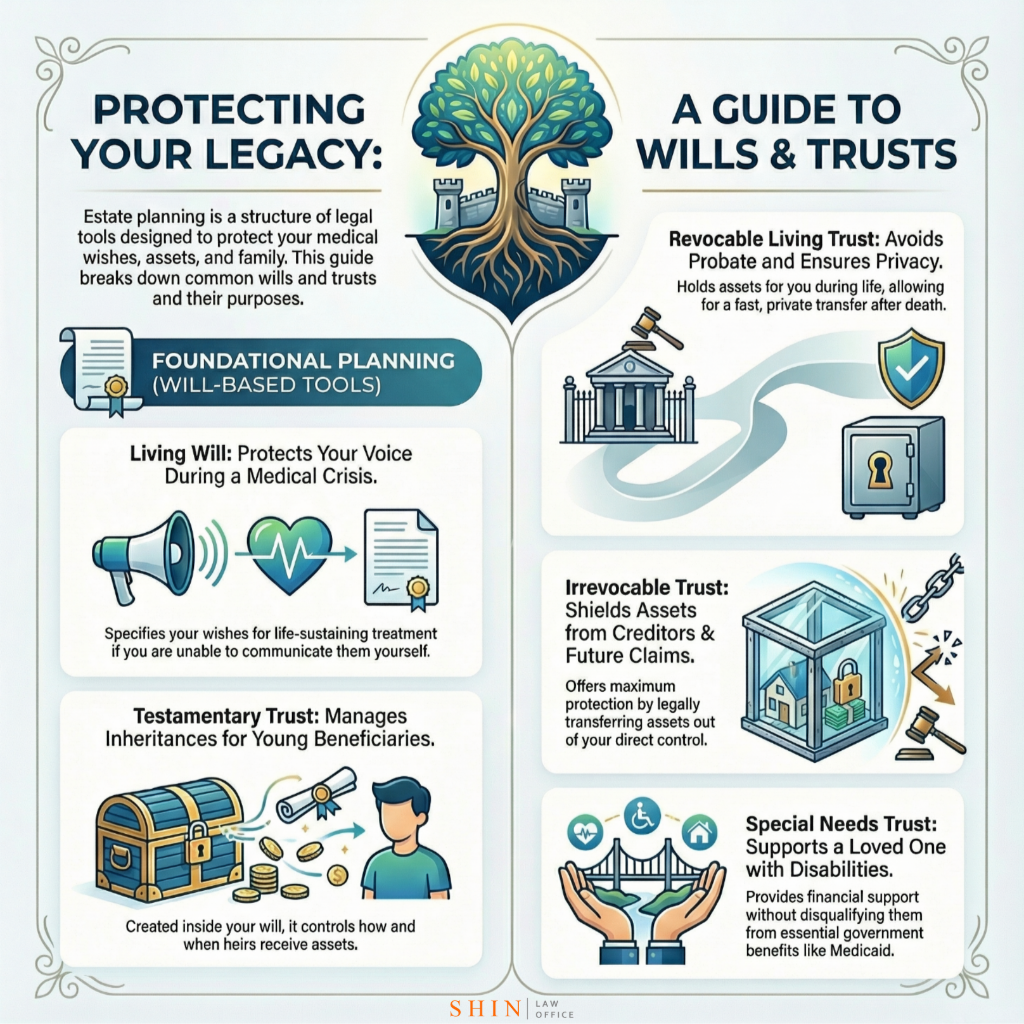
Estate planning is not only a legal process. It is one of the most personal decisions a family makes. I have sat across from clients in Fairfax County, Loudoun County, Prince William County, Arlington County, Clarke County, and Frederick County who felt overwhelmed when facing questions about living wills, medical choices, trust management, and long-term protection for their loved ones.
In this article, I explain what matters most:
How do you protect yourself during life if you cannot speak for yourself?
How do you protect your family after you pass?
How do you create clarity instead of conflict?
Virginia law gives each resident powerful tools. In my practice, I focus on two of the most misunderstood but most essential tools available. Living wills and five primary forms of trusts. I will walk you through how each works, how the Virginia Code applies, and how your choices may differ depending on whether you live in a busy city environment like Arlington or a rural landscape like Clarke County.
My goal is simple. When you reach the end of this article, you will understand how to build a plan that prevents confusion, prevents unnecessary court involvement, and keeps your family protected with clarity and dignity.
Table of Contents
- Chapter One: Living Wills in Virginia
- Chapter Two: Revocable Living Trusts
- Chapter Three: Irrevocable Trusts
- Chapter Four: Special Needs Trusts
- Chapter Five: Testamentary Trusts
- Chapter Six: Asset Protection Trusts
- Chapter Seven: Family Scenarios (County Specific)
- Final Chapter: Attorney Guidance & Roadmap
Chapter One
Living Wills in Virginia
Protecting Your Voice When You Cannot Speak
Estate planning begins long before anyone thinks about the distribution of property. It begins with a far more intimate question. What happens to me if I cannot speak? I have worked with families across Fairfax County, Loudoun County, Prince William County, Arlington County, Clarke County, and Frederick County who believed estate planning only mattered after they were gone. Yet the truth found within Virginia Code section fifty-four point two nine seven zero tells a different story.
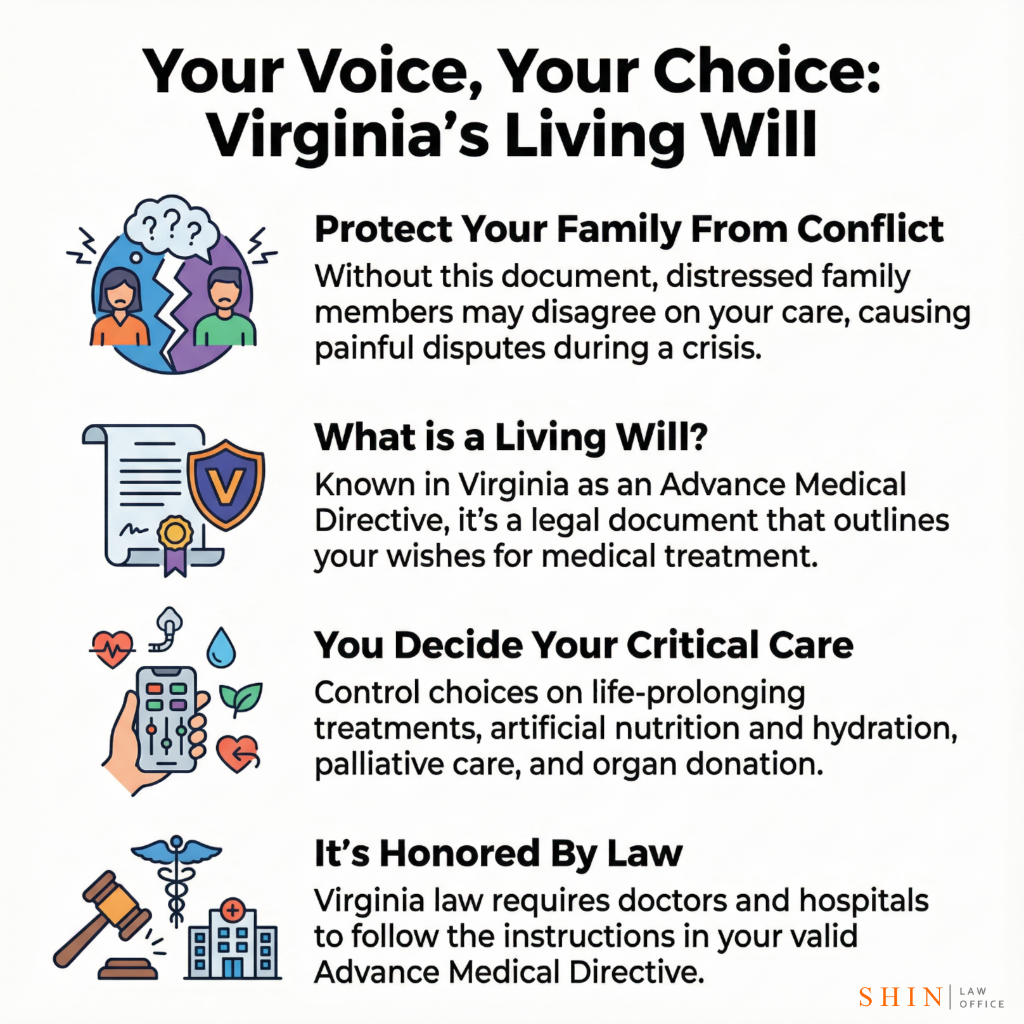
A living will in Virginia, known formally as an Advance Medical Directive, is the only document that allows you to speak clearly when your voice is taken away by illness or injury. I have sat in hospital rooms in Fairfax next to adult children who were terrified of making the wrong decision for a parent. I have counseled couples in Ashburn who did not realize that, without this document, medical teams have no written instruction to follow. I have stood beside families in Prince William County who faced heartbreaking disagreements because their loved one had never written down their wishes.
A living will allows you to remain in control of your body and your care even if you are unconscious or unable to communicate. In the most practical and human sense, this document protects your dignity.
Why Living Wills Matter More Than Most People Realize
I want you to imagine something that happens far more often than anyone likes to admit. An unexpected medical event occurs. A stroke. A sudden brain injury. A severe respiratory failure. You arrive at the hospital in Fairfax City, Leesburg, or Manassas. You are unconscious. The medical team acts quickly. Your family arrives. They stand beside you. The doctor asks them one impossible question. Has this person ever created a living will?
When the answer is no, the responsibility shifts to loved ones who are already afraid and emotional. They must make life-altering decisions without knowing what you actually want. I have seen good families fracture because of this.
A son insists his mother once said she wanted every measure taken to prolong life. A daughter remembers her saying she wanted no machines and no prolonged suffering. The doctor is caught between competing instructions from people who all care deeply, yet have no legal authority unless they have been formally designated. These painful disputes do not need to happen. A living will removes uncertainty and replaces it with clarity.
What a Living Will Covers Under Virginia Law
Virginia law recognizes that each of us must have the right to control our own medical decisions. Your living will answers questions that no family should ever have to guess.
These include
- Whether you want life-prolonging treatment when recovery is medically impossible
- Whether you want artificial nutrition
- Whether you want artificial hydration
- Whether you want palliative care that may reduce discomfort, even if it may shorten life
- Whether you want to donate organs
- Whether you authorize one chosen person to make decisions for you under a medical power of attorney
Doctors in Northern Virginia hospitals are legally required to honor a valid living will. Facilities such as Inova Fairfax Hospital in Falls Church, Reston Hospital Center in Reston, Sentara Northern Virginia in Woodbridge, Virginia Hospital Center in Arlington, and Winchester Medical Center in Frederick County all rely upon these directives to determine how to proceed in crisis conditions.
How Medical Reality Intersects with Your Wishes
People often assume that the decisions inside a living will only apply in extreme circumstances. In reality these decisions appear in far more common moments.
A Fairfax resident may suffer a stroke that leaves them unconscious for weeks. A Loudoun County resident in Ashburn may sustain a traumatic brain injury from a vehicle collision. A Prince William County resident in Dale City may be placed on a ventilator after a cardiac incident.
In these scenarios, the doctors need to know what you would choose for yourself. Would you continue on a ventilator if medical evidence shows no chance of recovery? Would you want artificial hydration if your organs are failing? Would you like comfort care in place of aggressive treatment? These answers must come from you. A living will ensures they do.
How Local Communities Shape the Way Living Wills Are Used
Each county in Northern Virginia has its own character. Families living in Arlington face different medical realities from those residing in Clarke County. I tailor every living will to the client’s unique circumstances and the local community they call home.
Fairfax County
Neighborhoods such as McLean, Fairfax Station, Oakton, and Burke often have residents who travel frequently for work or maintain complex medical histories. When a medical emergency occurs the living will becomes the guiding document that speaks instantly while family members travel back home. Fairfax hospitals rely heavily on clear directives because treatment plans often involve advanced intensive care procedures.
Loudoun County
Families in Ashburn, Sterling, Leesburg, and Purcellville often have multigenerational households. I usually work with families where grandparents, parents, and children live under the same roof. Disagreements come quickly if the family has not spoken openly about end-of-life wishes. A living will helps maintain unity by providing a legally binding set of instructions that no family member needs to interpret or debate.
Prince William County
Communities such as Woodbridge, Manassas, Haymarket, and Dumfries are diverse and fast-growing. Many families have recently moved to the area and may not have local relatives who can step in during emergencies. A living will ensures that your medical team does not need to wait for out-of-state relatives to arrive or give unclear guidance. It establishes authority immediately.
Arlington County
Arlington is home to professionals who often travel internationally, work in high-pressure government roles, or maintain irregular schedules due to federal responsibilities. A living will ensures no delay when a medical decision needs to be made quickly. Arlington medical providers are trained to look for an Advance Medical Directive immediately and will follow it.
Clarke County
Clarke County includes rural and agricultural communities where access to advanced medical facilities may involve longer travel times. Residents in Berryville or Boyce may be transported to hospitals in Winchester or Leesburg. The living will ensures that treatment preferences travel with you and remain honored no matter which facility receives you.
Frederick County
Winchester, Stephens City, and Middletown include many retirees and aging families who want clear guidance to avoid aggressive treatment that does not match their values. A living will provides that clarity and gives family members peace of mind that their loved one will be cared for in accordance with personal beliefs.
The Emotional Weight of a Living Will
I have yet to meet a client who felt comfortable the first time we discussed living wills. Thinking about the end of life feels unpleasant and overwhelming. Yet something powerful happens once a living will is completed. People tell me they feel relief. They feel protected. They feel that they have finally taken control of something they feared was uncontrollable.
In Fairfax, a client once told me that signing her living will felt like lifting a weight off her adult children. In Prince William County, a father expressed that having this document made him feel proud because he was protecting his family from conflict. In Loudoun County, a woman said it gave her peace knowing that her daughter would not be burdened with having to guess her wishes.
Why a Living Will Works Best When Paired with a Medical Power of Attorney
A living will states your treatment preferences. A medical power of attorney authorizes one trusted person to make real-time decisions when your preferences cannot be predicted.
Virginia Code § 54.2 990 recognizes this authority. I always recommend that clients designate a single decision maker rather than a group. When multiple family members must agree, conflict is almost guaranteed. When one trusted person is named, decisions become straightforward, fast, and legally sound.
Protecting Your Wishes Across Multiple Counties
Many clients live or work in one county and receive medical care in another. A Fairfax resident may be transported to a Loudoun hospital. An Arlington resident may be transferred to a facility in Fairfax. A Clarke County resident may receive care in Winchester or even in Fairfax, depending on the emergency.
Your living will is recognized throughout the Commonwealth of Virginia. Any licensed facility must honor it. This is one of the most critical protections available under Virginia law.
Preparing Your Loved Ones for Clarity Instead of Conflict
When you sign a living will, you do more than protect your own autonomy. You protect your family from the guilt and confusion that can follow a medical crisis. I encourage clients not only to sign the document but also to share its contents with the people they trust.
I have seen this preparation transform family dynamics. Conversations that once felt uncomfortable become moments of understanding and closeness. Parents express gratitude for the opportunity to guide their children lovingly, even in the most challenging moments. Adult children express gratitude that they no longer fear making the wrong choice.
Final Thoughts on Living Wills Before We Move to Trusts
A living will is not only a legal safeguard. It is an act of care. It is a statement that you want your loved ones to be protected from painful decisions. It is a promise that your medical team will know exactly how to honor your values.
Living wills represent the beginning of every strong estate plan. They establish your voice. Trusts build on that foundation and shape your legacy.
Chapter Two
Revocable Living Trusts in Virginia
A Foundation for Control, Privacy, and Probate Avoidance
If a living will protects your voice during life, a revocable living trust protects your legacy after you pass. Estate planning in Virginia cannot be complete without understanding how a revocable trust functions and why it has become the central estate tool for families in Fairfax County, Loudoun County, Prince William County, Arlington County, Clarke County, and Frederick County.
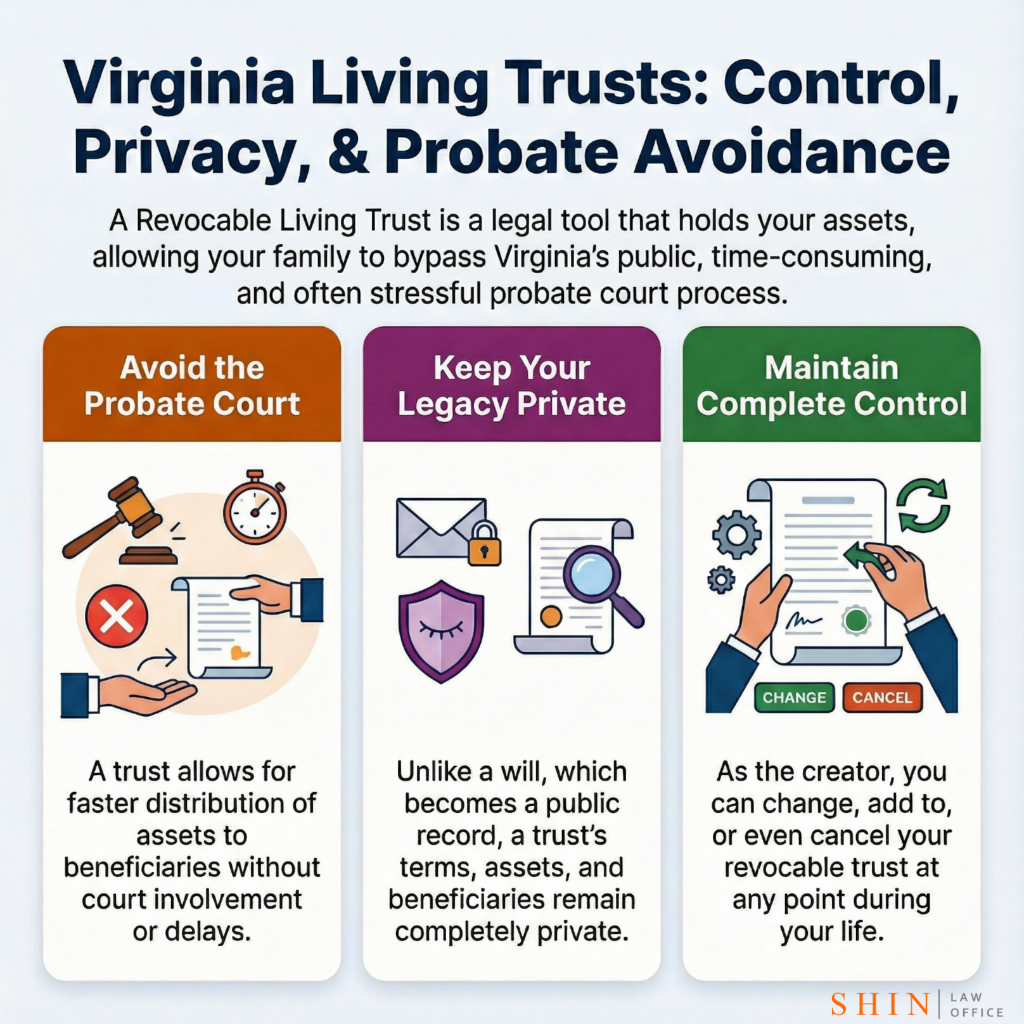
A revocable living trust is a legal arrangement created while you are alive that holds your assets for your benefit and later for your chosen beneficiaries. You control every part of it. You can change it. You can add or remove assets. You can revise it whenever life shifts around you. Under Virginia Code § 64.2, the Commonwealth recognizes these trusts as legally enforceable estate management vehicles that allow you to bypass probate, reduce conflict, create privacy, and ensure that your family receives your property exactly as intended.
Most people discover this tool only after they have witnessed a painful probate process. They have seen a parent’s estate tied up in court for months. They have watched siblings argue over access to property. They have seen the financial strain that court delays create. That is when they say the exact words I hear almost every week. If only my parents had created a trust. My goal is to make sure that families across Northern Virginia do not reach that point of regret.
What a Revocable Living Trust Actually Does
A revocable trust performs several critical legal functions. It holds title to your property. It establishes clear instructions for managing that property while you are alive and after you pass. It names a successor trustee who steps into your place without court involvement. It distributes your estate privately and efficiently.
These are the core advantages:
- Avoidance of Virginia probate
- Faster distribution to beneficiaries
- Complete privacy because trust documents are not public records
- Reduction of family conflict by providing a clear written plan
- Continuity of management if you become incapacitated
- Protection for blended families
- Flexibility to update terms during life
Probate in Virginia is not always complicated, but it is always public and always time-consuming. The moment your will is filed with the Circuit Court Clerk, anyone can request the file and read its contents. This includes your asset lists, your debts, your beneficiaries, and any disputes that arise. A trust keeps this information private. Only your trustee and your beneficiaries have access to its terms.
Why Revocable Trusts Are the Preferred Tool in Northern Virginia
Families in the counties served by Shin Law Office live in some of the most dynamic and rapidly growing regions of the Commonwealth. Real estate values fluctuate. Family structures change. Retirement patterns shift every year. A revocable trust adapts with you.
I help clients choose this structure for reasons that vary by community.
Fairfax County Trust Planning
McLean, Oakton, Burke, Fairfax Station, Reston, Vienna
Fairfax County families often own high-value real estate that is spread across multiple towns. A home in McLean may be valued differently from a townhome in Reston or a property in Fairfax Station. Many families also own investment properties, townhouses near employment centers, or older family homes passed down through generations.
When these assets pass through probate, delays occur. Real estate cannot be sold until the probate court grants authority to the executor. Mortgages must still be paid. Insurance must remain active. Utilities continue. All of this becomes overwhelming for grieving families.
A revocable trust prevents these delays entirely. Your successor trustee can immediately manage, sell, or maintain properties without waiting months for court approval. This is especially important for families living near Tyson offices, Fairfax government hubs, and Reston tech corridors, where property is both valuable and time sensitive.
In one Fairfax case I managed, a client owned a primary residence in Burke and a rental property in Annandale. Upon her passing, the trust allowed her daughter to immediately collect rent, pay expenses, and eventually sell the property. Without the trust, she would have spent many months navigating Fairfax Circuit Court before taking any action at all.
Loudoun County Trust Planning
Ashburn, Leesburg, Purcellville, Sterling, South Riding, Lovettsville
Loudoun County is known for rapid growth, technology corridors, expanding neighborhoods, and high-value homes. Many Loudoun families own multiple properties or operate small businesses. Trusts allow these assets to transition seamlessly.
Tech professionals in Ashburn who receive stock options or equity in companies often place these interests into their trust to keep the distribution private and protected. Families in Leesburg who own historic homes prefer trusts because these properties require constant management that should not pause while probate drags on.
In Purcellville and Lovettsville, where agricultural land and vineyards are common, trusts help families preserve land for future generations without interruption or forced sale. A will alone does not provide continuity. A trust ensures that operations continue without delay.
I once assisted a family in South Riding where the parents owned a small company, two rental homes, and their primary residence. With a revocable trust, the children were able to continue the business and rent the properties without waiting for a court to grant authority. This avoided financial losses and preserved family relationships.
Prince William County Trust Planning
Woodbridge, Manassas, Manassas Park, Gainesville, Haymarket, Dumfries, Nokesville
Prince William County includes a mix of suburban communities, rural farmland, and rapidly developing commercial zones. Many residents own a growing number of assets such as townhomes, rental units, and small farms.
Probate in Prince William can be particularly stressful because the county population is large and estates sometimes take longer to process. In Woodbridge and Dale City, where many families maintain multigenerational households, a trust prevents sibling disagreements and helps ensure a clean property transfer.
In Manassas and Gainesville, where new housing developments are common, homeowners often face mortgages, homeowners’ association dues, and property inspections. Without a trust, all of these obligations can stall during probate, leaving beneficiaries uncertain about their payment responsibilities.
In Nokesville, where land and agricultural operations are more common, trusts allow families to continue managing property without interruption. I created a trust for a family that operated a horse boarding farm. When the owner became incapacitated, the trust allowed her daughter to step in and run the business immediately. Without it, the operation would have stalled for months and risked closure.
Arlington County Trust Planning
Ballston, Clarendon, Rosslyn, Courthouse, Crystal City, Pentagon City
Arlington is unique because its residents often travel, work in high-security roles, or manage complex financial portfolios. Many households include two high-earning professionals who need a plan that functions efficiently during emergencies.
Arlington residents typically value privacy. Probate exposes financial details, including investment accounts, lists of debts, and asset valuations. Trusts prevent public disclosure.
Condominiums in Pentagon City or high-rise units in Rosslyn often require rapid decision-making when an owner passes away. A trust allows a successor trustee to sell, lease, or manage these units immediately, preventing association fines or legal complications.
One Arlington client worked for a federal agency with strict confidentiality requirements. He did not want his personal financial information entered into public probate records. The trust allowed his estate to pass privately, with no public record.
Clarke County Trust Planning
Berryville, Boyce, Bluemont, Millwood
Clarke County contains expansive farmland, historic rural properties, and families who value the preservation of land across generations. Trusts are vital for these clients because probate can place pressure on families to sell property to settle the estate.
A revocable trust prevents forced sales by keeping assets under trustee control. This allows family farms in Berryville or woodland property in Millwood to remain intact until the family decides how to manage them.
Clarke County is also home to residents who want to ensure that land conservation easements remain properly administered. A trust gives long-term oversight that a will cannot match.
I had a Clarke County client who owned a large historic home surrounded by protected land. By placing everything into a revocable trust, his successor trustee maintained the property according to his wishes and prevented any division or sale that would have violated the conservation goals he valued.
Frederick County Trust Planning
Winchester, Stephens City, Middletown, Clear Brook
Frederick County families often include retirees, military families, and homeowners with modest but meaningful assets. These families value simplicity. They want to avoid complicated court processes and ensure their property is transferred smoothly.
Winchester and Stephens City include many blended families. Second marriages are common, and trusts are essential in these cases. Without a trust, a surviving spouse may unintentionally disinherit children from a prior marriage because Virginia’s intestacy laws do not cover these complexities well.
With a trust, you can provide lifetime financial support for a spouse while ensuring that the ultimate beneficiaries remain your children.
In Middletown and Clear Brook, where residents often maintain multiple vehicles, equipment, or family businesses, trusts offer clarity and continuity. I assisted one family with a small machine repair shop. The trust allowed the surviving son to continue operations instantly instead of waiting months for probate authority.
Probate Avoidance: One of the Greatest Benefits
Under Virginia law, probate is required when a person passes away with assets titled solely in their name. This process requires filing a will, paying fees, submitting inventories, filing accountings, and waiting for approval. It is public, slow, and filled with potential for conflict.
A revocable trust avoids probate completely for any asset titled adequately into the trust. Families can act immediately. No delay. No fees other than normal administrative costs. No public disclosure.
I have guided families through probate in Fairfax, Loudoun, and Prince William. Even the simplest estate can take many months and require several filings. In contrast, a trust administration can take place privately and efficiently.
How a Revocable Trust Protects You During Incapacity
Many people believe trusts only matter after death. The truth is that a trust protects you during life when you cannot manage your own affairs.
If you become incapacitated, your successor trustee steps in and continues managing your finances exactly as you directed. This includes:
Paying bills
Managing property
Handling insurance claims
Maintaining rental units
Paying taxes
Managing investments
Without a trust, your family may need to petition the court for a guardianship or conservatorship under Virginia Code § 64.2. This process is stressful, time-consuming, and costly. A trust avoids it entirely.
Common Misunderstandings About Revocable Trusts
Many clients initially assume that trusts are only for wealthy families. This is not true. Trusts are valuable for anyone who wants to avoid probate, protect their privacy, and provide harmony for their family.
Others believe a will alone is enough. In many cases, a will is only the starting point and cannot provide the flexibility or efficiency that a trust offers.
Some clients worry that placing assets in a trust will reduce their control. This is also incorrect. You maintain 100% control of your trust while you are alive.
Putting Your Home into a Revocable Trust
In Northern Virginia, the family home is usually the most significant asset. Titling it into your trust prevents title complications, probate delays, and future disputes.
The trust does not affect your mortgage, your property taxes, your homeowners’ insurance, or your homestead exemption. It simply ensures that your home transitions smoothly without court involvement.
Coordinating Trusts with Beneficiary Designations
Revocable trusts work best when combined with updated beneficiary designations on accounts such as:
- Bank accounts
- Investment portfolios
- Retirement accounts
- Life insurance
A coordinated estate plan ensures that all assets flow cleanly into the trust or to the beneficiaries named outside the trust. Conflicts occur when designations are outdated or inconsistent.
The Human Impact of Having a Revocable Trust
I want to describe a common scenario I have seen across countries.
A father in Manassas passes away without a trust. His home must go through probate. His vehicles cannot be sold until the executor is appointed. His accounts are frozen. His children argue about personal belongings. Tension grows. Months pass before anything moves forward.
Now imagine the same family with a trust. The successor trustee immediately gathers assets, continues bill payments, and distributes property according to the instructions. There is no waiting. No public record. No drawn-out conflict.
This contrast is why I advocate strongly for trusts when appropriate.
Chapter Three
Irrevocable Trusts in Virginia
Long-Term Protection for Families, Land, and Legacy
If a revocable living trust is a flexible tool you control during life, an irrevocable trust is a powerful shield that protects your assets once you decide they must be preserved. I often tell clients that an irrevocable trust is less about what you own today and more about what you want to protect for the future. These trusts are designed for long-term stability. They guard property from creditors, preserve family land, support future generations, and allow for structured care planning as you age.
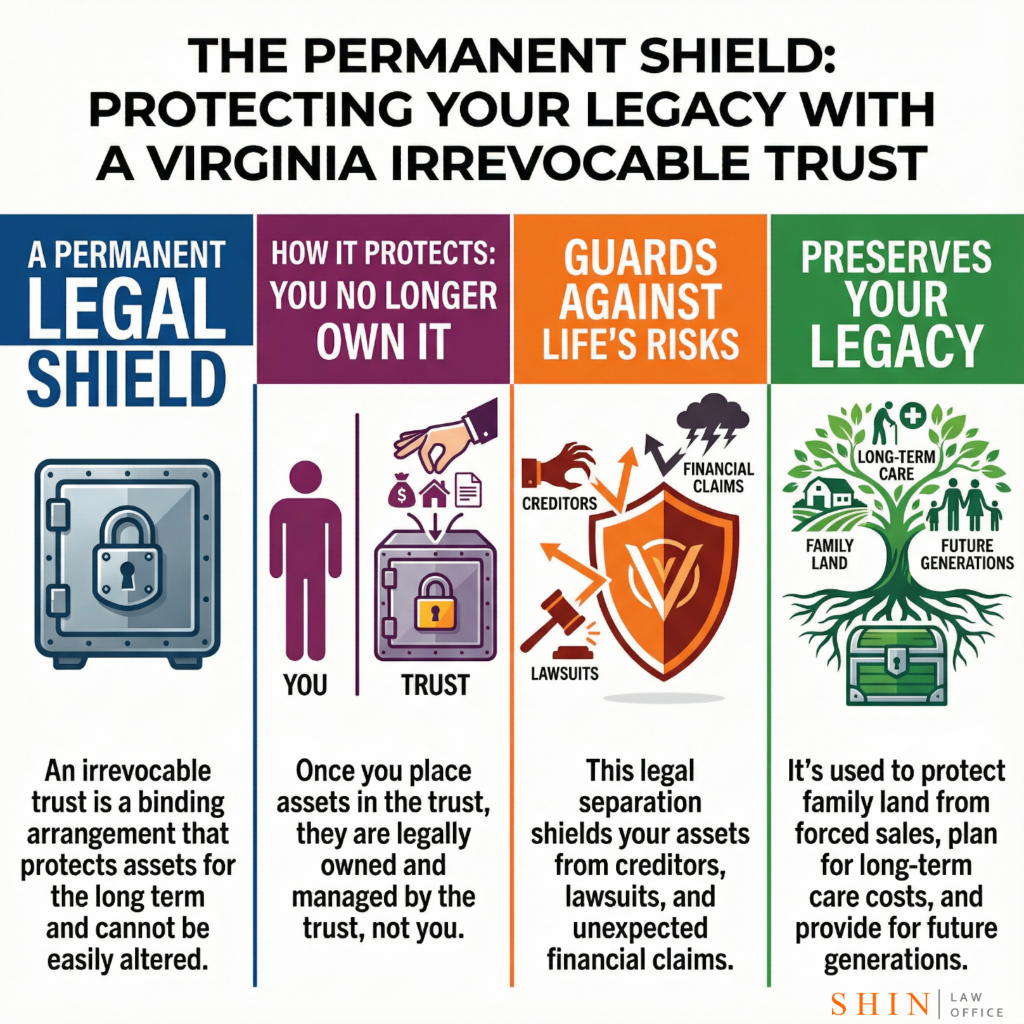
Under Virginia Code § 64.2, irrevocable trusts are recognized as binding arrangements that cannot be altered once created unless very limited exceptions apply. This permanence is precisely what gives them their unique strength. Clients across Fairfax County, Loudoun County, Prince William County, Arlington County, Clarke County, and Frederick County use irrevocable trusts to secure property that must stay protected no matter what life brings.
The reality is this. Life does not always follow our plans. Businesses fail. Health conditions appear. Family dynamics shift. Unexpected financial claims can arise. A revocable trust does not shield assets from these risks because you still control it. An irrevocable trust however changes the structure altogether. Once you place assets into it, they are no longer owned directly by you. They are held for your benefit or for the benefit of those you choose. This separation provides legal protection that cannot be achieved in any other routine estate planning arrangement.
Let me walk you through why families in each county choose irrevocable trusts and how these trusts secure the stability they need.
Why People Choose Irrevocable Trusts in the First Place
People do not wake up one morning and decide to create an irrevocable trust. This is a thoughtful decision usually made because of one of the following concerns:
- Protection from creditors
- Protection of family land from forced sales
- Long-term care planning and nursing home cost planning
- Tax mitigation for high-value estates
- Preservation of assets for children or grandchildren
- Protection of inherited assets from divorce or lawsuits
- Support for charitable giving in a controlled manner
When clients sit across from me and say they are ready to consider an irrevocable trust, it is usually because they fear losing something important. Their home. Their land. Their savings. A lifetime of hard work. The trust is their safeguard.
The Legal Purpose of an Irrevocable Trust Under Virginia Law
Under Virginia law, the defining feature of an irrevocable trust is the loss of direct control by the grantor. Once created, the trust owns the property. The trustee manages it. The beneficiaries receive it in accordance with the trust terms.
Virginia Code § 64.2 736 outlines the authority to modify or terminate trusts only under very specific and narrow conditions. This means the trust is stable and protected, even under external pressure. Creditors cannot claim the assets. Lawsuits cannot reach them. Unpredictable financial events cannot threaten what you have set aside.
County by County Reasons Clients Choose Irrevocable Trusts
Irrevocable trusts serve different purposes in each community. Families across Northern Virginia have unique goals based on their assets, land, businesses, and long-term financial concerns.
Below, I describe the reasons I see most often in each county and town.
Fairfax County
McLean, Vienna, Oakton, Fairfax Station, Burke, Reston
Fairfax County contains some of the most valuable residential properties in Northern Virginia. Families in McLean and Oakton may own homes valued well above the Virginia median, as well as investment accounts and business interests. These families often use irrevocable trusts to reduce estate tax exposure at the federal level through gifting strategies and long-term asset transfers.
In Fairfax Station and Burke, families who have accumulated wealth through federal careers or private sector engineering work often worry about future long-term care costs. When someone faces the possibility of entering a nursing facility, assets not placed into an irrevocable trust may be subject to Medicaid spend-down requirements. This means that lifetime savings can be consumed quickly. An irrevocable trust becomes a strategic tool for protecting assets for a spouse or future generations.
In Reston and Vienna, where homeowners may have second properties, investment condominiums, or retirement homes in other states, irrevocable trusts allow for multi-state coordination and protection.
I recall a Fairfax County client who had spent decades building a small technology firm. He feared that future litigation could jeopardize his family home. By placing the house into an irrevocable trust years before any claim arose, he ensured that the property would remain available for his family no matter what happened to his business.
Loudoun County
Ashburn, Leesburg, Purcellville, Sterling, Lovettsville, South Riding
Loudoun County has experienced significant growth in both population and property values. In Ashburn, where many residents work in the technology sector, clients frequently own valuable stock options, start-up equity, or investment portfolios. Irrevocable trusts allow families to protect these assets for children or grandchildren who may not yet be ready to manage them.
In Leesburg and Purcellville, where larger tracts of land and agricultural properties are common, families use irrevocable trusts to preserve farms, vineyards, and family estates. These properties often have historical value and sentimental meaning that families want to keep intact for future generations.
In Sterling and South Riding, where many families own rental homes or commercial buildings, irrevocable trusts serve as protection against liability or claims arising from tenant disputes, accidents, or property maintenance issues.
In Lovettsville, where land conservation plays a significant role in community identity, some residents use irrevocable trusts to ensure that their land cannot be developed or divided against their wishes.
One Loudoun family that owned a vineyard placed the property in an irrevocable trust to protect it from being sold if one of the siblings encountered financial difficulties. The trust ensured that the vineyard would remain in the family for generations and continue operating without interruption.
Prince William County
Manassas, Manassas Park, Woodbridge, Dale City, Gainesville, Haymarket, Dumfries, Nokesville
Prince William County includes a mix of suburban communities, rural areas, and expanding commercial corridors. Many clients come to me concerned about long-term care costs. Without planning, a sudden illness can leave most of the estate consumed by medical expenses.
In Manassas and Woodbridge, families often build wealth through steady employment, military service, or small business ownership. An irrevocable trust can protect their home and savings for a spouse or children.
In Dale City and Dumfries, where many residents care for aging parents, irrevocable trusts are used to ensure that the older generation does not lose their home to long-term care costs.
In Gainesville and Haymarke,t where residents often invest in multiple rental units, irrevocable trusts protect these assets from lawsuits or liability claims. A single-tenant dispute can result in financial exposure, and irrevocable trusts provide a protective barrier.
In Nokesville, where agricultural land and farm operations remain common, irrevocable trusts help preserve property that has often been in the family for decades.
One Prince William County client had a small trucking business and feared that a future accident claim could threaten his home. The irrevocable trust provided protection and allowed him to focus on his business without constant fear.
Arlington County
Ballston, Clarendon, Rosslyn, Courthouse, Columbia Pike, Crystal City
Arlington residents often work in fields that carry a heightened risk of litigation or financial liability. Attorneys, consultants, medical professionals, defense contractors, and government officials all face environments where claims can arise unexpectedly.
In Rosslyn and Ballston, where many clients own high-value condominiums or investment units, irrevocable trusts protect these properties from exposure under professional liability.
In Clarendon and Courthouse, where residents are often young professionals building financial portfolios, irrevocable trusts allow them to assign specific assets for long-term generational planning while keeping other assets fully under their control.
In Crystal City, where defense and technology intersect in high-security environments, irrevocable trusts provide enhanced privacy and stability.
One Arlington client worked in a profession where even a minor allegation could have led to financial claims. By placing a second home into an irrevocable trust, he insulated his family’s wealth from potential threats.
Clarke County
Berryville, Boyce, Bluemont, Millwood
Clarke County is known for its rural landscape, agricultural heritage, and preserved land. Many clients own farms that have been in their families for generations. These properties represent not only financial wealth but also emotional and cultural history.
Irrevocable trusts protect these farms from being divided, forced into sale, or lost to creditor claims. Families use these trusts to ensure that land remains intact and continues to be farmed or preserved according to long-held traditions.
In Berryville and Boyce, where large-acreage properties may be subject to land conservation restrictions, irrevocable trusts allow families to formalize the stewardship of the land.
In Bluemont and Millwood, where many residents maintain equestrian properties or orchards, irrevocable trusts provide continuity, ensuring operations can continue regardless of legal or financial challenges.
One Clarke County client told me that placing her family farm into an irrevocable trust was the first time she felt truly confident that the property her great-grandparents purchased would remain in the family for the next hundred years.
Frederick County
Winchester, Stephens City, Middletown, Clear Brook
Frederick County is home to residents who often approach estate planning with practicality and a long-term perspective. Many families have retired to Winchester or settled in Stephens City to protect modest yet meaningful assets.
In Winchester, where blended families are common, irrevocable trusts allow parents to preserve inherited assets for their own children without risking unintentional disinheritance.
In Stephens City, Middletown, and Clear Brook, where families often own small businesses, workshops, or rental units, irrevocable trusts protect these properties from unforeseen claims.
One Frederick County client owned a machine shop that employed several residents. After experiencing a lawsuit many years ago, he became determined to protect his personal property from any future risk. The irrevocable trust became his long-term solution.
Medicaid and Long Term Care Planning: The Role of Irrevocable Trusts
One of the most common reasons clients across all counties choose an irrevocable trust is long-term care planning. The cost of a nursing facility in Northern Virginia can exceed $100,000 per year. Without planning, most families are forced to spend down nearly all assets before Medicaid will assist.
Under federal and Virginia law, assets placed into an irrevocable trust before the Medicaid look back period cannot be counted as available resources. This means families can preserve homes and savings for a spouse or children instead of losing everything to long term care costs.
The key is timing. If the trust is created early enough, the protection is strong. If created late, it may not be effective. I always tell clients that long-term care planning is most successful when done before health declines.
Divorce Protection and Inheritance Stability
Irrevocable trusts also protect assets from being divided in divorce proceedings. Parents across Fairfax, Loudoun, and Prince William worry that inherited assets could be lost if their children later go through a divorce. By placing assets into an irrevocable trust for the benefit of children, the inheritance remains protected.
For example, a Fairfax mother placed her lake house into an irrevocable trust for her daughter. When the daughter later divorced, the property remained outside marital claims because it was owned by the trust, not by the daughter individually.
Creditor Protection and Lawsuit Shielding
Since the trust owns the assets rather than you, creditors generally cannot reach them. This protection is particularly valuable for clients in Arlington, Loudoun, and Prince William who operate businesses or work in high-risk professions.
Charitable Giving Through Irrevocable Trusts
Some clients use irrevocable trusts to support charitable causes while receiving tax benefits. A family in Leesburg who wanted to preserve their land for community benefit established a charitable land trust using an irrevocable trust.
The Emotional Significance of an Irrevocable Trust
Creating an irrevocable trust is an emotional decision. It requires accepting that you will no longer own the assets directly. Yet every client who ultimately signs the trust feels the same afterward. Relief. Peace. Certainty.
A Fairfax resident once said that signing the trust felt like she had finally secured her future. A Loudoun vineyard owner said it gave him confidence that his children would inherit the property without conflict. A Prince William farmer said it helped him sleep at night knowing no creditor could take his land.
Chapter Four
Special Needs Trusts in Virginia
Preserving Care, Dignity, and Eligibility for Those You Love
There is no area of estate planning more emotionally charged or more misunderstood than planning for a loved one with disabilities. Parents, grandparents, and caregivers in Fairfax County, Loudoun County, Prince William County, Arlington County, Clarke County, and Frederick County come to my office carrying the same fear. What will happen to my child, sibling, or spouse when I can no longer be there to help?
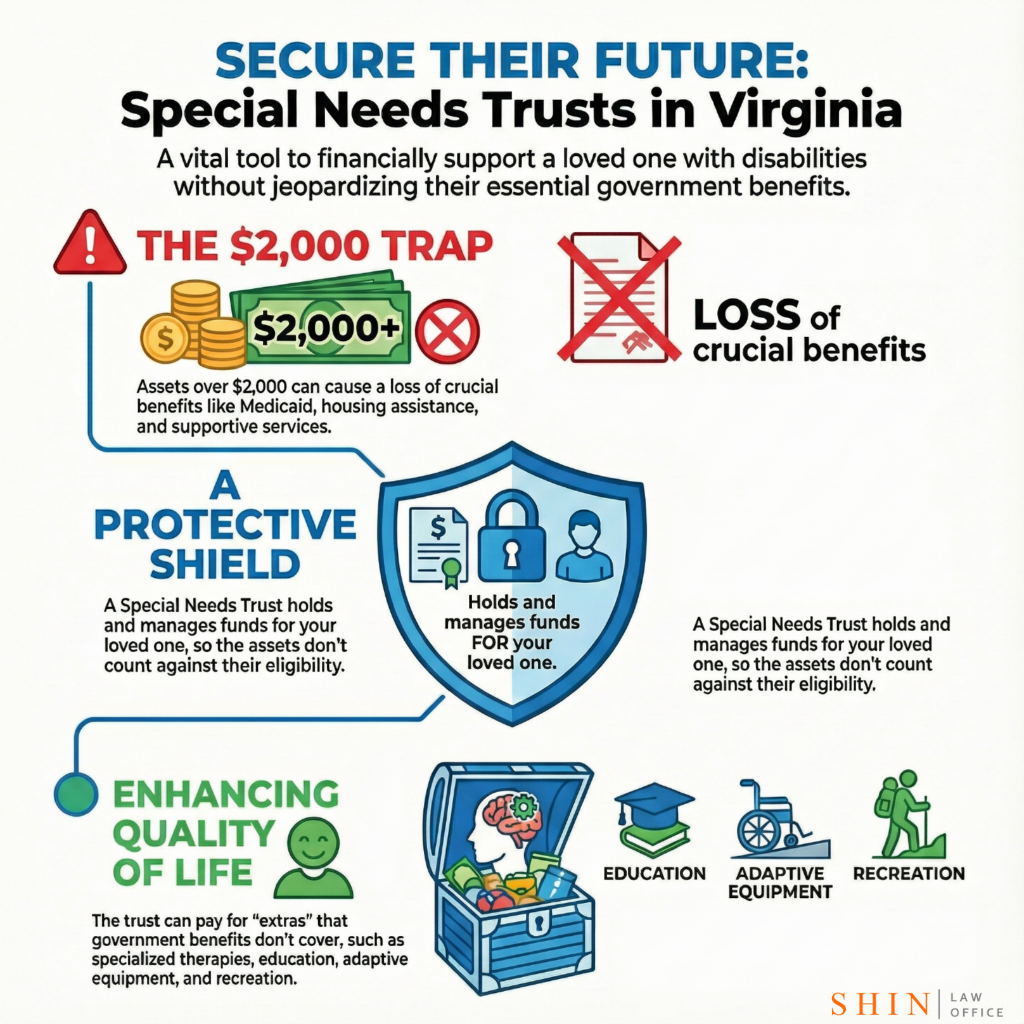
A Special Needs Trust, also known as a Supplemental Needs Trust, is one of the most potent tools available under Virginia and federal law for protecting vulnerable individuals. These trusts allow someone with disabilities to receive financial support from their family without losing essential government benefits such as Supplemental Security Income or Medicaid. Without a Special Needs Trust, a direct gift or inheritance can cause immediate disqualification from these programs. The consequences can be devastating.
Virginia Code § 64.2 1701 recognizes the validity of Special Needs Trusts and establishes the rules for their creation and administration. When properly drafted, these trusts provide a lifetime of controlled support while maintaining eligibility for public assistance programs that provide crucial medical care and services.
In my years of practice, I have found no estate planning document that offers families more peace of mind than a Special Needs Trust. It forever changes the trajectory of a vulnerable loved one’s life.
Why Special Needs Trusts Are Essential in Virginia
If a person with disabilities receives money directly, whether through inheritance, lawsuit settlement, or even a family gift, that money is counted as an available resource under federal and state benefit rules. These rules generally require an individual to maintain assets of less than $2,000 to remain eligible for Supplemental Security Income or Medicaid.
Once the individual exceeds that threshold, benefits may stop. That means:
- Loss of Medicaid coverage
- Loss of supportive services
- Loss of housing assistance
- Loss of personal care assistance
- Loss of vocational support
- Loss of transportation programs
- Loss of adult day care programs
The heartbreaking truth is that many families unknowingly jeopardize benefits by naming a child or adult with disabilities as a direct beneficiary in a will or insurance policy. A Special Needs Trust prevents this scenario entirely. The trust holds and manages the funds. The individual never owns the assets, and therefore, those assets are not counted against eligibility.
What a Special Needs Trust Can Pay For
A Special Needs Trust can provide the extras that improve quality of life, but cannot replace benefits covered by government programs. These include:
- Therapies not covered by insurance
- Education and training
- Transportation
- Adaptive equipment
- Personal care services beyond Medicaid coverage
- Communication devices
- Recreational programs
- Travel
- Companionship services
- In-home modifications
- Health and wellness programs
- Special dietary needs
The trust can fund nearly anything that contributes to dignity, independence, and quality of life. It becomes a lifetime support system tailored to your loved one’s needs.
County by County Perspectives on Special Needs Trusts
Families throughout Northern Virginia share common concerns, but each county presents unique circumstances that shape how these trusts are used.
Fairfax County
Fairfax City, Burke, Reston, McLean, Annandale, Springfield
Fairfax County has extensive educational and therapeutic resources for individuals with disabilities. Families often rely on Fairfax County Public Schools’ support programs, Inova Health Services, and behavioral health centers. A Special Needs Trust creates a stable financial foundation that supplements these services.
In McLean and Oakton, where families may have more substantial assets, parents often want to ensure that their child will not lose Medicaid-funded personal care assistance. The trust allows them to provide additional care without jeopardizing eligibility.
In Burke and Springfield, many families care for aging parents with dementia. A Special Needs Trust can protect funds for caregivers and ensure continuity of services even after the parent who managed the finances passes away.
In Reston, where many residents work in the technology sector, children with autism often utilize specialized therapy programs. A Special Needs Trust ensures that advanced or experimental therapies that are not covered by insurance remain available.
I once worked with a Fairfax family whose adult son relied on a combination of Medicaid and community-based programs. A well-meaning aunt left him $25,000 in her will. This inheritance would have removed his eligibility for benefits. We corrected the issue only because the funds had not yet been distributed. The family immediately created a Special Needs Trust and directed the inheritance into it.
Loudoun County
Ashburn, Leesburg, Sterling, Purcellville, South Riding, Lovettsville
Loudoun County is home to many families raising children with developmental disabilities such as autism, Down syndrome, or intellectual disabilities. The county offers specialized educational support and therapy centers, but long-term planning requires more than school-based assistance.
In Ashburn, where technology professionals often work demanding schedules, parents need reassurance that their child will be supported even if they cannot be present. Special Needs Trusts give them that reassurance.
Leesburg and Purcellville families frequently include multigenerational households where parents may worry about caring for both a disabled child and aging relatives. A Special Needs Trust simplifies this by ensuring stable financial resources for one generation while allowing the next generation to contribute without disrupting benefits.
In Sterling and South Riding, where real estate values are rising, families often want to leave property to a child with disabilities. Direct property ownership would jeopardize benefits, but a Special Needs Trust can hold the property and allow the child to live in it while preserving full eligibility.
In Lovettsville, where community-centered living is essential, Special Needs Trusts allow families to fund enrichment activities and local participation.
Prince William County
Manassas, Woodbridge, Dale City, Gainesville, Haymarket, Dumfries, Nokesville
Prince William County includes diverse families with varied economic backgrounds. Parents often work hard to build savings for a child with disabilities, but do not realize that direct ownership of those funds can cause the child to lose benefits.
In Manassas and Woodbridge, where families may rely heavily on Medicaid for medical coverage, a Special Needs Trust ensures that expensive therapies, prescriptions, and home health services remain uninterrupted.
In Gainesville and Haymarket, where many children participate in developmental programs, parents use Special Needs Trusts to fund private therapy sessions that exceed what insurance covers.
In Dale City and Dumfries, where families may face employment instability, these trusts create a long-term financial safety net.
In Nokesville, where agricultural lifestyles are the norm, families sometimes leave land or income-producing property to a child with disabilities. A Special Needs Trust can hold the property, generate income, and preserve all benefits.
I once guided a Prince William family who feared that their adult daughter with Down syndrome would be left without support if something happened to them. The trust provided a structured plan for lifelong care.
Arlington County
Ballston, Clarendon, Rosslyn, Courthouse, Crystal City, Columbia Pike
Arlington families often have children with disabilities who benefit from advanced therapy programs, private schooling options, and community enrichment opportunities. A Special Needs Trust provides financial support while protecting access to Medicaid-funded services.
Many Arlington residents also have retirement accounts, stock options, and employer-based benefits. Leaving these assets directly to a disabled child can cause immediate benefit loss. Instead, the assets can be directed into the trust.
In Clarendon and Ballston, where many young professionals are raising families, parents often begin planning early, sometimes when their children are still toddlers. Early trust creation gives families a long runway to build a secure financial future.
In Rosslyn and Pentagon Cit,y where residents often travel internationally or work in classified environments, a trust ensures that someone else can manage the child’s needs without delays or complications.
Clarke County
Berryville, Boyce, Bluemont, Millwood
Clarke County families often have deep local ties. Many households include adult children with disabilities who have always lived at home. When aging parents begin to consider the future, they often fear what will happen when they can no longer provide care.
Special Needs Trusts offer a compassionate and structured plan. Parents can fund the trust with life insurance, savings, or property. The trust then pays for supplemental care, transportation, home modifications, companionship programs, or part-time caregiving.
In Berryville and Boyce, where family farms are common, trusts can hold property interests and provide ongoing support without risking benefit eligibility.
In Bluemont and Millwoo,d where community life is quieter, the trust can fund activities that keep the individual engaged, supported, and socially connected.
Frederick County
Winchester, Stephens City, Middletown, Clear Brook
Winchester and Stephens City families often rely heavily on state and federal programs for a disabled loved one. When parents or grandparents leave even a modest inheritance directly to a disabled child, benefits can be interrupted immediately.
A Special Needs Trust ensures that the inheritance supplements rather than replaces government programs.
In Middletown and Clear Brook, where community-based living arrangements are more common, trusts can fund transportation, outings, skill workshops, and individualized care.
One Frederick County family I assisted had a son with significant medical needs. His parents worried constantly about what would happen after they passed. When they created the trust, they told me they finally felt peace for the first time in many years.
First Party and Third Party Special Needs Trusts
Special Needs Trusts come in two main forms:
A first-party trust is funded with the disabled individual’s assets. Virginia requires that any funds remaining in this type of trust after the individual passes be repaid to Medicaid.
A third-party trust is funded with someone else’s assets, such as a parent or grandparent. This type of trust does not require repayment to Medicaid. It is the most common form we use for long-term planning.
Both types protect eligibility for Supplemental Security Income and Medicaid, but they are used in different circumstances, which I carefully evaluate with each family.
The Trustee’s Responsibilities
Choosing the trustee is a critical decision. The trustee must:
- Pay allowable expenses
- Maintain accurate records
- Ensure compliance with Virginia and federal law
- Communicate with caregivers
- Coordinate services
- Protect trust assets
- Submit reports when required
Some families choose a relative. Others select a professional fiduciary. The decision depends on the complexity of the assets and the beneficiary’s needs.
Common Mistakes Families Make Without Realizing It
I often see the same errors before families come to me:
- Naming a child with disabilities as a direct beneficiary
- Leaving life insurance directly to the child
- Allowing grandparents to gift money directly
- Titling property in the child’s name
- Failing to coordinate Social Security and Medicaid rules
- Waiting too long to create trust
These mistakes can result in loss of essential benefits that the family depends on. Fortunately, with proper planning, many of these errors can be corrected.
The Emotional Reality Behind Special Needs Trusts
Creating a Special Needs Trust is an emotional journey. Parents often feel guilt or sadness when planning for a future where they may not be present. Others feel overwhelmed by the complexity of benefit rules.
But when the trust is complete, families repeatedly express a deep sense of relief. One mother in Fairfax told me that signing the trust felt like giving her daughter a future she could trust. A father in Loudoun told me he felt like a weight had lifted from his chest. A grandmother in Prince William’s cried when she learned that her grandson would never lose his care even if she passed unexpectedly.
These are the moments that remind me why this work matters.
When You Are Ready for Part Five
The following section covers Testamentary Trusts, which are created in a will and take effect after death. These trusts allow parents to control how and when children or other beneficiaries receive assets.
Chapter Five
Testamentary Trusts in Virginia
Guiding Your Loved Ones After You Are Gone
Some estate planning tools operate while you are alive. Others activate only after you pass. A testamentary trust is one of the latter. It is created inside your will and becomes legally effective only upon your death under Virginia Code § 64.2. For many families in Fairfax County, Loudoun County, Prince William County, Arlington County, Clarke County, and Frederick County, a testamentary trust provides a structured and thoughtful way to care for children, dependents, or loved ones long after the will has been probated.

A testamentary trust is more than an estate device. It is a message to your family about how you want them to be supported, protected, and guided when you are no longer physically present to help them. It gives you the ability to shape the future by creating instructions that last for years or even decades.
I tell clients that a testamentary trust is essentially your voice carried forward in time. Whether you want to ensure that your children receive income gradually, or you wish to delay access to large inheritances until maturity, or you want to create educational opportunities for grandchildren, this type of trust allows you to define how your legacy should be used.
How Testamentary Trusts Work Under Virginia Law
A testamentary trust is written into your will. Once your will is admitted to probate, the trust springs into existence. The court recognizes the trust as legally binding, and the trustee you named becomes responsible for managing the assets according to your instructions.
Virginia Code § 64.2 1900 explains that such trusts are governed by the same fiduciary standards as other trusts. This means the trustee must act with loyalty, care, prudence, and accountability.
Testamentary trusts can:
Hold money for minor children
Distribute income gradually
Protect assets from misuse
Provide for a spouse while preserving assets for children
Support a disabled adult
Protect inheritances in blended families
Preserve family land or businesses
Fund education or major life goals
Clients choose these trusts when they want control after death but do not need the flexibility or probate avoidance benefits of a revocable living trust.
Why Parents Often Prefer Testamentary Trusts
Parents often choose testamentary trusts because they worry about giving a large inheritance to a child who is not yet ready to manage it responsibly. I have seen countless cases where an 18- or 21-year-old inherits a significant sum of money and loses it quickly due to inexperience or the influence of others.
A testamentary trust prevents this by requiring the trustee to release funds gradually or only for specific purposes. For example, you can instruct that your child receive support for education, housing, or health expenses, but cannot withdraw principal until a certain age, such as 25 or 30. You can also divide distributions into milestones such as 1/3 at 25, 1/3 at 30, and 1/3 at 35. You can require completion of college programs or employment stability. The structure is entirely your decision.
County by County Examples of How These Trusts Are Used
The effectiveness of testamentary trusts becomes more apparent when we examine the real-world circumstances families face in each county and community.
Fairfax County
McLean, Vienna, Burke, Reston, Fairfax Station, Oakton
Fairfax County families often include high-achieving children who have access to college, internships, and early career opportunities. Parents here frequently want to encourage education without enabling irresponsible spending. A testamentary trust ensures that children receive support for tuition, rent, or career development while protecting the principal.
In McLean and Vienna, where real estate values are high, parents often want to prevent a child from impulsively selling the family home. A testamentary trust can hold the home and allow the child to live in it while restricting the sale until an appropriate age.
In Burke and Reston, where many families have college-bound students, parents use these trusts to support higher education without giving unrestricted access to inherited funds.
A Fairfax Station couple I assisted had two teenage children. They feared the children would be overwhelmed by receiving large inheritances at a young age. Their testamentary trust now ensures that funds are distributed only for education, medical needs, first home purchases, and later for structured income during adulthood.
Loudoun County
Ashburn, Leesburg, Sterling, Purcellville, South Riding, Lovettsville
Loudoun County families often have children involved in athletics, technology programs, or college preparatory paths. A testamentary trust provides financial support without giving the child immediate control over high-value inheritances.
In Ashburn and Leesburg, where many families rank among high-income earners, parents frequently establish trusts to preserve wealth for future generations. They do not want assets depleted through impulsive decisions or financial inexperience.
In Purcellville and Lovettsville, where families own agricultural land or vineyards, testamentary trusts preserve property so it cannot be divided or sold until children reach maturity and fully understand the importance of the land.
In Sterling and South Riding, where households may include exceptional circumstances such as stepchildren or blended families, testamentary trusts clarify distribution and prevent disputes among siblings.
One Loudoun family owned a large home in Ashburn and wanted to prevent the property from being sold until all three children completed college. Their testamentary trust holds the house, maintains it through a trustee, and allows the children to decide together once they are all adults.
Prince William County
Manassas, Woodbridge, Dale City, Dumfries, Gainesville, Haymarket, Nokesville
Prince William County includes a broad mix of family situations. Many clients have children who are still young or in high school. A testamentary trust ensures that their needs are met without giving a minor control over substantial funds.
In Manassas and Woodbridge, many families want trusts to protect inheritances from potential outside influence. A young adult may have friends or romantic partners who steer them toward poor financial decisions. The trust offers a safeguard.
In Gainesville and Haymarket, where families often own newer homes or real estate investments, a testamentary trust allows the trustee to manage property during the child’s younger years.
In Nokesville, where agricultural and family-operated properties are common, parents often use testamentary trusts to ensure the continuity of farm operations.
I once advised a Prince William family whose oldest child had difficulty managing money. A testamentary trust allowed the family to leave an inheritance safely and responsibly, ensuring long-term support without jeopardizing the child’s stability.
Arlington County
Ballston, Clarendon, Rosslyn, Crystal City, Courthouse
Arlington families often face demanding careers and fast-paced urban living. Many parents want to ensure that their minor children will not be overwhelmed by sudden access to wealth.
In Ballston and Clarendon, where residents often rent or own condominiums, parents frequently specify that the trust can pay for education and living expenses but cannot release lump sums until the child reaches a mature age.
In Rosslyn and Crystal Cit,y where many parents work in defense or technology sectors, incomes may fluctuate, and testamentary trusts offer stable support for children if something unexpected happens.
In the Courthouse, where many professionals plan to relocate or travel, testamentary trusts provide a long-term structure even when children may move between countries or states.
Clarke County
Berryville, Boyce, Bluemont, Millwood
Clarke County families often use testamentary trusts to preserve land, family homes, and agricultural operations. Parents frequently want their children to learn responsibility and understand the value of the land before gaining control.
A family in Berryville placed their farmland into a testamentary trust. The trust allows income from the land to support the children, but ownership cannot transfer until all children reach a specific age or demonstrate readiness to manage the property.
In Boyce and Bluemont, where small businesses or orchards are common, testamentary trusts allow operations to continue without interruption.
In Millwoo,d where historic homes carry cultural significance, parents use these trusts to prevent premature sale or division of property.
Frederick County
Winchester, Stephens City, Middletown, Clear Brook
Frederick County includes many practical planners who understand that children develop financial maturity at different stages. Testamentary trusts allow parents to protect modest but meaningful assets.
In Winchester and Stephens City, where blended families are ordinary, a testamentary trust ensures either an equal distribution or a tailored one that reflects the parents’ wishes.
In Middletown and Clear Brook, where many families operate small businesses or workshops, these trusts allow children time to decide if they want to continue operations or sell responsibly.
One Frederick County family used a testamentary trust to hold a family cabin. The trust required that all siblings agree unanimously before selling the property, preventing conflict and preserving family heritage.
Testamentary Trusts for Spouses and Blended Families
In second marriages or blended families, testamentary trusts protect children from previous relationships while still providing for the surviving spouse. These trusts may provide the spouse with a lifetime income or a residence while retaining the principal for the children after the spouse passes.
This structure prevents unintentional disinheritance and preserves family harmony.
Protecting Children with Special Challenges
Testamentary trusts are critical for children who are:
- Financially inexperienced
- Susceptible to influence
- Recovering from addiction
- Receiving government benefits
- Struggling with debt
- Entering high-risk employment fields
In these cases, the trust serves as a long-term stabilizer, supporting the child without placing assets directly in their hands.
The Trustee’s Role
The trustee manages the trust according to your instructions. They must act in the child’s best interest with:
- Prudent management
- Detailed accounting
- Steady communication
- Fiduciary responsibility
- Long-term oversight
You may choose a relative, a trusted friend, or a professional fiduciary. The right choice depends on the complexity of the trust and your children’s needs.
The Emotional Meaning Behind a Testamentary Trust
Parents often approach testamentary trusts with mixed emotions. They feel protective. They feel concerned about the future. They want to give guidance without controlling their children forever.
A testamentary trust allows parents to express their love in a structured, responsible way. It is a gift of stability, wisdom, and protection that lasts long after they have passed.
One mother in Fairfax told me she wanted her children to know she believed in their potential, but also tried to protect them from mistakes she knew they might make when young. Her testamentary trust delivered exactly that balance.
Chapter Six
Asset Protection Trusts in Virginia
Safeguarding What You Have Built for the People You Love
There comes a moment in many people’s lives when they realize that protecting wealth is just as important as creating it. Families across Fairfax County, Loudoun County, Prince William County, Arlington County, Clarke County, and Frederick County bring me the same concern. They worked for years to build a home, a business, a retirement fund, or an investment property, and now they want to make sure it cannot be lost to a lawsuit, a creditor claim, a family dispute, or an unexpected financial event.

An Asset Protection Trust is one of the strongest ways to secure that protection. Although Virginia does not currently authorize the same form of domestic asset protection trusts offered in some other states, Virginia residents can still build powerful asset protection strategies using irrevocable trusts, out-of-state trust structures, and layered planning approaches.
I explain to clients that the purpose of an asset protection trust is straightforward. It creates a barrier between your assets and potential legal or financial threats. This barrier keeps your wealth intact so it can support your family and future generations, rather than being exposed to claims arising from business risks, professional liability, or personal financial uncertainty.
In my practice, I see asset protection trusts used by business owners, professionals in high liability fields, military officers, federal contractors, medical professionals, property investors, and families with valuable real estate. Each trust is uniquely tailored to the individual and the county they call home.
What an Asset Protection Trust Actually Does
The primary purpose of an asset protection trust is to distance assets from your personal ownership so creditors or litigants cannot easily reach them. Once assets are transferred into the trust, they are managed by a trustee under terms you establish.
These trusts protect against:
Creditor claims
Medical debt
Business liability
Professional malpractice claims
Lawsuits from accidents
Divorce claims
Predatory financial behavior
Unexpected economic downturns
The trust becomes a wall that dire circumstances cannot penetrate. You still benefit from the assets according to the rules you set, but they are no longer directly vulnerable.
The Legal Foundation in Virginia
Although Virginia law does not authorize self-settled domestic asset protection trusts as some other states do, properly structured irrevocable trusts can still provide significant protection. Many asset protection strategies involve:
- Transferring assets into an irrevocable trust
- Ensuring the trust contains independent trustee requirements
- Ensuring the trust restricts direct control by the grantor
- Using out-of-state trust jurisdictions
- Coordinating with federal protections
- Integrating long-term care planning
- Combining protections with business entity structures
- Adding layers, such as limited liability companies
The strength of the trust depends on careful planning, proper timing, and adherence to legal formalities.
Why Families in Northern Virginia Need Asset Protection
Northern Virginia residents face unique liability exposure due to the region’s economic structure. Many clients work in fields that carry inherent risk, such as:
- Consulting
- Information technology
- Government contracting
- Defense work
- Medical professions
- Construction
- Real estate investment
- Transportation and logistics
- Small business operation
One lawsuit can jeopardize a lifetime of work. Asset protection trusts prevent that outcome.
County by County Uses of Asset Protection Trusts
Below, I explain the real-world reasons why clients in each community use these trusts.
Fairfax County
McLean, Fairfax Station, Burke, Vienna, Oakton, Reston
Fairfax County contains some of the most valuable personal and business assets in Virginia. High-earning professionals, executives, consultants, physicians, small business owners, and federal employees often seek asset protection planning.
In McLean and Oakton, where homes may be worth millions of dollars, families fear losing their property to litigation related to their careers or business activities. Asset protection trusts preserve family homes and investment accounts from these risks.
In Fairfax Station and Burke, where many residents own rental properties or small businesses, a single accident claim or tenant dispute can place assets at risk. The trust shields those properties so rental income continues uninterrupted.
In Reston and Vienna, where technology professionals often hold valuable stock or equity interests, asset protection trusts ensure that business failures or creditor disputes do not affect personal wealth.
One Fairfax client owned a consulting firm that occasionally became involved in complex contractual disputes. He once told me that knowing his home and retirement assets were insulated through trust planning allowed him to work without constant fear.
Loudoun County
Ashburn, Leesburg, Sterling, Purcellville, South Riding, Lovettsville
Loudoun County is a hub for technology, data centers, real estate development, and entrepreneurial activity. Residents often own properties, businesses, or investment portfolios that carry litigation risk.
In Ashburn, where many technology employees have high incomes and valuable assets, trusts protect wealth from unforeseen liabilities.
In Leesburg, where historic properties and family land remain significant, trusts ensure that lawsuits or creditor problems do not threaten inherited property.
In Sterling and South Riding, where many residents own rental units or operate side businesses, asset protection trusts secure those investments long-term.
In Purcellville and Lovettsville, where agricultural land and vineyards are common, asset protection structures help preserve land that carries both financial and cultural importance.
I once assisted a Loudoun County winery owner who wanted to protect the vineyard from business-related lawsuits. The trust structure we established ensured that the land would remain protected while still allowing the winery to operate.
Prince William County
Manassas, Woodbridge, Gainesville, Haymarket, Dale City, Dumfries, Nokesville
Prince William County includes a wide range of professions, businesses, and investment portfolios. Asset protection trusts are used here for both personal and business reasons.
In Manassas and Woodbridge, where many families run small businesses or own rental properties, trusts prevent personal homes and savings from becoming entangled in business-related claims.
In Gainesville and Haymarket, where high-value residential developments attract real estate investors, trusts protect equity from market fluctuations and liability issues.
In Dale City and Dumfries, where many residents work physically demanding jobs, medical debt or injury-related claims can threaten savings. Trusts provide stability.
In Nokesville, where agricultural operations are everyday, families use asset protection trusts to preserve farmland across generations.
One Prince William family I helped was in the contracting business. They wanted to ensure that their home, retirement accounts, and investment properties were protected from business-related accidents. The trust gave them confidence to grow their business without fear.
Arlington County
Clarendon, Ballston, Rosslyn, Courthouse, Pentagon City, Columbia Pike
Arlington residents frequently work in careers that carry significant liability, such as law, medicine, federal contracting, or consulting. The fast-paced environment and high-value assets in Arlington mean that many families choose asset protection planning.
In Clarendon and Ballston, where condominiums and investment properties are standard, trusts ensure those assets remain secure from litigation.
In Rosslyn and Pentagon City, where many employees work in high-risk government or defense roles, asset protection trusts provide privacy and security.
In the Courthouse, where young professionals are building wealth rapidly, trusts prevent early financial mistakes from causing long-lasting damage.
One Arlington client worked in a field where even a minor professional dispute could result in large claims. The trust protected her assets so she could continue her career without anxiety.
Clarke County
Berryville, Boyce, Bluemont, Millwood
Clarke County families often own farmland, agricultural businesses, horse properties, or inherited estates. These assets are often deeply tied to family identity.
Asset protection trusts preserve these properties from creditor claims, business disputes, or unforeseen financial circumstances.
In Berryville and Boyce, where large-acreage properties are common, trusts prevent forced sales due to liability claims.
In Bluemont and Millwood, where families often own historic homes or equestrian properties, trusts provide long-term protection and continuity.
One Clarke County family used an asset protection trust to shield a historic farm that had been in the family for more than one hundred years. The trust ensured that the land would never be lost to lawsuits or debt.
Frederick County
Winchester, Stephens City, Middletown, Clear Brook
Frederick County residents often own family businesses, workshops, agricultural land, or rental units. Asset protection trusts provide stability against economic downturns, liability claims, and generational disputes.
In Winchester, where blended families are ordinary, trusts preserve assets for children rather than leaving them vulnerable to outside claims.
In Stephens City and Middletown, where many businesses are small and family-run, trusts prevent personal property from being pulled into disputes involving the company.
In Clear Brook, where agricultural operations are everyday, trusts protect land and equipment from financial uncertainty.
Divorce Protection
One often-overlooked benefit of asset protection trusts is their ability to shield assets from divorce-related claims. Parents in Fairfax, Loudoun, Prince William, and Arlington frequently create trusts so a child’s inheritance remains separate property even if the child later marries and divorces.
Protection from Financial Predators
Some beneficiaries are vulnerable to financial manipulation or predatory behavior. Asset protection trusts prevent outsiders from accessing the funds and provide structured oversight.
Emotional Value of Asset Protection Planning
Asset protection is not simply a financial strategy. It is an emotional commitment to safeguarding everything you have built. Families tell me that they sleep better knowing their assets are secure. They tell me they feel empowered rather than afraid of the unknown. The trust becomes a promise to themselves and to their loved ones that the wealth they worked for will endure.
Chapter Seven
County and Town Specific Scenarios
How Living Wills and Trusts Protect Families Across Northern Virginia
One of the most powerful ways to understand estate planning is to see how it changes real families’ lives. Each county in Northern Virginia has its own rhythm, its own community culture, and its own pressures. Estate planning must meet the realities of each family where they live, work, and raise their children.
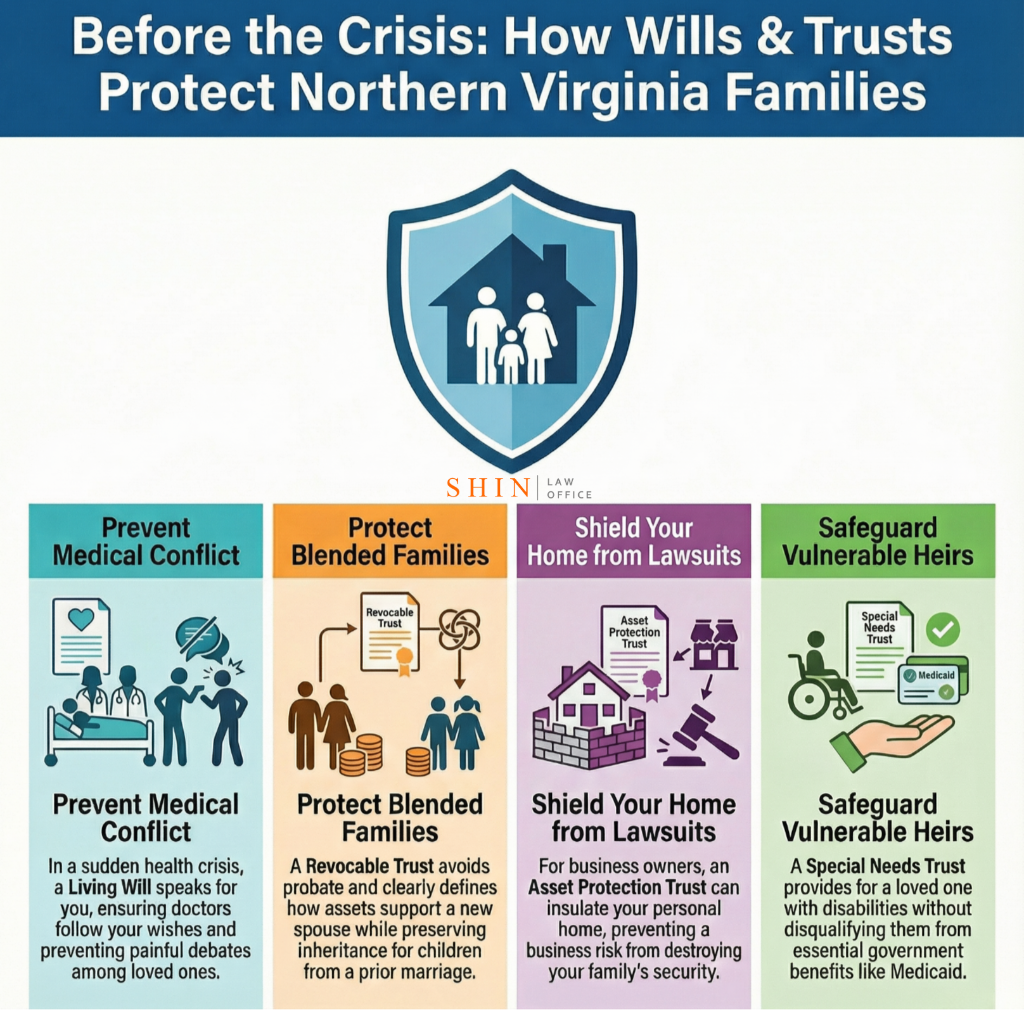
In this section, I share fully developed scenarios drawn from years of practice. Each story is a composite example based on patterns I see repeatedly. Every situation demonstrates how living wills, revocable trusts, irrevocable trusts, special needs trusts, testamentary trusts, and asset protection trusts become crucial at the very moment life takes an unexpected turn.
These scenarios represent the challenges that families in Fairfax County, Loudoun County, Prince William County, Arlington County, Clarke County, and Frederick County confront every single year.
Scenario One: Fairfax County, A Sudden Emergency With No Living Will
Fairfax City, McLean, Oakton, Reston, Burke
A father of three from McLean collapses unexpectedly while jogging. He is rushed to Inova Fairfax Hospital, unconscious and unable to communicate. The doctors ask his family about life-sustaining treatment. The family never discussed these decisions. His wife believes he would want aggressive care. His oldest son insists he once said he did not wish to be placed on machines. His daughter is overwhelmed and terrified.
The medical team cannot determine the patient’s wishes. Conflict grows. Emotions overtake reason. The family is forced into a painful debate during the worst moment of their lives.
If this father had signed a living will, the hospital team would have followed it immediately. There would be no conflict. No confusion. No guilt. His voice would guide his care even though he could not speak.
Families in Fairfax County tell me that advanced medical treatment options available in the region make living wills even more critical. The choices are complex. The consequences are emotional. A written directive removes the burden from the people you love.
Scenario Two: Fairfax County Blended Family Relief Through a Revocable Trust
Burke, Fairfax Station, Vienna
A mother in Burke passes away, leaving two children from her first marriage and a current spouse from her second marriage. She believed her will would be enough to protect everyone. However, her property is tied up in probate. Her spouse begins making decisions that unintentionally disadvantage the children. Tension rises. Misunderstandings escalate. The children feel replaced. The spouse feels attacked.
A properly funded revocable living trust would have prevented the entire conflict. It would have:
- Transferred assets without probate
- Separated property clearly
- Provided financial support for the spouse
- Preserved inheritance for the children
- Eliminated confusion and resentment
Blended family conflict is one of the most common problems I see in Fairfax County. Trusts provide clarity and peace that wills alone cannot guarantee.
Scenario Three Loudoun County A Vineyard Preserved Through an Irrevocable Trust
Purcellville, Lovettsville, Leesburg
A family in Purcellville owns a vineyard that has been passed down for generations. One sibling lives on the property and manages the operations. Another sibling lives in Leesburg and has financial troubles. A creditor pursues the second sibling and attempts to seize any interest he has in the vineyard.
If the vineyard is owned outright by the siblings, the creditor may force a sale. The family heritage is at risk. The sibling who lives on the land faces losing his home and livelihood.
An irrevocable trust would have safeguarded the vineyard long before any creditor issue arose. The trust becomes the legal owner. Creditors cannot reach the property. Family operations continue with stability. The land that holds emotional, cultural, and financial value remains intact for generations.
In Loudoun County, where agricultural properties, vineyards, and historic lands hold deep significance, irrevocable trusts have become a vital part of long-term preservation planning.
Scenario Four Loudoun County Technology Wealth Protected for Young Heirs
Ashburn, Sterling, South Riding
A software engineer in Ashburn builds significant wealth through stock options and early-stage company investments. He wants his two young children to benefit from his success one day. But he is concerned that they will inherit too much too soon.
His testamentary trust ensures that:
- Funds are reserved for education
- Children receive income gradually
- High-value stock is not sold irresponsibly
- The trustee manages distributions during early adulthood
- Inheritance is released only when children demonstrate maturity
This type of planning is common in Loudoun County, where many families suddenly accumulate wealth through technology careers. They want to protect this wealth from misuse while still providing opportunity.
Scenario Five: Prince William County A Business Lawsuit Threatens a Family Home
Manassas, Woodbridge, Dale City, Dumfries
A small business owner in Woodbridge faces a lawsuit from a client alleging breach of contract. The business owner is confident he will win, but fears that if he loses, the plaintiff may attempt to seize his personal home and savings.
Had he placed his home into an asset protection trust or structured his estate using an irrevocable trust layered with a business entity, the house would be insulated. Instead, the family now fears that everything they worked for may be lost.
This scenario is especially common in Prince William County, where small contractors, consultants, and service providers operate in fields with unpredictable risks. Asset protection planning prevents family homes from becoming collateral damage.
Scenario Six: Prince William County, A Child with Disabilities Protected Through a Special Needs Trust
Dale City, Gainesville, Nokesville
A family in Dale City has a young adult daughter with Down syndrome. They support her through a mix of Medicaid-funded services, local community programs, and family care. When the grandparents pass away, they leave the daughter a large inheritance directly.
The inheritance disqualifies her from benefits. She loses personal care attendants, transportation support, and access to essential programs.
The family is devastated.
If the grandparents had instead directed the inheritance into a Special Needs Trust, every benefit would have remained intact. The trust could have been used to pay for tutoring, health supplements, therapy, clothing, travel, and enrichment programs.
Whenever I advise Prince William families, I emphasize that well-intentioned gifts can unintentionally harm a disabled loved one. Special Needs Trusts eliminate that risk.
Scenario Seven: Arlington County A Professional Protects Sensitive Assets
Clarendon, Ballston, Rosslyn, Pentagon City
An Arlington resident works in a high-security role supporting federal defense operations. Her career exposes her to professional risk. She also owns a high-value condominium in Rosslyn and investment accounts she has carefully built over the years.
She worries that even a minor professional dispute may lead to claims against her assets. She also worries about privacy, since Virginia probate records are open to public inspection.
A revocable living trust combined with an asset protection trust structure ensures:
- Her financial information remains private
- Her assets are shielded from future legal threats
- Her beneficiaries receive property without public probate
- Her personal holdings do not appear in court records
- Her trust distributes assets quietly and efficiently
In a region like Arlington, where careers intersect with national security, public visibility is one of the most significant concerns clients share with me. Trusts protect privacy and stability in ways a will cannot.
Scenario Eight: Clarke County Farmland Preserved for Generations
Berryville, Boyce, Bluemont, Millwood
A family in Berryville owns two hundred acres of farmland that has been passed down for more than a century. The parents have three children. One wants to farm. One wants to maintain the land as conservation property. One wants to sell everything.
Without trust planning, this land will likely be sold during probate because the siblings cannot agree. The sale destroys family history and ends generations of stewardship.
With an irrevocable trust or a testamentary trust, the parents can:
- Keep the land unified
- Preserve conservation commitments
- Provide income for all children
- Allow the farming child to continue operations
- Prevent division, sale, or fragmentation
- Maintain family values across generations
In Clarke County trust planning is not simply financial. It is cultural. It is historical. It protects family identity.
Scenario Nine: Frederick County A Blended Family Protected from Conflict
Winchester, Stephens City, Middletown, Clear Brook
A father in Winchester has two adult children from his first marriage and a second wife whom he loves dearly. His greatest fear is that his children and spouse will fight when he dies. He does not want his children to feel ignored and he does not want his wife facing financial insecurity.
A revocable trust paired with a testamentary trust solves the conflict before it begins.
The revocable trust allows:
- Immediate management of assets
- Avoidance of probate entirely
- Privacy for the family
- Smooth transition of property
The testamentary trust allows:
- A lifetime residence for the surviving spouse
- Income to support her needs
- Preservation of principles for the children
- Clear boundaries that prevent disputes
Families across Frederick County often face similar concerns. Trusts give them the structure and peace they need.
Scenario Ten: Multi-County Long-Term Care Crisis Averted Through Irrevocable Planning
Fairfax, Loudoun, Prince William, Arlington
A married couple relocates across counties over several decades. They accumulate savings, a home in Fairfax, and land in Loudoun. In their early seventies, the husband develops dementia. The wife panics when she learns that nursing home care could cost more than one hundred thousand dollars per year and that Medicaid may require them to spend down assets before assisting.
Had they established an irrevocable trust years earlier, their home and savings would have been shielded from Medicaid spend-down rules. Their assets would have remained intact for the healthy spouse and for future generations.
This scenario is one I encounter frequently across all six counties. Many families wait until health declines before planning. Trusts work best when created proactively.
Scenario Eleven: A Young Arlington Professional Avoids Public Probate
Ballston, Courthouse, Crystal City
A young Arlington professional dies unexpectedly. She never created a trust. Her will enters probate. Property listings, bank account summaries, debts, and beneficiary names become part of the public record. A distant relative contests the will and the estate becomes entangled in months of litigation.
Had she used a revocable trust, her estate would have been administered privately without any public disclosures or challenges.
In dense urban communities like Arlington, privacy is a priceless gift.
Scenario Twelve: A Family Business Protected Through Multi-layer Trust Planning
Manassas, Leesburg, Winchester
A family owns a machine shop in Manassas with operations in Leesburg and Winchester. The business faces potential liability from equipment accidents. The owners fear losing their personal home and retirement because of one unexpected claim.
They establish:
A revocable trust for personal assets
An irrevocable asset protection trust for long-term holdings
A business entity for operational liability separation
A testamentary trust for future family management
This layered planning creates complete insulation between personal and business assets. The company can grow freely while the family home remains protected.
Scenario Thirteen: A Single Parent Creates Structure for Minor Children
Reston, Ashburn, Woodbridge, Winchester
A single mother raising two young children wants to ensure that if something happens to her, the children will not receive their inheritance at eighteen. She writes a will but does not include a trust. After her death, the children inherit immediately, and relatives must step in to manage funds informally.
If she had created a testamentary trust, she could have provided:
- Guardianship instructions
- Educational funding
- Age-based release of inheritance
- Protection from misuse
- Trustee oversight
- Long-term stability
I see this situation across every county. Young parents often believe a simple will is enough. The trust is what keeps children protected.
Scenario Fourteen: A Family Protects a Home from a Child’s Divorce
Fairfax, Loudoun, Prince William
A couple wants to leave their home to their daughter. The daughter marries, and a few years later the marriage becomes unstable. The couple becomes worried that if they pass, the house could become entangled in divorce proceedings.
By placing the home into an irrevocable trust for the daughter’s benefit, the parents ensure the property remains separate and protected, no matter what happens in the daughter’s marriage.
This scenario is increasingly common across Northern Virginia, where blended families, second marriages, and complex financial relationships shape inheritance patterns.
Scenario Fifteen: A Child with Addiction Given Safe Support Through Structured Trust Planning
Fairfax, Loudoun, Prince William, Arlington
A family has an adult child struggling with addiction. They love the child deeply but cannot give a lump sum inheritance that could cause harm. A revocable trust with a testamentary subtrust allows distributions only for:
- Treatment
- Housing
- Counseling
- Basic needs
- Monitored support
- Medical care
The trustee can deny distributions that would enable harmful behavior. This structure protects the child while providing compassionate support.
Families across Fairfax, Loudoun, and Prince William tell me this type of planning saved them years of fear and uncertainty.
How These Scenarios Shape My Approach to Estate Planning
Every family in these stories faced a turning point. Trusts and living wills did not prevent life from happening, but they prevented a crisis from becoming a catastrophe.
When I sit down with clients, I am not simply reviewing documents. I am helping them imagine the scenarios they hope never occur and creating structures that will protect them if they do.
Final Chapter:
Final Attorney Guidance
A Comprehensive Roadmap for Building a Secure Estate Plan in Virginia
Estate planning is not a set of forms. It is not a stack of documents created once and forgotten. It is a living structure built to protect your values, your voice, your family, and your legacy. When I sit with families from Fairfax County, Loudoun County, Prince William County, Arlington County, Clarke County, and Frederick County, I never begin by talking about legal tools. I begin by asking a far more critical question. Who do you want to protect? Everything else flows from that answer.
Over many years and many client stories, I have learned something essential. Every family believes their situation is ordinary until life proves otherwise. An unexpected medical event. A family conflict. A divorce. A lawsuit. A shift in health. A change in finances. These turning points reveal just how crucial thoughtful planning truly is.
My goal in this concluding chapter is to help you see the whole picture, understand how each piece of planning fits into your life, and feel empowered to create a plan that protects you now and far into the future.
Your Voice Must Be Protected While You Are Alive
A strong estate plan begins with a living will and a medical power of attorney.
Without these documents:
- Doctors may not know your wishes
- Family members may argue in moments of crisis
- Difficult decisions may fall upon people who feel unprepared
- Medical care may not align with your values
A living will preserves your dignity. A medical power of attorney chooses a trusted person to act for you with clarity and legal authority. These documents protect you now, when your voice matters most but may not be heard.
Your Property Must Transfer Without Conflict
A revocable living trust is your strongest tool for ensuring that property
Your Property Must Transfer Without Conflict
A revocable living trust is your strongest tool for ensuring that property flows smoothly to your loved ones. When your trust is funded correctly:
- Probate can be avoided
- Your estate can be administered privately
- Your children or spouse can access funds immediately
- Family conflict can be minimized
- Real estate can be sold or managed without delay
In communities that move as quickly as Northern Virginia, efficiency and privacy are priceless. Probate is public, slow, and exposes your estate to delays no family wants to experience. The trust closes those gaps and creates immediate stability.
Your Legacy Must Be Preserved for the Future
Irrevocable trusts protect families who want to preserve wealth or land for future generations. These trusts create a legal shield that prevents creditors, lawsuits, or unexpected expenses from consuming the assets you spent years building.
Families in Fairfax County often use irrevocable trusts to protect high-value homes. Loudoun County families use them to preserve vineyards and land. Prince William County families use them to prepare for long-term care. Clarke County families use them to protect farmland and tradition.
An irrevocable trust is a commitment to the future. It tells your family that you cared enough to safeguard what you could no longer personally control.
Your Vulnerable Loved Ones Must Never Lose Support
Special Needs Trusts are among the most compassionate documents in estate planning. These trusts ensure that a disabled child or adult receives supplemental care without losing essential benefits like Medicaid or Supplemental Security Income.
Parents across all six counties describe the same relief when a Special Needs Trust is complete. They know their loved one will have resources, stability, and dignity even after they are gone. No other tool provides such profound reassurance.
Your Children Must Be Guided Long After You Are Gone
Testamentary trusts allow parents to shape the future by creating rules for managing inheritances. These trusts are especially valuable when:
- Children are young
- Children need structured financial support
- Blended families create complex inheritances
- Significant assets such as homes or farms should not be sold
- A spouse needs protection while preserving assets for children
- A child struggles with responsibility or stability
A testamentary trust is your voice extended into the future. It reflects your values and protects your children at the very moment they will need guidance the most.
Your Wealth Must Be Protected From the Unexpected
Asset protection trusts defend your estate from:
- Business liability
- Professional risks
- Unpredictable lawsuits
- Divorce related threats
- Creditor claims
- Unforeseen financial hardship
Families in Arlington County often use these trusts because of the high risk associated with their professional roles. Families in Prince William County use them because small business operations carry unpredictable exposures. Families in Loudoun County use them to secure valuable land or technology-based wealth.
Asset protection is not about fear. It is about building a life where circumstances outside your control cannot undo your hard work.
Estate Planning Is Not One Document; It Is a Structure
When all the tools come together, they form a system:
- The living will protects your medical wishes
- The medical power of attorney protects your decision-making
- The revocable trust protects your family from probate
- The irrevocable trust protects your assets from risk
- The Special Needs Trust protects your vulnerable loved ones
- The testamentary trust protects your children’s future
- The asset protection trust protects your wealth from threats
This structure adapts to your life. It grows with your family. It reflects changes in marriage, children, property, career, or health.
Your County Shapes Your Planning More Than You Realize
Your local reality must shape estate planning.
Fairfax County
High-value homes, complex portfolios, multigenerational families, and sophisticated medical systems require proactive trust planning.
Loudoun County
Tech-based wealth, agricultural land, vineyards, and rapid development demand careful layering of revocable and irrevocable trusts.
Prince William County
Growing families, military households, small businesses, and diverse property ownership require flexible but protective planning.
Arlington County
High-income professionals, national security careers, and dense urban living call for privacy, efficiency, and asset protection.
Clarke County
Historic land, rural heritage, and preservation values make irrevocable and testamentary trusts essential for generational continuity.
Frederick County
Blended families, modest but meaningful estates, and small businesses benefit from structured planning that avoids conflict.
Your county is not just where you live. It is the foundation upon which your estate plan must be built.
The Emotional Reality Behind Estate Planning
Estate planning is one of the most emotional legal processes a family undertakes. It forces you to imagine moments you hope never happen. It requires honesty about family relationships. It asks you to face vulnerability to create strength.
Every single time a client signs their completed plan, I see the same expression. Relief. Peace. Confidence. Not because the documents themselves create comfort, but because the people they love are now protected.
My Final Guidance to You
Please do not wait for clarity to appear on its own. Create it.
- If you want your wishes honored during a medical crisis, put them in writing.
- If you want your family protected from conflict, create a trust.
- If you want your vulnerable loved ones cared for forever, build a Special Needs Trust.
- If you want to preserve your land or business, use irrevocable structures.
- If you want your wealth to be insulated from the unexpected, add asset protection planning.
- If you want your children’s future guided thoughtfully, embed their support into testamentary provisions.
This is not paperwork. This is protection.
Estate planning is an act of love. It is a declaration that your family will never be left without guidance or support. It is your voice carried across time. It is your values made permanent. And it is a gift that only you can give.
If you are ready to build a plan that protects your family across every moment of life and every future they may face, I would be honored to guide you.
Call Shin Law Office today at 571-445-6565 or use our online contact form to schedule a consultation with me.

By Adam L. Engel, Esq. | Estate & Probate Attorney | Shin Law Office
Disclaimer: The information provided in this article is for educational purposes only and does not constitute legal advice. Every case is unique. If you believe you have a claim, contact a qualified attorney immediately to discuss the specifics of your situation and the applicable statutes of limitation.