
Bottom Line Up Front (BLUF)
Chesterfield County real estate and construction disputes move fast because local zoning enforcement, permits and inspections, stormwater rules, and tight lien deadlines all collide on the same project. Homeowners and commercial businesses get pulled into the same high-cost fights: defective work, drainage damage, HOA enforcement, lease build-out delays, scope creep, and change orders that explode budgets and timelines. If you document early, protect deadlines, and address zoning, permit, and payment issues before positions harden, you can often stop a nuisance problem from becoming a lawsuit.
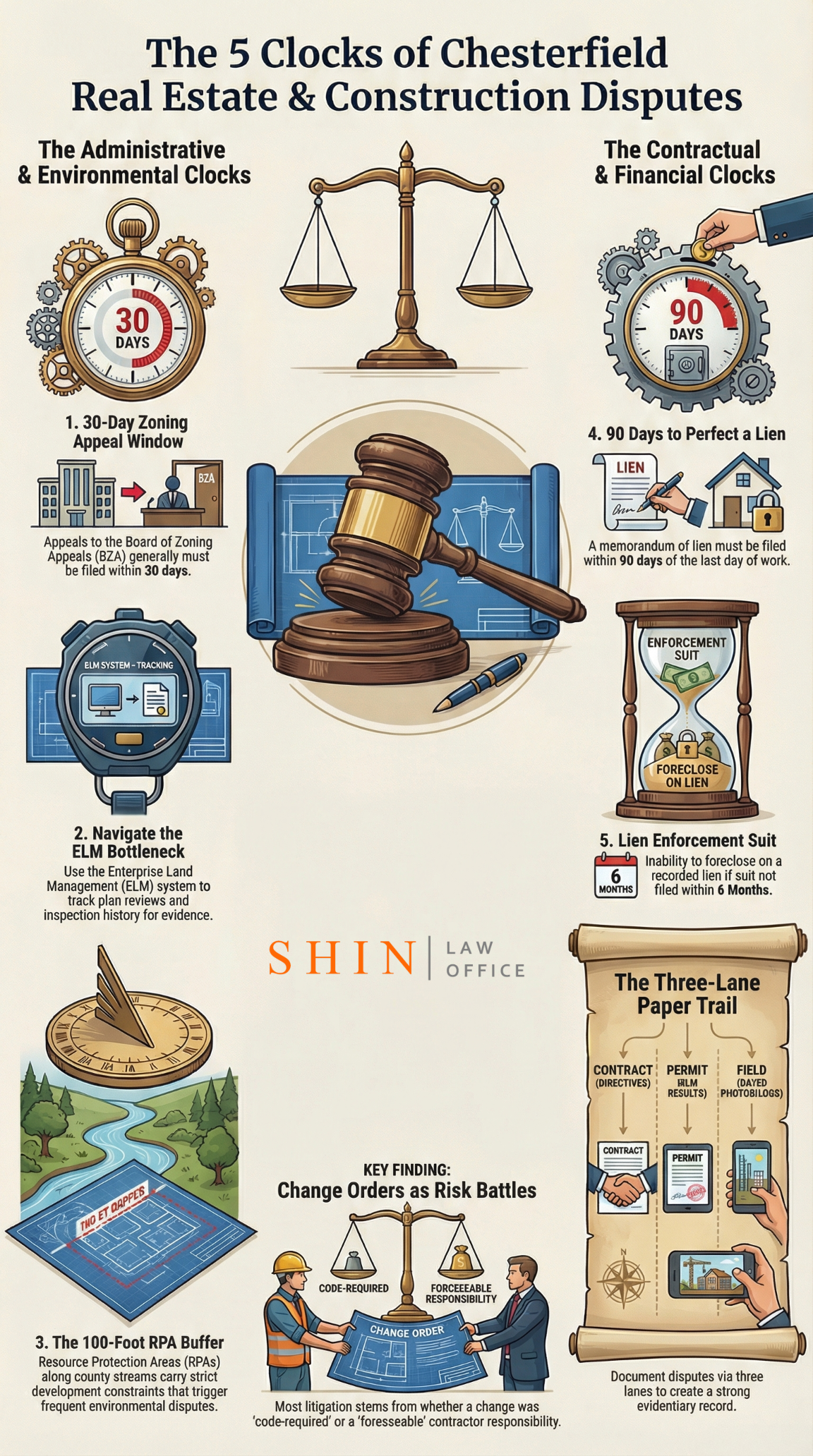
Table of Contents
- Real Estate Disputes in Chesterfield County, VA
- Clock 1: The Zoning & Enforcement Clock
- Clock 2: The Permits & Inspections Clock
- Clock 3: The Water, Dirt, and Buffer Clock
- Clock 4: The Change Order & Scope Clock
- Clock 5: The Money, Liens, and Deadlines Clock
- The Dispute Catalog
- Prevention Checklists
- References
For Homeowners and Commercial Property Owners in Chesterfield County, VA
A practical guide to the disputes, change-order fights, and litigation pressure points that hit homeowners and commercial businesses
This article is educational information, not legal advice. Real estate and construction disputes are intensely fact-specific, and Virginia deadlines can be unforgiving—talk with a qualified Virginia attorney about your exact situation.
Chesterfield County sits at an intersection that produces disputes in predictable ways: fast-changing development patterns, a complex permitting and inspection ecosystem, water-resource protections (Bay Act/RPAs), floodplain requirements, and the real-world chaos of construction pricing/scheduling. Add in HOAs, commercial leases, and the Virginia mechanics’ lien system, and you get a “conflict pipeline” that looks different from generic real estate articles.
To make this genuinely useful—and different from the standard “top 10 disputes” list—this guide is organized around five “clocks” that govern most Chesterfield property conflicts. When one clock runs out, the conflict tends to jump from inconvenience → leverage battle → formal claim → litigation.
The five clocks that drive most Chesterfield disputes
Clock 1: The Zoning & Enforcement Clock
This is the clock behind: “My business got cited,” “My neighbor’s use is wrecking my enjoyment,” “I can’t do the addition/driveway/sign I planned,” and “I need a variance.”
Where Chesterfield disputes start
- Community Enhancement enforcement: zoning and code compliance, business license enforcement, common complaints (property maintenance, tall grass, trash, unlicensed business, fence concerns, etc.).
- Planning and the Board of Zoning Appeals (BZA): special exceptions, variances, and appeals from certain Planning Director decisions/interpretations. Chesterfield’s BZA meets the first Wednesday of each month at noon at the public meeting room at 10001 Iron Bridge Road.
The “30-day rule” that surprises people
- Under Virginia law, an appeal to the BZA generally must be taken within 30 days of the decision appealed from.
- Chesterfield’s own BZA process materials also emphasize 30 days in multiple places (including appealing a denied petition to Circuit Court within 30 days from the public hearing date).
Common zoning/code disputes in Chesterfield
Homeowners
- alleged zoning violations (home occupations, vehicles, outdoor storage, signs)
- accessory structures (sheds/garages), setbacks, fences
- short-term recurring items that trigger notices/citations (and sometimes escalating penalties)
Commercial businesses
- use classification disputes (is it “retail,” “contractor yard,” “storage,” “light industrial,” etc.)
- signage conflicts (temporary/limited-duration signs, location issues, right-of-way conflicts)
- business license enforcement notices tied to county tax compliance and licensing
Litigation challenge: Zoning disputes often start administrative (notice → appeal → hearing), but quickly become “record-based” fights where timing and the administrative record matter as much as the merits. Miss the deadline or fail to build a clean record, and your best arguments may never be heard.
Clock 2: The Permits & Inspections Clock
This is the clock behind: stop-work orders, failed inspections, delayed Certificates of Occupancy, and “we’re done but can’t open the business.”
Chesterfield-specific friction points
- Chesterfield provides online permitting/inspection services through its Enterprise Land Management (ELM) system, including applying online, paying fees, retrieving plan review results, requesting inspections, and viewing inspection history.
- Chesterfield Building Inspection explains inspection scheduling rules (including scheduling up to five business days in advance and cutoffs for next-business-day inspection requests/cancellations).
- The County also publishes detailed residential permit/inspection process guidance (what requires permits, when inspections are required, how to schedule).
The legal backbone: Virginia’s Uniform Statewide Building Code (USBC)
- Virginia’s USBC sets building regulations for new construction, additions, repairs, renovations, and changes of use. It’s enforced by local building inspection departments and includes enforcement and administrative appeals pathways (including review by the State Building Code Technical Review Board).
Common permitting/inspection disputes
- Residential: Additions or renovations started without permits; “midstream” plan changes that don’t match approved drawings; failed rough-in inspections (electrical, plumbing, mechanical), reinspection fees and scheduling delays.
- Commercial: Tenant build-outs where the lease requires opening by a specific date, but inspections/CO timing becomes the bottleneck; code interpretation disputes on egress, fire separation, accessibility, change-of-use triggers.
Litigation challenge: Many construction lawsuits are really “schedule-loss lawsuits.” If a CO delay prevents a store opening or a tenant from occupying, damages can become a fight over causation, documentation, and “who owned the risk” under the contract (owner/GC/subs/design team).
Clock 3: The Water, Dirt, and Buffer Clock
This is the clock behind: erosion runoff to neighbors, sediment violations, drainage fights, floodplain constraints, and “we didn’t know we were in an RPA.”
Chesterfield’s real estate and construction landscape is heavily shaped by stormwater, waterways, and reservoirs—so disputes often involve environmental compliance + site engineering + neighbor impacts.
Chesterfield Environmental Engineering: why it matters
- Environmental Engineering reviews development plans for commercial sites and subdivisions, including compliance with the Chesapeake Bay Preservation Act and Chesterfield floodplain/stormwater ordinances.
- Field inspections: Chesterfield notes that state regulations require erosion and sediment control inspection at least once every two weeks until a Certificate of Occupancy or state road acceptance.
Chesapeake Bay Preservation Areas (CBPAs)
- Chesterfield explains that the Bay Act program requires localities to establish Resource Protection Areas (RPAs) and Resource Management Areas (RMAs) through zoning/subdivision ordinances.
- In Chesterfield, RPAs include 100-foot riparian buffers along streams/rivers/lakes and are located adjacent to the James and Appomattox rivers, Falling Creek/Swift Creek/Lake Chesdin reservoirs, and extensive perennial streams.
Floodplain pressure points
- Chesterfield’s commercial site plan checklist includes floodplain-related requirements such as showing the 100-year floodplain limits and, where required, floodproofing a proposed building to 1 foot above the base flood elevation, certified by a registered professional engineer or architect.
Common “water/dirt/buffer” disputes
- Homeowners: Neighbor-to-neighbor drainage (grading changes that send water onto adjacent property); tree clearing and buffer disturbances near streams; private stormwater facilities on the property (which can carry long-term maintenance obligations—often missed during resale).
- Commercial/developers: Unexpected BMP requirements (cost, land take, redesign); sediment-control enforcement and work stoppages; downstream impacts triggering demands for easements, offsite improvements, or redesign.
Litigation challenge: These disputes are expert-heavy: engineers, surveyors, environmental consultants, and sometimes hydrology modeling. The fight becomes: what was required, who caused the condition, and what is the least-cost compliant fix.
Clock 4: The Change Order & Scope Clock
This is the clock behind: “That wasn’t in the bid,” “You approved it verbally,” “The permit required it,” and “We can’t finish unless you pay for the extra work.”
Change order disputes are not just paperwork problems—they are risk-allocation battles. In Chesterfield, they’re often triggered by:
- plan review comments and revised approval conditions
- stormwater/BMP/floodplain/RPA constraints discovered late
- field conditions (utilities, unsuitable soils, hidden structural issues)
- material lead times and substitutions (affecting schedule and code compliance)
The most common change order fight patterns
- Scope ambiguity: plans/specs/contract drawings don’t match; someone priced “best case.”
- Authority mismatch: a tenant rep “approved” a change, but the lease requires landlord approval (or vice versa).
- Permit-driven changes: code or plan review requires a redesign, and parties argue whether it’s “contractor means/methods” or “owner’s design responsibility.”
- Allowances gone wild: allowances set too low (fixtures, finishes, site work) become budget explosions.
- Schedule acceleration: “finish by X date” becomes overtime, added crews, resequencing—and then a fight over who pays.
A Chesterfield-specific documentation strategy
If you want to prevent change orders from turning into litigation, build a “three-lane paper trail”:
- 🚀 Lane A (Contract lane): written change directive/change order, cost breakdown, schedule impact statement.
- 📝 Lane B (Permit lane): plan review comments, revised drawings, inspection results (ELM downloads can matter).
- 📸 Lane C (Field lane): dated photos, daily reports, RFI log, delivery tickets, subcontractor change tickets.
When a dispute hits court, the side with a clean contemporaneous record often wins—even if the other side has the “better story.”
Clock 5: The Money, Liens, and Deadlines Clock
This is the clock behind: mechanics’ liens, bond claims, retainage disputes, and “we finished—why aren’t we paid?”
Mechanics’ liens (private projects)
Virginia mechanics’ lien disputes are common because the lien is both a payment security device and a litigation trigger (owners often sue to remove or challenge liens).
Key timing features (general contractor and certain lien claimants):
- A memorandum of lien must be filed no later than 90 days from the last day of the month in which the lienor last performed labor/furnished material, and in no event later than 90 days from completion/termination of the work.
- The memorandum must be filed in the clerk’s office in the locality where the property is located, and it is recorded and indexed (constructive notice).
- A suit to enforce a lien generally must be brought within six months from recordation or within 60 days after completion/termination, whichever is later.
The “mechanics’ lien agent” trap on one- or two-family residential
For certain residential projects where the building permit identifies a mechanics’ lien agent, lien claimants must often provide notice to the lien agent within 30 days (with important limitations and exceptions). This is a frequent “gotcha” for subcontractors and suppliers—and a frequent defense tool for owners.
Payment terms and “pay-if-paid”
Virginia has statutory rules that can affect how payment clauses operate in construction contracts, including restrictions on provisions that attempt to make subcontractor payment dependent on owner payment (with limited exceptions).
Public projects: bonds, retainage, prompt payment
When the project is public (state/local), different tools often replace mechanics’ liens: Virginia’s public procurement framework includes performance/payment bond requirements above certain thresholds. Retainage is governed by statute (including limitations such as 5% in certain contexts). Payment timing rules for public contracts are also statutorily addressed.
Litigation challenge: Money disputes are deadline-driven. Miss a lien deadline, miss an enforcement deadline, or wait too long to document nonpayment—and leverage evaporates.
The dispute catalog: “what fights actually look like” in Chesterfield County
Below is a comprehensive catalog of the types of disputes that repeatedly show up for homeowners and commercial stakeholders in Chesterfield. It’s not a list of every individual lawsuit ever filed; it’s a map of the situations that generate claims, negotiations, liens, and litigation.
1) Real estate transaction disputes
A. “Buyer to beware” surprises and disclosure fights (residential)
Virginia’s residential disclosure regime is famously buyer-beware, and the statutory disclosure statement emphasizes that owners make no representations and buyers should perform due diligence (survey, zoning research, inspections, etc.).
- Zoning restrictions, setbacks, and permitting feasibility often turn into “I wouldn’t have bought this if I knew…” disputes.
- The disclosure act also addresses situations where owners have actual knowledge of pending USBC enforcement actions or pending zoning ordinance violations that have not been abated.
B. Earnest money and contract termination disputes
- inspection contingencies: what counts as “defect,” who chooses contractors, deadlines
- appraisal/financing failures
- “as-is” vs repair negotiations (these often end up as escrow disputes, mediation, or suit for specific performance)
C. Title, boundary, encroachment, and survey disputes
- fence/driveway encroachments
- shed/retaining wall over the line
- driveway access location disagreements
- prior recorded easements you “didn’t know mattered”
Chesterfield’s Real Property Office specifically notes the County does not provide property boundary services and owners should contact a land surveyor. That reality drives a lot of disputes: people build first, survey later.
D. Easements and rights-of-way disputes
- utility access conflicts
- drainage easement restrictions (you can’t build where you thought you could)
- disagreements about “who maintains what” and “who has the right to enter”
E. Co-ownership disputes (partition)
When siblings inherit, partners buy together, or unmarried couples split, disputes often become “we have to force a sale.” Virginia law provides a partition mechanism that can compel partition and gives courts equity jurisdiction to resolve related title questions.
F. Adverse possession / “they’ve used it forever” disputes
Virginia’s limitation on actions to recover land is 15 years. These conflicts often arise from long-standing fence lines, drive paths, and “everyone thought that was the line.”
2) HOA/POA and common-interest community disputes
In subdivisions and planned communities, conflicts often escalate because the HOA has rule enforcement tools, assessment collection power, and the ability to seek injunctive relief. Virginia’s POA Act addresses lack of compliance with the declaration, attorney’s fees, and ADR options.
Common HOA disputes: architectural approvals (fences, sheds, exterior changes); “business use” restrictions; enforcement consistency (“selective enforcement” allegations); assessment and late-fee disputes.
3) Landlord-tenant and lease disputes (residential + commercial)
Residential: Virginia’s Residential Landlord and Tenant Act governs core obligations. Fights involve habitability, mold/water intrusion, security deposit withholdings, and early termination.
Commercial: Fights center on build-out delivery condition (“vanilla shell” vs “as-is”); HVAC responsibility; CAM charges; default timing; and use exclusives.
4) Construction disputes (homeowners + commercial)
A. Defective work and construction defect claims: Typical issues include water intrusion (windows, roof, flashing); foundation settlement; MEP failures; and building envelope problems.
B. Permit-driven redesign and compliance conflicts: Code or plan review changes trigger fights over whether it is a design error (architect), means/methods problem (contractor), or owner change.
C. Erosion, stormwater, and land disturbance disputes: Sediment leaving site causing enforcement or neighbor complaints; BMP maintenance obligations post-construction.
5) Change order disputes in detail
- “The work was necessary” vs “the work was unauthorized”: Contractors argue constructive change; owners argue failure to follow contract procedure.
- “It’s code-required” vs “it was foreseeable”: Disputes turn on local USBC interpretations and whether administrative appeals were pursued.
- “You delayed the project” vs “you didn’t staff it”: Delay claims involve critical path analysis, concurrency (shared fault), and weather impacts.
6) Litigation situations: what actually makes these cases hard
- Forum selection: Disputes run through administrative hearings (BZA), General District Court (monetary), or Circuit Court (equity, injunctions, larger claims).
- Injunctions: HOA seeking to stop prohibited use; neighbors fighting drainage changes; business disputes over covenants.
- Expert battles: Serious cases require engineers, code consultants, scheduling experts, and hydrology modeling.
- Damages measure: Cost of repair vs. diminution in value; lost profits; loss of use.
Chesterfield-specific prevention checklists
Homeowners: 12 practical steps
- Confirm permit needs early and use Chesterfield’s published resources.
- Use ELM to retrieve plan review and inspection history.
- Keep a project binder: contract, drawings, photos, texts/emails.
- Require written change orders with price + time impact.
- Check CBPA/RPA constraints if near streams or water.
- Identify floodplain zones early to avoid red-tagging.
- Verify erosion control responsibility for any land disturbance.
- Do not ignore zoning notices; appeal windows are short.
- Treat HOA architectural approval as a mandatory “permit.”
- Photograph conditions before work begins (especially drainage).
- Learn lien timing early—whether you are an owner or contractor.
- Seek counsel before you attempt “self-help” or stop-payment.
Commercial businesses: 12 steps
- Get zoning confirmation early; understand the BZA calendar.
- Align lease obligations with CO timing risks.
- Use contracts that address schedule delays and material substitutions.
- Require a formal RFI/submittal/change order process.
- Treat plan review comments as formal contract events.
- Confirm BMP obligations and long-term maintenance.
- Watch floodplain triggers and engineer certifications.
- Keep clean pay app documentation—avoid handshake approvals.
- Know if mechanics’ liens or bond claims govern the project.
- Coordinate with the Real Property Office for easement encroachments.
- Anticipate expert needs early if a claim is brewing.
- Build a litigation-ready record before lawyers are involved.
When a dispute starts: the “first 10 documents.”
- signed contract + all exhibits
- drawings/specs and approved permit plan set (plus revisions)
- change order log (even if the other side refuses to sign)
- ELM downloads: plan review results, inspection results, permit status
- daily reports and job photos (dated)
- emails/texts confirming approvals, concerns, delays
- invoices, pay apps, lien waivers, proof of payment
- schedule updates and delay notices
- expert reports (if already obtained)
- any county notices (zoning, USBC, stormwater)
Closing perspective: what “comprehensive” really means in Chesterfield
In Chesterfield County, many disputes aren’t purely “legal.” They’re systems disputes:
- zoning + enforcement (and the 30-day appeal clock)
- permits/inspections through ELM and USBC enforcement/appeals
- water/buffer/floodplain requirements that reshape projects midstream
- payment security tools like liens and public bonds with strict deadlines
Chesterfield County real estate and construction disputes rarely start as lawsuits. They start as small cracks in the process: a permit snag, a failed inspection, a grading change that pushes water onto a neighbor, an HOA notice, a lease build-out delay, or a change order that was approved in a hallway instead of in writing. Then the clock starts. Deadlines tighten, positions harden, and costs climb.
If you take one thing from this guide, let it be this: protect the record early. Put scope changes in writing. Save permit and inspection results. Photograph conditions before and after work. Track payments and approvals. When you do that, you keep leverage, you reduce surprise, and you give yourself real options: fix it, negotiate it, mediate it, or litigate it from a position of strength.

Principal Attorney | Shin Law Office
Call 571-445-6565 or book a consultation online today.
(This article is provided for general informational purposes and does not constitute legal advice. For advice on your specific situation, consult with a licensed Virginia attorney.)