
Bottom Line Up Front (BLUF)
In Richmond, most business disputes start as breach-of-contract cases. The turning point is whether the other side violated a legal duty that exists outside the contract. When the harm is purely financial and tied to the bargain, Virginia courts often keep you in contract law. When there is deception, interference by a third party, or harm to people or property, tort claims become real leverage.
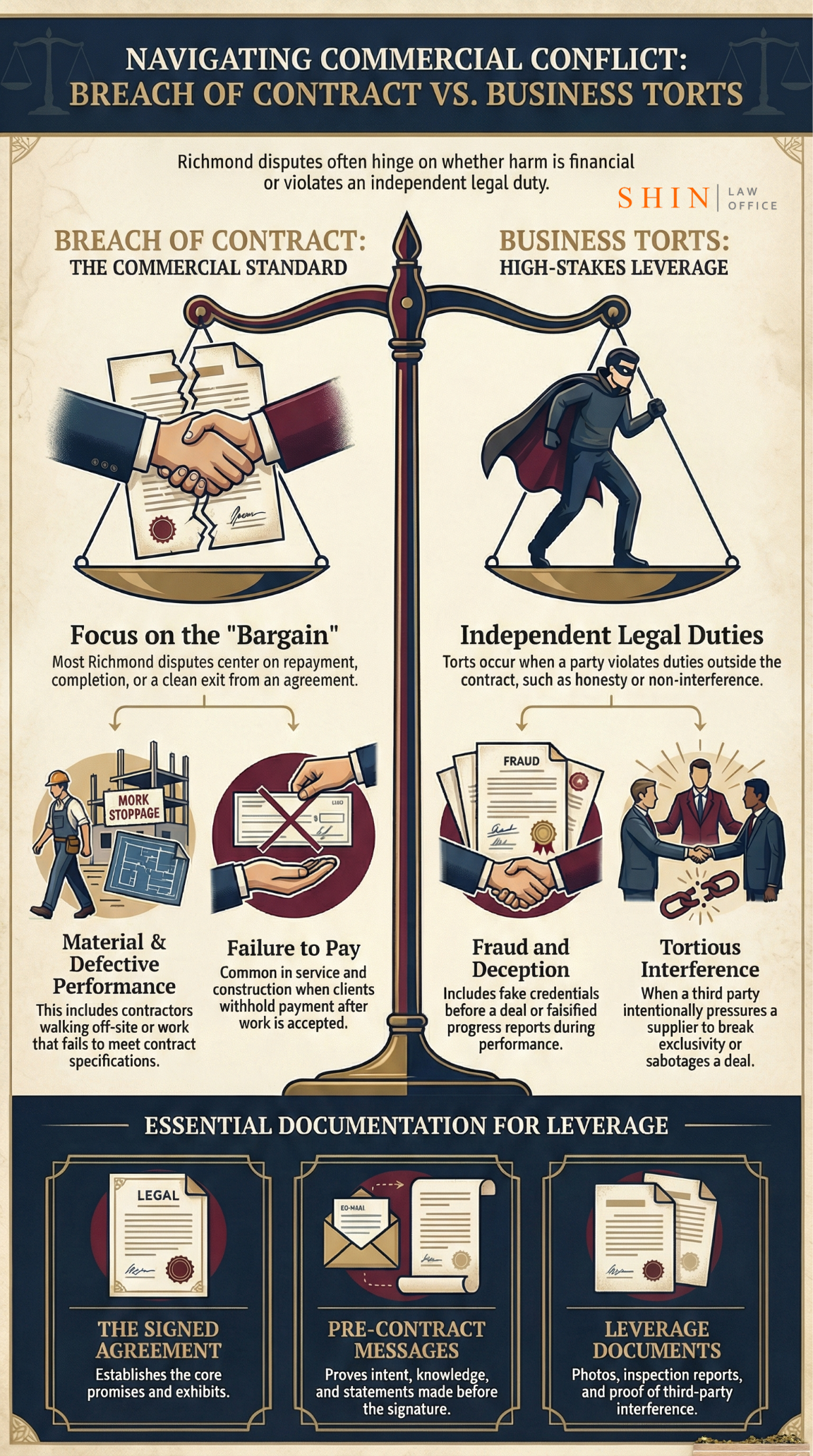
Why Richmond disputes fall into these two buckets
Richmond is a contract town. Construction, real estate, professional services, logistics, hospitality, and growing tech work all run on agreements. When performance breaks down, people want repayment, completion, or a clean exit.
Torts enter the story when the conduct feels like more than a failed deal. Think deception, theft, sabotage, or reputational harm. That difference matters because it changes what you must prove and what damages may be available.
Common breach of contract claims in Richmond
Material breach
This is a core failure that defeats the purpose of the agreement.
Example: A contractor walks off mid-project, leaving the site unsafe and unfinished.
Failure to perform
They do not do what they promised.
Example: You pay a deposit and the vendor never delivers the equipment or service.
Defective performance
Work happens, but it does not meet the contract specs.
Example: Wrong materials, failed inspections, missing scope items, or shortcuts.
Late performance
Deadlines matter when time is the value.
Example: A retail build out misses an opening date and revenue is lost.
Failure to pay
This is common in service and construction disputes.
Example: A client withholds payment after accepting the work, often over change orders.
Breach of warranty
This shows up in goods and equipment sales, and in service warranties.
Example: Equipment does not perform as represented or repeatedly fails after install.
Anticipatory breach
They clearly communicate they will not perform before the deadline.
Example: A supplier admits they cannot deliver next month, after taking your money.
Bad faith use of contract discretion
Virginia recognizes limits here, but the theme matters. If one side uses discretion to strip the deal of its benefits, it becomes a focal point in the dispute.
Common tort claims in Richmond
Fraud that gets you into the contract
This is pre-agreement deception.
Example: Fake credentials, hidden defects, false revenue claims, or concealed conflicts.
Virginia courts look closely at whether you pled a duty independent of the contract. If the claim is just poor performance dressed up as fraud, it often fails.
Fraud during performance
This is deception after the relationship begins.
Example: Fake invoices, fabricated test results, falsified progress reports.
Conversion
This is wrongful control over property that belongs to someone else.
Example: Keeping equipment you own, withholding delivered materials, or diverting identified funds.
Tortious interference with contract
This is when a third party intentionally causes a breach.
Example: A competitor pressures your supplier to break exclusivity or poaches a key account in violation of an agreement.
Tortious interference with business expectancy
This targets sabotage of a likely deal or ongoing relationship, even if the final contract is not signed.
Defamation
False statements that harm reputation can trigger real damages.
Example: A former partner posts false claims of fraud or licensing violations to kill your business.
Business conspiracy
When multiple actors coordinate to injure a business, Virginia has a statutory framework that can allow enhanced damages in the right case.
Negligence causing property damage or personal injury
If bad work causes physical damage, tort claims become stronger. Virginia courts distinguish this from purely financial loss tied to quality or value.
The contract versus tort line in Virginia
Here is the practical rule I use when evaluating a Richmond case.
When it stays a contract case
If the loss is the cost to repair, replace, or receive what you paid for, it is usually economic loss. Virginia courts often treat that as a contract remedy problem.
When tort claims become viable
Tort claims become viable when there is an independent legal duty, such as the duty not to commit fraud, not to defame, not to convert property, or not to interfere with contracts. Courts regularly analyze whether the duty comes from the contract or from general law.
What evidence wins these cases
Documents that matter most
- The signed agreement and all exhibits
- Statements made before signature, including emails and proposals
- Change orders, invoices, payment records, and delivery confirmations
- Photos, inspection reports, and punch lists for construction disputes
- Messages that show intent, knowledge, concealment, or pressure on a third party
The leverage documents
If you have clear proof of deception, property diversion, or third-party interference, the case often changes quickly. Without that, your cleanest path is usually a tight contract claim with strong damages proof.
Practical next steps before you escalate
- Lock down the documents and preserve messages
- Build a one-page timeline with dates, promises, and failures
- Quantify damages with receipts and realistic numbers
- Identify the remedy you actually want: money, completion, or termination
- Send a legally clean demand that tracks the contract language

Principal Attorney | Shin Law Office
Call 571-445-6565 or book a consultation online today.
(This article is provided for general informational purposes and does not constitute legal advice. For advice on your specific situation, consult with a licensed Virginia attorney.)
References
Chaves v. Johnson, 230 Va. 112 (1985).
Code of Virginia. (2026). Conspiracy to injure another in trade, business, or profession. Title 18.2, Chapter 12, Article 2.
Filak v. George, 267 Va. 612 (2004).
Sensenbrenner v. Rust, Orling & Neale, Architects, Inc., 236 Va. 419 (1988).
Code of Virginia. (2026). Civil relief for injury to reputation, trade, business, or profession. Title 18.2, Chapter 12, Article 2.