


Looking for the statewide framework? This page focuses on personal injury law specifically in Northern Virginia. For the Virginia-wide guide that covers contributory negligence, the two year deadline, damages, sovereign immunity, and the first 30 day playbook, see Virginia Personal Injury Lawyer: A Working Attorney’s Guide.
BLUF (Bottom Line Up Front)
In Virginia, slip-and-fall injuries are evaluated under premises liability law, requiring proof that a property owner owed and breached a duty of care by failing to address or warn of hazardous conditions, and that this breach directly caused compensable injuries. A key challenge in Virginia is the pure contributory negligence rule, even 1% fault on the part of the injured person can bar all recovery. Most claims must be filed within two years of the accident under Virginia Code § 8.01-243, and strong evidence of actual or constructive notice (such as photos, witness statements, or maintenance records) is essential.
Understanding local slip-and-fall risks, strict deadlines, and defenses especially contributory negligence and open and obvious conditions can make or break compensation in Northern Virginia counties including Fairfax, Loudoun, Prince William, and Arlington.
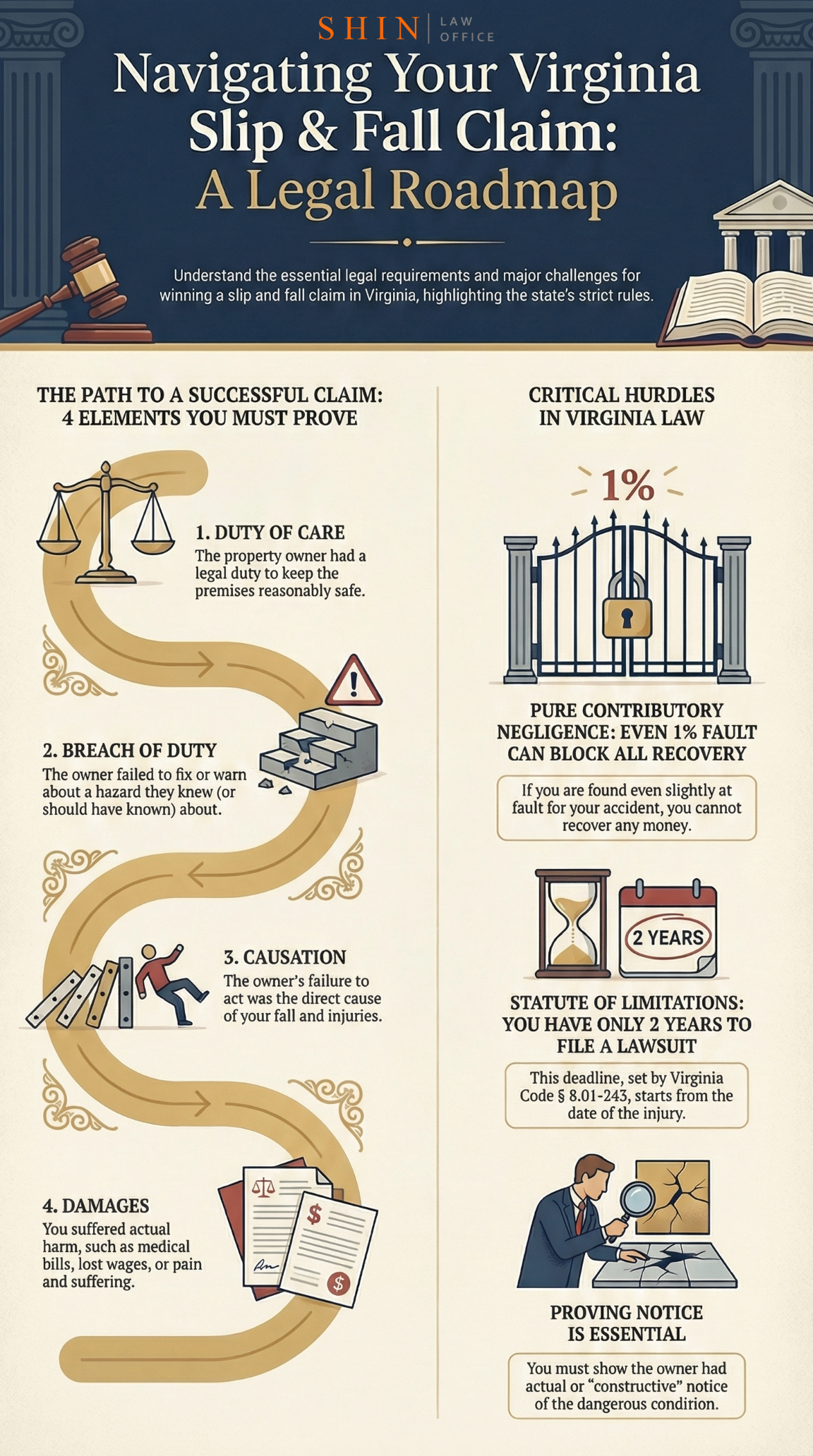
Table of Contents
- Chapter 1 – What Is Premises Liability Law in Virginia and Why It Matters
- Chapter 2 – What Statutory Standards Govern Premises Liability Claims in Virginia
- Chapter 3 – What Legal Elements Must Be Proven in a Virginia Premises Liability Claim
- Chapter 4 – How Does Virginia Case Law Define Premises Liability Standards
- Chapter 5 – What Types of Slip-and-Fall and Premises Liability Incidents Occur in Northern Virginia
- Chapter 6 – How Local Geography and Specific Areas in Northern Virginia Affect Premises Liability Risks
- Chapter 7 – What Defenses Are Commonly Used in Virginia Premises Liability Cases
- Chapter 8 – What Evidence Must Be Collected to Win a Virginia Premises Liability Claim
- Chapter 9 – What Legal Deadlines and Filing Requirements Apply in Virginia Slip-and-Fall Cases
- Chapter 10 – What Practice Tips and Strategic Recommendations Maximize Recovery
- Appendices
Chapter 1 – What Is Premises Liability Law in Virginia and Why It Matters

Premises liability law governs when and how a property owner or occupier can be legally responsible for injuries that happen on their property. In Virginia, slip-and-fall incidents are a significant category of premises liability claims. A slip-and-fall occurs when a person slips, trips, or loses footing on someone else’s property and suffers injury as a result. These injuries can range from minor bruises to severe fractures or head trauma.
Virginia’s legal system treats slip-and-fall accidents as premises liability tort claims. Under premises liability law, a property owner has a duty of care to maintain their property in a reasonably safe condition and to warn lawful visitors of hidden hazardous conditions. If the property owner fails to do so and someone is injured as a result, the owner may be legally liable for damages.
Understanding how this duty of care works is essential for both claimants and defense practitioners. In Virginia, the reason the person was injured and the reason they were on the premises affect the level of duty the owner owes. For example, someone visiting a store to shop (an invitee) is owed a higher duty of care compared to a social guest (a licensee). Premises liability also requires proof that the property owner knew or should have reasonably known about the dangerous condition and failed to correct it or warn visitors.
This article focuses on how Virginia’s premises liability laws apply to slip-and-fall injuries, with particular emphasis on four Northern Virginia jurisdictions: Fairfax County, Loudoun County, Prince William County, and Arlington County. These regions share similar legal standards but may also present distinct patterns of premises liability issues due to differences in population density, commercial activity, and seasonal weather conditions.
Virginia’s premises liability law is shaped not just by statutes but also by key doctrines and judicial interpretations. One of the most significant legal doctrines in Virginia is the pure contributory negligence rule. Under this doctrine, an injured person who was even slightly at fault for their own accident may be completely barred from recovering any compensation. This makes Virginia one of the strictest states in the nation for slip-and-fall liability claims.
In the chapters that follow, this article will explain the statutory and common-law framework, outline the core elements a plaintiff must prove, detail how contributory negligence affects recovery, and explore real-world types of slip-and-fall incidents in Northern Virginia. By grounding the legal analysis in Virginia law and case authorities, the reader will gain a clear, actionable understanding of how premises liability claims are evaluated and litigated in practice.
FAQs
What is premises liability law in Virginia, and how does it relate to slip-and-fall injuries?
Premises liability law in Virginia holds property owners or occupiers legally responsible when unsafe conditions on their property cause injuries to visitors. Slip-and-fall injuries are a common type of premises liability claim and occur when someone slips, trips, or falls on another person’s property because of a hazard the owner failed to fix or warn about. Premises liability covers conditions such as wet floors, uneven walkways, and poor maintenance.
What duty of care do property owners owe under Virginia premises liability law?
Property owners in Virginia must maintain reasonably safe conditions for lawful visitors and warn them of hidden hazards. The level of duty varies depending on the visitor’s legal status (such as invitee, licensee, or trespasser). Owners must address or warn about dangerous conditions they know or should have known about to avoid liability for injuries.
How does Virginia’s contributory negligence rule affect slip-and-fall claims?
Virginia follows a strict contributory negligence rule, meaning that if an injured person is found even slightly at fault for their own slip-and-fall injury, they may be completely barred from recovering any compensation. This makes it especially crucial to prove that the property owner was fully responsible in Virginia slip-and-fall cases.
Chapter 2 – What Statutory Standards Govern Premises Liability Claims in Virginia

In Virginia, slip-and-fall and other premises liability claims are governed by a combination of statutory law and common law negligence principles. Understanding these legal standards is essential to evaluating when a property owner or occupier may be liable for injuries that occur on their premises.
2.1 Statutory Framework for Personal Injury Claims in Virginia
Virginia’s statutory law addressing personal injury actions, including slip-and-fall claims, is found in Title 8.01 of the Code of Virginia. Article 3, § 8.01-34, and related sections govern the handling of negligence and related claims in civil actions. While § 8.01-34 itself concerns contribution among negligent parties, the broader statutory context provides the procedural backdrop for all personal injury litigation in the Commonwealth.
Another significant statute for slip-and-fall claims is § 8.01-243, which sets the statute of limitations for personal injury actions. Under this statute, a plaintiff generally must file a lawsuit within two years from the date of the injury. Missing this deadline usually bars the claim altogether.
These statutory rules operate alongside Virginia’s common law negligence principles, shaping how courts evaluate duty, breach, causation, and damages in slip-and-fall and other premises liability cases.
2.2 Common Law Duty of Care and Premises Liability
Premises liability claims in Virginia are rooted in the general common law duty of care that property owners or occupiers owe to visitors. A defendant must exercise reasonable care to maintain a property free of dangerous conditions and warn lawful visitors about latent hazards that are not readily observable. Failure to uphold this duty may make the owner liable for injuries that result from such conditions.
A plaintiff must prove that:
- The defendant owed a duty of care;
- The defendant breached that duty;
- The breach proximately caused the plaintiff’s injury; and
- The plaintiff suffered actual damages as a result. These elements reflect the classic common law negligence framework applied in Virginia courts.
2.3 Virginia’s Contributory Negligence Doctrine
One of the most distinctive aspects of Virginia negligence law, which directly impacts slip-and-fall and premises liability claims, is its adherence to the pure contributory negligence doctrine. Under this doctrine, if a plaintiff is found to have contributed to their own injury in any degree, even as little as 1 percent, the plaintiff is barred from recovering any compensation. This doctrine makes Virginia one of the strictest jurisdictions in the United States.
Virginia’s contributory negligence rule applies broadly in premises liability cases. For example, if a customer slips on a wet floor in a store but is found to have been looking at their phone instead of watching where they were walking, a court may conclude that the plaintiff’s own negligence contributed to the injury and bar recovery entirely.
Although Virginia’s statutes do not explicitly recite the contributory negligence rule in a premises liability context, the doctrine remains part of Virginia’s common law negligence jurisprudence and is routinely applied by judges and juries in slip-and-fall cases.
2.4 Duty Variations Based on Visitor Status
Virginia courts also consider the injured person’s status when determining the duty owed. A business invitee (such as a customer in a retail store) is generally owed the highest duty of care, including active hazard inspection and warning duties. A licensee (such as a social guest) and a trespasser owe progressively lower duties. While most modern cases focus on invitee status, courts will assess visitor status based on the specific facts of each case.
2.5 Landlord and Tenant Liability Exceptions
Under Virginia common law, landlords generally are not liable for injuries to tenants caused by conditions on the leased property unless the landlord maintains control over the area where the injury occurred or negligently concealed a hazardous condition. This principle arose from historic Virginia decisions interpreting landlord obligations and remains relevant in multi-family residential slip-and-fall claims.
2.6 Statutory and Judicial Interplay
The interplay between Virginia statutes and common law negligence principles highlights the complexity of slip-and-fall litigation. Statutes like § 8.01-243 provide procedural boundaries, while the courts interpret and apply doctrines such as contributory negligence and duty owed to visitors on a case-by-case basis.
In later chapters, this article will explore how these statutory and common law standards have been applied in actual Virginia cases, including key Supreme Court of Virginia rulings and trial court decisions that define duty and fault in premises liability contexts.
FAQs
What is the statute of limitations for slip-and-fall and other premises liability claims in Virginia?
In Virginia, most premises liability and personal injury claims must be filed within 2 years of the date of injury. This deadline is set by Virginia Code § 8.01-243(A), and missing it can bar recovery entirely. The time limit usually begins on the date the injury occurs, not on the date it is discovered.
Does Virginia follow contributory negligence in slip-and-fall cases?
Yes. Virginia follows the strict pure contributory negligence doctrine, meaning that if an injured person is found even partially at fault for their accident, they may be barred from recovering any compensation. Even minimal fault by the plaintiff can defeat a premises liability claim.
What laws govern premises liability claims in Virginia?
Premises liability claims in Virginia are evaluated under personal injury principles in Title 8.01 of the Code of Virginia, which sets procedural rules, including the statute of limitations and contribution among negligent parties. Courts also apply common law negligence standards to determine duty, breach, causation, and damages in slip-and-fall cases.
Chapter 3 – What Legal Elements Must Be Proven in a Virginia Premises Liability Claim

To succeed in a slip-and-fall or other premises liability claim in Virginia, a plaintiff must satisfy four core legal elements under the common law of negligence: duty, breach, causation, and damages. These elements form the foundational framework Virginia courts use to evaluate whether a property owner or occupier is legally responsible for an injury that occurred on their property.
3.1 Duty of Care: Who Owes a Legal Duty and to Whom
The first element in any premises liability claim is establishing that the property owner owed the injured person a duty of care. In Virginia, owners and occupiers must maintain their property in a reasonably safe condition and warn visitors of dangerous conditions they knew or should have known about. The duty owed varies depending on the visitor’s legal status (such as invitee, licensee, or trespasser). An invitee, like a business customer, is generally owed the highest level of care.
To prove duty in a premises liability claim, the plaintiff typically needs to show:
- They were a lawful visitor to the property, and
- The property owner or occupier was responsible for maintaining the area in a safe condition.
3.2 Breach of Duty: How the Duty Was Violated
Once duty is established, a plaintiff must demonstrate that the property owner breached that duty by failing to act as a reasonable person would under similar circumstances. A breach can occur when an owner fails to maintain safe conditions or provide adequate warnings about known hazards.
An essential component of proving breach in Virginia is showing that the property owner had notice of the dangerous condition. Notice may be “actual” when the owner or employee knew about the hazard, or “constructive” when the condition existed long enough that the owner, exercising reasonable care, should have discovered it.
Examples of breached duties include:
- Failure to clean up a known spill promptly.
- Failure to fix or warn about uneven flooring or broken stairs.
- Not inspecting the premises at reasonable intervals to discover hazards.
3.3 Causation: Linking the Breach to the Injury
After showing that a duty existed and was breached, the plaintiff must establish causation. This means connecting the property owner’s breach of duty directly to the injuries suffered. In Virginia slip-and-fall cases, the plaintiff must prove that:
- The hazardous condition caused the fall, and
- The fall caused the injuries claimed.
Virginia applies the standard of proof called “preponderance of the evidence,” meaning the plaintiff must show it is more likely than not that the owner’s negligence was the cause of the injury.
3.4 Damages: What Compensation Can Be Recovered
The final element is damages. A plaintiff must show that they suffered actual harm as a result of the fall. Damages can be:
- Economic factors, such as medical expenses and lost wages, and
- Non-economic, such as pain and suffering, emotional distress, and loss of enjoyment of life.
Without tangible injuries or financial loss, a premises liability claim generally cannot succeed, even if the property owner was negligent.
3.5 The Harsh Effect of Virginia’s Contributory Negligence Rule
In Virginia, satisfying the basic elements of negligence is necessary but not always sufficient. Even if all four elements above are proven, recovery can still be barred by the state’s pure contributory negligence doctrine. Under this rule, if the injured party is found to have contributed to their own accident in any degree, they are barred from recovering damages at all. Virginia remains one of the few states to uphold this strict standard.
For example, if a jury concludes that a plaintiff did not look where they were walking or failed to take reasonable precautions under the circumstances, the defendant may successfully argue contributory negligence, preventing any recovery despite the property owner’s breach.
3.6 Notice as a Critical Component of Breach
Another key issue in proving a premises liability breach in Virginia is notice of the dangerous condition. A plaintiff must typically show that the property owner or occupier either:
- Actually knew about the hazardous condition, or
- Should have known about it through reasonable inspection and maintenance practices.
Constructive notice often requires evidence that the condition existed long enough that the owner, exercising reasonable care, would have discovered it before the incident.
Key Takeaways for Virginia Premises Liability Claims
To establish a valid slip-and-fall claim in Virginia, a plaintiff must prove:
- The property owner owed a duty of care based on the visitor’s status.
- That duty was breached by failure to maintain safe conditions or warn about hazards.
- The breach directly caused the fall and resulting injuries.
- The plaintiff suffered real damages as a result of the injury.
- The plaintiff was not contributorily negligent in any respect.
These elements form the backbone of premises liability practice in Virginia. Later chapters will explore how Virginia case law interprets these elements and how courts apply them in real-world slip-and-fall contexts.
FAQs
What are the essential elements I must prove in a Virginia slip-and-fall or premises liability claim?
To succeed in a Virginia slip-and-fall or premises liability claim, you generally must prove four core elements: (1) the property owner owed you a legal duty of care to keep the premises reasonably safe; (2) the owner breached that duty by failing to fix or warn about a dangerous condition; (3) the breach directly caused your fall and injuries; and (4) you suffered actual damages such as medical costs, lost wages, or pain and suffering. Courts also often consider whether the property owner had actual or constructive notice of the hazard before the incident.
Why is providing notice of a dangerous condition critical in Virginia premises liability cases?
In Virginia, a plaintiff must typically show that the property owner knew (actual notice) or should have known (constructive notice) about the dangerous condition before the fall happened. This rule ensures that the owner had a reasonable opportunity to address or warn about hazards. Constructive notice can be shown by evidence that a condition existed long enough that a reasonably diligent owner would have discovered it.
How does Virginia’s strict contributory negligence rule affect my ability to recover in a premises liability claim?
Virginia follows a pure contributory negligence doctrine, meaning that if you are found even slightly at fault for your own slip-and-fall injury, you can be barred from recovering any compensation, even if the property owner was primarily at fault. This makes it especially important in Virginia premises liability cases to prove both that the owner breached their duty and that you were blameless.
Chapter 4 – How Does Virginia Case Law Define Premises Liability Standards

Understanding the elements of a premises liability claim requires placing statutory and common law principles into the context of actual Virginia court decisions. Virginia courts have shaped the standards for duty, notice, breach, and contributory negligence through judicial interpretation. The cases discussed below illustrate how these legal standards apply in practice to slip-and-fall and other premises liability claims.
4.1 How Virginia Courts Define Duty of Care in Premises Cases
In Virginia, whether a property owner owed a duty to a plaintiff is a question of law for the court, not the jury. The Supreme Court of Virginia has explained that determining duty requires legal analysis of the facts and applicable legal principles. In Burns v. Johnson, the court stated that “the question whether a duty of care exists in a negligence action is a pure question of law.” This means a judge decides whether law imposes an obligation on the defendant to protect the plaintiff before the case proceeds to other issues like breach or causation.
A property owner’s duty also depends on the visitor’s status (invitee, licensee, trespasser). Virginia case summaries show that an invitee—for example, a customer entering a store—is owed a duty to maintain safe premises and warn of hidden hazards that the owner knew or should have known about. In Roll “R” Way Rinks v. Smith, the court described that an owner owes ordinary care to maintain premises in reasonably safe condition for invitees, unless a dangerous condition is open and obvious.
4.2 What Constitutes Notice of a Hazard in Virginia Premises Liability Law
Virginia courts frequently emphasize notice as a critical component of breach. To prove a property owner breached a duty, a plaintiff must show the owner had actual or constructive knowledge of a dangerous condition. Colonial Stores, Inc. v. Pulley is a long-standing Virginia authority holding that a plaintiff must prove a property owner “knew or should have known” of the hazardous condition that caused the injury. Constructive notice can be shown when a defect existed long enough that a reasonably diligent owner should have discovered it.
This principle was applied in Grim v. Rahe, Inc., where the court held that constructive knowledge of a defective premise can be shown by evidence that a dangerous condition existed long enough to put the owner on notice.
4.3 How Virginia Courts Treat “Open and Obvious” Hazards
Virginia case law recognizes an open-and-obvious doctrine, under which the property owner may have no duty to warn of hazards that are clearly visible and would be apparent to a reasonable person. If the danger is open and obvious and a plaintiff should have seen it through the exercise of ordinary care, the risk is attributed to the injured person, often resulting in a finding of contributory negligence as a matter of law. For example, in Bassett Furniture v. McReynolds, courts discussed that when a risk is visible and apparent, the duty to warn may not apply, and the plaintiff may be guilty of contributory negligence for failing to observe it.
Under this doctrine, a plaintiff who trips over a noticeable crack in a sidewalk or on a visible icy patch may be barred from recovery if the condition was so apparent that they should have seen it while exercising ordinary care.
4.4 How Virginia’s Contributory Negligence Rule Impacts Premises Liability Claims
Virginians injured in slip-and-fall cases must contend with one of the strictest negligence defenses in the country. Virginia’s pure contributory negligence doctrine bars recovery if the injured person was even slightly at fault. Under common law, if a plaintiff contributed in any degree to their injury, they cannot recover damages from the property owner, even if the owner was primarily responsible.
Contributory negligence can arise where a plaintiff fails to observe an obvious hazard or otherwise acts carelessly in a way that contributes to the accident. Virginia courts have consistently applied this doctrine to slip-and-fall and other negligence cases, making it a central defensive strategy for property owners.
4.5 Landlord and Tenant Premises Liability Case Law
Virginia case law also clarifies that a landlord’s duty in premises liability is tied to notice of unsafe conditions. In Love v. Schmidt, the court explained that a landlord is not liable for dangerous conditions on leased property unless the landlord had actual or constructive notice of the hazard and sufficient time to remedy it. This reinforces that notice remains central to breach-of-duty claims in residential premises liability cases.
4.6 Summary of Key Premises Liability Cases in Virginia
To illustrate how legal standards are applied, here are key judicial principles derived from Virginia appellate cases:
- Duty of Care: Courts decide as a matter of law whether a duty exists between the parties based on foreseeability and responsibility. (Burns v. Johnson)
- Notice of Hazard: Property owners must have known, or reasonably should have known, of dangerous conditions before the incident. (Colonial Stores, Inc. v. Pulley; Grim v. Rahe, Inc.)
- Open and Obvious Doctrine: Visible hazards may eliminate the duty to warn and support contributory negligence. (Bassett Furniture v. McReynolds)
- Contributory Negligence: Even slight fault by an injured person can bar recovery under Virginia’s standard law negligence rules.
- Landlord Duty: A landlord’s responsibility hinges on notice and time to act. (Love v. Schmidt)
Virginia’s case law demonstrates how courts interpret the premises liability framework in practice. By grounding statutory and common law standards in judicial application, this chapter provides a foundation for evaluating how actual slip-and-fall claims are resolved in Virginia courts.
FAQs
What Virginia case law explains how courts evaluate whether a property owner knew about a hazard?
In Virginia premises liability law, a plaintiff must generally show that the property owner had actual or constructive notice of a dangerous condition before a fall. In Colonial Stores Inc. v. Pulley, the Supreme Court of Virginia held that the injured person must prove the owner knew or should have known about the hazard and failed to remedy it before the injury. This case illustrates how notice is a key basis for determining breach of duty.
How does Virginia law treat open and obvious hazards in slip-and-fall cases?
Under Virginia premises liability principles, property owners generally do not have a duty to warn of open and obvious hazards because a reasonable person should see and avoid them. Virginia courts have held that if a dangerous condition is clearly visible, failing to see it can amount to contributory negligence as a matter of law, barring recovery.
Why is contributory negligence such a robust defense in Virginia slip-and-fall lawsuits?
Virginia follows a pure contributory negligence doctrine, meaning that if an injured person is found even slightly at fault for their slip-and-fall injury, they may be completely barred from recovery. This strict rule makes contributory negligence one of the most important defenses property owners use in slip-and-fall cases.
Chapter 5 – What Types of Slip-and-Fall and Premises Liability Incidents Occur in Northern Virginia

In Virginia, slip-and-fall incidents are the most common form of premises liability claims, but they represent only a portion of the types of dangerous conditions that can lead to legal liability when someone is injured on another person’s property. “Premises liability” broadly includes any situation where a property owner or occupier fails to maintain safe conditions and someone is injured as a result.
This chapter categorizes the typical hazards that lead to premises liability claims in Fairfax County, Loudoun County, Prince William County, and Arlington County, explains how those hazards arise, and links them to the legal elements discussed earlier.
5.1 Classic Slip-and-Fall Hazards
slip-and-fall accidents occur when a person loses their footing due to a hazardous surface condition. These are the most frequent incidents in premises liability cases.
Wet or Slippery Floors
Spills in grocery stores, rainwater tracked into a building, floors recently mopped without adequate warning signage, and leaking roofs can create slick surfaces where a visitor may slip-and-fall. Property owners must act quickly to remove hazards and warn visitors.
Weather-Related Surfaces (Ice and Snow)
In colder months, untreated ice and snow on sidewalks, walkways, parking lots, and entryways create significant slip risks. Virginia premises liability law expects property owners to remove or treat these conditions promptly once the storm ends, though the application of duty varies by context.
5.2 Trip and Fall Incidents
Trip and fall injuries are another major category. These occur when someone’s forward motion is interrupted by an unseen object or uneven surface.
Uneven Walking Surfaces
Broken concrete, raised sidewalks, cracks in pavement, buckled flooring, and unmarked steps are common trip hazards. These can occur on public sidewalks, apartment complexes, retail parking lots, and around commercial buildings.
Obstructions and Debris
Loose cables, extension cords, merchandise left in aisles, construction debris, bunched rugs, and other items can create obstacles. Owners should remove or clearly mark such hazards to prevent trip-and-fall injuries.
5.3 Structural and Design-Related Incidents
Some premises liability incidents arise from deeper structural or design issues that naturally pose danger to visitors.
Defective Stairways and Handrails
Missing, broken, or unstable handrails on stairs increase the risk of a fall. Uneven steps, worn treads, and lack of non-slip surfaces are hazards that owners must remediate.
Inadequate Lighting
Poorly lit stairwells, parking garages, pathways, and hallways conceal hazards that would otherwise be visible. Owners have a responsibility to provide adequate lighting where visitors are expected to walk.
Construction and Maintenance Zones
Work areas must be properly cordoned off, with clear signage, barriers, and safe alternative pathways. Tools, materials, and equipment left in walkways can cause serious trips or falls.
5.4 Secondary Premises Liability Incidents
While slip-and-fall and trip and fall cases are most common, Virginia premises liability also includes other types of dangerous conditions that may lead to legal claims.
Falling Object Injuries
Objects that are improperly secured—such as merchandise in a store, construction materials, or overhead fixtures—can fall and injure visitors.
Parking Lot and Sidewalk Hazards
Potholes, uneven curbs, loose gravel, oil or fluid spills from vehicles, and poor signage in parking areas can lead to serious falls.
Recreational or Amenity Areas
Swimming pools with slippery surfaces, unmarked depth transitions, or inadequate barriers may cause falls. Playgrounds, golf courses, and walking trails with neglected conditions also fall into premises liability risk areas.
Inadequate Security and Physical Assaults
While not a classic slip-and-fall, dangerous conditions caused by inadequate security—such as poor lighting, broken locks, or failure to address known crime issues—can lead to attacks that result in injury. These incidents can still arise under premises liability theories in some Northern Virginia contexts.
5.5 Examples Specific to Northern Virginia Counties
In Fairfax, Loudoun, Prince William, and Arlington Counties, premises liability incidents often reflect local environmental and development patterns:
- Urban and suburban commercial environments such as shopping centers and restaurants see frequent slip-and-fall claims arising from spills, flooring defects, and tracked-in rain.
- Residential complexes and apartment walkways in these counties often give rise to trip-and-fall claims due to uneven sidewalks and poor maintenance.
- Public sidewalks and transportation hubs (e.g., near Metro stations in Arlington and Fairfax) see falls related to uneven paving and weather conditions.
- Seasonal weather cycles produce ice and snow hazards on properties and sidewalks across all four counties, requiring diligent maintenance by property owners.
5.6 Legal Implications for Different Incident Types
Understanding the type of incident is essential because the legal analysis varies depending on the nature of the hazard:
- In slip-and-fall cases, proving that the owner had notice of a hazardous condition, actual or constructive, is central to establishing a breach of duty.
- In trip-and-fall cases involving structural defects, courts examine whether the owner should have known about the hazard through reasonable inspections.
- Secondary incidents, such as falling objects or inadequate security, often require showing that the dangerous condition was foreseeable and preventable by the property owner.
5.7 Conclusion
Premises liability in Virginia extends beyond simple slips and falls to include a wide variety of hazardous conditions on properties. In the Northern Virginia context—particularly in Fairfax, Loudoun, Prince William, and Arlington Counties—these incidents are influenced by commercial density, varied property types, seasonal weather changes, and complex walking environments. Successful claims require tying the specific hazardous condition to the legal elements of duty, notice, breach, causation, and absence of contributory negligence.
FAQs
What common causes of slip-and-fall accidents lead to premises liability claims in Virginia?
slip-and-fall claims arise when someone is injured because of dangerous or unsafe conditions on another person’s property. Common causes include wet or slippery floors, uneven walking surfaces, broken stairs or handrails, poor lighting, snow and ice hazards, and obstructions or debris on walkways. These conditions can give rise to a premises liability claim if the property owner knew or reasonably should have known about the hazard and failed to fix or warn about it.
Can weather conditions like ice and snow create premises liability claims in Northern Virginia?
Yes. In Virginia, property owners and occupiers must maintain reasonably safe conditions on their property, including clearing snow and ice from sidewalks, entrances, and parking lots within a reasonable time after a storm. Failing to address hazardous weather conditions can lead to slip-and-fall injuries and potential premises liability claims, especially in areas like Fairfax, Loudoun, Prince William, and Arlington Counties, where winter weather creates icy walking surfaces.
Do non-slip hazards like parking lot potholes or falling objects count as premises liability incidents?
Yes. Premises liability includes more than slip-and-fall hazards. Uneven pavement in parking lots, potholes, loose gravel, and objects that fall from shelves or structures can all create dangerous conditions that lead to injuries. If a property owner knew or should have known about such hazards and failed to address them, they may be held responsible under Virginia premises liability law.
Chapter 6 – How Local Geography and Specific Areas in Northern Virginia Affect Premises Liability Risks

While Virginia’s laws on premises liability apply uniformly across the Commonwealth, the character of specific places within Fairfax, Loudoun, Prince William, and Arlington Counties influences where slip-and-fall and other premises liability incidents most frequently occur. Differences in density, land use, traffic patterns, walkability, and commercial activity help shape the kinds of unsafe conditions that give rise to legal claims.
This chapter examines specific areas and neighborhoods where premises liability hazards are more likely to arise or where pedestrian exposure is high, increasing the likelihood of slip, trip, and fall injuries.
6.1 Fairfax County: High-Pedestrian Activity Zones and Suburban Mixed Use
Fairfax County includes a diverse range of environments, from dense commercial centers and commuter corridors to suburban residential neighborhoods.
- Tysons Corner and Tysons Galleria are major commercial hubs with expansive retail space, large parking lots, and high foot traffic. These environments see frequent slip-and-fall hazards due to wet floors in malls, crowded sidewalks, and seasonal weather impacts.
- Reston Town Center and Reston Station are mixed-use, walkable districts centered around transit (the Wiehle-Reston East Metro). The high volume of pedestrians increases exposure to sidewalk defects, uneven pavement, and trip hazards.
- Annandale, Seven Corners, and the Route 1 corridor have been identified in local safety data as areas with high pedestrian activity and traffic incidents. These areas’ busy streets and walkways pose an increased risk of slip, trip, and fall accidents, especially near crosswalks and retail fronts.
In suburban residential neighborhoods like Vienna, Fairfax City, and Falls Church, sidewalks and multi-use paths are heavily used for walking, jogging, and commuting to local amenities. Aging sidewalks, tree root uplift, and uneven curbs in these areas can create significant trip hazards.
6.2 Loudoun County: Mixed Rural-Urban Walkable Centers
Loudoun County has experienced rapid growth with expanding suburban and urban centers that combine residential, retail, and office uses.
- Ashburn and Leesburg Town Centers are among the most pedestrian-friendly districts in Loudoun, with sidewalks, shops, and restaurants clustered around transit and community hubs. As these areas attract foot traffic, hazards such as uneven sidewalks, construction zone obstructions, and inadequate lighting can lead to slips and trips.
- Sterling and South Riding also have commercial corridors with large parking areas and mixed-use developments where slip-and-fall hazards often occur in parking lots, and at entranceways after rain or snow, and near curb ramps.
In more rural parts of Loudoun County, long stretches of sidewalkless roadways, bike paths, and trails—if poorly maintained—can contribute to fall risks, especially when vegetation or drainage issues compromise walking surfaces.
6.3 Prince William County: Commercial Centers and Pedestrian Corridors
Prince William County’s growth has created several pedestrian-oriented areas where premises liability risks are notable.
- Woodbridge and Occoquan are commercial and historic districts with mixed use that draw residents and visitors alike. Woodbridge’s shopping areas and the Occoquan waterfront have high pedestrian counts, where slip-and-fall risks may arise from wet surfaces, uneven walkways, and seasonal debris.
- Manassas and Gainesville both feature retail, office, and residential nodes with sidewalks, commuter connections, and frequent pedestrian crossings. Busy intersections, large parking lots, and construction areas often create conditions that may lead to trips and falls if not correctly maintained.
Prince William’s commuter corridors like Dale Boulevard and Route 1 have high vehicle and foot traffic. Crosswalks at major intersections in these areas can be particularly hazardous if poorly marked or maintained, leading to premises liability exposure for adjacent property owners.
6.4 Arlington County: Urban Neighborhoods With High Walkability
Arlington County’s dense, urban environment presents a unique mix of walkable neighborhoods, commercial corridors, and transit hubs—all of which increase foot traffic and the potential for slip-and-fall incidents.
- Rosslyn, Clarendon, and Ballston are among Arlington’s most pedestrian-intensive neighborhoods, featuring mixed-use developments, transit connections, and significant retail and office activity. High-foot-traffic sidewalks, plazas, bus stops, and Metro station entrances are all areas where slip-and-fall hazards can occur if surfaces are not properly maintained.
- Court House and Pentagon City have dense commercial development with large publicly accessible spaces and frequent transit users. These environments require rigorous maintenance of sidewalks, ramps, stairways, and public plazas to prevent trips and falls.
- Arlington’s urban villages like Shirlington also combine residential and retail sectors in walkable districts where sidewalks, street furniture, and shared spaces must be safely maintained.
Arlington’s emphasis on pedestrian-oriented infrastructure provides broad public access, but also demands vigilant property-level maintenance to reduce premises liability risks.
6.5 Transit Corridors, Sidewalk Networks, and Walkable Districts
Across all four counties, transit corridors and walkable districts such as Metro corridors, VRE and MARC station areas, and major arterial roads present added exposure to premises liability claims. Pedestrians navigating transit stops, bus shelters, and multi-modal connections encounter diverse surfaces—sidewalks, ramps, curbs, and shared-use paths—each of which can become the site of a dangerous condition if not properly maintained or signed.
In Fairfax County, areas around the Silver Line Metro stations have seen significant development and foot traffic, increasing demands for safe pedestrian environments. In Arlington, the Orange and Silver Line corridors through Rosslyn-Ballston emphasize continuous pedestrian flows that must be protected from hazards such as uneven paving, poorly drained surfaces, and construction disruptions.
6.6 Legal Relevance of Local Incident Patterns
Understanding where and how premises liability incidents occur in specific Northern Virginia neighborhoods helps attorneys, property owners, and plaintiffs evaluate duty, notice, and breach:
- High-traffic commercial and walkable urban districts often require more active hazard inspection and mitigation due to continuous foot traffic.
- Areas with weather-related exposures, like parking lots and sidewalks in suburban centers, must be promptly managed after rain, snow, or freezing conditions.
- Transit-oriented, walkable corridors demand attention to curb ramps, crosswalks, and pedestrian infrastructure, which, if poorly maintained, increase the risk of slip-and-trip injuries.
Linking specific geography with legal standards explained in prior chapters strengthens the evaluation of risk and liability for claimants and counsel alike.
Where do slip-and-fall hazards most commonly occur in Fairfax County, Virginia?
In Fairfax County, high-pedestrian areas like Tysons Corner, Reston Town Center, and significant retail corridors see frequent slip, trip, and fall hazards due to crowded sidewalks, mall plazas, and weather-related conditions. Commercial shopping areas, office building entrances, and transit corridors can also create dangerous surfaces when not correctly maintained. Property owners in these zones must address wet floors, uneven pavement, and ice or snow hazards to avoid premises liability.
Why are transit and sidewalk conditions in Loudoun and Prince William Counties relevant to premises liability claims?
Pedestrian corridors in Ashburn, Leesburg, Woodbridge, and Gainesville often include shared walkways, large parking areas, and mixed-use development, where slip-and-fall incidents occur due to hazards such as uneven pavement, ice, or poor lighting. When property owners fail to maintain these surfaces or warn of defects, they may be held liable under Virginia premises liability law for resulting injuries.
How does the urban environment of Arlington County affect slip-and-fall risks?
Arlington’s dense urban neighborhoods, such as Rosslyn, Clarendon, Ballston, and Pentagon City, have heavy pedestrian traffic on sidewalks, transit station entrances, and public plazas. These high-use areas are prone to hazardous conditions such as wet or uneven surfaces and construction obstructions. Property owners and local businesses in these districts must regularly inspect and maintain surfaces to reduce liabilities for slip-and-fall injuries.
Chapter 7 – What Defenses Are Commonly Used in Virginia Premises Liability Cases
In Virginia slip-and-fall and broader premises liability claims, defense strategies play a critical legal role, often determining whether a plaintiff ultimately recovers compensation. Unlike many other states that use comparative negligence, Virginia applies a strict pure contributory negligence doctrine, meaning a single misstep by an injured person can completely bar recovery. This chapter explains the most frequently asserted defenses in Virginia courts, including statutory and case law principles.
7.1 Pure Contributory Negligence: Virginia’s Most Powerful Defense
One of the most significant defenses in Virginia premises liability law is pure contributory negligence. Under this doctrine, an injured person who is even slightly at fault for the incident—no matter how minimal—can be barred from recovering any compensation. Virginia is one of only a few states that still follow this rule.
In practice, contributory negligence means that if a jury determines the plaintiff failed to act as a reasonable person under the circumstances—perhaps by not watching where they were walking, failing to heed obvious hazards, or otherwise contributing to their own fall—then their claim may be defeated entirely.
Contributory negligence in slip-and-fall cases often focuses on whether the plaintiff failed to observe a hazard that was clearly visible or otherwise obvious. If the injured person could have avoided the hazard through ordinary care for their own safety, the defense may assert that the plaintiff’s actions contributed to the accident.
7.2 Open and Obvious Hazard Doctrine
Closely related to contributory negligence is the open-and-obvious-hazard doctrine. Virginia courts have held that if a dangerous condition is patent (clearly visible and noticeable to a reasonable person), then the property owner may have no duty to warn about it and the plaintiff may be guilty of contributory negligence as a matter of law.
For example, if a visitor slips on a noticeable crack in a sidewalk or a clearly visible wet spot, the defense may argue that the hazard was open and obvious. Under longstanding Virginia authorities such as Scott v. City of Lynchburg and earlier Supreme Court of Virginia interpretations, persons are presumed to see what a reasonably attentive pedestrian should observe.
If the plaintiff had no valid excuse for failing to see the danger, a court may find the plaintiff contributorily negligent and bar recovery, even if the property owner otherwise breached a duty of care.
7.3 Assumption of Risk
Another defense that may arise in premises liability actions is assumption of risk. This defense applies when the injured party knowingly and voluntarily engaged in an activity that carried an inherent danger, and thus accepted the risk of injury.
Assumption of risk can be:
- Express, where the plaintiff agreed in writing or orally to waive claims for injuries (common in recreational or athletic contexts); or
- Implied, where the plaintiff’s conduct shows they understood and accepted the risk, such as knowingly walking across a visibly slick surface without taking precautions.
In Virginia courts, implied assumption of risk has historically been applied in circumstances where it would be unfair to impose liability because the plaintiff had equal or superior knowledge of the hazard and chose to encounter it anyway.
7.4 Lack of Notice and Maintenance Defenses
Even when an injured party proves that a dangerous condition existed, Virginia law requires proof that the property owner had actual or constructive notice of that condition before liability can be imposed.
A defendant can argue:
- They did not know of the defect or hazard (no actual notice).
- The condition did not exist long enough for them to discover it with reasonable care (no constructive notice).
- They exercised reasonable inspection and maintenance practices, and thus cannot be held negligent.
These defenses focus on breaking the link between breach of duty and the plaintiff’s injury by arguing that the defendant lacked sufficient awareness to correct the hazard.
7.5 Statutory and Legal Limitations
Unlike some states, Virginia does not have a statutory comparative fault regime that reduces a plaintiff’s recovery according to their percentage of fault. Instead, Virginia’s contributory negligence system is codified through judicial interpretation of common-law negligence principles and reinforced by case law in slip-and-fall contexts.
There is no broad statutory provision in the Code of Virginia that modifies the common-law rule in slip-and-fall cases, but punitive examples like § 8.01-34 (contribution among wrongdoers) illustrate how fault and responsibility are allocated among parties in negligence actions generally, separate from the plaintiff’s fault assessment.
7.6 Strategic Importance of Defenses in Northern Virginia Contexts
In areas with high pedestrian activity like Tysons Corner and Reston Town Center in Fairfax County or Rosslyn-Ballston in Arlington County, defendants often aggressively assert contributory negligence and open and obvious defenses because the volume of foot traffic and environmental factors (rain, shadows, crowds) can create mixed fault scenarios. Plaintiffs and attorneys must anticipate these defenses and compile evidence that either negates them or provides valid excuses for why the hazard was not observed or was not genuinely open and obvious.
7.7 Conclusion: Defenses Can Be Decisive in Virginia Premises Liability Cases
In Virginia slip-and-fall and broader premises liability claims, the most potent defenses include:
- Pure contributory negligence, which can block recovery if the plaintiff is even slightly at fault;
- Open and obvious hazard doctrine, which may justify no duty to warn and contribute to a finding of contributory negligence;
- Assumption of risk, particularly in implied contexts; and
- Lack of actual or constructive notice, undermining breach of duty.
Understanding how these defenses are applied in specific cases—especially in complex urban and suburban environments—can guide strategic litigation planning and influence case outcomes in Northern Virginia premises liability practice.
What is the contributory negligence defense in Virginia slip-and-fall and premises liability cases?
In Virginia, the pure contributory negligence doctrine means that if an injured person is found even slightly at fault for their own accident, they may be completely barred from recovering any damages. Under this defense, the defendant must show that the plaintiff’s actions contributed directly to the injury. Even a small degree of fault, such as failing to observe an obvious hazard, can prevent recovery in premises liability claims.
How does the “open and obvious” hazard defense affect a Virginia premises liability claim?
The open and obvious hazard doctrine holds that property owners may not have a duty to warn about hazards that are clearly visible and easily noticed by a reasonable person. If a hazard was so obvious that the plaintiff should have seen and avoided it, the defense may argue that the plaintiff’s own lack of attention constitutes contributory negligence, which can bar recovery entirely.
What is the assumption of risk defense, and when is it used in Virginia slip-and-fall cases?
The assumption of risk defense applies when a plaintiff knew about a danger and voluntarily exposed themselves to that risk. Under Virginia law, if a person understood the hazard and chose to proceed anyway, the defense can assert that they assumed the risk of injury, thereby preventing recovery. This doctrine may be used alongside contributory negligence in defending premises liability claims.
Chapter 8 – What Evidence Must Be Collected to Win a Virginia Premises Liability Claim

In Virginia slip-and-fall and premises liability cases, gathering strong, timely evidence is essential to prove negligence, overcome defenses like contributory negligence, and demonstrate that the property owner knew or should have known about a hazard. Because Virginia applies a strict contributory negligence rule, a poorly documented case can quickly fail even if the hazard was the defendant’s fault.
This chapter explains the types of evidence that help establish the key elements discussed earlier—duty, notice, breach, causation, and damages—and how attorneys and claimants should preserve and present that evidence.
8.1 Photographs and Scene Documentation
Photographs of the accident scene are among the most powerful forms of evidence in Virginia slip-and-fall cases. Photos should capture:
- The hazard that caused the fall (e.g., wet surfaces, cracks, uneven flooring)
- The location of the accident relative to landmarks, signage, and lighting
- Weather or environmental conditions at the time of the incident
Photos taken promptly after an accident help demonstrate the nature, size, and visibility of the danger, which is critical in proving whether the property owner had constructive notice. A hazard that appears worn, dirty, or long-standing can support evidence that it existed long enough for the owner to have discovered and remedied it.
8.2 Surveillance and Video Footage
CCTV or surveillance footage from the property where the slip-and-fall occurred can be compelling evidence. Video can show:
- How the accident happened
- Whether the property owner or employees knew of the hazard
- The actions of the injured person before and after the fall
Video is particularly valuable for establishing actual notice or undermining defenses that claim the hazard was not present long enough to give rise to constructive notice. Surveillance footage can also confirm whether warning signs were present.
8.3 Witness Statements and Testimony
Eyewitness testimony strengthens a premises liability claim by providing independent accounts of the hazard and the accident sequence. Witnesses can attest to:
- How long the hazard existed before the fall
- Whether employees were aware of the condition
- Whether warning signs were posted
A credible witness who saw the hazard before the fall can help establish that the property owner had constructive notice, while testimony confirming the absence of warnings can reinforce breach of duty.
8.4 Maintenance, Inspection, and Cleaning Records
Documentation from the defendant’s own records—such as maintenance logs, cleaning schedules, inspection reports, or work orders—is often decisive in proving breach and notice. For example:
- Logs showing routine inspections that did not note a dangerous condition may contradict defense claims that the hazard was new.
- Records indicating a known issue that wasn’t repaired can support a finding of actual notice.
- Cleaning logs may testify that a spill remained unattended for a significant period.
Because Virginia requires proof that a hazard existed long enough to give the owner a chance to address it, these records can directly support constructive notice.
8.5 Medical Records and Injury Documentation
Medical documentation is critical to establishing damages and connecting the injury directly to the accident. Records should include:
- Emergency room reports
- Treatment notes from physicians and specialists
- Diagnostic imaging findings (X-rays, MRI results)
- Physical therapy plans and prognoses
Medical records help quantify the severity of the injury and provide evidence of causation that links the fall to specific physical harm. The stronger the medical record, the harder it is for the defense to downplay the claim.
8.6 Expert Evidence and Professional Analysis
In complex premises liability cases—especially those involving structural defects, lighting issues, or engineering problems—expert witnesses can help interpret evidence and explain why a condition was hazardous. Experts may include:
- Structural engineers
- Safety specialists
- Human factors experts
- Medical professionals
Their expert affidavits or testimony can translate technical details into legal proof that the hazard was unsafe and should have been addressed. Expert evidence is beneficial in cases where causation or hazard duration is disputed.
8.7 The Duty to Preserve Evidence and Spoliation Risks
In Virginia, parties and potential litigants are subject to a statutory duty to preserve all evidence that may be relevant to reasonably foreseeable litigation. Under Virginia Code § 8.01-379.2:1, failing to take reasonable steps to preserve evidence—or intentionally destroying it—can result in court-ordered remedies, including presumptions that the evidence was unfavorable.
Examples of evidence that must be preserved include:
- Surveillance recordings
- Maintenance logs
- Incident reports
- Photographs and witness contact information
Evidence preservation becomes especially important in slip-and-fall litigation where video and records can be overwritten or lost without prompt action.
8.8 Documentation of Notice and Hazard Duration
Establishing that the property owner had actual or constructive notice of a hazard is central to any successful Virginia premises liability claim. Evidence for notice includes:
- Reports from employees about the hazard before the accident
- Surveillance footage showing the hazard before the fall
- Dated photographs indicating how long the hazard persisted
- Cleaning or inspection logs that show negligence in hazard mitigation
Case law in Virginia confirms that showing constructive notice requires evidence that a defect existed for a sufficient length of time that the property owner should have discovered and remedied it. Evidence that a hazard existed long enough supports the inference that the owner had notice of it. (Grim v. Rahe, Inc.)
8.9 Summary of Key Evidence Types
To build a compelling premises liability case in Northern Virginia, claimants and attorneys should focus on evidence that addresses:
- Notice: proving the owner knew or should have known about a hazard
- Breach: showing failure to fix or warn about the condition
- Causation: linking the hazard directly to injury
- Damages: documenting the injury and resulting impact
- Preservation: safeguarding all relevant evidence before it disappears
What types of evidence are most important to prove liability in a Virginia slip-and-fall case?
To prove liability in a Virginia slip-and-fall or premises liability case, it is critical to gather photographs and video of the hazard and accident scene, witness statements, medical records linking injuries to the fall, and documentation showing the property owner’s knowledge of the hazard. Surveillance footage and maintenance records can help establish actual or constructive notice of the dangerous condition.
How does “notice” of a hazard affect evidence gathering in Virginia premises liability claims?
In Virginia slip-and-fall claims, plaintiffs must show the property owner knew (actual notice) or should have known (constructive notice) about the dangerous condition that caused the accident. Evidence such as dated photographs showing the hazard over time, employee testimony, maintenance logs, or security footage can help prove constructive notice by showing the condition existed long enough that the owner should have discovered and fixed it.
Why is preserving evidence quickly crucial in a premises liability lawsuit in Virginia?
Virginia law imposes a duty to preserve evidence that may be relevant to foreseeable litigation. Under Virginia Code § 8.01-379.2:1, if evidence such as surveillance footage, maintenance records, or incident reports is destroyed, altered, or not preserved, a court may impose sanctions, presume the evidence would have been unfavorable, or dismiss claims. Prompt preservation of all relevant evidence strengthens a slip-and-fall claim.
Chapter 9 – What Legal Deadlines and Filing Requirements Apply in Virginia Slip-and-Fall Cases

In Virginia, understanding when and how to file a premises liability or slip-and-fall lawsuit is just as important as proving liability and damages. Virginia law imposes strict deadlines and special notice requirements that govern when a lawsuit must be filed and what procedural steps must be taken before a claim can proceed in court. These deadlines are critical because failing to meet them can permanently bar recovery, regardless of the strength of your case.
9.1 Two-Year Statute of Limitations for Personal Injury Lawsuits
The most fundamental filing requirement for slip-and-fall and other premises liability actions in Virginia is the statute of limitations. Under Virginia Code § 8.01-243(A), a plaintiff must file a personal injury lawsuit within two years from the date the cause of action accrues, which is usually the date the injury occurs.
- For a slip-and-fall accident, this generally means you have two years from the date of your fall to file a lawsuit in circuit court.
- Virginia courts strictly enforce this deadline, and filing even one day late will usually result in the claim’s dismissal.
This two-year period applies to most personal injury claims in the Commonwealth, including:
- slip-and-fall injuries
- Trip and fall claims
- Falls due to hazardous property conditions
- Other premises liability injuries caused by unsafe conditions on the property
9.2 When the Statute of Limitations Clock Begins
In most Virginia premises liability cases, the clock starts on the date of injury. Unlike some states that use a discovery rule (where the statute of limitations begins when the injury is discovered), Virginia generally begins the statute of limitations from the date of the accident, even if the full severity of the injury is learned later.
- Example: If someone slips on an icy sidewalk in Fairfax County on January 15, 2026, the deadline to file a lawsuit is typically January 15, 2028.
There are limited exceptions—for example, when a minor is injured, the statute may be tolled until the minor turns 18. Legal disabilities or mental incapacity can also postpone the deadline.
9.3 Notice Requirements for Claims Against Government Entities
When a slip-and-fall or premises liability incident involves a government property owner (federal, state, or local), additional procedural requirements apply before you can file a lawsuit:
- Claims against a city, county, or town typically require written notice of the claim within six months after the injury. This notice must contain specific details about the accident and the claimant.
- Claims against the Commonwealth of Virginia generally require written notice within one year of the injury, and the lawsuit must still be filed within the two-year statute of limitations.
These notice requirements are separate from the two-year lawsuit filing deadline, and failing to provide proper notice can bar the claim entirely, even if the later lawsuit is timely.
9.4 Wrongful Death and Related Deadlines
If a slip-and-fall injury results in death, a surviving family or estate representative may bring a wrongful death action. Virginia Code § 8.01-244 establishes that wrongful death lawsuits also must be filed within two years from the date of the victim’s death.
The statute of limitations for wrongful death is separate from but closely related to the underlying personal injury claim, and plaintiffs should be aware that these are distinct legal actions with their own deadlines.
9.5 Tolling and Exceptions to the Deadline
Although Virginia’s two-year statute of limitations is generally strict, a few limited exceptions can extend or “toll” the deadline:
- Minor plaintiffs: The limitations period may not begin until the minor turns 18.
- Incapacitated persons: If the injured person was legally incapacitated, the clock may be paused during the period of incapacity.
- Obstruction or fraud: In rare cases where the defendant obstructs or conceals the injury, the court may toll the statute based on equitable grounds.
However, these exceptions are limited and should not be assumed in slip-and-fall cases without specific legal analysis.
9.6 Practical Considerations for Plaintiffs
Because Virginia’s filing deadlines are strict, injured parties should take the following steps without delay:
- Seek medical attention immediately after the accident.
- Report the incident to the property owner or manager and ensure an incident report is created.
- Gather and preserve evidence promptly.
- Consult with an experienced attorney early to ensure that both notice requirements (if applicable) and filing deadlines are satisfied.
Delaying legal action can jeopardize your ability to file within the two-year window, weaken evidence, and complicate your ability to overcome defenses like contributory negligence.
9.7 Conclusion
Understanding and meeting the statute of limitations and associated filing requirements is essential in Virginia slip-and-fall and premises liability claims. Under Virginia Code § 8.01-243, most personal injury actions must be filed within two years from the date of injury. Particular care should be taken when a government entity is involved because shorter notice deadlines may apply. Missing these deadlines usually results in losing the right to pursue compensation, underscoring the importance of acting swiftly and strategically after a premises liability injury.
How long do I have to file a slip-and-fall lawsuit in Virginia?
In Virginia, most slip-and-fall and other personal injury claims must be filed within two years from the date the injury occurred. This deadline is set by Virginia Code § 8.01-243(A) and applies to premises liability claims where physical harm resulted from another’s negligence. Filing after this two-year window generally means your lawsuit will be barred and cannot proceed.
What notice requirements apply if my slip-and-fall claim is against a city, county, or town in Virginia?
If a slip-and-fall incident involves a local government entity (like a county, city, or town), you must often file a written notice of claim within six months of the injury under Virginia Code § 15.2-209. This notice must include the time, place, and nature of the injury. Failing to provide proper notice can bar the claim even if the later lawsuit is filed within the two-year statute of limitations.
Are there special deadlines to sue the Commonwealth of Virginia after a slip-and-fall?
Yes. When pursuing a slip-and-fall claim against the Commonwealth of Virginia, separate notice requirements apply. You typically must file a written notice of claim within one year of the injury. After that notice, the lawsuit must generally be filed within 18 months of the notice or within the usual two-year statute of limitations, whichever applies, under the Virginia Tort Claims framework.
Chapter 10 – What Practice Tips and Strategic Recommendations Maximize Recovery in Virginia Premises Liability Cases

Successfully pursuing a slip-and-fall or premises liability claim in Virginia requires more than merely proving that a dangerous condition existed. Because Virginia follows the strict pure contributory negligence rule—where any fault by the injured person can bar recovery—strategic case preparation and early planning are essential. This chapter offers practical, evidence-based tips to build a strong claim, reduce the risk of defensive strategies, and improve the chances of a successful outcome in jurisdictions like Fairfax, Loudoun, Prince William, and Arlington Counties.
10.1 Start the Investigation Immediately After the Incident
A strong claim begins before the lawsuit is filed. Prompt action ensures evidence remains fresh and convincing:
- Take photos and videos of the hazard and surrounding conditions right after the incident.
- Obtain surveillance footage that may show how long the dangerous condition existed.
- Ask for and preserve incident reports from property management or staff.
- Create an accident report on site if possible.
These early actions help establish notice, breach, and the duration of the hazard—critical elements in proving that an owner had actual or constructive notice.
10.2 Document the Hazard and Scene Thoroughly
Thorough documentation strengthens your case and reduces the ability of defense counsel to dispute key issues:
- Photograph the hazard from multiple angles, including objects, surfaces, and nearby signage.
- Capture environmental conditions like lighting, weather, and foot traffic.
- Ensure photos show scale and context (use everyday objects or people for reference).
Photographs and video are objective records that support your narrative and provide powerful visual evidence for judges, juries, and insurers.
10.3 Gather Witness Statements Early
Eyewitness accounts can corroborate your version of events, establish how long a hazard existed, and show whether property personnel were aware of the dangerous condition before the fall. Contact witnesses while their memory is fresh and collect:
- Full names and contact information
- Descriptions of what they saw before, during, and after the incident
Witness testimony is especially useful when proving constructive notice—the idea that a hazard existed long enough that the property owner should have known about it.
10.4 Preserve All Relevant Records and Avoid Spoliation
Under Virginia Code § 8.01-379.2:1, parties have a legal duty to preserve evidence relevant to reasonably foreseeable litigation. Destroying, altering, or failing to retain evidence can lead the court to presume it would have been unfavorable to the party that lost it.
Types of evidence that must be preserved include:
- Surveillance footage
- Maintenance and inspection logs
- Incident reports
- Witness contact information
- Photographs and video
Proactive preservation prevents defense claims that critical evidence “no longer exists.”
10.5 Collect and Organize Medical Records Promptly
Medical documentation is essential for proving damages and linking your injuries directly to the fall. Because Virginia requires a clear causal connection between the hazardous condition and your injuries, make sure your medical records include:
- Initial emergency care reports
- Physician and specialist treatment notes
- Diagnostic imaging (e.g., X-rays, MRIs)
- Physical therapy records
Consistent medical documentation not only substantiates your injury claim but also helps counter defenses that minimize your claimed damages.
10.6 Work With Experts When Appropriate
Expert testimony can clarify complex issues that lay jurors or judges may not readily understand, such as:
- Engineering analysis of structural defects
- Safety and human factors experts explaining visibility or floor traction issues
- Medical experts discussing the severity and long-term impact of injuries
Experts bolster your claim and can rebut defense arguments about hazard visibility, maintenance practices, and causation.
10.7 Anticipate and Address Common Defense Strategies
Virginia’s strict contributory negligence doctrine and related defenses make proactive case planning essential:
Contributory Negligence
Virginia courts may bar recovery if a plaintiff is even slightly at fault. To counter this:
- Demonstrate that you exercised reasonable care under the circumstances.
- Document why the hazard was not open and obvious.
- Provide evidence that the defendant had or should have had notice of the condition.
Open and Obvious Hazard
Defense counsel may argue that the hazard was clearly visible and thus not the defendant’s responsibility. Be prepared to show:
- The hazard’s visibility was obscured by other conditions.
- You had a reasonable belief the condition was safe.
- You did not have equal opportunity to recognize the danger.
Assumption of Risk
When appropriate, be ready to challenge claims that you voluntarily took on the risk. Clear evidence that you were unaware of the hazard or that it was not inherently obvious can undermine this defense.
10.8 Consult With an Attorney Early and Get Strategic Guidance
Because Virginia’s rules are among the strictest in the country, early input from a qualified premises liability attorney can shape your strategy and improve your chances of success. A skilled attorney can:
- Identify the most substantial evidence to collect
- Advise on how to counter defenses like contributory negligence
- Ensure deadlines and procedural requirements are met
Given Virginia’s pure contributory negligence defense and potential notice requirements for government defendants, prompt legal consultation often makes the difference between success and dismissal.
10.9 Educate and Instruct Clients on Safety and Documentation
In slip-and-fall cases, injured parties themselves play a role in building the claim. Attorneys should instruct clients to:
- Seek immediate medical care
- Avoid speculative statements to insurers
- Store and preserve all relevant documentation
- Communicate only through counsel when appropriate
These best practices help avoid inadvertently harming your own case and reduce the effectiveness of defense attacks on credibility.
10.10 Summary: Strategic Steps to Strengthen Your Claim
To maximize the chances of a successful outcome in Virginia premises liability litigation:
- Begin evidence collection immediately after the incident.
- Document hazards thoroughly with photos, video, and witness accounts.
- Preserve all evidence to avoid spoliation issues.
- Organize medical records to prove damages and causation.
- Use qualified experts where specialized knowledge is needed.
- Prepare to counter defensive strategies like contributory negligence.
- Work with experienced counsel early to shape legal strategy.
Why is prompt evidence gathering essential in Virginia slip-and-fall and premises liability claims?
Virginia’s strict pure contributory negligence doctrine means even slight fault by the injured person can bar recovery, making it crucial to collect compelling evidence right after the accident. Photos, videos, incident reports, maintenance logs, and witness information help prove that the property owner knew or should have known about the hazard and that your actions did not contribute to the fall. Early documentation strengthens your claim and reduces the risk that evidence is lost, altered, or destroyed.
How can maintenance and inspection records improve my Virginia premises liability case?
Maintenance and inspection records can show whether the property owner took reasonable steps to find and fix hazards. If records reveal ignored issues, inadequate inspections, or delayed repairs, they can support a claim that the owner breached their duty of care. These records also help counter defenses that the owner lacked notice of the dangerous condition.
Why should I report a slip-and-fall to the property owner or manager immediately?
Reporting the fall to the property owner or manager creates an official incident record and may prompt preservation of surveillance footage and other key evidence. Prompt reporting helps establish that the hazard was present and recognized, which is important for proving actual or constructive notice—a critical element in Virginia premises liability claims. It also starts the documentation process that supports your entire case strategy.
Closing Insights
Virginia slip-and-fall and broader premises liability law present unique legal challenges that injured people and practitioners must understand to protect their rights and pursue fair compensation. In this Commonwealth, a slip-and-fall case is not just about proving that someone slipped on a hazardous surface. You must show that the property owner owed you a legal duty, that they breached that duty by failing to fix or warn about a dangerous condition, and that this breach directly caused your injuries. These core elements reflect fundamental negligence principles that apply across all premises liability claims.
One of the most critical aspects of Virginia law is the pure contributory negligence doctrine. Under this rule, if an injured person is found even slightly at fault for their own injury, they can be completely barred from recovering any compensation. This harsh standard places enormous importance on careful evidence collection and strategic legal planning to show that the property owner was solely responsible for the dangerous condition.
Virginia also imposes a two-year statute of limitations on most premises liability and slip-and-fall claims under Virginia Code § 8.01-243, meaning lawsuits must be filed within two years of the date of injury. Failing to meet this deadline typically results in losing the right to pursue legal remedies, regardless of the merits of your case.
Throughout Fairfax, Loudoun, Prince William, and Arlington Counties, slip-and-fall incidents arise from wet or uneven surfaces, obstructions, inadequate maintenance, or weather-related hazards. Successful claims often hinge on prompt evidence collection, thorough documentation, and attentive consideration of local factors, such as high-traffic commercial corridors and pedestrian-oriented areas. Ensuring proper notice and preserving evidence, such as photographs, videos, and maintenance records, is essential to proving actual or constructive notice of the hazard.
Ultimately, navigating Virginia’s strict legal landscape requires both a detailed understanding of statutory law and case precedent and a proactive approach to building and defending your claim. By acting quickly, gathering comprehensive evidence, and seeking experienced legal guidance, injured persons can maximize their chances of a favorable outcome, even in the face of formidable defenses such as contributory negligence and the open-and-obvious rule.
See how we handle slip-and-fall and premises liability claims across Northern Virginia.

Principal Attorney | Shin Law Office
Call 571-445-6565 or book a consultation online today.
Personal Injury | Slip & Fall Attorney for Northern Virginia
Appendices
Appendix A – Key Virginia Statutes Referenced
1. Virginia Statute of Limitations for Personal Injury
Virginia Code § 8.01-243(A)
Provides that a personal injury cause of action — including slip-and-fall and other premises liability claims — must be filed within two years from the date of the injury. Failing to file within this window usually bars recovery.
2. Evidence Preservation (Spoliation Rule)
Virginia Code § 8.01-379.2:1
Establishes a duty for parties and potential litigants to preserve evidence that may be relevant to reasonably foreseeable litigation. Failure to preserve such evidence can lead to court remedies, including adverse evidentiary rulings or dismissal.
3. Contribution Among Wrongdoers
Virginia Code § 8.01-34
Allows enforcement of contribution among negligent parties in actions involving negligence in injury to person or property. This statute governs how fault can be apportioned among defendants.
Appendix B – Key Virginia Case Law Summaries
1. Colonial Stores, Inc. v. Pulley (1962)
This Supreme Court of Virginia case confirms that a plaintiff in a premises liability slip-and-fall claim must prove that the defendant owed a duty of ordinary care, breached it, and that the breach caused injury. Specifically, the plaintiff must show the hazardous condition was placed by the defendant or existed long enough for the defendant to have known of it and corrected it or warned the visitor.
2. Contributory Negligence Doctrine (General Authority)
Virginia follows a strict pure contributory negligence rule, meaning a plaintiff is barred from recovery if they are even slightly at fault for their own injury. Although not codified in a section dedicated to this rule, Virginia courts and legal commentary confirm this longstanding common law doctrine remains controlling in slip-and-fall and premises liability cases.
3. Burns v. Johnson (1995)
In this Virginia Supreme Court decision, the court noted that whether a duty exists in a negligence case is a question of law for the court. While this case involved a “special relationship” context, the legal principle that duty is a matter of law applies broadly across negligence claims, including premises liability.
Appendix C – Premises Liability Legal Concepts
1. Duty of Care
Under Virginia premises liability law, the property owner or occupier must exercise reasonable care to keep the premises safe and warn of known or discoverable hazards. Whether a duty exists is a legal question decided by the court.
2. Actual vs. Constructive Notice
To prove breach of duty in a slip-and-fall case, a plaintiff must demonstrate that the property owner either actually knew of the dangerous condition or had constructive knowledge that the condition existed long enough that it should have been discovered with reasonable care.
3. Open and Obvious Doctrine
Under Virginia premises liability principles, hazards that are clearly visible and obvious to a reasonable person may not impose a duty to warn. If a hazard is open and obvious, the plaintiff may be found contributorily negligent as a matter of law.
4. Standard of Proof
Premises liability claims in Virginia require proof by a preponderance of the evidence, meaning that it is more likely than not that the defendant was negligent and caused the injury.
Appendix D – Common Premises Liability Claim Elements
To properly plead and prove a Virginia slip-and-fall case, a plaintiff typically must establish the following:
- Duty: The defendant owed a legal duty to the injured visitor.
- Breach: The defendant breached that duty by failing to maintain safe conditions or warn of dangers.
- Notice: The defendant had actual or constructive notice of the hazard.
- Causation: The hazardous condition directly caused the plaintiff’s injury.
- Damages: The plaintiff suffered compensable harm as a result.
- Absence of Plaintiff Fault: The plaintiff was not at fault under Virginia’s pure contributory negligence rule.
Appendix E – Glossary of Legal Terms
Actual Notice – Awareness by the property owner or manager of a dangerous condition before the injury occurred.
Constructive Notice – Knowledge that a property owner should have had because the condition existed long enough that reasonable inspection would have discovered it.
Contributory Negligence – A defense that bars recovery if the plaintiff is even slightly at fault for their own injury.
Duty of Care – A legal obligation to act with reasonable care to avoid causing harm to others.
Open and Obvious Hazard – A condition so apparent that a reasonable person should see it and avoid it, often negating the duty to warn.
Preponderance of the Evidence – The standard of proof in civil premises liability cases meaning “more likely than not.”
