
Bottom Line Up Front (BLUF)
Hampton real estate disputes move fast because water rules, zoning, rentals, and enforcement collide on the same properties. Homeowners most often fight over flood and drainage damage, shoreline work such as bulkheads and living shorelines, boundary and easement conflicts, rental and short-term rental compliance, and property condition enforcement, which can lead to fees and liens. Commercial owners and tenants most often clash over permitted uses and zoning interpretations, build-out delays and change orders, stormwater and land-disturbance requirements, lease defaults and CAM disputes, and redevelopment pressure that can trigger condemnation and valuation battles. In Hampton, the outcome is usually decided by who controls the documents and the timeline first: surveys, permits, inspection records, engineering reports, notices, lease language, and tax and lien records, before the dispute turns into a board appeal or courtroom fight.
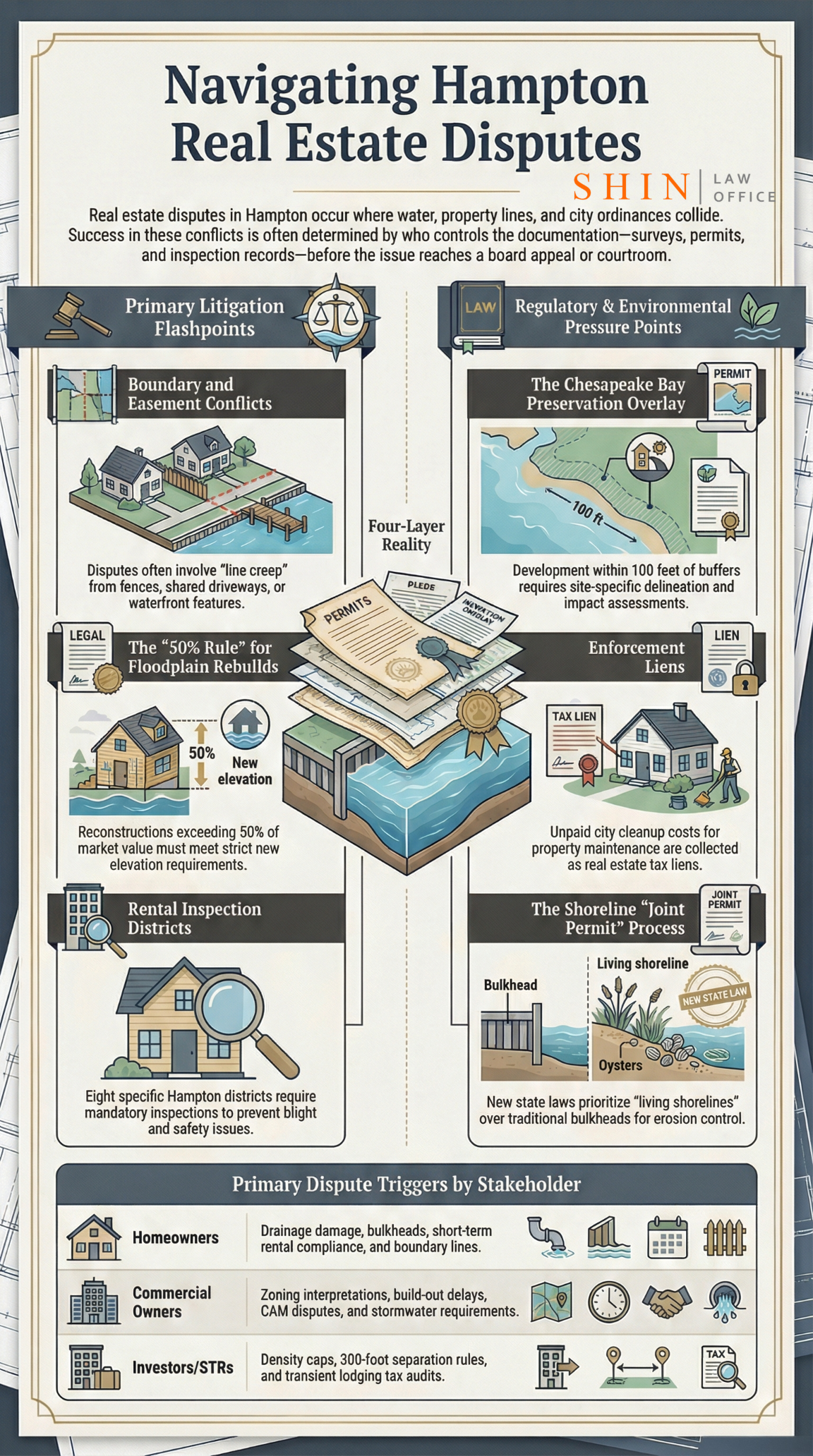
Table of Contents
- Real Estate Disputes in the City of Hampton
- 1. The “Four-Layer” Reality of Property Disputes
- 2. Homeowner vs. Homeowner Disputes
- 3. Landlord–Tenant Pressure Points
- 4. Short-Term Rentals (STRs)
- 5. Owner vs. City: Zoning and Appeals
- 6. The Chesapeake Bay Preservation Overlay
- 7. Shoreline Work: Wetlands and Bulkheads
- 8. Floodplain Rules and Rebuilds
- 9. Stormwater and Land Disturbance
- 10. Property Maintenance and Liens
- 11. Tax Valuation and Delinquent Sales
- 12. Condemnation / Eminent Domain
- 13. The Hampton Dispute “Escalation Ladder”
- 14. Prevention Checklist
- References
For Homeowners and Commercial Property Owners in the City of Hampton
Hampton real estate disputes don’t live in just one lane. They form where water, property lines, permits, rentals, and money intersect—often on the same parcel, in the same month. Hampton’s “coastal city reality” adds unique friction points: floodplain rules, shoreline work, wetlands oversight, stormwater controls, and Chesapeake Bay Preservation requirements—plus modern flashpoints like short-term rentals and rental inspection districts.
What follows is a comprehensive map of the dispute situations and litigation triggers that most often impact Hampton homeowners, landlords, tenants, investors, developers, and commercial operators—with Hampton-specific processes, boards, and ordinance-driven pressure points woven in.
Important note (not legal advice): This is general educational information about common dispute patterns and local regulatory frameworks. Real cases turn on facts, timelines, and documents, especially because appeals and enforcement matters can have strict deadlines.
1) The “Four-Layer” Reality of Hampton Property Disputes
Most real estate conflicts in Hampton can be understood as four layers stacked on the same land:
- The Ground Layer (boundaries, encroachments, easements)
- The Water Layer (floodplains, drainage, shoreline erosion, wetlands)
- The Paper Layer (zoning, permits, ordinances, leases, deeds, taxes)
- The People Layer (neighbors, tenants, HOAs, contractors, city enforcement)
Hampton’s local government structure reflects those layers: Planning & Zoning supports land-use decisions and boards such as the Board of Zoning Appeals and the Wetlands Board, while enforcement functions address existing property conditions and zoning compliance.
2) Homeowner vs. Homeowner Disputes
These are the “close-to-home” conflicts—often emotional, document-heavy, and surprisingly expensive once surveyors, engineers, or lawyers are involved.
A. Boundary line disputes and encroachments
Typical triggers in Hampton:
- Fences built on assumptions (old pins, outdated plats, “it’s always been like that”).
- Driveway edges, sheds, additions, retaining walls, and drainage pipes drifting across a line.
- Waterfront features (stairs, riprap placement, small walls) creating “line creep.”
Why it turns into litigation:
- Title insurers and lenders often demand resolution before closing.
- Encroachments can affect permitting, resale, and—near water—compliance with overlay rules.
Evidence that decides outcomes:
- Modern survey plats, historic plats, deeds, photos over time, and sometimes GIS context.
B. Easements and access conflicts
Common Hampton easement disputes include:
- Shared driveways and “who maintains what” arguments.
- Utility easements and conflicts over tree removal, landscaping, or fencing.
- Drainage easements (especially when flooding or standing water becomes chronic).
- Access-to-water or “back-lot access” claims near shoreline areas.
These disputes often escalate when one party blocks use, alters the surface, or installs improvements inside the easement corridor.
C. Nuisance-style conflicts that become “property disputes”
In Hampton, some neighbor disputes quickly become “real estate disputes” because the City has active enforcement tools for property conditions.
Examples:
- Trash accumulation, debris, or uncontrolled vegetation leading to enforcement actions and cost recovery. Hampton’s property maintenance ordinance framework includes written notice requirements and potential penalties, and it also contemplates the City performing cleanup and charging costs that can be collected like real estate taxes and become a lien.
- “Yard conditions” disputes that become enforcement disputes—especially when neighbors report conditions to the City.
Hampton’s Property Maintenance & Zoning Enforcement function describes proactive enforcement of property maintenance standards and responding to citizen complaints about issues like weeds/debris, inoperative vehicles, and graffiti.
D. Parking, “front yard use,” and neighborhood conflict
Hampton’s restriction on parking on front lawns is a real-world dispute catalyst because it touches aesthetics, mobility constraints, and “property rights” perceptions.
Hampton states that (with conditions) residents cannot park on front lawns if parking is allowed on their street, effective July 1, 2022, and driveway work requires permits (though the City emphasizes no one is required to install a driveway).
This can trigger:
- Neighbor-to-neighbor conflict (complaints, retaliation claims, “selective enforcement” perceptions)
- Owner-to-city disputes (citations, compliance timelines, permit questions)
3) Landlord–Tenant Disputes With Hampton-Specific Pressure Points
Hampton has two different “worlds” of leasing disputes: residential rentals (with habitability and local inspection districts) and commercial leasing (more contract-driven, often higher-dollar, and frequently tied to zoning/permits).
A. Residential rental disputes amplified by Hampton’s Rental Inspection Districts
Hampton has a rental inspection ordinance covering eight districts and explains the program is intended to improve health/safety, ensure decent living conditions, and prevent/reverse blight. It also identifies included neighborhoods such as North Phoebus, Olde Hampton, South Wythe, Sussex, and others, and provides program materials including violations lists and owner Q&As.
Dispute patterns that follow:
- Owner vs. City: inspection failures, reinspection cycles, and compliance costs.
- Owner vs. Tenant: repairs, habitability claims, access issues, and disputes over who caused damage.
- Tenant vs. City/Owner: displacement concerns, timing conflicts, and claims that enforcement is retaliatory (fact-specific).
Virginia law also enables rental inspection districts generally, which matters when disputes challenge authority or process.
B. Commercial lease disputes that tie directly into zoning and “permitted use”
Commercial landlords and tenants litigate over:
- Use clauses: what the tenant is allowed to do vs. what zoning allows.
- Permitting responsibility: who pulls permits and pays for compliance corrections.
- Build-out conflicts: delays, contractor defects, code compliance, and change orders.
- CAM/operating expenses: disputes over pass-throughs, capital vs. operating costs.
- Exclusive use and competition: especially in shopping centers.
Hampton’s zoning framework matters here because uses can be permitted “by-right,” by permit, by special exception, etc. Hampton’s zoning materials include a table approach to permitted uses and note that uses not listed are generally not permitted unless interpreted as substantially similar.
When a tenant’s business model doesn’t align with zoning permissions, “lease dispute” turns into a three-way problem: tenant vs. landlord vs. City enforcement.
4) Short-Term Rentals: A New Major Source of Disputes in Hampton
Short-term rentals (STRs) create a unique “hybrid” dispute category: part zoning, part nuisance, part licensing/tax.
Hampton’s STR regulatory framework includes:
- STR zones (51 zones) with a density cap (a maximum percentage of dwellings allowed as STRs per zone)
- A 300-foot separation requirement (with an exception allowing two to be directly next door)
- Permitting and fees (including an administrative permitting process and inspection fees)
- Operating conditions addressing safety and nuisances
- Public-facing tools: a map of approved STRs and a method to identify a responsible local contact person, plus guidance to report issues through Hampton’s 3-1-1 system if needed.
STR disputes commonly look like:
- Neighbor vs. STR operator: noise, trash, parking, occupancy, parties.
- Operator vs. City: permit denial, alleged noncompliance, separation/density conflicts.
- Investor vs. buyer/seller: “I bought this to Airbnb it” disputes when zoning/permit reality blocks the plan.
STR tax disputes also happen
Hampton imposes a short-term rental tax (described as 1% on gross proceeds, remitted quarterly) and separately describes a lodging tax framework for transient lodging (including an 8% component plus a nightly flat fee per room) with remittance timelines.
That can produce disputes over:
- Who is responsible for collecting/remitting (owner vs. property manager vs. platform)
- Audit exposure and back-tax assessments
- Business licensing and compliance sequencing
5) Owner vs. City Disputes: Zoning, Enforcement, Boards, and Appeals
A large share of Hampton real estate litigation starts as a disagreement with a City decision—then becomes an appeal, an enforcement action, or a court case.
A. Zoning enforcement and land-use decisions
Hampton’s Planning & Zoning function supports zoning ordinance administration and boards, and it identifies property maintenance/zoning enforcement as ensuring compliance for existing structures (residential and commercial).
Zoning-related disputes include:
- “My use is legal / nonconforming / grandfathered”
- Home-based business complaints
- Signage disputes
- Parking and buffering disputes for commercial properties
- “Interpretation” disputes (is your use “substantially similar” to a listed use?)
B. Board of Zoning Appeals: where zoning disputes often go next
Hampton’s Board of Zoning Appeals meets on a regular schedule and handles zoning-related requests like variances and appeals.
Under Virginia law, boards of zoning appeals have powers/duties including hearing appeals of administrative decisions.
Common litigation trigger: when an owner claims the zoning administrator’s determination is wrong (or when neighbors challenge an approval).
6) The Chesapeake Bay Preservation Overlay: “Water Quality” as a Litigation Trigger
In Hampton, some of the hardest disputes are not about buildings—they’re about what you’re allowed to disturb near sensitive waters.
Hampton’s Chesapeake Bay Preservation Overlay (CBPO) explains:
- The RMA extends 100 feet inland from the edge of the buffer (as described by the City).
- Hampton also identifies an Intensely Developed Area (IDA) overlay with defined criteria.
- The City notes development and disturbance in the RPA is limited, and projects often require site-specific delineation and submission of a Water Quality Impact Assessment.
- If criteria for encroachment aren’t met, an exception may be required via the Board of Zoning Appeals under legally established standards of review.
Disputes you see in practice:
- Homeowners wanting decks, additions, sheds, pools, patios, grading, or tree removal near buffers.
- Commercial developers facing redesigns, added stormwater controls, or denial/conditions.
- Neighbor challenges (“that work is too close to the water / buffer / wetlands”).
- Project delays that cascade into contract disputes (financing, contractor scheduling, tenant build-outs).
7) Wetlands, Bulkheads, Living Shorelines: Shoreline Work That Turns Into Court Fights
Hampton’s Wetlands Board reviews applications to use/develop wetlands and can investigate projects that alter wetlands within the City; the City describes the board as having power to prosecute violations of its orders or relevant provisions.
A. Wetlands disputes
Common triggers:
- Unpermitted filling, grading, clearing, or “minor” shoreline work that isn’t minor in a regulated area.
- Disputes over whether an area is jurisdictional wetlands or buffer.
- Conflicts between property owners and contractors who “handled it informally.”
B. Bulkhead disputes and permit-driven conflict
Hampton’s bulkheads guidance highlights:
- Permit fees vary; the City requests applicants bring a survey/plat.
- Building code requirements may require engineered plans for most bulkhead projects.
- Work on existing or new bulkheads requires submission of a Joint Permit Application, and the City references new state law around tidal wetlands that can require a living shoreline if it’s the most suitable option.
Where disputes arise:
- Neighbor objections (views, access, erosion impacts)
- Contractor claims (engineering changes, delays, cost overruns)
- Enforcement actions for unpermitted work
- Insurance disputes after storm damage
C. Shoreline erosion and “living with water” disputes
Hampton explicitly notes shoreline erosion as an increasing challenge and links erosion impacts to sea level rise and higher tides occurring more often, describing living shorelines as a more natural approach than hard stabilization.
That real-world trend fuels:
- Boundary uncertainty (shoreline changes)
- Damage claims after storms
- Disputes over who caused erosion (neighbor’s structure vs. natural processes)
- Compliance conflicts when owners want quick “hard” solutions
8) Floodplain Rules and Post-Storm Rebuild Disputes
Flood-related disputes are especially common in coastal Hampton because rebuilding is not just “construction”—it’s a compliance project.
Hampton states:
- Proposed development in the 100-year floodplain must be reviewed and permitted under the Floodplain Zone District ordinance framework.
- If reconstruction/rehab/additions equal or exceed 50% of the building’s market value, the structure must meet new construction requirements (potentially including elevation).
- Hampton plan reviewers calculate improvement costs and use market value provided by Hampton’s Assessor; “substantially damaged” buildings must also be brought up to the same standards regardless of the cause of damage.
Litigation and conflict patterns:
- Owner vs. City: disagreement over “substantial improvement” calculations or what must be elevated.
- Owner vs. insurer: coverage scope (especially because flood coverage is often separate).
- Buyer vs. seller: nondisclosure fights after repeated flooding or prior flood claims.
- Owner vs. contractor: delays, code-driven redesigns, disputed scope changes.
Hampton’s flood safety materials also emphasize that most homeowners and commercial policies exclude flooding and that flood policies may have a waiting period before they take effect—issues that can drive claim disputes.
9) Stormwater, Land Disturbance, and “Runoff Litigation”
Stormwater disputes are often misunderstood: they can be about permits, construction practices, and downstream damage to neighbors and public infrastructure.
A. Land-disturbing permits and erosion/sediment control
Hampton’s land-disturbing framework includes:
- Permit applications submitted in the owner’s name (or representative), with multiple copies of plans and stormwater management materials.
- Fee schedules tied to disturbance size.
- Incorporation of Virginia erosion and sediment control standards and the Virginia Erosion and Sediment Control Handbook and regulations.
Dispute triggers:
- Neighbor property damage (mud, sediment, clogged drainage)
- Stop-work orders and project shutdowns
- Contractor vs. owner disputes over who pays for compliance fixes
B. Stormwater management ordinance concepts
Hampton’s stormwater materials define key terms and tie stormwater concepts to Chesapeake Bay Preservation terminology (RPA/RMA).
C. MS4 compliance and enforcement ecosystem
A DEQ fact sheet describes Hampton’s municipal storm sewer system (MS4) permitting context (including a listed permit number and an expiration date).
This matters because:
- Developments may face stricter controls, inspections, and enforcement around discharges.
- Private property disputes can arise when owners claim municipal drainage contributes to flooding, or when private changes affect public drainage.
10) Property Maintenance, Blight, and Cost Recovery: When “Condition” Becomes a Lien
Hampton’s property maintenance enforcement isn’t just about aesthetics—it can become financial.
An ordinance record for unlawful property maintenance conditions includes:
- Rules around accumulations of trash and similar materials, and cutting of vegetation near structures, with notice frameworks and penalties.
- Provisions addressing overgrown shrubs/trees/vegetation that obstruct visibility, address numerals, emergency access points, or create hazards.
- Authority for the City to perform cleanup and charge expenses plus a service charge, collected like real estate taxes and becoming a lien.
Dispute patterns:
- Owners disputing notice, scope, or whether conditions qualify as violations.
- “Vacant property” cases where ownership is unclear or absentee owners don’t respond.
- Title disputes at sale/closing when a lien appears.
- Commercial property disputes when debris, vegetation, or construction-site maintenance triggers enforcement.
11) Property Tax Valuation, Appeals, and Tax Sale Disputes
Even when owners agree on property lines, they often disagree with the property’s value—or the consequences of delinquency.
A. Assessment disputes and appeals
Hampton describes its general reassessment as an annual review of assessment valuations as of January 1, using accepted mass appraisal methods and standards.
The City also describes an appeal process involving a Board of Review where appointed property owners hear appeals and decide whether adjustments are warranted.
Common disputes:
- Market value disagreements (especially after renovations, storm impacts, or neighborhood shifts)
- Equity arguments (“mine is higher than comparable properties”)
- Classification disputes (land use, condition, effective age)
B. Delinquent tax sale disputes
Hampton has issued notices of delinquent taxes and sale of real property pursuant to Virginia Code § 58.1-3975, describing auction sale details (date/location) for delinquent parcels.
Tax sale-related litigation commonly includes:
- Challenges to notice procedures
- Redemption/distribution disputes
- Title-clearing actions after purchase (quiet title–style litigation patterns)
12) Condemnation / Eminent Domain Disputes
Government takings and redevelopment projects can create major litigation for commercial owners and homeowners alike.
Virginia’s Hampton charter includes authority for the City to acquire property by condemnation when council declares public necessity.
There is also Hampton-related condemnation case law history (e.g., Virginia Supreme Court-level disputes) illustrating how “public use” and project purpose can become legal battlegrounds.
Common condemnation dispute issues:
- Valuation (highest and best use)
- Loss of access, parking, or business interruption impacts
- Partial takings and “damage to residue”
- Relocation and timing conflicts for tenants
13) Commercial-Specific Litigation Hotspots in Hampton
Here are the “repeat offenders” for Hampton commercial property disputes:
- Permitting delays that trigger lease default claims or kill tenant openings (especially when floodplain, CBPO, wetlands, and stormwater reviews overlap).
- Site drainage disputes (paved lots and runoff impact neighbors).
- Zoning enforcement tied to operating hours, parking, or “use” disputes—sometimes triggered by competitor complaints.
- Construction conflicts: change orders, defects, lien filings, and responsibility splits between landlord and tenant.
- STR and lodging-adjacent compliance for mixed-use or investor-held properties.
14) The Hampton Dispute “Escalation Ladder”
Most real estate conflicts follow a recognizable escalation pattern:
- A trigger event (flooding, noise, failed inspection, denied permit, boundary discovery)
- A document battle (permits, plats, photos, notices, policies, emails)
- A process battle (BZA, Wetlands Board, inspection cycle, appeal hearing)
- A money battle (repairs, fines, lien, lost rent, business interruption)
- Litigation when the parties run out of leverage or time
15) Practical “Hampton-Ready” Prevention Checklist
These steps reduce the odds of disputes turning into lawsuits:
For homeowners
- Know whether floodplain rules apply before renovating (the 50% threshold can change the entire project).
- If near water, check CBPO and consider site-specific delineation needs early.
- Before shoreline work, assume you may need engineered plans and joint permits, and consider the suitability of a living shoreline.
- Keep the property compliant to avoid enforcement costs becoming liens.
For landlords and investors
- If you own in a rental inspection district, use Hampton’s published violations list and Q&As as a pre-inspection checklist.
- For STR operations, confirm zoning/permit eligibility first; treat neighbor relations and nuisance controls as part of compliance.
For commercial owners and developers
- Use early permit coordination—Hampton’s Development Services Center provides pre-meeting support and reviews stormwater and tidal wetlands issues.
- Treat stormwater and land-disturbance compliance as a core risk item, not an afterthought.
In Hampton, real estate disputes are rarely just paperwork problems. They are collision problems. Water meets land. Rules meet reality. A single decision, such as raising a home after a flood, installing a bulkhead, clearing brush near a buffer, or renting a property in an inspection district, can turn a quiet parcel into a regulated project with deadlines, inspections, and financial consequences.
What makes Hampton different is that the coastline does not negotiate. Floodplain rules, shoreline permits, wetlands oversight, stormwater controls, and Bay protection buffers create a second set of property lines that do not show up on a deed. Homeowners learn this when a renovation crosses the substantial improvement threshold, triggering elevation requirements. Investors learn it when a short-term rental plan fails a density map or separation rule. Developers learn it when drainage and land-disturbance compliance becomes the schedule driver, not the contractor’s.
The hard truth is this. Most Hampton real estate litigation is not driven by bad intentions. It is driven by bad sequencing. People act first and discover the regulatory layer later. Neighbors complain. Inspectors show up. A notice arrives. Costs stack up. Then everyone argues about who is responsible: the owner, the tenant, the contractor, the prior seller, or the City.
If you own property in Hampton, your best leverage is not conflict. It is control. Control of the documents. Control of the timeline. Control of the approvals before money is spent. The people who win these disputes are not always the ones with the loudest position. They are the ones who can prove what happened, what was allowed, and what had to be done next.

Principal Attorney | Shin Law Office
Call 571-445-6565 or book a consultation online today.
(This article is provided for general informational purposes and does not constitute legal advice. For advice on your specific situation, consult with a licensed Virginia attorney.)
References
- City of Hampton, Virginia. (n.d.). Appeal process. Retrieved March 3, 2026, from https://www.hampton.gov/416/Appeal-Process
- City of Hampton, Virginia. (n.d.). Board of Zoning Appeals. Retrieved March 3, 2026, from https://www.hampton.gov/175/Board-of-Zoning-Appeals
- City of Hampton, Virginia. (n.d.). Bulkheads. Retrieved March 3, 2026, from https://www.hampton.gov/1119/Bulkheads
- City of Hampton, Virginia. (n.d.). Chesapeake Bay Preservation Overlay (CBPO). Retrieved March 3, 2026, from https://www.hampton.gov/4332/Chesapeake-Bay-Preservation-Overlay-CBPO
- City of Hampton, Virginia. (n.d.). Create a living shoreline. Retrieved March 3, 2026, from https://www.hampton.gov/4008/Create-a-Living-Shoreline
- City of Hampton, Virginia. (n.d.). Development Services Center (Permits). Retrieved March 3, 2026, from https://www.hampton.gov/442/Permits
- City of Hampton, Virginia. (n.d.). Flooding and flood safety. Retrieved March 3, 2026, from https://www.hampton.gov/1747/Flooding-Flood-Safety
- City of Hampton, Virginia. (n.d.). General reassessment. Retrieved March 3, 2026, from https://www.hampton.gov/414/General-Reassessment
- City of Hampton, Virginia. (n.d.). No parking on lawns. Retrieved March 3, 2026, from https://www.hampton.gov/3927/No-Parking-on-Lawns
- City of Hampton, Virginia. (n.d.). Property maintenance and zoning enforcement. Retrieved March 3, 2026, from https://www.hampton.gov/259/Property-Maintenance-Zoning-Enforcement
- City of Hampton, Virginia. (n.d.). Rental inspections. Retrieved March 3, 2026, from https://www.hampton.gov/2312/Rental-Inspections
- City of Hampton, Virginia. (2025, November 3). Short term rentals. Retrieved March 3, 2026, from https://www.hampton.gov/4135/Short-Term-Rentals
- City of Hampton, Virginia. (n.d.). Short term rental tax. Retrieved March 3, 2026, from https://www.hampton.gov/1085/Short-Term-Rental-Tax
- City of Hampton, Virginia. (2015, February 4). Chapter 13.1 land disturbing operations (PDF). Retrieved March 3, 2026, from https://www.hampton.gov/DocumentCenter/View/6652/Chapter-131-Land-Disturbing-Operations-February-4-2015
- City of Hampton, Virginia. (2015, February 2). Chapter 33.2 stormwater management (PDF). Retrieved March 3, 2026, from https://www.hampton.gov/DocumentCenter/View/6653/Chapter-332-Stormwater-Management-February-2-2015
- City of Hampton, Virginia. (2022, November 1). Notice of delinquent taxes and sale of real property (PDF). Retrieved March 3, 2026, from https://www.hampton.gov/DocumentCenter/View/37365/Notice-of-Delinquent-Taxes-and-Sale-of-Real-Property-on-Nov-1-2022-PDF
- City of Hampton, Virginia. (n.d.). VPDES permit fact sheet: VSMP MS4 permit overview (PDF). Retrieved March 3, 2026, from https://www.hampton.gov/DocumentCenter/View/48392/VSMP-MS4-Permit-Overview
- City of Hampton, Virginia. (n.d.). Zoning. Retrieved March 3, 2026, from https://www.hampton.gov/3565/Zoning
- City of Hampton, Virginia. (n.d.). Zoning ordinance chapter 2 uses permitted (PDF). Retrieved March 3, 2026, from https://www.hampton.gov/DocumentCenter/View/3836/Zoning-Ordinance-Chapter-2-Uses-Permitted
- City of Hampton, Virginia. (n.d.). Wetlands board. Retrieved March 3, 2026, from https://www.hampton.gov/220/Wetlands-Board
- City of Hampton, Virginia. (2015, June 1). Unlawful property maintenance conditions (ordinance document) (PDF). Retrieved March 3, 2026, from https://mcclibraryfunctions.azurewebsites.us/api/ordinanceDownload/14532/1031296/pdf
- Virginia General Assembly. (n.d.). Charter: Hampton. Retrieved March 3, 2026, from https://law.lis.virginia.gov/charters/hampton/
- Virginia General Assembly. (n.d.). Code of Virginia § 15.2 2309 powers and duties of boards of zoning appeals. Retrieved March 3, 2026, from https://law.lis.virginia.gov/vacode/title15.2/chapter22/section15.2-2309/
- Virginia General Assembly. (n.d.). Code of Virginia § 36 105.1:1 rental inspections, rental inspection districts, exemptions, penalties. Retrieved March 3, 2026, from https://law.lis.virginia.gov/vacode/title36/chapter6/section36-105.1%3A1/
- Ottofaro v. City of Hampton, 275 Va. 590 (2003). Retrieved March 3, 2026, from https://caselaw.findlaw.com/court/va-supreme-court/1223072.html