
Bottom Line Up Front (BLUF)
Breach of contract is the most frequent source of business lawsuits I handle in Montgomery County. When a deal falls apart, whether due to unpaid invoices, missed deadlines, or broken promises, businesses in Rockville, Bethesda, Gaithersburg, and beyond often find themselves in court. Understanding how Maryland law treats contracts and what to expect in a breach-of-contract dispute can help you protect your company and resolve issues efficiently.
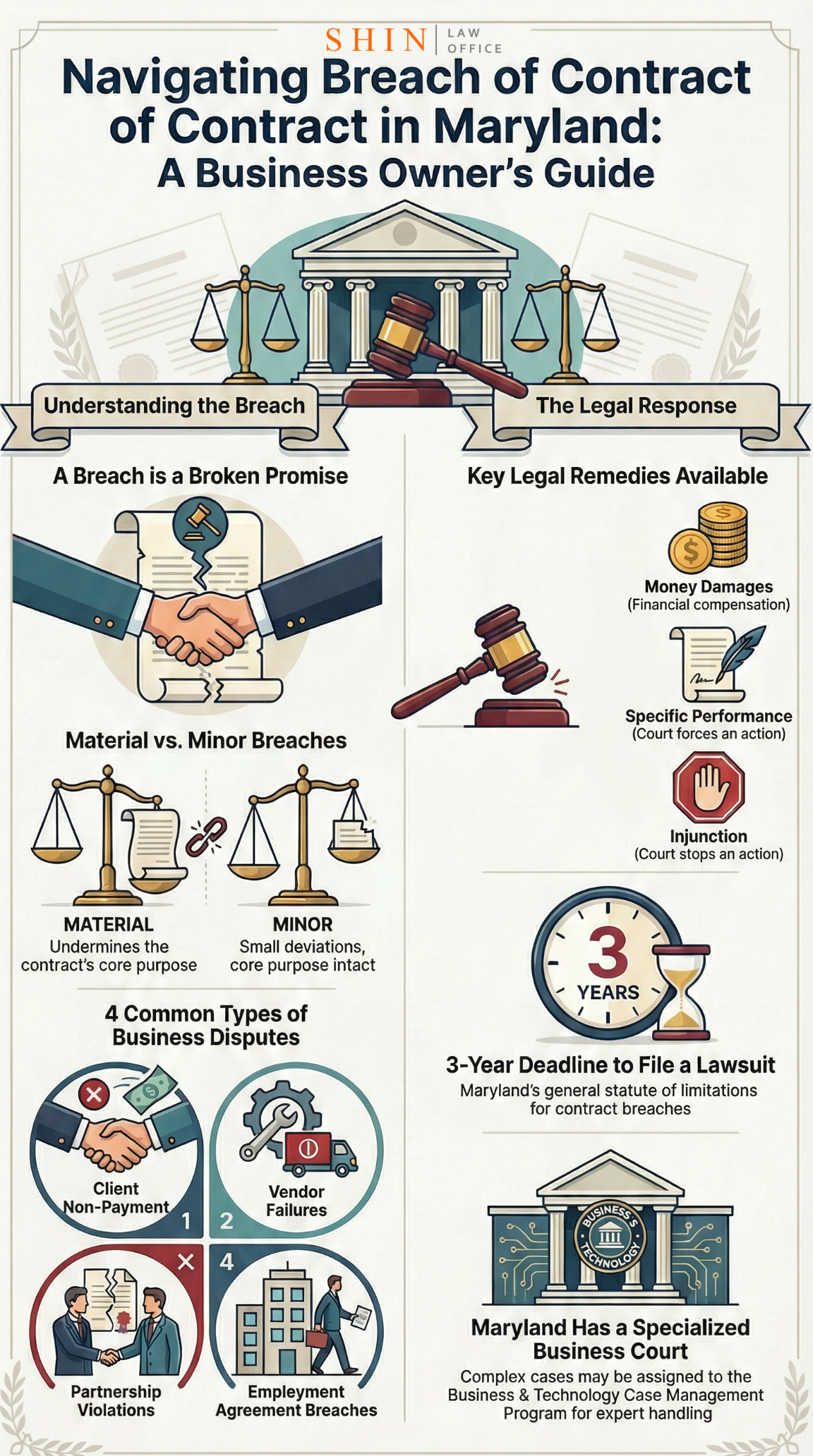
Table of Contents
- Chapter 1: Why Breach of Contract Disputes Are So Common
- Chapter 2: What Constitutes a Contract (and a Breach) in Maryland
- Chapter 3: Proving a Breach of Contract Under Maryland Law
- Chapter 4: Typical Business Contract Disputes (Clients, Vendors, Partners)
- Chapter 5: Legal Remedies for Breach of Contract in Maryland
- Chapter 6: Navigating a Breach of Contract Lawsuit in Montgomery County
- References
Chapter 1: Why Breach of Contract Disputes Are So Common
Breach of contract is by far the most common cause of commercial litigation in my practice. Nearly every business deals with contracts, from client service agreements to supplier orders, so it’s no surprise that many business lawsuits stem from one party not upholding their end of a deal. In Montgomery County (including business hubs like Rockville and Bethesda), I often see disputes with clients, suppliers, partners, or vendors over contract terms, performance issues, or nonpayment. These disputes arise when one side believes the other failed to fulfill a promise made in a contract. Because contracts are the backbone of most business relationships, a breakdown can quickly lead to a legal claim for breach of contract.
One reason these disputes are so prevalent is that businesses rely on contracts for almost everything: purchasing inventory, providing services, leasing property, forming partnerships, etc. When something goes wrong – a shipment isn’t delivered, a client doesn’t pay, a partner violates a term of the partnership agreement – the injured party’s main recourse is often a breach of contract lawsuit. In Montgomery County’s busy economy, with many transactions and partnerships underway, it’s almost inevitable that some percentage will end up in conflict. As an attorney, I know that prompt communication and negotiation can sometimes resolve these issues. But if those efforts fail, the next step is often to file suit and let the courts enforce the contract’s obligations.
Chapter 2: What Constitutes a Contract (and a Breach) in Maryland
Before we talk about “breach,” we should clarify what counts as a valid contract. In Maryland, a contract is essentially a legally enforceable agreement between parties. To form a valid contract, there must be an offer, an acceptance of that offer, and consideration (meaning each side gives or promises something of value). For example, if I offer to sell you 100 widgets for $5 each and you accept, and we both get something (you get widgets, I get money), we have a contract. Importantly, contracts don’t always have to be in writing – oral agreements can be binding too, as long as they meet the legal requirements. (However, certain agreements, like those for the sale of real estate or long-term deals, do require written form under the Statute of Frauds.) In my experience, even a handshake deal can be enforceable in court, though proving the exact terms is harder without a written document.
Once a valid contract exists, a breach of contract occurs when one party fails to perform their obligations under the agreement. This failure can take many forms. Perhaps a vendor doesn’t deliver goods on time, or a client refuses to pay for completed work, or a partner violates a non-compete clause. Big or small, any unmet contractual obligation can constitute a breach if it’s not legally excused. It’s worth noting that not every deviation is treated the same; the law distinguishes between minor breaches (small deviations that don’t defeat the purpose of the deal) and material breaches (major failures that undermine the whole contract). For instance, delivering an order one day late might be a minor breach if the delay doesn’t really harm the buyer, whereas delivering completely wrong or defective products would be a material breach. Similarly, if one party declares in advance that they won’t fulfill their duties (e.g. a contractor saying they won’t finish the project next month), that’s called an anticipatory breach, and the other side can take action immediately rather than waiting for the deadline to pass. In sum, any significant failure to perform a contractual promise without a valid excuse or the other side’s agreement constitutes a breach that could lead to a lawsuit.
Chapter 3: Proving a Breach of Contract Under Maryland Law
If you end up in court over a contract, what do you need to prove? Under Maryland law, a plaintiff suing for breach of contract must show two fundamental things: (1) that a contractual obligation existed (in other words, a valid contract and a duty owed by the defendant), and (2) that the defendant breached that obligation. Essentially, you’re proving “we had a deal, and the other side didn’t hold up their end.” Unlike some states, Maryland does not require proving actual damages as part of liability – if you prove the breach but can’t quantify a loss, you can still win the case and get nominal damages (a token amount, like $1, just to acknowledge the breach). This is an important quirk: even if the breach didn’t cause a large financial harm, Maryland courts recognize the principle that a broken promise is a legal wrong in itself. (Of course, if you want meaningful compensation, you will need to prove your losses, but the lack of provable damages won’t defeat your claim entirely.)
Let’s break down those elements a bit further. Proving a contract existed often means showing documents or communications that establish the agreement – a signed contract, a series of emails outlining terms, or even an oral agreement supported by witnesses or conduct. I’ve handled cases where the existence of a contract was hotly contested (for example, whether a series of purchase orders and phone calls constituted a binding deal). Maryland follows the objective theory of contracts, meaning the court looks at the outward signals of agreement (what was written or said) rather than secret intentions. Next, proving a breach involves demonstrating how the other party failed to perform. This could be as straightforward as unpaid invoices or as complex as subpar performance that does not meet industry standards (in service contracts). We often use documents (e.g. delivery receipts, payment records) and witness testimony to show the promise and the failure. It’s also critical to address any defenses the breaching party might raise. Common defenses in contract cases include arguing that no valid contract ever formed, that the contract was void or illegal, or that somehow the breach was excused (for instance, the breaching party might claim the other side breached first, or that an unanticipated event made performance impossible). As a litigator, I prepare for these defenses in advance – for example, making sure we can prove my client fulfilled their own obligations or was ready and willing to perform, since a party who materially breaches first can’t complain about the other’s later breach (the concept of “first breach” defense).
Lastly, while not required to establish liability, demonstrating damages is a key part of any breach-of-contract case if you want more than a symbolic win. Maryland law allows recovery of a variety of contract damages (which we’ll cover in Chapter 5), but as the plaintiff you must substantiate the amount. The burden is on the injured party to prove their losses with reasonable certainty – you can’t just speculate or throw out a big number. In a Montgomery County case I recently handled, we spent considerable effort working with an expert to calculate the lost profits resulting from a supplier’s breach. If you fail to convincingly tie your losses to the breach, the court may award far less than you seek, or only nominal damages. Overall, winning a breach of contract claim in Maryland requires carefully proving the deal, the breach, and the resulting impact, while fending off any legal defenses the other side may raise.
Chapter 4: Typical Business Contract Disputes (Clients, Vendors, Partners)
Not all contract disputes are alike – they come in many flavors in the business world. Here are some common scenarios I see in Montgomery County’s commercial litigation practice:
- Client/Customer Nonpayment: A classic example is when a business provides goods or services to a client, but the client fails to pay as agreed. This could be a contractor building an addition for a customer who then refuses to pay the final invoice, or a consulting firm delivering work and the client claiming dissatisfaction to avoid payment. The breach here is nonpayment for performance rendered. Often, the dispute centers on whether the service was properly performed or delivered as promised, or on the payment terms (e.g., the client argues that some condition wasn’t met).
- Vendor/Supplier Failures: On the flip side, a company might sue a vendor who didn’t deliver on time or at quality. For instance, a retailer in Gaithersburg might have a contract with a supplier for holiday inventory by December 1, but the shipment arrives weeks late (or not at all), causing lost sales. Or a manufacturer delivers goods that don’t meet the specifications in the contract. These breaches can entitle the business to damages for the disruption – e.g., the lost profits from empty shelves or the cost of obtaining replacement goods. We often have to show the contract terms (delivery date, product specs) and how the vendor deviated.
- Partnership & Shareholder Disputes: Many Montgomery County businesses are closely held, so I also see breaches of partnership or LLC agreements and shareholder disputes. An example might be a partner who violates a non-compete or confidentiality clause in the partnership agreement, or who fails to contribute capital as promised. Another example is a minority shareholder who has contractual rights (such as a buyout provision or dividend rights) that the majority owners don’t honor. These internal business disputes often mix contract and fiduciary duty issues. A breach of the operating agreement or shareholders’ agreement is actionable, and the remedies may include buyout orders or monetary damages.
- Employment Contract Breaches: Although employment issues can be its own area of law, high-level employment agreements (like a CEO’s contract or a sales manager’s non-compete agreement) often lead to contract suits. For example, an executive might sue a company for breaching a severance agreement, or a company might sue a former employee for breaching a non-solicitation clause by poaching clients. In towns like Silver Spring and Rockville, with many tech and biotech firms, these contract disputes are not uncommon. They involve specialized considerations (such as whether restrictive covenants are enforceable), but fundamentally, they are breach-of-contract cases at heart.
- Miscellaneous Business Contracts: There are countless other contract types that lead to litigation – leases (when a tenant or landlord breaches a commercial lease), franchise agreements (disputes between franchisees and franchisors), licensing deals (when one side uses IP beyond the license terms), and more. For example, a restaurant in Bethesda might sue its landlord for failing to repair the premises as required under the lease (a breach of a lease covenant), or, conversely, the landlord might sue the restaurant for unpaid rent – both are breaches of the lease contract.
In all these scenarios, the key thread is that one party failed to fulfill their promise under a business agreement, and that failure caused harm to the other party. As a litigator, my first step is to pin down the exact contract terms (what each side was obligated to do) and then gather evidence of how the defendant fell short. Business contract cases can sometimes be resolved by highlighting these clear failures and negotiating a settlement (for example, a payment plan for an overdue invoice, or a partial refund and a fix for subpar work). If not, we prepare to prove the breach and resulting damages in court, as discussed earlier. Montgomery County businesses should also be aware that some industries or contracts may require alternative dispute resolution (such as mandatory arbitration clauses), which can alter how these disputes are handled. But if there’s no such clause, these scenarios typically play out in our state courts.
Chapter 5: Legal Remedies for Breach of Contract in Maryland
When a breach of contract is proven, the next question is: what can the injured party get? Maryland law provides several remedies to compensate or otherwise fix the harm from a broken contract. Here are the main types of remedies available:
- Compensatory Damages: These are the most common damages, meant to make the non-breaching party whole. In a breach of contract case, compensatory damages usually equal the actual financial loss the innocent party suffered. There are two sub-categories: direct (or “expectation”) damages and consequential damages. Direct damages are the immediate losses from the breach – for example, the unpaid contract price or the cost to complete a job that the breaching party abandoned. Consequential damages are more indirect losses that flow from the breach, such as lost profits because a delayed shipment caused you to lose customers. Maryland allows recovery of consequential damages if they were reasonably foreseeable at the time of contracting (this echoes the classic rule from Hadley v. Baxendale, meaning you can’t claim extreme or unforeseeable losses that the breaching party had no reason to know about). It’s important to document these losses clearly; courts will require proof that the breach caused the specific dollar amounts claimed.
- Liquidated Damages: Many business contracts include a liquidated damages clause, which is an agreed-upon amount of damages in the event of a breach. Maryland courts will enforce such clauses as long as they are a reasonable estimate of actual damages and not a “penalty”. For instance, a software vendor contract might specify a $ 500-per-day charge for late delivery. If the vendor breaches by delivering late, the client can simply claim the liquidated sum (instead of having to prove actual loss for each day). However, if the court finds the amount was exorbitant or punitive (designed just to punish the breacher rather than compensate for loss), it won’t enforce it. In practice, I advise clients to ensure that any liquidated damages in their contracts are proportional to the likely losses to avoid invalidation.
- Nominal Damages: As mentioned earlier, even if you can’t show significant loss, a court can award nominal damages (like $1 or another trivial sum) when a breach occurred. Nominal damages serve as a token acknowledgment that your rights were violated. In business, a purely nominal award is rare (since usually a breach has some financial effect), but it can happen. I’ve seen cases where a principle was at stake more than money, and a party pursued the case to establish the breach and receive a nominal $1 judgment – not a lucrative outcome, but it proved the point.
- Punitive Damages: Generally, punitive damages are not available for a standard breach of contract in Maryland. Punitive damages are meant to punish wrongful conduct, and in contract law the focus is compensation, not punishment. Only if the breach of contract is tied to some egregious tortious behavior – fraud, malice, or other willful wrongdoing – might punitive damages come into play. For example, if a breach is accompanied by a fraudulent scheme, a court might award punitive damages under the fraud claim, but not under the contract claim alone. In the vast majority of business contract cases, you won’t get punitive damages no matter how angry you are at the breaching party’s conduct, unless you prove a separate tort. I often have to remind clients that “the American Rule” also means you typically cannot recover your attorneys’ fees in a breach of contract case, unless the contract itself or a statute provides for it. (Thus, many contracts do include an attorney’s fee clause for the prevailing party, which is enforceable in Maryland.)
- Specific Performance: This is an equitable remedy in which the court orders the breaching party to perform their contractual duty instead of (or in addition to) paying money. Specific performance is usually reserved for situations where the subject of the contract is unique, and money can’t adequately compensate for the loss. A common example is a real estate contract – every piece of property is unique, so if a seller breaches a land sale contract, the buyer can ask the court to force the sale (convey the property) rather than just give damages. In a business context, I’ve also seen specific performance ordered for contracts for unique goods or irreplaceable assets. However, courts won’t enforce specific performance for personal services (you generally can’t compel an employee or contractor to work by court order, due to public policy). In Montgomery County, seeking specific performance means you file your case in the Circuit Court (equity jurisdiction) and convince the judge that no amount of money could put you in as good a position as the contract itself would. It’s a powerful remedy when applicable.
- Injunctions: Another equitable remedy is an injunction, where the court orders a party to refrain from doing something. In contract cases, this comes up for restrictive covenants – for example, if a former partner or employee has a non-compete or non-disclosure agreement, we might seek an injunction to stop them from violating it (such as an order barring them from working for a competitor or disclosing trade secrets). Injunctive relief can be temporary (a preliminary injunction or TRO to maintain the status quo while the case is ongoing) or permanent (as part of the final judgment). I often file for preliminary injunctions in cases where waiting for a full trial would cause irreparable harm (such as a competitor siphoning off customers in violation of a contract). To get an injunction in Maryland, you must show that you’re likely to win on the merits of the breach and that you’ll suffer irreparable harm without the court’s intervention, among other factors.
- Rescission and Restitution: In some cases, a non-breaching party may choose to rescind the contract – essentially, ask the court to cancel it and put the parties back in their pre-contract position. Rescission is often coupled with restitution, meaning any benefits conferred are returned. This is common when a contract was induced by fraud or a material misrepresentation, or when breaches are so fundamental that the contract’s purpose is defeated. For example, if a software vendor delivered a product so defective that it’s unusable, the buyer might seek rescission: return the software and get a refund of the price paid, rather than keep the defective product and recover damages. Rescission is an alternative remedy – you typically either affirm the contract and sue for damages, or rescind the contract and undo the transaction. It’s an equitable remedy at the court’s discretion.
In any breach of contract case, the non-breaching party also has a duty to mitigate damages. This means you must take reasonable steps to reduce your losses after the other side’s breach. For instance, if a supplier fails to deliver, you should try to find an alternate supplier rather than just letting your losses pile up – otherwise, a court might limit your damages to what you couldn’t avoid with reasonable effort. I always counsel clients: don’t cut off your nose to spite your face during a breach fallout; be proactive in controlling damage, or it could hurt your recovery later.
Maryland’s approach to contract remedies is pretty standard, but one thing to highlight for local businesses is how the courts in Montgomery County enforce these remedies. The judges here are experienced with complex business cases (and as we’ll note in Chapter 6, there’s even a special program for business and tech cases). If you have a well-drafted contract, it can greatly help in the remedies phase – for example, a clear liquidated damages clause or an attorneys’ fee provision will likely be honored by the court if properly crafted. Ultimately, the goal of contract remedies is to fulfill the promise of the contract – either by equivalent money or by the actual performance – so that the innocent party is not left holding the short end of the stick.
Chapter 6: Navigating a Breach of Contract Lawsuit in Montgomery County
The Montgomery County Circuit Court in Rockville, Maryland, is the primary forum for significant business litigation in our area. If you’re pursuing a breach of contract claim seeking substantial damages or equitable relief, you will likely file in the Circuit Court at 50 Maryland Avenue (for smaller claims under $30,000, the District Court in Rockville or Silver Spring may have jurisdiction). In my experience, navigating a lawsuit here involves several key steps and local practices to be aware of:
- Filing the Case: A breach-of-contract lawsuit in Montgomery County begins with a Complaint filed in the appropriate court. For big cases (over $30k or seeking injunctions), that’s the Circuit Court. The Complaint sets out the contract, the breach, and the damages sought. Maryland is a fact-pleading state, so we include enough detail to show a valid claim. The defendant will be served and must file an Answer (or possibly a motion to dismiss if they see a legal deficiency). Common early defenses might include arguing the court lacks jurisdiction, or the venue is wrong, or that the Complaint is legally insufficient. Montgomery County is a populous jurisdiction, but our Circuit Court clerks are efficient – once filed, the case gets a number and a judge assignment relatively quickly under our Differentiated Case Management (DCM) system.
- Pretrial Process: After the initial pleadings, the case enters discovery, where each side exchanges information and evidence. This includes document requests (for contracts, emails, accounting records, etc.), interrogatories, and depositions of key players. For example, I might depose the other party’s project manager to clarify their explanation for why they didn’t deliver on time. Montgomery County Circuit Court follows the Maryland Rules of Procedure for discovery and has an early scheduling order that sets deadlines for discovery, motions, and a trial date. Judges here often require a mediation or settlement conference before trial – the court may refer the case to a magistrate or facilitator to see if a resolution can be reached. In fact, Maryland courts encourage alternative dispute resolution, and I’ve settled many contract cases through court-mandated mediation. It’s a chance for both sides to avoid the cost of trial by finding common ground, possibly preserving a business relationship in the process.
- Business & Technology Case Program: One unique aspect of handling substantial contract cases in this county (and statewide) is the Maryland Business and Technology Case Management Program. The state’s highest court established this program to assign complex business disputes to judges with expertise in that area. Montgomery County’s Circuit Court participates – we have certain judges designated to handle business and tech cases. If your contract dispute is complex (say, it involves a large technology implementation or a multi-million-dollar commercial transaction with novel issues), your case might be assigned to the Business & Tech track. In practice, I’ve found those judges move the cases efficiently and understand the business context well. It’s essentially a specialized business court within the Circuit Court, aimed at coordinated and expert handling of complex commercial matters. This is a benefit to local businesses – your big case might get a judge who’s seen similar complex contract cases and can cut through the noise. (Note: To get into the program, typically one party must request it or the court decides on its own if the case fits the criteria.)
- Trial (Bench or Jury): If the case doesn’t settle, it proceeds to trial. In Circuit Court, either party can request a jury trial for civil cases seeking damages above a certain amount (currently, Maryland law allows jury trials generally for claims over $15,000). Many breach-of-contract cases, however, are tried before a judge (bench trial), especially if they turn on contract interpretation or the detailed accounting of damages. I’ve tried contract cases in the Montgomery County Circuit Court both ways. A jury trial will involve jury selection from our local community, which, given the educated population here, can yield jurors who might even have business experience. Presenting a contract case to a jury means simplifying the story: jurors need to understand the agreement and how it was broken, without getting lost in legalese. Judges, on the other hand, are adept at parsing contract clauses and often appreciate detailed legal arguments about ambiguity, course of dealing, etc. The decision to seek a jury may depend on the case specifics. During trial, we introduce evidence (the contract itself, emails, witness testimony, including perhaps experts on damages) and make legal arguments. Maryland judges often rule on motions in limine to exclude irrelevant or prejudicial evidence in advance, ensuring the trial stays focused. By the end, if it’s a bench trial, the judge will issue a ruling (sometimes with a written opinion later); if it’s a jury trial, the jury will deliberate on liability and damages under the judge’s instructions on the law.
- Outcome and Enforcement: If you win the case (plaintiff), the court will enter a judgment in your favor – either for a sum of money, or an order of specific performance/injunction, etc., depending on what you sought and proved. Collecting a money judgment might involve post-trial steps if the defendant doesn’t pay up – such as garnishments or liens – but Maryland provides mechanisms for that. If you lose, you have the right to appeal (in a contract case, an appeal from Circuit Court would go to the Appellate Court of Maryland, formerly the Court of Special Appeals). Many contract cases don’t reach appeal unless there’s a significant legal issue (e.g., how a contract clause was interpreted) because appeals are costly and the standard of review for factual issues is deferential to the trial court. Still, some important Maryland contract law precedents have emerged from appeals from Montgomery County cases. For example, issues like the enforceability of contract clauses or the proper measure of damages can get clarified on appeal, which then guides future cases.
- Statute of Limitations: One crucial procedural factor is the time limit to file suit. In Maryland, the general statute of limitations for breach of contract is three years from when the breach occurred or was discovered. This applies to both oral and written contracts in most cases. There are two notable exceptions: if the contract was executed under seal, it carries a 12-year statute of limitations (an old tradition; some contracts literally have the word “SEAL” next to the signatures to invoke this, which extends the time to sue), and if it’s a sale of goods under the UCC, there’s a specialized 4-year statute of limitations for those transactions (unless the contract specifies otherwise). The towns of Montgomery County are full of businesses old and new; I always check the dates carefully. If a client comes to me with a breach that happened, say, five years ago and they never took action, their claim might be time-barred (unless the contract was under seal or another exception applies). Courts strictly enforce these deadlines – filing even one day late can result in the case being dismissed. So, a word to the wise: don’t wait too long to consult counsel if you suspect a significant breach.
- Local Legal Culture: Practicing in Montgomery County, I’ve noticed a professional but diligent legal culture. The judges expect thorough preparation. They also often encourage settlement – it’s not uncommon for a judge at a pretrial conference to give a candid assessment of the case’s strengths and weaknesses to foster a resolution. That said, if a case must be tried, our courts will give it the time and attention it needs. Montgomery County being a major jurisdiction, trials can span days or weeks for complex contract disputes. It’s important for clients to understand the commitment – litigation is a marathon, not a sprint. I help my clients weigh the cost-benefit at each stage: is continuing to trial worth it compared to a settlement offer on the table? Sometimes, making a point or setting a precedent is worth the fight; other times, a pragmatic business decision to settle and move on is best.
Conclusion: Facing a breach of contract dispute can be daunting for any business, but you don’t have to navigate it alone. As an attorney who regularly handles these cases in Montgomery County, I always emphasize two things to my clients: prevention and preparation. Preventive measures – like clearly written contracts, careful review of terms (especially notice requirements, cure periods, and dispute resolution clauses), and timely communication when problems arise – can avert many breaches or at least strengthen your position if litigation ensues. But when a breach is unavoidable, being prepared to enforce your rights is key. Maryland law provides robust remedies to the wronged party, and our local court system is well-equipped to handle business litigation efficiently and fairly. By understanding how breaches are proven and resolved, you put your business in the best position to either avoid the courtroom or, if needed, to prevail in it. If you find yourself in a contract crisis, consulting an experienced business litigation attorney early can make all the difference – whether it’s negotiating a fix or fighting it out under the courthouse’s fluorescent lights. My role is to shoulder that burden so you can get back to what you do best: running your business, hopefully with lessons learned and contracts intact for the future.

Attorney | Shin Law Office
Call 571-445-6565 or book a consultation online today.
(This article is provided for general informational purposes and does not constitute legal advice. For advice on your specific situation, consult with a licensed Maryland, Virginia, & DC attorney.)
References
- Appellate Court of Maryland. (2007). Taylor v. NationsBank, N.A., 365 Md. 166, 776 A.2d 645.Appellate Court of Maryland. (2003). RRC Northeast, LLC v. BAA Maryland, Inc., 413 Md. 638, 994 A.2d 430.Appellate Court of Maryland. (2005). Kiley v. First National Bank of Maryland, 102 Md. App. 317, 649 A.2d 1145.Appellate Court of Maryland. (1999). Jones v. Hyatt Insurance Agency, Inc., 356 Md. 639, 741 A.2d 1099.Appellate Court of Maryland. (1998). Snyder v. Snyder, 79 Md. App. 448, 558 A.2d 412.Maryland Code, Commercial Law Article § 2-725 (Statute of limitations in contracts for sale).Maryland Code, Courts and Judicial Proceedings Article § 5-101 (General statute of limitations).Maryland Code, Courts and Judicial Proceedings Article § 5-102 (Specialties and contracts under seal).
Maryland Judiciary. (n.d.). Business and Technology Case Management Program. https://mdcourts.gov/business-tech
Maryland Rules of Procedure. (n.d.). Title 2. Civil Procedure – Circuit Courts.
Restatement (Second) of Contracts § 347 (1981) (Measure of damages in breach of contract).
Restatement (Second) of Contracts § 356 (1981) (Liquidated damages and penalties).